0456././3
7#∃)88∀∀∗∀∗,8048
Real Coded Genetic Algorithm with Enhanced Abilities for Adaptation Applied to Optimisation of MIMO Systems
Gergana Yalamova1, Georgi Iliev2, Kalin Penev1
1Technology School, Southampton Solent University,
2Faculty of Telecommunications, Technical University of Sofia
1[email protected], 2[email protected], 3[email protected]
Abstract: This article presents an investigation of real coded Genetic Algorithm Blend Crossover Alpha modification, with enhanced ability for adaptation, applied to minimisation of transmit power in multiple-input multiple-output (MIMO) systems beamforming. The goal is to formulate transmit power minimisation task as a black box software object and evaluate an alternative to currently existing methods for optimisation of transmit energy in multicast system constrained by signal to noise ratio. The novelty of this adaptive methodology for determination of minimal power level within certain Quality of Service criteria is that it guarantees satisfaction of the constraint and 100% feasibility of achieved solutions. In addition this methodology excludes retuning algorithms parameters by using black box model for the problem definition. Experiments are conducted for identification of weight vectors assigned for signal strength and direction. Achieved experimental results are presented and analysed.
Keywords: MIMO Multicast Systems, Transmit Power Minimisation, Optimisation, Real Coded Genetic Algorithm BLX alpha.
1. Introduction
Due to the powerful performance and due the abilities to achieve a high level of spectral efficiency required in 3G and 4G technologies, MIMO systems are popular in wireless networks [3][13][18]. These systems become an integral part of Evolved High-Speed Packet Access (HSPA+), Worldwide Interoperability for Microwave Access (WiMAX) and Long Term Evolution (LTE) mobile technologies [17][18]. Continuous growth of modern multimedia applications and extension of high data rate transmission towards multiple users requires effective use of limited resources and reduction of power emission. In this case MIMO systems are particularly useful. The capacity and quality of wireless communications enhancement by using multiple-output antenna arrays configuration are widely discussed in the literature [6][10][11][19]. A simultaneous serving multiple mobile stations (users), without compromising available radio spectrum, by a base station (BS) in a MIMO system, needs to perform optimal beamforming within Quality of Service (QoS) constraints in order to suppress multiuser interference (MUI) to the end users [8]. Maximizing overall capacity in compliance with the utilisation of available Channel State Information (CSI) at the transmitter additionally improves the performance but complicates the energy efficiency problem formulation [2][9][12]. The requirements for minimal power, limited frequency bandwidth and hard signal to noise ratio constraint make in practice the task for designing high data rate of wireless communication systems extremely challenging [20]. The transmission power as a very substantial resource requires adequate antenna management methods that in addition have to satisfy the defined signal-to-interference-plus-noise ratio (SINR) constraints. There are many methods and strategies, which are searching for solutions of this optimisation problem by reducing the computational complexity, relaxation techniques based on semidefinite programming (SDP), interior point methods in polynomial time, minimal transmit power indicators, and multicast power control schemes [2][8].
Although many methods for resolving this problem are published, there is no enough evidence that they could provide solution convenient for wide implementation in practice, which can manage with the hard SINR constraint. QoS (providing a guaranteed minimum received SINR to every user) and max-min fair (MMF) (maximizing the smallest received SINR) define that the transmit beamforming for multicast systems problem is NP-hard [16].
This investigation applies real coded Genetic Algorithm Blend Crossover Alpha modification (GA BLX
)
[4] with enhanced abilities for adaptation(GA BLX
EAA) [
14] to transmit beamforming power minimisation. The task core is formulation of the problem into software object using Black box model for task definition required by algorithms with enhanced abilities for adaptation, capable to cope with hard constrained non-linear numerical tests at this level of complexity [14]. Evaluation of the algorithms’ abilities in terms of fast identification of acceptable minimal power, more accurate results, and adaptation to parameters variation, and possibilities for further implementation and integration within real MIMO systems are the main objective of this study. A number of experiments are conducted for identification of weight vectors assigned for signal strength and direction.Within the next section the theoretical problem formulation and antenna configuration system model are introduced. A methodology for determination of minimal power level for certain QoS criteria is discussed. Compact overviews of Genetic Algorithm and Black box model for task formulation are also presented within the second section. The third section summarises the results in tabular and graphical format followed by critical analysis and discussion on essential characteristics of the used method. Recommendations for future research conclude the article.
2. System Model and Problem Statement
Notations: In the sections below, lowercase bold letters denote column vectors, in particular channel and weight vectors. The Hermitian transpose matrix operator is denoted as(.)H
. The Euclidian norm is indicated as || . ||2while the absolute value is denoted as| . |
.
2.1. MIMO Antennas Configuration
This section presents a system model based on previous study [15] and beamforming management strategy assuring QoS. The model includes a single-cell MIMO mobile system with N antenna elements of a multi-antenna BS and M mobile stations (MS) with single antenna receivers (for each users). Regarding the fact that the system could perform transmission of multiple diverse data signals - s tk( )
,
the users are sectioned in differentmulticast groups indicated below with G. Mobile stations that receive the same information defined a particular Group. The number of groups should be in the range:
1
≤
G
≤
M
which specifies three kinds of scenario: G = 1 broadcasting,1 < G < M
multicasting, G = M unicasting.The channel state information (CSI), contained by channel vectors hiN, i
1, ..., M
is used for beamforming at the transmitter. The channel is assumed to be frequency-flat quasi-static channel and the propagation loss and phase shift of it depends on these vectors as well as the quality of the CSI at the transmitter impacts beamforming performance.1
h , h2, … , hM =
11 21 1 N h h h , 12 22 2 N h h h ,… 1 2 M M NM h h h
The instantaneous signal that contains information for the users in group
k
at the moment t with noise variance
i2 is s tk( ).
The adaptation of the energy strength and direction is achieved by selecting a number of appropriate weight vectors corresponding to each antenna element [1]. Multiplication of the signal with these weight vectors at the transmitter is necessary to confirm the required signal-to-interference-plus-noise ratio (SINR) levels, ci,
1, ..., M
i
. The weight vectors are denoted as N,
1, ..., G
k k
w then:
1 ( ) G H k k k s t
w (1)This formula describes that the transmitted signal by the BS is a linear combination of weight vectors and the signals for each group.
Assuming that s tk( )is zero-mean as well as that
1
( )
Gk k
s t
are mutually uncorrelated, which means the total transmitted energy is:2 2 1 || || G k k
w (2)2.2. Problem Statement
The problem of minimizing the total transmitted power [1, 7] by covering the defined in advance SINR requirements for each user is presented as:
1
2 2
{ } 1
2
2 2
minimize || ||
| |
subject to: ,
| |
, , {1, ..., }.
N G k k G k k H k i i H
l i i l k
k
c
i G k l G
w w w h w h (3)Earlier publication [12] where a relaxed method based on an equivalent problem is applied, suggests that it is difficult to cope with the SINR constraint in a reasonable time. This investigation attempts to evaluate real-value coded GA BLX EAA on transmitted power minimisation without task relaxation and with 100% satisfaction of SINR constraint.
2.3. Methodology
Base StaƟon ( )
k
s t
2( )
s t
1( )
s t 1= w 11 21 w w 1 N w 2= w 12 22 w w 2 N w k= w 1 2 k k w w NG w 1 2 3 User 1 Group 1 User 2 User 3 User M Group 2 Group G 1 h 2 h 3 h M h
Figure 1: Diagram of transmit beamforming antenna configuration.
Configuration of the algorithms parameters including population size, blend variation, selection and replacement are rigorously tested on heterogeneous numerical tasks and together with the results are published [14]. In used Black box search model the objective function is differentiated and separated from the algorithm. Tasks are designed as replaceable software objects - black boxes independent to the method. This makes the methodology convenient for minimisation of transmit power where users change their locations and hard SINR constraint may changes its level over time.
The algorithm generates checks and delivers variables values to the problem ‘box’ within the assigned QoS constraints. Identification and usage for optimisation only variables, which satisfies SINR constraints guarantee that the achieved results are feasible.
The problem ‘box’ reacts and returns corresponding value of the objective function. In this case GA does not require knowledge about the explored tasks, including knowledge about possible hidden convexity. GA uses existing and newly generated values of the objective function for crossover and mutation in order to continue the optimisation process. Detailed description of the methodology is discussed earlier [14]. The search space borders and constraints are taken into account for generation of new variables. In fact experimental results indicate that once variables, which satisfy the SINR constraints, are identified then the optimisation is simple.
A previous study suggests that the convergence speed and overall success in GA depend on the initial population, which usually is stochastic [14]. Generation of this initial population could be related with already achieved solutions and with knowledge about the constraint restricted area if this knowledge exists. In case where the knowledge about feasible space of solutions is available, it supports generation of a better starting point for the algorithm and improves the GA's performance. Simply the algorithm does not generate candidate solutions, which do not satisfy presented constraints. The GA next stage modification is its major event that involves selection of parents, recombination between them and mutation. For selected Blend crossover modification strategy called
BLX-
the offspring is a random location within the area determined by randomly selected parents and extended with a blend interval .
A mathematical description is presented with equation (4).where
X
p2andX
p1 are selected parents,X
p2>
X
p1,
is a blend around the selected parents,random
(0,1)
generates a random value between 0 and 1 [14]. An extension of the spacebetween selected parents increases the chances of the algorithm to reach an appropriate solution if it is near to the area determined by the parents. The population size for all experiments is 10 individuals where each individual corresponds to the set of weigh vectors for explored case. The blend
varies between 0.7 and 1.7. Offspring replaces the low fit individual of the population if it is better. Mutation probability is 0.3.The design of MIMO transmit power objective function as a Black box software object allows adaptation to the explored problem and reduces necessity for preliminary settings of the optimisation parameters. This makes the methodology potentially useful for implementation in devices firmware and determines it selection for the investigation.
3. Results
According to the system model, the input data is as following: number of transmit antenna array N = 5, number of user groups G = 3, users in each group Gk= 1 and users in total
M = 3. Initial channel characteristics are preliminarily defined as random values with a noise variance set to
i2
1
for all channels. The SINR levels in the range of 6 to 12 dB with step 2 dB for all users are evaluated.For each SINR level, series of experiments limited to 100, 500 and 1000 iterations are accomplished. Generated results are presented in Table 1. The first stage identifies and assesses convergence speed. The second stage evaluates the method reliability on minimisation of MIMO transmit power.
The convergence speed evaluation is based on four experiments with different level of SINR (6dB, 8dB, 10dB, and 12dB) where the number of tests is 10 for each experiment. These 10 tests differ from each other by the initial conditions namely starting from purposefully different stochastically generated initial populations.
The first experiment for lowest examined SINR level 6dB begins with randomly generated combination of weight vectors according to the equation:
k
w
(
cr) =
wmin+ random (0,1) * (
wmax-
wmin)
(5)for k
1, ..., G
and r
1, ..., R
where weight vectors wk are in range between thelowest wmin and the highest wmax limit, which in this investigation is [ -2; 2 ]. A number of
different SINR levels limited to R = 4 are denoted withcr
.
The algorithm searches for acombination, which produces minimal, power consumption.
In order to avoid generation of non-feasible candidate solutions, which do not satisfies presented constraint, the second experiment for SINR level 8dB starts from a slightly randomised set of weight vectors achieved for 6dB SINR level, which satisfies this constraint, according to the equation:
k
w (cr1) = wk(cr) + 0.0001
*random (0,1)
(6)systems it reflects positively on the period of time for identification of these sets of parameters, which satisfies the SINR constraint.
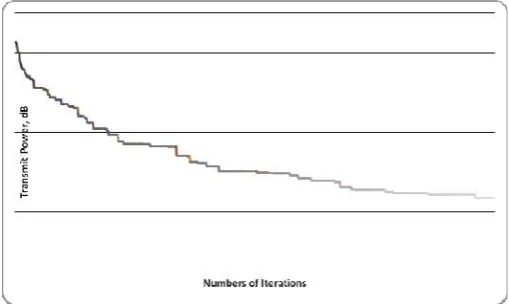
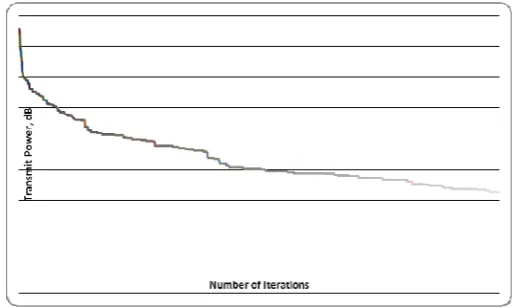
The graphs for four experimental processes of the first stage are illustrated on Figures 2-5:
Figure 2: Achieved minimal Transmit Power for SINR level 6 dB
Figure 3: Achieved minimal Transmit Power for SINR level 8 dB
Figure 5: Achieved minimal Transmit Power for SINR level 12 dB
Presented above graphics indicates that GA BLX
EAA achieves acceptable level of transmit power within 500 iterations. Within 1000 iterations minimisation of the emitted power continues and reaches level achieved by other methods [15]. The advantage is that all the GA BLX
EAA results are 100% feasible.Additional set of experiments with gradual change of the SINR levels starting from 0 dB to 12 dB with step 1 dB has been performed. In this case the process of power optimisation starts from stochastic initial population, which satisfies the constraints for 0 dB SINR level and uses the achieved results to generate feasible initial candidate solutions for next levels of the SINR constraint (6 dB, 8 dB, 10 dB, 12 dB). In order to evaluate probability for success the number of experiments is 320 for 10 different values of blend Alpha in total 3200 for each constraint level.
Achieved experimental results are presented in Table 1.
Table 1: Iterations
Number Mean Std Pmin dB Pmax dB
Feasibility, % SINR, dB
6 100 1.01 0.02 6.4646 6.5649 100
6 500 1.01 0.02 6.4269 6.5218 100
6 1000 1.01 0.01 6.4212 6.5013 100
8 100 1.02 0.04 8.6458 8.8007 100
8 500 1.01 0.03 8.5865 8.6802 100
8 1000 1.01 0.02 8.5724 8.6493 100
10 100 1.01 0.03 10.6761 10.7356 100
10 500 1.00 0.02 10.6754 10.7161 100
10 1000 1.00 0.02 10.6722 10.7100 100
12 100 1.00 0.05 12.7673 12.8313 100
12 500 1.00 0.03 12.7562 12.7920 100
12 1000 1.00 0.02 12.7493 12.7927 100
In Table 1, the first column presents the examined SINR levels in dB; the second column presents the number of iterations limit. In the third column, mean value refers to a normalised average value of the transmit power achieved for a particular number of iterations throughout all the experiments. This value is calculated from the sum of achieved power values after each experiment, divided by the number of experiments and normalised to the minimum obtained powerPmin
.
The standard deviation is denoted asStd
in column 4.variables satisfies the QoS constraints. Feasibility percentage of the successful solutions is indicated in column 7.
4. Discussion
Analysis of the experimental results suggests several issues, which deserve attention. The period of time required for identification of variables, which satisfies the SINR constraint for values above 6 dB is lower when the optimisation process is split on several sub-processes. It begins from low level of SINR (lower than 6 dB) and then gradually changes this SINR level using sets of parameters available from previous low level SINR. In this case the process performance seems to be less time consuming and allows acceleration of the overall optimisation.
A search process for SINR constraint level 6 dB and 8 dB limited to 100 iterations is completed for less than second and for 1000 iterations within 12 seconds. For SINR level 10 dB and 12 dB limited to 1000 iterations search process is completed for less than 3 seconds and for 1000 iterations within 22 and 60 seconds respectively. In case of rough change of SINR levels time for identification of variables, which satisfies this change increases. The gradual SINR change facilitates faster performance.
Precise assessment of periods of time required for constraint satisfaction and then for actual optimisation time, including comparison to other methods, could be a subject of further research. It could focus, also, on utilisation of more narrow methods for constraints satisfaction, in order to minimise the time for identification of variables, which satisfies the SINR constraint and lead to feasible solutions.
5. Conclusion
Presented in the article approach for using real coded Genetic Algorithm Blend Crossover Alpha modification with enhanced abilities for adaptation contributes to the research efforts in minimisation of transmit power for wireless MIMO systems. An overview of MIMO systems states the essence of beamforming transmit power minimisation. Transmit power minimisation task is implemented in Black box model suitable for optimisation by methods with enhanced abilities for adaptation. Particularly explored methodology demonstrates good capabilities to optimise transmit power satisfying 100% SINR hard constraint. The experimental results and their analysis suggest that in certain extent Genetic Algorithm could be an alternative for existing methods. Potential for improvement, in terms of decreasing the time for constraint satisfaction, is identified. For further research, the MIMO Black box software object could be developed as unified object for arbitrary number of antennas, users and users groups. Future investigation could focus, also, on comparison with other methods.
Acknowledgement
Preparation of this paper is supported by Southampton Solent University, Research and Enterprise Fund, Grants 516/17062011, 623/19102011.
References
1. J. Andrews, A. Ghosh, R. Muhamed, Fundamentals of WiMAX: understanding broadband wireless networking. Prentice Hall, 2007.
2. M. Bengtsson, B. Ottersten. Optimal and suboptimal transmit beamforming. Handbook of antennas in Wireless Communications. CRC Press LLC, 2002.
3. E. Biglieri, R. Calderbank, A. Constantinides, A. Goldsmith, A. Paulraj and H. V. Poor, MIMO Wireless Communication. Cambridge University Press, New York, 2007.
5. D. E. Goldberg, Genetic Algorithms in Search, Optimization, and Machine Learning, Addison Wesley Longman Inc. ISBN 0-201-15767-5, 1989.
6. A. He, S. Srikanteswara, K. Bae, T. Newman, J. Reed, W. Tranter, M. Sajadieh, M. Verhelst, Power Consumption Minimization for MIMO Systems – A Cognitive Radio Approach. IEEE Journal on Selected Areas in Communications, Vol. 29, No. 1, pp. 469-479, Jan. 2011.
7. J. Holland, Adaptation in Natural and Artificial Systems. University of Michigan Press, 1975.
8. E. Karipidis, N. D. Sidiropoulos, Z.-Q. Luo, Quality of service and max-min fair transmit beamforming to multiple cochannel multicast groups. IEEE Transactions on Signal Processing, vol. 56, no. 3, pp. 1268-1279, Mar. 2008.
9. B. G. Lee, D. Park, H. Seo, Wireless Communications Resource Management. John Wiley & Sons Pte Ltd, Singapore, 2009.
10. Q. Li, Q., G. Li, W. Lee, M. Lee, D. Mazzarese, B. Clerckx, Z. Li, MIMO Techniques in WIMAX and LTE: A Feature Overview. IEEE Commun. Mag., Vol. 48, No. 5, pp. 86-92, May. 2010.
11. A. Liu, H. Xiang, W. Luo, Y. Liu, Power minimization of multi-access MIMO systems with the rate constraint and finite – rate feedback. Information Sciences and Systems. CISS 43rd Annual Conference, Mar. 2009.
12. Z.-Q. Luo, E. Karipidis, N. D. Sindiropoulos, Transmit Beamforming to multiple co-channel multicast groups. IEEE International Workshop, 1:109-112, Dec. 2005.
13. C. Oestges, and B. Clerckx, MIMO Wireless Communications – from real-world propagation to space-time code design. Academic Press, Elsevier, Oxford, 2007.
14. K. Penev, Adaptive Search Heuristics Applied to Numerical Optimisation, PhD Thesis, Nottingham Trent University & Southampton Institute, UK, 2005.
15. N. Petrov, V. Poulkov, G. Iliev, Reduced Computational Complexity Beamspace Beamforming Design for MIMO Multicast Systems. NTMS, Cairo, Egypt, IEEE Dec.20-23, 2009.
16. N. D. Sidiropoulos, T. N. Davidson, Broadcasting with channel state information, in Proc. IEEE Sensor Array and Multichannel (SAM) Signal Process Workshop, Vol. 1, pp. 489-493, Sitges, Barcelona, Spain, Jul. 18-21, 2004.
17. W. Vereecken, W. V. Henddeghem, M. Deruyck, B. Puype, B. Lannoo, W. Joseph, D. Colle, L. Martens, and P. Demeester , Power Consumption in Telecommunication Networks: Overview and Reduction Strategies. IEEE Commun. Mag., Vol. 49, No. 6, pp. 62-69, Jun. 2011.
18. C.-X. Wang, X. Hong, X. Ge, X. Cheng, G. Zhang, J. S. Thompson, Cooperative MIMO Channel Models: A Survey. IEEE Commun. Mag., Vol. 48, No. 2, pp. 80-87, Feb. 2010. 19. Y.-H. Yang, S.-C. Lin, H.-J. Su, Multiuser MIMO Downlink Beamforming Design Based on Group Maximum SINR Filtering. IEEE Transactions on Signal Processing, Vol. 59, No. 4 pp. 1746-1758, Apr. 2011.