http: // www.ijrtsm.com© International Journal of Recent Technology Science & Management 23
ISSN : 2455-9679
[Mahesh et. al, 4(12), Dec 2019] Impact Factor : 3.340
IJRTSM
INTERNATIONAL JOURNAL OF RECENT TECHNOLOGY SCIENCE & MANAGEMENT
“
DESIGN AND ANALYSIS OF TVS BIKE FRAME USING FEA METHOD
”
Patil Mahesh Dilip
1, Dr. Shyam Kumar Birla
21 M.Tech. Scholar, Dept. of Mechanical Engineering, OIST, Bhopal, MP, India 2 Associate Professor, Dept. of Mechanical Engineering, OIST, Bhopal, MP, India
ABSTRACT
The bike frame is an important part in a two wheeler and it carries the load acting on the vehicle. So it must be strong enough to resist the shock, twist, vibration and other stresses. In vehicle frame different types of failure occur due to static and dynamic loading conditions. The objective of thesis is to analysis of double cradle frame under rider weight case and double cradle frame in static structural analysis by using CATIA V5 R20 simulation module. Our goal is to minimize the stresses and deformation parameters. The dynamic characteristics of the two wheeler chassis such as the stresses and deformation will determine by using finite element (FEM) method in ANSYS19.2 static analysis. Author will be taking ideal procedure for improve strength of chassis with respect to different materials.
Keyword: Stress, FEM, Bike frame, ANSYS, Structure, CATIA, simulation.
I.
INTRODUCTION
The frame is a skeleton upon which parts like gearbox and engine are mounted. So it is very important that the frame should not buckle on uneven road surface. Also it should not be transmitted distortion to the body. Two wheeler frames can be made of steel, aluminium or an alloy. Mostly the frame is consisting of hollow tube. If the natural frequency of two wheeler frame is coincides with excitation frequency then the resonance will occur. Due to resonance the frame will undergo dangerously large oscillation, which may lead excessive deflection and failure. To solve these problems, experimental modal analysis is very essential. Natural frequency, damping and mode shapes are the inherent structural properties and can be found out by experimental modal analysis.
Experimental Modal analysis (EMA) is the process of determining the modal parameters of a structure for all modes in the frequency range of interest. The main purpose of this thesis is to find out natural frequency, damping and mode shape of two wheeler frame using experimental modal analysis. A chassis consists of an internal framework that supports a man-made object. It is analogous to an animal's skeleton. An example of a chassis is the under part of a motor vehicle. That mass or weight reduction is an important issue in automotive industry. Chassis is a prominent structure for a moped body, which takes the loads during serious accidents, costly recalls; chassis also has an impact on product image.
II.
CAD
MODELING
OF
MODIFIED
DOUBLE
CRADLE
FRAME
FOR
STRENGTH
As shown in Figure 2.1, there are different orientations of TVS bike Cradle Frame as isometric view, front view, top
http: // www.ijrtsm.com© International Journal of Recent Technology Science & Management 24
ISSN : 2455-9679
[Mahesh et. al, 4(12), Dec 2019] Impact Factor : 3.340
Fig.2.1 Bike chassis CATIA modeling
III.
BASIC
STEPS
OF
FEA
ANALYSIS
FOR
MODIFY
DOUBLE
CRADLE
FRAME
(1) Preprocessing: defining the problem The major steps in preprocessing are
(i) Define key points/lines/areas/volumes,
(ii) Define element type and material/geometric properties,
(iii) Mesh lines/areas/ volumes as required. The amount of detail required will depend on the dimensionality of the analysis, i.e., 1D, 2D, ax symmetric, and 3D.
(2) Solution: assigning loads, constraints, and solving
Here, it is necessary to specify the loads (point or pressure), constraints (translational and rotational), and finally solve the resulting set of equations.
(3) Post processing: further processing and viewing of the results In this stage one may wish to see
(i) lists of nodal displacements, (ii) element forces and moments, iii) deflection plots, and
(iv) Stress contour diagrams or temperature maps.
IV.
METHODOLOGY
This chapter will describe all the processes that involved in the dynamic analysis structure of motorcycles chassis. For structural analysis, it consist two methods which are finite element analysis and modal analysis testing for motorcycles chassis structure. while the finite element analysis used ANSYS software. It is necessary to select a proper methodology for any research work. Computational Experimental approach along with numerical approach gives verified results. In this proposed work the experimental analysis is done and results are verified using the advanced numerical method called as finite element analysis.
Design of motorcycles chassis using CATIA software
http: // www.ijrtsm.com© International Journal of Recent Technology Science & Management 25
ISSN : 2455-9679
[Mahesh et. al, 4(12), Dec 2019] Impact Factor : 3.340
Figure 4.1 Motorcycles TVS 125 CC Figure 4.2 Chassis Motorcycles TVS 125 CC
V.
RESULT
&
DISCUSSION
Figure 5.1 TVS Bike frame import to ANSYS Figure 5.2 TVS Bike frame meshing ANSYS
Figure 5.3 TVS Bike frame boundary conditions Figure 5.4 Bike frame Steel material stresses
http: // www.ijrtsm.com© International Journal of Recent Technology Science & Management 26
ISSN : 2455-9679
[Mahesh et. al, 4(12), Dec 2019] Impact Factor : 3.340
Figure 5.7 Bike frame Aluminium alloy material deformation Figure 5.8 Titanium alloy bike frame stresses results
Figure 5.9 Titanium alloy bike frame deformation results Fig.5.10 S- Glass material bike frame stresses
Fig.5.11 S- Glass material bike frame deformation results
VI.
RESULT
&
DISCUSSION
http: // www.ijrtsm.com© International Journal of Recent Technology Science & Management 27
ISSN : 2455-9679
[Mahesh et. al, 4(12), Dec 2019] Impact Factor : 3.340
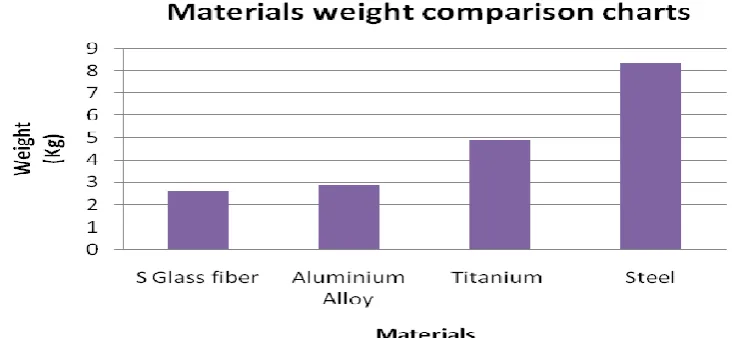
According to the results obtained from ANSYS software, it can be concluded that the weight of S- Glass fiber is lighter and minimum stress also predicted when compare to bike frame with Steel , Aluminum Alloy , Titanium Alloy and S-Glass Fiber. The results clearly indicate that the new design (bike frame with S - Glass fiber) much lighter and has more strength than initial design of bike frame (Steel material). Hence S - Glass fiber is the best replacement material in place of steel and aluminium alloy for present generation bike frames. Material optimization approach will be considered for future research.
Figure 6.1Materials weight comparison charts
VII.
CONCLUSION
According to the results obtained from ANSYS software, it can be concluded that the weight of S- Glass fiber is lighter and maximum stress also predicted when compare to bike frame with Steel materials , Titanium alloy material and Aluminum alloy materials. The results clearly indicate that the new design (bike frame with S- glass fiber materials ) much lighter and has more strength than initial design of bike frame (Steel materials). Hence S- Glass fiber is the best replacement material in place of steel, titanium alloy and aluminium alloy for present generation bike
frames. Materialoptimization approach will be considered for future research.
REFERENCES
1) CH.Neeraja, C.R.Sireesha and D. Jawaharlal, "Basic Analysis of Two Wheeler Suspension
Frame",International Journal of Engineering Research&Technology,Vol.1 Issue 6,August - 2012.
2) Teo Han Fui, RoslanAbd. Rahman, Faculty of Mechanical Engineering, University Teknologi Malaysia,
"Statics and Dynamics Structural Anal-ysis of a 4.5 Ton Truck Chassis"December,2007
3) S. Agostoni, A. Barbera, E. Leo, M. Pezzola, M. Vanali, "examination on motorvehicle basic vibrations
Caused by motor unbalanc-es",Proceedings of the SEM Annual Conference June 1-4, 2009 Albu-querque New Mexico USA
4) Conle, F.A. also, Chu, C.C., 1997, "Weariness Analysis andthe Local Stress-strain Approach in Complex
VehicularStructures",International Journal of Fatigue.
5) Abhishek Sharma, Pramod Kumar, Abdul Jabbar and Mohammad Mamoon Khan, "Structural Analysis of a
Heavy Vehicle Chassis Made of Different Alloys by Different Cross Sections", International Journal of Engineering Research &Technology (IJERT), Vol. 3 Issue 6, June – 2014, pp.1778-1785.
6) Jakub Šmiraus1, Michal Richtář2, "Plan of motorcyle dynamic body geometry Change system".Number 5,
Volume VI, December 2011.
7) Haval Kamal Asker1 AndArkanFawzi, "Stress Analysis Of Standard Truck Chassis During Ramping On Block
http: // www.ijrtsm.com© International Journal of Recent Technology Science & Management 28
ISSN : 2455-9679
[Mahesh et. al, 4(12), Dec 2019] Impact Factor : 3.340
8) CicekKaraoglu, N. SefaKuralay ,"Stress examination of a truck body with bolted joints" , Journal of Finite Elements in Analysis and Design 38 (2002), Elsevier Science, page no-1115–1130.
9) Karaoglu, C. what's more, Kuralay, N.S., 2000, " Stress Analysis of a Truck Chassis with Riveted Joints", ElsevierScience Publishers B.V. Amsterdam, the Netherlands, Vol. 38, 1115-1130.
10) Conle, F.A. what's more, Chu, C.C., 1997, "Exhaustion Analysis and the Local Stress-strain Approach in
Complex Vehicular Structures",International Journal of Fatigue.
11) Filho, R.R.P., Rezende, J.C.C., Leal, M. de F., Borges, J.A.F., 2003. "Car Frame Optimization" twelfth
universal Mobility
12) KutayYilmazçoban, YaşarKahraman, Sakarya University, Mech. Eng. Dept., 54187 Serdivan-Sakarya,Turkey,
July2011
13) Teo Han Fui, RoslanAbd. Rahman, Faculty of Mechanical Engineering, University TeknologiMalaysia,