Copyright © 2015 IJECCE, All right reserved
An Attack Investigation, Characterization and
Simulation of Various Attacks in MANET
Mr. Pratik Gite
Pacific Academy of Higher Education and Research University, Udaipur, India. email:[email protected]
Dr. Sanjay Thakur
Pacific Academy of Higher Education and Research University, Udaipur, India.
Abstract: Mobile Ad-hoc Network is one of the most popular network technology in the field of research and development community. Due to their dynamic and ad-hoc nature, the network suffers from the various performance and security issues. The main objective of this paper is to evaluate the performance of Ad-hoc On Demand Distance Vector (AODV) routing protocol under normal condition and attacks conditions on the basis of different performance metrics. This paper is also concerned about the different kinds of attacks formation viz. Black Hole, Worm Hole, Gray Hole and Denial of Service attacks on MANET environment. In addition of that different kinds of approaches available for detection and prevention of such attacks are also investigated. Finally using different experimentation and simulations through NS-2, the effort is made to identify the effective network characteristics. After concluding the effects and simulation the need of a new Intrusion Detection System (IDS) model is presented for future implementation.
Keywords: MANET, Ad-Hoc Distance Vector Routing (AODV), Attacks Formation, Performance Analysis, Netwo- rk Simulator (NS-2).
1.
I
NTRODUCTIONA Mobile Ad Hoc Network (MANET) is a group of wireless mobile nodes forming a network without any infrastructure where all nodes are free to move randomly and where all the nodes in a defined range themselves [1]. In MANET, each node proceeds both as a router and as a host. Additionally topology of network may also vary quickly. In such kind of network, topology creation is responsibility of routing protocol. Therefore, router may help in creating topology, finding path between source and destination and during path break condition route repairing. The above characteristics of MANET attract researchers in domain of MANET, but some key issues and challenges are also available which limit the performance and security of MANET. A MANET environment has to overcome certain issues of limitation and inefficiency. It contains [2]:
The wireless link characteristics are time-varying in
nature:
There are transmission impediments like vanishing, path loss, blockage and interference that add to the susceptible behaviour of wireless channels. The steadfastness of wireless transmission is resisted by different factors.
A Limited range of wireless transmission
–
The limited radio band results in reduced data rates compared to the wireless networks. Hence the optimal usage of bandwidth is necessary by keeping low overhead as possible.Packet losses due to errors in transmission
–
MANETs experience higher packet loss due tofactors such as hidden terminals that results in collisions, wireless channel issues (high BER), interference, and frequent breakage in paths caused by mobility of nodes, improved collisions due to the presence of hidden terminals and unidirectional links.
Route changes due to mobility -
The dynamic nature of network topology results in frequent path breaks.Frequent network partitions -
The random movement of nodes often leads to the partition of the set of connections. This mainly affects the intermediate nodes.In addition of the above listed issues of performance the some additional issues related to the security are also affecting the performance of network. In the next section the MANET security issues and MANET node organiz- ation is discussed.
2.
B
ACKGROUNDThis section reports the detailed understanding of the mobile ad hoc network and their security issues are discussed in detail.
A. MANET:
In order to deliver data at the client end the TCP IP protocol layers are given in figure 1.
Fig.1. Current MANET
In these networks the connectivity among the nodes are not provided in wired manner. That is wireless links which are varies according to the physical conditions of network node surrounding. Due to this connectivity and available throughput of network is affected. And additional issues are in concern.
On the other hand the each node in network act as both as a router and host, because of the radio range of nodes. The radio range of Wi-Fi nodes are not much capable to deliver data is a large range. Thus data transmission depends on the intermediate nodes in network. Routing provides the support for discovering the routes between two communicating nodes. Thus routing protocols are played key role in such networks.
Thus in the next section different routing protocols are reported for discussion which are characterized according to their behavior and data management techniques.
B. Ad hoc routing:
In ad hoc networks routing protocols are categorized under three main classes Table Driven, Source Initiated and Hybrid as shown in Figure 2.
Fig.2. Classification of Routing Protocol
Table driven protocols are sometimes also called proactive routing protocol. In proactive protocols, routes to all the nodes in the network are discovered in advance. Whole table is broadcasts after a fixed interval of time independent of any route changes or not. This increases the overhead and so decreases the throughput of network such as DSR. In hybrid Protocol, every node stores one or more routing tables. Routing table stores all the available destinations, number of hopes (intermediate nodes) to reach the destination node, sequence number assigned by the destination node. The sequence number stored in routing table is used to make the protocol loop free. Every node maintains a monotonically increasing sequence number for itself. It also maintains the highest known sequence number for each destination in the routing table
(called “destination sequence numbers”). The routing updates can be “Event Driven” or “Time Driven. These
routing table updates can be sent via “full dump” or
“incremental updates”. In incremental updates, only that information’s are sent which has change since last updates.
Full Dump means sending whole routing table. In source initiated routing protocols also called reactive protocol as it only requests a route when needed and does not require nodes to maintain routes to the destinations that are not actively used in communication [4].
C. Routing attacks:
There are a number of different kinds of routing based attacks are deployed in mobile ad hoc networks. Some of
them which are strongly affecting the performance of the network is considered in this section for demonstration.
Wormhole attack -
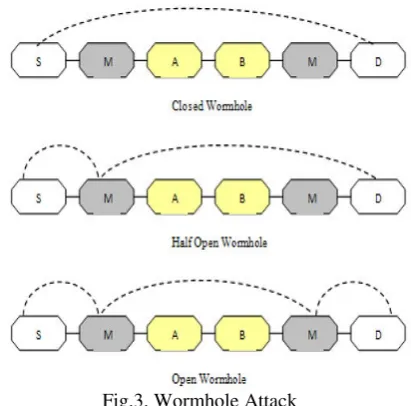
In a wormhole attack more than one malicious nodes are joining the network and according to the nodes they are connected thorough, high speed data buses by which their promises to send data from source to sink, the form of attack is determined as a malicious node can capture packets at one place in the network and tunnel them to another place through a private network pooled with a colluding malicious node. Wormhole attack can also perform with one node, but usually two or more than two attackers connected via a link called wormhole link. Wormhole attack can be categorized into three types: Half Open Wormhole, Closed Wormhole, and Open Wormhole.Fig.3. Wormhole Attack
Formation of wormhole -
In wormhole attack, a mischievous node obtains packets at one position in the network and tunnels them to a different position in the network, where these packets are resent into the network. This tunnel among two conspiring attackers is known as a wormhole. It could be recognized through a wired connection among two colluding attackers or, using a single long-range wireless connection. In this form of attack the attacker may generate a wormhole even for packets not addressed to itself because of the advertising nature of the radio channel.Copyright © 2015 IJECCE, All right reserved Fig.4. Black hole Attack
Byzantine Attack:
In this attack, a compromised intermediary node or a set of intermediate nodes works in agreement and perform attacks like creating routing loops, dispatching packets on non-finest paths and selectively falling packets which results in disturbance or degradation of the routing services [5]. It is hard to detect Byzantine failures. The network would appear to be operating habitually in the perspective of the nodes, though it may actually be showing Byzantine behaviour.Resource Consumption attack:
In this attack, an attacker effort to consume or drain the resources of other devices available in the network. The resources that are aimed are bandwidth, battery power, and computational power, which are only available in limited amount in ad hoc wireless systems. The attacks could be in the form of excessive requests for routes, regular generation of beacon packets, or dispatching of stale packets to nodes. Using up the battery power of another device by observing that node continuously busy by constantly pumping packets to that node is recognized as a sleep deprivation attack.Denial of Service:
In this type of attack, an attacker efforts to avert legitimate and authorized users of the services obtained by the network. A denial of service (DoS) attack can be deployed in many techniques. The classic way is to flood packets to any consolidated resource existing in the network so that the resource is no longer existing to nodes in the network, as a result of which the network no longer operating in the routine it was designed to function. This may lead to a failure in the delivery of assuring services to the end users. Due to the distinctive features of ad hoc wireless networks, there exist many more techniques to launch a DoS attack in such a network, which would not be probable in wired networks. Dos attacks can be deployed against any layer in the network protocol. On the physical and MAC layers, an opponent could apply jamming signals which interrupt the on-going communications on the wireless channel. On the network layer, an opponent could take part in the routing practice and abuse the routing protocol to disturb the normal functioning of the network.Rushing Attack:
On-demand routing protocols that use identical conquest during the route discovery practice are susceptible to this attack [6]. An attacker which receives a route request packet from the originating node floods the packet, rapidly throughout the network earlier other nodes, which also obtain the same route request packet, can react. Nodes that obtain the legitimate route request packets assume those packets to be replicas of the packet already received through the attacker and therefore discard those packets. Any route exposed by the source device would have the attacker as one of the intermediary nodes. Therefore, the source node would not be able to discoversecure routes, that is, routes that do not include the attacker. It is tremendously difficult to sense such attacks in ad hoc wireless networks.
3.
P
ROPOSEDW
ORKFor investigation and demonstration of attacks some essential and crucial kinds of attacks are investigated in this section. Therefore, black hole, wormhole, grey hole and DDOS attacks are selected for demonstration.
A. Simulation setup:
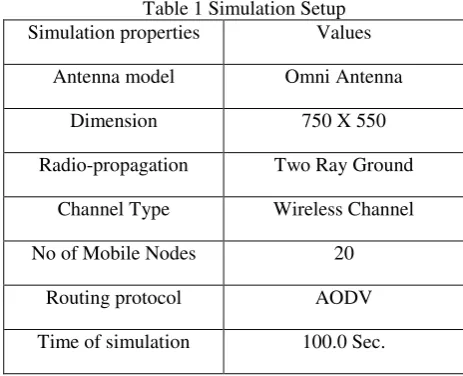
In order to simulate the effectiveness of the proposed attack analysis the following network parameters are setting up for network simulation.
Table 1 Simulation Setup Simulation properties Values
Antenna model Omni Antenna
Dimension 750 X 550
Radio-propagation Two Ray Ground
Channel Type Wireless Channel
No of Mobile Nodes 20
Routing protocol AODV
Time of simulation 100.0 Sec.
In order to characterize the effect of considered attacks the following scenarios are desired to implement with the simulation.
1. Simulation of black hole attack:
In this scenario for demonstrating the effect of black hole attack a MANET configured using AODV routing protocol and using the simple configuration the packet delivery ratio is estimated in addition of the a black hole node is deployed on network and the performance of the network is measured and compared.2. Simulation of the Worm Hole Attack:
I
n the similar way in the simple network configuration the wormhole link is deployed in the network and the performance of the network is compared with the normal network performance.3. Simulation of Gray Hole Attack:
In this scenario in MANET a Gray Hole attack is deployed and performance is compared with the normal MANET.4. Simulation of DDOS Attack:
In this scenario the DDOS attack is deployed and the performance in terms of RTT and packet delivery ratio is compared.C. performance analysis:
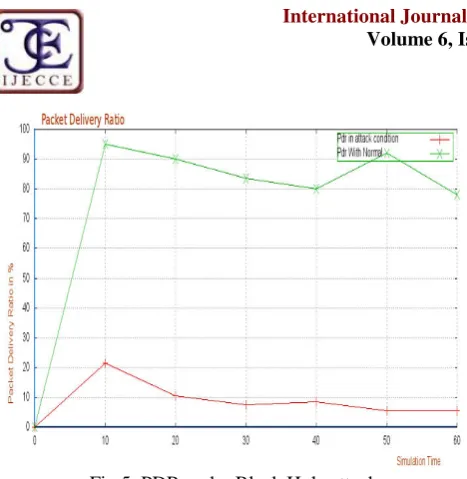
Fig.5. PDR under Black Hole attack
The figure 5 shows the comparative performance of normal MANET and the network performance after attack deployment for the similar configuration of network. In this given diagram the green line shows the network performance of the normal network and the red line shows the network performance under attack condition. According to the evaluated performance the black hole attack directly affect the packet delivery ratio of network.
In addition of that for DDOS attack demonstration, figure 6 shows the network performance in terms of packet delivery ratio. According to the evaluated performance of the network during DDOS attack deployment the network performance in terms of packet delivery ratio is degraded considerably. And the given figure 7 where the number of request packets (RREQ) flooding is demonstrated. In the normal network conditions the number of request packets in network is increases continuously with respect to the normal network configuration. Therefore for DDOS attack identification packet delivery ratio and number of request packet send can be considered as characteristics of DDOS attack.
Fig.6. PDR during DDOS attack
Fig.7. number request during DDOS attack
During the Gray Hole attack network performance is given using figure 8. In this diagram the red color line is shows the performance of network under the attack conditions and the green line shows the performance of the normal network. According to the gray hole attacker node selectively drop the packets. Thus it is hard to identify a grayhole node is deployed on network. Therefore in order to identify the node an average threshold for packets can be used.
Fig.8. PDR during Gray Hole attack
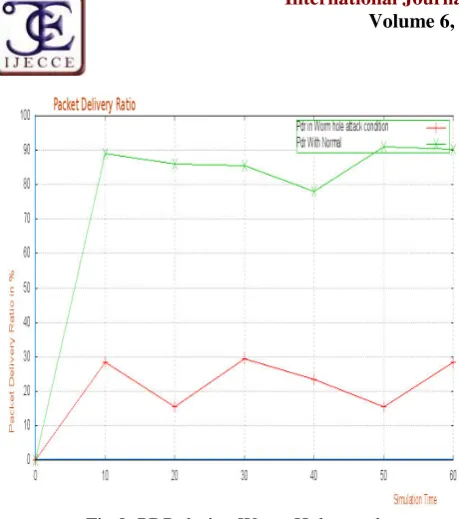
Copyright © 2015 IJECCE, All right reserved Fig.9. PDR during Worm Hole attack
Fig.10. RTT during Worm Hole
According to the given results the performance of the network in terms of packet delivery ratio is degrade in considerable amount on the other hand the round trip time of the packet delivery is increases. Thus RTT and PDR can be used for identify the wormhole attack in network.
4.
A
TTACKP
ROPERTIESSecurity in the wireless ad hoc network and performance is a classical issue. In order to provide security and performance in ad hoc network various security schemes are recently designed and implemented. Most of them are not much effective due to their computational overhead. Additionally most of them are providing the security against a single or specific security flaws. Thus required to design and develop a novel security technique by which the immunity in network for different kinds of attack in wireless network is developed and network performance is not affected during the malicious attack deployment.
In the mobile ad hoc network the basic problem is their Ad-hoc nature of routing and infrastructure less network organization. Due to this topology is developed dynamically and trust evaluation of intermediate nodes is not available. Thus during the routing any kind of attacker can easily join the network active network communication. In addition of that is the security implementation during the route discovery increases the computational overhead which directly affects the routing overhead and end to end delay in network. Thus the following issues are addressed for finding solution in the proposed study.
1. Most of the attacks are deployed in the route discovery phases due to on demand nature of the routing protocols.
2. Security improvement on the network communication without affecting the performance of network in terms of end to end delay and routing overhead.
3. Incorporating solution for the on demand routing with the third party decision making and malicious nodes locating infrastructure server.
Thus required to develop a low cost, easy to implement, efficient and secure routing algorithm or security architecture, which is able to provide all the security solution of the wireless network.
During literature survey a number security solutions are evaluated. In most of them authors believe that detection and prevention technique is depends upon the kind of attack. Some observations of these researchers are given in the below table 2.
Table 2 Attacks Parameters
S. No. Attack type Parameter
1 Black Hole 1. Packet delivery ratio 2. buffer size
2 Worm Hole
1. time to leave 2. packet delivery ratio
3. buffer size
3 Dos
1. Control message 2. Energy 3. packet delivery ratio
4. buffer size
4 Gray Hole 1. packet delivery ratio
5.
C
ONCLUSIONR
EFERENCES[1] Kshmeera N. Khachar and Mrs. Jayna B. Shah, “Detection and Prevention of Black hole Attack in Mobile Ad-hoc Networks: A Survey”, IOSR Journal of Computer Engineering (IOSR-JCE), e-ISSN: 2278-0661, P-e-ISSN: 2278-8727, Vol. 26, Issue 2, Ver. XI (May-April 2014), PP. 108-112.
[2] Martin K Parmar, Harikrishna B Jethva, “Survey on Mobile ADHOC Network and Security Attacks on Network Layer”, International Journal of Advanced Research in Computer Science and Software Engineering, Volume 3, Issue 11, November 2013. [3] Meghna Chabra and B.B. Gupta, “AN Efficient Scheme to Prevent
DDos Flooding Attacks in Mobile Ad-hoc Network (MANET)”, Research Journal of Applied Sciences, Engineering and Technology 7 (10): 2033-2039, 2014, ISSN: 2240-7459; e-ISSN: 2040-7467, PP. 2033-2039, © Maxwell Scientific Organization, 2014. [4] Context-Sensitive and Adaptive Routing in Wireless Mobile
Ad-Hoc Networks Using Cross-Layer Design, http://www.uni-marburg.de/fb12/verteilte_systeme/ forschung/pastproj/adhoc _routing _emul.
[5] AsmaTuteja, Rajneesh Gujral, Sunil Thalia, “Comparative Performance Analysis of DSDV, AODV and DSR Routing Protocols in MANET using NS2”, 2010 International Conference on Advances in Computer Engineering,978-0-7695-4058-0/10 $26.00 © 2010 IEEE.
[6] R. Bronson and G. Naadimuthu, “Operations Research”, 2 ed., Schaum’s Outlines, McGraw Hill, New York, 1997.
[7] A. Boukerche, “Performance Comparison and Analysis of Ad-hoc Network Routing Algorithms”, IEEE Conference on Performance, Computing and Communication, PP.171-178, April 2001.
[8] Jaydip Sen, M. Girish Chandra, Harihara S.G., Harish Reddy, P. Balamurlidhar, “ A Mechanism for Detection of Grayhole Attack in Mobile Ad-hoc Networks”, ICICS 2007, 1-4244-0983-7/07/$25.00©2007 IEEE.
[9] “AODV implementation on TinyOS-2.x”, written by Junseok KIM, last updated April 8, 2011,
http://www2.engr.arizona.edu/~junseok/AODV.html.
[10] Martin K Parmar and Harikrishna B Jethwa, “Survey on Mobile ADHOC Network and Security Attacks on Network Layer ”, International Journal of Advanced Research in Computer Science and Software Engineering, PP. 708-716, Vol. 3, Issue 11, November 2013, ISSN: 2277 128X.
[11] Weichao Wang, Bharat Bhargava, Yi Lu and Xiaoxin Wu, “Defending Against Wormhole Attacks in Mobile Ad-hoc Networks”, Wiley Journal of Wireless Communication and Mobile Computing (WCMC), PP. 1-24.
[12] J. Broch, D. A. Maltz, D. B. Johnson, Y.C. Hu and J. Jetcheva, “A Performance Comparison of Multi-hop Wireless Ad-hoc Network Routing Protocols”, Proceedings of the 4th Annual ACM/IEEE International Conference on Mobile Computing and Networking, PP. 85-97, ACM Press, 1998.
[13] A. Boukerche, “Performance Comparison and Analysis of Ad-hoc Network Routing Algorithms”, IEEE Conference on Performance, Computing and Communication, PP.171-178, April 2001.
[14] D. Chakeres and E. B. Royer “The Utility of Hello Message for
Determining Link Connectivity”, Proceedings of 5th International
Conference on Wireless Personal Multimedia Communications (WPMC) Vol. 2 , PP. 504-508, Hawaii, 2002.