Ankur Rohilla, Senior Lecturer (Pharmacology), Dept. of Pharmaceutical Sciences,
Shri Gopi Chand Group of Institutions, Baghpat 250609, UP, India. Tel.: +91 9896516778
E-mail: [email protected] Address for correspondence
Access this article online www.japer.in
Pharmacovigilance: Needs and Objectives
INTRODUCTION
The under-reporting of adverse drug reactions is
the major setback worldwide which may be
attributed to the lack of time and report forms. It
has been known that world health organization
(WHO) has initiated the program of reporting all
adverse reactions possessed by the drugs. [1] The
further awareness about the adverse drug
reactions resulted in emergence of the practice
and science of pharmacovigilance, which can be
defined as the science of detection, assessment,
understanding, and prevention of adverse effects
or any other possible drug-related problems. [2-3]
It is widely accepted that a drug has to go
through various phases of clinical trial to
establish its safety and efficacy before it is
marketed commercially. However, the clinical
trials offer various limitations, like; strict criteria
of inclusion and exclusion make it to be used in a
very selective group of patients; special
population groups like children, pregnant
woman, and old age population are not studied
during the trials; and other factors causing drug
reactions such as genetic factors, environmental
factors, and drug-drug interactions may not have
been studied during the clinical trials. [4] Hence,
need of pharmacovigilance has been demanded,
which include the detection, assessment, and
prevention of adverse drug reactions in humans.
[5-6] Moreover, its concerns have been widened to
include the herbal drug products; traditional and
complementary medicines; blood products;
biologicals; medical devices; and vaccines. In
addition, pharmacovigilance possess various
roles like, identification, quantification and
documentation of drug-related problems which
are responsible for drug-related injuries. [7-8]
Further, national pharmacovigilance
programmes have been introduced which
occupies a prime role in increasing the public
awareness about drug safety. [9-10] This review
article discusses about the need and objectives of
pharmacovigilance in day-to-day lives.
Additionally, various adherents and followers of
pharmacovigilance have been argued in the
present review.
NEED OF PHARMACOVIGILANCE Review Article
Pharmacovigilance is defined as the science and activities relating to the detection, assessment, and prevention of adverse drug reactions in humans. Pharmacovigilance has been regarded as a type of continual monitoring of unwanted effects and other safety-related aspects of drugs, which are already placed in markets. The pharmacovigilance has been known to play an important role in rational use of drugs, by providing information about the adverse effects possessed by the drugs in general population. The present review presents in brief about the relevance, need, functioning, role, and importance of pharmacovigilance.
Key words: Pharmacovigilance, Adverse Drug Reactions ABSTRACT
Ankur Rohilla*, Nishant Singh, Vipin Kumar, Mohit Kumar Sharma, Amarjeet Dahiya, Ashok Kushnoor
Department of Pharmaceutical Sciences, Shri Gopi Chand Group of Institutions,
Baghpat-250609, UP, India
It is widely accepted that clinical development of
medicines is a complex process which require
huge amount of time for its completion. Once a
drug is marketed, it leaves the secure and
protected scientific environment of clinical trials
and is free for consumption by the general public.
At this point, most medicines will only have been
tested for short-term safety and efficacy on a
limited number of carefully selected individuals.
Hence, need of pharmacovigilance arises which
include, securing the early detection of new
adverse reactions or patients subgroups of
exceptional sensitivity; and introducing certain
measures in order to manage such risks. [11]
Moreover, it is essential that new and medically
still evolving treatments are monitored for their
effectiveness and safety under real-life
conditions after being marketed. Furthermore,
more information is generally needed about use
in specific population groups like children,
pregnant women and the elderly, about the
efficacy and safety of chronic use in combination
with other drugs. [12-13] Numbers of adverse
effects, drug-interactions and risk factors have
been reported later in the years of drug release
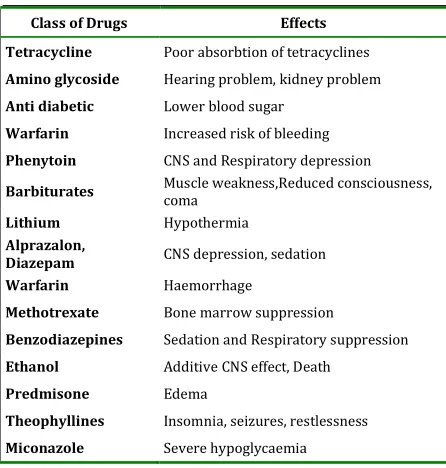
(Table 1).
OBJECTIVES OF PHARMACOVIGILANCE
Improvement of patient care and safety in
relation to the use of medicines with medical and
paramedical interventions remains to be an
important parameter. The main objectives of
pharmacovigilance involve exhibiting the efficacy
of drugs by monitoring their adverse effect
profile for many years from the lab to the
pharmacy; tracking any drastic effects of drugs
improving public health and safety in relation to
the use of medicines; encouraging the safe,
rational and cost-effective use of drugs;
promoting understanding, education and clinical
training in pharmacovigilance; and effective
communication to the generic public. [14] In
addition, providing information to consumers,
practitioners and regulators on the effective use
of drugs alongwith designing programs and
procedures for collecting and analyzing reports
from patients and clinicians conclude to the
objectives of pharmacovigilance studies. [3,14]
ROLES OF PHARMACOVIGILANCE
Pharmacovigilance has been widely accepted to
possess a significant role in early observation of
the risk associated with the drug. All the
medicines are tested on a concerned small ratio
of population before it is approved for
post-marketing surveillance. The pharmacovigilance
has been known to possess various roles like,
identification, quantification and documentation
of drug-related problems; contribution towards
reducing the risk of drug-related problems in
healthcare systems; and enhancement of
knowledge and understanding of factors and
mechanisms which are responsible for
drug-related injuries. [4] However, in order to fulfill
various roles of pharmacovigilance, the
interactions and influence of many stakeholders
in society with decision-making powers has been
required, which include, politicians at national,
regional and local levels; healthcare
administrators; drug regulatory authorities;
pharmaceutical companies; healthcare
professionals like physicians, dentists,
pharmacists and nurses; academic institutions;
media representatives; health insurance
ADHERENTS OF PHARMACOVIGILANCE
An imperative relationship has been known to
exist between wide ranges of partners in drug
safety monitoring process. These partners are
required to anticipate, understand and respond
to the continually increasing demands and
expectations of the public, health administrators,
policy officials, politicians and health
professionals. [14] Numbers of adherents of
pharmacovigilance have been widely known,
which involve the quality assurance and safety
centres, which are a part of the Department of
Essential Drugs and Medicines Policy, within the
WHO Health Technology and Pharmaceuticals
cluster, the purpose of which is to improve health
by closing the huge gap between the potential
that essential drugs have to offer and help save
lives. [16] Another important follower of
pharmacovigilance is the uppsala monitoring
centre, the principal function of which is to
manage the international database of adverse
drug reports received from national
centers. [17] The national pharmacovigilance
centers have been considered as another
adherent of pharmacovigilance that play a
significant role in increasing public awareness of
drug safety. Major centers in developed countries
have established active surveillance programmes
using record linkage and prescription event
monitoring systems to collect epidemiological
information on adverse reactions to specific
drugs. [18-19] A number of medical institutions
have developed adverse reaction and medication
error close watch systems in their clinics, wards
and emergency rooms, during which various
case-control studies and other
pharmacoepidemiological methods have
increasingly been used to estimate the harm
associated with marketed medicines. [20-22] Other
important followers of pharmacovigilanve are
the health professionals: Originally physicians
were the only professionals who observe
different kinds of drug related problems by
exercising the skill of differential diagnosis. [23-24]
Last of all, the patients form the most important
adherent of pharmacovigilance as, a patient
knows the actual benefit and harm of a medicine
prescribed to him. Direct patient participation in
the reporting of drug related problems has
increased the efficiency of the pharmacovigilance
system significantly. [25]
PHARMACOVIGILANCE PROGRAMME
The national pharmacovigilance system plays a
vital role in increasing public awareness of drug
safety. However, minimum requirements for a
functional national pharmacovigilance system
are required which include a national
pharmacovigilance centre with designated staff,
stable basic funding, clear mandates, well defined
structures and roles and collaborating with the
WHO programme for international drug
monitoring; the existence of a national
spontaneous reporting system with a national
individual case safety report (ICSR) form; a
national database or system for collating and
managing adverse drug reaction reports; a
national pharmacovigilance advisory committee
able to provide technical assistance on causality
assessment, risk assessment, risk management,
case investigation; and a clear communication
strategy for routine communication and crises
communication. [14,26-27] However, the national
pharmacovigilance system has been known to
exhibit various functions which include,
orderto collect and manage adverse drug
reaction; reporting of medication errors and
suspected substandard drugs; collaborating and
harmonizing with existing adverse reaction
collection activities within the country;
identifying signals of medicine safety;
undertaking assessment of risk and options for
risk management; identifying the possible quality
problems in medicines resulting in adverse
reactions; supporting the identification of
medicine quality issues; providing effective
communication on aspects related to medicine
safety; applying resulting information from
pharmacovigilance for the benefit of public
health programmes, individual patients and
national medicines policies and treatment
guidelines; developing and maintaining drug
utilization information; and identifying issues
associated with unregulated prescribing and
dispensing of medicines. [28-30]
CONCLUSION
Pharmacovigilance play an important role in
meeting the challenges offered by the increased
range and potency of medicines. After the
appearance of adverse effects and drug toxicities,
it is essential that these are reported, analyzed
and communicated to the general public having
knowledge to interpret the information.
Although, a significant amount of information
regarding the effective use and adverse reactions
has been collected, but more information is
required in order to offer effective drug use in
specific populations like children, pregnant
women and the elderly. Moreover, providing the
regulators with the necessary information to
amend the recommendations on the use of the
medicines; improving communication between
the health professionals and the public; and
educating the health professionals to understand
the effectiveness and risk of medicines they
prescribe, is the need of the moment.
Table 1: Common Drug Interactions
Class of Drugs Effects
Tetracycline Poor absorbtion of tetracyclines
Amino glycoside Hearing problem, kidney problem
Anti diabetic Lower blood sugar
Warfarin Increased risk of bleeding
Phenytoin CNS and Respiratory depression
Barbiturates Muscle weakness,Reduced consciousness,
coma
Lithium Hypothermia
Alprazalon,
Diazepam CNS depression, sedation Warfarin Haemorrhage
Methotrexate Bone marrow suppression
Benzodiazepines Sedation and Respiratory suppression
Ethanol Additive CNS effect, Death
Predmisone Edema
Theophyllines Insomnia, seizures, restlessness
Miconazole Severe hypoglycaemia
REFERENCES
1. WHO Policy Perspectives on Medicines. Geneva: WHO; 2004. Geneva: World Health Organization. Looking at the Pharmacovigilance: ensuring the safe use of medicines.
2. Klepper MJ. The periodic safety update report as a pharmacovigilance tool. Drug Saf 2004;27:569-78.
3. Livio F, Renard D, Buclin T. Pharmacovigilance. Rev Med Suisse 2012;8:116-9
4. Pharmacovigilance. Mann RD, Andrews EB, eds. John Wiley & Sons Ltd, Chichester, 2002.
5. Harmark L, van Grootheest AC. Pharmacovigilance: Methods, recent developments and future perspectives. Eur J Clin Pharmacol 2008;64:743-52.
6. Biswas P, Biswas A. Setting standards for proactive pharmacovigilance in India: The way forward. Ind J Pharmacol 2007;39:124-8.
component of pharmacovigilance. Drug Saf 2012;35:785-91.
8. Arnott J, Hesselgreaves H, Nunn AJ, Peak M, Pirmohamed M, Smyth RL, et al. What can we learn from parents about enhancing participation in pharmacovigilance?. Br J Clin Pharmacol 2012; in press.
9. Gerritsen R, Faddegon H, Dijkers F, van Grootheest K, van Puijenbroek E. Effectiveness of pharmacovigilance training of general practitioners: a retrospective cohort study in the Netherlands comparing two methods. Drug Saf 2011;34:755-62.
10.Kshirsagar N, Ferner R, Figueroa BA, Ghalib H, Lazdin J. Pharmacovigilance methods in public health programmes: the example of miltefosine and visceral leishmaniasis. Trans R Soc Trop Med Hyg 2011;105:61-7.
11.The importance of pharmacovigilance. Geneva: World Health Organization; 2002.
12.Joshi SR, Sapatnekar SM. Pharmacovigilance in India: how safe are the new drugs? How sure are we?. J Assoc Physicians Ind 2008;56:933-4. 13.Olsson S. Pharmacovigilance training with focus
on India. Ind J Pharmacol 2008;40: S28-S30. 14.WHO, Pharmacovigilance: ensuring the safe use
of medicines, Geneva: WHO 2004.
15.The Importance of Pharmacovigilance, WHO 2002.
16.WHO Medicines Strategy: Framework for Action in Essential Drugs and Medicines Policy 2000-2003.
17.Olsson S. The role of the WHO Programme for International Drug Monitoring in coordinating worldwide drug safety efforts. Drug Saf 1998;19:1-10.
18.Coulter DM. The New Zealand intensive medicines monitoring programme in proactive safety surveillance. Pharmacoepidemiol Drug Saf 2000;9:273-80.
19.Mackay FJ. Post-marketing studies: The work of the drug safety research unit. Drug Saf
1998;19:343-53.
20.Folb PI, ten Ham M. Drug monitoring in developing countries: A drug regulator’s perspective. Drug Inf J 1995;29:303-5.
21.Talbot JC, Nilsson BS. Pharmacovigilance in the pharmaceutical industry. Br J Clin Pharmacol 1998;45:427-31.
22.Moore N. The role of the clinical pharmacologist in the management of ADRs. Drug Saf 2001;24:1-7.
23.Hall M, McCormack P, Arthurs N, Feely J. The spontaneous reporting of ADRs by nurses. Br J Clin Pharmacol 1995;40:173-5.
24.Hornbuckle K, Wu HH, Fung MC. Evaluation of spontaneous adverse event reports by primary reporter: A 15-year review (1983 to 1997) Drug Inf J 1999;33:1117-24.
25.Jeetu G, Anusha G. Pharmacovigilance: a worldwide master key for drug safety monitoring. J Young Pharm 2010;2:315-20. 26.WHO. Safety monitoring of medicines. Guidelines
for setting up and running a pharmacovigilance centre. Geneva, World Health Organization, 2000. 27.Department of CDSCO, Ministry of health & family welfare, Government of India: Protocol for national pharmacovigilance programme, November 2004.
28.WHO. The World Health Organization Collaborating Centre for International Drug Monitoring [web site]. The World Health Organization Collaborating Centre for International Drug Monitoring, Uppsala.
29.Biswas P. Pharmacovigilance: Safety matters. Ind J Phamacol 2008;40:1-2.
30.Dikshit RK. Challenges in pharmacovigilance. Ind J Pharmacol 2010;42:333.
Ankur Rohilla, Nishant Singh, Vipin Kumar, Mohit Kumar Sharma, Amarjeet Dahiya, Ashok Kushnoor; Pharmacovigilance: Needs and Objectives, J. Adv. Pharm. Edu. & Res. 2012: 4: 201-205