ENTERPRISE KNOWLEDGE BASED SOFTWARE
REQUIREMENTS ELICITATION
Aurelijus Morkevičius
1, Saulius Gudas
1, 21
Kaunas University of Technology, Faculty of Informatics, Information Systems Department, Studentu St. 50-313a, LT-51368 Kaunas, Lithuania,
e-mail: [email protected], 2
Vilnius University, Kaunas Faculty of Humanities, Muitines St. 8, LT-44280 Kaunas, Lithuania,
e-mail: [email protected]
Abstract. One of the ways to capture enterprise knowledge is Enterprise Architecture (EA). EA allows inden-tifying the majority of software “to-be” requirements for information systems (IS) engineering. However, the transition between enterprise architecture model and IT resource design still lacks a clear approach and tools for implementing it in practice. The paper presents an approach for the enterprise knowledge based software requirements elicitation. The suggested approach is based on the Unified profile for Ministry of Defence Architecture Framework (MODAF) and Department of Defense Architecture Framework (DoDAF), System Modeling Language (SysML) requirements model, and a Semantics of Business Vocabulary and Business Rules (SBVR) standard as a formal background for elicited soft-ware requirements. A real world example is presented to validate the suitability of the approach.
Keywords: UPDM, SysML, Enterprise Architecture, SBVR, Requirements Elicitation, Enterprise Knowledge, Software Requirements Specification.
1. Introduction
Enterprise Architecture (EA) has been a hot topic since 1980-ies [1]. However, it was not very widely applied in practices due to lack of modeling languages and tools suitable for EA [1]. The EA movement was reinforced with the successful adoption of the Unified Modeling Language (UML) [2]and the Model-Driven Architecture (MDA) [3]. There have been multiple attempts to apply Unified Modeling Language (UML) for Enterprise Architecture (EA) modeling [4], but many modelers found it too complicated and non-natural for solving their domain-specific problems [5]. In 2005, the Unified profile for MODAF and DoDAF (UPDM) initiative has been started in Object Manage-ment Group (OMG), but the first version of UPDM was released only in 2009, four years later [6]. As soon as the UPDM has been officially released, US Department of Defense mandated UPDM as Informa-tion Technology Standard and Profile Registry (DISR) standard. As UPDM is a profile of UML, it has been easily adopted by the majority of UML tool vendors. The versatility of UML and its compatibility with its profiles allows integrating UPDM with the other OMG standards based on UML, such as System Mo-deling Language (SysML), Service Oriented Architec-ture Modeling Language (SoaML), etc [7]. This
enables creating large and versatile EA models to pre-serve enterprise knowledge [8] in order to solve a range of problems: business transformation into know-ledge-based business, business and IT alignment, and the computerization of business management tasks [9].
Enterprise Knowledge allows indentifying the majority of software “to-be” requirements. However, first of all, enterprise knowledge models should be verified in accordance to the meta-knowledge of the enterprise. In case correctness and completeness of the enterprise knowledge models are sufficient enough, software requirements can be elicited or existing software requirements can be verified in accordance to enterprise knowledge. We can state that the enterprise knowledge can be either:
• A source for requirements elicitation [10], • A constraint for requirements verification. The purpose of this paper is to propose a new technique for software requirements elicitation from preserved enterprise knowledge.
the proposed approach is presented; in section 4, experimental evaluation of the proposed approach on a small real world EA model is described; in section 5, the achieved results, conclusions, and future work directions are indicated.
2. Related Work
Several authors have emphasized the importance of enterprise modeling before requirements elicitation [11, 12 13]. Enterprise models capture the structural and the behavioral aspects of an organization and are very useful in helping software engineers properly understand the organizational environment and the requirements that the information system must fulfill.
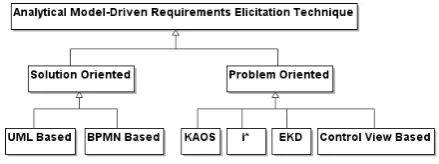
Requirements elicitation techniques are described, analyzed, classified and evaluated by Zheying Zhang in [14]. The author separates conversational, observa-tional, analytical and synthetic methods. We will focus only on analytical model based techniques providing ways to explore the existing enterprise knowledge. According to the observation of related works, we have classified such techniques into solution oriented such as based on UML, BPMN and problem oriented based on KAOS, i*, EDK, Control View (Figure 1).
Figure 1. The taxonomy of analytical software requirements elicitation techniques
Authors using UML are De la Vara [15], Eriksson [16], Silingas [5] and Marshall [17].
Software requirements elicitation method from business process models based on the BPMN notation and UML use case model has been proposed in [15]. The approach transforms business process model to the goal tree. Goal tree leaves are then transformed to use cases and presented as the requirements for the software system. However the main objective of this proposal is the extension of OO-Method 0, which is a methodology for automatic software generation based on conceptual modeling (solution oriented approach). We are mostly focusing to the problem orientted approach; to the requirements elicitation where human factor matters such as i* 0, KAOS [19], EKD [20], and Control View based [21].
Another attempt to extract functional software re-quirements from the enterprise model has been pro-posed in [22]. The approach aims at the use case model extraction from business function described using Enterprise Meta-Model (EMM). However, the approach focuses only on functional user-level requirements; the same as Control View Based
Elicitation of Functional Requirements proposed in [21]. The approach in [21] is the knowledge-based (KB) and concerns usage of formally defined manage-ment and control view based structural component of Enterprise model. KB construct of Enterprise model is formally defined in [23] as Elementary Management Cycle (EMC), and comprises management informa-tion transformainforma-tions of any Enterprise management function. The semantics of Enterprise management function correlates with the definition of Primary Activity of the M. Porter’s Value Chain Model [9]. According to [21], the KB requirements elicitation methods should be related with the KB enterprise modeling techniques.
The KAOS methodology is aimed at supporting the whole process of requirements elaboration, start-ing from the high-level goals to be achieved and finishing with the requirements, objects, and opera-tions to be assigned to the various agents in the composite system. Each construct in the KAOS language has a two-level generic structure: an outer semantic net layer for declaring a concept, its attri-butes, and its links to other concepts; an inner formal assertion layer for formally defining the concept [24]. The declaration level is used for conceptual modeling (through concrete graphical notation), requirements traceability (through semantic net navigation), and specification reuse (through queries) [19]. The asser-tion level is usually written in a real-time temporal logic described in [25].
Tropos has also an associated formal specification language called Formal Tropos (FT) for adding const-raints, invariants, pre- and post- conditions capturing more of the subject domain’s semantics to the gra-phical models in the i* notation [26]. FT has been designed to supplement i* models with a precise description of their dynamic aspects. In FT, the focus is not only on the intentional elements themselves, but also on the circumstances in which they arise, and on the conditions that lead to their fulfillment [27].
We think both the KAOS temporal logic and the FT languages are barely readable by humans other than IT experts. This limits the awareness of the stake-holders of the aspects that are not captured in gra-phical KAOS and i* notation. For this reason we have discovered a human and machines readable format that allows capturing software requirements in a for-mal way which is called SBVR and is defined in [28]. Semantics of Business Vocabulary and Business Rules (SBVR) standard is targeted to capture business concepts and business rules in a language close enough to ordinary language (such as Structured Eng-lish) to permitbusiness people to read them, and at the same time formal enough (based on predicate and commonlogic) to be suitable for interchanging among software tools. Formalized methods such as SBVR could ensure avoiding of many mistakes when ap-plying it in practice for IS engineering [29].
supplemented with OCL constraints [30, 31, 32] and in BPMN models [31]. However only in [30, 33] authors deal with the behavioral aspect by trans-forming SBVR rules to the BPMN process, UML activity, and UML sequence models. Though our work is focusing on reverse transformation, the ideas presented in [30, 31, 32, 33] are captured and reused where applicable in this paper.
Further the requirements elicited can be a source for the automated business rules transformation to software design models realizing the MDA transfor-mation of the context independent model to the plat-form independent model. However this is out of the scope for this paper.
3. Requirements Elicitation from Enterprise Models
Standards, patterns, and techniques for the sug-gested approach of requirements elicitation from pre-served enterprise knowledge are discussed in this section.
3.1. Enterprise Knowledge
Requirements elicitation is recognized as one of the most critical, knowledge-intensive activities of software development [34]; poor execution of elicita-tion will almost guarantee that the final project is a complete failure. The early requirements analysis or in other words requirements elicitation process as a pos-sible source of Software Requirements states domain experts, documents, existing system, etc. According to Wiegers, documents describe corporate or industry standards that must be followed or regulations and laws with which the product must comply. Descrip-tions of both present and future business processes also are helpful [10]. The other wider concept used to describe what Wiegers described as sources for requi-rements specification is domain knowledge. There are multiple ways to record domain knowledge within enterprise. One of the ways to capture domain know-ledge is Enterprise Architecture. Schekkerman defines Enterprise Architecture as “an emerging approach for capturing complex knowledge about organizations and technology” [35]. It is obvious that an EA is the source of knowledge for requirements elicitation pro-cess.
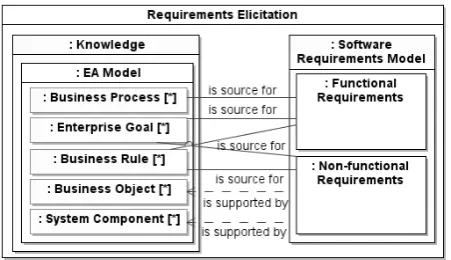
To be more concrete (Figure 2), EA usually cap-tures enterprise goals, business processes within an enterprise, business rules, business and IT objects. Goals can be directly translated to requirements. If we are looking deeper into requirement tree, goals can even be either functional, or non-functional software requirements [36, 37]. Processes, as we will take a more detailed look later in this paper, can also be directly translated to software functional requirements, for example, in a form of use cases or enterprise goals [15]. Business rules are both the non-functional and functional requirements for the software [10].
Figure 2. Software requirements elicitation form EA model
Business objects and IT objects act as supportive entities for requirements elicitation from enterprise knowledge models. For example, business objects could be the actors for the derived use case model and IT components can be used for requirements grouping. The quality of the process of software require-ments model derivation directly depends on the quality of knowledge. Quality of knowledge depends on the quality of meta-knowledge. To ensure quality of meta-knowledge it should be validated according to the domain knowledge. It might be done by evaluation of domain experts. Quality of meta-knowledge can be also ensured by picking the best practice configuration within the domain.
3.2. UPDM based Enterprise Model
The Unified Profile for MODAF and DoDAF (UPDM) defines a set of UML and optional SysML stereotypes and model elements and associations. UPDM is not an architectural framework. It is a language dedicated to build MODAF and DoDAF requirements meeting enterprise architecture models [6].
We will use UPDM language based models to de-monstrate our proposed technique. The main reason for the choice of UPDM is UML, especially when we are using SysML; other UML based modeling lan-guage. The integrity of both would make the starting point easier; integrated OMG metamodels allow designing various enterprise systems in one CASE tool [38]. The other obvious reason is the support of DoDAF and MODAF: emerging enterprise architect-ture frameworks. However the proposed approach is planned to be extended to meet TOGAF and Archi-mate requirements in the future.
UPDM consists of seven viewpoints: all views, strategic, acquisition, operational, service oriented, systems and technical [6]. We will focus on opera-tional and systems viewpoints. A suite of operaopera-tional viewpoint products are used to describe a requirement for a to-be architecture in logical terms. Systems view-point specifies a requirement for a System without delving deep into systems design [39].
according to their origin. Authors in [10, 40], and [41] separate requirements into user requirements (user needs in [41]) and system requirements. System re-quirements are also called as functional [10] or simply software requirements [7]. Based on this classification and the definition of the DoDAF viewpoints, we can state that the Operational viewpoint model is the source to elicit user requirements and the systems viewpoint model is the source to elicit system requirements.
UPDM closely enough to other enterprise model-ing languages defines the concepts of operational activity and function. Operational activity is perform-able by logical entity called Node and the function by the physical entity called Resource. It is also im-portant to note that both the operational activities and the functions consume and produce the information we need to capture during the requirements elicitation from the enterprise model.
3.3. SBVR Transformation Patterns
Object Management Group (OMG) has published the Semantics of Business Vocabulary and Business Rules (SBVR) specification [28] that defines the metamodel for documenting the semantics of business vocabulary, business facts andbusiness rules. SBVR is targeted to capture business concepts and business rules in alanguage close enough to ordinary language (such as Structured English) to permitbusiness experts
to read them, and at the same time formal enough (based on predicateand commonlogic) to be suitable for interchanging among organizations or software tools.Thus, SBVR is specially suited for actingas an intermediate representation between the stakeholders and the designers.
Enterprise model transformation to human readable SBVR format consists of two phases:
Transformation of user (operational in defense frameworks) requirements, and
Transformation of system requirements. The proposed approach does not support full trans-formation of the model yet. Currently it deals with activities, information flows, activity performing enti-ties, and data ignoring state and interaction models of the performing entities.
Suggested patterns are formed according to [31, 33, 30, 31]. Patterns are common for both the opera-tional model and the systems model of the enterprise. A single unit of transformation is activity (an ope-rational activity or a function dependent on the enter-prise viewpoint). In UPDM, activity is performed by performer [6]. It also produces and consumes ex-change items and participates in the sequential activity flow model usually comprised of more than one ac-tivity. These aspects semantically differentiate UPDM activity models from the UML ones.
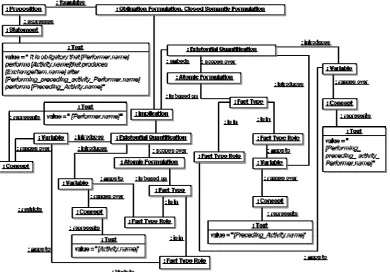
Figure 3. The example of the transformation pattern as the instance of SBVR MOF metamodel
During the transformation activities, performers and exchange items are transformed to concepts, performs relationship is transformed to the fact type
exchange item is transformed to the fact type “<activity> produces <data>”.
Using basic set of logical operations provided in SBVR standard there is no way to express first order logic such as before/after relationship. In order to in-volve temporal meanings the introduction of new key-word after is required into SBVR structured English [33]. The pattern supporting introduced keyword after is provided bellow.
after <antecedent> then <consequent>.
Note that both <antecedent> and <consequent> are binary fact types and both after and then are keywords [33].
Activity preceding the transformed activity is added as the antecedent in the SBRV statement. In case only the start node is before the activity, after/then pattern won’t be used. Complete SBVR structured English pattern for the activity producing an exchange item is:
[Obligation formulation]
[Performer.name] performs
[Activity.name] that produces
[ExchangeItem.name] after
[Performing_preceding_activity_Perfo
rmer.name] performs
[Preceding_Activity.name]
SBVR sentences are written in a different font and color to make it easier to read. The “
Perfor-mer.name” font is devoted for object types; the
“performs” font renders fact types and “after” font is for keywords. The notation has been taken from [28].
As an instance of the SBVR MOF-based meta-model, the rule pattern representing the activity that does not produce and does not consume an exchange item is displayed in Figure 3. Note that there is only a core fragment of the pattern displayed: fact type forms are not shown.
Activities consuming exchange items are trans-formed in the same manner. In case the activity is producing and consuming an exchange item, both clauses will be added and separated by the logical conjunction operation.
Sample SBVR based statement definition is: It is obligatory that the
administration performs send_invoice
that produces the invoice after the
administration performs
prepare_invoice
Activity that is not consuming and producing an exchange item will be transformed using the following pattern:
[Obligation
formulation][Performer.name]
performs [Activity.name] after the
[Performing_preceding_activity_Perfo
rmer.name] performs
[Preceding_Ope-rationalActivity.name]
Sample SBVR based requirement definition is: It is obligatory that the administration performs
cancel_order after the administration performs re-ceive_order.
In both cases above, activity control nodes such as decision, merge, fork and join are also supported. In case of decision before the activity, guard condition is added as the fact type underlying logical conjunction in combination with the preceding activity fact type.
In case of merge node, number of preceding activi-ties is added in the logical disjunction operation.
In case of join node, number of preceding acti-vities is added in the logical conjunction operation.
In case of the fork node, operational activities following the node are transformed to two or more sentences separated by the logical conjunction operations.
3.4. SysML Requirements Model
SysML is a systems modeling language based on UML [42]. Both SysML and UML languages are based on the same metametamodel, the OMG Meta Object Facility (MOF) [43]. SysML is considered both a subset and an extension of UML [42].
Besides other features we will not discuss in this paper, SysML provides multiple ways for capturing requirements and their relationships, in both graphical (SysML Requirements diagram) and tabular notations. A requirement that is captured in text is represented in SysML using the Requirement model element [44]. It can be related to other model elements through a set of relationships: containment, derive, satisfy, verify, re-fine and trace [42]. Relationships used in our approach are briefly explained below.
A containment relationship in UML expresses ownership and is very rarely represented in UML dia-grams. In SysML it is frequently used to express requirements hierarchy. Meanwhile, a deriveReqt (de-rivation) relationship is a dependency between two requirements in which a client requirement can be derived from the supplier requirement. For example, a system requirement may be derived from a user re-quirement, or a business requirement etc [42]. We will also use refine relationship to establish traces between requirements and the behavioral architecture elements that the requirement is directly elicited from.
2. Identify processes for transformation. The tech-nique will not be discussed in this paper.
“Requirements for <Operational Activity / Function. name> Business Process / Application Function”. The grouping requirement contains other requirements transformed from lower level activities. Only the re-quirements representing atomic activities are repre-senting SBVR sentences. Such requirements will al-ways be the leaf requirements in the requirements tree.
3. Transform Business Processes to SBVR model. The transformation will be made according to the proposed transformation patterns.
4. Transform SBVR model to structured English. 5. Build requirements tree using SysML
require-ments model and notation. Derivation relationship will be created between
user requirements and system requirements in case the application function represented by system require-ment implerequire-ments the process represented by user requirement in the UPDM based enterprise model.
6. Identify Application Functions for transformation. 7. Transform Application Functions to SBVR mo-del. The transformation will be made according to the proposed transformation patterns.
8. Transform SBVR model to structured English.
3.5. The process of Requirements Elicitation from
Enterprise model 9. Build software requirements tree using SysML re-quirements model and notation.
As all the techniques required for requirements elicitation from enterprise model have been discussed separately, it requires a clear workflow definition of how to associate these techniques together to achieve the desired results.
10. Add traces between different layers of require-ments and requirerequire-ments and architecture ele-ments.
11. Generate software requirements specification (SRS) document according to the predefined re-port template.
The process of applying the proposed approach consists of several steps:
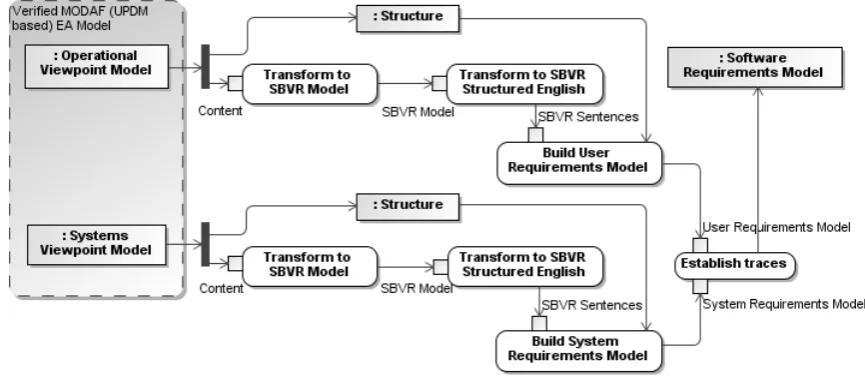
Summarizing the process of the proposed approach step by step, overview diagram is provided in Figure 4 that covers the process of eliciting user and system requirements from the enterprise architecture model. 1. Verify enterprise model to make sure the model is
correct and complete. The technique for Enter-prise Model verification will not be discussed in this paper. The model we use in the experimental section is treated as verified.
Figure 4. The process of requirements elicitation from the enterprise architecture model
4. Experimental Evaluation
Let us define a simple operational and systems viewpoint fragments of UPDM based Enterprise Ar-chitecture in order to demonstrate the proposed enterprise knowledge based software requirements elicitation approach.
The given EA fragment represents IT consulting enterprise. The consulting process shown in Figure 5 is defined as operational activity composed of two atomic operational activities accept order and accom-plish order. Consulting operational activity has one input and one output. The input is order and the output is course; both representing information. Atomic ope-rational activity accept order is performed by Admi-nistration business entity and the operational activity accomplish order is performed by the Trainer.
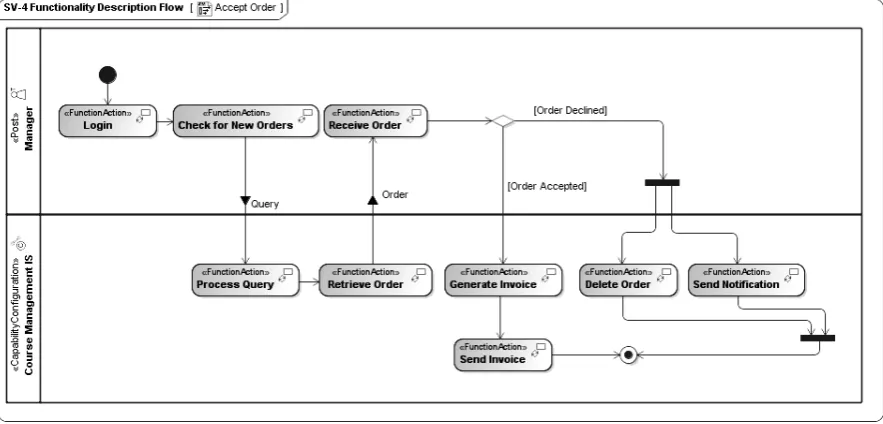
Accept order operational activity is implemented by function called Accept order in the systems view-point. The function is decomposed into multiple ato-mic Functions in Figure 6.
EA fragment, according to the defined SBVR transformation patterns and following the defined
process steps, is transformed to the SysML require-ments model:
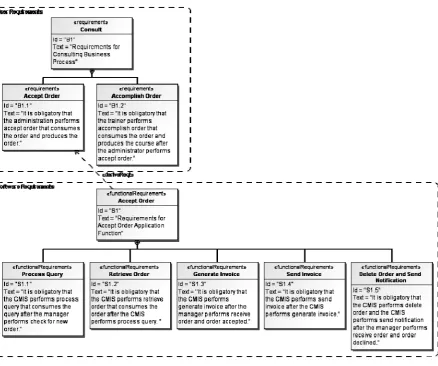
First, the accept order and accomplish order ope-rational activities are transformed to user Require-ments. The SysML user requirements model con-taining SBVR sentences is shown in Figure 7. Second, the accept order function and only its sub
functions performed by the Course Management IS (CMIS) are transformed to system Require-ments. The SysML system requirements model containing SBVR sentences is shown in Figure 7. Third, the derivation relationships are created
bet-ween related user and system requirements. Finally the refine relationships are created
bet-ween the requirements and the operational acti-vity/function the requirement has been elicited from.
Functions performed by the human resource Manager are not transformed to the requirements model directly; however, the functions are used when transforming following functions performed by CMIS.
Figure 6. Accept order functionality description diagram
5. Conclusions and Future works
We have presented an approach for requirements elicitation from EA models based on a new UPDM standard. Elicited requirements are based on the emer-ging SBVR standard. SysML Requirements model is generated and SysML Requirements Diagram is used to visualize it. The proposed approach has been im-plemented in MagicDraw and has been evaluated on a small illustrative fragment of real world EA model.
Based on the experience on implementing and eva-luating the proposed approach, we can make the following conclusions:
Figure 7. Transformation outcome: SysML user and system requirement models
Elicited Requirements are stored into the same UML based repository the UPDM models are. Such an integrated repository ensures integrity and traceability between the architecture models and several different abstraction layers of software requirement models; integrated UML based repository is supported by the most of CASE tools.
Compared to others, the proposed approach is both human and machine readable; readability by machines allows performing automated software design generation directly from the requirements model (MDA).
The proposed approach currently elicits requirements from behavioral activity based UPDM models only; support of data models, business rules and state machines will be considered in the future.
Verification of enterprise model and techniques of process categorization are subjects to the future works improving the proposed approach.
The proposed approach is a starting point for the more detailed future works on performing the require-ments elicitation from preserved enterprise know-ledge.
Acknowledgement
The authors would like to thank No Magic, Inc, especially the MagicDraw product team and professor Lina Nemuraite from Kaunas University of Techno-logy for the comprehensive support.
References
[1] J.A. Zachman. A Framework for Information Sys-tems Architecture. IBM SysSys-tems Journal, 26(3), 1987, 276-292.
[2] OMG. Unified Modeling Language (OMG UML) Infrastructure. v2.1.2. Needham, MA, USA: Object Management Group, 2007.
[3] OMG. MDA Guide Version 1.0.1. Object ment Group, Needham, MA, USA: Object Manage-ment Group, 2003.
[4] M. Dalgarno, M. Fowler. UML vs. Domain-Specific Languages. Methods and Tools , 16(2), 2008, 2-8. [5] D. Silingas, R. Butleris. Towards customizing UML
tools for enterprise architecture modeling. Information Systems 2009: proceedings of the IADIS international conference, Barcelona, Spain, 2009, 25-27.
Needham, MA, USA: Object Management Group, 2009.
[7] D. Šilingas, R. Butleris. Towards Implementing a Framework for Modeling Software Requirements in MagicDraw UML. Information Technology and Control, 38(2), 2009, 153 – 164.
[8] A. Morkevicius, S. Gudas, D. Silingas. Model-Dri-ven Quantitative Performance Analysis of UPDM-Based Enterprise Architecture. Proceedings of the 16th International Conference on Information and Software Technologies. Kaunas, 2010, 218-223. [9] S. Gudas. Enterprise knowledge modelling domains
and aspects. Technological and economical develop-ment of Economy, 15(2), 2009, 281-293.
[10] K.E. Wiegers. Software Requirements, Second Edit-ion. Redmond, Washington: Microsoft Press, 2003. [11] E. Kavakli, P. Loucopoulos. Goal Modeling in
Re-quirements Engineering: Analysis and Critique of Cur-rent Methods. Information Modeling Methods and Methodologies, 2004, 102-124.
[12] G. Regev, A. Wegmann. Defining Early IT System Requirements with Regulation Principles: The Light-switch Approach. Proc. 12th IEEE International Re-quirements Engineering Conference (RE’04), 2004. [13] E. Yu. Towards Modelling Strategic Actor
Relation-ships for Information Systems Development – With Examples from Business Process Reengineering. Pro-ceedings of the 4th Workshop on Information Techno-logies and Systems, Vancouver, B.C., Canada, 1994, 21-28.
[14] Z. Zheying. Effective Requirements Development - A Comparison of Requirements Elicitation techniques. INSPIRE, Tampere, Finland, 2007.
[15] J. L. De la Vara González, J.S. Díaz. Business pro-cess-driven requirements engineering: a goal-based approach. Proceedings of the 8th Workshop on Busi-ness Process Modeling, 2007.
[16] H. Eriksson, M. Penker. Business Modeling with UML: Business Patterns at Work. John Wiley and Sons, 2000.
[17] C. Marshall. Enterprise Modeling with UML. Addi-son-Wesley, 2001.
[18] E. Yu. Towards Modeling and Reasoning Support for Early-Phase Requirements Engineering. 3rd Interna-tional Symposium on Requirements Engineering (RE’97), Washington, USA. 1997.
[19] R. Darimont, E. Delor, P. Massonet, A. Van Lams-weerde. GRAIL/KAOS: An Environment for Goal-Driven Requirements Engineering. Proc. ICSE’98 – 20th Int’l Conf. Software Eng., Kyoto, Japan, 1998, 58-62.
[20] S. Zaharova, J. Stirna. Using Organizational Patterns as a Technique for Knowledge Management. 5th CAiSE/IFIP8.1 International Workshop on Evaluation of Modeling Methods in Systems Analysis and Design (EMMSAD'00), Stockholm, Sweden, 2000.
[21] A. Lopata, S. Gudas. Control View Based Elicitation of Functional Requirements. Business Information Systems Workshops, BIS 2009 International Work-shops, Poznan, Poland, April 27-29, 2009, Revised Papers Series: Lecture Notes in Business Information Processing, 2009.
[22] S. Gudas, A. Lopata. Meta-Model Based Develop-ment of Use Case Model for Business Function. Information Technology and Control, 36(3), 2007, 302-309.
[23] S. Gudas. A framework for research of information processing hierarchy in enterprise. Mathematics and Computers in Simulation, 33, 1991, 281-285.
[24] A. Van Lamsweerde, R. Darimont, E. Letier. Ma-naging Conflicts in Goal-Driven Requirements Engi-neering. IEEE Transactions on Software Engineering, 24(11), 1998, 908-926.
[25] R. Koymans. Specifying Message Passing and Time-Critical Systems with Temporal Logic. Springer-Verlag, 1992.
[26] A. Fuxman, M. Pistore, J. Mylopoulos, P. Traver-so. Model Checking Early Requirements Specifi-cations in Tropos. 5th International Symposium on Requirements Engineering (RE’01). Toronto, Canada. 2001.
[27] A. Fuxman, L. Liu, J. Mylopoulos, M. Pistore, M. Roveri, P. Traverso. Specifying and analyzing early requirements in Tropos. Requirements Engineering, 9(2), 2004, 132-150.
[28] OMG. Semantics of Business Vocabulary and Business Rules (SBVR), v1.0. Needham, MA, USA: Object Management Group, 2008.
[29] S. Gudas, A. Lopata. Workflow Models Based Ac-quisition of Enterprise Knowledge. Information Tech-nology and Control, 36(1A), 2007, 103-109. [30] L. Ceponiene, L. Nemuraite, G. Vedrickas.
Seman-tic business rules in service oriented development of information systems. 15th International Conference on Information and Software Technologies, IT 2009, Kaunas, Lithuania, 2009, 404–416.
[31] L. Nemuraite, T. Skersys, A. Sukys, E. Sinkevicius, L. Ablonskis. VETIS Tool for Editing and Trans-forming SBVR Business Vocabularies and Business Rules into UML & OCL Models. 16th International Conference on Information and Software Technolo-gies, Kaunas: Kaunas University of Technology, 377-384, 2010.
[32] J. Cabot, R. Pau, R. Raventós. From UML/OCL to SBVR specifications: A challenging transformation. Information Systems. 35(4), 2010, 417-440.
[33] R. Eder, T. Kurz, A. Filieri, A. Margarito. D2.3 - Extended vocabulary and rule set for an existing scenario. OPAALS Project, 2008.
[34] A. M. Hickey, A. M. Davis. Requirements Elicitation and Elicitation Technique Selection: A Model for Two Knowledge-Intensive Software Development Proces-ses. Proceedings of the 36th Annual Hawaii Inter-national Conference on System Sciences (HICSS'03). Washington, DC, USA: IEEE Computer Society, 2003, 96.
[35] J. Schekkerman. Enterprise Architecture Tool Selec-tion Guide v5.0. Institute for Enterprise Architecture Developments. 2009.
[36] A. Caplinskas. Requirements Elicitation in the Con-text of Enterprise Engineering: A Vision Driven Approach. Informatica , 20(3), 2009, 343–368. [37] A. Van Lamsweerde, L. Willemet. Inferring
[38] S. Pavalkis, L.Nemuraite, P.Tarvydas, A. Noreika. Specification of finite element model of electronic device using model-driven Wizard-based guidance. Electronics and Electrical Engineering, 2(98), 2010, 59-62.
[39] Department of Defence. DoD Architecture Frame-work Version 2.0. Volume 2: Architectural Data and Models Architect’s Guide. USA, 2009.
[40] N. Maiden. User Requirements and System Require-ments. Software, IEEE. 25(2), 2008, 90 – 91.
[41] R.R. Young. The requirements engineering handbook. Nordwood, MA, USA: Artech House, 2004.
[42] OMG. Systems Modeling Language, Version 1.1. Needham, MA, USA: Object Management Group, 2008.
[43] OMG. Meta Object Family Specification (MOF), Needham, MA, USA: Object Management Group, 2002.
[44] S. Friedenthal, S., A. Moore, A., R. Steiner. A Prac-tical Guide to SysML. Burlington, MA, USA: Elsevier. 2008.