Anna Winiarska-Mieczan
1, A–E,
Robert Krusiński
2, B, E, F, Małgorzata Kwiecień
2, B, E, FTannic Acid Influence on Lead and Cadmium
Accumulation in the Hearts and Lungs of Rats
Wpływ kwasu taninowego na akumulację ołowiu i kadmu
w sercach i płucach szczurów
1 Department of Bromatology and Food Physiology, University of Life Sciences in Lublin, Poland 2 Department of Animal Nutrition, University of Life Sciences in Lublin, Poland
A – research concept and design; B – collection and/or assembly of data; C – data analysis and interpretation;
D – writing the article; E – critical revision of the article; F – final approval of article; G – other
Abstract
Background. The presence of heavy metals in food products has become a global problem. In order to reduce the absorption of heavy metals from food we should consider substances which bind these toxic metals and are gener-ally available and easy to apply, such as tannins.
Objectives. The study aimed at verifying if oral administration of tannic acid could reduce the accumulation of lead and cadmium in the heart and lungs of rats subjected to a continuous exposure of toxic metals in low doses.
Material and Methods. Adolescent and adult male Wistar rats were given tannic acid (2% solution) or distilled water containing 0, 50, 100 mg Pb (as (CH3COO)2Pb)/L or 0, 7, 14 mg Cd (as CdCl2)/L, for 6 or 12 weeks.
Results. Administering a 2% solution of tannic acid alternately with Pb or Cd to the rats was the effective method of reducing lead and cadmium content in the rats’ heart and lungs.
Conclusions. The obtained results may be referred to people. It is necessary to conduct further research in order to confirm the hypothesis that tannic acid, present in numerous food products and primarily in drinks (wine, tea and coffee), used in the human diet, may reduce the accumulation of lead and cadmium in the tissues and thus weaken their toxicity, which is important regarding our common exposure to heavy metals found in food (Adv Clin Exp Med 2013, 22, 5, 615–620).
Key words: lead, cadmium, tannic acid, accumulation, hearts, lungs, rats.
Streszczenie
Wprowadzenie. Obecność metali ciężkich w żywności jest problemem globalnym. Aby ograniczyć wchłanianie metali ciężkich z żywności, należy brać pod uwagę substancje wiążące te toksyczne metale, które przy okazji będą łatwe w użyciu i ogólnie dostępne, np. kwas taninowy.
Cel pracy. Sprawdzenie, czy doustne podawanie kwasu taninowego spowoduje zmniejszenie akumulacji kadmu i ołowiu w sercu oraz płucach szczurów wystawionych na stałą ekspozycję tych metali toksycznych w małych daw-kach.
Materiał i metody. Rosnące i dorosłe samce szczurów Wistar otrzymywały 2% roztwór kwasu taninowego lub wodę destylowaną zawierającą 0, 50, 100 mg Pb (w postaci (CH3COO)2Pb)/L albo 0, 7, 14 mg Cd (CdCl2)/L przez
6 lub 12 tygodni.
Wyniki. Zastosowanie 2% roztworu kwasu taninowego naprzemiennie z Pb lub Cd okazało się skutecznym sposo-bem ograniczenia koncentracji tych metali w sercach i płucach szczurów.
Wnioski. Uzyskane wyniki można odnieść do ludzi. Należy prowadzić dalsze badania mające na celu potwierdze-nie, czy stosowanie w diecie człowieka kwasu taninowego, występującego w wielu pokarmach, a przede wszystkim w napojach (wino, kawa, herbata), może ograniczyć kumulowanie ołowiu i kadmu w tkankach i tym samym osłabić ich toksyczne działanie. Jest to ważne z uwagi na powszechne narażenie ludzi na metale ciężkie, których podstawo-wym źródłem jest żywność (Adv Clin Exp Med 2013, 22, 5, 615–620).
Słowa kluczowe: ołów, kadm, kwas taninowy, akumulacja, serca, płuca, szczury.
Adv Clin Exp Med 2013, 22, 5, 615–620 ISSN 1899–5276
ORIgINAL PAPERS
Lead and cadmium are toxic elements whose occurrence in the environment is related to anthro-pogenic activity [1]. The high level of heavy met-als in the environment is reflected in their amount found in plant and animal organisms which is then used to make food for people. The circulation of heavy metals in the environment is connected with the food chain including the soil – the plant – the animal – man. The transition of metals to a higher link results in a cumulative increase of their con-tent [2]. Cadmium and lead are characterized by high accumulation ability; they are easily absorbed from the digestive tract and easily permeate bio-logical barriers [3, 4]. The half-life of cadmium in soft tissues is 5–30 years [1], whereas for lead this time amounts to ca. 30 days [5]. These elements administered orally are deposited, among others, in the heart muscle [6] and in the lungs [7].
Lead and cadmium in large doses reveal tox-ic activity. Studies on the toxtox-icity of heavy metals were performed in most cases on rats [8, 9], but al-so on hamsters [10] and mice [11]. In those stud-ies the doses [12], the time of exposure to the ele-ment (from a few hours to several months) [13–15] and the form of administration were all different (mainly with drinking water, by inhalation or with food) [16]. However, what is especially danger-ous to the human organism, is its long exposure to the effects of these xenobiotics. Acute intoxica-tion with cadmium and lead occurs infrequently, and it is their chronic toxicity that is more com-mon. In order to reduce the absorption of heavy metals from food, it is necessary to consider sub-stances which bind these elements and are at the same time simple to use and generally accessible. Tannic acid in in vitro conditions is a very efficient chelator for lead and cadmium [17], so it may be assumed that it will reduce the absorption of these metals into the animal’s tissues. Studies performed by Kim et al. [18] on mice showed that the use of tannic acid led to decreasing the accumulation of cadmium in the organism when the authors used very large doses of the element (20 mg/kg/day). Easily available food products containing tannic acid include tea and coffee [19].
The present study aimed at verifying if the oral administration of a 2% solution of tannic ac-id would lower the accumulation of lead and cad-mium in the heart and the lungs of rats exposed to constant activity of these toxic metals in small dos-es. Since toxicity depends on its degree of distribu-tion, uptake and metabolism, we investigated the differential accumulation of cadmium and lead in organs of adolescent and adult rats.
Material and Methods
Animals and Diet
The experiment was performed with the accep-tance of the II Ethical Committee at the Universi-ty of Life Sciences in Lublin, No. 18/2010. Princi-ples embodied in the declaration of Helsinki were adhered to and all animal protocols conformed to the guiding Principles for Research Involving An-imals. The rats were allowed a period of one week to stabilize with their new environment. The prop-er expprop-eriment took 12 weeks (the first pprop-eriod of weeks 1–6 and the second period of weeks 7–12). Male Wistar rats (30 growing, weighting 169.3 ± ± 14.7 g at 35 days of age, and 30 adult, weight-ing 349.8 ± 17.4 g at 84 days of age) were assigned to five experimental groups, each group including 12 rats (6 adolescent and 6 adult). The rats were given distilled water or drinking fluids ad libitum
and were fed a standard chow ad libitum with 160 g protein, 28 g fat, 50 g crude fibre, 70 g crude ash in 1 kg of chow, metabolizable energy of the diet is 11 MJ. Lead, cadmium and tannic acid concen-tration in chow was determined in our laborato-ry: Pb and Cd by means of the AAS technique in the Varian Spectr AA 880 apparatus, whereas tan-nic acid by Tyczkowska`s method [20]. Diet con-tained 54.24 µg of Pb, 5.12 µg of Cd and 3.1 g of tannic acid in 1 kg. The animals were individually housed in polypropylene cages in an environmen-tally controlled clean air room, with a tempera-ture of ca. 21°C, a relative humidity of ca. 55% and a 12 h light/12 h dark cycle.
Experimental Design
Tannic acid (TA), cadmium chloride and lead acetate were produced by POCH SA (Poland). The rats were given heavy metals or tannic acid as fol-low: 50 mg Pb per 1 L of distilled water (group Pb); 100 mg Pb per 1 L of distilled water or 2% water-based TA solution (alternately every 7 days) (group Pb/TA); 7 mg Cd per 1 L of distilled wa-ter (group Cd); 14 mg Cd per 1 L of distilled wawa-ter or 2% water-based TA solution (alternately every 7 days) (group Cd/TA). Table 1 presents the me-thodical system of the experiment and mean con-sumption of tannic acid (2% solution), lead (as (CH3COO)2Pb) and cadmium (as CdCl2) from
1.15 mg Cd or 1.02 mg Cd + 46.92 mL of 2% TA solution, respectively. Rats were given lead at about 3.3 mg/kg body weight/day and cadmium in quan-tities not exceeding 0.5 mg/kg body weigh/day (Tab. 1). At the end of the experimental periods
(6 or 12 weeks), animals were put down in CO2,
and they died as a result of their spinal cord be-ing broken. There were six animals in each group (3 adolescent and 3 adult). Hearts (without blood) and lungs were immediately extricated and dis-sected in iced saline. The tissue samples were put in separate plastic containers.
Chemical Analysis
Portions of hearts and lungs (ca. 3 g) were dried first at a temperature of 103oC for ca.
48 hours, and mineralised in a muffle furnace at 450oC for 16 h. After a complete mineralisation the
burnt samples were dissolved in a 10 mL of 0.1 N
HNO3 and transferred into flasks. The content of
cadmium and lead was determined by gF AAS technique in the Varian Spectr AA 880 apparatus, including atomisation in a graphite furnace and using the Zeeman background correction. Argon was used as the pure gas. The content of lead was determined at a wavelength λ = 217.0 nm (LOD 0.011 µg/kg) and cadmium at λ = 228.8 nm (LOD 0.0001 µg/kg). The deviation of duplicate measure-ment was below 5%. Quality control of analytical
measurements was performed using blank samples and certified reference material (CRM-185R – bo-vine liver). Mean recovery rate of Pb was 95% and that for Cd was 96%. The spectrometer was cali-brated according to the Merck (germany) stand-ard containing 50 µg/L Pb and 2.5 µg/L Cd. The analyses were performed in three replications.
Statistical Analysis
Data analysis was done by STATISTICA 6.0 computer program. Statistically significant differ-ences were established at the level of p < 0.05. The significance of differences between the mean val-ues in the groups was estimated with the use of Duncan’s tests.
Results
The Content of Lead in the Rats’
Heart and Lungs
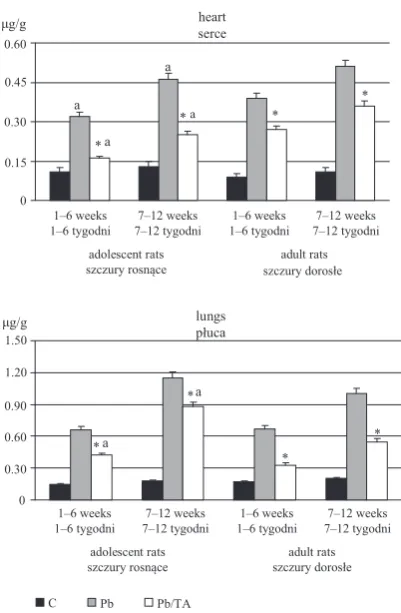
In both experimental periods the application of tannic acid (Pb/TA) in adolescent and adult rats resulted in depositing smaller amounts of lead in the studied tissues, compared to group Pb (Fig. 1). The animals’ age affected lead concen-tration in their heart and lungs: the heart of the adolescent rats accumulated more Pb than in the
Table 1. Experimental design and mean consumption of tannic acid (TA), cadmium and lead from drinking fluids Tabela 1. Układ doświadczenia oraz średnie pobranie kwasu taninowego (TA), ołowiu i kadmu z napojami
Experimental
groups Treatment Consumption of tannic acid (2% solu-tion), mL/week
Consumption of Cd
and/or Pb, mg/week Consumption of Cd and/or Pb, mg/kg BW/day
adoles-cent rats adult rats adoles-cent rats adult rats adoles- cent rats adult rats
I – control C distilled water – – – – – –
II Pb 50 mg Pb/L distilled
water * – – 8.28 Pb 9.96 Pb 3.26 Pb 3.37 Pb
III Pb/
TA 100 mg Pb/L distilled water * 2% water-based TA solu-tion (alternately every 7 days)
55.97 48.18 8.08 Pb 9.66 Pb 3.38 Pb 3.24 Pb
IV Cd 7 mg Cd/L distilled water ** – – 1.15 Cd 1.15 Cd 0.43 Cd 0.38 Cd
V Cd/
TA 14 mg Cd/L distilled water ** 2% water-based TA solu-tion (alternately every 7 days)
58.12 46.92 1.16 Cd 1.02 Cd 0.49 Cd 0.35 Cd
* as (CH3COO)2Pb; ** as CdCl2; BW – body weight.
adult animals. The lungs of both young and adult rats receiving only a solution of lead (group Pb) did not reveal statistically significant (p = 0.245) differences in the content of Pb. At the same time it was observed that the lungs of young rats from Pb/TA group contained significantly (p = 0.012) more Pb than in the adult rats. It was observed that the lungs accumulated much more Pb than the heart.
The Content of Cadmium
in the Rats’ Heart and Lungs
The hearts and lungs of the young rats accu-mulated significantly more Cd than in the adult animals (Fig. 2). Irrespective of the rats’ age, it was noted that using TA in the form of a 2% water-based solution administered alternately with a cad-mium solution (group Cd/TA) resulted in a statis-tically significant (p = 0.009) reduction of Cd in the heart and lungs, compared to group Cd. The rats’ lungs accumulated more cadmium than their hearts.Discussion
The study aimed at verifying if oral administra-tion of tannic acid could reduce the accumulaadministra-tion of lead and cadmium in the heart of rats subjected to a continuous exposure of toxic metals in low doses (about 3 mg Pb/kg body weight/day and cadmium in quantities not exceeding 0.5 mg/kg body weight/ day). So far there has been hardly any comparative data regarding this problem in rats, which are mod-el animal substitutes for humans.
The author’s own studies revealed that admin-istering a 2% solution of tannic acid alternately with Pb or Cd to the rats was the most effective method of reducing lead and cadmium content in the ani-mals’ heart and lungs. Polyphenol compounds, in-cluding tannic acid, have an ability to chelate me-tallic elements [21]. Tannic acid in vitro is a very effective chelator for lead and cadmium [17]. The author’s own studies suggest that tannic acid may also chelate Pb and Cd inside the animal’s or-ganism. Kim et al. [18] performed research which aimed at determining the effect of tannic acid on
heart serce
0
1–6 weeks
1–6 tygodni 7–12 tygodni7–12 weeks 1–6 tygodni1–6 weeks 7–12 tygodni7–12 weeks
* * * * a a a a adolescent rats
szczury rosnące szczury dorosłeadult rats
μg/g 0.60 0.45 0.30 0.15 1–6 weeks
1–6 tygodni 7–12 tygodni7–12 weeks 1–6 tygodni1–6 weeks 7–12 tygodni7–12 weeks adolescent rats
szczury rosnące szczury dorosłeadult rats
lungs płuca
0
C Pb Pb/TA
* * * * a a μg/g 1.50 1.20 0.90 0.60 0.30
Fig. 1. The distribution of Pb in the hearts and lungs (for 6 and 12 weeks of exposure), mean ± SD,
* significant versus Pb (p < 0.05); a – significant versus adult rats (p < 0.05)
Ryc. 1. Dystrybucja Pb w sercach i płucach
(po 6 i 12 tygodniach ekspozycji), wartość średnia ± SD, * istotne wobec Pb (p < 0,05); a – istotne wobec szczu-rów dorosłych (p < 0,05)
0 * * * * a μg/g 0.04 0.03 0.02 0.01 0
C Cd Cd/TA
* * * * a a μg/g 0.06 0.04 0.02 heart serce 1–6 weeks
1–6 tygodni 7–12 tygodni7–12 weeks 1–6 tygodni1–6 weeks 7–12 tygodni7–12 weeks adolescent rats
szczury rosnące szczury dorosłeadult rats
1–6 weeks
1–6 tygodni 7–12 tygodni7–12 weeks 1–6 tygodni1–6 weeks 7–12 tygodni7–12 weeks adolescent rats
szczury rosnące szczury dorosłeadult rats
lungs płuca
Fig. 2. The distribution of Cd in the hearts and lungs (for 6 and 12 weeks of exposure), mean ± SD,
* significant versus Cd (p < 0.05); a – significant versus adult rats (p < 0.05)
Ryc. 2. Dystrybucja Cd w sercach i płucach
the absorption of cadmium in mice. The authors used tannic acid amounting to 0.5 mg/mL, 1 mg/ mL and 2 mg/mL with a simultaneous adminis-tration of cadmium in a very large dose of 20 mg/ kg/day. Both tannic acid and Cd were given oral-ly. The administration of tannic acid resulted in reducing Cd accumulation in the organism of the mice and in the analyzed organs.
The author’s own studies showed that the lungs of the rats contained much more Pb and Cd than their heart. Nwokocha et al. [22] observed that the lungs of the rats given water containing 100 ppm of lead acetate revealed significantly more Pb than their heart. Studies performed by Brzóska et al. [23] showed that intoxicating rats with cadmium ad-ministered orally at different levels of concentra-tion led to depositing higher amounts of Cd in the lungs than in the heart. It should be noted that the difference increased along with a higher supply of Cd. Lead and cadmium show their toxic effects via depletion of glutathione and bonding to sulphydryl groups of proteins [24]. Proteins, such as metallo-thioneins and amino acids, are examples of biomol-ecules, which are able to bind toxic metals in bio-logical matrices. Metallothioneins are induced on exposure to heavy metals. A positive correlation has been observed between Cd content and metallo-thionein levels in the brain and lungs of mon-keys [25]. The synthesis of metallothioneins in the organs of rats drinking water containing 50 ppm Cd was higher in the lungs than in the heart [26]. More-over, such a higher concentration of Cd and Pb in the lungs can be accounted for by their better blood supply, since as much as 5000 mL of blood per one minute flows through a man’s lungs [27], compared to 250 mL of blood in the heart [28].
In the present study, the hearts and lungs of the young rats accumulated significantly (p < 0.05) more Cd and Pb than in the adult animals. Satarug et al. [29] found that cadmium absorption and ac-cumulation depend, among others, on animals’ age: young individuals tend to absorb more of Cd. Ex-perimental animals studies show that adult animals absorb less toxic metals than young animals [30]. Studies performed by Horiguchi et al. [31] sug-gest a higher accumulation of Cd in young female Japanese. Oral absorption in children seems to be higher than in adults. Human infants may absorb as much as 50% of Pb from diet, compared with 10% for adults [32]. Because of the not fully devel-oped liver and/or kidneys in the adolescent indi-viduals, the excretion processes are generally poor-er than in adults [33, 34]. The fastpoor-er distribution in both infants and children and a slower elimination are probably the cause. Young animals and infants have a low body weight and lower immunity [35]. Moreover, the activity of most digestive enzymes in young is much lower than in adults, the gastric pH is higher, and the intestinal epithelium is not fully developed [36]. This explains their enhanced susceptibility to the potential effects of lead.
The rats are relevant models for humans. The obtained results may be referred to people. It is necessary to conduct further research in order to confirm the hypothesis that tannic acid, present in numerous food products and primarily in drinks (wine, tea and coffee), used in human diet may re-duce the accumulation of cadmium and lead in the tissues and thus weaken their toxicity, which is im-portant regarding our common exposure to heavy metals found in food.
References
[1] Castelli M, Rossi B, Corsetti F, Mantovani A, Spera G, Lubrano C, Silvestroni L, Patriarca M, Chiodo F, Menditto A: Levels of cadmium and lead in blood: an application of validated methods in a group of patients with endocrine/metabolic disorders from the Rome area. Microchem J 2005, 79, 349–355.
[2] Bradstreet J, Geier DA, Kartzinel JJ, Adams JB, Geier MR: A case-control study of mercury burden in children with autistic spectrum disorders. J Am Phys Surg 2003, 3, 76–79.
[3] Hegazy A, Hashem M, El Shafei A, Shaker N, Hady MA: Development of anti-microbial jute fabrics via in situ formation of cellulose-tannic acid-metal ion complex. Carb Polym 2010, 79, 890–897.
[4] Tong SE, von Schirnding YE, Prapamontol T: Environmental lead exposure a public health problem of global dimensions. Bull World Health Organ 2010, 78, 1068–1077.
[5] EFSA Panel on Contaminants in the Food Chain (CONTAM); Scientific Opinion on Lead in Food. EFTA J 2010, 8, 1423–1570.
[6] Shiraishi N, Rehm S, Waalkes MP: Effect of chlorpromazine pretreatment on cadmium toxicity in the male Wistar (WF/NCr) rat. Toxicol Environ Health 1994, 42, 193–208.
[7] Jedlińska-Krakowska M: Influence of cadmium, lead and vitamin E and C on the levels of selected oxidative and biochemical indices in rat males. Bromat Chem Toksykol 2010, 4, 551–557 [in Polish, English abstract].
[8] Kojima S, Sugimura Y, Ono H, Shimada H, Funakoshi T: N-benzyl-D-glucamine dithiocarbamate and N-p- -isopropylbenzyl-D-glucamine dithiocarbamate improve the protective effect of diethyldithiocarbamate against cadmium-induced testicular toxicity in rats. Biol Pharm Bull 1993, 16, 244–247.
[10] Chubatsu LS, Gennari M, Meneghini R: glutathione is the antioxidant responsible for resistance to oxidative stress in V79 Chinese hamster fibroblasts rendered resistant to cadmium. Chem Biol Interact 1992, 82, 99–100.
[11] Shimada H, Funakoshi T, Waalkes MP: Acute, nontoxic cadmium exposure inhibits pancreatic protease activities in the mouse. Toxicol Sci 2000, 53, 474–480.
[12] Iscan M, Coban T, Iscan ML: Combinated effect of cadmium and nickel on rat hepatic monooxygenases: possible stimulation of certain cytochrome P-450 isozymes. Toxicol Lett 1992, 62, 191–199.
[13] Bialonska D, Zakrzewska M, Rawicka-Kapusta K, Konior M: The long-term effect of cadmium exposure trough food on the postnatal development of the bank vole. Filia Biol 2001, 50, 203–209.
[14] Giridhar J, Rathinavelu A, Isom GE: Interaction of cadmium with atrial natriuretic peptide receptors: implica-tions for toxicity. Toxicol 1992, 75, 133–143.
[15] Hayashi T, Sudo J: Interrelations of cadmium contents and histopathological changes in kidneys following single intravenous injection of cadmium-saturated metallothionein II in rats. J Toxicol Sci 1994, 19, 45–53.
[16] Leonzo G, Fossi MC, Lari L, Focardi S: Influence of cadmium on polychlorobiphenyl uptake, MFO activity, and serum lipid levels in Japanese quail. Arch Environ Contain Toxicol 1992, 22, 238–241.
[17] Pekdemir T, Tokunaga S, Ishigami Y, Kyung-Jin H: Removal of cadmium or lead from polluted water by biologi-cal amphiphiles. J Surf Deterg 2000, 3, 43–46.
[18] Kim PG, Ahn RM, Hwang SH: The effects of tannic acid to the cadmium on mouse. J Fd Hyg Safety 1998, 13, 87–93.
[19] Savolainen H: Tannin content of tea and coffee. J Appl Toxicol 1992, 12, 191–192.
[20] Tyczkowska K: Determination of tannic acid content in sorghum seeds. Biul Inf Przem Pasz 1997, 4, 40–45 [in Polish].
[21] Al-Oud SS: Heavy metal contents in tea and herb leaves. Pak J Biol Sci 2003, 6, 208–212.
[22] Nwokocha CR, Ufearo CS, Owu DU, Idemudo NC, Ojukwu LC:In vivo distribution of lead in male and female rats after intraperitoneal and oral administration. Toxicol Ind Health 2011, 27, doi: 10.1177/0748233711407955.
[23] Brzóska MM, Moniuszko-Jakoniuk J, Jurczuk M, Gałażyn-SidorczukM, RogalskaJ: Effect of short-term etha-nol administration on cadmium retention and bioelement. metabolism in rats continuously exposed to cadmium. Alcohol Alcoholism 2000, 35, 439–445.
[24] Jomova K, Valko M: Advances in metal-induced oxidative stress and human disease. Toxicol 2011, 283, 65–87.
[25] Ravi K, Paliwal VK, Nath R: Induction of Cd-metallothionein in cadmium exposed monkeys under different nutritional stresses. Toxicol Lett 1984, 22, 21–26.
[26] Revis NW, Osborne TR: Dietary protein effects on cadmium and metallothionein accumulation in the liver and kidney of rats. Environ Health Perspect 1984, 54, 83–91.
[27] West J: Respiratory physiology – the essentials. Williams & Wilkins, Baltimore, 2008, 8th ed.
[28] Neil E: Principles of vascular control. Postgrad Med J 1974, 50, 557–559.
[29] Satarug S, Baker JE, Reilly PE, Moore MR, Williams DJ: Changes in zinc and copper homeostasis in human livers and kidneys associated with exposure to environmental cadmium. Hum Exp Toxicol 2001, 20, 205–213.
[30] Eklund G, Grawé KP, Oskarsson A: Bioavailability of cadmium from infant diets in newborn rats. Arch Toxicol 2001, 75, 522–530.
[31] Horiguchi H, Oguma E, Sasaki S, Miyamoto K, Ikeda Y, Mahida M, Kayama F: Comprehensive study of the effects of age, iron deficiency, diabetes mellitus, and cadmium burden on dietary cadmium absorption in cadmi-um-exposed female Japanese farmers. Toxicol Appl Pharmacol 2004, 196, 114–123.
[32] Gundacker C, Pietschnig B, Wittmann KJ, Lischka A, Salzer H, Hohenauer L, Schuster E: Lead and mercury in breast milk. Pediatrics 2002, 5, 873–878.
[33] Rosenthal P: Assessing liver function and hyperbilirubinemia in the newborn. Clin Chem1997,43, 228–234.
[34] Sastre JB, Aparicio AR, Cotallo GD, Colomer BF, Hernández MC: Urinary tract infection in the newborn: clini-cal and radio imaging studies. Pediatr Nephrol 2007, 22, 1735–1741.
[35] Rotenberg JS, Newmark J: Nerve agent attacks on children: diagnosis and management. Pediatrics 2003, 112, 648–658.
[36] Milsap R, Jusko W: Pharmacokinetics in the infant. Environ Health Perspect 1994, 102, 107–110.
Address for correspondence:
Anna Winiarska-Mieczan
Department of Bromatology and Food Physiology University of Life Sciences in Lublin
Akademicka 13 20-950 Lublin Poland
Tel.: +48 81 445 67 44
E-mail: [email protected] Conflict of interest: None declared Received: 15.06.2012