Chunduru Prathyusha
Bapatla College of Pharmacy, Bapatla, Andhra Pradesh Email: [email protected]
Address for correspondence
Access this article online www.japer.in
Compatibility studies of Donepezil with different excipients by
using HPLC and FTIR
INTRODUCTION
Donepezil is a potent acetyl cholinesterase inhibitor used in the patients with Alzheimer’s disease to help stave off the cognitive abilities.[1] Pharmaceutical dosage form is a combination of active pharmaceutical ingredients (API) and excipients(s) although considered pharmacologically inert excipients can initiate, propagate or participate in chemical or physical interactions with drug compounds, which may compromise the effectiveness of a medication. In solid dosage forms drug excipient interactions whether physical or chemical can affect the process like disintegration, dissolution, stability and thereby affecting its safety or efficacy.[2] Compatibility study is the most important part of any pre formulation testing of proposed dosage form, and it is necessary that it should be carried out before the development of first formulation with a new drug or new formulation of existing API.[3] Compatibility studies provide rational basis for selecting excipients used in model formulations. They are various techniques used
for drug excipient compatibility studies such as Chromatography (HPLC, TLC) Thermal analysis (DSC, DTA, and TGA) and spectrophotometry (Diffuse reflectance spectroscopy, FTIR). [4] Drug and excipient mixtures are stored under accelerated temperature as binary blends and then analyzed for any decomposition using HPLC & FTIR. [5] Any changing chromatogram such as extra peaks corresponding to degradation products or disappearance of bands in FTIR spectrum is indicative of an interaction. The purpose of study was to evaluate the physical and chemical stability of Donepezil when mixed with excipients.
Structure of Donepezil MATERIALS
The following materials where used Donepezil (Hetero drugs ltd., Hyderabad). Mannitol, MCC, SSG Mg sterate, Talc (S.D. Fine chemicals, Mumbai) Ortho phosphoric acid(OPA), Triethylamine(TEA), Methanol (Merck HPLC grade).
Validation of HPLC method used in the investigation and to determine the possible interactions between Donepezil Hydrochloride and some excipients like microcrystalline cellulose (MCC), sodium starch glycolate (SSG), Mannitol, magnesium sterate (Mg sterate) and talc when stored in elevated temperature. The drug and excipient binary mixtures were evaluated by using HPLC & FTIR KBr pellet method.The HPLC method shows linearity in the range of 2 to20µg/ml with regression of 0.998, %RSD of method precision was found to be 0.510 and %Recovery was found to be101.66. The chromatograms of drug excipient mixtures (stored at 55°C for20 days) results no change in Rt, area and did not show any extra peak when compared with the standard chromatogram. FTIR spectras shows neither missing nor appearance of new peaks when compared with the standard spectra. The drug excipient results of HPLC & FTIR results shows the suitability of Donepezil with selected excipients when stored in elevated temperature conditions .
Key words: Donepezil, Compatibility Studies, HPLC, FTIR
ABSTRACT ABSTRACT ABSTRACT ABSTRACT Prathyusha C H*
Murthy. T. E. G. K.
Department of Pharmaceutical Analysis & Quality Assurance Bapatla College of Pharmacy Bapatla, Andhra Pradesh 522101
METHODS
Preparation of physical powder mixtures
In order to evaluate Donepezil excipient interactions physical powder mixtures of drug and excipients commonly used for orodispersible tablets were selected for the study. The excipients and drug were taken in different ratios [Donepezil with Mannitol (1:6.4), MCC (1:0.2), SSG (1:0.8), Mg sterate (1:0.2) and talc (1:0.2)] and homogeneously mixed with a mortar and pestle for 10min, then powder mixture was placed in glass vials with a rubber stoppers. These vials were stored in oven at 55°C for a period of 20 days. Samples were analyzed for related substances using HPLC method and the method was validated. Mobile phase preparation
600ml of purified water and 400ml methanol (HPLC grade) were mixed to this 1ml of TEA was added and finally PH was adjusted to 3 using OPA and then
filtered through 0.45µ membrane filters, mobile phase was used as a diluent.
Procedure
Equal volumes of 20 micro liters of samples were injected into the Agilent Zorbax (150 X 4.6mm) C18
column. The mobile phase flow rate was maintained at 1ml/min with 10min runtime. The samples were detected at 230nm.The parameters were calculated by using EZ-chrom elite software.
Validation of Analytical Method [6]
Linearity
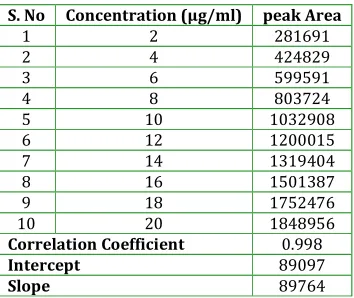
Appropriate aliquots of Donepezil standard stock solution of 1000µg/ml was transferred to series of 10 ml volumetric flasks and the volume was made up to the mark with mobile phase to get final concentrations of 2 to 20 µg/ml.(Table 1)
Accuracy studies
Accuracy of the proposed method was determined by recovery studies using standard addition method. The percentage recovery studies of Donepezil was carried out in triplicate 3 different levels 50%,100%,150% by spiking standard drug solution to the placebo.(Table 2)
Precision Studies
The method precision of the method are ascertained by injecting 6 replicates of test sample % recovery, % RSD was calculated. (Table 3)
Table 1: Linearity table
S. No Concentration (µg/ml) peak Area
1 2 281691
2 4 424829
3 6 599591
4 8 803724
5 10 1032908
6 12 1200015
7 14 1319404
8 16 1501387
9 18 1752476
10 20 1848956
Correlation Coefficient 0.998
Intercept 89097
Slope 89764
Table 2: Accuracy studies of the prepared formulation
%
level
Amount of API Spiked in
(µg/ml)
Peak
Area
Amount Found in
(µg/ml)
%
Recovery
Mean %
Recovery Std. Dev % RSD
50
6 `609893 6.023 100.38
100.44 0.118 0.117
6 610720 6.032 100.58
6 609823 6.022 100.37
100
8 785207 7.962 99.529
100.4 0.735 0.732
8 794624 8.0624 100.781
8 784906 7.959 99.487
150
10 1056267 10.226 102.26
102.83 0.501 0.487
10 1064472 10.305 103.05
Table 3: Method Precision Table
Name of the sample Sample area %Assay on the label claim
Precision-1 1012908 104.08
Precision-2 1016909 105.24
Precision-3 1020901 105.66
Precision-4 1012914 104.80
Precision-5 1016913 105.24
Precision-6 1014812 105.01
Mean 105.005
Std. Dev 0.536
%RSD 0.510
Compatibility Studies
Standard preparation
An accurately weighed 100mg of Donepezil was transferred to 100ml volumetric flask. To it 30ml of methanol was added and shaken for 10min then the volume was made up to 100ml with methanol. 1ml of above solution was transferred to 100ml volumetric flask and the volume was made up to the mark using mobile phase.
Sample preparation
An accurately weighed sample powder equalent to 100mg of Donepezil was transferred to 100ml volumetric flask, to this 40ml of methanol was added and sonicated for a period of 15min and then volume was made up to mark with methanol. 1ml of above solution was transferred to 100ml volumetric flask and the volume was made up to the mark using mobile phase.
Compatibility Studies
Percentage of unknown impurity=
System suitability testing
System suitability testing is an integral part of method development. It is conducting by injecting standard, sample preparations separately in 6 replicates and % RSD of peak area, tailing factor and theoretical plates were calculated using EZChrom-Elite software they should be within the USP limits in the present investigation the % RSD of peak area was 0.8, tailing factor was 1.6 and theoretical plates was found to be 4194 and all are within the USP limits.
Conditions for storage study
One of the approaches to investigate the drug excipients interactions is by conducting studies under elevated temperature that is 55°C. For this purpose pure drug, binary mixtures were stored at 55°C for a period of 20days of and samples were analyzed by HPLC & FTIR.
Preparation of samples for FTIR
Potassium Bromide pellet method was used in the study. Test samples were prepared by physical mixing of Donepezil and excipients in different ratios. Initially, potassium bromide was powdered and dried in oven for 45min. 100mg of potassium bromide power was mixed with 2mg of each sample, thoroughly triturated in mortar and pestle. A portion of mixture was compressed using IR pelletizing press. Then the KBr pellet was placed in sample holder of Bruker FT-IR spectrophotometer. The spectra were recorded in the wave number region of 4000-500cm-1.
In each case the spectra was compared with the pure Donepezil spectrum to detect the interactions between drug and excipients.
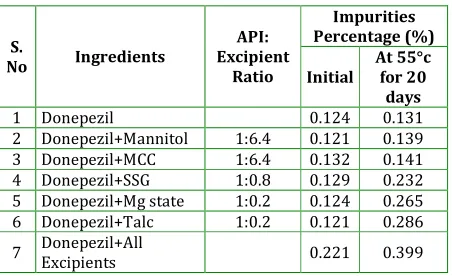
Table 1: Results of Donepezil-Excipient Compatibility Studies
S.
No Ingredients
API: Excipient
Ratio
Impurities Percentage (%)
Initial
At 55°c for 20
days
1 Donepezil 0.124 0.131
2 Donepezil+Mannitol 1:6.4 0.121 0.139
3 Donepezil+MCC 1:6.4 0.132 0.141
4 Donepezil+SSG 1:0.8 0.129 0.232
5 Donepezil+Mg state 1:0.2 0.124 0.265
6 Donepezil+Talc 1:0.2 0.121 0.286
7 Donepezil+All
Fig.1 Chromatogram of pure Donepezil
Fig. 2 Chromatogram of donepezil +all excipients (both were mixed and injected immediately)
Fig. 3: Chromatograms of pure Donepezil at 55ºc (20days)
Fig. 4 chromatograms of Donepezil+All excipients at 55ºc (20days)
Fig.5.FTIR Spectrum of Donepezil (API)
Fig.6: FTIR Spectrum of Donepezil Formulation at 55ºc (20days)
RESULTS AND DISCUSSION
Chromatograms of binary mixtures of Donepezil with Mannitol, MCC, SSG, Mg state, Talc show the similar peak as the standard drug. The chromatograms (fig 1 & 2) revealed that there is no possible immediate interaction between Donepezil and the used excipients. The chromatograms (3 & 4) revealed that there is no interaction between Donepezil and used excipients when stored at 55ºc for a period of 20 days the drug was eluted at 5.8 and no unknown impurity were found to be more than 0.1% and the total impurities were found to be not more than 2% i.e., impurities are within the limit as per ICH guidelines. The selected FT-IR spectrums of Donepezil and samples of dispersions of physical powder mixtures are shown in Figure (5, 6). Following bands were observed in the spectrum of C=O (1697), C-N (1262), C-O (1081), C-H bending aromatic (855), C=C Aromatic (1589), C-H stretching in CH3 (2923). When
IR spectrum of pure Donepezil was compared to the spectrum of Donepezil in powder mixtures, no difference was observed between the spectra. Furthermore, neither missing in the bands nor appearance of new bands in the IR spectra of powder mixtures were noted at day 20 stored at 55°C. Pure drug Donepezil or Donepezil in binary mixtures was stable for 20 days at 55°C since there is no change in peak area or change in Rt or no extra peaks reported due to the degradation products of drug and excipients.It can be deduced that the drug was stable in pure form or in the presence of excipients tested under these storage conditions. Therefore these excipients were found to be compatible with Donepezil.
CONCLUSION
The concept of excipients from an inert cheap vehicle has changed to an essential constituent of the formulation. Optimizing the selection of excipients in the formulation can reduce drug-excipients incompatibility during production and storage period of dosage form. In this study, excipients, which were commonly used in solid drug formulations, were
evaluated for interaction possibility with Donepezil. The results of HPLC& FTIR studies showed that there were no interactions between drug and selected excipients stored at elevated temperature 55°c for a period of 20 days. This method was suitable for the estimation of Donepezil in the given orodispersible formulation and also for the evaluation of related substances in drug product.
ACKNOWLEDGMENTS
The author grateful to Principal, Bapatla college of Pharmacy Bapatla for encouragement and providing the necessary facilities during the course of investigation, authors are also gratified to Hetero Drugs for providing the gift sample.
REFERENCES
1. Wilson and Gisvold's. Textbook of Organic Medicinal
and Pharmaceutical Chemistry. 10th edition. Walnut
street (Philadelphia): Lippincott Williams &
wilkins;1998.
2. Nishath Fathima, Tirunagari Mamatha, Husna
Kanwal Qureshi, Nandagopal Anitha and Jangala
Venkateswara Rao. Drug-excipients interaction and
its importance in dosage form development. Journal
of Applied Pharmaceutical Science 2011;01:66to71.
3. Murthy T.E.G.K., Bala Vishnu priya M, Suresh Babu
V.V: Compatibility studies of Acetazolamide with
excipients by using High performance liquid
chromatography. Indian drugs2012;49(05): p.no 39
to 45.
4. Sibel Bozag pehlivian, Birsellsubasi, Imran vural,
Nursen unlu, Yilmaz capan: Evaluation of
Drug-Excipient Interaction in the Formulation of Celecoxib
Tablets. Acta Poloniae Pharmaceutica 2011; 68: pp.
423to433.
5. Patrickcrowley, Dr.Luigimartini.Drug excipient
interactions.Advanstar Publications 2001.
6. International conference on Harmonization (ICH),
Draft guidelines on validation of analytical
procedure definition & terminology Federal
registar.1995; 60; 11260.
7. Gurudeep R Chatwal, Sham K Anand Instrumental
Methods of Analysis. 5thedition. Hyderabad:
8. Indian Pharmacopeia, Volume 2. Ghaziabad: Indian
Pharmacopeia commission, P.no 1248 to1249
9. Kenneth E. Avis, Herbert A. Lieberman, Leon
Lachman. Pharmaceutical Dosage forms.
Parenteral medications volume. 2nd Edition.
Hyderabad:CBS Publishers&Distributors: 1986
p.no.144 to 150.
How to cite this article: Prathyusha C H* Murthy. T. E. G. K.;
Compatibility studies of Donepezil with different excipients
by using HPLC and FTIR; J. Adv. Pharm. Edu. & Res. 2013:
3(3): 273-278.