Copyright © 2017 IJECCE, All right reserved
1 5 . 0 , 1 2 cos 1
2 sin 1
5 . 0 0 , 2
cos 2 sin
1
n n
n n
n n
n n n
x x
x x
x x
x x x
Concave Chaotic-Based Image Encryption
Fadi Abu-Amara
11Computer & Information Science Department, Higher Colleges of Technology, Abu Dhabi, UAE.
Aladdein M. S. Amro
2*2Computer Engineering Department, Taibah University, Medina, KSA.
Date of publication (dd/mm/yyyy): 11/01/2017
Abstract — The literature reported different chaotic-based image encryption algorithms. Three factors are used to evaluate performance of any encryption algorithm; computational complexity, security, and encryption speed. This paper proposes a novel chaotic map, referred to as Concave Chaotic Map (CCM), and investigates its characteristics. An image encryption algorithm is developed based on the CCM and used to encrypt grey-scale and plain-text images. Results indicate that the CCM achieves S-unimodality and provides chaotic behavior. Results also indicate that the proposed image encryption method provides acceptable encryption performance and high security.
Keywords — Image Encryption, Chaotic Map, S-unimodality, Chaotic Behavior
I.
I
NTRODUCTIONThe massive use of multimedia technology increased the demand for protecting users’ privacy and for secure data transmission. Encryption methods can be used to inhibit malicious attacks from unauthorized users. The strong relationship between chaos theory and cryptography proposed using chaotic-based image encryption schemes [1]. The literature reported using different chaotic maps such as the Logistic Map, Tent Map, Quadratic Map, Bernoulli Map, Nonlinear Chaotic Map, B-Exponential Map, and Skew Tent Map, to name a few [2-4]. On the other hand, different chaotic-based image encryption methods were reported in the literature [5-12]. Each algorithm has its own pros and cons in terms of computational complexity, security, and encryption speed. This paper proposes a novel one-dimensional chaotic map, referred to as Concave Chaotic Map (CCM), and investigates its characteristics. An image encryption algorithm is developed based on the CCM and used to encrypt grey-scale and plain-text images. Computational complexity, encryption performance, and statistical properties of the proposed algorithm are analyzed.
The rest of this paper is organized as follows. The Concave Chaotic Map is illustrated in Section 2 while Section 3 investigates characteristics of CCM. Section 4 explores the proposed image encryption algorithm while Section 5 shows experimental results and discussion. Finally, conclusion and future work is given in Section 6.
II.
CONCAVE CHAOTIC MAPEquation (1) shows the proposed Concave Chaotic Map.
(1)
where
x
n1
[
0
,
1
]
, the control parameter and the initial conditionx
0 form part of the secret key.III.
CCM
C
HARACTERISTICSA
NALYSISThis section is intended to analyze characteristics of the Concave Chaotic Map such as S-unimodality and chaotic behavior.
The iteration function of Concave Chaotic Map is shown in Fig. 1. As Fig. 1 shows, the iteration function has a single maximum value, starts from zero, keep increasing until it reaches its maximum value and then decrease back to zero. The iteration function shown in Fig. 1 indicates that the CCM meets the unimodality property at the selected value of. On the other hand, the Bifurcation Diagram is used to find range of control parameter
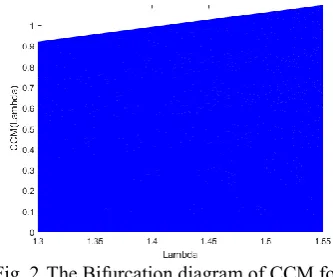
within which the CCM meets the unimodality property [13]. Fig. 2 shows the Bifurcation Diagram of Concave Chaotic Map for
[1.3,1.55]. As Fig. 2 shows, theCCM meets the unimodality property for
] 4424 . 1 , 3859 . 1 [
.Fig. 1.The iteration function of CCM for 1.42
Fig. 2.The Bifurcation diagram of CCM for ]
55 . 1 , 3 . 1 [
0 0.2 0.4 0.6 0.8 1
0 0.1 0.2 0.3 0.4 0.5 0.6 0.7 0.8 0.9 1
x
C
C
M
(x
2 ' '' '
'' ' ) (
) (
) ( 5 . 1 ) (
) (
x f
x f x
f x f Sf x
0 10 20 30 40 50
0 0.2 0.4 0.6 0.8 1
0.26 0.26001
1 0
'
0 lim 1 ln ,
N
n n
N
LE x N f x
The Schwarzian Derivative is used to investigate chaotic behavior of the CCM as shown in equation (2), [14]. Experimental results indicate, as shown in Fig. 3, a negative obtained Schwarzian Derivative for
1.42and0.26
0
x which indicates a robust chaos. In summary, the
achieved unimodality property and robust chaos indicates that the CCM meets the S-unimodality property at the selected value of secret key parameters.
(2)
Fig. 3.The Schwarzian derivative of CCM for 1.42
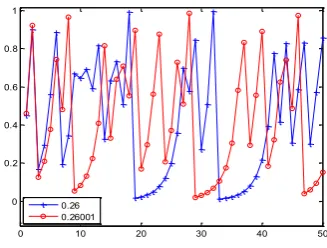
Sensitivity to a small change in the initial condition is another property to analyze. Fig. 4 shows two sequences generated using equation (1) for a small change in the initial condition. As the figure indicates, the two sequences become different after a few iterations which indicates the high sensitivity of the Concave Chaotic Map to a small change in the initial condition.
Fig. 4.Two sequences obtained for
x0,)(0.26,1.42
, marked with squares, and for
x0,)(0.26001,1.42
, markedwith circles.
The chaotic behavior of CCM can be analyzed through the Lyapunov Exponent per equation (3), [14]. Equation (4) shows the derivative of equation (1). Fig. 5 shows the graphed Lyapunov exponent of Concave Chaotic Map for
]. 6 . 1 , 1 [
A chaotic behavior is obtained when the Lyapunov Exponent is within the range of [0,0.69].From Fig. 5, CCM provides chaotic behavior for [1,1.466].
(3)
Fig. 5.The Lyapunov Exponent of the CCM for ].
6 . 1 , 1 [
The previous results of Lyapunov Exponent and Bifurcation Diagram indicate that the Concave Chaotic Map meets the S-unimodality and provides chaotic behavior for[1.3859,1.4424]which indicates a wide range chaotic behavior. For example, the Tent and Logistic Maps achieve S-unimodality with chaotic behavior for [1.999,2)and [3.96,4], respectively.
IV.
CCM-B
ASED IMAGE ENCRYPTIONThe CCM-based image encryption algorithm is summarized in the following steps. Without loss of generality, dimension of the original image I is assumed as
N
M .
1. The original image is scaled into size of 256x256 pixels.
2. The original image is divided into blocks where each block of size mxnpixels. The parameter m is found per equation (5).
2
k MN
m (5)
where k forms a part of the secret key.
3. For each extracted block, do the following:
a. The extracted block is converted into row vector. b. Equation (1) is used to generate pseudorandom
numbers in the range [1,mxn]. The generated random numbers are used as pixel location indices to shuffle pixel locations of the row vector.
c. Equation (6) is proposed to modify pixel intensity value of the obtained row vector from the previous step.
K
b
K
K
sin
(6) where K is the generated key using equation (1) and b is the obtained row vector from the previous step.d. The resultant row vector is converted into matrix of size mxm pixels and stored back in the image. 0 10 20 30 40 50 60 70 80
-12 -10 -8 -6 -4 -2
f(x)
S
[f(
x)
]
1 1.1 1.2 1.3 1.4 1.5 0.45
0.5 0.55 0.6 0.65 0.7
Lambda
L
ya
p
u
no
v
E
xp
on
e
Copyright © 2017 IJECCE, All right reserved 4. Equation (6) is used to modify pixel intensity value
of the whole resultant image. This step is intended to improve security of the proposed algorithm.
V.
E
XPERIMENTALR
ESULTSFig. 6-A shows the original Cameraman image of size 256
256x pixels while Fig. 6-B shows its histogram. As Fig. 6-B indicates, the Cameraman image has a non-uniform histogram where majority of image pixel intensity values are concentrated around the middle. The parameter
k of equation (5) is set to four resulting in block size of 16
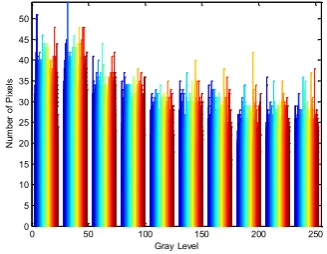
16x pixels. Fig. 7-A shows the obtained encrypted image after applying the CCM-based image encryption algorithm. As Fig. 7-A indicates, the embedded information in the original image are completely obscured. Histogram of the encrypted image, as shown in Fig. 7-B, indicates a semi-uniform distribution of encrypted image pixels which shows robustness of the proposed algorithm against histogram attack methods.
Fig. 6.(A) Original Cameraman image.
Fig. 6. (B) Histogram of Cameraman image of figure 6-A.
Security of the CCM-based image encryption algorithm against brute force attack methods is analyzed. The brute-force attack methods decrypt an encrypted image through extensive search of the set of all possible values of secret key parameters. Experimental results indicate that the parameters xo,
,kmust be adjusted to an accuracy of one part in 1018,1017,1016 to completely recover original image from the encrypted image. This indicates that the CCM-based image encryption algorithm has a complexity of orderO
2169 . As reported in the literature, any encryptionalgorithm should have a complexity larger than O
2128 to be sufficiently secure against brute force attacks [15].Fig. 7.(A) Encrypted image using CCM-based algorithm.
Fig. 7. (B) Histogram of encrypted image of figure 7-A.
An efficient image encryption scheme should ensure high encryption performance in case of images with high correlation between adjacent pixels. Equation (7) is used to measure the horizontal, vertical, and diagonal correlation between two adjacent pixels in a digital image.
(7)
where
xi,yi
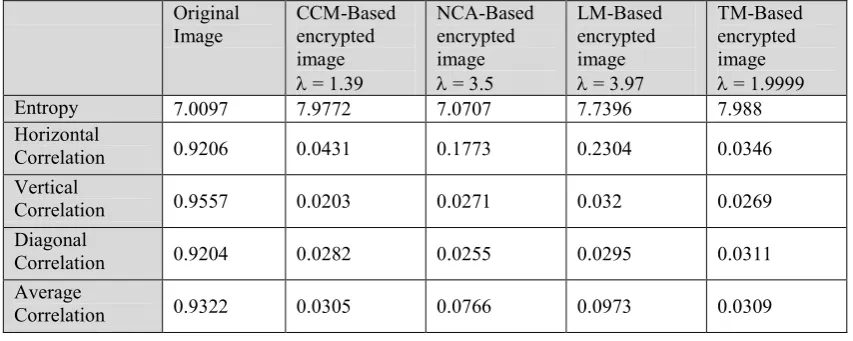
indicates pixel intensity value of tworandomly selected neighboring pixels. One thousand neighboring pixels are randomly selected to calculate their vertical, horizontal, and diagonal correlation. Encryption performance of the proposed Concave-Chaotic Map is compared against performance of well-known maps such as Logistic Map (LM), Tent Map (TM), and Nonlinear Chaotic Map (NCA), Equations 8-10, as shown in Table 1. As Table 1 shows, the vertical, horizontal, and diagonal correlation of adjacent pixels of the original image are high while poor correlation is obtained in case of encrypted images. The Best average correlation result is obtained in case of proposed Concave-Chaotic Map-based image encryption. The amount of randomness in an image can be estimated using entropy. Table 1 indicates low value of entropy of original image in comparison with entropy value of encrypted images which is close to the ideal value of eight. Best result is obtained in case of Tent Map-based image encryption. However, entropy of the
Original Image
0 50 100 150 200 250
0 20 40 60 80 100 120 140 160
Histogram of the Original Image
Gray Level
N
um
b
er
o
f
P
ix
e
ls
Encrypted Image
0 50 100 150 200 250
0 5 10 15 20 25 30 35 40 45 50
Histogram of the Encrypted Image
Gray Level
N
um
be
r
of
P
ix
el
s
2
1
2 2
1 2 2
1
2 2
1 2
2
1
2
1 2
1
2 2
) ( 2
i i i i
i i i i
i i i i ii i
y y x
x
CCM-based image encryption is close to the best result which indicates robustness of proposed image encryption algorithm against entropy attack methods. In summary, the obtained semi-uniform histogram, statistical correlation, and entropy results indicate the superior permutation and substitution properties of the proposed encryption algorithm.
)
1
(
1 n n
n
x
x
x
(8)
1 1 tan (1 )
1 cot 1 4
1 n n
n x x
x
(9)
1 0.5
5 . 0 ,
1
n n
n n
n x x
x x
x
(10)
Performance of the proposed encryption algorithm in encrypting plain-text images is analyzed. Fig. 8-A shows a plain-text image while Fig. 8-B shows its histogram. As Fig. 8-B indicates, majority of image pixels are concentrated in the upper half of pixel distribution. Fig. 9-A shows the encrypted image using the CCM-based encryption algorithm where all embedded information are completely obscured. Fig. 9-B shows histogram of encrypted image which shows a semi-uniform distribution indicating robustness of the proposed encryption algorithm in encrypting plain-text images.
Fig. 8.(A) Original plain-text image.
Fig. 8. (B) Histogram of original plain-text image of figure 8-A.
VI.
C
ONCLUSIONA one-dimensional Concave Chaotic Map is proposed. The proposed CCM provides wide range chaotic behavior, meets the S-unimodality property, and has high sensitivity
to small changes in initial condition. An image encryption algorithm is proposed based on the Concave Chaotic Map that performs two operations; the first operation shuffles location of image pixels while the second operation changes intensity value of image pixels.
Fig. 9.(A) Encrypted plain-text image using CCM-based algorithm.
Fig. 9. (B) Histogram of encrypted plain-text image of figure 9-A.
Experimental results on gray-scale and plain-text images indicate the superior substitution and permutation properties and immunity against histogram attack and entropy attack methods. The achieved complexity indicates sufficient immunity against brute force attack methods. Future work should reduce computational complexity preserving performance and security.
VII.
A
CKNOWLEDGMENTThe authors would like to thank the anonymous referees for their valuable feedback in improving this paper.
R
EFERENCES[1] W. Wu and N.F. Rulkov, “Studying chaos via 1-D maps—a tutorial,” IEEE Trans. on Circuits and Systems I: Fundamental Theory and Applications, vol. 40, no. 10, 1993, pp. 707–721. [2] F. Dachselt and W. Schwarz, “Chaos and cryptography,” IEEE
Trans on Circuits And Systems—I: Fundamental Theory and Applications, vol. 48, 2001, pp. 1498-1501.
[3] M. Shastry, N. Nagaraj, and P. Vaidya, “The B-Exponential map: a generalization of the logistic map, and its applications in generating pseudo-random numbers,” Computing Research Repository, vol. 7, arXiv preprint cs/0607069, 2006.
[4] H. Gao, Y. Zhang, S. Liang, and D. Li, “A new chaotic algorithm for image encryption,” Chaos, Solitons and Fractals, vol. 29, 2006, pp. 393–399.
Original Image
0 50 100 150 200 250
0 50 100 150 200 250
Histogram of the Original Image
Gray Level
N
um
b
er
o
f
P
ix
e
ls
Encrypted Image
0 50 100 150 200 250
0 5 10 15 20 25 30 35 40 45 50
Histogram of the Encrypted Image
Gray Level
N
um
b
er
o
f
P
ix
e
Copyright © 2017 IJECCE, All right reserved [5] G.A. Sathishkumar, K.B. Bagan, and N. Sriraam, “Image
encryption based on diffusion and multiple chaotic maps,” International Journal of Network Security & Its Applications, vol. 3, no. 2, 2011 pp. 181-194.
[6] R. Ye and W. Guo, “A chaos-based image encryption scheme using multimodal skew Tent maps,” Journal of Emerging Trends in Computing and Information Sciences, vol. 4, no.10, 2013, pp. 800-810.
[7] G. Hanchinamani and L. Kulakarni, “Image encryption based on 2-D Zaslavskii chaotic map and pseudo hadmard transform,” International Journal of Hybrid Information Technology, vol. 7, no. 4, 2014, pp.185-200.
[8] C. Fu, W. Li, Z. Meng, T. Wang, and P. Li, “A symmetric image encryption scheme using chaotic baker map and lorenz system,” Ninth International Conference on Computational Intelligence and Security, Dec. 2013, pp. 724-728.
[9] D. Point, A. Pande, P. Mohapatra, J. Zambreno, “Using Chaotic Maps for Encrypting Image and Video Content,” IEEE International Symposium on Multimedia, 2013, pp: 171-178. [10] P.R. Sankpal, P.A. Vijaya, “Image Encryption Using Chaotic
Maps: A Survey,” Fifth International Conference on Signal and Image Processing (ICSIP), 2014, pp: 102-107.
[11] B. Hossain, T. Rahman, S. Rahman, S. Islam, “A new approach of image encryption using 3D chaotic map to enhance security of multimedia component,” International Conference on Informatics, Electronics & Vision (ICIEV), 2014, pp: 1-6. [12] C.L. Kuo, L.C. Huang, S.J. Wang, J.S. Lin, C.C. Wang, J.J. Yan,
“Image Encryption Based on Fuzzy Synchronization of Chaos Systems,” IEEE 37th Annual Computer Software and Applications Conference (COMPSAC), 2013, pp: 153-154. [13] P. Glendinning, “Stability, instability and chaos,” Cambridge
University Press, 1994.
[14] J.M. Aguirregabiria, “Robust chaos with variable lyapunov exponent in smooth one-dimensional maps,” Chaos, Solitons and Fractals, vol. 42, no. 4, 2009, pp. 2531-2539.
[15] C. Paar, J. Pelzl, and B. Preneel, “understanding cryptography: a textbook for students and practitioners,” Springer, 2010, ISBN 3-642-04100-0.
A
UTHORS’
P
ROFILEFadi Abu-Amara received his bachelor degree in Computer Engineering from Faculty of Engineering Technology, Al-Balqa’ Applied University, Jordan in 2001, received his master degree in Computer Engineering from Western Michigan University, USA in 2007 and received his Doctoral degree in Electrical and Computer Engineering from Western Michigan University, USA in 2010. Fadi worked as a lecturer in Computer Engineering department at Intermediate University College Jordan in the period of 2001 to 2004. Then, he worked as assistant professor in Computer Engineering Department at Al-Hussein Bin Talal University, Jordan in the period of 2010 to 2013. He also worked as head of IT department at Al-Khawarizmi International College, UAE from 2013 to 2016. Currently, Fadi joined the CIS department in Higher Colleges of Technology, UAE. Current and future research interests include cryptography, biomedical engineering, and robotic systems.
Aladdein M. Amro received M.S.in Automation Engineering from Moscow Technical University in 1996, and Ph.D. in Telecommunications Engineering from Kazan State University (Russian Federation) in 2003. Had been an Assistant Professor atthe Computer Engineering Dept. Al-Hussein Bin Talal University (Jordan) during the years 2004-2011. Since then has been working as an Assistant Professor at the Computer Engineering Dept., Taibah University (Kingdom of Saudi Arabia). Research interest is in the areas of digital Signal processing, image processing, real time systems.
1 5 . 0 , 1 2 cos 1
2 sin 1
2 cos 2 1
2 sin 2 1
5 . 0 0
, 2 cos 2
sin 2
sin 2 2 cos 2 )
, (
'
n n
n n
n n n
n n
n n
n n
n
x x
x x
x x
x x
x x
x x
x f
(4)
Table 1: Correlation results of one thousand neighboring pixels randomly selected from original and encrypted images
Original
Image CCM-Based encrypted image = 1.39
NCA-Based encrypted image = 3.5
LM-Based encrypted image = 3.97
TM-Based encrypted image = 1.9999
Entropy 7.0097 7.9772 7.0707 7.7396 7.988
Horizontal
Correlation 0.9206 0.0431 0.1773 0.2304 0.0346
Vertical
Correlation 0.9557 0.0203 0.0271 0.032 0.0269
Diagonal
Correlation 0.9204 0.0282 0.0255 0.0295 0.0311
Average