The Journal of Threatened Taxa (JoTT) is dedicated to building evidence for conservation globally by publishing peer-reviewed articles online every month at a reasonably rapid rate at www.threatenedtaxa.org. All articles published in JoTT are registered under Creative Commons Attribution 4.0 International License unless otherwise mentioned. JoTT allows allows unrestricted use, reproduction, and distribution of articles in any medium by providing adequate credit to the author(s) and the source of publication.
www.threatenedtaxa.org
ISSN 0974-7907 (Online) | ISSN 0974-7893 (Print)
Building evidence for conservation globally
Journal of Threatened Taxa
For Focus, Scope, Aims, Policies, and Guidelines visit https://threatenedtaxa.org/index.php/JoTT/about/editorialPolicies#custom-0
For Article Submission Guidelines, visit https://threatenedtaxa.org/index.php/JoTT/about/submissions#onlineSubmissions
For Policies against Scientific Misconduct, visit https://threatenedtaxa.org/index.php/JoTT/about/editorialPolicies#custom-2
For reprints, contact <[email protected]>
Note
First record of the Blue-and-white Flycatcher
Cyanoptila cyanomelana (Temminck, 1829)
(Aves: Passeriformes: Muscicapidae) from Bhutan
Kado Rinchen, Kinley Kinley, Chhimi Dorji & Dorji Wangmo
26 July 2019 | Vol. 11 | No. 9 | Pages: 14232–14234
DOI: 10.11609/jott.4608.11.9.14232-14234
Partner
Member
Threatened Taxa
Publisher & Host
PLATINUM OPEN ACCESS
14232
of bamboo were also observed in and around the bird
observation area.
After referring to several online websites such
as Birdlife International, ebird and circulation of the
photographs amongst many birdwatchers through
the social media facebook forum Birds of Bhutan, the
bird was initially identified as a male Blue-and-white
Flycatcher by Tim Inskipp and was later confirmed by
Dr. Sherub, ornithologist at Ugyen Wangchuck Institute
for Conservation and Educational Research Institute in
Bhutan. It is the first record for the Himalayan kingdom
of Bhutan. The new record adds the 729
thbird species
for Bhutan (Dr. Sherub pers. comm. April 2018). With this
observation, the Blue-and-White Flycatcher is known
to occur in three countries of the Indian subcontinent.
Clement & Taylor (2006) described the Blue-and-White
No
te
DOI: https://doi.org/10.11609/jott.4608.11.9.14232-14234 | ZooBank: urn:lsid:zoobank.org:pub:2ADDBC8A-9954-4BDD-A902-B06168F7C2E0
Editor: Carol Inskipp, Bishop Auckland Co., Durham, UK. Date of publication: 26 July 2019 (online & print)
Manuscript details: #4608 | Received 03 October 2018 | Final received 09 April 2019 | Finally accepted 28 June 2019
Citation: Rinchen, K., K. Kinley, C. Dorji & D. Wangmo (2019). First record of the Blue-and-white Flycatcher Cyanoptila cyanomelana (Temminck, 1829) (Aves: Pas-seriformes: Muscicapidae) from Bhutan. Journal of Threatened Taxa 11(9): 14232–14234. https://doi.org/10.11609/jott.4608.11.9.14232-14234
Copyright: © Rinchen et al 2019. Creative Commons Attribution 4.0 International License. JoTT allows unrestricted use, reproduction, and distribution of this article in any medium by adequate credit to the author(s) and the source of publication.
Funding: Royal Government of Bhutan, Department of Forest and Park Services.
Competing interests: The authors declare no competing interests.
Acknowledgements: We are thankful to Mr. Phento Tshering, director of Department of Forest and Park Services, Mr. Sacha Dorji, director of Ugyen Wangchuck Institute for Conservation and Educational Research, Bhutan, Mr. Pankay Drukpa, chief forestry officer of Jigme Singye Wangchuck National Park, and Mrs. Dimple Thapa, chief forestry officer of Tsirang Forest Division, Bhutan for supporting us in writing this article.
First record of the Blue-and-white Flycatcher
Cyanoptila cyanomelana (Temminck, 1829)
(Aves: Passeriformes: Muscicapidae) from
Bhutan
Kado Rinchen
1, Kinley Kinley
2, Chhimi Dorji
3&
Dorji Wangmo
41 Jigme Singye Wangchuck National Park, Department of Forest and Park Services, Bhutan. 2,3 Tsirang Forest Division, Department of Forest and Park Services, Bhutan. 2 Landscape Ecology and Nature Conservation, University of
Greifswald, Greifswald 17489, Germany.
4 Damphu Lower secondary School, Ministry of Education, Bhutan.
1 [email protected] (corresponding author), 2 [email protected], 3 [email protected],
Journal of Threatened Taxa | www.threatenedtaxa.org | 26 July 2019 | 11(9): 14232–14234
The Blue-and-white Flycatcher
Cyanoptila
cyanomelana
is
known to be a summer visitor
to northeastern Asia, moving
towards the south during winter
to Taiwan, southeastern China,
and southeastern Asia, through
the Greater Sunda Islands to the
Philippines (Clement & Taylor
2006). It is a recent addition to
the South Asian avifaunal database. It is not listed in
Ali & Ripley (1987), Rasmussen & Anderton (2005), or
Grimmett et al.
(2011).
According to Choudhury (2006) the bird has been
observed on rare occasions in northeast India and was
sighted once 16 years ago on 24 November 2002 in
Upper Siang District, Arunachal Pradesh in India.
In the past, this species has been reported from
several isolated localities in the Indian subcontinent;
nine locations in India as reported by Choudhury (2006),
Kawale (2013), Rajeshkumar et al.
(2014), Barve &
Kamath (2016), Bhoopathy & Indrajith (2016), Praveen et
al. (2016), and one record in Sri Lanka (Vidanapathirana
et al.
2014).
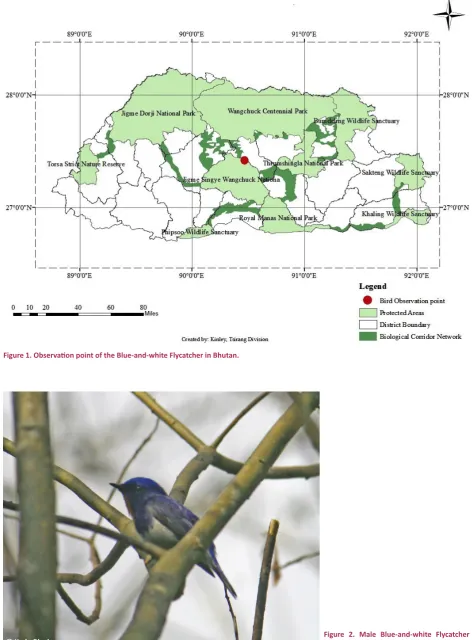
During patrolling duty in Jigme Singye Wangchuck
National Park on 14 April 2018, a male
Blue-and-white Flycatcher was observed and photographed at
an elevation of 1,610m on abandoned land at Dimba
Village (27.419
0N & 90.469
0E) under Tangsibji Block in
Trongsa District. It was observed perching on a tree
in a broadleaved forest with vegetation dominated by
Quercus grifithii
, along with other broadleaved species
like
Lyonia
spp.,
Rhus
spp., Dog wood,
Bahunia
spp.,
Erythina
spp., and
Alnus
spp.. Several small clumps
ISSN 0974-7907 (Online) ISSN 0974-7893 (Print)
Black-and-white Flycatcher: first record in Bhutan Rinchen et al.
Journal of Threatened Taxa | www.threatenedtaxa.org | 26 July 2019 | 11(9): 14232–14234 14233
Figure 1. Observation point of the Blue-and-white Flycatcher in Bhutan.
Figure 2. Male Blue-and-white Flycatcher
perched on a tree observed in Bhutan.
Journal of Threatened Taxa | www.threatenedtaxa.org | 26 July 2019 | 11(9): 14232–14234
Black-and-white Flycatcher: first record in Bhutan Rinchen et al.
14234
Flycatcher
as a passage migrant through southern and
southeastern China between early or mid-December to
mid-February and returning to its breeding sites through
Guangdong from mid to late March. This Bhutan record
proves that the Blue-and-white Flycatcher can migrate
as late as mid-April. Possibly, while on their return
migration, a few birds might sojourn in various places
in Bhutan or elsewhere in the subcontinent’s mainland
before reaching their breeding grounds. There could
be other undetected incidences of migrant species’
occurrence in the country and it would be useful if more
observations were carried out during bird migration
seasons to discover such instances. The development
of a long-term bird monitoring protocol for Bhutan to
ensure the survival of all residents and migratory birds
is recommended.
References
Ali, S. & S.D. Ripley (1987). Compact Handbook of the Birds of India and Pakistan together with those of Bangladesh, Nepal, Bhutan and Sri Lanka. 2nd Edition. Oxford University Press, Delhi, i–xiii+1–737pp.
Barve, M. & R. Kamath (2016). More records of Blue-and-white Flycatcher Cyanoptila cyanomelana from the Western Ghats, India.
Indian Birds 11(1): 24.
Bhoopathy, A. & A. Indrajith (2016). Blue-and-white Flycatcher
Cyanoptila cyanomelana from Kotagiri, an addition to Tamil Nadu
avifauna. Indian Birds 11(1): 25.
Choudhury, A. (2006). A Pocket Guide to the Birds of Arunachal Pradesh. 1st Edition. Gibbon Books & The Rhino Foundation for Nature in NE India, Guwahati, 109pp.
Clement, P. & P.B. Taylor (2006). Family Muscicapidae (Old World flycatchers): Species accounts of Muscicapidae, pp102–163. In: del Hoyo, J., A. Elliott & D. Christie (eds.). Handbook of the Birds of the World. Volume 11. Old World Flycatchers to Old World Warblers. Lynx Edicions, Barcelona.
Grimmett, R., C. Inskipp & T. Inskipp (2011). Birds of the Indian Subcontinent. 2nd Edition. Oxford University Press & Christopher Helm, London, 528pp.
Kawale, P. (2013). First record of the Blue-and-white Flycatcher
Cyanoptila cyanomelana in India. Journal of the Bombay Natural
History Society 110(1): 75–76.
Rajeshkumar, S., C. Raghunathan & G. Maheswaran (2014). Blue-and-white Flycatcher Cyanoptila cyanomelana: First record for Andaman & Nicobar Islands, India. Indian Birds 9(4): 104–105.
Rasmussen, P.C. & J.C. Anderton (2005). Birds of South Asia: The Ripley Guide: Attributes and Status. 1st Edition, Vol 2. Smithsonian Institution and Lynx Edicions, Washington, D.C. and Barcelona, 683pp.
Vidanapathirana, D.R., K.D. Prachnarathna, M.D.G. Rajeev & S. Bandara (2014). Blue-and-white Flycatcher Cyanoptila cyanomelana: first record for Sri Lanka. Birding Asia 21: 114–115.
ISSN 0974-7907 (Online) | ISSN 0974-7893 (Print)
July 2019 | Vol. 11 | No. 9 | Pages: 14087–14246
Date of Publication: 26 July 2019 (Online & Print)
DOI: 10.11609/jott.2019.11.9.14087-14246
www.threatenedtaxa.org
The Journal of Threatened Taxa (JoTT) is dedicated to building evidence for conservation globally by publishing peer-reviewed articles online every month at a reasonably rapid rate at www.threatenedtaxa.org. All articles published in JoTT are registered under Creative Commons Attribution 4.0 International License
unless otherwise mentioned. JoTT allows allows unrestricted use, reproduction, and distribution of articles in any medium by providing adequate credit to the author(s) and the source of publication.
Article
Species richness and abundance of monogonont rotifers in relation to environmental factors in the UNESCO Sakaerat Biosphere Reserve, Thailand – Nattaporn Plangklang, Chaichat Boonyanusith & Sujeephon Athibai, Pp. 14087–14100
Communications
Distribution and habitats of Paphiopedilum Pfitzer (Orchidaceae) known to occur in Bhutan
– Dhan Bahadur Gurung, Nima Gyeltshen, Kezang Tobgay, Stig Dalström, Jangchu Wangdi, Bhakta Bahadur Ghalley, Lekey Chaida, Phuntsho, Ngawang Gyeltshen, Kelzang Dawa, Tandin Wangchuk, Rebecca Pradhan, Thomas Hoijer & Choki Gyeltshen, Pp. 14101–14111
Diurnal Serianthes nelsonii Merr. leaflet paraheliotropism reduces leaflet temperature, relieves photoinhibition, and alters nyctinastic behavior – Thomas Edward Marler, Pp. 14112–14118
Pollination ecology of Brownlowia tersa (Malvaceae), a Near Threatened non-viviparous true mangrove shrub
– Aluri Jacob Solomon Raju, Pp. 14119–14127
A note on the taxonomy and natural history of the Summer Clicker
Lahugada dohertyi (Distant, 1891) (Insecta: Hemiptera: Cicadidae) along with
its distribution in northern West Bengal, India – Vivek Sarkar, Pp. 14128–14136
Observations on nesting activity, life cycle, and brood ball morphometry of the Bordered Dung Beetle Oniticellus cinctus (Fabricius, 1775) (Coleoptera: Scarabaeidae) under laboratory conditions
– Amar Paul Singh, Kritish De, Shagun Mahajan, Ritwik Mondal & Virendra Prasad Uniyal, Pp. 14137–14143
Spiders of Odisha: a preliminary checklist
– Sudhir Ranjan Choudhury, Manju Siliwal & Sanjay Keshari Das, Pp. 14144– 14157
Status of water birds in Haripura-Baur Reservoir, western Terai-Arc landscape, Uttarakhand, India
– Tanveer Ahmed, Harendra Singh Bargali, Deepa Bisht, Gajendra Singh Mehra & Afifullah Khan, Pp. 14158–14165
Bird diversity in the coastal talukas of Sindhudurg District, Maharashtra, India – Golusu Babu Rao, Santhanakrishnan Babu, Goldin Quadros &
Vijaykumar Anoop, Pp. 14166–14186
Greater One-horned Rhinoceros Rhinoceros unicornis (Mammalia:
Perissodactyla: Rhinocerotidae) population census in the Rajiv Gandhi Orang National Park, Assam, India
– Deba Kumar Dutta & Parikshit Kakati, Pp. 14187–14193
Crowding, group size and population structure of the Blackbuck
Antilope cervicapra (Linnaeus, 1758) (Mammalia: Cetartiodactyla: Bovidae)
in the semi-arid habitat of Haryana, India – Deepak Rai & Jyoti, Pp. 14194–14203
Short Communications
An updated checklist of Indian western Himalayan gymnosperms and lectotypification of three names
– Jibankumar Singh Khuraijam & Jaideep Mazumdar, Pp. 14204–14211
New record of Blue Perch Badis badis (Anabantiformes: Badidae) from Godavari River basin of Telangana State, India
– Kante Krishna Prasad & Chelmala Srinivasulu, Pp. 14212–14215
First record of the Small Bamboo Bat Tylonycteris fulvida (Peters, 1872)
(Mammalia: Chiroptera: Vespertilionidae) from Nepal
– Basant Sharma, Anoj Subedi, Bandana Subedi, Shristee Panthee & Pushpa Raj Acharya, Pp. 14216–14219
Is canine distemper virus (CDV) a lurking threat to large carnivores? A case study from Ranthambhore landscape in Rajasthan, India
– Nadisha Sidhu, Jimmy Borah, Sunny Shah, Nidhi Rajput & Kajal Kumar Jadav, Pp. 14220–14223
Notes
Extended distribution of the vulnerable Cooper’s Stone Flower
Corallodiscus cooperi (Gesneriaceae) in India
– Vikas Kumar, Samiran Panday, Sudhansu Sekhar Dash, Bipin Kumar Sinha & Paramjit Singh, Pp. 14224–14227
Extended distribution record of two bellflower species of Codonopsis
(Campanulaceae) from the Indian state of Arunachal Pradesh – Khilendra Singh Kanwal, Umeshkumar Lalchand Tiwari, Lod Yama & Mahendra Singh Lodhi, Pp. 14228–14231
First record of the Blue-and-white Flycatcher Cyanoptila cyanomelana (Temminck, 1829) (Aves: Passeriformes: Muscicapidae) from Bhutan – Kado Rinchen, Kinley Kinley, Chhimi Dorji & Dorji Wangmo, Pp. 14232– 14234
Butterflies collected using malaise traps as useful bycatches for ecology and conservation
– Augusto Henrique Batista Rosa, Lucas Neves Perillo, Frederico Siqueira Neves, Danilo Bandini Ribeiro & André Victor Lucci Freitas, Pp. 14235–14237
Notes on the hairstreak butterflies Euaspa Moore, 1884 (Lepidoptera: Lycaenidae) with new distribution records to the Indian eastern Himalaya – Gaurab Nandi Das, Subrata Gayen, Motoki Saito & Kailash Chandra, Pp. 14238–14241
First report of the Australian gall midge Actilasioptera tumidifolium Gagné, 1999 (Diptera: Cecidomyiidae) from Andaman Islands, India – Duraikannu Vasanthakumar & Radheshyam Murlidhar Sharma, Pp. 14242– 14243
New record of Blanford’s Fox Vulpes cana (Mammalia: Carnivora: Canidae) in central Oman: a connection between the northern and southern populations – Taimur Alsaid, Abdulrahman Aluwaisi, Sultan Albalushi, Zahran
Alabdulsalam, Said Alharsusi & Steven Ross, Pp. 14244–14246