Thermal Diffusivities and Conductivities of Molten Germanium and Silicon
Tsuyoshi Nishi
1, Hiroyuki Shibata
2and Hiromichi Ohta
31Graduate School, Department of Materials Processing, Tohoku University, Sendai 980-8577, Japan 2Institute of Multidisciplinary Research for Advanced Materials, Tohoku University, Sendai 980-8577, Japan 3
Department of Materials Science, Ibaraki University, Hitachi 316-8511, Japan
Thermal diffusivity values of molten germanium and silicon were measured by a laser flash method. Simple but useful sample cell systems were developed to keep the molten germanium and silicon shape uniform for a given thickness. In the present experimental condition, it is necessary to consider the effect of not only the radiative heat loss but also the conductive heat loss at the interface between the molten sample and the cell material under the present experimental conditions. However, the computer simulation results suggest that the conductive heat loss is found to be negligibly small. The thermal diffusivity values of molten germanium and silicon are given in the following equations (unit: m2/s).
Ge¼1:40108ðT1218Þ þ2:29105 1218T1398 ðunit: KÞ
Si¼4:48109ðT1685Þ þ2:23105 1685T1705 ðunit: KÞ
(Received July 10, 2003; Accepted September 16, 2003)
Keywords: molten germanium, molten silicon, laser flash method, sample cell, thermal diffusivity, thermal conductivity, high temperature
1. Introduction
In order to obtain a high quality single crystal grown from the germanium or silicon melt, it is necessary to minimize a temperature gradient in the melts by accurate temperature control. For this purpose, the sufficiently reliable values of the thermal diffusivities and conductivities of molten germanium and silicon are strongly required. However, some reservations have been suggested on the available thermal diffusivity and conductivity values of molten germanium and silicon,1–6) because of the experimental difficulties arising mainly from onset of convection, heat leakage to the container and mixed contributions of radiative and conduc-tive heat transfer components during the measurement of the thermal diffusivity at high temperatures. On the other hand, the laser flash method7) is widely employed as one of the most versatile techniques for measuring the thermal diffu-sivity of various materials. The novel sample cell for the laser flash method has been recently developed for measuring the thermal diffusivity of high temperature melts8,9) by the present authors to overcome the experimental difficulties at high temperature.
The main purpose of this work is to present new results of the thermal diffusivity and conductivity for molten germa-nium and silicon by the laser flash method with the novel sample cell, newly developed.
2. Experimental
The thermal diffusivity values of molten germanium and silicon were measured by means of the laser flash technique using a vertical type laser flash apparatus. As shown in Fig. 1, the upper surface of a sample with a disk shape was instantaneously irradiated by Nd glass laser (10 J, 1060 nm emission wavelength). The temperature increase at the bottom surface of the sample was measured by using an
InSb infrared detector (1.2-5.5mm effective wavelength). Accordingly, since the upper surface of a sample was heated, the convection in the melt sample did not take place under this experimental condition. In addition, the signal to noise ratio was improved in this work by accumulating ten temperature response curves in molten germanium measure-ments or five temperature response curves in molten silicon measurements. The sample of molten germanium was heated to 1398 K and the sample of molten silicon was heated to 1705 K with a tungsten mesh heater under vacuum of less than2103Pa.
Fig. 1 Schematic diagram of a laser flash apparatus. 2003 The Japan Institute of Metals
[image:1.595.319.532.370.618.2]An appropriate sample cell must be used to maintain the molten germanium and silicon at high temperature. Then, two kinds of sample cell systems were newly used. One consists of an alumina tube (thickness: 1 mm, inner diameter: 9 mm, and outer diameter: 13 mm) sandwiched by two sapphire plates (thickness: 1 mm, and diameter: 13 mm). This sample cell worked well for measuring thermal diffusivity of molten iron, cobalt and nickel.8)The other is a fabricated cell with a silica glass crucible and a lid (See Fig. 2(a)). Sapphire and silica glass are known to be transparent to Nd glass laser and infrared ray.
The sample cell consisted of an alumina tube and two sapphire plates was successively used to measure thermal diffusivity of molten germanium. In the case of molten silicon, the sample cell has been modified as shown in Fig. 2(a) because of the following reasons;
1. Sapphire reacts with the molten silicon.
2. The volume contraction takes place remarkably when silicon melts.
In case with volume expansion on melting, the cell was fixed by a graphite fixture at room temperature. However, silicon is known to show volume contraction on melting. For this reason, the amount of silicon sample was carefully weighted and packed in order to fill the silicate crucible completely at the melting point. Moreover the lid is floating as shown in Fig. 2 (a) and always attached to the sample surface as the graphite fixture loads to the lid due to the gravity force (See Fig. 2 (b)). This devised cell arrangement makes the height of molten silicon sample precise without free volume. It would be our intention to give this point in the present the thermal diffusivity of molten silicon was measured very well.
When considering the radiative heat loss, the thermal diffusivity,, can be evaluated by the following equation:10)
¼K l
2
t1=2
ð1Þ
wherelis the thickness of sample andt1=2is the time required
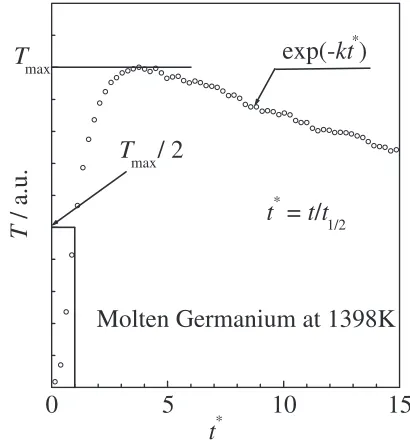
for the back surface of the sample to reach one half of the maximum temperature rise.Kis the coefficient theoretically determined by the ratio of radiative heat loss to conductive heat flux, and the value of K becomes 0.1388 at adiabatic conditions where the heat loss is negligibly small.7)When the radiative heat loss becomes significant, the temperature of the back surface of the sample, T, reaches its maximum,Tmax,
and decreases along the line proportional to the form of
expðktÞas schematically shown in Fig. 3, wherekis the
coefficient of the temperature decrease and t is the
dimensionless time normalized by t1=2. The correlation
between k and the coefficient K can theoretically be calculated. Ohta et al.11) reported the coefficient K in the range between k¼0and 0.40. The coefficient of K can be given in the following equation as a function ofk.
K¼0:13880:3873kþ1:369k23:223k3þ2:805k4
ð2Þ
In practice, k is determined, in the first step, from the measured temperature response curve in the longer time region (See Fig. 3), and subsequently we obtain theKvalue by the use of k from eq. (2). Thus, the thermal diffusivity value of molten germanium and silicon can be estimated from the relation given by eq. (1).
3. Results and Discussion
3.1 The estimation of the effects of radiative and conductive heat losses on the thermal diffusivity value
Under the present experimental conditions, it is necessary to consider the effect of not only radiative heat loss but also Silica glass crucible
Silica glass lid
13mm 9mm 13mm 9mm
2.5mm 1.5mm
1mm 0.5mm (a)
(b)
Graphite fixture
Molten silicon
Silica glass lid
Silica glass crucible
Fig. 2 Schematic diagram of the silica glass sample cell employed in this work.
0
5
10
15
Molten Germanium at 1398K
exp(-kt
*)
T
max/ 2
T
maxt
*= t/t
1/2
T
/ a.u.
t
* [image:2.595.65.275.71.349.2] [image:2.595.322.527.545.766.2]conductive heat loss at interfaces between molten sample and cell material. More detailed information has been reported by Nishi et al.9) using numerical analysis with the following assumptions to construct the theoretical heat transport equation with the appropriate boundary and initial condi-tions.
(1) one-dimensional heat flow,
(2) the whole cell is under adiabatic conditions for the conductive heat flow,
(3) each layer is homogeneous,
(4) all thermophysical properties of the three layers are known,
(5) the thermal contact resistance at the interface between layers is uniform and has the same value at both the upper interface and the lower interface,
(6) the heat pulse is uniformly absorbed on the front surface,
(7) the radiative heat loss is proportional to the temperature difference, TmTe, where Tm is temperature of the
molten sample, Te is steady-state temperature before
laser irradiation, respectively,
(8) there is no absorption of the energy in the medium of the cell because the cell is transparent to both the laser pulse and infrared, and
(9) radiative heat loss occurs only on the surface of the molten semiconductors.
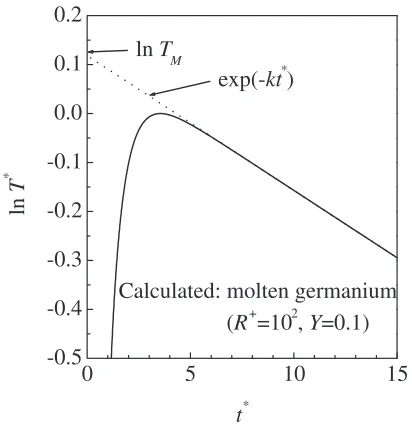
A typical temperature response curve where the dimensionless parameter of the thermal contact resist-ance at interface, Rþ¼mR=lm¼102, Biot number, Y¼
4"Te3lm=m¼0:1, and the normaliged temperature, T¼
T=Tmaxis shown in Fig. 4 using the molten germanium case
as an example, where m is the thermal conductivity of
molten sample,Ris the thermal contact resistance,lmis the
thickness of molten sample,"is the thermal emissivity of the surface of molten sample, is the Stefan-Boltzmann constant. The decay part of the temperature response curve normalized by the maximum temperature rise is approx-imately represented by the following equation in the normalized time region between 8 and 12.
T¼TMexpðktÞ ð3Þ
whereTMcorresponds to the temperature when extrapolated
from the attenuation curve down by the time where the laser beam irradiates. The linear relationship between the loga-rithmic value ofTandt may be described as follows.
lnT¼ ktþlnTM ð4Þ
The gradient,k, and the intercept,lnTM, provide information
with respect to the effects of radiative and conductive heat loss at interface between melt sample and cell material. The simulated results of the relationship betweenkandTMwith
conduction for the thermal resistance parameter Rþ¼10n,
n¼0:5 to1 and Biot numberY ¼0 to 0.25 are shown in Fig. 5. This figure includes the experimental results of molten germanium obtained under different conditions and a point at the origin in Fig. 5 corresponds to the adiabatic condition. The experimental results of k and lnTM for molten
germanium are found to be situated near the curve of
Rþ¼ 1. Small dispersion is likely to be attributed to the
fluctuations in the signal to noise ratio detected in the temperature response curves. Accordingly, the authors mention the view, from the results of Fig. 5, that the effect of the conductive heat loss at interface between melt sample and cell material is negligibly small within the present experimental condition. In other words, the thermal contact resistance at the interface between melt sample and cell material can be considered to be sufficiently large and consequently only the radiative heat leakage is taken into account for the present experimental condition for the thermal diffusivity measurements.
3.2 Thermal diffusivities of molten germanium and silicon
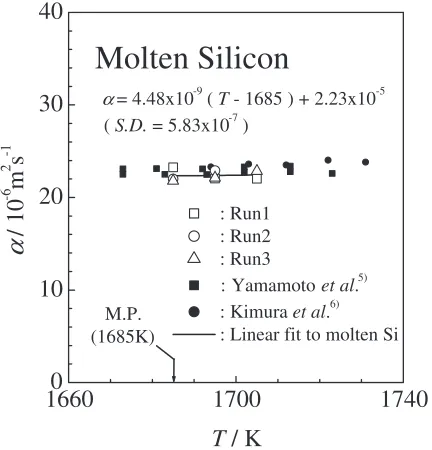
Thermal diffusivity values of molten germanium in the temperature range from 1218 to 1398 K and for silicon in the temperature range from 1685 to 1705 K were measured. It may be worth noting that good reproducibility of the experimental thermal diffusivity data was confirmed by repeating the measurements under a given condition three times. The results are shown in Figs. 6 and 7.
0
5
10
15
-0.5
-0.4
-0.3
-0.2
-0.1
0.0
0.1
0.2
ln
T
M
exp(-
kt
*)
Calculated: molten germanium
(
R
+=10
2,
Y
=0.1)
ln
T
*
t
*Fig. 4 Simulated temperature response curve for molten germanium.
0.00 0.01 0.02 0.03 0.04 0.05
0.00 0.05 0.10 0.15 0.20 0.25
2.0
∞
1.0
n = 0.5
R+ = 10n
Molten Germanium
ln
T M
k
Fig. 5 Relationships betweenkandlnTMof molten germanium. Symbols
[image:3.595.317.534.74.254.2] [image:3.595.66.272.554.767.2]The thermal diffusivity values of molten germanium and silicon are in good agreement with the values reported by Takasukaet al.,3,4)Yamamotoet al.5)and Kimuraet al.6)In these previous measurements, the thermal diffusivities of molten germanium and silicon were obtained by means of the laser flash method using the optical alignment in the horizontal line. Thus, it is quite likely to induce the convection in molten germanium and silicon. However, Takasukaet al.4)have estimated the effect of the convection in the molten germanium sample on the thermal diffusivity values measured by a horizontal type laser flash method.
From the results, the effect of the convection was considered not serious because the measurement was already finished for the very short time before occurring the convection in the molten germanium sample.
The thermal diffusivity values of molten germanium and silicon are summarized in the following equations (unit: m2/s).
Ge¼1:40108ðT1218Þ þ2:29105
1218T1398 ðunit: KÞ ð5Þ Si¼4:48109ðT1685Þ þ2:23105
1685T1705 ðunit: KÞ ð6Þ
The experimental uncertainty of the thermal diffusivity of molten germanium and silicon are 1:9 % and 7:6 %, respectively. The uncertainties are caused as follows:
1) Random error of the measured values is mainly caused by the electrical noise on the measured temperature response curve. This error corresponds to the uncer-tainty ofkandK, which is estimated to be0:9% for molten germanium and6:6% for molten silicon. 2) The uncertainty due to the thermal expansion of sample
and sample cell is0:5% at most.
3) The uncertainty of the effective sample temperature in the thermal diffusivity measurements using the laser flash method is0:5% at most.12)
3.3 Thermal conductivities of molten germanium and silicon
Thermal conductivity,(unit: Wm1K1), is known to be
connected with the thermal diffusivity, the heat capacity,Cp
(unit: Jkg1K1), and density,(unit: kgm3), as follows.
¼Cp ð7Þ
Then, the thermal conductivity values of molten germa-nium and silicon were calculated from the present exper-imental thermal diffusivity data by coupling with the literature values of the heat capacity13,14)and the density.15)
Figures 8 and 9 show the thermal conductivities for molten germanium and silicon. The standard deviation (S:D:) was found to be 0.60 for molten germanium and 1.53 for molten silicon. The thermal conductivity values of molten silicon and germanium are given in the following equations (unit: Wm1K1):
Ge¼2:39102ðT1218Þ þ48:0
1218T 1398 ðunit: KÞ ð8Þ Si¼5:71104ðT1685Þ þ58:6
1685T 1705 ðunit: KÞ ð9Þ
The uncertainty of the thermal diffusivity using the laser flash method is estimated to be less than1:9% for molten germanium and7:6% for molten silicon. The uncertainty of the heat capacity using the drop method is estimated to be less than 0:3% for molten germanium13)and1:0 % for molten silicon.14)The uncertainty of the density of molten germanium and silicon using the maximum bubble pressure method is estimated to be less than1:0%.15)Thus a total uncertainty of the thermal conductivity is estimated to be less
1200
1300
1400
0
10
20
30
40
α = 1.40x10⁻⁸ ( T - 1218 ) + 2.29x10⁻⁵
( S.D. = 2.89x10⁻⁷ )
M.P. (1218K)
Molten Germanium
: Run1 : Run2 : Run3
: Takasuka et al.3)
: Linear fit to molten Ge
α
/ 10
-6
m
2s
-1
T
/ K
Fig. 6 Thermal diffusivity of molten germanium as a function of temper-ature. Symbols of , , and denote the results obtained in this work at different runs.
1660
0
1700
1740
10
20
30
40
α = 4.48x10⁻⁹ ( T - 1685 ) + 2.23x10⁻⁵
( S.D. = 5.83x10⁻⁷ )
M.P. (1685K)
Molten Silicon
: Run1 : Run2 : Run3
: Yamamoto et al. 5)
: Kimura et al. 6)
: Linear fit to molten Si
α
/ 10
-6
m
2
s
-1
T / K
[image:4.595.62.278.370.595.2]than2:2% for molten germanium and7:7% for molten silicon.
Nagai et al.2) measured the thermal conductivities of molten silicon by a hot-plate method. As shown in Fig. 8, the thermal conductivity values of molten silicon obtained in this work are higher than that values obtained by the hot plate method. In practice, the thermal contact resistance at the interface between the molten sample and all material can be considered to be sufficiently large (See Fig. 5). Therefore, the thermal conductivity values of molten silicon obtained by the hot-plate method should be affected by the thermal contact resistance at the interface between molten sample and ceramic.
Yamasueet al.1)also measured the thermal conductivities of molten germanium and silicon by a hot-wired method. The thermal conductivity values of molten silicon obtained in the hot-wired method are nearly in accordance with that values obtained in this work. However, the thermal conductivity values of molten germanium obtained in the hot-wired method are lower than that values obtained in this work. Thus, it can be presumed that the thermal conductivity values of molten germanium obtained by the hot-wired method may be affected by the thermal contact resistance at the interface between silica layer and melt sample.
Filippov16)measured the thermal conductivities of molten germanium by a radial temperature wave technique. In this method, it is quite likely to induce the convection in molten germanium. However, such effect is considered not serious because of the short measuring time.
In the results shown in Figs. 8 and 9, a slightly positive temperature variation is observed in the thermal conductivity of molten germanium and silicon. The heat capacities of molten germanium and silicon are known to stay constant with increasing temperature.13,14) The densities of molten germanium and silicon slightly decrease with increasing of temperature.15)However, positive temperature dependence is obtained in the thermal diffusivity values of molten germa-nium and silicon (See Figs. 6 and 7). The variation detected in the thermal conductivity values of molten germanium and silicon results from the harmony of three thermophysical properties of,Cp and.
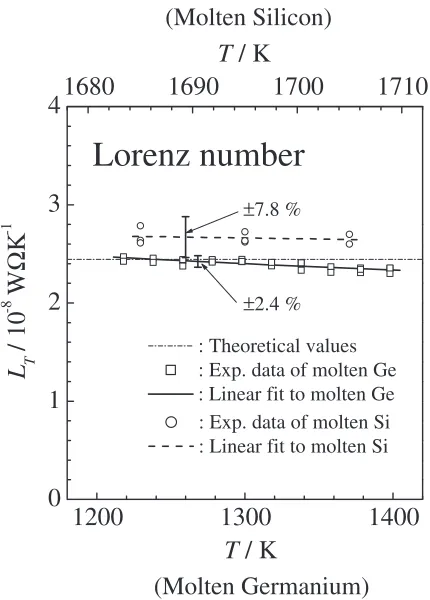
Electronic conduction is considered to be dominant in metals at temperatures around the melting point,15,17) in comparison with the mechanism of phonon or lattice conduction, which is well confirmed at lower temperature. In this subject, the Wiedemann-Franz law has been fre-quently used for combining the thermal conductivity,, and electrical conductivity,,15)for metals at higher temperature. The Wiedemann-Franz-Lorenz relation is a function of temperatureT(K) given as follows.
¼L0T ð10Þ
where L0 is the theoretical Lorenz number of L0¼
2:445108WK2. It should be kept in mind that this
relation is valid only to the case that the thermal conduction is controlled by free electrons. This suggests that no contribu-tion from phonon to the thermal conduccontribu-tion is taken into account. The Lorenz number, LT, was estimated from the
present the thermal conductivity values including, more or less, the contribution from phonon and the electrical conductivity values of molten germanium and silicon in the literature.15)The results with the theoretical Lorenz number,
L0, are shown in Fig. 10. As mentioned above, the uncertainty
of the thermal conductivity of molten germanium and silicon are 2:2 % and 7:7 %. The uncertainty of electrical conductivity of molten silicon and germanium is estimated to be less than 1:0 %.14)The uncertainty of sample temper-ature, controlled within 1:0K, is negligibly small. Thus a total uncertainty of Lorenz number is estimated to be less than2:4% for molten germanium and7:8% for molten silicon. From the result of Fig. 10, all experimental Lorenz number data exist within a range of the uncertainty. Thus, the Lorenz number presently obtained appears to be significant.
1200
1300
1400
0
40
80
λ = 2.39x10⁻² ( T - 1218 ) + 48.0
( S.D. = 0.60 )
M.P. (1218K)
Molten Germanium
: This work
: Yamasue et al.1)
: Takasuka et al.3)
: Filippov et al.16)
: Linear fit to molten Ge
λ
/ Wm
-1
K
-1
T
/ K
Fig. 8 Thermal conductivity of molten germanium as a function of temperature.
1680
0
1690
1700
1710
50
100
: This work
: Yamasue et al. 1)
: Nagai et al. 2)
: Yamamoto et al. 5)
: Kimura et al. 6)
: Linear fit to Molten Si
λ = 5.71x10⁻⁴ ( T -1685 ) + 58.6
( S.D. = 1.53 )
M.P. (1685K)
Molten Silicon
λ
/ Wm
-1
K
-1
T / K
[image:5.595.61.283.72.309.2] [image:5.595.62.281.366.591.2]The results of molten germanium and silicon are found to be quite in agreement with L0 in the temperature range
investigated in this work. Thus, the principal mechanism for the thermal conduction of molten germanium and silicon may be represented by the simple electron transport. This is consistent with the fact that both germanium and silicon show rather metallic behavior in their liquid state.15)
4. Conclusion
Thermal diffusivity values of molten germanium and silicon have been successfully determined by using laser flash method with the sample cell system. It was also found from the results of computer simulation that the effect of the conductive heat loss at the interface between the molten semiconductor sample and the cell is negligibly small for the thermal diffusivity measurements at elevated temperature within the present experimental condition.
The thermal conductivity values of the molten germanium and silicon were calculated by combining the thermal diffusivity data with the specific heat and the density. The resulting values are summarized in the following equations (unit: Wm1K1).
Ge ¼2:39102ðT1218Þ þ48:0
1218T 1398 ðunit: KÞ
Si¼5:71104ðT1685Þ þ58:6
1685T1705 ðunit: KÞ
With respect to the Lorenz number defined by the Wiedemann-Franz law, fair agreement between the exper-imental values,LT, and the theoretical ones,L0, was obtained
for molten germanium and silicon in the temperature range presently investigated. Accordingly, the principal mechanism for the thermal conduction of molten germanium and silicon is quite likely to be controlled by the electron transport.
Acknowledgements
This work is supported by Special Coordination Funds for Promoting Science and Technology (Promotion System for Intellectual Infrastructure of Research and Development, ‘Research on measurement technology and reference materi-als for thermophysical properties of solids’), Japan and a Grant-in-Aid for Scientific Research (13750683-00) of the Ministry of Education, Culture, Sports, Science and Tech-nology, Japan. The authors are grateful for valuable dis-cussion with and comments by Prof. Y. Waseda, IMRAM, Tohoku university.
REFERENCES
1) E. Yamasue, M. Susa, H. Fukuyama and K. Nagata: J. Crys. Growth. 234(2002) 121-131.
2) H. Nagai, Y. Nakata, T. Tsurue, H. Minagawa, K. Kamada, S. E. Gustafsson and T. Okutani: Jpn. J. Appl. Phys.39(2000) 1405-1408. 3) E. Takasuka, E. Tokizaki, K. Terashima and S. Kimura: The Fourth Asian Thermophysical Properties Conference (Tokyo, September 1995) pp. 89-92.
4) E. Takasuka, E. Tokizaki, K. Terashima and S. Kimura: Netsu Bussei9 (1995) 169-174.
5) K. Yamamoto, T. Abe and S. Takasu: Jpn. J. Appl. Phys.30(1991) 2423-2426.
6) S. Kimura and K. Terashima: J. Crys. Growth.180(1997) 323-333. 7) W. J. Parker, R. J. Jenkins, C. P. Butler and G. L. Abbott: J. Appl. Phys.
32(1961) 1679-1684.
8) T.Nishi, H.Shibata, H.Ohta and Y.Waseda: Metall. Trans. A 34A (2003) in press.
9) T.Nishi, H.Ohta, H.Shibata and Y.Waseda: Int. J. Thermophys. 24 (2003) 1735-1751.
10) Y. Takahashi, T. Azumi and M. Sugano: Netsu-Sokutei8(1981) 62-66. 11) H.Ohta and Y.Waseda: High. Temp. Mat. Proc.7(1986) 179-184. 12) H.Ohta, T.Baba, H.Shibata and Y.Waseda: Int. J. Thermophys. 23
(2002) 1659-1668.
13) P. Sommelet and R. J. Orr: J. Chem. Eng. Data11(1966) 64-65. 14) P. B. Kantor, O. M. Kisel and E. M. Fomichev: Ukrain. Fiz. Zh.5
(1960) 358.
15) V. M. Glazov, S. N. Chizhevskaya and N. N. Glagoleva; Liquid Semiconductors, (Plenum Press, New York 1969) pp.60, 61, 69. 16) L. P. Filippov: Int. J. Heat Mass Transfer16(1973) 665-885. 17) K.C.Mills, B.J.Monaghan and B.J.Keene: Int. Mater. Rev.41(1996)
209-242.
1200
1300
1400
0
1
2
3
4
1680
1690
1700
1710
(Molten Silicon)
(Molten Germanium)
T
/ K
Lorenz number
: Theoretical values
±2.4 %
±7.8 %
: Exp. data of molten Ge : Linear fit to molten Ge
L
T/ 10
-8
W
Ω
K
-1
T
/ K
[image:6.595.62.277.72.372.2]: Exp. data of molten Si : Linear fit to molten Si
Fig. 10 Temperature dependence of the Lorenz number, LT, estimated