EFFECTS OF ELECTRONIC DATA INTERCHANGE ON ORGANIZATION’S
PROCUREMENT PERFORMANCE: A CASE OF SUPERMARKETS IN ELDORET
TOWN
Yusuf Kimutai Kibet*1 Michael Korir2 *1Moi University Box 3900 Eldoret, Kenya.
2Department of Marketing Box 3900 Eldoret, Kenya.
KEYWORDS
:
Testing of Hypothesis, significant effect of EDI on organization’s Procurement Performance.ABSTRACT
The procurement unit in an organization today operates in a dynamic, complex environment and in order to operate efficiently and effectively it has to create appropriate structures and make use of suitable instruments, information technology (IT) can play an important role in this. However, the path to a successful implementation and effective application of Information Technology continue to be a challenge to many cost conscious firms. It is therefore obvious that a broader perspective of research of effects of Information Technology on organization’s procurement performance is required in order to exploit its potential benefits. The primary aim of this study therefore was to determine the effects of information technology (IT) in procurement performance of selected supermarkets in Eldoret, Kenya. The specific objectives were to establish the effects of Electronic Data Interchange (EDI) on organization’s procurement performance. The major theory that was adopted in this study was Resource Base View (RBV). The study adopted explanatory research design, with the target population being managers and operational staff of selected supermarkets within Eldoret town. The sampling technique employed was purposive sampling to select 6 supermarkets that apply fully information technology (IT) system. Census technique was used to select 153 respondents from selected supermarkets. Data was collected by administering questionnaires to the respondent, a pilot test was conduct to test validity of instrument and cronbach alpha (α) was conducted to test reliability. Data collected was coded and analyzed with the help of Statistical Package for Social Sciences (SPSS) and the findings represented in tables. The finding indicates that Electronic Data Interchange (EDI), was significant determinant of organization’s procurement performance as depicted by the results. By investing more on electronic data interchange enhance balancing supply and demand at every supply node, for these are the key determinants of successful organization’s procurement performance. Retailers need to exploit the advantages of an information intensive business environment in order to deliver superior solutions to their customers, and at the same time simplify their businesses.
INTRODUCTION
Procurement plays a major role in an organization which can significantly influence organization success. As a core function it is, however, subject to trends of the market. Its day to day existence is very much defined by growing procurement volumes due to greater concentration of business on core competences, globalization of procurement markets, growing market dynamics as well as the shorter Product lifecycle: (Carter et al., 2005). As the world’s economy becomes increasingly competitive, sustaining competiveness and the resulting profitability depend less on the ability to raise prices, instead firm’s need to compete on the basis of product innovativeness, higher quality, and faster response time. All of which must be delivered simultaneously and always at the lowest cost attainable (Presutti 2003).
Firms with the most competitive supply chains are and will continue to be the big winners in contemporary business. In today’s customer focused marketplace supply chain has become a key to competitive advantage (Grieger 2003). For procurement organization to operate efficiently and effectively in such a complex environment useful structures need to be created and suitable instruments put in to use. Information Technology (IT) can have an important function in this regard. If Information Technology is used appropriately it can offer: smoother and faster process flows, efficient distribution of information, decentralization of tasks and decisions, increased transparency and better control (Carter et al., 2006).
Information Technology has been applied to widen the benefit of communication and organization in business sector, (Abdurrahman, 2000) reveals in his report in development and corporation 2000 that group of eight states at their summit in Okinawa had spread a major initiative to promote the spread of IT in developing countries. The use of Information Technology in procurement in supermarkets is still relatively low despite the research results on the benefits of information technology on procurement performance. The electronic data interchange (EDI) technique is based on agreed standards, which enables computers in different organizations to successfully send business or information from one to another. In the context of electronic communication, (Heizer et al., 2005) notes that frequent use of EDI is critical to supply chain success. (Juma 2000) also indicates that the high frequency of written/electronic communication lowered both acquisition and operations costs for buying firms. In the same (Kenneth 2000) demonstrates that frequency of Internet communication between trading partners is positively related to supply chain performance. Thus, it is conceivable that high frequency of Internet communication could result in enhanced purchasing performance.
Technically, EDI is the business transfer of documents. It can also be viewed as the business-to-business transfer of data or information (Kaefer et al.,2000). Essentially, instead of transferring paper documents using the mail or other transportation services, EDI transfers the documents in an electronic form using telecommunication links. The traditional paper transfer for a purchase order is when the buyer's computer information system prints a paper order which is manually transferred to the seller. The seller then manually enters the buyer's order into the seller's computer information system. In the late 1960's as more firms began to use computer based information system, they began to realize much of the output of one computer is input to another computer (Emmelhainz 1990). This along with the need to reduce costs lead firms to develop EDI. Implementing EDI can be done with very little integration into the existing information technology system in a company.
Alternatively, EDI can be tightly integrated into an organization’s information technology system. Generally, this is described as either integrated or non-integrated EDI. Non-integrated EDI is when a firm only uses EDI to transfer documents from or to another firm. In this situation, all of the existing paper processes in a firm are maintained but the transfer method is changed from a manual system such as the postal service to a telecommunication method. Typically, the telecommunication transfer is done through a third party vendor called a Value Added Network (VAN) supplier. The firm basically uses EDI to reduce document transfer time and by some estimates this is how over 70% of organizations implement EDI (Lehmann, et al., 1996). This is one end of the EDI implementation spectrum.
Business firms all over the world are operating under an extremely competitive environment, compounded by unpredictability of the markets, as exemplified by the global economic crisis (Kiruthi 2000). Kenyan businesses have no exception. Many firms have to compete not only with local rivals, but even with established international competitors in an era where the pool of potential customers has shrunk due to shrinking economies. Organizations must grapple with the challenges of the changing environment in which they operate (Kiruthi 2000). This is especially true for the supermarkets, which face competition against other international retail outlets.
Procurement is an important and expensive business activity for organization Chan et al., (2003). This is because organizations usually spend a larger portion even up to 70% of the revenue budget on purchasing goods and services (Davis et al., 2003). Despite such importance, procurement function still suffers inefficiency problems. First procurement traditionally is labour intensive and as such managers spend considerable time on “non-value-added” activities (Cater et al., 2005). Second traditional procurement process permits infamous maverick buying practices which represent a situation where procurement units make unplanned purchases from non-preferred suppliers at higher prices (Turban et al., 2008). To combat this state, organizations have to enhance procurement efficiency using innovative internet base IT solution.
It is clear that IT is mature and highly effective, however, the path to a successful implementation and effective application of IT continue being a challenge to many cost conscious firms. It is therefore obvious that a broader perspective of research in IT is required in order to exploit its potential.
performance in supermarkets in Eldoret Kenya. This was achieved through establish the perceived effects of electronic data interchange (EDI) on organization’s procurement performance. The finding will help supermarkets and other organizations in Kenya to develop strategic plans to promote organization procurement performances.
RESEARCH METHODOLOGY
The study was carried out in Eldoret town in western Kenya and the head quarter administrative center of Uasin Gishu County. Eldoret has an estimated population of 250,000, Eldoret is a town with major economic undertaking, it is currently the fastest growing town in Kenya and currently 5th largest in Kenya, Ayaya et al.,
(2005). Eldoret is home to Moi University, the second medical school in Kenya, Moi Teaching and Referral Hospital (MTRH), is also located in within the city limits of the Eldoret Town. Eldoret is accessible and served with an international airport (Moi International Airport). It is a town with enormous economic potential with farming as a major economic undertaking. It also home to top known athletes, the most renowned of whom is Kipchoge Keino. The high altitude is an ideal training ground for many middle and long distance athletes. The runners from Edoret have injected a substantial amount of revenue to the local economy. The town is also rich with shopping outlets with the major supermarkets namely: Nakumatt, Naivas, Tuskys, Uchumi, Ukwala and Trasmatt. The town also has a number of supermarkets totaling 13 (with 6 supermarkets fully utilizing IT system) located within the central business district.
Research design guides the study in planning and implementing a study in a way that is most likely to achieve the intended goal (Burns et al., 1993). The study used explanatory research design to establish effects of information Technology (IT) on procurement performance. The design was also appropriate for the study as it allows for the use of questionnaires that facilitate rapid collection of data from respondent, the design allow for analysis of any relevant variables at the same time. An explanatory study requires collection of complete and accurate information that maximizes reliability (Sekeran 2007).
The target population of the study was managers and operational staff from selected supermarkets that fully apply IT systems in their operation. The population covered a complete set of managers and operational staff representative of six selected supermarkets namely; Nakumatt, Uchumi, Tuskys, Naivas, Transmat, and Ukwala. The study adopted purposive technique to select 6 supermarkets within Eldoret town this was on the basis of the supermarkets that fully apply IT systems in procurement, within the selected supermarkets the study use census sampling technique in order to achieve its respondents. The census sampling technique was used to sample 153 respondents from selected supermarkets. The researcher used questionnaires to obtain information from the respondents. Pilot test was conduct to test validity of instrument and cronbach alpha (α) was conducted to test reliability.
Data obtained from employees was mainly analyzed quantitatively using Statistical Package for Social Sciences (SPSS 17.0 version). Both descriptive and inferential tests were performed. Descriptive methods included frequency distribution tables and percentages, while inferential comprised Multiple Linear Regression. Pearson product moment correlation was carried out to establish the degree of relationship between procurement performance, and the independent variables namely electronic data interchange.
RESULTS
Relationship between procurement performance and electronic data interchange
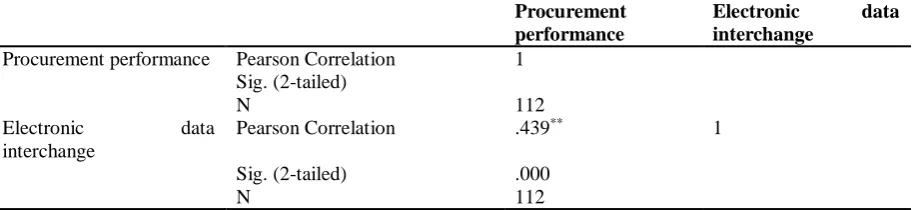
Table 1 Correlation between procurement performance and electronic data interchange
Procurement performance
Electronic data interchange
Procurement performance Pearson Correlation 1 Sig. (2-tailed)
N 112
Electronic data interchange
Pearson Correlation .439** 1
Sig. (2-tailed) .000
N 112
**. Correlation is significant at the 0.01 level (2-tailed).
From the study there exists a positive correlation between procurement performance and the electronic data interchange. The correlation coefficient between procurement performance and electronic data interchange was 0.439. The positive sign of the correlation indicates that the two variables tend to move together in the same direction. This showed that an increase in electronic data interchange ultimately contribute positively to procurement performance of retail chains or any other business establishments.
Testing of Hypothesis
There is no significant effect of EDI on organization’s Procurement Performance
In order to test the stated hypothesis, statistical significance of parameter estimates were established using t-test.
The 95% confidence interval for the estimation of 1
ranged between 0.072 and 0.349 for the lower and upperbound respectively with 1
0
.
211
. The true population parameter would lie in this range on 95% occasions out of one hundred occasions this parameter is estimated. The standard error of the estimate stood at 0.070. Thesample estimate 1
0
.
211
was found to be statistically significant at 1% level with 108 degrees of freedom with t1= 3.021.Clearly, EDI is a significant determinant of procurement performance of selected retail chains in Eldoret town. Since the two variables relate positively, then to improve procurement performance, the electronic data interchange must be improved. In essence, all the sub-variables making up EDI need to be improved that is, transfer of data in agreed electronic format, supplier delivery performance, invoice payment, global purchasing, inventory cost, lead time, and acquisition cost. With this result, we reject the hypothesis that there is no significant effect of electronic data interchange on procurement performance.
Table 2 Correlation Coefficients on Electronic Data Interchange
Model Unstandardized
Coefficients
Standardized Coefficients
t Sig.
B Std. Error Beta
(Constant) 1.830 .304 6.03 00
EDI .211 .070 .266 3.02 .00
a. Dependent Variable: Procurement performance
information, better customer service, reduce paper work, increase productivity, improve tracing and expediting, cost efficiency, competitive advantage and improve billing. Reducing these costs becomes important to firms that have high labour costs relative to competitors with lower labour costs. Without EDI, some firms would not be cost competitive.
The two variables relate positively results shows a coefficient of correlation of 0.439. The positive sign of correlation indicates that the two variables tend to move together in the same direction then to improve procurement performance the electronic data interchange must be improved. In essence all sub-variables making EDI need to be improved, β1=0.211 it shows that when EDI improves by one unit procurement improves by
21.1%. EDI can enhance supplier delivery performance, which will improve the performance of supply chain (Lee et al., 1997). IT also shortens delivery lead time. Implementation of IT has enabled organizations such as the Campbell Soup Company to reduce its order processing time from one week to two or three days (Cachon & Fisher, 2000). Hence, with EDI, suppliers have access to the purchasing company's demand, which allows suppliers to improve supply ordering and production scheduling in addition to reduce inventory levels in the supply chain (Wisner, & Tan, 2005).
CONCLUSION
This study aimed at finding out the effect of information technology on organization’s procurement performance. The electronic data interchange, was found to be significantly influence organization procurement performance. EDI enables transfer of data in agreed electronic format, such as; invoices, bills, and purchase order between the buyer and supplier. EDI enhance supplier delivery performance which will improve performance of supply chain. Information technology solutions reduce costs, increase supply chain flexibility and response, integrate suppliers and partners, and ultimately provide a more effective shopping experience for the customer. Information technology enhance organizational capabilities that can eventually lead to higher procurement performance.
RECOMMENDATION
Retailers need to exploit the advantages of an information intensive business environment in order to deliver superior solutions to their customers, and at the same time simplify their businesses. For positive improvement of procurement performance supermarkets also are required to improve electronic data interchange that constitute bar-coding and inventory management system.
By utilizing and sharing technology with key players in the supply chain, retailers can develop collaborative planning, forecasting, and replenishment programs. In this way, they can reduce stock-outs, increase inventory turns and margins, and ultimately deliver a convenient, fast, cost-effective, and enhanced shopping experience to consumers.
REFERENCES
[1] Abdurahman, A. (2000) “African and the Internet” Development and Cooperation Issue No 32, (pp. 24-25).
[2] Auramo, Jaana, Jouni Kauremaa and Kari Tanskanen (2005). “Benefitsof IT in Supply Chain Management: An explorative study of progressivecompanies” International Journal of Physical Distribution and Logistics Management; 35,2; Academic Research Library pg. 82
[3] Ayaya.s, Sitienei. j and Rotich. j (2003). “Knowledge, attitude and practices of private medical practitioners on Tuberculosis among HIV/AIDS patients in Eldoret Kenya” East African medical journal vol 80 No 2.
[4] Burns, T., Beadsmore, A., Bhat, A., et al (1993) A controlled trial of home-based acute psychiatric services. I. Clinical and social outcome. British Journal of Psychiatry, 163, 49 -54.
[5] Carter, Phillip L: Monczka, Robert M. (2005). Strategic Performance Measurement Purchasing and supply, AZ, CAPS: Center for Strategic supply Research.
[6] Chian C (1998). “Increase Your Profit Margin through Electronic procurement”. A journal of internet. [7] Davis, M, Aquilano, NJ, Chase, R (2003). Fundamentals of Operations Management, 4th Ed. Boston.
Irwin McGraw-Hill, Publisher
[8] Emmelhainz, M. (1990). Electronic Data Interchange: A Total Management Guide, Van Nostrand Reinhold, New York.
[10]Heizer, J & Render, B (2005). ‘Operations Management’, 7th edn, Prentice-Hall, Upper Saddle River, NJ.
[11]Juma, N. (2000). “E-Commerce and Modern Business,” The Professional Journal of KASNEB:July December, Issue p 3-4.
[12]Kaefer, F. and Bendoly, E., (2000). “The Adoption of Electronic Data Interchange: A Model and Practical Tool for Managers,” Decision Support Systems, Volume 30, Number 1, pp. 23-32.
[13]Kenneth Lysons (2000). Purchasing and Supply Chain Management, 5th Edition. Pearson Educational
Limited.
[14]Kenneth Lysons and Brian Farrington (2006). Purchasing and Supply chain management 7th. Edition.
Pearson Educational Limited.
[15]Larson, P.D. and J.D. Kulchitsky (1997) "Logistics Improvement Programs: The Dynamics between People and Performance," International Journal of Physical Distribution and Logistics Management, (29:2), , pp. 88-102.
[16]Lehmann, F. (1996). “Machine-Negotiated, Ontology- Based EDI (Electronic Data Interchange),” in N. Adam and Y. Yesha (Eds.), Electronic Commerce: Current Research Issues and Applications, pp. 27-45, Springer-Verlag, Berlin, Germany.
[17]Presuttin W.D, (2003), Supply Management and e-procurement: Creating value added in the supply chain, Industrial marketing management 32(3), pp 219-226.
[18]Sekaran, U. (2003). Research methods for business: A skill-building approach (4th ed.) New York: John Wiley & Sons, Inc.
[19]Turban E. King D. Lee J and Viehland, (2008). “Electronic Commerce” New Jersey.