I
nternationalJ
ournal of PharmaceuticalB
iological andC
hemicalS
ciences e-ISSN: 2278-5191International Journal of Pharmaceutical, Biological and Chemical Sciences (IJPBCS) | JUL-SEPT 2014 | VOLUME 3 | ISSUE 3 | 56-65 www.ijpbcs.net or www.ijpbcs.com
R
esearch
A
rticle
Pa
ge
56
DEVELOPMENT AND IN-VITRO EVALUATION OF
IMMEDIATE RELEASE TABLETS OF EFAVIRENZ
Gummadi Sridhar Babu *, Darna Vijay Kumar, Guguloth Balakrishna, Ramavath Redya Naik, Puttireddy S Malathy
Pragathi Pharmacy College, Pemberthy, Jangaon, Warangal Dist, Telangana-506201 India
*Corresponding Author Email: [email protected]
INTRODUCTION
The goal of any drug delivery system is to provide a
therapeutic amount of drug to the proper site in the
body and then maintain the desired drug concentration
[1]. Oral route is considered most natural,
uncomplicated, convenient and safest due to its ease of
administration, patient acceptance and cost effective
manufacturing process [2]. Different types of tablet
formulations are available, which could be broadly
classified based on:
1. Route of administration such as tablets for oral
delivery, sublingual delivery, buccal delivery, rectal
delivery or vaginal delivery.
2. Formulation characteristics such as immediate
release tablets, effervescent tablets, melt-in mouth or
fast dissolving tablets, delayed release or extended
release tablets. In all the cases, the general
manufacturing process, machinery used for preparation
of tablets and materials used are similar [3].
Immediate release solid oral dosage forms are
classified as either having rapid or slow dissolution
rates. Immediate release dosage forms are those for which ≥85% of labeled amount dissolves within 30
min. For immediate release (IR) tablets, the only
barrier to drug release is simple disintegration or
erosion stage, which is generally accomplished in less
than one hour. For many substances, conventional
immediate release formulation provide clinically
effective therapy maintaining the required balance of
pharmacokinetic and Pharmacodynamic profiles with
an acceptable level of safety to the patients [4]. The
immediate release preparations have the advantage of
enhanced oral bioavailability through transmucosal
delivery and pregastric absorption, convenience in
drug administration to dysphasic patients, especially
ABSTRACT:
Immediate release tablets are those tablets which disintegrate and release the drug rapidly once it enters GIT. Recently immediate release tablets have started gaining popularity and acceptance as a drug delivery system, mainly because they are easy to administer and lead to better patient compliance. They are also a tool for expanding markets, extending product life cycles and generating opportunities. Efavirenz is an anti retroviral drug with poor aqueous solubility. The present work involves the formulation development and invitro evaluation of immediate release Efavirenz tablets for enhancement of dissolution rate. Direct compression method was selected for the formulation of immediate release Efavirenz tablets. Tablets were prepared using different concentrations of Croscarmellose sodium, Crospovidone, and sodium starch glycolate as superdisintegrants. During the course of study it was found that the formula F8 containing Sodium starch Glycolate as superdisintegrant exhibited acceptable disintegration time and in vitro drug release. The Drug-excipient interaction was investigated by FTIR. Later they were subjected to stability studies after packing which showed acceptable results.
KEYWORDS:
Gummadi Sridhar Babu * et al;DEVELOPMENT AND IN-VITRO EVALUATION OF IMMEDIATE RELEASE TABLETS..
International Journal of Pharmaceutical, Biological and Chemical Sciences (IJPBCS) | JULY-SEPT 2014 | VOLUME 3 | ISSUE 3 | 56-65| www.ijpbcs.net
Pa
ge
57
the elderly and bedridden, and new business
opportunities.
Efavirenz,(4S)-6-chloro-4-(2-cyclopropylethynyl)-4-(trifluoromethyl)-2,4-dihydro
1H-3,1-benzoxazin-2-one (Figure 1) is a non-nucleoside reverse transcriptase
inhibitor (NNRTI) and is used as part of highly active
antiretroviral therapy (HAART) for the treatment of a
human immunodeficiency virus (HIV) type 1.
Efavirenz inhibits the activity of viral RNA-directed
DNA polymerase (i.e., reverse transcriptase). It is
believed that inhibition of reverse transcriptase
interferes with the generation of DNA copies of viral
RNA, which in turn are necessary for synthesis of new
virions [5]
In the present study Sodium starch glycolate,
Crospovidone and Croscarmellose sodium used as
superdisintegrants, PVP as binder, Talc and
Magnesium stearate as lubricants and SLS is used to
enhance the drug release.
MATERIALS AND METHODS
Materials
Efavirenz was obtained as a gift sample from Intas
Pharmaceuticals Ltd., Ahmedabad, and Gujarat, India.
Croscarmellose sodium, Sodium Starch Glycolate and
Crospovidone were gift sample from Signet Chemical
Corporation, Mumbai. Povidone was obtained from
Loba Chemical, Mumbai. All other chemicals used
were analytical grade. Double distilled water was used
in the study.
Methodology
PRE FORMULATION STUDIES
Drug-Excipient Compatibility Studies
The FTIR samples (Efavirenz Pure drug and
formulations) were obtained, using Perkin Elmer
FT-IR system Spectrum BX series (Beaconsfield,
Buckinghamshire, UK), in the frequency range of
4000–550 cm-1at 4 cm-1 resolution. The technique used
very small amount of each sample which directly
loaded into the system. Spectrum BX series software
version 2.19 was used to determine peak positions [6,
7].
Preparation of Efavirenz IR tablets:
Formulation of Efavirenz IR tablets were prepared by
direct compression employing various excipients as
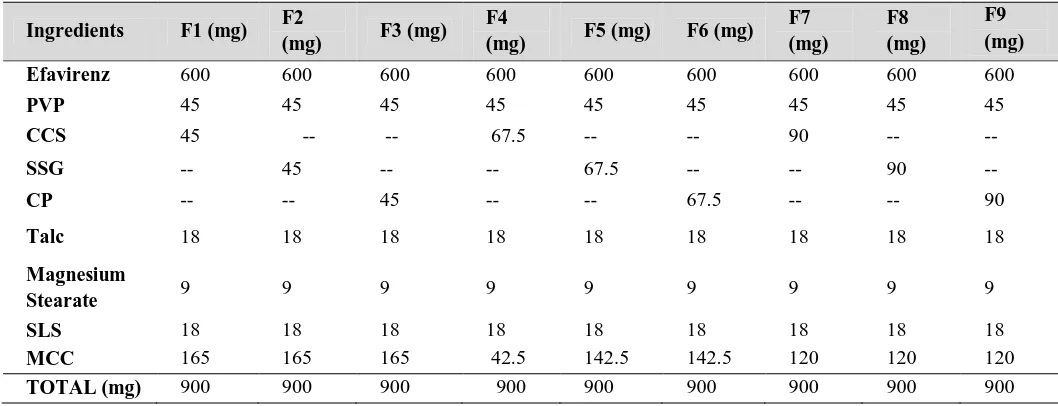
mentioned in Table 1. Efavirenz and PVP were shifted
together trough mesh #40. Microcrystalline cellulose
(Avicel PH 102) was passed through 40 # mesh and
mixed well in the previous blend for 10 minutes. To
this, superdisintegrants was added after shifting
through 40 # mesh [8]. Sodium lauryl Sulphate was
added to aid release. The above obtained blend was
lubricated with magnesium stearate and talc after
passing through 60 # mesh. The prepared powder
blend was evaluated for various parameters like bulk
density, tapped density, angle of repose,
compressibility index and Hausner’s ratio. This blend
was then compressed using a 16 station rotary
compression machine (Cadmach, Ahmedabad, India).
EVALUATION
Pre Compression parameters of Powder Blend:
a) Bulk Density (Db): It is the ratio of total mass of
powder to the bulk volume of powder. It was measured
by pouring the weighed powder (passed through
standard sieve # 20) into a measuring cylinder and
initial weight was noted. This initial volume is the bulk
volume. From this the bulk density was calculated
according to the formula mentioned below [9]. It is
expressed in gm/ml and is given by
Db = M/ Vb
Where, M and Vb are mass of powder and bulk
volume of the powder respectively.
b) Tapped Density (Dt): It is the ratio of total mass of
the powder to the tapped volume of the powder.
Gummadi Sridhar Babu * et al;DEVELOPMENT AND IN-VITRO EVALUATION OF IMMEDIATE RELEASE TABLETS..
International Journal of Pharmaceutical, Biological and Chemical Sciences (IJPBCS) | JULY-SEPT 2014 | VOLUME 3 | ISSUE 3 | 56-65| www.ijpbcs.net
Pa
ge
58
times and the tapped volume was noted if the
difference between these two volumes is less than 2%.
If it is more than 2%, tapping is continued for 1250
times and tapped volume was noted. Tapping was
continued until the difference between successive
volumes is less than 2 % (in a bulk density apparatus)
[10].
It is expressed in gm/ml and is given by
Dt = M / Vt
Where, M and Vt are mass of powder and tapped
volume of the powder respectively.
c) Angle of Repose [13]: The flow properties of blend
(before compression) were characterized in terms of angle of repose, Carr’s index and Hausner’s ratio. For
determination of angle of repose (θ), the blend were
poured through the walls of a funnel, which was fixed
at a position such that its lower tip was at a height of
exactly 2.0 cm above hard surface. The blends were
poured till the time when upper tip of the pile surface
touched the lower tip of the funnel [11]. Angle of
repose was calculated using following equation.
tan θ = (h/r)
Where, h = height of pile; r = radius of pile
d) Carr’s index (or) % compressibility [11]: It
indicates flow property of powders. It is expressed in
percentage and is given by
C.I. = Dt – Db / Dt * 100
Where, Dt and Db are tapped density and bulk density
respectively.
e) Hausner’s ratio: Hausner’s ratio is an indirect
index of ease of powder flow. It was calculated by the
following formula [12].
Hausner’s ratio = Dt / Db
Where, Dt and Db are tapped density and bulk density
respectively.
Post compression parameters of Tablets:
The formulated tablets were evaluated for the
following physicochemical parameters.
a) Physical appearance
The general appearance of tablets involves
measurement of number of attributes such as tablet
size, shape, colour, presence or absence of odor, taste,
surface texture and consistency of any identification
marks [13].
b) Tablet Size
Thickness of the tablet was measured by using Vernier
calliper in mm.
c) Weight variation test
Twenty tablets were selected at random and the
average weight was determined. Not more than two of
the individual weights deviate from the average weight
by more than the percentage and none deviates by
more than twice the percentage. Official limit of
Efavirenz IR tablets (F1-F9) percentage deviation is
±5% [14].
d) Hardness
Hardness of all batches was determined using Tablet
hardness tester (Monsanto hardness tester). The test
was carried out in triplicate for all batches as per USP
XXIV monograph for uncoated tablets [14].
e) Friability
Tablets of all batches were used to evaluate friability
as per USP XXIV monograph. Friability testing was
done by Friability test apparatus (Lab India Friability
Gummadi Sridhar Babu * et al;DEVELOPMENT AND IN-VITRO EVALUATION OF IMMEDIATE RELEASE TABLETS..
International Journal of Pharmaceutical, Biological and Chemical Sciences (IJPBCS) | JULY-SEPT 2014 | VOLUME 3 | ISSUE 3 | 56-65| www.ijpbcs.net
Pa
ge
59
f) Disintegration test
Six tablets were taken randomly from each batch and
placed in USP disintegration apparatus baskets and
note down the time taken to disintegrate the tablets
then average is calculated.
g) In vitro dissolution studies
Dissolution test was carried out using USP XXIV
(model DISSO, M/s. Lab India) rotating paddle
method (apparatus II). The stirring rate was 50 rpm.
0.1 N hydrochloric acid was used as dissolution
medium (900ml) and was maintained at 37±0.50C.
Samples of 5ml were withdrawn at predetermined time
intervals, filtered and replaced with 5ml of fresh
dissolution medium. The collected samples were
suitably diluted with dissolution fluid, wherever
necessary and were analyzed for the Efavirenz at
247nmby using a double beam UV spectrophotometer
(Shimadzu-2000). Each dissolution study was
performed for three times and the mean values were
taken [15].
RESULTS
PREFORMULATION STUDIES
Compatibility Studies by FTIR:
Compatibility of the drug with excipients is studied by
the FTIR technique. The results show that the drug is
compatible with the all excipients. Compatibility is
characterized on the characteristic peaks in respective
wave number (Figure no. 4 & 5).
Precompression Evaluation Parameters of powder
Blend:
The powder blend was prepared by mixing of various
ingredients mentioned and used for characterization of
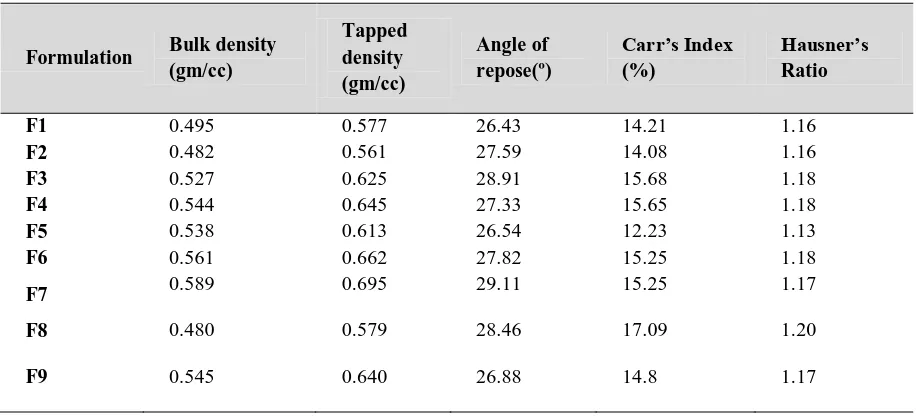
various flow properties of powder. The bulk density of
all the formulations was found to be in the range of
0.480 to 0.589 gm/cm3. The tapped density of all the
formulations was found to be in the range of 0.561 to
0.695gm/cm3. The Angle of Repose for all
formulations was found to be between the 25º to 30º
which show that the powder has good flow properties.
The compressibility index of all the formulations was
found to be ranging between 12 to 18 which indicating
that the powder has good flow properties. All the
formulations has shown the Hausner's ratio ranging
between 0 to 1.2 indicating the powder has good flow
properties (Table 3).
Post Compression Evaluation Parameters of
Efavirenz IR Tablets:
All the tablets were observed visually and did not show
any effect such as capping, chipping and lamination.
The physical characteristics of Efavirenz IR tablets (F1
to F9) such as weight variation, thickness, hardness,
friability and disintegration time were determined and
results of the formulations found to be within the limits
specified in official books ( Table no.4).The thickness
of the tablets of all formulations was found to be
within the range of 5.20 to 5.24 mm. A difference in
tablet hardness reflects difference in tablet density and
porosity. The hardness of tablets was found to be in the
range of 5.12 to 5.94 Kg/cm2. Percentage friability of
all formulations was found to be in the range of 0.21 to
0.38%.This indicates good handling property of the
prepared tablets. The average weight of the tablet is
900mg. The USP Pharmacopoeial limit for percentage
deviation is ± 5%. The weights of all tablets were
ranged from 886.2mg to 925.5mg. Disintegration test
was performed for all formulations and F8 shows less
disintegration time (2 min) compared to other
formulations (Figure 3).
In vitro dissolution studies were studied for all the
formulations in 0.1N HCl using Dissolution Apparatus
(Paddle type). The samples were withdrawn at
different time intervals and cumulative % drug release
was calculated. The results were shown in Table no.5
and Figure 4. Among all the formulated tablets F8
which is based on Efavirenz with 10% SSG gave the
highest dissolution (99.25%) in 60 mins. Based on
Gummadi Sridhar Babu * et al;DEVELOPMENT AND IN-VITRO EVALUATION OF IMMEDIATE RELEASE TABLETS..
International Journal of Pharmaceutical, Biological and Chemical Sciences (IJPBCS) | JULY-SEPT 2014 | VOLUME 3 | ISSUE 3 | 56-65| www.ijpbcs.net
Pa
ge
60
Sodium Starch Glycolate > Crospovidone>
Croscarmellose sodium.
Stability Studies:
Based on the drug release studies F8 is selected as a
best formulation and conducted the stability studies on
optimized formulation as per ICH guidelines. Stability
studies are continued for a period of one month and
Results of the stability study had shown no remarkable
change in the release profile of Efavirenz IR Tablets
after the stability shown in Table no.6.
CONCLUSION
In the present work efforts have been made to develop
Efavirenz Immediate release tablet as a promising
approach to enhance the drug release profile using
Superdisintegrants. The results showed that the release
of the drug was depended on different
superdisintegrants used, in that Sodium starch
glycolate can release drug faster compare to
Crospovidone and Croscarmellose sodium and the best
formulation (F8) containing 10 % SSG showed
minimum disintegration time and better drug release
profile as compare to other formulations.
ACKNOWLEDGEMENT
The authors thankful to the Management of Pragathi
Pharmacy College, Jangaon, Warangal, for providing
required facilities to carry out this research work.
Conflict of interest statement
We declare that we have no conflict of interest. The
authors alone are responsible for the content and
writing of the paper.
REFERENCES
1. Schreiner, T., Immediate drug release from solid oral
dosage forms, J Pharm Sci., 2005; 5th edition: 120-133.
2. Jani GK, Goswami JM, Prajapati VD; Studies on
Formulation and Evaluation of new Superdisintegrants
for Dispersible Tablets. Int. J. Pharm. Expt., 2005; 2:
37-43.
3. Lieberman HA, Lachman L, Schwartz JB;
Pharmaceutical Dosage Forms, 2nd edition, Marcel
Dekker Inc, New York.1989; 1: 195- 229.
4. G. Sridhar Babu et al., Formulation and Evaluation of
Fast dissolving Tablets of Carbamazepine by Direct
Compression using superdisintegrants. Int. J. Ph.sciences
letters,2014; 4(5) :432-436
5. Martindale. The complete Drug reference, 32th ed. The
Pharmaceutical press, London, 1999; P 1473.
6. Chetan N. Yeole, SagarS.Darekar, Amit Gupta, Ganga
Shrinivasan, Formulation and Evaluation of Immediate
Release Tablet of Paroxetine Hydrochloride, Journal of
Pharmacy Research, 2010 ; 3(8):1736-1738
7. Manikandan M, Kannan K, Selvamuthukumar S et al.
(2012). Formulation development and evaluation of
Emtricitabine and Tenofovir Disproxil Fumarate Tablets.
Int. J. Drug Dev. & Res., 4(1): 247-256.
8. Jaysweh J Harani, Dhaval A Rathod, Kantilal R Vadila.
Orally disintegrating tablets: A review, Tropial Journal
of Pharm.Sciences.2009; 8(2); 161-172.
9. Vijay Kumar D. et al. Development and Evaluation of
Celecoxib buccal Mucoadhesive Patches, International
Journal of Pharmacy & Therapeutics, 2013; 4(2):76-81.
10. Bhupendra G. Prajapati, Niklesh Patel and Hitesh K.
Patel. Sustained release itopride hydrochloride matrix
tablet. Journal of Pharmaceutical Research and Health
Care. 2010; 2(1):75-83.
11. Shoukri RA, Ahmed IS, Shamma RN; In vitro and in
vivo Evaluation of Nimesulide Lyophilized Orally
Disintegrating Tablets. European Journal of
Pharmaceutics and Biopharmaceutics, 2009; 73: 162–
171.
12. Jani GK, Goswami JM, Prajapati VD; Studies on
Gummadi Sridhar Babu * et al;DEVELOPMENT AND IN-VITRO EVALUATION OF IMMEDIATE RELEASE TABLETS..
International Journal of Pharmaceutical, Biological and Chemical Sciences (IJPBCS) | JULY-SEPT 2014 | VOLUME 3 | ISSUE 3 | 56-65| www.ijpbcs.net
Pa
ge
61
for Dispersible Tablets. Int. J. Pharm. Expt., 2005; 2:
37-43.
13. Hwang R, Peck GR; Systematic Evaluation of the
Compression and Tablet Characteristics of Various
Types of Microcrystalline Cellulose, Pharm. Technol.,
2001; 25(3): 112–132.
14. Lahdenpaa E, Niskanen M, Yliruusi J; Crushing
Strength, Disintegration Time, and
Weight Variation of Tablets Compressed from Three
Avicel PH Grades and Their Mixtures. Eur. J. Pharm.
Biopharm., 1997; 43: 315–322.
15. Campisi B, Chicco D,Vojnovic D, Phan-Tanluu R;
Experimental Design for a Pharmaceutical Formulation:
Optimization and Robustness. J.Pharm. Biomed. Anal.,
1998; 18: 57-65.
Table 1: Formulation of Efavirenz IR tablets
Ingredients F1 (mg) F2
(mg) F3 (mg)
F4
(mg) F5 (mg) F6 (mg)
F7 (mg)
F8 (mg)
F9 (mg)
Efavirenz 600 600 600 600 600 600 600 600 600
PVP 45 45 45 45 45 45 45 45 45
CCS 45 -- -- 67.5 -- -- 90 -- --
SSG -- 45 -- -- 67.5 -- -- 90 --
CP -- -- 45 -- -- 67.5 -- -- 90
Talc 18 18 18 18 18 18 18 18 18
Magnesium
Stearate 9 9 9 9 9 9 9 9 9
SLS 18 18 18 18 18 18 18 18 18
MCC 165 165 165 42.5 142.5 142.5 120 120 120
TOTAL (mg) 900 900 900 900 900 900 900 900 900
Table 2: Drug-Excipient compatibility Study
S.No Structure Wave number
(cm-1) Pure API API+Excipients
1 C-OH ( -COOH, stretching ) 3405-3395 3405 3401
2 R2NH amines, N-H stretching 3350-3310 3332 3325
3 Aromatic C-C, Stretching 1600-1585 1619 1610
4 Alkyl halides C-F, Stretching 1350-1000 1261 1255
5 Alkyl halides C-Cl, Stretching 850-750 760 760
Gummadi Sridhar Babu * et al;DEVELOPMENT AND IN-VITRO EVALUATION OF IMMEDIATE RELEASE TABLETS..
International Journal of Pharmaceutical, Biological and Chemical Sciences (IJPBCS) | JULY-SEPT 2014 | VOLUME 3 | ISSUE 3 | 56-65| www.ijpbcs.net
Pa
ge
62
Table 3: Pre compression Parameters of Powder blend
Formulation Bulk density
(gm/cc)
Tapped density (gm/cc)
Angle of repose(º)
Carr’s Index (%)
Hausner’s Ratio
F1 0.495 0.577 26.43 14.21 1.16
F2 0.482 0.561 27.59 14.08 1.16
F3 0.527 0.625 28.91 15.68 1.18
F4 0.544 0.645 27.33 15.65 1.18
F5 0.538 0.613 26.54 12.23 1.13
F6 0.561 0.662 27.82 15.25 1.18
F7 0.589 0.695 29.11 15.25 1.17
F8 0.480 0.579 28.46 17.09 1.20
F9 0.545 0.640 26.88 14.8 1.17
Table 4: Post compression parameters of Efavirenz IR tablets
Formulation Weight
Variation(mg) Thickness
(mm)
Hardness
(kg/cm2)
Percentage of
weight loss
(%)
Disintegration time (min)
F1 895.3 5.21 5.12 0.29 5
F2 888.1 5.20 5.94 0.32 4
F3 910.5 5.20 5.33 0.21 3
F4 915.7 5.21 5.20 0.21 4
F5 886.2 5.21 5.71 0.30 3
F6 891.9 5.24 5.89 0.31 3
F7 910.3 5.20 5.26 0.22 3
F8 925.5 5.23 5.66 0.32 2
F9 895.7 5.22 5.58 0.29 3
Table 5: Comparative % drug release profiles of all formulations (F1-F9)
Time
(min)
Cumulative % Drug release
F1 F2 F3 F4 F5 F6 F7 F8 F9
0 0 0 0 0 0 0 0 0
5 11.41 20.92 16.53 16.47 22.37 18.73 24.38 27.51 26.04
10 15.86 26.89 23.94 26.55 30.32 28.46 35.72 38.64 37.9
15 22.54 33.63 28.46 42.44 47.65 43.89 47.92 52.02 48.35
30 31.78 41.13 38.86 49.03 55.96 52.87 61.77 69.14 63.25
45 40.57 50.87 44.93 61.77 65.78 62.54 83.03 84.88 85.55
Gummadi Sridhar Babu * et al;DEVELOPMENT AND IN-VITRO EVALUATION OF IMMEDIATE RELEASE TABLETS..
International Journal of Pharmaceutical, Biological and Chemical Sciences (IJPBCS) | JULY-SEPT 2014 | VOLUME 3 | ISSUE 3 | 56-65| www.ijpbcs.net
Pa
ge
63
Table.6: Various physicochemical parameters after stability study
Conditions Parameter Initial
data Data after one month
Room temperature Hardness(kg/cm2) 5.66 5.66 Room temperature Friability (%) 0.32 0.31
Room temperature Disintegration time
(min) 2 2
Room temperature % drug release 99.25 99.17 Intermediate Hardness(kg/cm2) 5.66 5.64
Intermediate Friability (%) 0.32 0.32
Intermediate Disintegration time
(min) 2 2
Intermediate % drug release 99.25 99.19 Accelerated Hardness(kg/cm2) 5.66 5.65
Accelerated Friability (%) 0.32 0.32
Accelerated Disintegration time
(min) 2 2
Accelerated % drug release 99.25 99.23
Figure: 1 Structure of Efavirenz
Gummadi Sridhar Babu * et al;DEVELOPMENT AND IN-VITRO EVALUATION OF IMMEDIATE RELEASE TABLETS..
International Journal of Pharmaceutical, Biological and Chemical Sciences (IJPBCS) | JULY-SEPT 2014 | VOLUME 3 | ISSUE 3 | 56-65| www.ijpbcs.net
Pa
ge
64
Fig.3: Comparative graph of Disintegration time for all formulations
Fig.4: Comparative Percentage drug release Profile of all formulations
0 1 2 3 4 5 6
F1 F2 F3 F4 F5 F6 F7 F8 F9
D
is
in
te
gr
at
io
n
T
im
e(m
in
)
Formulation
0 10 20 30 40 50 60 70 80 90 100
0 10 20 30 40 50 60
%
Dr
u
g
Re
le
as
ed
Time (min)
Gummadi Sridhar Babu * et al;DEVELOPMENT AND IN-VITRO EVALUATION OF IMMEDIATE RELEASE TABLETS..
International Journal of Pharmaceutical, Biological and Chemical Sciences (IJPBCS) | JULY-SEPT 2014 | VOLUME 3 | ISSUE 3 | 56-65| www.ijpbcs.net
Pa
ge
65
Figure.5: FTIR of Pure Efavirenz
Figure.5: FTIR of Pure Efavirenz
Figure.6: FTIR of Pure Efavirenz with Excipients
*Corresponding author address:
Email address: