
150
SYNTHESIS, ANALYSIS AND BIOACTIVITY EVALUATION OF
COPPER(II) TETRADENTATE SCHIFF BASE COMPLEX
HN Aliyu* and RS Zayyan
Department of Chemistry, Bayero University, P. M. B. 3011, Kano, Nigeria.
ABSTRACT
A tetradentate Schiff base ligand was prepared by a 2:1 molar condensation of 4 – (Benzeneazo) salicylaldehyde with o-phenylenediamine. The copper (II) chelate was synthesized by refluxing ethanolic solutions of the schiff base ligand and copper (II) chloride. The ligand and the copper (II) complex were characterized by melting point, decomposition temperature, molar conductance, infrared, elemental analysis, antibacterial, antifungal and potentiometry. The ligand is orange, has a melting point temperature of 193oC, and percentage yield of 70%. The copper (II) complex is red, has decomposition temperature of 286oC and percentage yields of 62%. The ligand and its copper (II) complex are not soluble in water and most common organic solvents except DMSO and DMF. The molar conductance of the complex determined is 7.9 ohm-1cm2mol-1. The band at 1590cm-1 in the infrared spectral data of the ligand is assigned to v(C=N) stretching vibrations, which undergoes a shift to lower wave numbers at 1538cm-1 on coordination to the metal ions. The band at 586 and 511cm-1 are attributable to
v(Cu-N) and v(Cu-O) vibration modes. The elemental analysis of the complex established 1:1 copper – ligand ratio. The antifungal and antibacterial tests carried out on the ligand and its copper (II) copper showed moderate activity. The dissociation constant of the ligand determined is 11.67, indicating a week acid. The ratio of metal to ligand determined potentiometrically suggested 1:1. The stability constant and the Gibb’s free energy of copper (II) complex determined is 3.16X10¹¹ and 4.15 KJmol-1, respectively, establishing that the complex is very stable.
Keywords: 4 – (Benzeneazo) Salicylaldehyde, Potentiometry, Complex compound, Schiff base, Molar Conductance and Solubility.
INTRODUCTION
A Schiff base is a compound formed from the condensation of either an aldehyde or a ketone [1-3]. The carbonyl group of the aldehyde gives aldimines while that of ketone gives ketoimines. It has been known that different metal ions on interaction with Schiff bases yield chelates, for example Tsumaki [4] reported [Co(sal2-en)]
Complex which received a great attention owing to its ability to undergo reversible adduct formation with molecular oxygen. The oxygenation ability of the complex was first recognized by Hassan et al [5]. However, the mechanism for the oxygenation process was not well understood until recently with the advent of modern physical techniques. Xishi et al [6], reported the synthesis and characterization of a novel Schiff base ligand formed from the condensation of 2, 2-bis
(P-methoxyphenylamine) and Salicylaldehyde and its Mn(II), Co(II) and Cu(II) complexes. Then Ben Saber et al [7], reported the synthesis and characterization of Cr(III), Fe(III), Co(II) and Ni(II) complexes with a Schiff base derived from 4-dimethylamino benzaldehyde and primary amines. The chemical analysis data showed the formation of (1:1) metal - ligand ratio and a square planar geometry was suggested for Co(II) and Ni(II) complex while an octahedral structure was suggested for Cr(III) and Fe(III) complexes. Ben Saber et al [7] reported the synthesis of a Schiff base derived from salicylaldeyde, and Histidine and its complex compounds with divalent transition metal ions. The complexes were investigated by elemental analysis and were found to be of 1:1 metal to ligand ratio. Transition metal Schiff base complexes are used in various fields, such as medicine, agriculture, industries etc. For
Corresponding Author: - HN Aliyu Email: [email protected]
International Journal of
Medicinal Chemistry & Analysis
www.ijmca.com
e ISSN 2249 - 7587
151
example, [Co (acac2-en)] in dimethylformamide, pyridine
and substituted pyridines proved to be involved in oxygen metabolism [8]. Transition metal complexes with 1, 10 – phenanthroline and 2, 2 – bipyridine are used in petroleum refining [9]. Schiff base formed by the condensation of 1-formyl-2-hydry-3- naphtholic arylamide with O-hydroxyl or O-methoxy aniline complexes of Co (II), Ni (II), Cu (II) and Zn (II) are useful as figments [10]. Oxovanadium Complexes have been found strongly active, against some type of Leukemia [11]. Transition metal complexes derived from a number of amino acids have been reported to have biological activity [12]. Morad et al [13] reported the antibacterial activity of Ni(II) with salicyaldehyde and 2-amino-benzoic acid complex. Popora and Berova [14] reported that copper is good for liver function, its level in blood and urine has influence in pregnancy disorders, nephritis hepatitis, leprosy, anemia and leukemia in children.
This paper reports the synthesis, analysis and bioactivity evaluation of N,N’-bis(4-enzeneazo salicylidene)-o-phenylenediiminatocopper(II) complex due to paucity of information.
MATERIALS AND METHODS
All the glass wares used were washed with detergent, rinsed with distilled water and dried in an oven. All the reagents and solvents used were of analytical grade (AnalaR or BDH) and were used without further purification. Molar conductance measurements were carried out using Cyber Scan 500 model. Electric metler balance model AB 54 was used for weighing. Infrared spectral analysis data were recorded using Fourier Transform IR Genesis series model Nujol, within 400 – 4000cm-1. The pH measurements were carried out using Jenway pH meter model 3320. The molar conductance measurements were carried out on a cyber scan 500 model and the melting/decomposition temperatures were carried out using Gallenkamp melting point apparatus.
Preparation of the Schiff base ligand
0.01mol (1.814g) of o-phenylenediamine was added slowly into a solution of 0.02mol (4.5245g) 4-(Benzeneazo) salicylaldehyde (an intermediate) in 20cm3 ethanol. After refluxing the reaction mixture for 2 hours, the precipitate that formed was separated, washed several times using ethanol, followed by recrystallisation in ethanol and drying at 500C in an oven overnight [15].
Preparation of copper (II) Schiff base complex
The complex was prepared by refluxing a mixture of aqueous solution of CuCl2.2H2O (1.0mmol; 0.1705g)
and hot ethanolic solution of the prepared Schiff base (0.524g) for 2 hours. The reaction mixture was allowed to cool in an ice bath and the greenish yellow precipitate obtained was separated, washed with ethanol and diethyl ether, followed by drying at 500C overnight [15].
Determination of dissociation Constant (pKa) of the tetradentate Schiff base
The dissociation constant of the Schiff base ligand was determined by introducing a standardized pH meter electrode into a 400cm3 beaker containing magnetic stirrer bar, 90cm3 water, 100cm3 of 0.2mol dm-3 KNO3
and 10cm3 of 0.4mol dm-3 Schiff base ligand solution. To this mixture, 10cm3 of standardized 0.5mol dm-3 aqueous solution of NaOH was added gradually and the corresponding pH value recorded after each addition [16].
Determination of number of coordinated Schiff base in the complex
To a 400cm3 beaker containing 100cm3 of 0.2 mol dm-3 KNO3, 10cm3 0.1 mol dm-3 HNO3 90cm3 of
water and 1mmole of copper (II) chloride were added. Now 10cm3 of 0.4 mol dm-3 sodium salt which was prepared by neutralizing a weighed solid ligand with calculated amount of standardized 0.5 mol dm-3 NaOH solution. After each 0.2cm3 aliquote addition the corresponding pH was recorded. From the knowledge of the pH recorded, the average number of coordinated Schiff base per copper (II) ion was calculated as reported by Robert [16] and Angelici [17].
RESULT AND DISCUSSION
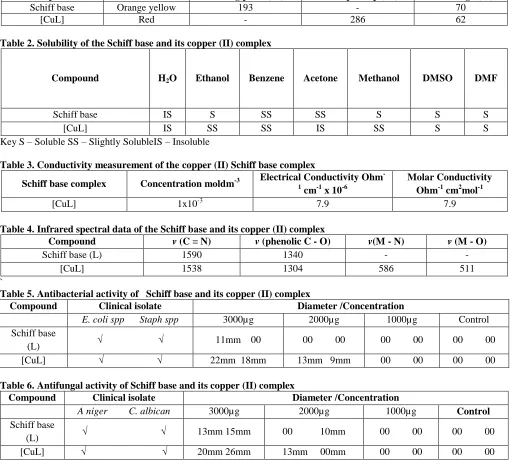
The N,N’–bis (4- Benzeneazo salicylidene)-o-phenylenediimine ligand was prepared by a 2:1 molar condensation of o-phenylenediimine with a reaction intermediate, 4–(Benzeneazo) salicylaldehyde. The copper (II) chelate was synthesized by refluxing ethanolic solutions of the schiff base ligand and copper (II) chloride [15]. The Schiff base ligand is orange, has a melting point of 193oC and percentage yield of 70%. The complex is red, has decomposition temperature of 286oC and percentage yield of 62%. The results are presented in Table 1. The solubility tests of the Schiff base ligand and its copper (II) complex in water and common organic solvents carried out revealed that the ligand is soluble in methanol, ethanol, DMSO and DMF, however, the complex is slightly soluble in most organic solvents but readily soluble insoluble in water, slightly soluble in most organic solvents, readily soluble in DMSO and DMF, but insoluble in water (Table 2). The molar conductance of 10
-3M complex in DMSO solution is 7.9 ohm-1cm2mol-1,
152
coli spp with a diameter of inhibition zone of 11mm per 3000µg concentration. The copper (II) complex on the other hand showed higher activity against the bacterial isolates particularly at 3000µg concentration and is also found to be more active on E. coli spp with a diameter of inhibition zone of 22mm (Table 5). The results of the antifungal activities of the free Schiff base and its copper (II) complex are similar to that of antibacterial and that the copper (II) Schiff base complex exhibits higher activity against the bacterial and fungal isolates than the ligand (Table 6). The dissociation constant of the Schiff base ligand determined is 11.67, which revealed that it is highly
basic. The result is presented on Table 7. The average number of Schiff base ligand coordinated to the copper (II) ion determined potentiometrically, is one, consistent with 1:1 metal – Schiff base (Table 8). The stability constant and the Gibb’s free energy of the complex determined are 4.0X10¹³ and -75.8 KJmol-1, indicating that the complex is very stable (Table 9).
On the basis of the spectral data and other analytical results of the Schiff base and its copper (II) complex, the following molecular structure of the complex is proposed.
Table 1. Physical properties of the Schiff base ligand and its copper (II) complex
Compound Colour Melting point (oC) Decomp. temp (oC) Percentage (%)
Schiff base Orange yellow 193 - 70
[CuL] Red - 286 62
Table 2. Solubility of the Schiff base and its copper (II) complex
Compound H2O Ethanol Benzene Acetone Methanol DMSO DMF
Schiff base IS S SS SS S S S [CuL] IS SS SS IS SS S S Key S – Soluble SS – Slightly SolubleIS – Insoluble
Table 3. Conductivity measurement of the copper (II) Schiff base complex
Schiff base complex Concentration moldm-3 Electrical Conductivity Ohm
-1 cm-1 x 10⁻⁶
Molar Conductivity Ohm-1 cm2mol-1
[CuL] 1x10⁻³ 7.9 7.9
Table 4. Infrared spectral data of the Schiff base and its copper (II) complex
Compound v (C = N) v (phenolic C - O) v(M - N) v (M - O)
Schiff base (L) 1590 1340 - - [CuL] 1538 1304 586 511 `
Table 5. Antibacterial activity of Schiff base and its copper (II) complex
Compound Clinical isolate Diameter /Concentration
E. coli spp Staph spp 3000µg 2000µg 1000µg Control Schiff base
(L) √ √ 11mm 00 00 00 00 00 00 00 [CuL] √ √ 22mm 18mm 13mm 9mm 00 00 00 00
Table 6. Antifungal activity of Schiff base and its copper (II) complex
Compound Clinical isolate Diameter /Concentration
A niger C. albican 3000µg 2000µg 1000µg Control
Schiff base
153
Table 7. Dissociation constant (pKa) of the tetradentate Schiff baseS/No Vol. of NaOH (cm3) pH [H+] [OH-] [Na+] Atotal pKa
1 200.5 0.5 9.56 1.80E-10 8.80E-05 1.20E-03 0.01995 10.9645 2 201.0 1.0 9.91 8.20E-11 2.00E-04 2.39E-03 0.0199 10.9919 3 201.5 1.5 10.22 4.00E-11 4.00E-04 3.57E-03 0.019851 11.1152 4 202.0 2.0 10.51 2.10E-11 7.80E-04 4.75E-03 0.019802 11.2851 5 202.5 2.5 10.74 1.20E-11 1.33E-03 5.93E-03 0.019753 11.4323 6 203.0 3.0 10.93 7.90E-12 2.05E-03 7.09E-03 0.019704 11.5684 7 203.5 3.5 11.07 5.70E-12 2.84E-03 8.26E-03 0.019656 11.6639 8 204.0 4.0 11.18 4.40E-12 3.65E-03 9.41E-03 0.019608 11.7356 9 204.5 4.5 11.27 3.60E-12 4.49E-03 1.06E-02 0.01956 11.7916 10 205.0 5.0 11.34 3.10E-12 5.28E-03 1.17E-02 0.019512 11.8233 11 205.5 5.5 11.41 2.60E-12 6.20E-03 1.28E-02 0.019465 11.8702 12 206.0 6.0 11.46 2.30E-12 6.96E-03 1.40E-02 0.019417 11.8816 13 206.5 6.5 11.51 2.10E-12 7.81E-03 1.51E-02 0.01937 11.9031 14 207.0 7.0 11.55 1.90E-12 8.56E-03 1.62E-02 0.019324 11.9064 15 207.5 7.5 11.58 1.80E-12 9.18E-03 1.73E-02 0.019277 11.8877 16 208.0 8.0 11.63 1.60E-12 1.03E-02 1.85E-02 0.019231 11.9365 17 208.5 8.5 11.66 1.50E-12 1.10E-02 1.96E-02 0.019185 11.9306 18 209.0 9.0 11.69 1.40E-12 1.18E-02 2.07E-02 0.019139 11.9301 19 209.5 9.5 11.72 1.30E-12 1.27E-02 2.18E-02 0.019093 11.9353 20 210.0 10.0 11.74 1.20E-12 1.33E-02 2.29E-02 0.019048 11.9082 Average pKa = 11.67308
Table 8. Determination of average number of coordinated Schiff base to copper (II) ion
S/NO Vol(cm3) pH [H+] [OH-] Mtotal Log[A2-] n
1 0 2.29 0.003432 4.70652E-12
154
28 5.4 6.1 5.31E-07 3.03879E-08 0.004864 8.39 1.96 29 5.6 6.14 4.85E-07 3.33196E-08 0.004864 -8.36 2.04 30 5.8 6.19 4.32E-07 3.73852E-08 0.004859 -8.31 2.12 31 6 6.27 3.59E-07 4.49469E-08 0.004854 -8.23 2.19 Average n value = 1.156
Table 9. Stability constant and the Gibb’s free energy of the complex
Compound Stability constant (K) Gibb’s Free Energy (kJmol-1)
[CuL] 4.0X10¹³ -75.8
Figure 1. proposed molecular structure of the copper (II) Schiff base complex
N
N C
C
O O
Cu
H H
N N
N N
REFERENCES
1. Holm RH, Everett JR and Chakravorty RS. Metal Complexes of Schiff Bases and -ketoimines. Inorganic Chemistry, 7, 1966, 83-214.
2. Hobday MD and Smith TD. N, N-ethylene bis(salicylideneiminato), Transition Metal ion Chelates. Coordination Chemistry Review, 9, 1972, 311-337.
3. Pierre. Organic reactions, Johnson Wiley Pub. New York USA. 1987, 73-79.
4. Tsumaki T. Synthesis and characterization of bis(salicyl)ethylenediiminatocobalt(II) complex, Bull Chem Soc Jap, 13, 1983, 254.
5. Hassan AMA. Co (II) and Fe (III) chelates drived from Isatin and some amines. Journal of Islamic Academy Sciences, 4(4), 1998, 271-274.
6. Xishi T, Xian HY, Qiang C and Minyu T. Synthesis of Some Transition Metal Complexes of a Novel Schiff Base Ligand Derived from 2, 2’ – Bis(p-Methoxy Phenylamine) and Salicylic Aldehyde. Molecules, 8, 2003, 439-443.
7. Ben Saber SM, Mailub AA, Hudere SS and El-ajaily MM. Complexation behavior of some Schiff base complexes toward transition metal ions. Micro Chemical Journal, 81, 2005, 191-194.
8. Hanna Wageih G, Moawaad Mona Synthesis, characterization and antimicrobial activity of Co (II), Ni (II) and Cu (II) with new asymmetrical Schiff base. Transition Metal Chemistry, 26(6), 2001, 644-651.
9. John J Alexander and Magret JS. Chemistry with Laboratory, Harcout Bruce, Johanovich, 1976, 63-64.
10. Gupta SK, Hitchcock and Kushwah YS. Synthesis, characterization and crystal structure of a Ni (ii) shiff base complex derived from acetylacetone and ethylene diamine. J. of coord. Chem, 55(12), 2002, 1401-1407.
11. Dong, Y, Narla, RK, Sudbeck, E. Synthesis, X-ray structure, and anti-leukemic activity of oxovanadium (IV) complexes.
Journal of Inorganic Biochemistry, 78, 2002, 321-330.
12. Zahid H Chohan, Arif M, Akhtar A and Claudiu T. Supuran Bioinorg Chemand Al, 2007, 1-13. 13. Morad FM, El-ajaily S and Gweirif B. J. of science and its Al, 1, 2007, 72-78.
14. Popora E and Berova S. coer as coating for ceramies. Bulgarius chemical abstract, 84, 1981, 184.
15. Jiannings L, Bo-wan W, Bing Z and Yungchun. Synthesis and characterization of Metal complexes of Cu(II), Ni(II), 2n(II), Co(II), Mn(II) and Cadimium. Turk J Chem, 30, 2005, 11- 18.
16. Gregory S, Thomas BR and Robert JA. Synthesis and techniques in inorganic chemistry 3rd edition, Longman publishers, London. 1978, 119-126.
17. Angellici RJ. Synthesis and Technique in inorganic chemistry 2nd Edition, W.B. Saunder Company Philadelphia, London, Toronto, 1977, 115-125.
18. Geary WJ. The use of conductivity measurements in organic solvents for characterization of coordination compounds.
Coord Chem Review, 7(1), 1971, 81–122.
19. Ahmed A and Akhtar F. Cu (II) and Ni(II) complexes with a tetradentate Schiff base derived from 2-hydroxy-1-naphthaldehyde and ethylenediamine. Indian Journal Chemistry, 20A, 1983, 737-758.
![Table 7. Dissociation constant (pKa) of the tetradentate Schiff base S/No Vol. of NaOH (cm3) pH [H+]](https://thumb-us.123doks.com/thumbv2/123dok_us/8884027.1821557/4.612.54.564.80.343/table-dissociation-constant-tetradentate-schiff-base-vol-naoh.webp)
![Table 9. Stability constant and the Gibb’s free energy of the complex Compound [CuL]](https://thumb-us.123doks.com/thumbv2/123dok_us/8884027.1821557/5.612.47.566.72.293/table-stability-constant-gibb-free-energy-complex-compound.webp)
