106
MOLECULAR DOCKING STUDIES – A REVIEW
*
B. Vijayakumar and
1P. Dheen Kumar
*Department of Pharmaceutical Chemistry, Sri Venkateswara College of Pharmacy,
R.V.S Nagar, Chittoor-517127, Andhra Pradesh, India.
1
Department of Pharmaceutical Chemistry, EJS Pillai College of Pharmacy, Nagappatinam, Tamilnadu, India.
ABSTRACT
Docking is frequently used to predict the binding orientation of small molecule drug candidates to their protein targets in order to in turn predict the affinity and activity of the small molecule. Hence docking plays an important role in the rational design of drugs. Given the biological and pharmaceutical significance of molecular docking, considerable efforts have been directed towards improving the methods used to predict docking. This present review focused on importance of docking in molecular modeling, types of docking and application of docking in varies fields.
Keywords: Docking, Macromolecular docking, Applications.
INTRODUCTION
In the field of molecular modeling, docking is a method which predicts the preferred orientation of one molecule to a second when bound to each other to form a stable complex. Knowledge of the preferred orientation in turn may be used to predict the strength of association or binding affinity between two molecules using for example scoring functions. The associations between biologically relevant molecules such as proteins, nucleic acids, carbohydrates, and lipids play a central role in signal transduction. Furthermore, the relative orientation of the two interacting partners may affect the type of signal produced (e.g., agonism vs antagonism). Therefore docking is useful for predicting both the strength and type of signal produced.
Docking is frequently used to predict the binding orientation of small molecule drug candidates to their protein targets in order to in turn predict the affinity and activity of the small molecule. Hence docking plays an important role in the rational design of drugs. Given the biological and pharmaceutical significance of molecular docking, considerable efforts have been directed towards improving the methods used to predict docking.
Macromolecular docking is the computational modelling of the quaternary structure of complexes formed by two or
more interacting biological macromolecules. Protein– protein complexes are the most commonly attempted targets of such modelling, followed by protein–nucleic acid complexes.
The ultimate goal of docking is the prediction of the three dimensional structure of the macromolecular complex of interest as it would occur in a living organism. Docking itself only produces plausible candidate structures. These candidates must be ranked using methods such as scoring functions to identify structures that are most likely to occur in nature.
The term docking originated in the late 1970s, with a more restricted meaning; then, docking meant refining a model of a complex structure by optimizing the separation between the interactors but keeping their relative orientations fixed. Later, the relative orientations of the interacting partners in the modelling was allowed to vary, but the internal geometry of each of the partners was held fixed. This type of modelling is sometimes referred to as rigid docking. With further increases in computational power, it became possible to model changes in internal geometry of the interacting partners that may occur when a complex is formed. This type of modelling is referred to as flexible docking [1].
Corresponding Author: - B. Vijayakumar Email: [email protected]
International Journal of
Medicinal Chemistry & Analysis
107
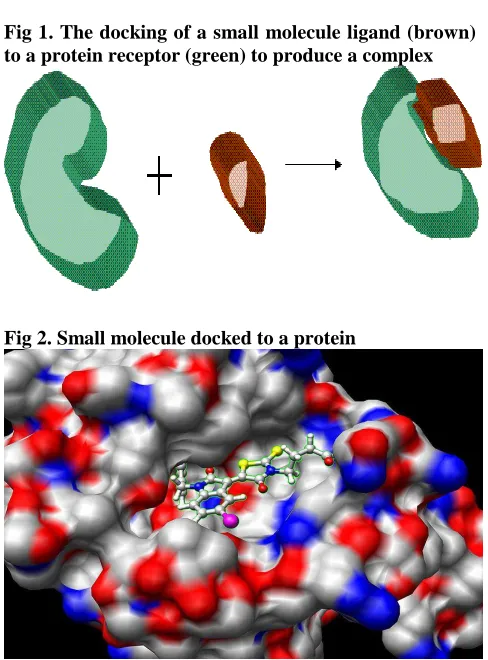
Docking (molecular) Receptor or host or lock – The receiving molecule, most commonly a protein or other biopolymer.
Ligand or guest or key – The complementary partner
molecule which binds to the receptor. Ligands are most often small molecules but could also be another biopolymer.
Docking – Computational simulation of a candidate ligand binding to a receptor.
Binding mode – The orientation of the ligand relative to the receptor as well as the conformation of the ligand and receptor when bound to each other.
Pose – A candidate binding mode.
Scoring – The process of evaluating a particular pose by counting the number of favorable intermolecular interactions such as hydrogen bonds and hydrophobic contacts.
Ranking – The process of classifying which ligands are most likely to interact favorably to a particular receptor based on the predicted free-energy of binding [2].
Fig 1. The docking of a small molecule ligand (brown) to a protein receptor (green) to produce a complex
Fig 2. Small molecule docked to a protein
Definition of problem
Molecular docking can be thought of as a problem of lock-and-key, where one is interested in finding the correct relative orientation of the key which will open up the lock (where on the surface of the lock is
the key hole, which direction to turn the key after it is inserted, etc.). Here, the protein can be thought of as the lock and the ligand can be thought of as a key. Molecular docking may be defined as an optimization problem, which would describe the best-fit orientation of a ligand that binds to a particular protein of interest. However, since both the ligand and the protein are flexible, a hand-in-glove analogy is more appropriate than lock-and-key. During the course of the process, the ligand and the protein adjust their conformation to achieve an overall best-fit and this kind of conformational adjustments resulting in the overall binding is referred to as induced-fit.
The focus of molecular docking is to
computationally simulate the molecular recognition process. The aim of molecular docking is to achieve an optimized conformation for both the protein and ligand and relative orientation between protein and ligand such that the free energy of the overall system is minimized [3].
Docking approaches
Two approaches are particularly popular within the molecular docking community. One approach uses a matching technique that describes the protein and the ligand as complementary surfaces. The second approach simulates the actual docking process in which the ligand-protein pairwise interaction energies are calculated. Both approaches have significant advantages as well as some limitations. These are outlined below.
Shape complementarity
108
geometric descriptions of the ligands to find optimalbinding.
Simulation
The simulation of the docking process as such is a much more complicated process. In this approach, the protein and the ligand are separated by some physical distance, and the ligand finds its position into the protein’s active site after a certain number of moves in its conformational space. The moves incorporate rigid body transformations such as translations and rotations, as well as internal changes to the ligand’s structure including torsion angle rotations. Each of these moves in the conformation space of the ligand induces a total energetic cost of the system, and hence after every move the total energy of the system is calculated. The obvious advantage of the method is that it is more amenable to incorporate ligand flexibility into its modeling whereas shape complementarity techniques have to use some ingenious methods to incorporate flexibility in ligands. Another advantage is that the process is physically closer to what happens in reality, when the protein and ligand approach each other after molecular recognition. A clear disadvantage of this technique is that it takes longer time to evaluate the optimal pose of binding since they have to explore a rather large energy landscape. However grid-based techniques as well as fast optimization methods have significantly ameliorated these problems [4].
Mechanics of docking
To perform a docking screen, the first requirement is a structure of the protein of interest. Usually the structure has been determined using a biophysical technique such as x-ray crystallography, or less often, NMR spectroscopy. This protein structure and a database of potential ligands serve as inputs to a docking program. The success of a docking program depends on two components: the search algorithm and the scoring function.
The search space in theory consists of all possible orientations and conformations of the protein paired with
the ligand. However in practice with current
computational resources, it is impossible to exhaustively explore the search space—this would involve enumerating all possible distortions of each molecule (molecules are dynamic and exist in an ensemble of conformational states) and all possible rotational and translational orientations of the ligand relative to the protein at a given level of granularity. Most docking programs in use account for a flexible ligand, and several attempt to model a flexible protein receptor. Each snapshot of the pair is referred to as a pose. A variety of conformational search strategies have been applied to the ligand and to the receptor. These include:
systematic or stochastic torsional searches about rotatable bonds
molecular dynamics simulations
genetic algorithms to evolve new low energy
conformations
Ligand flexibility
Conformations of the ligand may be generated in the absence of the receptor and subsequently docked[13] or conformations may be generated on-the-fly in the presence of the receptor binding cavity,[14] or with full rotational flexibility of every dihedral angle using fragment based docking.[15] Force field energy evaluation are most often used to select energetically reasonable conformations,[16] but knowledge-based methods have also been used [5].
Receptor flexibility
Computational capacity has increased
dramatically over the last decade making possible the use of more sophisticated and computationally intensive methods in computer-assisted drug design. However, dealing with receptor flexibility in docking methodologies is still a thorny issue. The main reason behind this difficulty is the large number of degrees of freedom that have to be considered in this kind of calculations. Neglecting it, however, leads to poor docking results in terms of binding pose prediction.
Multiple static structures experimentally
determined for the same protein in different conformations are often used to emulate receptor flexibility. Alternatively rotamer libraries of amino acid side chains that surround the binding cavity may be searched to generate alternate but energetically reasonable protein conformations.
Rigid-body docking vs. flexible docking
If the bond angles, bond lengths and torsion angles of the components are not modified at any stage of complex generation, it is known as rigid body docking. A subject of speculation is whether or not rigid-body docking is sufficiently good for most docking. When substantial conformational change occurs within the components at the time of complex formation, rigid-body docking is inadequate. However, scoring all possible conformational changes is prohibitively expensive in computer time. Docking procedures which permit conformational change, or flexible docking procedures, must intelligently select small subset of possible conformational changes for consideration [6].
Methods
Successful docking requires two criteria:
Generating a set configuration which reliably includes at least one nearly correct one.
Reliably distinguishing nearly correct configurations from the others.
109
case for antibodies and for competitive inhibitors. In othercases, a binding site may be strongly suggested by mutagenic or phylogenetic evidence. Configurations where the proteins interpenetrate severely may also be ruled out a priori.
After making exclusions based on prior knowledge or stereochemical clash, the remaining space of
possible complexed structures must be sampled
exhaustively, evenly and with a sufficient coverage to guarantee a near hit. Each configuration must be scored with a measure that is capable of ranking a nearly correct structure above at least 100,000 alternatives. This is a computationally intensive task, and a variety of strategies have been developed.
Reciprocal space methods
Each of the proteins may be represented as a simple cubic lattice. Then, for the class of scores which are discrete convolutions, configurations related to each other by translation of one protein by an exact lattice vector can all be scored almost simultaneously by applying the convolution theorem.[4] It is possible to construct reasonable, if approximate, convolution-like scoring functions representing both stereochemical and electrostatic fitness.
Reciprocal space methods have been used extensively for their ability to evaluate enormous numbers of configurations. They lose their speed advantage if torsional changes are introduced. Another drawback is that it is impossible to make efficient use of prior knowledge. The question also remains whether convolutions are too limited a class of scoring functions to identify the best complex reliably [7].
Monte Carlo methods
In Monte Carlo, an initial configuration is refined by taking random steps which are accepted or rejected based on their induced improvement in score (see the Metropolis criterion), until a certain number of steps have been tried. The assumption is that convergence to the best structure should occur from a large class of initial configurations, only one of which needs to be considered. Initial configurations may be sampled coarsely, and much computation time can be saved. Because of the difficulty of finding a scoring function which is both highly discriminating for the correct configuration and also converges to the correct configuration from a distance, the use of two levels of refinement, with different scoring functions, has been proposed.[7] Torsion can be introduced naturally to Monte Carlo as an additional property of each random move. Monte Carlo methods are not guaranteed to search exhaustively, so that the best configuration may be missed even using a scoring function which would in theory identify it. How severe a problem this is for docking has not been firmly established.
Scoring function
The scoring function takes a pose as input and returns a number indicating the likelihood that the pose represents a favorable binding interaction. Most scoring functions are physics-based molecular mechanics force fields that estimate the energy of the pose; a low (negative) energy indicates a stable system and thus a likely binding interaction. An alternative approach is to derive a statistical potential for interactions from a large database of protein-ligand complexes, such as the Protein Data Bank, and evaluate the fit of the pose according to this inferred potential.
There are a large number of structures from X-ray crystallography for complexes between proteins and high affinity ligands, but comparatively fewer for low affinity ligands as the later complexes tend to be less stable and therefore more difficult to crystallize. Scoring functions trained with this data can dock high affinity ligands correctly, but they will also give plausible docked conformations for ligands that do not bind. This gives a large number of false positive hits, i.e., ligands predicted to bind to the protein that actually doesn’t when placed together in a test tube [8].
One way to reduce the number of false positives is to recalculate the energy of the top scoring poses using (potentially) more accurate but computationally more intensive techniques such as Generalized Born or Poisson-Boltzmann methods. To find a score which forms a consistent basis for selecting the best configuration, studies are carried out on a standard benchmark (see below) of protein–protein interaction cases. Scoring functions are assessed on the rank they assign to the best structure (ideally the best structure should be ranked 1), and on their coverage (the proportion of the benchmark cases for which they achieve an acceptable result). Types of scores studied include:
Heuristic scores based on residue contacts.
Shape complementarity of molecular surfaces
(stereochemistry).
Free energies, estimated using parameters from
molecular mechanics force fields such as CHARMM or AMBER.
Phylogenetic desirability of the interacting regions.
Clustering coefficients.
It is usual to create hybrid scores by combining one or more categories above in a weighted sum whose weights are optimized on cases from the benchmark. To avoid bias, the benchmark cases used to optimize the weights must not overlap with the cases used to make the final test of the score.
110
(annotation of interactome). Several scoring functionshave been proposed for binding affinity / free energy
prediction. However the correlation between
experimentally determined binding affinities and the predictions of nine commonly used scoring functions have been found to be nearly orthogonal (R2 ~ 0). It was also observed that some components of the scoring algorithms may display better correlation to the experimental binding energies than the full score, suggesting that a significantly better performance might be obtained by combining the
appropriate contributions from different scoring
algorithms. Experimental methods for the determination of binding affinities are: surface plasmon resonance (SPR), Förster resonance energy transfer, radioligand-based techniques, isothermal titration calorimetry (ITC), Microscale Thermophoresis (MST) or spectroscopic measurements and other fluorescence techniques [9].
The CAPRI assessment
The Critical Assessment of PRediction of Interactions is an ongoing series of events in which researchers throughout the community try to dock the same proteins, as provided by the assessors. Rounds take place approximately every 6 months. Each round contains between one and six target protein–protein complexes whose structures have been recently determined experimentally. The coordinates and are held privately by the assessors, with the cooperation of the structural biologists who determined them. The assessment of submissions is double blind.
CAPRI attracts a high level of participation (37 groups participated worldwide in round seven) and a high level of interest from the biological community in general. Although CAPRI results are of little statistical significance owing to the small number of targets in each round, the role of CAPRI in stimulating discourse is significant. (The CASP assessment is a similar exercise in the field of protein structure prediction) [10].
Applications
A binding interaction between a small molecule ligand and an enzyme protein may result in activation or inhibition of the enzyme. If the protein is a receptor, ligand binding may result in agonism or antagonism. Docking is most commonly used in the field of drug design — most drugs are small organic molecules, and docking may be applied to:
Hit identification – docking combined with a scoring
function can be used to quickly screen large databases of potential drugs in silico to identify molecules that are likely to bind to protein target of interest (see virtual screening).
Lead optimization – docking can be used to predict in
where and in which relative orientation a ligand binds to a protein (also referred to as the binding mode or pose). This
information may in turn be used to design more potent and selective analogs.
Bioremediation – Protein ligand docking can also be used
to predict pollutants that can be degraded by enzymes [11].
Agricultural practice
Tail docking may be performed on livestock for a variety of reasons:
In the case of domestic pigs, where commercially raised animals are kept in close quarters, tail docking is performed to prevent injury or to prevent animals from chewing or biting each other’s tails.
Many breeds of sheep have their tails docked to reduce the buildup of faeces which can encourage fly strike. Also used for this purpose is mulesing. Docking also makes it easier to view a grown ewe's udders to detect potential problems.
While tail docking is an effective preventive method in some cases, if it is not carried out correctly it may result in other problems such as rectal prolapse or ill thrift. In lambs, tail docking at the distal end of the caudal folds tends to minimize docking effects on incidence of rectal prolapse. Docking at that length has been recommended by the American Veterinary Medical Association, In the UK the law states that for sheep docked tails should at a minimum cover the anus in male lambs, and the vulva in female lambs. These minimum lengths are also recommended in Canada.
Depending on the animal and the culture, docking may be done by cutting (knife or other blade), searing (gas or electrically heated searing iron), or constriction methods, i.e. rubber ring elastration. The Canadian Veterinary Medical Association indicates that pain, stress, recovery time and complications associated with docking of livestock will be minimized by docking when animals are under one week of age. However, docking of lambs within 24 hours of birth is not recommended, as it may interfere with ingestion of colostrum and/or formation of the maternal bond. In the UK the law requires that docking on sheep using constriction methods must be performed within the first week of the animal's life. The UK Farm Animal Welfare Council has noted that this limitation can be problematic in management of hill flocks where normal practice is to handle lambs as little as possible during the first week to avoid mis-mothering, mis-adventure and injury.
111
leptospiral titers were not related to tail docking. TheAmerican Veterinary Medical Association opposes routine tail docking of cattle. Similarly, the Canadian Veterinary Medical Association opposes docking tails of dairy cattle [12].
Benchmarks
A benchmark of 84 protein–protein interactions with known complexed structures has been developed for testing docking methods. The set is chosen to cover a wide range of interaction types, and to avoid repeated features, such as the profile of interactors' structural families according to the SCOP database. Benchmark elements are classified into three levels of difficulty (the most difficult containing the largest change in backbone conformation).
The protein–protein docking benchmark contains
examples of enzyme-inhibitor, antigen-antibody and homomultimeric complexes.
A binding affinity benchmark has been based on the protein–protein docking benchmark. 81 protein– protein complexes with known experimental affinities are included; these complexes span over 11 orders of magnitude in terms of affinity. Each entry of the benchmark includes several biochemical parameters associated with the experimental data, along with the
method used to determine the affinity. This benchmark was used to assess the extent to which scoring functions could also predict affinities of macromolecular complexes [13,14].
CONCLUSION
The new set is diverse in terms of the biological functions it represents, with complexes that involve G-proteins and receptor extracellular domains, as well as antigen/antibody, enzyme/inhibitor, and enzyme/substrate complexes. It is also diverse in terms of the partners' affinity for each other, with Kd ranging between 10−5 and 10−14 M. Nine pairs of entries represent closely related complexes that have a similar structure, but a very different affinity, each pair comprising a cognate and a noncognate assembly. The unbound structures of the component proteins being available, conformation changes can be assessed. They are significant in most of the complexes, and large movements or disorder-to-order transitions are frequently observed. The set may be used to benchmark biophysical models aiming to relate affinity to structure in protein–protein interactions, taking into account the reactants and the conformation changes that accompany the association reaction, instead of just the final product.
REFERENCES
1. Lengauer T, Rarey M. Computational methods for biomolecular docking. Curr. Opin. Struct. Biol, 6 (3), 1996, 402–6. 2. Kitchen DB, Decornez H, Furr JR, Bajorath J. Docking and scoring in virtual screening for drug discovery: methods and
applications. Nature reviews. Drug discovery, 3 (11), 2004, 935–49.
3. Jorgensen WL. Rusting of the lock and key model for protein-ligand binding. Science 254 (5034), 1991, 954–5.
4. Wei BQ, Weaver LH, Ferrari AM, Matthews BW, Shoichet BK. Testing a flexible-receptor docking algorithm in a model
binding site. J. Mol. Biol, 337 (5), 2004, 1161–82.
5. Goldman BB, Wipke WT. QSD quadratic shape descriptors. 2. Molecular docking using quadratic shape descriptors (QSDock). Proteins, 38 (1), 2000, 79-94.
6. Meng EC, Shoichet BK, Kuntz ID. Automated docking with grid-based energy evaluation. Journal of Computational
Chemistry, 13 (4), 2004, 505–524.
7. Morris GM, Goodsell DS, Halliday RS, Huey R, Hart WE, Belew RK, Olson AJ. Automated docking using a Lamarckian
genetic algorithm and an empirical binding free energy function. Journal of Computational Chemistry, 19 (14), 1998, 1639–1662.
8. Feig M, Onufriev A, Lee MS, Im W, Case DA, Brooks CL. Performance comparison of generalized born and Poisson methods in the calculation of electrostatic solvation energies for protein structures. Journal of Computational Chemistry, 25 (2), 2004, 265–84.
9. Shoichet BK, Kuntz ID, Bodian DL. Molecular docking using shape descriptors. Journal of Computational Chemistry, 13 (3), 2004, 380–397.
10. Cai W, Shao X, Maigret B. Protein-ligand recognition using spherical harmonic molecular surfaces: towards a fast and efficient filter for large virtual throughput screening. J. Mol. Graph. Model, 20 (4), 2002, 313–28.
11. Morris RJ, Najmanovich RJ, Kahraman A, Thornton JM. Real spherical harmonic expansion coefficients as 3D shape descriptors for protein binding pocket and ligand comparisons. Bioinformatics, 21 (10), 2005, 2347–55.
12. Kahraman A, Morris RJ, Laskowski RA, Thornton JM. Shape variation in protein binding pockets and their ligands. J.
Mol. Biol, 368 (1), 2007, 283–301.
13. Kearsley SK, Underwood DJ, Sheridan RP, Miller MD. Flexibases: a way to enhance the use of molecular docking methods. J. Comput. Aided Mol. Des, 8 (5), 1994, 565–82.