ISSN 2374-2666 (Print) 2374-2658 (Online) Copyright © The Author(s). All Rights Reserved. Published by American Research Institute for Policy Development DOI: 10.15640/jibf.v4n1a2 URL: https://doi.org/10.15640/jibf.v4n1a2
Islamic Banks, Conventional banks and Subprime Crisis: Empirical Evidence by
Using DEA Approach
Amine Nafla
1& Amine Hammas
2Abstract
The bad trails left by the financial crisis led many researchers to propose an adequate remedy to ensure financial stability. It is integrated in this framework paper from which we will be testing the resistance of the Islamic bank before, during, and after the period of the subprime crisis (2003-2012). To find out if Islamic finance is a real driver of financial stability, by making a comparison between the two industries, we will use the Data envelopment analysis method (DEA) by integrating a new input "Interest expense". The results do not confirm totally on one of the previous works, nor reject them, since they support the work who says that Islamic banks have kept their stability during the crisis. But those results did not agree that conventional banks are affected by the subprime crisis.
Keywords: Islamic finance, Bank, Financial stability, DEA
Paper type: Research paper
JEL classification: E6, F43, N20, O43, P50, Z12
1. Introduction
No one can deny the negative effects of the financial crisis on the stability of the financial system in developed countries such as those in development. In fact, the bad traces of the disaster prompted many researchers to break and at the same time to propose appropriate solutions. To escape from the crisis and ensure financial stability, several economists have resorted to the adoption of Islamic finance. The latter is considered a remedy, when we look its strength during the crisis at least in a lot of countries. Before the appearance of various financial troubles in 2007, the actual financial stability did not really have the chance to be studied. In fact, the number of articles has addressed this phenomenon remain timid.
But after the emergence of the financial holocaust in the United States, several studies have seen the light, the main aim of assessing the robustness of the Islamic financial system. Moreover, the majority of articles and recent studies have highlighted a comparison between Islamic and conventional banks by adopting both approaches. But our primary target remains to using DEA, the group of banks that are really attacked by the subprime crisis. It is in this context fits our paper from, which we will try to test the resistance of the Islamic bank before, during and after the crisis period. To find out whether this new system can be considered a true engine of financial stability, we will compare with their homolog. In fact, we will empirically analyze the robustness of the Islamic financial system, choosing a sample containing a group of Islamic and conventional banks divided into two categories, investment, and commercial.
1
Researcher in management at Higher Institute of Management of Sousse, Tunisia
We begin our part by the ability of Islamic finance, namely banks in our sample, to resist facing the financial crisis. Based on our empirical results we can know whether Islamic finance can be an instant cure for at least escape from the crisis in the first place, and safeguarding financial stability in the second place. That is why we have chosen a sample that decomposes fifty six banks from eight countries of which seven belong to the MENA region. All countries have both commercial and investment banks. These last allow having more: parity for systems, transparency, accuracy, effectiveness, and credibility to our results. Besides, the originality of our paper is also emerging through the integration of a new input "Interest expense".
1.
Literature reviewIf we talk about the stability of the Islamic financial system, there are several theoretical works that fought this, but for practical or empirical testing, is very little. We can cite Kaleem Ahmed (2000), which analyzed the effectiveness of Islamic monetary instruments, in case of dual banking system case (Islamic and conventional) of Malaysia (an example prototype where there are two types of systems). Research shows a high level of control over the Islamic monetary instruments, but totally rejects the current policy level application of reserves and liquidity ratios on the similar Islamic bank. Kaleem Ahmed (2010) concluded that Islamic monetary instruments grow most favored and stable in case where a comparison of two banking systems, as highlighted in Malaysia.
Bashir (2000) in their empirical study has measured the performance of Islamic banks in eight countries in the Middle East. The results of the study confirm the findings of previous studies, which claim that the profitability of Islamic banks is directly related to equity and loans. Consequently, Islamic finance will be more profitable if these two variables are important and the loan to asset ratio will also proportionately high with leverage.
In the same way Abdus Samad (2004) has examined the comparative performance between conventional commercial banks in Bahrain (interest-based) and Islamic banks during the period after the Gulf War, respecting profitability, liquidity risk and credit risk, by using new ratios for performance measurement. The outputs are given, as a conclusion, there is no great difference in stability and performance compared to the profitability and liquidity, but the study shows that there is significant diversity in the credit performance.
A practical study covering 18 Islamic banks in the Gulf Cooperation Countries (GCC), East Asia, Middle East and African countries for the period 1997-2000, using a nonparametric approach, made by Yudistira (2004) explained the performance of 18 Islamic banks. The results suggest that Islamic banks were slightly inefficient during the global crisis of 1998-1999. According to the author, the main factor of scale inefficiency is the size. However, profitability has not had a significant impact both risk taking.
In fact Martin.C, Heiko.H (2008), among the pioneers who spoke about the relationship between banking stability and Islamic banks. The work stimulates that small Islamic banks are the best performing with a high degree of efficiency stabilizer for the banks in particular and the financial systems in general. In the same context, Sufien and Noor (2009) studied the technical efficiency, pure technical, and scale of Islamic banks in the MENA region and Asia, using the DEA during 2001-2006. Empirical outputs found that profitability, capitalization, and size of Islamic banks have a positive effect on efficiency. But broadly speaking, the study shows that Islamic banks in the MENA region are more exposed to the average technical efficiency. For cons, the Asian countries are more exposed to the scale efficiency and pure technical efficiency.
Further investigations have evaluated the productive efficiency of Islamic banking, based on non-parametric DEA approach, such as Chawki. EM and Hassan. O (2011), they have studied and evaluated the efficiency of Production of Islamic banks in the GCC countries. The results of this work show that the internal and external factors involved or contributed significantly to the development of Islamic banks operating efficiency scores in the GCC region.
Another investigation, which highlights a comparison between Islamic and conventional banking efficiency in the Malaysian industry, according to the DEA, for the period 2003-2007, made by Ahmad and Abdul Rahman (2012). The results showed that conventional commercial banks are more efficient than their Islamic counterparts, given the technical progress and efficiency of management.
Ahmed.h and Mohamed.N (2011), using the non-parametric DEA approach, with a sample of 78 Islamic banks in 25 countries for the period 1992-2009, suggest that international Islamic banks have shown greater technical efficiency pure. The research also finds a positive correlation between bank profitability and technical efficiency levels, indicating that the most efficient banks tend to be more profitable with a strong result are those of Asia.
Shafique et al (2012) note that: "The performance of Islamic banks during the subprime financial crisis is better than traditional banks." Thus, they are "more stable". In fact, the empirical results show that the most profitable banks are those with operating expenses on assets, more actions on the assets and focused on high-income countries and demonstrating the crucial role of monetary factors in determining the profitability of Islamic banks. It's true that most studies that have been done over the past decade have mentioned the strength of Islamic banks, especially during the crisis period, but it prevents the existence of exceptions that give the favor of efficiency to conventional banks subject to adjustment. Mr. Kabir. H (2006), using both approaches shows that, on average, the Islamic banking industry is relatively less effective compared to their conventional counterpart in other parts of the world. Due to make a comparison between Islamic and conventional banking performance in Egypt Esam Mona Fayed (2013) chose a sample, which breaks down three Islamic banks and six conventional for a period of two years. The results indicate the superiority of conventional banks over Islamic banks in terms of profitability, liquidity and solvency. Thorsten.B, Asli. Ouarda.M and DK (2013) we found that Islamic banks are less efficient, however, they have better asset quality as well are better capitalized.
In order to assess whether Islamic banks can be an adequate alternative to escape the subprime crisis Romzie.R, Norazlina. Abd. W, and Zairy. Z (2013) has tried to analyze critically, using the method of data envelopment analysis DEA, pure technical efficiency and effectiveness of scale banks (banks) Islamic countries in the Middle East (79 banks) and Asian estimating performance scale. The results show that, it is true that, Islamic banks have managed to withstand and sustain operations through the crisis. However, the survey also shows that the majority of Islamic banks have inefficient scale scores.
The recent global financial crisis has not only cast doubt on the proper functioning of the Western classical bank, but also increased attention to Islamic finance, as some observers have pointed to their superior performance during the crisis Hasan and Dridi (2010). Academic researchers and policy makers as well highlight the benefits of financial products Sharia compliant.
2.
Methodology 2.1 Sample and dataOur analysis is based on a sample composed of unconsolidated panel or cylinder capacity and it essentially amounts to a lack of data for some variables all throughout the estimated period "2003-2012". The choice this time is very important to assess the strength, durability, and performance of Islamic banks, especially in the period of the subprime crisis. This is why we chose a sample of twenty eight Islamic banks and the same number for conventional institutions (Annex). The mentioned sample is divided into two groups, commercial, and investment banks. The purpose of this estimate is to make a comparison before, during, and after the period of financial crisis that engulfed almost the whole world. We tried in this work to diversify our sample with implementation of the countries belonging to different regions (see Annex). We attacked the entire banking efficiency using the DEA under the assumption of variable returns to scale and by adding the input “interest expense”.
2.2 Nonparametric approach : Data Envelopment Analysis (DEA)
Farrell (1957) implemented the measure of a production unit based only on the case of input and single output. His study explained a measure of price, technical efficiency, and efficient production deviation. Farrell (1957) practiced his model to assess primarily the efficiency of American agriculture on a sample of 48 countries, while imposing the assumption of constant returns to scale.
However, it has not begun as a way to minimize multiple inputs and multiple outputs to a single input and virtual output. Cooper and Rhodes (1978) followed the work Farrell (1957), using a model aimed to generalize the evaluation or measurement of the efficiency of a single unit of decision-making (decision Making Unit: DMU) with a ratio of one input and one output to another framework in which the outputs and inputs are varied. Also, do not forget that the DMU is an entity that uses inputs to produce outputs.
2.3 Input and output selection
The selection of inputs and outputs is linked to the power of DEA in the discrimination between units. In our analysis, we try to measure the failure for a sample of fifty six banks (see Table 1).
Table 1: Inputs and outputs
Inputs Outputs
Total deposits Total Earning Assets
Fixed assets Total Loans
Personnel expensesl3
Interest expense4
Created by the author
2.4 Basic model
The base model DEA (Data Envelopment Analysis) is as follows: S: the number of measures of outputs
T: the number of measures of inputs
N: the number of decision-making units (DMUs); evaluate under constraint: UrVi
ε
;
r
, iYik: the observed quantity (≥ 0) of output "i" produced by unit "k". (M1)
Xjk : the observed quantity (≥ 0) of the input "j" used by the unit "k" .
Ui : the weight (≥ 0) of the output r.
Vj : the weight (≥ 0) of the input i.
N : the number of units (> 0). : Very small positive quantity.
Conceptually, DEA defines the total output Sk for each DMU k which, as the sum of output weight.
K= 1, …, n,
Wherein the weight measuring units, as if the product without dimension. In this case the output of different measurement units can be integrated into the total output Sk, which is in turn dimensionless.
The total input of Tk is defined as that of the output:
K= 1,………, n,
3
Comprend les salaires, les charges sociales, les frais de pension et autres dépenses de personnel, y compris les charges liées aux options d'achat d'actions personnel.
4
L’input charge d’intérêt inclut les frais sur les dépôts, autres frais financiers et les dividendes préférés payés et déclarés.
s
s1 i
ik i k
u
y
T
t1 j
jk j k
v x
For this reason, it is dimensionless as the output function.
We determine the efficiency (ek) of DMUk by using a non-linear program P (ek) given by:
Maximisation ek
Which K= 1,………....,k. ek≤ 1 K= 1,…………,n.
Ui ≥ i= 1,………….,s.
Vj = v = 1,………....,t.
Equation 4 defines ek efficiency as total output (Sk) divided by the total input (Tk).
Equation (5) is subtracted from the analogous art. So ek≤ 1 implies that the total output ≤ total input (ie).
(Sk ≤ Tk)
Equations (6) and (7) ensure that all weights are other than zero or non-null.
This non-linear program can turn into a linear program by using a nonparametric approach of Charnes and Cooper, and now it can be easily solved. Charnes and al (1978) are the pioneers who proposed the DEA approach. From the onset of this method, several areas have benefited from it until now, especially in the field of education, US forces banks, medical...
Several theoretical studies have used DEA approach for determining efficiency in several areas. The role of is the subject of some debate in the literature. In practice is a significant number, their characteristic is essentially double strands.
a) Mathematical; ensure that the denominator of the right part of the equation (4) is non-null (assuming, ∑
Xjk> 0, k= 1,………n, and at least DMUs non-null input measures).
b) Conceptual; ensures that each ratio input / output is assigned a certain weight.
2.5 Linear model
Primal form
The linearization of the model (M1) is given by the model (M2)
Under constrained:
Yrj: observed quantity of the output r produced by the unit j.
Xij: the observed quantity of input i used by the unit j.
Ur: the weight of the output r.
Vi: the weight of input i.
N: the number of units.
ε
: Very small positive quantity.t 1
r
rj
Y
r
U
00
h
Max
(M2)
m
1 i t
1 r
0
Xij
Vi
-rj
Y
r
U
; r= 1………T
; i= 1………m
ε
-Vi
-
ε
-Vi
-
)
e
s t1 j
jk j 1
i ik i
k
(
u y)
/(
v x We can solve the dual of (M2) as the primal, if we have in the primal t + m variables, then the dual has t + m constrained and if we have i + j constrained into the primal, so we find i + j variables in the dual.
- Forme dual
The Dual of (M2) is as follows:
t 1 r m 1 i -i S ε -r s ε
-Min Z0
Under constrained:Xij0 -
i
S
-
n 1 jj
0
;
i
1...m
X ij
.t
1...
r
;
t
1
r
r
Yrj j rj0S
-
Y
0
;
j,r
et
i
r
s
,
-i
S
,
j 0et Z
-i
S
,
r
S
,
j
are the dual variables.
Yrj: observed quantity of the output r produced by the unit j.
Xij: the observed quantity of input i used by the unit j.
n: the number of units.
ε
: Very small positive quantity.*
0
Z
Is the optimal value of Z0 in (M 3)
The unit j0 would be efficient, in Pareto sense if
*
0
Z
= 1 and
S
r
,
S-i
are null regardless of i and r. The weight Vi and Ur defined in the model M1 regarded as dual variables that are associated with inputs or outputs respectively.
2.6 A DEA model under the assumption of variable returns to scale (VRS)
The constant returns to scale are appropriate, especially when all DMU's or the banks are operating on an optimal scale. Imperfect competition, finance constrained, can affect DMU's by making them non-operational on the optimal scale. Charnes and Cooper (1984) suggest an extension CRS DEA model for explain the situation of the VRS. If several DMU's are not operating at the optimum level, while the use of CRS result of TE measures is troubled by scale efficiency. Using VRS would focus on the calculation of TE devoid of these efficiencies of scale. The problem of the linear CRS program can be easily modified to justify the VRS by adding the constraint of convexities: N1’ג = 1:
minӨ,גӨ,
St - yj + Yג≥ 0,
Ө xi - Xג≥ 0,
N1’ג = 1 ג≥ 0,
This approach forms a convex curve, which includes the intersection of the planes which envelope data points that are closer to each other that the conical envelope and thus, it provides scores techniques efficiencies that are greater than or equal to those obtained by the use of the CRS model. The VRS model was used frequently in the nineties. The use of DEAP 2.1 software under variable returns to scale assumptions gives us the following results:
2.7 Analysis and discussion
The results of the analysis of efficiency under the assumptions of variable returns to scale, for most banks, regardless of industry, are a bit of that of constant returns to scale. We will make a comparison between the two types of banks (Islamic and ordinary) and also additional analysis that allows us to distinguish between investment banks and commercial ones. Tables 2, 3, 4 and 5 give us a clear idea about the look of the percentage efficiency during, before, and after the 2007 crisis, for all the banks in our sample (MENA and Malaysia).
Commercial conventional banks:
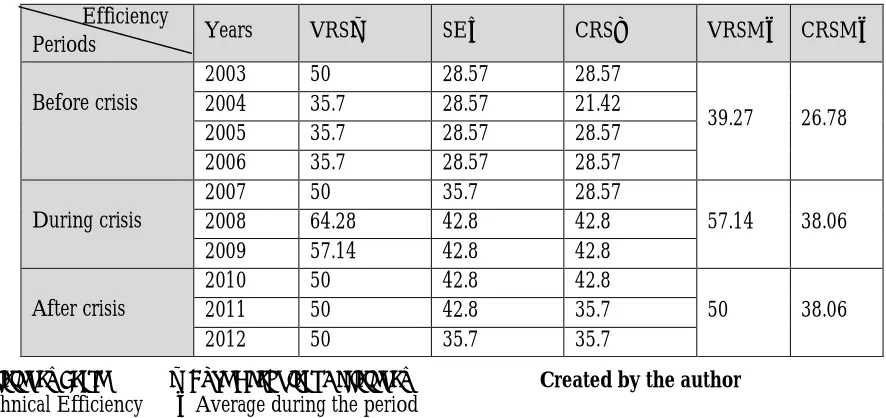
On the contrary, there are many economists who think that commercial conventional banks are keeping his efficiency score during the crisis, although it has increased to a considerable margin to 64% in 2008. The intermediation role and the low cart credits, allowed him to avoid the negative effects of the crisis. Since the main cause of the subprime crisis is linked to mortgages. In fact, the part of the mortgage is not the same as that found in investment banks. It is true that the percentage was decreased during the period "after crisis" but remains stable with an average of 50% (VRS). Following the results found by our analysis, conventional commercial banks are not affected by the reputable financial catastrophe triggered in 2007. We should not forget that we test the banking efficiency in the Gulf countries where the liquidity factor is not a problem, since these countries have a considerable income return coming of oil (see Table 2).
Table 2: Efficiency in (%) in commercials conventional banks
Efficiency
Periods Years VRS♣ SE○ CRS♦ VRSM♠ CRSM♠
Before crisis
2003 50 28.57 28.57
39.27 26.78
2004 35.7 28.57 21.42
2005 35.7 28.57 28.57
2006 35.7 28.57 28.57
During crisis
2007 50 35.7 28.57
57.14 38.06
2008 64.28 42.8 42.8
2009 57.14 42.8 42.8
After crisis
2010 50 42.8 42.8
50 38.06
2011 50 42.8 35.7
2012 50 35.7 35.7
○ Efficiency Scale ♣ Pure Technical Efficiency Created by the author
♦ Technical Efficiency ♠ Average during the period Conventional investment banks:
Based on our results, we distinguish that the financial crisis had a significant impact on the bank efficiency which resulted in the failure of several banks. This decrease comes down to the nature of the investment banks that is based mainly on mortgages. In addition, the main origin of the subprime crisis is these kinds of loans which we find several debtors are not able to honor their commitments (Table 3).
Table 3: Efficiency in (%) in investment conventional banks
Efficiency
Periods Years VRS♣ SE○ CRS♦ VRSM♠ CRSM♠
Before crisis
2003 35.7 28.57 28.57
28.56 16.66
2004 35.7 14.28 14.28
2005 21.42 14.28 7.14
2006 21.42 14.28 14.28
During crisis
2007 21.42 21.42 14.28
19.04 9.52
2008 28.57 14.28 14.28
2009 7.14 0 0
After crisis
2010 0 7.14 0
26.16 14.28
2011 42.8 21.42 14.28
2012 35.7 42.8 28.57
Created by the author
○ Efficiency Scale ♣ Pure Technical Efficiency
♦ Technical Efficiency ♠ average during the period
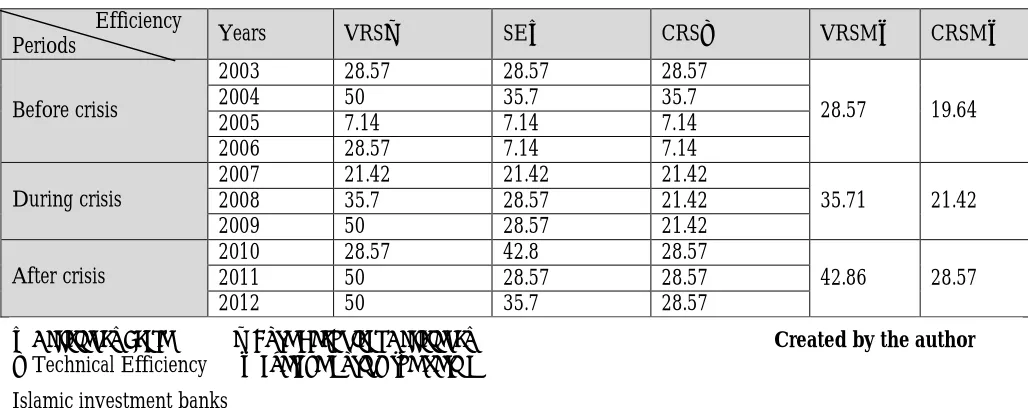
Islamic commercial banks
By leveraging our efficiency scores from DEA method, according to the three techniques (VRS, SE and CRS), we notice that Islamic commercial banks have experienced an improvement in their financial strength. Besides, there is an increase in average rate of efficiency, about 28.57%, in the period before the subprime crisis and to 42.86% after the crisis. This resuscitation is reasonable, given the financial and economic crisis triggered, which the United States of America in 2007 was the spark that status.
Table 4: Efficiency in (%) in commercials Islamic banks
Efficiency
Periods Years VRS♣ SE○ CRS♦ VRSM♠ CRSM♠
Before crisis
2003 28.57 28.57 28.57
28.57 19.64
2004 50 35.7 35.7
2005 7.14 7.14 7.14
2006 28.57 7.14 7.14
During crisis
2007 21.42 21.42 21.42
35.71 21.42
2008 35.7 28.57 21.42
2009 50 28.57 21.42
After crisis
2010 28.57 42.8 28.57
42.86 28.57
2011 50 28.57 28.57
2012 50 35.7 28.57
○ Efficiency Scale ♣ Pure Technical Efficiency Created by the author
♦ Technical Efficiency ♠ average during the period
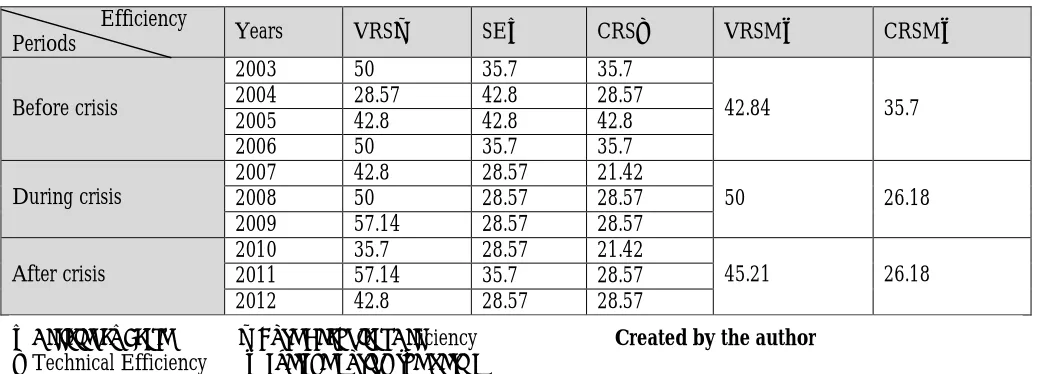
Islamic investment banks
Starting from the empirical results (Table 5), we can distinguish that Islamic investment banks continue to progress. Before the crisis, the percentage of average efficiency in this category amounted to 42.84% on the variable returns to scale, while 35.7% of the constant returns to scale. These rates rose during the period of the subprime crisis arriving until 50%, based on the variable returns to scale method. After the crisis of efficiency rate reached 57.14% in 2011. While, according VRS there is a 4.79% recession. This stagnation or financial stability of investment banks in the period up to the crisis:
Table 5: Efficiency in (%) in investment Islamic banks
Efficiency
Periods Years VRS♣ SE○ CRS♦ VRSM♠ CRSM♠
Before crisis
2003 50 35.7 35.7
42.84 35.7
2004 28.57 42.8 28.57
2005 42.8 42.8 42.8
2006 50 35.7 35.7
During crisis
2007 42.8 28.57 21.42
50 26.18
2008 50 28.57 28.57
2009 57.14 28.57 28.57
After crisis
2010 35.7 28.57 21.42
45.21 26.18
2011 57.14 35.7 28.57
2012 42.8 28.57 28.57
○ Efficiency Scale ♣ Pure Technical Efficiency Created by the author
♦ Technical Efficiency ♠ average during the period
Panorama: it's true that Islamic banks have resisted during the period of the subprime crisis, especially the investment category, which experienced a remarkable increase at the onset of the crisis. But that does not prevent that said disaster has not affected traditional commercial banks where they keep their financial stability and as well their degree of efficiency. By way of summary, we distinguish according to our empirical results that:
- Islamic investment banks are more stable than conventional investment banks.
- Common commercial banks are not affected in a meaningful way and keep the pace of efficiency throughout the three periods.
- Commercial ordinary banks are more stable than their Islamic counterparts are.
- The Islamic investment banks are more efficient than commercial investment banks and Islamic commercial banks.
- A remarkable recovery on the financial stability of conventional banks after the crisis period (from 2011). Contributions and Comparison:
Our results confirm the work of (Ahmed.h and Mohamed.N, 2011) and (Shafique and al, 2012), but we do not agree through these works on conventional commercial banks. However, we are in agreement with (Ahmad and Abdul Rahman, 2012) the resistance of conventional commercial banks with respectable scores.
Conclusion
On the other side, commercial conventional banks keep not only their stability during and after the period of the crisis, but also with a very respectable average percentage of efficiency, see better than other groups of banks. While, Islamic commercial banks their efficiency score did not match the expectations of experts.
Annex
Banks used in our Estimates
countries Banks Categories
Islamic Conventional
Investment Commercials Investments Commercials
B
ah
re
ïn ♣unicorne investment bank BSC
♣investor bank BSC
♣Citi islamic bank
♣National Bank of Bahrain
♣Arab Banking Corporation BSC
♣Albaraka Banking Group B.S.C.
♣Shamil Bank of Bahrain B.S.C.
♣Investcorp Bank. BCS
♣United Gulf Bank.( BSC) EC
X X X
X
X X
X
X X
Jo
rdan
ie ♣Jordan Dubai Islamic Bank
♣Jordan Islamic Bank
♣Islamic International Arab Bank
♣Jordan Commercial Bank
♣Arab Bank Group
♣Arab Jordan Investment Bank
♣Invest Bank
X X
X X X X X M al ai si
e ♣Al Rajhi Banking & Investment Corporation
♣Aminve Bank
♣RHB Islamic Bank Berhad
♣Alliance Bank Malaysia Berhad
♣Bank Pembangunan Malaysia Berhad
♣Maybank Investment Bank ♣BerhadMIDF Amanah Investment Bank Berhad
X X X X X X X A rab ie s ao u di te
♣Al Rajhi Banking & Investment Corporation
♣Islamic Development Bank
♣Islamic Corporation for the Development of the Private Sector
♣National Commercial Bank
♣Arab Petroleum Investments Corporation
♣Arab investment company
♣ Saudi investment Bank
X X X X X X Ku wa it
♣International investor company KSC
♣Aref Investment Group
♣First Investment Company K.S.C.C.
♣Ayan leasing&investment company
♣global investment house
♣Kuwait Finance House
♣National Bank of Kuwait S.A.K.
♣Ahli United Bank KSC
♣Gulf Investment Corporation
♣Boubyan Bank ksc
♣Kuwait International Bank
E
m
arat
s
A
rab
es
U
n
is
♣Emirates Islamic Bank PJSC
♣Dubai Islamic Bank plc
♣Abu Dhabi Islamic Bank - Public Joint Stock Co
♣National Bank of Abu Dhabi
♣Abu Dhabi Commercial Bank
♣Sharjah Islamic Bank
♣ Abu Dhabi Investment Company
X
X
X X
X
X X
Y
em
en
♣Islamic Bank of Yemen for Finance & Investment
♣National Bank of Yemen
♣Shamil Bank of Yemen & Bahrain
♣Yemen Kuwait Bank for Trade and Investment X
X
X
X
S
u
dan ♣Industrial Development Bank
♣Sudanese French Bank
♣Tadamon Islamic Bank
♣Export Development Bank
X
X
X
X
Created by the author
Références
Abdus, S. (2004), « performance of interest-free Islamic banks vis-à-vis interest-based conventional banks of Bahrain», IIUM Journal of Economics and Management, no 2.
Ahmed, h., Mohamed, N. (2011), « The Determinants Efficiency and Profitability of World Islamic Banks», International Conference on E-business, Management and Economics. IPEDR, vol 3.
Ali, S. (2012), «Efficiency in Islamic Banking during a Financial Crisis-an Empirical Analysis of Forty-Seven Banks», Journal of Applied Finance & Banking, vol 2, pp.163-197.
Bashir, H. (2000), «Determinants of profitability in Islamic Banks: Some evidence from the Middle East», Islamic Eco. Stud, vo1: pp. 31-57.
Charnes, A., W,W, Cooper., et E Rohdes. (1978), « Measuring the Efficiency of European », Journal of Operation Research, vol 2, pp. 429-444.
Chawki, EM., Hassan O. (2011), « Evaluating the Productive Efficiency of Islamic Banking in GCC: A Non- Parametric Approach », International Management Review, Vol 7, n°1.
D, Yudistira. (2004), « Efficiency in Islamic banking: An empirical analysis of eighteen banks », Islamic Economic Studies, pp. 1-20.
Houcem, S., Ines, B. (2012), « Profitability of Islamic Banks in the GCC Region », Global Economics and finance Journal.
M, Čihák., H Hesse. (2008), “Islamic Banks and Financial Stability: An Empirical Analysis”, International Monetary
Fund, WP/08/16
Kabir, H. (2006), « The x-efficiency in Islamic Banks », Islamic Economic Studies, Vol 13, n° 2.