Regular Article
ANALYTICALAND BIOANALYTICAL CHEMISTRY
RESEARCH
Published by the
Iranian Chemical Society
Anal. Bioanal. Chem. Res., Vol. 4, No. 2, 295-306, December 2017.
An Electrochemical Sensor Based on Novel Ion Imprinted Polymeric Nanoparticles
for Selective Detection of Lead Ions
Masoud Ghanei-Motlagh
a,* and Mohammad Ali Taher
ba
Young Researchers and Elite Club, Kerman Branch, Islamic Azad University, Kerman, Iran
b
Department of Chemistry, Faculty of Science, Shahid Bahonar University of Kerman, Kerman, Iran (Received 21 April 2017, Accepted 23 June 2017)
In this study, the novel surface ion-imprinted polymer (IIP) particles were prepared and applied as an electrode modifier in stripping voltammetric detection of lead(II) ion. A carbon paste electrode (CPE) modified with IIP nanoparticles and multi-walled carbon nanotubes (MWCNTs) were used for accumulation of toxic lead ions. Various factors that govern on electrochemical signals including carbon paste
composition, pH of the preconcentration solution, supporting electrolyte, stirring time, reduction potential and time were studied in details. The best electrochemical response for Pb(II) ions was obtained with a paste composition of 7% (w/w) of lead IIP, 10% MWCNTs, 53%
(w/w) of graphite powder and 30% (w/w) of paraffin oil using a solution of 0.1 M acetat buffer solution (pH = 4.5) with a extraction time
of 15 min. A sensitive response for Pb(II) ions in the concentration range of 3-55 µg l-1 was achived. The proposed electrochemical sensor
showed low detection limit (0.5 µg l-1), remarkable selectivity and good reproducibility (RSD = 3.1%). Determination of lead(II) content in
different environmental water samples was also realized adopting graphite furnace atomic absorptions spectrometry (GF-AAS), and the
obtained results were satisfactory.
Keywords: Lead, Imprinted polymer, Heavy metal, Electrochemical sensing, Carbon past electrode
INTRODUCTION
Presently, pollution of the environment by heavy metal ions (HMIs) has created a serious environmental problem [1]. Among all of the HMIs, lead is one of most common toxic bivalent metal ion because of its serious toxicity even at low concentrations [2]. The permissible limit of lead in drinking waters considered by the Environmental Protection Agency (EPA) is 15 µg l-1 [3]. Serious poisoning effects of lead have led to remarkable efforts towards developing of sensitive analytical methods for the determination of lead [4]. Electrochemical methods have been attractive for detection of lead due to its experimental simplicity, low cost, remarkable sensitivity and portability [5,6]. Insofar, as selectivity is concerned, introducing of high selective
*Corresponding author. E-mail: m.ghaneimotlagh@yahoo. com
(MWCNTs) [11], magnetic nano-particle [12], reduced graphene oxide (RGO) [9], silica particles [13] and nanometer titanium dioxide (TiO2) [14] have been
exploited.
Recently, IIPs have been utilized as the selective modifiers for electrochemical measurement of some HMIs including mercury(II) [9], silver(I) [15], zinc(II) [16], palladium(II) [17], and copper(II) [18] ions. However, it is of great significance to develope electrochemical sensors based on nanosized IIP beads for detection of toxic HMIs in low concentrations due to better properties in term of selectivity and sensivity [19]. The aim of the present work is to design a novel lead(II) electrochemical sensor based on the nano-structured IIP material and MWCNTs. Various experimental factors, linear calibration response, and the limit of detection (LOD) of the suggested electrochemical device in the detection of lead(II) were evaluated. The desired method was successfully employed for voltammetric detection of Pb(II) ions in various environmental water samples with satisfactory selectivity.
EXPERIMENTAL
Reagents and Apparatus
Ethyleneglycol dimethacrylate (EGDMA), 2-vinylpyridine (2-VP), 2,2′-azobisisobutyronitrile (AIBN), 3-methacryloxypropyl trimethoxysilane (KH-570), ferrous sulfate heptahydrate (FeSO4.7H2O), ferric chloride
hexahydrate (FeCl3.6H2O) and ammonium hydroxide
(NH4OH, 25%, w/w) were purchased from Merck
(Darmstadt, Germany). The magnetite (Fe3O4) nanoparticles
were prepared through coprecipitation of Fe2+ and Fe3+ ions
in the presence of ammonium hydroxide solution according to the literature methods [20]. Graphite powder (average particle size 50 μm) and high viscosity paraffin oil (density = 0.88 Kg l-1), both from Merck (Darmstadt,Germany), were used as the working electrode substrates.
All electrochemical data were obtained with a Metrohm computrace electroanalyzer Model 757 VA (Herisau, Switzerland). The electrochemical cell consisted of a home-made modified carbon paste electrodes (MCPE) as a working electrode and an Ag/AgCl electrode and a platinum wire as the reference and counter electrode, respectively.
The pH of buffer solutions was determined with a digital metrohm 827 pH-meter (Herisau, Switzerland).
Synthesis of the Lead(II) Imprinted Polymeric
Nanoparticles
Lead imprinted polymer based on surface imprinting process was prepared by the following procedure. Firstly, vinyl functionalization of the magnetic nanoparticles was performed by reaction of coupling agent KH-570 with Fe3O4 nanoparticles. For this purpose, 1.0 g Fe3O4 was
suspended in 50 ml of acetonitrile followed by the addition of 1.1 ml of KH-570 and the mixture was refluxed at 60 °C for 24 h under stirring. The resulting particles were separated from the solution by a magnet and stored for further steps. As the next step, 0.5 mmol of Pb(NO3)2 and 2
mmol of 2-VP (monomer) were dissolved in 50 mL of DMSO-AN (1:2). After 2 h of the complexation reaction, 0.5 g of vinyl functionalized Fe3O4 was dispersed in the
above solution for 5 min by ultrasonic dispersion. Afterwards, 10 mmol of EGDMA and 80 mg AIBN were added to the reaction vessel and the solution was mixed for a few minutes. Then, the oxygen of the sample solution was removed by bubbling nitrogen through the sample for 15 min. The mixture solution was heated at 60 ºC in a water bath under N2 atmosphere for 24 h. Afterward, the resultant
product were washed successively with ethanol to remove the unreacted materials. The entrapped lead ions were then removed with a solution containing 0.5 M of HCl. Finally, the prepared IIP materials were rinsed with ultra-pure water seven times and dried at 60 ºC for the further use. Schematic illustration for the synthesized IIP nanoparticles is represented in Fig. 1. Correspondingly, the non-imprinted polymer (NIP) was prepared in the same method but in the absence of the lead(II) ions.
Fabrication of MCPE
An Electrochemical Sensor Based on Novel Ion Imprinted Polymeric Nanoparticles/Anal. Bioanal. Chem. Res.,Vol. 4, No. 2, 295-306, December 2017.
Preparation of Water Samples
Various real water samples including river water (Kardeh river, Mashhad, Iran), aqueduct water (Balvard village, Kerman, Iran), waste water (copper factory, Sarchashmeh, Kerman, Iran) and waste water (Coal Processing, Zarand, Kerman, Iran) were selected to explore the applicability of the proposed method. Water samples were filtered through a membrane of 0.2 µm pore-size to remove any suspended material and stored at 4 °C in a refrigerator until analysis.
Electrochemical Procedure
The MCPE was immersed in a 20 ml of 0.1 M acetate buffer solution (pH = 4.5) containing a known amount of lead ions and the solution was stirred (500 rpm) for 15 min in an open circuit condition. Then, the MCPE was inserted into the washing solution (deionized water) for 15 s, and then placed into the voltammetric cell containing 20 ml of HCl solution (0.1 M) as supporting electrolyte. Finally,
preconcentrated Pb(II) was reduced for 40 s in -1.0 V. The differential pulse voltammograms were recorded between -0.8 to 0.0 V with pulse amplitude of 0.1 V and scan rate of 50 mV s-1 at room temperature (23 ± 2 ºC).
RESULTS AND DISCUSSION
Characterization
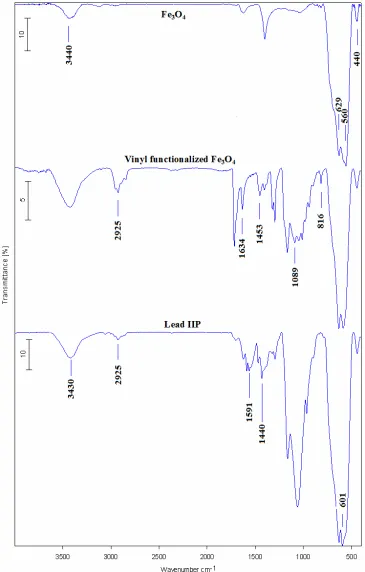
The Fourier transform infrared (FT-IR) spectra for Fe3O4, vinyl functionalized Fe3O4 and lead IIP particles are
demonstrated in Fig. 2. The adsorption band around at 629, 560 and 440 cm-1 are the characteristic bands of Fe3O4,
corresponding to Fe-O vibrations of Fe3O4 [21]. In vinyl
functionalized Fe3O4 spectrum, the characteristic band at
816 cm-1 is assigned to Si-O bending and stretching vibrations [22]. The absorption peak around 1089 cm-1 was
confidently attributed to the siloxane vibrations [23]. The band at 2925 cm-1 was assigned to the stretching vibrations
of C-H bonds [24]. The observed peak at 1634 cm-1 can be
An Electrochemical Sensor Based on Novel Ion Imprinted Polymeric Nanoparticles/Anal. Bioanal. Chem. Res.,Vol. 4, No. 2, 295-306, December 2017.
Fig. 3. TEM image of as-prepared IIP nanoparticles.
attributed to the C=C stretching band [25]. In FT-IR spectra of lead IIP particles, the bands at 3430, 2925, 1591 and 1601 cm-1 are assigned to O-H, C-H aliphatic, C=N and Fe-O stretching vibrations, respectively. Morover, the -CH2-CH2- bending vibration absorption band was shown at
1450 cm-1 [26].
Transmission electron microscopy (TEM) image of the imprinted material is shown in Fig. 3. As can be seen, the surface of Fe3O4 nanoparticles was fully coated by polymer
layer. So, it can be confirmed from TEM image that lead IIP nanoparticles have been successfully synthesized, and the core-shell structure formed. Moreover, the thickness of the imprinted layer was about 15-25 nm.
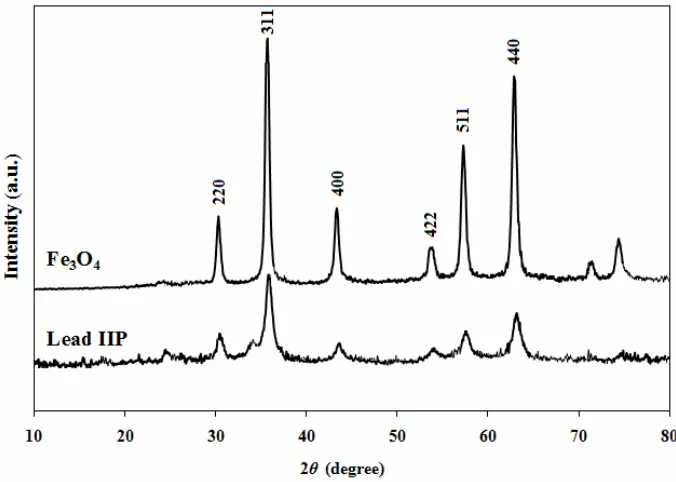
Figure 4 shows X-ray diffraction (XRD) patterns of Fe3O4 and the lead IIP samples. The XRD pattern of Fe3O4
nanoparticles shows six characteristic peaks that the diffraction peaks (2θ = 30.2º, 35.7º, 43.4º, 53.8º, 57.4º and 63.1º) indexed to the (220), (311), (400), (422), (511), and (440) crystalline plane of Fe3O4 [27]. Furthermore, the
decrease in the intensity of the characteristic peaks in lead IIP sample can be attributed to lower crystallinity of the Fe3O4 structure after modification with imprinted layer.
Electrochemical Behavior of Pb(II) at the MCPE
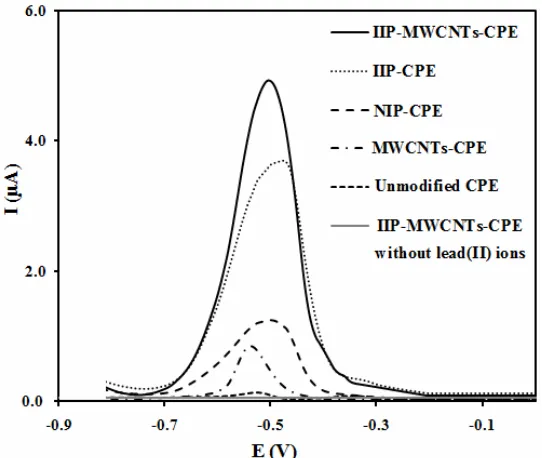
The electrochemical behavior of the MCPE for preconcentration of lead(I) ions were investigated by differential pulse voltammetry. Figure 5 shows the typical voltammograms of the unmodified CPE, MWCNTs-CPE, IIP-CPE, IIP-MWCNTs-CPE, NIP-CPE with lead(II) and IIP-MWCNTs-CPE (proposed MCPE) without lead(II) ions. The distinct voltammetric peaks indicat the ability of the various modifiers for sensing of analyte ion on the modified electrode surface. As seen in Fig. 5, the obtained response for the IIP-MWCNTs-CPE is higher noticeably than other modifiers, indicating properly preconcentration of lead(I) by MCPE.
Optimization of Significant Parameters
Considering the carbon paste composition is a critical parameter in the electrochemical response of the MCPE, the effect of the lead IIP amount on the voltammetric signal of 25 µg l-1 of Pb(II) was studied. The results are shown in Fig. 6. The signal of Pb(II) increased with the increase of lead IIP amount to 7% (mass/mass). The peak current decreased
at higher IIP content because of the diminished conductivity of the carbon paste. Morover, the best electrochemical signal with higher sensitivity achieved with 10% for MWCNTs in carbon paste composition. Consequently, 7% lead IIP, 10% MWCNTs, 53% graphite powder and 30% paraffin oil were selected as the optimal values in further experiments.
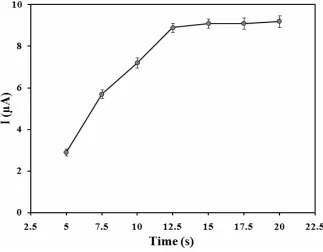
In order to evaluate influence of pH of the buffer solution on the peak current, the MCPE was applied for preconcentration of lead ions (25 µg l-1) in pH range 3.5l5.5 under stirring condition for 10 min. As clearly seen in Fig. 7, an optimum pH of 4.5 was selected in next experiments. The influence of stirring time (in the range of 5-20 min) on the proposed method was also investigated. For this purpose, the MCPE was applied for extraction of 25 µg l-1 lead(II) solution (pH 4.5) at different times, while keeping all the other experimental parameters constant. As depicted in Fig. 8, the electrochemical signal increased linearly with changing extraction time from 1 to 12.5 min and remained almost constant at higher stirring times (>15 min) due to the surface saturation of the MCPE. Thus, a time of 15 min was employed as the stirring time in further studies.
An Electrochemical Sensor Based on Novel Ion Imprinted Polymeric Nanoparticles/Anal. Bioanal. Chem. Res.,Vol. 4, No. 2, 295-306, December 2017.
Fig. 5. Differential pulse voltammograms of unmodified CPE, MWCNTs-CPE, IIP-CPE, IIP-MWCNTs-CPE, NIP-CPE with 25 µg l-1 of Pb(II) and IIP-MWCNTs-CPE without Pb(II) in extraction medium. Other
conditions; stripping solution = 0.1 M potassium nitrate and acetate buffer (0.1 M, pH 4.0), extraction time = 10 min, amount of IIP = 5%, accumulation potential = -0.9 V (vs. Ag/AgCl), accumulation time = 40 s, scan starting from -0.8 to 0.0 V, scan rate = 50 mV s-1, pulse amplitude = 0.1 V and pulse period = 4 ms.
Fig. 7. Effect of preconcentration solution pH on the voltammetric signal.
An Electrochemical Sensor Based on Novel Ion Imprinted Polymeric Nanoparticles/Anal. Bioanal. Chem. Res.,Vol. 4, No. 2, 295-306, December 2017.
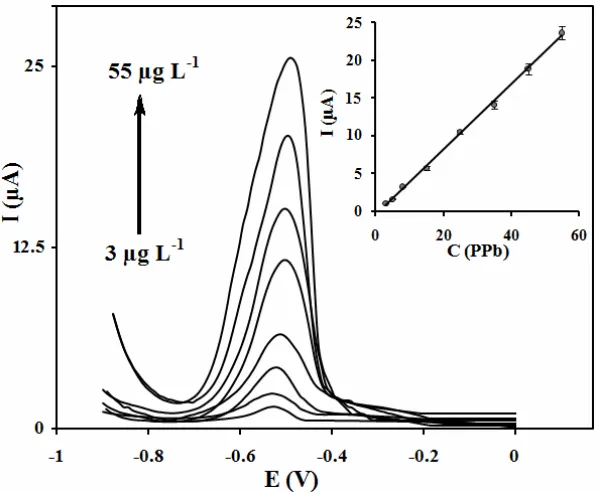
Fig. 9. Stripping voltammograms of the proposed MCPE under optimized experimental conditions, lead(II) concentration (µg l-1) 3, 5, 8, 15, 25, 35, 45 and 55. Inset shows the related calibration graph.
Table 1. Effects of Various Metal Ions on the Electrochemical Signals of Lead(II)
Interference Contribution
(%)a
Cd(II) -3.1
Cu(II) -4.9
Zn(II) -2.1
Cr(III) -3.7
Ag(I) -1.2
Hg(II) -4.0
Al(III) -0.8
Fe(III) -1.7
Mn(II) -1.2
Co(II) -0.9
Ni(II) -2.1
a
Table 2. Comparison of the Performance of the Proposed Lead Sensor with other Electrochemical Sensors
Electrode type Method LOD
(μg l-1)
Linear range
(μg l-1)
[Ref.]
Cyclodextrin-modified gold electrode DPSVa 1.9 4.6-251 [6] Glassy carbon electrode modified with
MWCNTs/Nafion composite
ASVb 1.3 21.6-1621 [28]
Glassy carbon electrode modified with
mercury-film
ASV 0.78 5.4-27 [29]
Carbon paste electrode modified with
MWCNTs
PSAc 6.6 58.4-646.2 [30]
Bismuth modified gold microelectrode SWASVd 3.3 10.8-1810.3 [31] CPE modified with IIP-MWCNTs DPSV 0.5 3-55 This work
aDifferential pulse stripping voltammetry (DPSV). bAnodic stripping voltammetry (ASV). cPotentiometric
stripping analysis (PSA). dSquare wave anodic stripping voltammetry (SWASV).
Table 3. Determination of Pb(II) in Different Water Samples
Found by GF-AAS
(μg l-1) Recovery (%)a ±
R.S.D.b Found by voltammetry
(μg l-1) Added
(μg l-1) Sample 4.4 - 4.2 -River water - 97.0 ± 1.9
9.9 6.00
- 102.1 ± 2.7
14.5 10.00 B.D.L. - B.D.L.c -Aqueduct water - 96.6 ± 2.5
5.8 6.00
- 99.0 ± 2.0
9.9 10.00 12.5 - 12.8
-Copper factory waste water
- 98.2 ± 3.1
23.2 10.00
10.1 -
9.7 Coal Processing waste water
- 103.0 ± 3.2
20.3 10.00
aAverage value from three individual experiments. bRelative standard deviations (n = 3). cB.D.L.: Below
An Electrochemical Sensor Based on Novel Ion Imprinted Polymeric Nanoparticles/Anal. Bioanal. Chem. Res.,Vol. 4, No. 2, 295-306, December 2017.
The effect of the reduction time on the sensor performance was studied. Based on the results of this study, the peak currents increased linearly versus the accumulation time between 10 and 30 s and then leveled off after 40 s. Hence, reduction time of 40 s was applied as an optimum applying time in the present study.
Study of Interferences
Some cations species were examined concerning their interference with the determination of Pb(II) under the optimum conditions. The effect of 200 µg l-1 Cd(II), Cu(II),
Zn(II), Cr(III), Ag(I), Hg(II), Al(III), Fe(III), Mn(II), Co(II) and Ni(II) on the voltametrice response of 10 µg l-1 Pb(II) was investigated. As shown in Table 1, most of these metal ions do not interfere with the detection of lead (below 5%). Accordingly, the method has good tolerance towards matrix interferences without sacrificing the signal intensity.
Calibration
Curve,
Detection
Limit
and
Reproducibility
Figure 9 shows the voltammograms of the MCPE toward Pb(II) with the corresponding calibration plot (inset). The voltammetric peak currents varied linearly with Pb(II) concentration in the range of 3-55 µg l-1 with a correlation coefficient, R2, of 0.9987. The limit of detection (LOD) was found to be 3 µg l-1 based on the signal-to-noise characteristics of S/N = 3 (where the S and N are the electrochemical signals in the presence and absence of analyte, respectively). The relative standard deviation (R.S.D., for 10 measuring cycles) was 3.1% demonstraing the excellent repeatability of the proposed method. Another important feature is the functional stability of the
electrochemical sensor. The MCPE, used in this work, were stable during at least one month of intensive use. The elaborated procedure was also compared with those of the some previously analytical methods [6,28-31] for analysis of lead (Table 2). It can be seen that the suggested protocol can provide better sensitivity over the most of the reported methods.
Practical Application
To test the suggested methodology, various real water samples including river water, aqueduct water and waste water were assayed after pre-treatment according to section 2.4. The content of lead(II) was then determined by the standard addition method (Table 3). The recoveries of spiked sample were evaluated using the t-test, and at 95% confidence level. The analytical data were verified by graphite furnace atomic absorption spectrometry (GF-AAS) as a confirmatory method. The reliability of the the proposed procedure was aslo investigated by the analysis of lead in two synthetic samples (Table 4). Evidently, the electrochemical detection assay can be used for practical analysis of Pb(II) in real samples.
CONCLUSIONS
A novel procedure for selective and sensitive determination of lead(II) ions in the environmental ware samples was successfully developed. The presented method possesses some advantages such as simplicity, remarkable selectivity, high sensitivity, cost-effectiveness and good reproducibility. The obtained LOD is lower than the maximum contaminant level of lead allowed by the EPA
Table 4. Analysis of Lead in Synthetic Samples
Recovery Founda
Composition Sample
97.3 14.6 ± 0.4 μg l-1
Co(II):50.0, Cd(II):50.0, Zn(II):50.0,
Al(III):50.0, Pb(II):15.0 μg l-1 Synthetic sample1
96.0 14.4 ± 0.6 μg l-1
Cr(III):50.0, Ni(II):50.0, Fe(III):50.0,
Cu(II):50.0, Pb(II):15.0 μg l-1 Synthetic sample2
(15 µg l-1) for drinking water. In light of these findings, the novel electrochemical sensor based on lead IIP material would likely be suitable for application in environmental monitoring. To conclude, the MCPE based on imprinted strategy is very promising.
REFERENCES
[1] M. Fayazi, M.A. Taher, D. Afzali, A. Mostafavi, M. Ghanei-Motlagh, Mater. Sci. Eng., C 60 (2016) 365. [2] S. Gunduz, S. Akman, Food Chem. 141 (2013) 2634. [3] A. Islam, H. Ahmad, N. Zaidi, S. Kumar, ACS Appl.
Mater. Interfaces 6 (2014) 13257.
[4] M. Ghanei-Motlagh, M. Fayazi, M. Taher, E. Darezereshki, E. Jamalizadeh, R. Fayazi, RSC Adv., 5 (2015) 100039.
[5] S.-S. Li, W.-J. Li, T.-J. Jiang, Z.-G. Liu, X. Chen, H.-P. Cong, J.-H. Liu, Y.-Y. Huang, L.-N. Li, X.-J. Huang, Anal. Chem. 88 (2015) 906.
[6] W. Li, G. Jin, H. Chen, J. Kong, Talanta 78 (2009) 717.
[7] A. Shirzadmehr, M. Rezaei, H. Bagheri, H. Khoshsafar, Int. J. Environ. Anal. Chem. 96 (2016) 929.
[8] M. Nasiri-Majd, M.A. Taher, H. Fazelirad, Talanta 144 (2015) 204.
[9] M. Ghanei-Motlagh, M.A. Taher, A. Heydari, R. Ghanei-Motlagh, V.K. Gupta, Mater. Sci. Eng., C 63 (2016) 367.
[10] H.-T. Fan, J. Li, Z.-C. Li, T. Sun, Appl. Surf. Sci. 258 (2012) 3815.
[11] H. Ebrahimzadeh, E. Moazzen, M.M. Amini, O. Sadeghi, Chem. Eng. J. 215-216 (2013) 315. [12] S. Wei, Y. Liu, M. Shao, L. Liu, H. Wang, Y. Liu,
RSC Adv. 4 (2014) 29715.
[13] M. Li, C. Feng, M. Li, Q. Zeng, Q. Gan, H. Yang, Appl. Surf. Sci. 332 (2015) 463.
[14] Q. Li, H. Su, T. Tan, Biochem. Eng. J. 38 (2008) 212.
[15] R. Zhiani, M. Ghanei-Motlag, I. Razavipanah, J.
Mol. Liq. 219 (2016) 554.
[16] M. Shamsipur, H.R. Rajabi, S.M. Pourmortazavi, M. Roushani, Spectrochim. Acta, Part A 117 (2014) 24. [17] M.K. Bojdi, M. Behbahani, A. Sahragard, B.G.
Amin, A. Fakhari, A. Bagheri, Electrochim. Acta 149 (2014) 108.
[18] H. Ashkenani, M.A. Taher, J. Electroanal. Chem. 683 (2012) 80.
[19] A. Bahrami, A. Besharati-Seidani, A. Abbaspour, M. Shamsipur, Mater. Sci. Eng., C 48 (2015) 205. [20] M. Koneracká, P. Kopčanský, M. Antalık, M. Timko,
C. Ramchand, D. Lobo, R. Mehta, R. Upadhyay, J. Magn. Magn. Mater. 201 (1999) 427.
[21] H. Shaikh, N. Memon, M.I. Bhanger, S.M. Nizamani, A. Denizli, J. Chromatogr. A 1337 (2014) 179. [22] Z.-C. Li, H.-T. Fan, Y. Zhang, M.-X. Chen, Z.-Y.
Yu, X.-Q. Cao, T. Sun, Chem. Eng. J. 171 (2011) 703.
[23] H.-T. Fan, T. Sun, H.-B. Xu, Y.-J. Yang, Q. Tang, Y. Sun, Desalination 278 (2011) 238.
[24] Z. Long, W. Xu, Y. Lu, H. Qiu, J. Chromatogr. B 1029-1030 (2016) 230.
[25] T. Alizadeh, Biosens. Bioelectron. 61 (2014) 532. [26] W. Yang, L. Liu, W. Zhou, W. Xu, Z. Zhou, W.
Huang, Appl. Surf. Sci. 258 (2012) 6583.
[27] M. Fayazi, M.A. Taher, D. Afzali, A. Mostafavi, Mater. Sci. Semicond. Process. 40 (2015) 501. [28] D. Sun, Z. Sun, J. Appl. Electrochem. 38 (2008)
1223.
[29] L.C. Martiniano, V.R. Abrantes, S.Y. Neto, E.P. Marques, T.C. Fonseca, L.L. Paim, A.G. Souza, N.R. Stradiotto, R.Q. Aucélio, G.H. Cavalcante, Fuel 103 (2013) 1164.
[30] C.R.T. Tarley, V.S. Santos, B.E.L. Baêta, A.C. Pereira, L.T. Kubota, J. Hazard. Mater. 169 (2009) 256.