Vol. 7, No. 4, 2015 Article ID IJIM-00534, 11 pages Research Article
An artificial intelligence model based on LS-SVM for third-party
logistics provider selection
B. Vahdani∗†, Sh. Sadigh Behzadi‡, S. M. Mousavi §
————————————————————————————————–
Abstract
The use of third-party logistics (3PL) providers is regarded as new strategy in logistics management. The relationships by considering 3PL are sometimes more complicated than any classical logistics supplier relationships. These relationships have taken into account as a well-known way to highlight organizations’ flexibilities to regard rapidly uncertain market conditions, follow core competencies, and provide long-term growth strategies. Choosing service providers has been considered as a notable research area in the last two decades. The review of the literature represents that neural networks have proposed better performance than traditional methods in this area. Therefore, in this paper, a new enhanced artificial intelligence (AI) approach is taken into consideration to assist the decision making for the logistics management which can be successfully presented in cosmetics industry for long-term prediction of the real performance data. The presented AI approach is based on modern hybrid neural networks to improve the decision making for the 3PL selection. The model can predict the overall performance of the 3PL according to least squares support vector machine and cross validation technique. In addition, the proposed AI approach is given for the 3PL selection in a real case study for the cosmetics industry. The computational results indicate that the proposed AI approach provides high performance and accuracy through the real-life situations prediction along with comparing two other two well-known AI methods.
Keywords: Artificial Intelligence (AI); Least squares support vector machine (LS-SVM); Cross vali-dation; Third-party logistics (3PL) provider selection problem.
—————————————————————————————————–
1
Introduction
C
otics has now being taken into account as ansidering intense global competition, logis-significant field where various industries for en-hancing customer service and selecting appropri-ate inventory levels along with increased com-petitiveness. New trend is outsourcing logistics∗Corresponding author. [email protected] †Faculty of Industrial and Mechanical Engineering,
Qazvin Branch, Islamic Azad University, Qazvin, Iran.
‡Department of Mathematics, Islamic Azad University,
Qazvin Branch, Qazvin, Iran.
§Industrial Engineering Department, Faculty of
Engi-neering, Shahed University, Tehran, Iran.
activities to show the core competence, and im-prove the quality of services. Third-party logis-tics (3PL) providers let many organizations to in-crease logistics levels and functions which have been regarded as operational ways for them [1]. The key merits of logistics alliances are to high-light the outsourcing organizations by focusing on the core competence, increasing the efficiency and service along with decreasing the transporta-tion and operatransporta-tional costs [2, 3]. Within out-sourcing of logistics tasks, shippers have been followed to appraise and choose the best suit-able 3PL provider [4, 5]. The related literature has represented the application of different multi-criteria analysis tools in this context. Efendigil
et al. [6] introduced a tool for evaluating suitable third-party vendors by regarding the subjective requirements of the organization. The presented tool has provided the development of a concep-tual framework by hybridizing fuzzy logic and ar-tificial neural networks (ANNs) while focusing on the environmental attributes or factors in the se-lection process of the reverse logistics provider.
Cakir et al. [7] noted logistics service provider selection with decision support system based on the fuzzy analytic hierarchy process (FAHP) method. Kannan et al. [8] found a fuzzy based multi-criteria group decision-making tool to pro-vide the suitable selection process of best 3PRLP. The assessment was according to interpretive structural modeling (ISM) and fuzzy technique for order preference by similarity to ideal solu-tion (TOPSIS). Liu and Wang [9] described a fuzzy tool for the evaluation and appraisement of 3PL providers. Singh Bhatti et al. [10] showed the intangible variables into 3PL choice and ap-praisement by 4PL players. They applied a risk-based index to denote the risks according to any particular choice performed by the 4PL. Ding and Chou [11] represented a fuzzy multi-criteria analysis model to appraise middle managers for 3PLs. Govindan and Murugesan [12] concen-trated on a decision tool for selection of third-party reverse logistics provider by fuzzy assess-ment. Zhang et al. [13] provided an innovative information granulation entropy method to ap-praise3PL providers. A fuzzy appraisement ma-trix, an information granulation entropy tool ac-cording to information science theory and data mining approach, was given to obtain the weights of factors or criteria. Finally, TOPSIS closeness rating tool was considered to give the priorities of candidates or alternatives.
The review of the related literature indicates that there existed several papers for the appraise-ment of providers in the 3PL problem. Taking artificial intelligence (AI) models into account for the 3PL provider selection problem can be presented and regarded as new approaches with suitable results in this field of research. In fact, AI models have been employed to several indus-tries for appraising the alternatives, suppliers, or providers [14, 15,16, 17].This study is a first at-tempt to illustrate a new AI-based approach in the 3PL selection problem regarding the time se-ries prediction. Key merit of the AI models is that
the complicated process of the decision making is not applied under multiple appraisement cri-teria or factors. In the AI approaches, the user or expert follows available information according to current situation. It means that the overall performance of alternatives or providers can be taken into account versus the appraisement cri-teria or factors, based on the approach’s learning from the decision makers or cases in the past [15].
The available statistical methods, such as mul-tiple linear regression and general exponential smoothing, could predict the linear time series; however, they cannot taken the nonlinear char-acter of time series into account because of the inflexibility in their structures along with the in-herent limitations [18, 19, 20]. The ANN ap-proaches could learn a non-linear mapping be-tween the input and output of a process in lo-gistics management, and then to approximate non-linear functions properly without consider-ing any assumptions taken by the statistical tools. Therefore, some recent studies in different indus-tries have proposed the ANNs instead of statis-tical regression [16]. Also, the new ANN ap-proach, i.e., LS-SVM, can theoretically provide the global optimum, rather than local optima, as there is a common-phenomenon in the tradi-tional AI models [21]. Moreover, in the related literature regarding time series forecasting, there are useful applications of the LS-SVM in the re-cent years (e.g., supplier selection [15]; tourism demand forecasting [21], structural design cost es-timation [18], pipe image interpretation [22].
man-agement in a real case study in the cosmetics in-dustry to appraise and select the providers. Fur-ther, to highlight the high performance of the pre-sented AI approach, two well-known intelligent tools, including back propagation neural network (BPNN) and radial basis function (RBF) neural network are followed and the comparative analy-sis is given in detail.
The rest of this paper is organized as follows. In Section 2, assessment criteria or factors are considered and hierarchical structure is provided for the 3PL selection problem. The proposed hy-brid AI model is given in Section 3. In Section
4, the comparisons among three AI models are conducted in the case study for the cosmetics in-dustry. Finally, conclusion remarks are shown in Section5.
2
Assessment factors for 3PL
selection problem
In this section, the appraisement attributes or factors and the hieratical structure are taken into account for the complex 3PL selection problem. The goal of hierarchy model is the appraisement of the 3PL providers for logistics management that is denoted in the first level. These attributes or factors are represented according to the help of literature survey [6, 23] and the discussion with the experts in logistics management. Hence, six-teen appraisement attributes or factors are listed as follows. The hierarchical structure is indicated in Figure1to show the aforementioned attributes or factors.
• On time delivery ratio (C1) • Confirmed fill rate (C2) • Service quality level (C3) • Unit operation cost (C4) • Capacity usage ratio (C5) • Total order cycle time (C6) • System flexibility index (C7) • Integration level index (C8) • Increment in market share (C9) • Research and development ratio (C10) • Environmental expenditures (C11) • Customer satisfaction index (C12) • Communication systems (C13) • Enterprise alliance (C14) • Location (C15)
• Experience (C16)
Figure 1: Hierarchical structure of the 3PL provider selection problem [24].
3
Proposed
artificiel
intelli-gence approach
Real-life applications in 3PL selection problem are not amenable to linear prediction tools. In-deed, 3PL selection problem are complex in lo-gistics management and often nonlinear in na-ture. Therefore, conventional linear prediction tools are not applicable; presenting advanced AI-based approaches for forecasting the performance of 3PL providers is necessary in this field. To overcome the disadvantages of the commonly-used tools, this paper focuses on the selection of these 3PL providers by developing a new hy-brid AI approach according to two powerful tools given as follows.
3.1 Support vector machine
re-Figure 2: Nonlinear suppor vector machine.
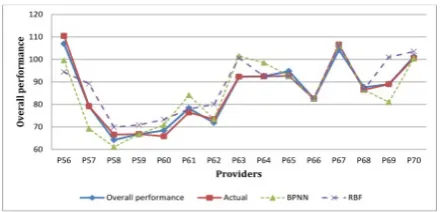
Figure 3: Comparative analysis according to ac-tual overall performance ratings, BPNN, RBF and proposed AI-based approach for test records.
gression [28]. By mapping input vectors x into a high-dimensional feature space, SVM models given in the new space can represent a linear or nonlinear decision boundary in the original space. In the new space, an optimal separation is de-termined between instances of distinct classes ac-cording to the hyper plane which has the maximal distance to the nearest training instances. There-fore, the SVM is regarded as a new AI approach that focuses on the maximum margin hyper plane to supply the maximum separation between dis-tinct classes. The maximum margin hyper plane for available learning problem is uniquely demon-strated regarding the instances that are closest to it, and these instances are taken as support vec-tors. In addition, the separate function for this approach could be linear or nonlinear [28].
For the linearly separable case, let S a given set with n labeled training instances {(x1, y1),(x2, y2), ...,(xn, yn)} . Each training in-stance xi ∈Rk , for i= 1,2, ..., n, regards either of the two classes versus its label yi ∈ {−1,+1} , wherek is the input dimension. The maximum margin hyper plane could be supplied by the fol-lowing equation:
y=b+ Σwiyix(i)x, (3.1)
where denotes the dot product; the vector x
ex-presses a test example and the vectors x(i)s are regarded as the support vectors. In this equation, b and wi are regarded as parameters, in which the hyper plane could be learned by the SVM. To create an optimal hyper plane, the following quadratic programming problem can be solved:
M inimize1 2∥w∥
2
Subject to yi(wxi+b)≥1,
(3.2)
i= 1,2, . . . , n. (3.3)
where the function K(x(i), x) is regarded as the kernel function. There are several kernels for building SVMs regarding the different types of nonlinear decision surfaces in the input space. The commonly-used kernel functions include the polynomial kernel K(x, y) = (xy + 1)d , and the Gaussian radial basis function K(x, y) = exp(δ2(x−−1y)2) , where dis regarded as the degree
of the polynomial kernel, andδ2is regarded as the bandwidth of the Gaussian radial basis function. Regression: The concept of a maximum margin hyper plane that are described above is only considered for the classification. However, the SVM has been extended for general prediction and forecasting problems that include LS-SVM as a version of the SVM for regression. The objec-tive of the LS-SVM is to obtain a function, ap-proximating the training instances well regarding the minimization of the prediction error. When minimizing the error, the risk of over-fitting is re-duced by taken the maximization of the flatness for the function [25,26,27]. By solving the follow-ing quadratic programmfollow-ing problem, an optimal hyper plane could be determined:
M inimize 12∥w∥2
Subject to yi(wxi+b)≤ε, i= 1,2, ..., n. (3.4) whereεregarded as the bound for the prediction error.
con-straints of the following optimization problem:
M inimize 12∥w∥2+C∑li=1(ξi+ξi∗)
Subject to
yi−< w, xi >−b≤ε+ξi < w, xi>+b−yi≤ε+ξi∗ ξi, ξi∗ ≥0
(3.5)
The constant C computes the trade-off between the flatness of f and the amount up to which deviations larger than ε are tolerated. By con-structing the Lagrangian function, this optimiza-tion problem can be provided as a dual problem:
L=1 2∥w∥
2+C
l ∑
i=1
(ξi+ξi∗)
−
l ∑
i=1
λi (
ε+ξi−yi+< w, xi > +b
)
−
l ∑
i=1
λ∗i(ε+ξi∗+yi−< w, xi >−b)
−
l ∑
i=1
λi(ηiξi+η∗iξ∗i),
and λi, λ∗i, ηi, ηi∗≥0. (3.6)
By solving the Lagrangian, we provide the opti-mal solutionsw∗ and b∗:
w∗ = l ∑
i=1
(λi−λ∗i)xi,
b∗ =yi−< w∗, xi >−ε, 0≤λi ≤C, i= 1,2, . . . , l,
b∗ =yi−< w∗, xi >+ε,
0≤λi ≤C, i= 1,2, . . . , l, (3.7)
Similar to classification, the inner products could be regarded as proper kernels in nonlinear prob-lems. Controlling the tradeoff between minimiz-ing the prediction error and maximizminimiz-ing the flat-ness of the regression function can be performed by taking the upper limitCon the absolute value of the coefficients wis . Restricting the upper limit influences off the support vectors on the shape of the regression function and taking a pa-rameter that the user or decision maker could consider beside ε . The larger C is, the more closely the function may fit the data. In the
degenerate case where ε = 0, the method sim-ply conducts least-absolute-error regression un-der the coefficient size constraint, and all training instances could be support vectors. Conversely, if ε is large enough, the error models zero, and the presented method outputs the flattest that includes the data irrespective of C [28,29,30].
3.2 Cross validation technique
A well-known tool namely cross validation is taken for the prediction of generalization error [31,32].This paper utilizes K-fold among several types of the cross validation to enhance the hold-out technique. For this purpose the dataset is separated K subsets, and the presented technique is repeated K times. Each time, one of the K subsets can be proposed as the test set and the other K −1 subsets are denoted as a training set. Then, the average error is obtained across all K trials. The key merit of this presented method is that separating the data is not vital. It means that every data point can be regarded in a test set exactly once, and taken as a training set K−1 times. In the related literature, 3-fold, 5-fold and 10-fold as commonly-used cross valida-tion approaches were introduced to apply in the real-life applications [29,30,31,32].
3.3 Steps of the proposed approach
The presented hybrid AI approach takes two pow-erful techniques into account, namely LS-SVM and cross validation. In the presented approach, the LS-SVM is taken as a supervised learning methodology to consider input-output mapping and regard characteristics of 3PL selection data in the logistics management, and theK-fold cross validation is taken to train the LS-SVM tool in or-der to create a more realistic evaluation of the ac-curacy by dividing the training dataset into sev-eral training and test sets (K subsets), and to recommend suitable results. The presented AI approach can be a computationally efficient com-bination and can be reliable in the logistics man-agement for the data prediction for performances of 3PLproviders. The main steps of the presented approach are described as follows:
utilized to appraise the LS-SVM model perfor-mance.
Step 2. Training data: Training data is applied as sequential data. In this step, the sequential data follows the identified factor or criteria, and the training data can be normalized into the same range (0,1) by the following relation (3.8):
xsca=
xi−xmin xmax−xmin
(3.8)
Step 3. Training the SVM: In this step, LS-SVM is deployed to handle input-output map-ping. The Gaussian radial basis function kernel is applied as a reasonable choice. By using the K-fold cross validation technique on the training dataset, the LS-SVM training is performed to ob-tain the prediction model. In fact, for training set, K-fold cross validation is conducted on the training set, and the average cross validation ac-curacy (i.e.,min MAPECV) is calculated based on the combination of the LS-SVM parameters (i.e., C and δ ).
Fitness definition: TheK-fold cross validation technique is taken into account in this step. In fact,K subsets randomly are taken after dividing the training dataset, and by considering a set of parameters (C, δ) withK−1 subsets as the train-ing set the regression function is given; where C ∈ (0,1017), δ ∈ (0,300). The last subset is taken as the validation. The above approach can be repeated K times. Consequently, the fitness function, namely M AP ECV, is provided for the K-fold cross validation on the training dataset:
F itness value= min M AP ECV (3.9)
M AP Ecv= 1 l
l ∑
j=1
| yj−yj˜
yj | ×
100% (3.10)
whereyJ is denoted as the actual value; ˜YJ is re-garded as the predicted value andl is considered as the number of subsets. The solution with a smallerM AP ECV of the training dataset can be donated as a smaller fitness value.
Step 4.Determining parameters: The parame-ters of LS-SVM in this step are created to predict. Step 5. Adopt the best parameter combination to build the LS-SVM approach: Replacing the test dataset into LS-SVM approach to take the esti-mation values. Considering performance factors or criteria to provide the error between actual
and estimation values regarding the testing per-formance can give the LS-SVM’s estimated capa-bility.
4
Model validation and
compar-ative results
Kaf company is regarded as case study in this sec-tion. It is the leading producer of cosmetic and hygienic products (oldest brand ”DARUGAR”) in Iran. The studied company is taken into ac-count as pioneer of innovation in the cosmetics industry for the logistics management. The 3PL provider selection can be one of the most signif-icant tasks of logistics management by consider-ing the key role of providers’ performances on cost, quality, delivery and service in achieving the functions of logistics management. In fact, 3PL provider selection for Kaf company is denoted as a complex decision problem, in which several con-flicting factors should be considered for the ap-praisement and selection. In order to show the capability of the presented AI-based approach, the above company is given as our case study for the logistics management.
4.1 Dataset
Table 1: 9-scale for performance of 3PL providers rating versus qualitative factors
Verbal judgment Explanation Corresponding
number
Absolutely Poor (AP) Performance of a 3PL provider with respect to 0 an appraisement factor is absolutely poor.
Very Poor (VP) Performance of a 3PLprovider with respect to 1 an appraisement factor is very poor.
Poor (P) Performance of a 3PLprovider with respect to 3 an appraisement factor is poor.
Medium Poor (MP) Performance of a 3PLprovider with respect to 4 an appraisement factor is medium poor.
Fair (F) Performance of a 3PLprovider with respect to 5 an appraisement factor is fair.
Medium Good (MG) Performance of a 3PLprovider with respect to 6 an appraisement factor is medium good.
Good (G) Performance of a 3PLprovider with respect to 7 an appraisement factor is good.
Very Good (VG) Performance of a 3PLprovider with respect to 9 an appraisement factor is very good.
Absolutely Good (AG) Performance of a 3PLprovider with respect to 10 an appraisement factor is absolutely good.
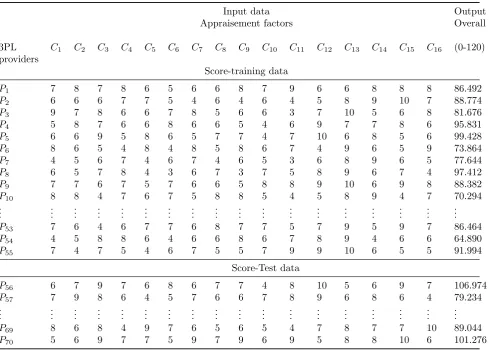
Table 2: Dataset for predicting of overall performance for 3PL providers
Input data Output
Appraisement factors Overall
3PL C1 C2 C3 C4 C5 C6 C7 C8 C9 C10 C11 C12 C13 C14 C15 C16 (0-120) providers
Score-training data
P1 7 8 7 8 6 5 6 6 8 7 9 6 6 8 8 8 86.492
P2 6 6 6 7 7 5 4 6 4 6 4 5 8 9 10 7 88.774
P3 9 7 8 6 6 7 8 5 6 6 3 7 10 5 6 8 81.676
P4 5 8 7 6 6 8 6 6 5 4 6 9 7 7 8 6 95.831
P5 6 6 9 5 8 6 5 7 7 4 7 10 6 8 5 6 99.428
P6 8 6 5 4 8 4 8 5 8 6 7 4 9 6 5 9 73.864
P7 4 5 6 7 4 6 7 4 6 5 3 6 8 9 6 5 77.644
P8 6 5 7 8 4 3 6 7 3 7 5 8 9 6 7 4 97.412
P9 7 7 6 7 5 7 6 6 5 8 8 9 10 6 9 8 88.382
P10 8 8 4 7 6 7 5 8 8 5 4 5 8 9 4 7 70.294
..
. ... ... ... ... ... ... ... ... ... ... ... ... ... ... ... ... ...
P53 7 6 4 6 7 7 6 8 7 7 5 7 9 5 9 7 86.464
P54 4 5 8 8 6 4 6 6 8 6 7 8 9 4 6 6 64.890
P55 7 4 7 5 4 6 7 5 5 7 9 9 10 6 5 5 91.994
Score-Test data
P56 6 7 9 7 6 8 6 7 7 4 8 10 5 6 9 7 106.974
P57 7 9 8 6 4 5 7 6 6 7 8 9 6 8 6 4 79.234
..
. ... ... ... ... ... ... ... ... ... ... ... ... ... ... ... ... ...
P69 8 6 8 4 9 7 6 5 6 5 4 7 8 7 7 10 89.044
4.2 Statistical metrics
Common statistical criteria or metrics, i.e., mean squared error (MSE), mean absolute percentage error (MAPE), root mean squared error (RMSE) and R-squared (R2), are given to appraise the estimation performance of the proposed AI-based approach. Four criteria or metrics are provided as below:
M SE= 1 N
N ∑
i=1
(pi−piˆ)2 (4.11)
M AP E= 1 N
N ∑
i=1
| pi−pˆi pi ×
100| (4.12)
RM SE = v u u t 1
N N ∑
i=1
(pi−pˆi)2 (4.13)
R2= 1− ∑N
i=1(pi−pˆi)2 ∑N
i=1(pi−p¯i)2
(4.14)
where,piand ˆpidenotes the actual and estimated values of thei-th data, respectively. Also, ¯pis the average of the actual values, andN is the number of data.
4.3 Results and discussion
The parameters of two well-known AI-based ap-proaches, i.e., BPNN and RBF, for the compar-ative analysis given in this case study for the lo-gistics management are as below:
• BPNN: The number of neurons in the hidden layer is 3 and
• the function is logsig(n) = (1+exp(1 −n)).
For the proposed AI-based approach, LS-SVM: C= 79810 andγ = 0.096. Also, the Gaussian ra-dial basis function kernel is taken as a commonly-used function. In addition, 10-fold cross valida-tion is regarded for the computavalida-tional process. This paper considers K = 10, meaning that all data provided by the training dataset could be separated into 10 subsets, each of which could take turns at being the test dataset. The other 9 subsets take into consideration as the train-ing dataset for finaliztrain-ing the model parameters. This implementation is computed according to the Libsvm introduced by [27]. Finally, the over-all comparative results for the logistics manage-ment according to the MSE, MAPE, RMSE and
Table 3: Overall comparative results of three intelligent models
Intelligent MSE MAPE RMSE R2
models
BP N N 28.9652 6.3261 4.0141 0.1313
RBF 31.0786 6.4923 4.3198 0.1298
Proposed AI-based 27.9623 5.8707 3.6294 0.1407
approach
5
Conclusion
The appraisement and selection of third-party lo-gistics (3PL) providers has been taken into ac-count many criteria or factors, resulting in com-plex conditions that could be identified by some conventional tools and methods. To overcome this problem in this research we provided a new hybrid artificial intelligence (AI)-based approach according to least square-support vector machine and cross validation methods. Support vector machine is taken to provide the non-linear re-lationship between selection, appraisement fac-tor or criteria and performance rating of 3PL providers and has proved high overall perfor-mance of non-linear representations. To demon-strate the ability and suitability of the presented AI approach, we have applied real test data set for the logistics management in 3PL provider ap-praisement and selection problems. Then we have compared our AI-based approach with two well-known tools, including BPNN and MLP, for the performance rating estimation. The comparative analysis indicated that the presented AI approach has a higher generalization performance for the logistics managers and provides lower estimation error. Notably that the ability of presented AI approach for overall rating prediction is affected by input parameters. As further research, the op-timization of the input parameters is suggested for the possible improvement to predictions and estimations in the logistics management.
Acknowledgments
The authors are grateful for the financial support from the Iran’s National Elite Foundation.
References
[1] S. Hertz, M. Alfredsson, Strategic develop-ment of third party logistics providers,
Indus-trial Marketing Management 32(2003) 139-149.
[2] W. C. Hong, Y. Dong, L. Y. Chen, S. Y. Wei,
SVR with hybrid chaotic genetic algorithms for tourism demand forecasting, Applied Soft Computing 11(2011) 1881-1890.
[3] S. H. Soh, A decision model for evaluating third-party logistics providers using fuzzy an-alytic hierarchy process, African Journal of Business Management 4 (2010) 339-349.
[4] S. Senthil, B. Srirangacharyulu, A. Ramesh, A robust hybrid multi-criteria decision mak-ing methodology for contractor evaluation and selection in third-party reverse logistics, Expert Systems with Applications 41 (2014) 50-58.
[5] R. Tavakkoli-Moghaddam, S. M. Mousavi, H. Hashemi, and A. Ghodratnama, Pre-dicting the conceptual cost of construc-tion projects: a locally linear neuro-fuzzy model, The First International Conference on Data Engineering and Internet Technol-ogy (DEIT) (2011) 398-401.
[6] B. Efron, Estimating the error rate of a prediction rule: Improvement on cross-validation, Journal of the American Statis-tical Association 78 (1983) 316-331.
[7] C. Chang, C. C. Lin, C. J. LIBSVM, A li-brary for support vector machines, (2008). [8] H. T. Liu, W.K. Wang , An integrated fuzzy
approach for provider evaluation and selec-tion in third-party logistics, Expert Systems with Applications 36 (2009) 4387-4398.
[9] J. Mashford, M. Rahilly, P. Davis, S. Burn,
[10] T. Skjoett-Larsen, Third party logistics -from an inter organisational point of view, International Journal of Physical Distribu-tion and Logistics Management 30 (2000) 112-127.
[11] T. Efendigil, S. ¨On¨ut, E. Kongar, A holistic approach for selecting a third-party reverse logistics provider in the presence of vague-ness, Computers and Industrial Engineering 54 (2008) 269-287.
[12] R. Gupta, A. Sachdeva, A. Bhardwaj, Selec-tion of 3PL service provider using integrated fuzzy Delphi and fuzzy TOPSIS, Proceedings of the World Congress on Engineering and Computer Science 2010, WCECS 2010, Oc-tober 20-22, San Francisco, USA, Vol. II.
[13] G. Zhang, J. Shang, W. Li, An information granulation entropy-based model for third-party logistics providers evaluation, Interna-tional Journal of Production Research 50 (2011)
[14] S. M. Mousavi, S. H. Iranmanesh, Least squares support vector machines with ge-netic algorithm for estimating costs in NPD projects, The IEEE International Confer-ence on Industrial and Intelligent Informa-tion (ICIII 2011), Indonesia (2011) 127-131.
[15] V. N. Vapnik, The Nature of Statistical Learning Theory, Springer, London (1999). [16] B. Vahdani, H. Iranmanesh, S. M. Mousavi,
M. A. Abdollahzade, locally linear neuro-fuzzy model for supplier selection in cosmet-ics industry, Applied Mathematical Mod-elling 36 (2012) 4714-4727.
[17] K. L. Peng, C. H. Wu, Y. J. Goo, The de-velopment of a new statistical technique for relating financial information to stock mar-ket returns, International Journal of Man-agement 21 (2004) 492-505.
[18] J. F. Ding, C. C. Chou, Middle man-agers selection for third-party logistics ser-vice providers, International Journal of the Physical Sciences 6 (2011) 610-619.
[19] Q. Wu, A hybrid-forecasting model based on Gaussian support vector machine and chaotic particle swarm optimization, Expert
Systems with Applications 37 (2010) 2388-2394.
[20] C. F. Huang, A hybrid stock selection model using genetic algorithms and support vec-tor regression, Applied Soft Computing 12 (2012) 807-818.
[21] S. C. Huang, P. J. Chuang, C. F. Wub, H. J. Lai, Chaos-based support vector regressions for exchange rate forecasting, Expert Sys-tems with Applications 37(2010) 8590-8598.
[22] S. M. Mousavi, R. Tavakkoli-Moghaddam, B. Vahdani, H. Hashemi and M. J. Sanjari, M. J.,A new support vector model-based im-perialist competitive algorithm for time esti-mation in new product development projects, Robotics and Computer-Integrated Manu-facturing 29 (2013) 157-168.
[23] R. Singh Bhatti, P. Kumar, D. Kumar, A loss function based decision support model for 3PL selection by 4PLs, International Journal of Integrated Supply Management 5 (2010) 365-375.
[24] B. Vahdani, F. Razavi, S.M. Mousavi,A high performing meta-heuristic for training sup-port vector regression in performance fore-casting of supply chain, Neural Computing and Applications (2015) 1-11.
[25] D. R. Salgado, F. J. Alonso,An approach based on current and sound signals for in-process tool wear monitoring, International Journal of Machine Tools and Manufacture 47 (2007) 2140-2152.
[26] V. N. Vapnik, The Nature of Statistical Learning Theory, Springer, London (1999). [27] K. Y. Chen, C. H. Wang, Support vector
re-gression with genetic algorithms in forecast-ing tourism demand, Tourism Management 28 (2007) 215-226.
[28] G. Kannan, S. Pokharel, P. S. Kumar,A hy-brid approach using ISM and fuzzy TOPSIS for the selection of reverse logistics provider, Resources, Conservation and Recycling 54 (2009) 28-36.
Systems with Applications 37 (2010) 8417-8423.
[30] K. Selviaridis, M. Spring, Third party logis-tics: a literature review and research agenda, International Journal of Logistics Manage-ment 18 (2007) 125-150.
[31] B. R. Efron, J. Tibshirani,An Introduction to the Bootstrap, Chapman and Hall, London, (1993).
[32] K. Govindan, P. Murugesan, Selection of third-party reverse logistics provider using fuzzy extent analysis, Benchmarking: An In-ternational Journal 18 (2011) 149-167.
Behnam Vahdanireceived a PhD degree from the Department of Industrial Engineering at Tehran University, Iran, and is a mem-ber of Iran’s National Elite Foun-dation. His current research inter-ests include: Supply chain network design, facility location and design, logistics plan-ning and scheduling, multi criteria decision mak-ing, uncertain programmmak-ing, artificial neural net-works, meta-heuristics algorithms and operations research applications. He has published several papers and book chapters in the aforementioned areas.
Shadan Sadigh Behzadi she has born in Tehran- Iran in 1983. Got B.Sc and M.Sc degrees in applied-mathematics, numerical analysis field from Islamic Azad Univer-sity, Central Tehran Branch and-PHD degree in applied mathemat-ics, here numerical analysis field from Science and Research Branch, Islamic Azad University.Main research interest includ numerical solution of nonlinear Fredholm- Volterraintegro-differential equation systems, ordinary differential equation, partial differential equation, fuzzy system and some equations in uid dynamics.
![Figure 1:Hierarchical structure of the 3PLprovider selection problem [24].](https://thumb-us.123doks.com/thumbv2/123dok_us/8877245.1817589/3.595.309.533.69.187/figure-hierarchical-structure-plprovider-selection-problem.webp)