TIGHT JUST EXCELLENT GRAPHS
SR. I. K. MUDARTHA1, R. SUNDARESWARAN2, V. SWAMINATHAN3,§
Abstract. A graphGisχ-excellent if for every vertexv, there exists a chromatic
par-tition π such that {v} ∈ π.A graphG is justχ-excellent if every vertex appears as a singleton in exactly one χ-partition. In this paper, a special type of just χ-excellence namely tight justχ-excellence is defined and studied.
AMS Subject Classifcation: 03B52; 05C40; 05C75.
1. Definition and Properties of tight just χ-excellent graphs
Definition 1.1. G is χ-excellent if for every vertex v, there exists a chromatic partition
π such that {v} ∈π.
Example 1.1. :
1. Kn is χ-excellent.
2. C2nis not χ-excellent but C2n+1 (n≥1) is χ-excellent.
3. W2n (n≥2) is χ-excellent.
Definition 1.2. A graph G is just χ-excellent if every vertex appears as a singleton in exactly oneχ-partition.
Example 1.2.
1. Kn is just χ-excellent. 2. C2n+1 is just χ-excellent
Definition 1.3. Harary graphs Hn,m withnvertices andm < nare defined as follows: Case(i):
n is even and m = 2r. Then Hn,2r has n vertices 0,1,2,· · · , n−1 and i, j are joined if
i−r ≤j≤i+r, where the addition is taken with respect to modulon. Case(ii):
1
Department of Mathematics, Maris Stella college, Vijayawada, Andhra Pradesh, India, e-mail: [email protected]; ORCID: https://orcid.org/0000-0002-0018-2655.
2 Department of Mathematics, SSN College of Engineering, Old Mahabalipuram Road, Chennai, India. e-mail: [email protected]; ORCID: https://orcid.org/0000-0002-0439-695X.
3 Saraswathi Narayanan College, Madurai, Tamilnadu, India.
e-mail: [email protected]; ORCID: https://orcid.org/0000-0002-5840-2040. § Manuscript received: March 03, 2017; accepted: July 24, 2017.
TWMS Journal of Applied and Engineering Mathematics, Vol.9, No.2 cI¸sık University, Department of Mathematics, 2019; all rights reserved.
m is odd and n is even. Let m = 2r+ 1. Then Hn,2r+1 is constructed by first drawing Hn,2r and then adding edges joining vertexito the vertex i+n2, for 0≤i≤ n2.
Case(iii):
m, n are odd. Let m = 2r+ 1. Then Hn,2r+1 is constructed by drawing Hn,2r and then adding edges joining vertex 0 to the vertices n−21 and n+12 and vertex i to i+ n+12 , for 1≤i≤ n−1
2 .
Definition 1.4. Kneser Graph Let k, n be two positive integers, such that 2≤k≤n. LetM be a set with n elements. The Kneser graphK(n, k) is defined as the graph with vertex set V as the set of all subsets of n of cardinality k. Two vertices of K(n, k) are adjacent if and only if the corresponding sets are disjoint. This concept was introduced by Kneser in 1978. Whenn= 2k+ 1, the Kneser graph is also called odd by Mulder. The domination number ofK(n,2) is 3 for every n.
Definition 1.5. A justχ-excellent graph of ordernhaving exactlyn χ-partitions is called a tight justχ-excellent graph.
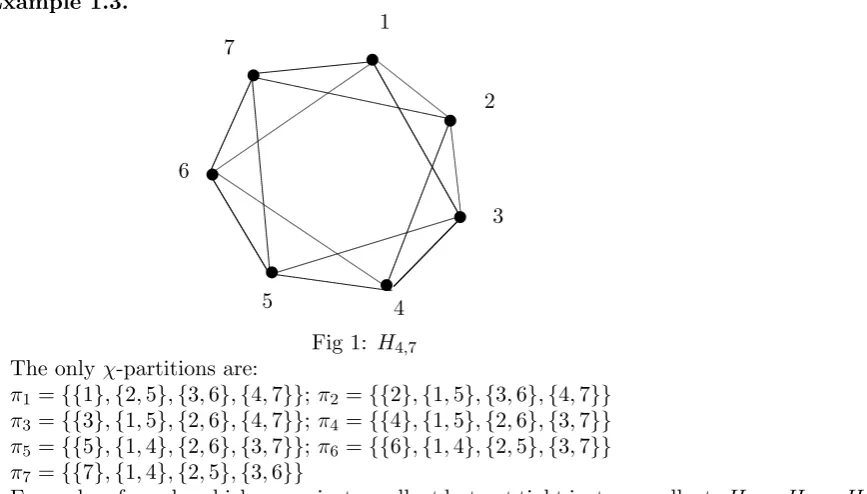
Example 1.3.
u u
u
u u
u u
1
2
3
4 5
6 7
Fig 1: H4,7
The only χ-partitions are:
π1={{1},{2,5},{3,6},{4,7}};π2={{2},{1,5},{3,6},{4,7}} π3={{3},{1,5},{2,6},{4,7}};π4={{4},{1,5},{2,6},{3,7}} π5={{5},{1,4},{2,6},{3,7}};π6={{6},{1,4},{2,5},{3,7}} π7={{7},{1,4},{2,5},{3,6}}
Examples of graphs which areχ- just excellent but not tight justχ-excellent: H4,10, H5,10, H7,13, H9,13.
Corollary 1.1. If G is a just χ-excellent graph, then either it is tight or it contains a
χ-partition in which no singleton appears( That is it contains at least n+1 χ-partitions).
Example 1.4.
s s s
s s
s s
1
2
3
4 5
6 7
Fig 2: C7
The χ-partitions of are :
{{4},{2,5,7},{1,3,6}};{{5},{1,3,6},{2,4,7}};{{6},{2,4,7},{1,3,5}} {{7},{1,3,5},{2,4,6}}
Some other χ-partitions are:
{{1,3},{2,4,6},{5,7}};{{1,3},{2,5,7},{4,6}};{{1,4},{3,5,7},{2,6}} {{1,4},{2,5,7},{3,6}};{{1,5},{2,4,6},{3,7}};{{1,5},{2,4,7},{3,6}} {{1,6},{3,5,7},{2,4}};{{1,6},{2,4,7},{3,5}};{{2,4},{1,3,6},{5,7}} {{2,5},{1,3,6},{4,7}};{{2,5},{1,4,6},{3,7}};{{2,6},{1,3,5},{4,7}} {{2,7},{1,3,5},{4,6}};{{2,7},{1,4,6},{3,5}}
Total number of chromatic partitions = 21. Of these14 Chromatic partitions do not involve singletons. It is an example of a non-tight justχ-excellent graph. In generalC2n+1
is a non-tight justχ-excellent graph.
Remark 1.1. If G is justχ-excellent and not tight, then any chromatic partition with a singleton class contains at least one class with more than two elements.
Proposition 1.1. Let G be a just χ-excellent graph. Then G is a tightχ-excellent graph if and only if n= 2χ−1.
Proof. LetG be a justχ-excellent graph with n= 2χ−1. SinceG is just
χ-excellent, given any vertexu, there exists a chromatic partition with{u}as an element of the partition. The remainingχ−1 partitions must have atleast two elements each since in a justχ-excellent graph no chromatic partition can contain two singletons. Therefore the minimum number of elements in any partitions are 2(χ−1) + 1 = 2χ−1 = n. But the total number of elements are n. Therefore every chromatic partition containing a singleton must contain only two elements sets as other elements of the partition. If a chromatic partition does not contain a singleton then the total number of elements in the partition are at least 2χ > na contradiction. Therefore the graph is tight justχ-excellent.
The converse is obvious.
Remark 1.2. C5 is χ-excellent and number of χ-partitions is 5.
Proposition 1.2. If G is a tight just χ-excellent graph, then
χ−1≤deg(u)≤2χ−4 =|V(G)| −3 for anyu∈V(G).
Proof. Since G is a tight justχ-excellent graph,|V(G)|= 2χ−1. Clearly u is not a full degree vertex. Thereforedeg u≤n−2 = 2χ−3. Suppose degu=n−2. Then u is not adjacent to exactly one vertex ofG say v. Let π ={{v}, V2,· · ·, Vχ} be a χ-partition of
Gcontaining {v}. Then u ∈Vi for some i, 2≤i≤χ. Butu is adjacent to every vertex other thanv. Therefore|Vi|={u}, a contradiction, since in a justχ-excellent graph any
χ-partition can contain at most one singleton class. Hencedeg(u)≤n−3≤2χ−4.
Proposition 1.3. Given a positive integer k, there exists a tight just χ-excellent regular hamiltonian graphGsuch thatχ(G) =k+1,|V(G)|= 2k+1and every vertex that appears as a singleton in a chromatic partition is adjacent to every element of (k−2) doubletons in that partition and adjacent with exactly one element in the remaining two doubleton classes.
Proof. Consider the graph H2k−2,2k+1. β0(H2k−2,2k+1) = 2. ( For: Suppose S is an
independent set with 3 vertices say {u1, u2, u3}. But u1 is not adjacent with only two vertices say v, wwhere d(u1, v) =k and d(u1, w) =k+ 1. Therefore u2 =v and u3 =w.
But d(v, w) = 1 and hence u2 and u3 are adjacent, a contradiction. Clearly {u1, v} is independent ). Therefore βn
0 ≤χ gives 2k+1
Let π = {{1},{2, k+ 2},{3, k+ 3},· · ·,{k+ 1,2k+ 1}}. Then π is a proper colour partition of cardinalityk+1 and henceχ=k+1 andπis aχ-partition in which 1 is adjacent with 2,3,4,· · · , k,2k+ 1,2k,· · · , k+ 3. Therefore 1 is adjacent with exactly 1 element namely 2 and 2k+ 1 in the remaining two doubleton classes{2, k+ 2},{k+ 1,2k+ 1}.
Observation 1.1. The graphG=H2k−2,2k+1 is2k−2regular,β0 = 2andχ≥k+12. The
graph admits ak+ 1-colour partition. Therefore χ(H2k−2,2k+1) = k+ 1. Degree of every
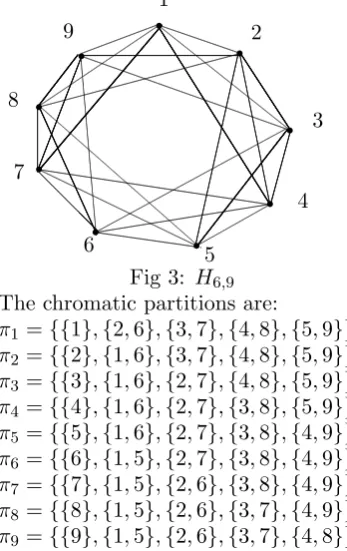
vertex = 2k−2 = 2χ−4. |V(G)|= 2k+ 1 = 2χ−1. This graph is tight just χ-excellent and the degree of every vertex is2χ−4. As illustrations, the graphs H6,9, H8,11, H10,13are
drawn and the chromatic partitions are exhibited.
r
r r
r r
r
r r
r
1
2
3
4
5 6
7 8
9
@ @
@@
Fig 3: H6,9
The chromatic partitions are:
π1={{1},{2,6},{3,7},{4,8},{5,9}} π2={{2},{1,6},{3,7},{4,8},{5,9}} π3={{3},{1,6},{2,7},{4,8},{5,9}} π4={{4},{1,6},{2,7},{3,8},{5,9}} π5={{5},{1,6},{2,7},{3,8},{4,9}} π6={{6},{1,5},{2,7},{3,8},{4,9}} π7={{7},{1,5},{2,6},{3,8},{4,9}} π8={{8},{1,5},{2,6},{3,7},{4,9}} π9={{9},{1,5},{2,6},{3,7},{4,8}}
In H8,11,
The chromatic partitions are:
π1={{1},{2,7},{3,8},{4,9},{5,10},{6,11}} π2={{2},{1,7},{3,8},{4,9},{5,10},{6,11}} π3={{3},{1,7},{2,8},{4,9},{5,10},{6,11}} π4={{4},{1,7},{2,8},{3,9},{5,10},{6,11}} π5={{5},{1,7},{2,8},{3,9},{4,10},{6,11}} π6={{6},{1,7},{2,8},{3,9},{4,10},{5,11}} π7={{7},{1,6},{2,8},{3,9},{4,10},{5,11}} π8={{8},{1,6},{2,7},{3,9},{4,10},{5,11}} π9={{9},{1,6},{2,7},{3,8},{4,10},{5,11}} π10={{10},{1,6},{2,7},{3,8},{4,9},{5,11}} π11={{11},{1,6},{2,7},{3,8},{4,9},{5,10}}
Observation 1.2. Two families of tight justχ-excellent graphs are given below. Both are obtained from Harary graphs by removing suitable edges. Construct H2n−2,2n+1. Remove
the edges with one end at vertexi(1≤i≤2n+ 1)and the other end at the vertices shown against eachi. The resulting graph is tight justχ-excellent withχ=n+ 1. Every positive integral value in the range[χ−1,2χ−4](that is n to 2n−2) is realized as degree of the vertices.
Case 1: n is odd. ConsiderH16,19 with specified edges removed.
Vertex degree Non-adjacent vertices Other end of the Edges
1 n+ 1 n+ 1, n+ 2 n+ 3, n+ 4,· · ·,2n−1
2 n+ 1 n+ 2, n+ 3 n+ 4, ...,2n
3 n+ 2 n+ 3, n+ 4 n+ 5, ...,2n
4 n+ 2 n+ 4, n+ 5 n+ 6, ...,2n+ 1
5 n+ 3 n+ 5, n+ 6 n+ 7, ...,2n+ 1
6 n+ 4 n+ 6, n+ 7 n+ 8, ...,2n+ 1
· · · ·
· · · ·
· · · ·
n−1 2n−3 2n−1,2n 2n+ 1
n 2n−2 2n,2n+ 1 · · ·
n+ 1 2n−3 2n+ 1,2n+ 2 2n
n+ 2 2n−3 2n+ 2,2n+ 3 2n+ 1
n+ 3 2n−4 2n+ 3,2n+ 4 2n+ 1,1
n+ 4 2n−4 2n+ 4,2n+ 5 1,2
n+ 5 2n−5 2n+ 5,2n+ 6 1,2,3
n+ 6 2n−6 2n+ 6,2n+ 7 1,· · · ,4
· · · ·
· · · ·
· · · ·
2n−1 n+ 1 n−2, n−1 1,2,· · ·, n−3
2n n n−1, n n+ 1,2,· · ·, n−2
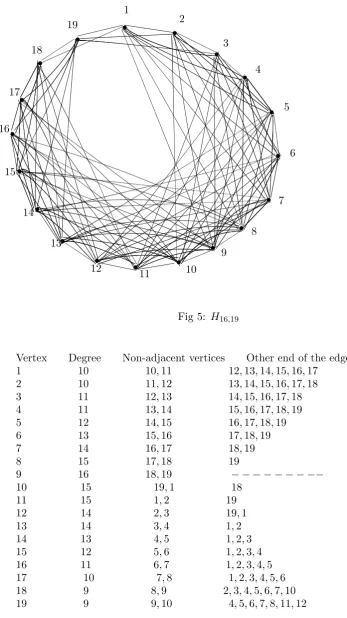
Illustration 1.1. : For H16,19 with specified edges removed, χ = 10. Every positive
integral value in[9,16] is realized as the degree of the vertices.
s
s
s
s
s
s
s s s
s s
s s s s
s s
s s
1
2
3
4
5
6
7
8
9
10 11
12 13
14 15 16
19
18
J J
J 17
Fig 5: H16,19
Vertex Degree Non-adjacent vertices Other end of the edges
1 10 10,11 12,13,14,15,16,17
2 10 11,12 13,14,15,16,17,18
3 11 12,13 14,15,16,17,18
4 11 13,14 15,16,17,18,19
5 12 14,15 16,17,18,19
6 13 15,16 17,18,19
7 14 16,17 18,19
8 15 17,18 19
9 16 18,19 − − − − − − − −−
10 15 19,1 18
11 15 1,2 19
12 14 2,3 19,1
13 14 3,4 1,2
14 13 4,5 1,2,3
15 12 5,6 1,2,3,4
16 11 6,7 1,2,3,4,5
17 10 7,8 1,2,3,4,5,6
18 9 8,9 2,3,4,5,6,7,10
Case 2: n is even.
Vertex degree Non-adjacent vertices Other end of the Edges
1 n+ 2 n+ 1, n+ 2 n+ 3, n+ 4, ...,2n−2
2 n+ 2 n+ 2, n+ 3 n+ 4, ...,2n−1
3 n+ 2 n+ 3, n+ 4 n+ 5, ...,2n
· · · ·
· · · ·
· · · ·
· · · ·
n+2
2 n+ 2
3n+2 2 ,
3n+2 2 + 1
3n+2
2 + 2,· · ·,2n+ 1,
1,· · · ,n−26
n+2
2 + 1 n+ 3
3n+2 2 + 1,
3n+2 2 + 2
3n+2
2 + 3,· · ·,2n+ 1,
1,· · · ,n−26
n+2
2 + 2 n+ 4
3n+2 2 + 2,
3n+2 2 + 3
3n+2
2 + 4,· · ·,2n+ 1,
1,2,· · · ,n−28
. · · · ·
· · · ·
· · · ·
· · · ·
3n+2
2 −4 2n−2
5n+2 2 −4,
5n+2
2 −3 · · ·
3n+2
2 −3 n+ 2 3n+2
2 +n−3, 3n+2
2 +n−2 2n,2n−1,· · · ,2n−(n−5) 3n+2
2 −2 n+ 2 3n+2
2 +n−2, 3n+2
2 +n−1 2n+ 1,2n,· · · ,2n+ 1−(n−5)
· · · ·
· · · ·
· · · ·
· · · ·
2n−2 n+ 2 3n−2,3n−1 n+22 −2,n+22 −3,· · · ,1,2n+ 1,
2n,· · ·,2n+ 1−(n−28) 2n−1 n+ 1 3n−1,3n 2n+ 3,2n+ 4,· · · ,3n−2,2n−5
2n n 3n,3n+ 1 2n+ 4,· · ·,3n−1,2n−5,2n−4
Illustration 1.2. ForH10,13 with specified edges removed, χ= 7. Every positive integral
value in [6,10] is realized as the degree of the vertices.
s
s
s
s
s
s s
s s
s s s
s
1
2
3
4
5
6
7 8
9 10 11
12
13
Fig 6: H10,13
Vertex Degree Non-adjacent vertices Other end of the edges
1 8 7,8 9,10
2 8 8,9 10,11
3 8 9,10 11,12
4 8 10,11 12,13
5 9 11,12 13
6 10 12,13
———-7 8 13,1 11,12
8 8 1,2 12,13
9 8 2,3 13
10 8 3,4 1,2
11 7 4,5 2,3,7
12 6 5,6 3,4,7,8
13 6 6,7 4,5,8,9
Proposition 1.4. The Kneser graph K(n,2)is not χ-excellent forn≥3.
Proof. χ(K(n,2)) =n−2.χ(K(n,2)− {u}) =χ(K(n,2)) for anyu∈V(K(n,2)). ThereforeK(n,2) is not χ-critical and hence notχ-excellent.
Proposition 1.5. The Kneser graph K(n, k) (k≤n 2
) is not χ-excellent forn≥3.
Proof. Let u = {1,2, ..., k}. Then χ(G−u) = χ(G) = n−2k+ 2. Therefore G is not
χ-excellent.
Observation 1.3. C2n+1 is just χ-excellent. It is not tight just χ-excellent if n ≥ 1.
Further there exists a chromatic partition in which every vertex of the cycle is colourful if and only if 2n+ 1≡0(mod 3).
Proof. Consider C3n where n is odd. The chromatic number is 3. The partition π =
{{u1, u4,· · · , u3n−2},
vertices is{{u1, u4, u7, u10,· · ·, u3n−2}, {u2, u5,· · · , u3n−1, u3n+1},{u3, u6,· · · , u3n}}.
Hereu1 and u3n+1 are not colourful and all other vertices are colourful.
Let π = {V1, V2, V3} be a chromatic partition of C3n+1 (n even). In any Vi, if ui ∈ Vi thenui−2 andui+2can not be inVi. ThereforeV1 ={u1, u4,· · · }, V2={u2, u5,· · · }, V3 = {u3, u6,· · · }. Since total number of vertices is 3n+ 1, there exists at least one Vi such that |Vi| ≥ n+ 1. Suppose |V1| ≥ n+ 1. If |V1|= n+ 1, then the (n+ 1)th term in V1 is u3n+1 which is adjacent to u1 in V1, a contradiction. A similar contradiction arises if |V1|> n+ 1. Therefore |V1| ≤n. Similarly |V2| ≤ n and |V3| ≤ n, a contradiction since
|V|= 3n+ 1.
Further ifV1={u1, u4,· · · , u3n−2}, V2={u2, u5,· · · , u3n−1}, and
V3 ={u3, u6,· · ·, u3n}, thenu3n+1cannot be accomodated inV1andV3, since they contain
the adjacent verticesu1 andu3nrespectively. Thereforeu3n+1 has to be included inV2. In
this caseu3nandu1will not be colourful. Hence the number of colourful vertices is at most 3n−1. Since we have already shown that there exists a chromatic partition containing 3n−1 colourful vertices, we get that the maximum number of colourful vertices in any chromatic partition ofC3n+1 (neven) is 3n−1.
Similar proof can be given forC3n+2 wheren is odd to show that the maximum number
of colourful vertices in any chromatic partition is 3n. Hence the observation.
Remark 1.4. In a tight justχ-excellent graph of ordern, the maximum number of colour-ful vertices in any chromatic partition is n−2. For:
In any tight just χ-excellent graph of order n every chromatic partition contains exactly one singleton class and the maximum degree of a vertex is 2χ−4 where n = 2χ −1. The number of colourful vertices in any chromatic partition is equal to 1 +deg(v) where
{v} appears as a colour class in that partition. Therefore maximum number of colourful vertices in any chromatic partition is equal to 1 + 2χ−4 = 2χ−3 =n−2. Thus there is a vertex of degreen−3 in that graph.
Remark 1.5. H2r,2r+3is tight justχ-excellent, in which every colour partition hasn−2 (=
2r+ 1) colourful vertices.
Remark 1.6. There are tight just excellent graphs of order n in which the maximum number of colourful vertices is less thann−2.
Example 1.5.
v v
v
v
v
v v
v v v
v
1 2
3
4
5
6 7
8 9
10 11
The χ-partitions of Gare:
π1={{1},{2,7},{3,8},{4,9},{5,10},{6,11}} π2={{2},{1,7},{3,8},{4,9},{5,10},{6,11}} π3={{3},{1,7},{2,8},{4,9},{5,10},{6,11}} π4={{4},{1,7},{2,8},{3,9},{5,10},{6,11}} π5={{5},{1,7},{2,8},{3,9},{4,10},{6,11}} π6={{6},{1,7},{2,8},{3,9},{4,10},{5,11}} π7={{7},{1,7},{2,8},{3,9},{4,10},{5,11}} π8={{8},{1,6},{2,7},{3,9},{4,10},{5,11}} π9={{6},{1,6},{2,7},{3,8},{4,10},{5,11}} π10={{10},{1,6},{2,7},{3,8},{4,9},{5,11}} π11={{11},{1,6},{2,7},{3,8},{4,9},{5,10}}
The colourful vertices with respect to
π1 are: 1,2,3,4,5,10,11;π2 are: 1,2,3,4,5,6,11;
π3 are: 1,2,3,5,6,7; π4 are: 1,2,3,4,5,6,7; π5 are: 1,2,3,4,5,6,7,8;π6 are: 2,4,5,6,7,8,9; π7 are: 3,4,5,6,7,9; π8 are: 5,6,7,8,9,10,11;
π9 are: 6,7,8,9,10,11;π10 are: 1,7,8,9,10,11; π11 are: 1,2,7,8,9,10,11.
Hence maximum number of colourful vertices is 8 and this is realized in the partition
π5. Heren= 11 and 8<9 =n−2
Proposition 1.6. ConsiderC3n. There is no chromatic partition containing exactly (n− 1)colourful vertices.
Proof. LetV(C3n) ={u1, u2,· · · , u3n}. Suppose there exists a chromatic partition sayπ, containing exactlyn−1 colourful vertices. Letπ ={V1, V2, V3}. Since exactly one vertex sayui is not colourful, ui−1 and ui+1 belong to the same colour class of π sayV1. Every
element ofV2 andV3is colourful. LetV2 ={ui1, ui2,· · ·, uir}andV3={uj1, uj2,· · · , ujs}, where (i1 < i2 < · · · < ir and j1 < j2 < · · · < js). Further in V2 and V3 ik and ik+1
must have difference at least 3 and so also jk and jk+1. The maximum cardinality of V2
satisfying the above property is n. The same condition holds in V3. Moreover no Vi can have cardinality more thannsinceβ0(C3n) =n. If|V1|or|V2|or|V3|is less than n, then
one or two of the remaining elements of the partition will have more than n elements a contradiction. Therefore |V1| = n = |V2| = |V3|. Since V2 and V3 satisfy the property
that the difference between any two suffixes is 3, V1 also satisfies the same condition, a contradiction. Therefore exactly n−1 colourful vertices in a chromatic partition is not
possible.
Observation 1.4.Every tight justχ-excellent graph is of odd order. But a justχ-excellent graph may be of even order. For example, H5,10 is 5-regular and is just χ-excellent with χ= 4, n= 2χ+ 2.
r r
r
r r r r r
r r
1
2
3
4
5 6
7 8
9 10
The partitions are:
π1={{1},{2,5,8},{3,6,9},{4,7,10}};π2 ={{2},{1,5,8},{3,6,9},{4,7,10}} π3={{3},{1,5,8},{2,6,9},{4,7,10}};π4 ={{4},{1,5,8},{2,6,9},{3,7,10}} π5={{5},{1,4,8},{2,6,9},{3,7,10}};π6 ={{6},{1,4,8},{2,5,9},{3,7,10}} π7={{7},{1,4,8},{2,5,9},{3,6,10}};π8 ={{8},{1,4,7},{2,5,9},{3,6,10}} π9={{9},{1,4,7},{2,5,8},{3,6,10}};π10={{10},{1,4,7},{2,5,8},{3,6,9}}
References
[1] Fricke, G. H. , Teresa W. Haynes, Hetniemi,S. T. , Hedetniemi,S. M. and Laskar, R. C. (2002), Excellent trees, Bull. Inst. Combin. Appl.,34 pp.27-38.
[2] Sridharan,N. and Yamuna,M.,(1980), Excellent-Just Excellent-Very Excellent Graphs, Journal of Math. Phy.Sci., 14 (5), pp.471-475.
[3] Sampathkumar, E. and Bhave, V. N.,(1976), Partition Graphs and Colouring Numbers of a Graph, Discrete Mathematics, 16, pp.57-60.
[4] Sampathkumar, E. and Bhave, V. N., (1975), Partition Graphs of a Graph, Progress of Mathematics, 9(2), pp.33-42.
[5] Terasa W. Haynes, Stephen T. Hedetneimi, Peter J. Slater,(1998), Fundamentals of Domination in Graphs, Marcel Dekker Inc.
Irene Kulrekha Mudartha received her Master’s degree in 1987 from Bombay University, Bombay and PhD in 2013 from Madurai Kamaraj University, Madurai, India. Currently, she is working as the Principal of Maris Stella College in Vijayawada, Andhra Pradesh, India. She has 19 years of teaching experience and 8 years of research experience. Her research interests include Semigraphs, Partition Graphs and Coloring. She has published 3 research articles in national and international refereed journals.
R. Sundareswaranreceived his Masters degree in 1999, Ph.D. degree in 2011 from Madurai Kamaraj University, Madurai, India. He did Ph.D. work in the major re-search project entitled Domination Integrity in graphs sponsored by Department of Science and Technology, New Delhi, India. His area of interest include vulnerabil-ity parameters of graphs, domination and colouring. He is currently working as an Assistant Professor in the Department of Mathematics, SSN College of Engineer-ing, Chennai, India. He has more than 15 years of teaching experience and 8 years of research experience. He published more than 10 research article in international refereed journals. He is a reviewer of American Mathematical society.