E-TENDER APPLICATION AND ITS IMPLICATION TO MALAYSIAN CONSTRUCTION INDUSTRY
Saiful Hadi bin Mastor Anim Zalina binti Azizan
Kolej Universiti Teknologi Tun Hussein Onn, Malaysia saifulh, [email protected]
The advent of globalization, increased local and international competition and the need to improve the profitability of Construction Company has resulted internet technology becoming a major focus in the construction industry. The used of internet technology in construction industry is being said to have many advantages including speed, real-time data input and availability, centrally located applications, database and documents; definable user accessibility and increased uptime. Among crucial business application is using the internet technology as a method of tendering for business-to-business, which is also known as Electronic Tendering (e-Tender). It is a relatively simple technical solution based around secure e-mail and electronic document management. It involve uploading tender document on to a secure a website with secure login, authentication and viewing rules. E-tendering offers an opportunity for automating most of the tendering process: from help with preparing the tender specification; advertising; tender aggregation; to the evaluation and placing of the contract. Throughout this paper, the practice of Tender system in Malaysia, the challenges and the impact of adopting e-Tender will be discussed. As this is a conceptual paper, the findings could contribute much in expanding construction industries’ motivation to embark on e-Tender endeavor.
The global economy has changed dramatically from an industrial society to an
information society. Several information and communication technologies (ICTs) have been developed in the marketplace and these ICTs have presented numerous
opportunities and challenges for both developed and developing countries. The Internet is an important information technology that has developed over the years and it is
transforming the manner in which several companies conduct their business activities and it has enabled the evolution of electronic commerce (E-commerce).
The benefits of e-commerce are several:- consumers are able to purchase goods online; professional services for example financial services can also be accessed online; time-savings; the opportunity to participate in a global marketplace unrestricted by geographical barriers or boundaries; accessibility to information improving the
competitiveness of firms, levelling the playing field and leading to improved customer service and satisfaction.
This rapid and unparalleled change has also transformed the construction
leadership focus; and reactive to more proactive state (Russell J. S, 2000; NOIE, 2002; Murray M., 2003 ).
International predictions, relating to the amount of business conducted electronically have reached hundreds of billions of dollars, with little doubt that the emergence of the Internet is ‘revolutionising’ business access to communication and information. These ‘e-activities’ can generally be described as being about eliminating inefficiencies in traditional processes, communications, etc. and finding ‘smarter’ ways of undertaking these activities in an electronic environment, and generally requires industry organisational commitment, change and investment (NSW Government 2002). Unfortunately, there still exists within today’s construction industry a considerable lack of knowledge and awareness about innovative information and communication
technology (ICT) and web-based communication processes, systems and solutions, which may prove beneficial in the procurement, delivery and life cycle of projects (Kajewski S. and Weippert A., 2000).
Consequently, through increased knowledge, awareness and successful
implementation of innovative systems and processes - such as electronic tendering (E-Tender) - raises great expectations regarding their contribution towards ‘stimulating’ the globalisation of electronic procurement activities, and improving overall business and project performances throughout the construction industry sectors and overall
marketplace (NSW Government 2002; Harty C. 2003; Murray M. 2003; Pietroforte R. 2003). This paper identifies the benefits and challenges to the adoption of e-Tender systems and recommendations.
E-Tender in Construction
According to Thorpe & Bailey, 1996, tendering is a method of entering into a sales contract. It is a long and complex business process and generates a series of contractually related legal liabilities. Substantial construction and and engineering contracts are entered into through the tendering process. Tendering process here can be defined as an invitation to those relevant parties to make an offer to the principal, which must be capable of accepting the offer, thereby creating a legally binding contract ( Atlas, Pitney, Curtis, Greenham, Hanly, Glodstein, Mansfield & Grace, 1993, Thrope & Bailey, 1996 )
Traditional process of tendering starts when the owner of the tender published the notification of tender through print media such as newspapers within a period of time. Then , the contractor will respond to the tender advertisement by purchasing the
1 2 Publish Respond Tender To Tender
3
Bid Opening
4 5
Award Award/ Regret Tender Email
Tender close
Figure1 : Traditional Tender Process
Source: Ezanee , Norlila and Nurshuhada ( 2005 )
In contrast, electronic tendering ( E-Tender ) has evolved over the past decade from a dial-up modem-to-modem computer access to a more elaborate Internet based tendering system. In today’s terms, electronic tendering may be defined on a broad spectrum from a simple Internet based system that displays only a brief description of the commodity being procured to a more sophisticated Internet system that provides
contractors with the ability to download and pay for a complete tender document (specifications included) in electronic form, all without any paper being produced-
paperless and benefits to lower the cost to the organisations ( Shapiro and Varian, 1999 ).
According to Harry, The Builder in Construction News and Views, Issue 3 ( JUBM, 2002 ), electronic tendering or E-Tender is one of the many interesting
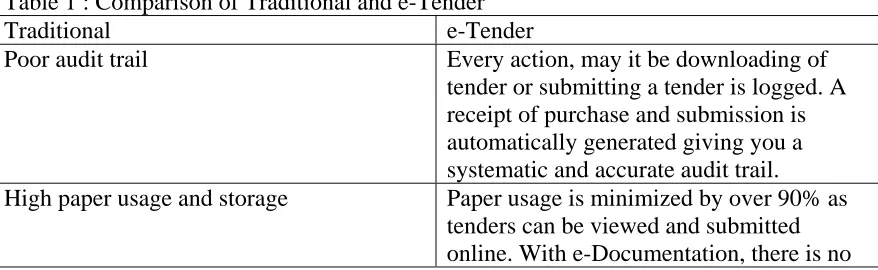
[image:3.612.88.527.575.710.2]development in today’s construction industry. It refers to the use of the Internet and other electronic media to manage and facilitate the tendering process. Fundamentally, it does not change the way the tendering process is done, however it enhances the process by utilizing today’s digital technology. Table 1 below shows the differences between Traditional and E-Tender.
Table 1 : Comparison of Traditional and e-Tender
Traditional e-Tender Poor audit trail Every action, may it be downloading of
tender or submitting a tender is logged. A receipt of purchase and submission is automatically generated giving you a systematic and accurate audit trail.
need for physical storage space of tender document.
Long lead –time is required for bidders to physically come to a centralized location to purchase tender
Tender documents can be viewed and downloaded via the internet, hence there is no geographical boundaries making it fast and convenient, reducing lead-time by over 80%.
Poor information safety and availability As all tender documents are securely stored online and backed up via remote servers, and are assured of 99.9% information safety, and availability
Poor Information security and integrity All activities online are logged and access to different types of information can be granted based on “ need to use” basis. This gives the absolute control over tender information and documents.
High processing cost Cost is fixed through process automation. Access to documents online further eliminates the need to manage documents requested by bidders saving more
resources.
Time consuming and slow processing Automated documentation flow reduces over 80% of tedious data entry and
compilation, making it a breeze to process hundreds, even thousands of tenders Source: Ezanee , Norlila and Nurshuhada ( 2005 )
The typical e-tendering process generally engaged in by most systems. The components of the systems will facilitate the process of prequalification or registration, public invitation, tender submission, close of tender, tender evaluation and award of tender.
E-Tender initiatives in Malaysian Construction Industry
In 2004, Construction Industry Development Board ( CIDB ) had signed a memorandum of understanding with the Public Works Department (JKR) on a project that is expected to revolutionise the tendering process of the construction industry in Malaysia. CIDB’s role under this project is to develop, implement, operate and maintain the National e-Tender System. The objective is to develop greater corporate governance in the public construction tendering process. This involves tendering information management, specific tender distribution and the selection of services for all construction works undertaken by the government.
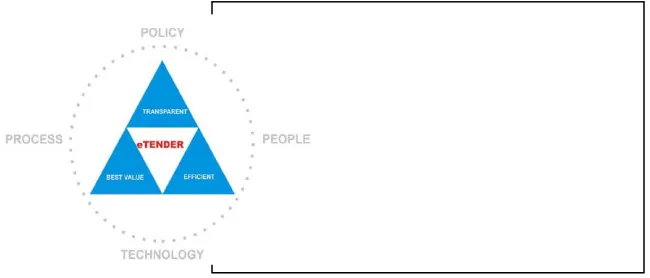
process into a streamlined, progressive and ‘ intelligent’ one by use of procedural streamlining and technology empowerment. What distinguishes NeTi from her other international counterparts is that it is designed ti integrate with the Malaysian
[image:5.612.92.417.189.328.2]eGovernment Flagship as a 2nd tier infrastructure to like up and interface with all other agencies for construction procurement and tenders as well as project management. By doing this, as illustrated in Figure 2, NeTi synthesis all aspect of pre, during and post tender processing for government projects as provate-based projects; providing not only integration but also streamlined processing of all data and payment directly.
Figure 2: Model for an Effective E-Tender National Programme Source: Syed Alwee Alsagof, Eric, L.C. W and Nurshuhada ( 2006 )
By enhancing the efficiency and implementing transparency in the construction supply-chain process, the National e-Tender System encourages the development of IT construction players. The system utilises JKR’s established tendering protocols and its current contract monitoring system. It links all components of public construction projects. CIDB provides its current technology and knowledge resources to develop and manage the online tendering engine, while JKR, as the tender-process owner, sets the required professional protocols under which the tender information, documentation and selection process are operated to ensure a transparent and smooth transition from the current manual process into the electronic tender process.
Altogether, the implementation of the E-Tender system can be segregated into four phases.
Phase 1: Online Tender Box
A client starts by creating an online tender box, Bills of Quantities ( BQs ), drawings and other related documents are uploaded to the tender box.
One of the main advantages of advertising tender notices online is that it can be updated regularly and quickly, thus saves time and money.
Phase 2: Viewing Tender Documents Online
The E-Tender include some portions of the tender documents for viewing. These portions contain the Specifications and Instructions to contractors, plus other relevant information for the benefits of the prospective contractors. It also allows anyone who is interested in vying for the tenders to view the tender details anytime and anywhere as long as there is access to the Internet.
In the “Tender Notices” page, click a tender title in the list and a new window will open detailing the relevant documents to be viewed. These documents have been
uploaded and attached to the tender notices online, but full details of the tender document is not included. The full physical tender document will have to be purchased from JKR offices.
The purpose of this phase is to enable a hesitant contractor to view some of the important details of a tender and thus helping him to decide whether the tender is relevant with his scope of business.
Phase 3: Buying Tender Documents Online
In Phase 3, E-Tender system allows purchasing of tender documents online. At this third stage, online buying of tender documents is done by integrating the E-Tender with the Electronic Bills Presentment and Payment (EBPP) system. The modes of payment available are credit cards or direct debiting from bank accounts.
For this purpose, the contractor is required to register as a user on the website. The contractor’s information as provided by the user will be verified against the record from UPK registry from the State Financial Secretary’s Office. These are all standard procurement procedures which run concurrently with Government’s practice, except now it is done online.
Once the contractor has viewed the tender notices and has decided to purchase the entire tender documents, he can do so online. After the payment is received, the entire tender document is then made available to the contractor for downloading and printing purposes.
Phase 4: Virtual Tender Box
In Phase 4, the E-Tender system is anticipated to evolve to become a fully web-based system suitable for online bidding; thus creating a virtual Tender Box and allowing contractors to make tender submissions online. To achieve this, a more comprehensive online networking community is required, i.e. all interested manufacturers and suppliers would need to be linked to the Internet. This is because tender submission would be in the form of electronic data instead of in paper form.
and agency’s appointment letters can be included as either direct links to the manufacturers’ websites or in the form of scanned documents.
The same personnel who are in charge of opening the present physical tender documents will now open this E-Tender box. The opening, however, would be done electronically. As a security measure, only the officers-in-charge would be provided with the password to access this virtual Tender Box, and hence able to vet through them officially following standard Government procurement procedure.
At presence, CIDB under E-Construct Services Sdn. Bhd has successfully completed the implementation of Phase 2.
Case Study : First successful construction E- Tendering In Malaysia
Last 2001,icFox Sdn. Bhd, one of the E-Tender provider was successfully used on its first eTender in Malaysia . Much has been discussed in the industry about the adoption of eTendering but, this is the first real live application in the Malaysia construction industry. icFox’s online tendering platform is an internet based platform which the various parties involved were able to access via their office PC’s and an internet connection. Some of the findings are discussed below.
Project Earthworks and Ancillary Works in Shah
Alam
The Players Client ( major local developer ), Civil & Structural Engineer, Quality Surveyor ( JUBM) and six ( 6) tenders.
Duration 23 November 2001 to 7 January 2002 (
including tender reporting)
List of Key Technology icFox’s web –based tendering platform, Tender editor ( a downloadable software programme to use the tendering platform ), an internet browser ( Internet
Explorer 5.5 and above) and Internet access via modem. ISDN or ADSL
Tender Documents Tender Documents are prepared based on CITE ( Construction Industry Trading Electronically ) format. This is a standard messaging format for collaborative electronic information exchange. IT Requirements Tenderers can easily upload a 1 Mb BQ
done in the afternoon. A leased line facility is preferred to improve enduser experience of etendering.
Source: Construction News and Views, Issue 1 ( JUBM, 2002 )
E-Tender Benefits
According to the NSW Government (NSW Government 2002) and Department of
Commerce (NSW Government 2003), the construction industry and government agencies / departments can achieve numerous benefits from introducing an e-Tendering system or process, including:
• General:
• Streamlines the whole tendering process;
• Provides improved and secure access to tender information; • Brings about innovative business processes;
• Initiates greater opportunities for small and regionally based businesses; • Allows downloading of electronically submitted tenders in a form suitable for
evaluation purposes without having to manually re-enter data; and
• Makes it easier for businesses to obtain tender documentation and to submit an offer on time.
• Industry perspective:
• Provides quick and easy access to public and private tendering information; • Increased tender opportunities;
• Improved access for geographically isolated industry organisations; • Increased market share and competitiveness; and
• Reduces the cost of printing - saving time and resources.
• Government perspective:
• Best value for taxpayers’ money; • Increased efficiency and effectiveness;
• Consistent tendering practice across Government; • Promotes overall e-Commerce initiative; and
• Environmentally friendly due to a predominantly ‘paperless’ process.
Challenges in implementing E-Tender in Malaysia
Despite the benefits mentioned in the preceding section, there are several challenges to be faced in the development and implementation of E-Tender system in Malaysia. There are:-
In terms of security, one of the main areas that needs to be addressed is that of signatures. There are no regulations or standards governing what constitute a valid signature in the E-Tender environment. The issue of the validity of electronic
signatures requires urgent attention before E-tender can take place between different parties.
ii) User acceptance
Lack of trust in technology can present a problem as well as lack of knowledge amongst both the buyers and sellers. Resistance to use new technology can also be an issue.
iii) Accessibility issues
There is limited accessibility to E-Tender systems in Malaysia due to lack of access to computers, prices charged for access coupled with upgrading costs. These are
prohibitive factors in most developing nations. The challenge is not only to make it accessible but also how to make it affordable for the entrepreneurs in the construction sector.
iv) Low levels of computer literacy
There are low level of understanding of information technology in Malaysian construction industry and this presents a problem. Computer literacy is absolutely essential if E-Tender systems are to be implemented and utilized effectively.
v) Legal barriers
If E-tender is to be implemented for construction contracts not only within Malaysia but globally there are legal challenges that will be encountered. Different countries have different legal systems and this could present a problem when trying to enforce contracts in different countries.
vi) Staff resistance.
This arises from a variety of causes. Some officials are resentful or fearful about the potential loss of bribe income the system could entail; they tend to manipulate what data goes into the system to their own advantage. Others lack the skills to use the system and so tend to ignore it. Others still are resentful of what they see as an additional workload without any commensurate additional reward; as noted above, they pay juniors to do that work for them.
Recommendations
When it comes to the implementation of an e-Tender system, a number of basic recommendations are identified, including:
i) Involve citizen groups.
systems if those systems are credibly to affect the accountability of government officials.
ii) Don't just focus on technical skills.
Lack of technical skills is still an issue for this e-transparency system, both inside and outside government. However, the 'transparency' aspects of the system are more important than that 'e' aspects, and training and change management should thus also focus on introducing more transparent procedures, systems and culture into
government.
iii) Don't just focus on digital ICTs.
Digital ICTs only penetrate so far. To really reach out to a developing country's citizens, e-transparency systems must either a) make use of more pervasive technologies such as radio or television, and/or b) make active use of ICT-owning intermediaries who can then trickle-down information and services by non-ICT means.
Conclusion
In this uncertain and ever changing world, the construction industry and its pariticipants need to be creative, alert to opportunities, responsive to external stimulus, have a good grasp of the changing environment, and increase existing levels of confidence in its ability to adapt ( Banks E. 1999). It is been over 40 years since the introduction of ICT tools and systems into the construction industry, yet organization are still unable to obtain the many potential benefits of ICT investment – many years after the initial expenditures have been incurred. Furthermore the industry has been identified as ‘slow’ in embracing innovative ICT tools and system such as eCommerce, e- Tendering, etc ( Stewart R.A., Mohamed S. et al.2002).
These e- Activities will underpin further growth in the Malaysian economy, enabling innovation and significant advances in productivity and efficiency within and across industry sectors. While the continued development of these e-Activities are widely recognized as major ‘dynamics’ in business, there are sign that a more realistic
understanding is emerging of how they will act to transform business. The pace of change will be fast and all embracing. It will create more and greater business opportunities than ever before, both at home and overseas. It will be highly dependent on information sharing, customer-centric thinking, electronic processes and co-operation at every level throughout an integrated supply chain. It will also embrace a changed ‘culture thinking’ that impacts on and benefits numerous aspects of the user environment ( Foresight 2000)
The construction industry must take into account that the successful implementation of any electronic tendering system often directly depends on the successful integration of innovative ICT/ internet solutions, with traditional and
As this is a conceptual paper, research should be conducted in presenting the real situation on the impact and challenges faced by construction players especially
contractors that involved more in E-Tender. Focus should be on investigating empirically how those companies are using E-Tender to gain competitiveness from supply chain management.
References
Atlas, I., Pitney, A., Curtis, J., Greenham, P., Hanly, G., Glodstein, D., Mansfield, J. & Grace, T., eds (1993), The Tendering Process, Blec Business Law Education Centre from the training division of Longman Cheshire.
Banks E. (1999) , Creating a Knowledge Culture, Work Study 48 (1)
Bourn J. (2002). Better Public Services Through e-Government. London, National Audit Office (NAO) www.nao.gov.uk: 29.
Ezanee Mohamed Elias, Norlila Mahidin and Nurshuhada Shiratuddin ( 2005 ), E-Tendering System for Construction Projects, Proceedings of Internatioal Conference on E-Commerce 2005. Selangor, Malaysia.10th -11th January 2005.
Foresight (2000). Constructing the Future: Making the Future Work For You. UK, Foresight, Built Environment and Transport Panel, Construction Associate Programme.
Harty C. (2003). The Re-Organising of Construction Design Information Technologies and Coordination in Construction Practice. Construction Innovation and Global Competitveness - 10th International Symposium, USA, CRC Press.
Jabatan Ukur Bahan Malaysia, JUBM ( 2002 ) Construction News and Views, Issue 1, March 2002. JUBM Sdn. Bhd, Selangor, Malaysia.
Jabatan Ukur Bahan Malaysia, JUBM (2002) Construction News and Views, Issue 3 , September 2002. JUBM Sdn. Bhd, Selangor, Malaysia.
Kajewski S. and Weippert A. (2000). Online Remote Construction Management: Literature Review. Brisbane, Australia., Queensland University of Technology (QUT).
Murray M., B. D. (2003). The Development of E-Commerce within the Global
Construction Industry. Construction Innovation and Global Competitveness - 10th International Symposium, USA, CRC Press.
NOIE (2002). Doing Business Online with Government. A guide for Suppliers to Trade Electronically with Commonwealth Government Agencies. Canberra, Australia, National Office for the Information Economy (NOIE)
NSW Government (2002). Electronic Procurement Implementation Strategy – Guidelines
(http://www.cpsc.nsw.gov.au/e-procurement/contents.htm). Sydney, New South
Wales (NSW) Department of Public Works and Services (DPWS). Report No 02010. NSW Government (2003). Welcome to the eTendering System Help
Page.https://tenders.nsw.gov.au/commerce/shared/help.cfm?p_page=rulesoftendering
&p_pagetitle =Rules of Tendering, New South Wales (NSW) Government
Pietroforte R., C. N. (2003). E-Construction in the USA: A New Research
Agenda.Construction Innovation and Global Competitveness - 10th International Symposium, USA, CRC Press.
Russell J.S. (2000). "Trends in Our Industry (Editors Letter)." Journal of Management in Engineering (January/February).
Shapiro, Carl , and Hal, R. Varian (1999) Information Rules, MA: Harvard Business School Press, Boston.
Stewart R.A., Mohamed S., et al. (2002). "Strategic Implementation of IT/IS Projects in Construction: A Case Study (Article in Press for Publication)." Automation in Construction.
Syed Alwee Alsagof, Eric, L.C. W and Nurshuhada Zainon ( 2006 ), How ready are we for Tendering?A Malaysian Case Study in the preparation for implementing of E-tendering for the Construction Industry, Proceedings of International Conference in the Built Environment in the 21st Century (ICiBE2006). Kuala Lumpur, Malaysia.13-15 June 2006.