Vol. 12, No. 1, 2016, 95-99
ISSN: 2279-087X (P), 2279-0888(online) Published on 18 August 2016
www.researchmathsci.org
95
Annals of
Secure Edge Domination in Graphs
V.R.Kulli
Department of Mathematics
Gulbarga University, Gulbarga 585106, India e-mail: [email protected]
Received 8 August 2016; accepted 16 August 2016
Abstract. Let G = (V, E) be a graph without isolated vertices. A secure edge dominating set of G is an edge dominating set F⊆E with the property that for each e ∈ E – F, there exists f∈F adjacent to e such that (F – {f}) ∪ {e} is an edge dominating set. The secure edge domination number γ's(G) of G is the minimum cardinality of a secure edge dominating set of G. In this paper, we initiate a study of the secure edge domination number and establish some results on this new parameter.
Keywords: Edge dominating set, secure edge dominating set, secure edge domination number.
AMS Mathematics Subject Classification (2010): 05C69 1. Introduction
All graphs considered here are finite, undirected without isolated vertices, loops and multiple edges. Let G = (V, E) be a graph with |V| = p, vertices and |E| = q edges. For definitions and notations, the reader may refer to [1].
A set D ⊆ V is a dominating set if every vertex not in D is adjacent to at least one vertex in D. The domination number γ(G) of G is the minimum cardinality of a dominating set of G. Recently many domination parameters are given in the books by Kulli in [2, 3, 4]. A set F of edges in a graph G is an edge dominating set if every edge e in E – F is adjacent to at least one edge in F. The edge domination number γ'(G) of G is the minimum cardinality of an edge dominating set of G. A secure dominating set of G is a dominating set D ⊆ V with the property that for each u ∈ V – D, there exists v ∈ D adjacent to u such that (D–{v}) ∪ {u} is a dominating set. The secure domination number
γ's(G) of G is the minimum cardinality of a secure dominating set. The concept of secure
domination was introduced by Cockayne et al. in [5]. Many other domination parameters were studied, for example, in [6, 7, 8, 9, 10, 11, 12, 13, 14].
96 2. Secure edge domination
We introduce the concept of secure edge domination in graphs.
Definition 1. A secure edge dominating set of G is an edge dominating set F ⊆ E with the property that for each e ∈ E – F, there exists f ∈ F adjacent to e such that (F – {f}) ∪ {e} is an edge dominating set. The secure edge dominating number γ's(G) of G is the
minimum cardinality of a secure edge dominating set of G.
Note that γ's(G) is defined only if G has no isolated vertices. A γ's-set is a
minimum secure edge dominating set.
Proposition 2. Let G be a graph without isolated vertices. Then
γ'(G) ≤γ's(G) (1)
and this bound is sharp.
Proof: Every secure edge dominating set of G is an edge dominating set. Thus (1) holds. The graphs K1, p, p ≥ 2, achieve this bound.
Proposition 3. Let G be a connected graph with p ≥ 2 vertices. Then 1 ≤γ's(G).
This bound is sharp. For example, γ's(K1, 2) = 1.
We determine γ's(G) for some standard graphs.
Proposition 4. For a path Pp+1 with p≥1 vertices,
( )
1 3 '7 s p
p P
γ +
=
Proposition 5. For a cycle Cp with p≥3 vertices,
( )
3' .
7
s p
p C
γ =
Proposition 6. For a complete bipartite graph Km, n, 2 ≤ m ≤ n,
γ's(Km, n) = m.
Proposition 7. For a star K1, p, p ≥ 2,
γ's(K1, p) = 1.
The double star Sm, n is the graph obtained from joining centers of two stars K1, m
and K1, n with an edge.
Proposition 8. For a double star Sm, n, 1 ≤ m ≤ n,
γ's(Sm, n) = 2.
Suppose D1 and D2 are γ's-sets of G1 and G2 respectively. Then D = D1 ∪ D2 is a
γ's-set of G1 ∪ G2. In view of this fact, we have the following proposition.
97
γ's (G1 ∪ G2) = γ's(G1) + γ's(G2).
Theorem 10. Let G be a connected graph with p ≥ 3 vertices. Then γ's(G) = 1 if and only
if G = K1, p – 1 or K3.
Proof: Suppose γ's(G) = 1. If G is a connected graph with 3 vertices, then G is K1, 2 or K3.
Clearly γ's(K1, 2)=1 and γ's(K3)=1.
Suppose G is a connected graph with p ≥ 4 vertices. Let D={e} be a secure edge dominating set of G. We now prove that G = K1, p – 1. On the contrary, assume G ≠ K1, p – 1. We consider the following two cases.
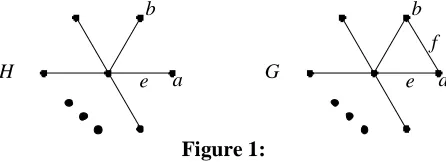
Case 1. Let H = K1, p – 1 and let endvertices a, b ∈ V(H). Consider the graph obtained G from H by adding the edge f=ab∉E(H), see Figure 1. It follows that the set (D – {e}) ∪ {f} = {f} is not an edge dominating set of G. This implies that D is not a secure edge dominating set, which is a contradiction. Thus G = K1, p – 1.
b
H e a
b
f
G e a
Figure 1:
Case 2: Let H = K1, p – 1 and an endvertex a ∈ V(H). Consider the graph obtained G from H by adding the vertex v ∉ V(H) and the edge f = av, see Figure 2. It follows that the set (D – {e}) ∪ {f} = {f} is not an edge dominating set of G. This implies that D is not a secure edge dominating set, which is a contradiction. Thus
G=K1, p – 1.
Converse is obvious.
H e a
f
G e a
v
Figure 2: The following result is immediate.
Proposition 11. If G is a connected graph and G is not a star or K3, then 2 ≤ γ's(G)
and this bound is sharp.
Proof: This result follows from Theorem 10. The double star Sm, n achieves this bound.
Proposition 12. For any graph G with maximum edge degree ∆',
( )
' .
' 1 s
q
G
γ
≤
∆ +
98 Further, equality holds if G = P3.
Proof: Due to Jayaram [15], '
( )
. ' 1 q Gγ ≥∆ +
Also by Proposition 2, we have γ'(G) ≤ γ's(G). Thus (2) holds.
The following result gives that the value of the parameter γ's(G) ranges over all
positive integers.
Theorem 13. Given positive integers k and p such that p≥3 and 1≤k<p, there exists a connected graph G with p vertices and γ's(G) = k.
Proof: We consider the following cases.
Case 1. Suppose k = 1. Let G = K3. Clearly |V(G)| = 3 and γ's(G) = 1.
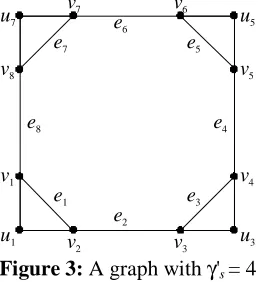
Case 2. Let C2m = {v1, e1, v2, e2, v3, … v2m, e2m, v1} be an even cycle with 2m vertices. For each odd integer i, join the vertices vi and vi+1 to a new vertex ui to form the graph G, see
Figure 3.
u7 u5
u1 u3
v8 v5
v1 v4
v7
v2
v6
v3
e7 e5
e1 e3
e8 e4
e6
e2
Figure 3: A graph with γ's = 4
It is easy to see that the set F = {e1, e3, ..., e2m – 1} is a minimum secure edge dominating set of G. Then |F|=m. Hence |V(G) | = 3m and γ's(G) = m = k.
Problem 14. Characterize graphs G for which γ'(G) = γ's(G).
Problem 15. Characterize graphs G for which γ's(G) = 2.
Problem 16. Characterize graphs G for which '
( )
. ' 1 sq G
γ =∆ +
REFERENCES
1. V.R.Kulli, College Graph Theory, Vishwa International Publications, Gulbarga, India (2012).
2. V.R.Kulli, Theory of Domination in Graphs, Vishwa International Publications, Gulbarga, India (2010).
99
4. V.R.Kulli, Advances in Domination Theory II, Vishwa International Publications, Gulbarga, India (2013).
5. E.J.Cockayne, O.Favaron and C.M.Mynhardt, Secure domination, weak Roman domination and forbidden subgraphs, Bull. Inst. Combin. Appl. 39(2003) 87-100. 6. S.Benecke, E.J.Cockayne, and C.M.Mynhardt, Secure total domination in graphs,
Utilitas Math. 74(2007) 247-259.
7. E.J.Cockayne, P.J.P.Grobler, W.R.Grundlingh, J.Munganga and J.H. van Vuuren, Protection of a graph, Utilitas Math. 67(2005) 19-32.
8. E.L.Enriquez and S.R.Canoy, Jr, Secure convex domination in a graph, International J. of Mathematical Analysis, 9(7) (2015) 317-325.
9. V.R.Kulli, Inverse and disjoint secure dominating sets in graphs, International Journal of Mathematical Archive, 7(8) (2016).
10. V.R.Kulli, Inverse and disjoint secure total domination in graphs, Annals of Pure and Applied Mathematics, 12(1) (2016) 23-29.
11. V.R.Kulli, Inverse total edge domination in graphs. In Advances in Domination Theory I, V.R.Kulli ed., Vishwa International Publications, Gulbarga, India (2012) 35-44.
12. V.R.Kulli and S.C.Sigarkanti, Inverse domination in graphs, Nat. Acad. Sci. Lett., 14 (1991) 473-475.
13. V.R.Kulli and D.K.Patwari, On the total edge domination number of a graph. In A. M. Mathai ed., Proc. of the Symp on Graph Theory and Combinatorics. Kochi, Centre Math. Sci. Trivandrum, Series Publications 21 (1991) 75-81.
14. V.R.Kulli and N.D.Soner, Complementary edge domination in graphs, Indian J. Pure Appl. Math. 28(7) (1997) 917-920.