177
ISSN 1822–8402 EUROPEAN INTEGRATION STUDIES. 2012. No 6
LATVIAN POPULATION HEALTH QUALITY APPROXIMATION TO THE EU LEVEL - ONE
OF THE CHALLENGES FOR PERSISTENT EU ECONOMIC DEVELOPMENT
Solvita Sunite, Edgars Kasalis
University of Latvia, Economic Department, Latvia e-mail: [email protected], [email protected]
http://dx.doi.org/10.5755/j01.eis.0.6.1437
With the admission of Latvia in constitution of EU, issues related to the harmonization of Latvian national economy development characterizing indexes with the average EU indexes became topical. Since EU economic development is based on sustainable development principles, increasing inequalities in human capital potential within EU member countries could be considered as the restriction for persistent economic growth in future.
The aim of the research is to evaluate current Latvian population health quality differences from the average EU indexes and outline possible function directions for it approximation to the EU level, considering it as one of the challenges for providing persistent EU economic development. In the course of the research the following tasks were solved: quintessential goals in the area of Latvian public health development in the context of EU joint health development goals were evaluated; various aspects of Latvian population health quality were analysed in contrast with the actual situation in the EU countries, conclusions on Latvian population health quality were drawn, demonstrating the existing health inequalities and analysing the possible causes of originated disproportions, possible function directions for the health index approximation to the EU level were proposed in order to provide the improvement of human capital potential for further harmonic EU economic development. To reach the goal of the specific research, the analysis of database and recent scientific research was done; the methods of analysis and synthesis were applied, as well statistical methods.
The research results demonstrate remarkable deviation of Latvian public health indexes from the average indexes of EU countries and immense falling behind from the indexes of developed EU countries that draws attention to the existing health inequalities among the EU countries, causing restrictions for provision of harmonic EU economic development .
In addition to the problems on a national economy level and organisational issues of industry, one of the substantial reasons that has lead to the current ES health inequalities caused by the low Latvian population health quality level, is the attitude of Latvian population themselves for their health, which is characterised by large health affecting harmful habits prevalence and low activity in implementation of disease prevention measures.
Therefore, currently the health quality of Latvian population is rated as insufficient and for its improvement there are necessary drastic reorganisations in the health care industry. As one of the possible solutions for existing difference reduction in human capital development in EU, can be considered transition to the compulsory health insurance financing model in Latvia, integrating population joint responsibility for their health maintenance as a separate dimension, measuring by such criteria as population involvement in disease prevention activities and giving up of health influencing harmful habits. Thus, gradual public health quality improvement would be possible, which reduced the health inequalities among the EU countries facilitating EU sustainable economic development.
Keywords: health, health quality, sickness, health care.
Introduction
With the admission of Latvia in constitution of EU, issues related to the harmonization of Latvian national economy development characterizing indexes with the average EU indexes, thus conducting the economic development of all member countries in compliance with agreed strategic setup, became topical. Since one of the fundamental principles of EU economic development is stimulation of sustainable development of national economy, the improvement of Latvian population health quality indexes approximating those to the average indexes of EU countries, is one of the substantial strategic goals which is defined in several long-term development planning documents.
Although the health quality of population as one of the sustainable factors of national economy has not been
178 an impact on the birth-rate of population, as well as the mental health quality, which affects education, professional growth and the potential of scientific development. Therefore the analysis of Latvian population health quality indexes in comparison with the EU countries indexes characterizes the potential of sustainable development of national economy in human capital area, as well as illustrates the existing health inequalities among the EU countries. Looking more closely at Europe, we have seen that the targets once set by the WHO, aiming to reduce health inequalities in the region, have not been met. On the contrary, country differences in mortality/ life expectancy have increased. European policies have not been very strong in the health field. So far the arena for collective action has usually been local community politics or national politics, but there are also concerns that have become global policy issues (Vagero D.(2010)). Therefore it can be concluded that there are certain restrictions for harmonic EU development, which are defined by unequal human capital development in the framework of region. Thus, this research is based on existing scientific problem that appears as EU persistent economic development restriction caused by noticeable health inequalities within the member countries..
The aim of the research is to evaluate current differences of Latvian population health quality from the average EU indexes, and outline possible function directions for it approximation to the EU level considering it as one of challenges for providing persistent and harmonic EU economic development. In the course of the research the main goals in the Latvian population health quality development area were evaluated in the context of development of EU joint health development goals, which are regarded as one of the preconditions in provision of persistent EU economic development; various aspects of Latvian population health quality were analysed in contrast with the actual situation in the EU countries, marking the existing differences, conclusions on Latvian population health quality were drawn, demonstrating the existing health inequalitiesand analysing the possible causes of originated disproportions, possible function directions for the approximation of existing index to the EU level were proposed, regarding those as precondition for human capital development in accordance with sustainable economic development guidelines .The scientific novelty of the research appears in the update of additional dimension in maintenance of Latvian population health quality, evaluating the importance of population involvement in the maintenance of public health.
The research is based on WHO, European Commission, LR National Health Service, Health Economic Centre statistical and published research numeral data, applying the methods of analysis and synthesis as well as statistical methods. In comparison of data, in addition to the average EU countries indexes, for better illustration of the situation, the indexes of the countries representing the EU Northern region were used as Latvia is bonded with these countries not only by the common geography, but also the historical similarity of national economy development. The term „population health quality” used in the research, combines the aspects of public health and population self-evaluation of their health.
In the result of the research noticeable falling behind of Latvian population health characterizing indexes from other EU countries indexes was established and the idea of
population self-liability in their health maintenance as one of the health financing model components was updated.
Main objectives in the area of Latvian population health quality
Healthcare is a prerequisite for the preservation of human dignity. States’ duties in this respect cover the whole range of health services: health promotion and disease prevention (public health in its traditional sense), as well as diagnosis, treatment, care and rehabilitation (healthcare). The case law under the European Social Charter summarises the duties of the State as follows: States must ensure the best possible state of health for the population according to existing knowledge (Roscam Abbing H.D.C.,( 2010)).
After Latvia joined the EU, its development strategy in the health care area is defined in accordance with the EU guidelines, specifying general objectives in the health area in conformity with the actual situation in Latvia.
One of the EU strategy in the health care area in 2008- 2013 goals-fostering good health in an aging Europe (Commission of the European Communities(2007)),- which foresees certain procedure in the area of prevalence of oncologic, rare diseases and the area of reduction of health affecting harmful habits are directly referred to the improvement of health quality. This document with other strategic planning documents of European Commission regarding food, overweight and health issues, associated with obesity, reduction of inequality in health area, prevention of injuries and safety promotion,, WHO documents on children and youth health, mental health, reduction of alcohol and tobacco influence, served as the background in development of Latvian Public Health Strategy 2011-2017. The guidelines formulated in this document continue the Public health strategy for 2001-2010, and support the goals which are defined in strategic planning documents of Latvia–sustainable development strategy of Latvia till 2030 and strategic development plan of Latvia for 2010- 2013.
179 framework of a certain time period is persecuted. There is a negative experience in Latvia in the health quality goal implementation in the previous period. In accordance with the performed analysis, all 12 objectives formulated in Public Health Strategy 2001-2010 have been executed incompletely, i.e. 3 objectives have not been reached, 6 objectives have been executed partially and on the execution of 3 objectives is not possible to judge of, due to the lack of appropriate data(Health Economic Centre (2010)) Therefore the authors believe that concretization of all sub-objectives as well as the regular analysis of the achieved results and correction of action plans following it, is one of the necessary pre-conditions in implementation of public health politic objectives.
Characterization of separate public health indexes.
Healthy ageing has become a major concern given current and prospective demographic changes.(Hung L.W,. Kempen G. I. J. M., De Vries N. K, (2010)), therefore as one of the public health key indexes should be the expected healthy years of life, which define the ability of state population to contribute to the growth of the national economy and participation in the GDP creation.. For better characterization of the situation, the authors have chosen two indexes characterizing healthy life expectancy – expected healthy life years of infants at birth and expected healthy life years at the age of 65, comparing Latvia’s indexes with the average EU indexes gathered in Table 1.
As the data in the Table 1 illustrates, demonstrated relevance of both indexes is analogical – the healthy life expectancy of Latvian population is noticeably lower than in other EU countries, slightly higher for females than for males. Although the deviation in absolute numbers of expected life years at birth is larger, relatively more important deviations are observed in the population, that has reached the age of 65 years of expected healthy years of life, as healthy years of life for Latvian population, that have reached the age of 65, comprise 57% for males and 68% for females, according to the average EU countries indexes. Although the indexes of the Baltic countries are almost analogical, it must be admitted that indexes of Latvia in all groups, except the expected healthy life years for males that have reached the age of 65, are the lowest among the Baltic countries. Much more dramatic difference is noticeable in comparison with the developed European Northern countries. For example, the expected healthy life years for males that have reached
the age of 65 in Latvia comprises only 35% from Swedish, 42% from Danish index, for females these indexes comprise 39% and 48% respectively. It is evident, that this situation inevitably leads to the increase of the health care expenses in the situation, when the tendency of general state population ageing is observed, therefore the specific meaning should be given in the guidelines of Latvian public health for execution of certain goal, thus reducing backwardness from the average EU healthy life expectancy level.
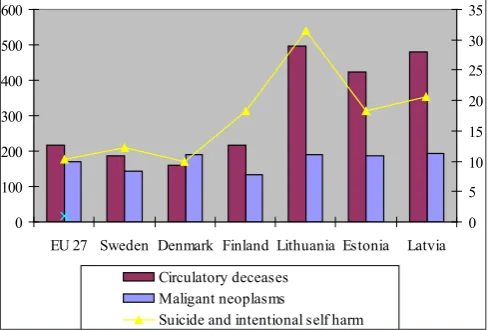
Taking into consideration, that the second topical objective in the public health strategic development is regarded to the reduction of potentially lost years of life, it is important to compare Latvian and EU standardized death rates from circulatory system and oncologic diseases, which are the main mortality reasons at the moment, therefore leaving the direct influence on the index of potentially lost years of life.
0 100 200 300 400 500 600
EU 27 Sweden Denmark Finland Lithuania Estonia Latvia 0 5 10 15 20 25 30 35
Circulatory deceases Maligant neoplasms
Suicide and intentional self harm
(Sources: http://ec.europa.eu/health/indicators, accessed 10. 03.2012.), http://ec.europa.eu/health/mental_health/ indicators, accessed 10.03.2012)
Figure 1. Standardised death rate per 100000 inhabitants, diseases of the circulatory system, maligant neoplasms and suicide and intentional self harm in EU countries, 2009.
The Figure 1 shows, that the situation in the area of cancerous diseases is comparatively similar to the overall EU scene, and in 2009, when Latvian index is the highest in the region of Baltic sea, it exceeds the average EU index only by 14%, but the difference from Swedish and Finnish indexes is quintessential and comprise 34% and 44% respectively.
Table 1
Male Female Male Female Male Female Male Female
EU 27 60.9 61.6 8.3 5.8 8.2 8.3 3.5 2.6
Sweden 70.5 66.6 17.9 10.8 13.6 14.6 8.9 8.9
Denmark 61.8 60.4 9.2 4.6 11.2 12 6.5 6.3
Finland 58.1 58.4 5.5 2.6 8.1 8.9 3.4 3.2
Lithuania 57.0 60.9 4.4 5.1 5.9 6.7 1.2 1
Estonia 54.8 59 2.2 3.2 5.5 5.3 0.8 -0.4
Latvia 52.6 55.8 0 0 4.7 5.7 0 0
Healthy life expectancy in EU countries, 2009 (Source:http://ec.europa.eu/health/indicators, accesed 10.03.2012.)
+/–, comparing with Latvia Healthy lifeyears at
birth
+/–, comparing with Latvia
180 Unfortunately the situation is sharply different in the area of circulatory system diseases as the standardized mortality indexes from circulatory system diseases in Latvia exceeds the average EU level by 220%, but the difference from the Northern countries is much more quintessential, as far as 300%(Denmark).
Mental health is an indivisible part of public health and significantly affects countries and their human, social and economic capital.(Herrman H, Saxena S, Moodie R.(2005)) The economic consequences of mental health problems– mainly in the form of lost productivity–are estimated to average 3–4% of gross national product in European Union countries (Gabriel P, Liimatainen M-R, (2000)). One of the mental health indexes –standardized death rate from suicides and intentional self harms, the values of which in 2009 in certain EU countries are gathered in Figure 1, are demonstrating previously reviewed analogical relevance, Latvian index noticeably, by 201% exceeds the average EU countries level, taking the second place in the Baltic countries group.
As the separate population health quality aspect, can be considered the self evaluation of population health. In authors’ opinion, its importance appears in 2 aspects. Firstly, the self evaluation of population health shows not only the objective health quality level but also to some extent demonstrates the society attitude on health maintenance and the necessity of disease prevention measures. Secondly, researchers from the Institute of Social and Preventive Medicine at the University of Zurich found that Swiss men who rated their health as “very poor” were 3.3 times more likely to die earlier than men of the same age who rated their health as “excellent,” and the risk of an earlier death was 1.9 times higher in women who rated their health as “very poor” than for those who rated it as “excellent”( Bopp M. , Braun J., Gutzwiller F., Faeh D (2012)). Thereof it can be considered, some relation exists between person’s self-reported health status and his life expectancy. Therefore, the self evaluation of population health, with the status” very good or good” has been chosen as the base of comparison.
EU 27 Sweden
Denmark Finland
Lithuania Estonia
Latvia
30 35 40 45 50 55 60 65 70 75 80 85
2005 2006 2007 2008 2009 2010
(Source: http://ec.europa.eu/health/indicators , accessed 10. 03.2012.)
Figure 2. Proportion of persons (%) in EU countries who asses their health to be very good or good, 2010
Analysing the dynamics of Latvian population health self evaluation in the period of time from 2005 to 2010
(Figure 2), positive dynamic is observed, with the indicator approximating to the level of Lithuania and Estonia, however still demonstrating the lowest population satisfaction level with their health quality among the countries of Baltic States. In 2010 49.2% of Latvian population evaluated their health as „ very good” or „ good”, forming backwardness of 19.6% points from the average EU countries indicators, which comprised of 68.8%. Therefore the situation, when their own health quality is rated as positive by less than half of all state population, can be considered as serious endanger for successful human capital improvement and sustainable development of state economy in Latvia.
Previously inspected coherences demonstrated by indexes of public health characterizing indexes, convincingly indicate on the appreciable difference of Latvian population health quality indexes from the average level of EU countries as well as lower health quality level among the Baltic countries. The author’s conclusion is also certified with the I-distance method done research in 2007 by Serbian researchers in compliance with which, the health of Latvian population among the 27 EU countries is taking 22 place (Estonia, based on the results of this research is taking 21, Lithuania -19 place) (Jeremic V., Seke K., Radojicic Z., et al(2011)).
181 affecting factors. The time has come to propose a model of health care that puts more focus on health promotion and disease prevention. This is a complex problem that requires a multifaceted approach, combining public policy and social marketing strategies to create environmental and behavioural changes. (Novelli W.D., 2008). In author’s thoughts, currently much greater importance should be granted to the involvement of state population in their own health maintenance, therefore it is important to evaluate the possible spectrum of activities.
Characterization of health affecting factors related to the population behaviour.
Analysing the influence of factors related to the population habits and behaviour on the Latvian population health quality, it is necessary to part 2 aspects –prevalence of health affecting harmful habits among the Latvian population and involvement of Latvian population in health maintenance and disease prevalence measures.
As catastrophic predominance of standardized mortality indexes from circulatory system diseases in Latvia over average indicators of EU countries was established before, it is important to analyse the prevalence of lifestyle related harmful habits influencing this disease in comparison with the indicators of other EU countries.
0 5 10 15 20 25 30 35 40
EU 27 Sweden Denmark Finland Lithuania Estonia Latvia
Adult population who are daily smokers, % Obesity among adult population, %
(Sources: OECD (2011), “Tobacco consumption”, Health: Key Tables from OECD, No. 14., https://apps.who.int/ infobase/Indicators.aspx, Health in Baltic countries 2010)
Figure 3. Non-medical health affecting factors prevalence in EUR countries, 2009.
The data gathered in Figure 3 on density of everyday smokers and density of population with signs of obesity in certain countries, are demonstrating direct relevance between prevalence of health affecting harmful habits and morbidity of circulatory system diseases. Density of everyday smokers in Latvia among the adult population, which in 2009 reached 33.7% from state adult population by 39% exceeds the average EU index and is noticeably higher than Northern countries indexes, exceeding the respective index of Sweden even by 240%. The data of population survey shows that even higher smoker density is among the young adults -43%(Health Economic Centre, 2011)), furthermore, the tendency of increase is observed in recent years, because according to the research data on substance usage causing dependence among the population in 2011 in comparison with 2007, density of
smokers in Latvia has increased by 6% (National Health Service, 2012)). The data regarding the obesity caused by lifestyle habits are not as sharply different from the average EU indexes, exceeding the average EU level by 9%, but the difference from the indexes of Northern countries is noticeably largest and reaches even 70%(in comparison with the index of Sweden). Performing the research on young adult eating habits in EU countries it was established that European adolescents consume far too little fruit, vegetables and milk products, but far too much meat, meat products and sweets. A key message from this analysis might be that adolescents do not need to eat more or less (regarding energy), but need to rearrange their food patterns. (Diethelm K., Jankovic N., Moreno L.A et al.(2011)). Similar situation is observed also in Latvia- fresh vegetables are consumed by 35,3% from population, this index is even lower among the young adults -only 26.3%, from their everyday menu 54,3% have excluded milk, but dairy products-47.5% from Latvian population, besides obesity risk is increased by sedentary lifestyle of Latvian population also-49% of population do not practise physical activities (Health Economic Centre(2011)). Taking into consideration that obesity problem is affecting even younger population – overweight or obesity in 2010 was stated to 28% first year pupils (Health Economic Centre, 2011)), then in the coming years the situation regarding the obesity area could worsen. It is clear, that by maintaining this prevalence of harmful health influencing habits among the Latvian population, it will not be possible to reduce the illness of circulatory diseases and to reduce due to the deaths caused by the illness the lost potential years of life in the nearest time.
Dangerous situation is also observed in terms of alcohol consuming, which concurrent with causing other health problems leaves direct influence on mental health of the population and amount of suicides. According to the data of population survey, alcohol is consumed by 85.4% from Latvian population, int. al. 87.4% Latvian adult males and 83.6% females, but at least 6 alcohol doses at least once a week are consuming 10.1% males and 0.7% females (National Health Service, (2011)) Data on alcohol consumption among the young adults are similar to the average EU data. Unfortunately, taking into consideration the massive density of unregistered alcohol, believable data on level of consumed alcohol on 1 Latvian citizen in Latvia are not available, but the authors estimate that it possibly could be 13-14l per capita, which is close to the average consumption in the EU, which comprise 12.4 l per capita (WHO, 2012)). Unfortunately, the quality of the consumed alcohol noticeably differs, which is influenced by the massive density of illegal alcohol, therefore its influence on population health quality is much more baleful.
Therefore it can be concluded that prevalence of harmful health influencing habits to Latvian population is considered as one of the insufficient health quality reasons, conducting to the illness of circulatory system diseases, oncologic diseases and increasing potentially lost years of life.
182 is characterized by participation in the disease prevention measures also.
Data on the measures which are directly connected to the prevention of circulatory disease as blood pressure and cholesterol tests, defining of sugar level as well as the vaccination against the widespread infectious diseases in Latvia – flu and tick-borne encephalitis, which are obtained in the run of the Latvian population influencing habit research are gathered in Table 2.
Reviewed prevention measures are done during the GP visit, therefore are not connected with additional time and
finance investment. Despite that, the level of regularly done health tests is comparatively low, especially among the males, moreover in the survey it was established that 34,3% from the surveyed had never had measured the sugar level in the blood but 41.1% had never in the life had fixed the cholesterol level (Health Economic Centre(2011)). The vaccination level, especially against the flu diseases is also very low. In the high-risk group in Latvia in 2009 were vaccinated also only 2.9% from population at above the age of 65(Health Economic Centre (2011)), whereas the average vaccination level of European countries in this group reached 27.9% (European
Table 2
Total population Male Female
Blood pressure tests 66.9 61.6 71.9
Cholesterol tests 30.2 25.5 34.7
Sugar level tests 32.8 37.3 28.1
Influenza vaccination 5.2 5.8 4.6
Tick-borne encephalitis vaccination 26.7 31.5 22.9
Proportion of population invoived in ilness prevention acivities in Latvia, 2010, %. (Source:http://www.vmnvd.gov.lv/uploads/files/4e672991e40ef.pdf, accesed 12.03.2012.)
Commission (2009)). Therefore it can be considered that the potential of prevention measures in prevention of diseases is not fully made use of due to the low activity of Latvian population.
Overall it can be affirmed, that unhealthy lifestyle and low activity in the implementation of illness prevention measures testify on the lack of interest of Latvian population in the maintenance of their health leaving negative impact on the inspected health care indexes. Thus henceforth on the list of strategic tasks in the area of Latvia’s health care definitely should be added population involvement and increase of joint responsibility on the improvement of population health quality.
Conclusions
Latvian public health strategic goals for imminent 5 years are defined in accordance with the EU health development strategy in regard of increase of healthy years of life and reduction of potentially lost years of life. Thus providing the progress in the direction of health inequalities reduction in direction of equable economic development in EU countries.. Unfortunately the complex structure of hierarchic sub-goals , as so as detailed lack of objectives in respect of other health quality indexes can impede effective monitoring and performance control, thus endangering the performance of main objectives. Therefore, as a necessary precondition for the successful realization of public health strategy is considered to be designation of concrete and measurable goals in all health quality index categories.
In terms of the health quality, Latvia is demonstrating the lowest performance among the Baltic countries and takes one of the last places among the EU countries, It is confirmed with notable falling behind of Latvia from the average EU indexes in respect to healthy years of life (healthy life expectancy for males composes only 57% from the average EU index),and immense exceed over standardized average EU countries
non-communicable diseases mortality rates (mortality of circulatory systems diseases by 220%, mortality of suicide and intentional self harm –by 201% exceeds the average EU level).
At present overall health quality of Latvian population is not sufficient and cannot provide the base for successful human capital development in the framework of the development of sustainable national economy perspective nor in the framework of persistent EU economic development perspective. Thus the improvement of Latvian population health quality, reducing the existing health inequalities, is considered one of the substantial challenges in order to provide the harmonic EU economic development.
One of the causes originated the notable health inequalities among the EU countries is considered to be Latvian population low involvement level in the health maintenance, which is characterized by the massive prevalence of health affecting harmful habits and low population activity in implementation of preventive measures. It is confirmed both by data on wide smoking prevalence (density of everyday smokers in Latvia exceed the average EU level by 39%), unhealthy diet and insufficient physical activity habits which have caused obesity problems (average index of obesity by 9% exceeds the average EU index) , and disinterest in regular health examination ( more than 41% of population have never done the cholesterol tests, but more than 34% not once have measured the sugar level in the blood) and low vaccination level (vaccination index against flu at the age group of over 65 is 10 times lower than the average EU countries index ).
183 is successfully implementable, introducing compulsory health insurance model, based on the population payment differentiation, dependant from the population activity in the implementation of illness prevention measures and provision of healthy lifestyle. Therefore, the financial joint responsibility of the population would conduct the decrease of influence of health affecting harmful habits on the quality of public health and wider implementation of illness prevention measures would reduce the illness indexes, facilitating the increase of healthy lived years and reduction of potentially lost years of life, approximating to the average EU population health quality level. Thus equalization of human capital potential development in EU would be promoted, establishing the preconditions for sustainable development of EU countries in the future.
References
Bopp M., Braun J., Gutzwiller F., Feah D(2012) Health Risk or Resource?Radual and Independent Association between Self-Rated Health a Mortality Persisits Over 30 Years.//PLoS ONE7(2):e30795.doi:10.1371/ journal. pone. 0030795. On-line: http://www.plosone.org/article/ info:doi%2F10.1371%2Fjournal.pone.0030795
Börsch-Supan A., Brugiavini A., Jürges H. et al .Health, Ageing and Retirement in Europe (2004–2007). Starting the Longitudinal Dimension. Mannheim: MEA,2008. On-line http://www.shareproject.org/t3/share/index. php?id=98
Buchner B.(2011) Nutrition, Obesity and EU Health Policy// European Journal of Health Law/Koninklijke Brill NV, Leiden, 2011, doi: 10.1163/157180911X546084, no 18, p.1-8
Commission of the European Communities.(2007) White Paper — Together for Health: A Strategic Approach for the EU 2008-2013. On-line: http://ec.europa.eu/health-eu/doc/whitepaper_en.pdf
Conceição C, Mc Carthy M.(2011) Public health research systems in the European union//Health Research Policy and Systems 2011, 9:38. On-line: http://www.health-policy-systems.com/content/9/1/38
Diethelm K., Jankovic N., Moreno L.A. et als (2011) Food intake of European adolescents in the light of different food-based dietary guidelines: results of the HELENA (Healthy Lifestyle in Europe by Nutrition in dolescence) Study//Public Health Nutrition http://dx.doi.org/10.1017/ S1368980011001935, p 1-13
European Commission. Health in Europe: Information and Data Interface. On-line: http://ec.europa.eu/health/ indicators/echi/list/index_en.htm#id4
European Commission. Health in Europe: Mental Health. On-line: http://ec.europa.eu/health/indicators/echi/list/ index_en.htm#id4
European Economic and Social Commitee(2009) Questions and Answers on Solidarity in health: Reducing health inequalities in the EU. On-line: http://europa.eu/rapid/ pressReleasesAction.do?reference=MEMO/09/467&for mat=HTML&aged=1&language=EN&guiLanguage=en Fryers T et al.(2005) The distribution of the common mental
disorders: social inequalities in Europe / Clinical Practice
in Epidemiology and Mental Health, 2005, 1:14. http:// dx.doi.org/10.1186/1745-0179-1-14
Gabriel P, Liimatainen M-R. Mental health in the workplace. Geneva, International Labour Office, 2000.
Health Economic Centre (2011) Latvijas iedzīvotāju veselību ietekmējošo paradumu pētījums 2010/Veselības Ekonomikas centrs.-ISBN 978-9984-837-34-5.-Riga, 32p
Health Economic Centre(2010)Sabiedrības veselības stratēģijas mērķu sasniegšanas izvērtējums,. On- line: http://vec.gov.lv/uploads/files/4ecfdd8ae6732.pdf Health in the Baltic Countries 2010.19th edition. On-line:
http://www.vmnvd.gov.lv/uploads/files/4f546ace90211. pdf
Herrman H, Saxena S, Moodie R. Promoting mental health: concepts, emerging evidence, practice. Geneva, World Health Organization, 2005. On-line: http://www.who.int/ mental_health/evidence/en
Hung L.W., Kempen G. I. J. M. , De Vries N. K.(2010) Cross-cultural comparison between academic and lay views of healthy ageing: a literature review.// Ageing & Society/Cambridge University Press2011, http://dx.doi. org/10.1017/S0144686X10000589, p.1373-1391 Jeremic V., Seke K., Radojicic Z. et als(2011)Measuring
health of countries: a novel approach//HealthMED , Vol.5, no 6, p.1762-1766
Mackenbach J.P.; Meerding W.J.; Kunst A.E.(2010) Economic costs of health inequalities in the European Union// Journal Of Epidemiology And Community Health.- ISSN: 1470-2738.-p.412-419.
Mackenbach J.P., Bakker M.J.(2003) Tackling socioeconomic inequalities in health: analysis of European experiences// Lancet, vol.362/ EBSCO Publishing, p.1409-1414
Ministry of Health of the Republic of Latvia(2011) Public Health Strategy for 2011.–2017. On-line:http://phoebe. vm.gov.lv/misc_db/web.nsf/626e6035eadbb4cd852564 99006b15a6/ab75e1a6c38b637dc22573d800293aaa/$FI LE/POamatnostadnes_eng_pdf.pdf18
Nacional Health Service (2012) Addictive substance use prevalence in Latvia2011. On-line: http://www.vmnvd. gov.lv/uploads/files/4f7165d1500fb.pdf
Neesham C, Tache I.(2009) Is there an East-European social model?// International Journal of Social Economics/ Emerald Group Publishing Limited 0306-8293 , doi:10.1108/03068291011038936.- vol. 37 no. 5, 2010, p. 344-360
Novelli W.D. (2008) Transforming the healthcare system a focus on prevention// Healthcare Financial Management 2008, vol. 4, p.94-98
OECD Libraries. Tobacco consumption. Percentage of population who are daily smokers On-line: http://www. oecd-ilibrary.org/social-issues-migration-health/tobacco-consumption_20758480-table14
184
Public Health Agency(2007) ESPAD 2007.Atkarību
izraisošo vielu lietošanas paradumi un tendences skolēnu vidū// VA Sabiedrības Veselības aģentūra.-ISBN: 978-9984-837-02-4, Riga, p.112
Roscam Abbing H.D.C.(2010) Social Justice and Healthcare Systems in Europe// European Journal of Health Law /Koninklijke Brill NV, Leiden, 2010, http://dx.doi. org/10.1163/157180910X50721317, p. 217-222 Sustainable Development Strategy of Latvia till 2030.
On-line: www.latvija2030.lv/upload/lias_1redakcija_pilnv_ final.pdf
Vagero D.(2011) The East–West Health Divide in Europe: Growing and Shifting// European Review, Vol. 18, No. 1/ Academia Europæa doi:10.1017/ S106279870999010X, p. 23–34
Wahlbeck K. (2011)European comparisons between mental health services// Epidemiology and Psychiatric Sciences vol. 20/ Cambridge University Press 2011, http://dx.doi. org/10.1017/S2045796011000060, p. 15–18.
World Health Organization. Health Financing Policy. On-line: http://www.who.int/health_financing/functions/en/
WHO Europe(2008) Policies and practices for mental health in Europe – meeting the challenges. On-line: http:// www.euro.who.int/__data/assets/pdf_file/0018/103536/ fs_mh_10oct2008e.pdf
World Health Organization (2011) Social determinants approaches to public health: from concept to practice / edited by Erik Blas at al.//WHO.- ISBN 978 92 4 156413 7.-Geneva, p.209
World Health Organization. WHO Global Infobase. On-line: https://apps.who.int/infobase/Indicators.aspx
Xavier A., Price C., von Nordheim F.(2009) Solidarity in health .The European Commission sets out new actions on health inequalities// Eurohealth /LSE Health.-ISSN 1356-1030.-London, vol. 15 no 3, p.1-4.
Zaborskis A., Lenciauskiene I (2006) Health Behaviour among Lithuania’s adolescents in Context of European Union//Croat Med J. 2006 vol. 47, p.335-43
The article has been reviewed.