A cross-sectional study of request perspective use among
Iranian EFL learners
Tamimi Sa'd, Seyyed Hatam
Urmia University, Iran ([email protected])
Mohammadi, Mohammad
Urmia University, Iran ([email protected])
Received: 5 December 2013 Revised: 15 December 2014 Accepted: 31 January 2014 Available Online: 9 February 2014 DOI: 10.5861/ijrsll.2014.656
ISSN: 2243-7754 Online ISSN: 2243-7762
OPEN ACCESS
Abstract
One of the key aspects in the use of the speech act of request as proposed by Blum-Kulka and
Olshtain (1984) in their CCSARP study is the perspective in which requests can be encoded.
Motivated by the dearth of literature on this point, this study set out to investigate the request
perspectives of a sample of 61 request utterances elicited through a discourse completion task
(DCT) from 30 Iranian MA EFL learners. The DCT included 6 situations, 2 situations for each
social status or relative power (P) level (i.e., +P, -P or =P). The results showed that overall,
Iranian EFL learners favored the hearer-oriented perspective most and the speaker-hearer
oriented perspective least. The results also indicated that while in +P situations, the most
frequent perspective was the impersonal perspective, the dominant perspective in both -P and
=P situations was hearer oriented. Since, when requesting, any avoidance of naming the
addressee can serve as a strategy for the speaker to sound polite, Iranian EFL learners'
frequent use of the hearer oriented request perspective can be interpreted as evidence of
impoliteness or the potential to be so. The participants were found to follow routine ways of
performing the speech act of request traceable to their early stages of language learning of
high school and pragmatic transfer from their L1. In conclusion, the study highlighted the fact
that Iranian EFL learners are not fully aware of the power dynamics in interactions and that
they are therefore in need of instructional intervention in pragmatics in language learning.
Tamimi Sa'd, S. H. & Mohammadi, M.
A cross-sectional study of request perspective use among Iranian EFL learners
1. Introduction
Acquiring a language is not, and to be more precise should not be, confined to the structural patterns of that language. It has to include the pragmatic aspects as well. In other words, language acquisition is to be accompanied by acquiring how these structural patterns that are learnt at the linguistic level are put to use in the social milieu. This aspect of language learning should be done by the learner whether in a second language setting or in a foreign one. Bryant (2009) asserted that most learners, if not all, are faced with difficulty acquiring these pragmatic ways of using language. In fact, when used in context, utterances can, and do, convey more than they literally do by themselves.
One of the most crucial features of successful language learning is the acquisition of the appropriate as well as the inappropriate patterns and norms of behavior, commonly known as polite behavior, of the target language. Chatterjee (2012) posits that to communicate effectively, it is essential for an individual to be polite. On the other hand, one of the ubiquitous features of almost every interaction is the presence of the interlocutors' relative power which results in the establishment of power relationships among the individuals. Successful communication, therefore, can be viewed as the joint product of both linguistic proficiency and pragmatic ability.
1.1 Request and Request Perspectives
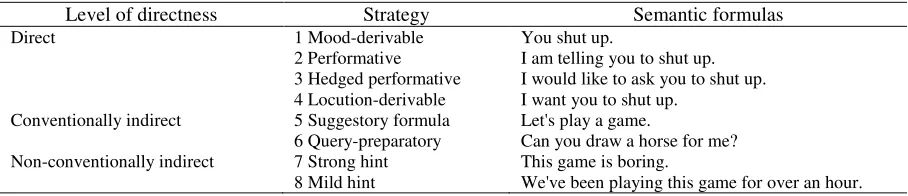
Requests are "attempts on the part of the speaker to get the hearer to perform or to stop performing some kind of action in the interests of the speaker" (Ellis, 2012, p. 172). Performing requests can be considerably a face-threatening task as they are, according to Blum-Kulka, House, and Kasper (1989b), 'inherently imposing' and therefore performing them requires considerable 'face-work' (Ellis, 2012). To the language learner this means a high level of sociolinguistic competence. According to Ellis, one major focus of enquiry is the language learners’ ability to distinguish between polite and less polite or impolite requests. Research has identified a number of ways and strategies in which requests can be realized. Adopted from Blum-Kulka et al. (cited in Ellis, 2012, p. 173), these strategies are summarized in Table 1.
Table 1
Taxonomy of Request Strategies
Level of directness Strategy Semantic formulas
Direct 1 Mood-derivable You shut up.
2 Performative I am telling you to shut up.
3 Hedged performative I would like to ask you to shut up.
4 Locution-derivable I want you to shut up.
Conventionally indirect 5 Suggestory formula Let's play a game.
6 Query-preparatory Can you draw a horse for me?
Non-conventionally indirect 7 Strong hint This game is boring.
8 Mild hint We've been playing this game for over an hour.
Particular attention has been paid to requests in the SLA research because of the important part that this speech act plays in social life, the threat they expose to the hearer and so forth. Blum-Kulka (1987) investigated the relationship between indirectness in requests and its association with politeness. The results of this study were astounding: politeness is achieved by seeking a balance in the use of both directness and indirectness and not through adherence to either totally and solely. Blum-Kulka argued that politeness can be obtained by use of conventional indirectness in the case of the speech act of request.
perspective and impersonal perspective. For instance, the difference between 'Could I …' and 'Could you …' lies in the perspectives these requests have been encoded in: the former is 'speaker oriented' and emphasizes the role of the speaker while the latter is 'hearer oriented' and stresses the role of the addressee. Thus, by definition, the former is more polite than the latter. They expanded on this point by positing that the realizations of requests can include references to the requestor ('I' the speaker) the requestee ('you' the hearer) or the action which is to be performed. The requesters have a number of ways to choose the request perspective from. Two other request perspectives are 'speaker and hearer oriented' and 'Impersonal' as exemplified in 'Could we please end this game?' and 'Is it possible to end this game', respectively. Blum-Kulka and Olshtain’s point in their discussion concerning request perspectives is that, when requesting, avoiding naming the hearer/addressee can substantially add to the politeness level of the request.
1.2 Theoretical Background
Requests have long attracted the attention of a myriad number of researchers. Schmidt and Richards (1980) classified them into the speech act category of directives. Bulut and Rabab'ah (2007) examined the politeness of Saudi female students’ requests when communicating with their male university professors via email. They found that the students employed negative politeness strategies to address their professors and positive politeness to perform the speech act of request. In another study, Alfattah (2009) explored the request strategies employed by Yemeni EFL learners. The results showed that query-preparatory, mood-derivable and want/need statements to request were the most frequent request strategies and politeness was achieved through such politeness markers as ‘please’, ‘sorry’, ‘pardon’ and ‘excuse me’. In yet another study of Yemeni female learners of English, Al-Marrani and Sazalie (2010) investigated the learners’ polite requests. Their results demonstrated that direct and conventionally indirect request strategies were encoded using mood derivable and want statements and query preparatory, respectively. Martínez-Flor (2009) undertook a study of the role that ‘please’ played as a mitigating device to soften a request. This study indicated that the participants of the study, Spanish EFL learners, employed ‘please’ only at the end of the request move. Martínez-Flor posited that this pattern of use can be changed by presenting rich sources of pragmatic input such as film scenes to the learners.
Requests have received substantial attention in the Iranian contexts, as well. In this connection, a cross-cultural study comparing 96 Iranian EFL learners with 10 Australian native speakers of English conducted by Jalilifar, Hashemian and Tabatabaee (2011) showed that there existed an imbalance in the form of overuse of direct requests and underuse of indirect requests of the former group, the latter were balanced in their use of direct and indirect strategies. In another study, Ahangari and Shoghli (2011) also carried out a comparative study of the request strategies of Iranian EFL learners and Canadian native speakers of English. The findings made clear the fact that both groups made use of conventionally indirect strategies which were encoded through query-preparatory. The study, however, also confirmed that the Iranian group overused indirect strategies. Another recent study examined the politeness markers utilized in business ESP textbooks produced by native speakers (Alemi & Razzaghi, 2013). The results of this study indicated there were an inadequate number of politeness markers in the textbook which the researchers perceived as potential to expose the ESP students to “serious difficulties in developing a comprehensive communicative competence in the business setting” (p. 109).
Tamimi Sa'd, S. H. & Mohammadi, M.
the researcher’s knowledge, no previous study has already focused exclusively on this important aspect of the requestive behavior.
1.3 Research questions
The following research questions were attempted in the present study:
1. What are the requests strategies used the most frequently by Iranian EFL learners?
2. Is there any significant difference between male and female Iranian EFL learners in the use of request strategies?
3. What are the requests perspectives used the most frequently by Iranian EFL learners across gender and power?
4. Is there any significant difference between male and female Iranian EFL learners in the use of request perspectives across gender and power?
2. Method
2.1 Participants
The participants were 30 MA students of English, 15 females and 15 males. They all majored in Teaching English as a Foreign Language (TEFL), either students of MA or holders of MA in TEFL, with their age ranging from 23 to 31. As for the participants’ language background, they all spoke Persian as their mother tongue.
2.2 Instruments
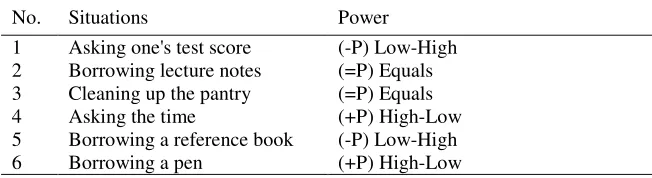
Together with other data collection tools, extensive use has been made of Discourse Completion Tasks (DCT) in research on the L2 pragmatic aspects of language in general and politeness in particular (Al-Qahtani, 2009; Kasper & Dahl, 1991). DCTs have various advantages and have been used frequently in the study of such commonly studied speech acts as requests and apologies have been concerned (Chaudron, 2005). It is feasible, for example, to manipulate factors like age differences and status differences between interlocutors in addition to the fact that DCTs easy to administer (Mackey & Gass, 2005). As one of the most frequently used data collection instruments, DCTs have numerous advantages. This said, the present study also employed a DCT to elicit data on the use of request strategies and request perspectives among Iranian EFL learners. Summarized in Table 2, the DCT consisted of 6 situations for the three power status levels of high, low and equal and was adopted and adapted from Blum-Kulka and Olshtain (1984).
Table 2
The Variables Underlying the Construction of Request Situations
Power Situations
No.
(-P) Low-High Asking one's test score
1
(=P) Equals Borrowing lecture notes
2
(=P) Equals Cleaning up the pantry
3
(+P) High-Low Asking the time
4
(-P) Low-High Borrowing a reference book
5
(+P) High-Low Borrowing a pen
6
2.3 Procedure and data analysis
these were determined for both genders. The request strategies were identified across power status as well. The request perspectives were then exemplified and qualitatively discussed in light of previous studies. Finally, the impact of the use and type of the request perspectives on the politeness as well as impoliteness was explored and evaluated.
3. Results
3.1 Request strategy use
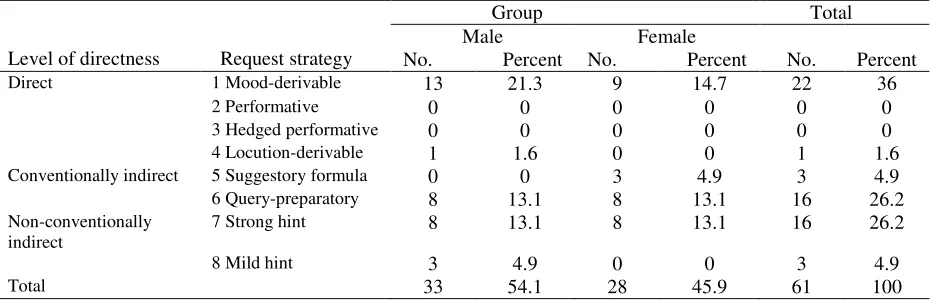
The present study aimed at identifying the most frequent request perspectives used by Iranian EFL learners across social statuses. This study, however, set about first investigating the request strategies used by the participants and then their use of request perspectives the use of the latter is to a large degree closely linked to that of the former. The use of request strategies was addressed in the first research question. The results are presented in Table 3.
Table 3
Raw Frequency and Percentage of Request Strategies across Gender
Level of directness Request strategy
Group Total Male
No. Percent
Female
No. Percent No. Percent
Direct 1 Mood-derivable 13 21.3 9 14.7 22 36
2 Performative 0 0 0 0 0 0
3 Hedged performative 0 0 0 0 0 0
4 Locution-derivable 1 1.6 0 0 1 1.6
Conventionally indirect 5 Suggestory formula 0 0 3 4.9 3 4.9
6 Query-preparatory 8 13.1 8 13.1 16 26.2
Non-conventionally indirect
7 Strong hint 8 13.1 8 13.1 16 26.2
8 Mild hint 3 4.9 0 0 3 4.9
Total 33 54.1 28 45.9 61 100
As can be seen from Table 3, the participants have used mood-derivable, query-preparatory and strong hints most frequently of all other strategies. Males used 33 request strategies and females 28, accounting for 54.1% and 45.9%, respectively. Both genders used the same types of strategies except for two strategies, 'Suggestory formula' and 'mild hint', the first of which was used only by females and the second only by males. Two strategies were not employed by either gender: 'performative and 'hedged performative'.
Regarding the role of gender in the use of request strategies, an issue that was dealt with in the second research question, a chi-square analysis showed no significant difference between males and females in this regard. Table 4 summarizes the results of the chi-square analysis.
Table 4
Chi-square Analysis of Request Strategy Use
Value df Sig.
Chi-square 7.367 5 .195
Note. N=61 p< .05 Critical Value: 11.07
3.2 Request perspective use across Gender and Power
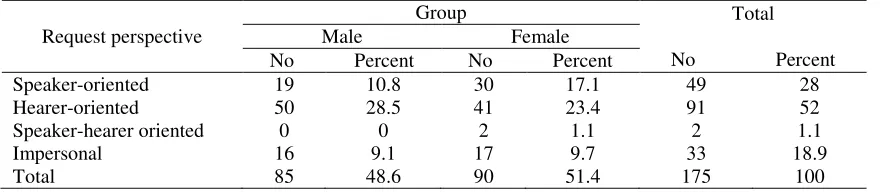
Tamimi Sa'd, S. H. & Mohammadi, M. Table 5
Frequency and Percentages of Request Perspective Analysis across Gender
Request perspective
Group Total
No Percent
Male Female
No Percent No Percent
Speaker-oriented 19 10.8 30 17.1 49 28
Hearer-oriented 50 28.5 41 23.4 91 52
Speaker-hearer oriented 0 0 2 1.1 2 1.1
Impersonal 16 9.1 17 9.7 33 18.9
Total 85 48.6 90 51.4 175 100
As can be seen from Table 5 above, overall, the four main request perspectives have been used 175 times. The most frequently used request perspective was hearer oriented. This perspective constituted 52% of the cases of the request perspective use. Both genders have used this perspective most frequently although males have employed it more than females have. The next most frequently used perspective was speaker oriented (28%). Females have used this perspective more frequently than males. The next perspective is the impersonal perspective used with almost the same frequency by both males and females.
Regarding the role of gender in the participants' use of request perspectives, the fourth research question, a chi-square analysis was run which showed no significant difference in this respect (see Table 6 below).
Table 6
Chi-square Analysis of Request Perspective Use
Value df Sig.
Chi-square 5.251 3 .154
Note. N=175 p< .05 Critical Value: 7.81
The use of request perspectives was examined across interlocutor relative power, too. This analysis, the subject of the third research question, is presented in Table 7.
Table 7
Frequency of Request Perspective Analysis across Interlocutor Relative Power and Gender
Perspective Power S p ea k er o ri en te d H ea re r o ri en te d S p ea k er -h ea re r o ri en te d Im p er so n al
M F M F M F M F
S > H 4 8 13 7 0 0 8 13
S = H 6 9 20 17 0 2 4 1
S < H 9 13 17 17 0 0 4 3
Total 19 30 50 41 0 2 16 17
Note. S= Speaker; H= Hearer; M= Male; F= Female
The above table shows that no considerable difference can be observed between males and females in their use of request perspectives. Face concerns are more important when H is the superior (S<H) and S is supposed to use a request perspective that preserves the superior interlocutor's face. In this connection, the participants' frequent use of the hearer oriented perspective in all power status levels does not indicate pragmatic competence. Another point to consider is that hearer oriented perspective has been used most frequently between equals (21.1%). They should be made aware that different perspectives can be used to direct requests in different ways.
4.1 Use of Request Strategies
As outlined in Table 3, the first three most frequent request strategies were mood-derivable, query-preparatory and strong hints. These findings support the results obtained by Byon (2004), Alfattah (2009), Al-Marrani and Sazalie (2010), Ahangari and Shoghli (2011), Jalilifar (2009), and Jalilifar, et al. (2011). The first strategy was encoded in imperatives.
The second strategy was mainly realized by means of structures like ‘Could you …’, ‘Can I …’ or ‘Would you …’. The third most frequent strategy was expressed by use of dropping hints or discussing with the hearer the topic or theme of the interaction.
Since this study aims specifically to investigate the perspectives that Iranian EFL learners employ when requesting, then what follows will specifically focus on these perspectives.
4.2 Request Perspective Use
The results of request perspective use were presented in Tables 5, 6 and 7. This analysis was carried out with the two variables of gender and relative power in mind. In both situations, that is whether when gender or relative power was taken into consideration, the findings showed that the hearer oriented perspective was the most frequently used one. It has been noted in the literature that "any avoidance in naming the addressee as the principal performer of the act serves to soften the impact of the imposition" (Blum-Kulka & Olshtain, 1984, p. 203). This might be suggestive of the fact that what has contributed to the impoliteness of the requests is the perspective that the participants have adopted. The role of gender is tangible once again. Males have used the hearer oriented perspective more frequently than females, a finding which is not consistent with Holmes' (1995) finding that women are more polite than men (Bataineh & Bataineh, 2006). This might suggest that the oft-repeated fact that women are more sensitive to the addressee's face concerns is only a stereotype as pointed out by Mills (2003). Females have also employed speaker hearer oriented perspective (1.1%) which males have not employed at all. A further explanation for the frequent use of hearer oriented perspective is that this might emanate from the participants' L1 since this perspective is the dominant way of realizing a request in Persian. The results are also remarkably in keeping with Kim’s (2007) findings of the use of request perspectives by Korean ESL learners.
Another point to rise is that the impersonal perspective was realized mainly through strong or mild hints, for example, 'The pantry is messy!' used as a request for cleaning the pantry. This strategy employs an impersonal perspective.
4.3 Examples and Discussion of Request Perspectives
In this part, request perspectives are exemplified from the data gathered from the participants to shed more light on the way the requests have been realized by means of the four main perspectives. It is worthwhile to note that the examples offered here have been quoted in their complete form and not the head move of the requests.
Hearer-oriented Requests
1. I would be truly grateful if you could let me know my test score. (Sit # 1; S<H)
2. I’m sorry; would you please tell me my score? (Sit # 1; S<H)
3. Will you please lend me your notes? (Sit # 2; S=H)
4. Can you tell me the time? (Sit # 4; S>H)
Tamimi Sa'd, S. H. & Mohammadi, M. 6. Tell me the time. (Sit # 4; S>H)
The participants had encoded most of the requests in the hearer-oriented perspective which was not unexpected since the hearer-oriented perspective is viewed as a universal feature of the requestive behavior (Lin, 2009). The results clearly support Kim’s (2007) findings which revealed that the most frequent perspective selected by Korean ESL learners was hearer-oriented. Kim’s study also included native English speakers’ realizations of requests which showed that 54.4% of the requests had been encoded using the speaker-oriented perspective. This finding, therefore, indicates that Iranian EFL learners deviate from the native-speaker norms in that they preferred the hearer-oriented perspective (52%) to the speaker-oriented perspective (28%). The analysis of the hearer-oriented requests showed that most of these had been expressed using the 'Can you…' or 'Would you…' structures. Such syntactic structures are among the first that Iranian EFL learners are exposed to in their early years of learning English in high school and it can be therefore hypothesized that in most of such requests we deal with the influence of these years. One of the strategies of negative politeness is hedging which Bloor and Bloor (2007) defined as "a linguistic avoidance of full commitment or precision" (p. 103). Holmes (2003) proposed that the speaker can soften the face-threatening dimension of the request considerably by use of hedged syntactic structure. Requests 3, 4 and 5 are all lacking in what Levinson (1997) termed ‘pre-requests’. Nonetheless, pre-requests have been utilized in request 1 above in the form of a conditional sentence and in 2 as an apology.
Furthermore, one common feature shared by all the above requests is the use of the ‘please’ which acts as a downgrader. According to Wichmann (2004), a recent phenomenon in English, ‘please’ is closely linked to polite requests. Despite the fact that ‘please’ as a politeness marker can be employed as a formulaic response, in the above request utterances the speakers seem to have utilized it with the aim of mitigating the inherent force of the requests.
Request 6 employs bald on record politeness since the request is not redressed and no mitigation accompanies it. The subject of this request is 'you' which has been omitted as the structure is imperative and therefore this request employs hearer oriented perspective. Such a request strategy is inappropriate in this situation since it puts the hearer's face under threat.
Speaker-oriented Requests
1. Sorry sir. May I ask my test score? (Sit # 1; S<H)
2. Sir may I know my score on the test? (Sit # 1; S<H)
3. Can I have the time? (Sit # 4; S>H)
4. Can I borrow this book for a day or two? (Sit # 5; S<H)
5. May I have your pen? (Sit # 6; S>H)
The above requests take a speaker-oriented perspective in that they emphasize the speaker’s role in the communication. In effect, the speaker’s avoidance in making any references to the hearer can be taken as evidence of his/her adherence to the politeness conventions. While this perspective could have been used as politeness device, it was utilized in only 28% of the cases. Kim (2007), studying Korean ESL learners, also obtained similar results, Reporting Mir-Fernandez (1994), Kim concluded that the participants “may not have been interested in using perspective as a face-saving strategy but in performing their requests effectively by explicitly naming the hearer as the agent of the act and thus making the illocutionary intent of requests clear” (p. 84).
of which are negative politeness strategies, have served as preludes to the head act of the request utterance. The honorific conveys deference to the hearer. Apologizing prior to requesting is what Allami and Naeimi (2011) deem to be signs of pragmatic transfer from the participants’ first culture (Iranian culture). The second request does not begin with an apology; however, it utilizes another strategy: hedging by means of ‘may’. This auxiliary serves as a strategy to indicate the speaker’s uncertainty of whether or not the hearer will comply with the request, hence the speaker’s tacit admission of the hearer’s possession of power. All in all, these request utterances are polite since they employ one politeness strategy or another. Request 4, for example, uses a linguistic device to minimize the imposition posed by the very act of requesting by using the expression ‘for a day or two’. Interestingly enough, more strategies have been used in situations where the speaker is in a lower social status relative to the hearer (i.e., situations 1 and 4) which is in accordance with what Brown and Levinson's (1987) prediction that the more face-threatening an act is, the larger the number of politeness strategies employed (Blum-Kulka, 1987 ).
Speaker-hearer oriented Requests
1. Let’s clean up the room. (Sit # 3; S=H)
2. Because you and I are the only ones living in the room, we need to clean the room ourselves. (Sit # 3; S=H)
The above requests have been realized using the type of requestive perspective that makes a reference to both the speaker and hearer. Therefore, the politeness of such requests is mainly positive on the ground that the speaker uses inclusive forms such as 'Let's' and 'we' to include him/herself and the hearer in the activity (Morand, 2000). As a result, in these request utterances the interlocutors have attempted to enhance solidarity, and therefore reduce the social distance. In the situation above, the speaker and hearer are of the same power status and employing positive politeness in this case sounds polite and appropriate. The results are in line with Kim (2007) whose study compared the performance of requests by native English speakers and Korean ESL learners. It is noteworthy that Kim used the term ‘inclusive’ to refer to the speaker-hearer oriented perspective. Furthermore, the use of speaker-hearer oriented perspective can be considered to be a kind of ‘division of labor’ between the addressee and addresser which would result in a highly mitigated request utterance.
Impersonal Requests
1. The pantry is very dirty! (Sit # 3; S=H)
2. What time is it? (Sit # 4; S>H)
3. Are the test scores ready? (Sit # 1; S<H)
4. Well then, sorry sir! What about the scores? (Sit # 1; S<H)
Tamimi Sa'd, S. H. & Mohammadi, M.
by the hearer. However, the fact that they are too short can run counter to the politeness conventions.
5. Conclusion and implications
The current study focused on the request perspectives employed by Iranian EFL learners to realize the speech act of request with interlocutors with differing power statuses. The findings were then interpreted in terms of appropriacy and politeness. The findings revealed that the most frequently used request strategy was mood-derivable followed by query-preparatory and strong hints.
It was also found that the dominant request perspective was hearer oriented followed by the speaker oriented perspective. The results clearly indicated the significant role of formulaic expressions and sequences in the participants' request utterances. Regarding the role of gender, the findings showed no significant differences between males and females in the use of request strategies and request perspectives.
The study showed that pragmatic transfer from the participants' L1, Persian, was at work as well. In this respect, the transfer manifested itself in the hearer-oriented perspective which was used the most frequently.
The extensive use of the hearer oriented perspective was also traced back to the Iranian EFL learners' early exposure to this perspective in their English high school textbooks which abound in this request perspective realized by certain syntactic structures such as ‘Can you…’ or ‘Could you please…’. It is therefore implied that material developers and syllabus designers are to pay special attention to the pragmatic presentation included in language teaching textbooks.
The use of the hearer oriented request perspectives along with other strategies such as apologizing prior to requesting resulted in the employment of mainly negative politeness and bald on record politeness. Off record politeness strategies were also utilized when hints, through which impersonal request perspectives were realized, were used. Positive politeness was employed mainly in speaker-hearer oriented perspective.
Finally, it seems that Iranian EFL learners are not fully aware of the role of power in interactions among individuals and the politeness conventions that arise as a result of the influence of power. This conclusion is reached on the ground that the participants employed almost the same request perspectives in situations with interlocutors with varying power statuses which therefore require using request perspectives that fit those situations. Lin (2009) argued that “NSs might be more capable of making use of linguistic devices to reduce imposition than L2 learners by switching the perspective” (p. 1652). Lin further posits that this observation as a pragmatic problem may be related to the effect of the classroom teaching which therefore implies that language teachers are required to pay closer attention to the pragmalinguistic nuances of the ways in which speech acts like request are realized.
In conclusion, the study highlights the need for instructional intervention in pragmatics in language learning for Iranian EFL learners. They should also be taught how in speech acts are to be realized and by using which structural patterns, when and with whom. Teachers can play a significantly important part in providing the language learners with the input required for successful pragmatic function in the target language. Finally, without a doubt, the ability to successfully perform the speech act of request can offer a firm guarantee against pragmatic failure in intercultural communication.
A final implication which is of considerable significance is the point that has been raised by a plethora of researchers: the need to include the teaching of pragmatics in language programs. According to Kim (2007), the selection of the request perspectives is a culture-specific matter. This idea expresses the need for intercultural understanding on the part of the interlocutors in cross-cultural interaction.
6. References:
native speakers of English in various social situations. IPEDR, 26, 173-176.
Alemi, M., & Razzaghi, S. (2013). Politeness markers in English for business purposes textbook. International Journal of Research Studies in Language Learning, 2(4), 109-123.
http://dx.doi.org/10.5861/ijrsll.2012.191
Alfattah, M. H. A. (2009). Politeness strategies in the English interlanguage requests of Yemeni learners. Iranian Journal of Language Studies (IJLS), 3(3), 249-266.
Allami, H., & Naeimi, A. (2011). A cross-linguistic study of refusals: An analysis of pragmatic competence development in Iranian EFL learners. Journal of Pragmatics, 43, 385-406.
http://dx.doi.org/10.1016/j.pragma.2010.07.010
Al-Marrani, Y. M. A. & Sazalie, A. B. (2010). Polite request strategies by Yemeni females: A sociopragmatic study. MJAL, 2(6), 478-516.
Al-Qahtani, H. A. (2009). Female use of politeness strategies in the speech act of offering: A contrastive study between spoken Saudi Arabic and spoken British English. Unpublished Masteral thesis, King Saud University.
Bataineh, R. F., & Bataineh, R. F. (2006). Apology strategies of Jordanian EFL university students. Journal of Pragmatics, 38, 1901-1927. http://dx.doi.org/10.1016/j.pragma.2005.11.004
Bloor, M., & Bloor, T. (2007). The practice of critical discourse analysis. London: Hodder Education. Blum-Kulka, S. (1987). Indirectness and politeness in requests: Same or different? Journal of Pragmatics, 11,
131-146. http://dx.doi.org/10.1016/0378-2166(87)90192-5
Blum-Kulka, S., & Olshtain, E. (1984). Requests and apologies: A cross-cultural study of speech act realization patterns (CCSARP). Applied Linguistics, 5, 196-213. http://dx.doi.org/10.1093/applin/5.3.196 Blum-Kulka, S., House, J., & Kasper, G. (1989b). Investigating cross-cultural pragmatics: An introductory
overview. In S. Blum-Kulka, J. House & G.Kasper (eds.), Cross-cultural pragmatics: Requests and apologies (pp. 123-154). Norwood, N. J.: Ablex.
Brown, P., & Levinson, S. (1987). Politeness: some universals in language use. Cambridge: Cambridge University Press.
Bryant, J. B. (2009). Language and social contexts: Communicative competence in the preschool years. In J. B. Gleason & N. B. Ratner (Eds.), The development of language (pp. 192-226). USA: Pearson
International Edition.
Bulut, D., & Rabab'ah, G. (2007). Pragmatics of email communication between Saudi female students and male professors. The JALT CALL Journal, 3(3), 49-73.
Byon, A. S. (2004). Sociopragmatic analysis of Korean requests: Pedagogical settings. Journal of Pragmatics, 36, 1673–1704. http://dx.doi.org/10.1016/j.pragma.2004.05.003
Chatterjee, J. (2012). The art of polite communication. Global Media Journal, 3(2).Retrieved from http://www.caluniv.ac.in
Chaudron, C. (2005). Data collection in SLA research. In C. J. Doughty & M. H. Long (eds.), The handbook of second language acquisition (pp.762-828). USA: Blackwell Publishing.
Ellis, R. (2012). The study of second language acquisition. USA: Oxford University Press.
Holmes, J. (1995). Sex differences and apologies: one aspect of communicative competence. In H. D. Brown & S. Gonzo (Eds.), Readings on second language acquisition (pp. 362–385). Prentice Hall Regents, Englewood Cliffs, New Jersey.
Holmes, J. (2003). Politeness strategies as linguistic variables. In J. L. Mey (Ed.) Concise encyclopedia of pragmatics (pp. 711-723). UK: Elsevier Ltd.
Jalilifar, A. R. (2009). Request strategies: Cross-sectional study of Iranian EFL learners and Australian native speakers. English Language Teaching, 2(1), 46-61.
Jalilifar, A. R., Hashemian, M., & Tabatabaee, M. (2011). A cross-sectional study of Iranian EFL learners request strategies. Journal of Language Teaching and Research, 2(4), 790-803.
http://dx.doi.org/10.4304/jltr.2.4.790-803
Tamimi Sa'd, S. H. & Mohammadi, M.
Kim, H. K. (2007). The role of the learner subjectivity and pragmatic transfer in the performance of requests by Korean ESL learners. Unpublished Doctoral Dissertation, Texas A & M University.
Levinson, S. C. (1997). Pragmatics. USA: Cambridge University Press.
Lin, Y. (2009). Query preparatory modals: Cross-linguistic and cross-situational variations in request
modification. Journal of Pragmatics, 41, 1636-1656. http://dx.doi.org/10.1016/j.pragma.2008.12.007 Mackey, A., & Gass, S. M. (2005). Second language research. New Jersey: Lawrence Erlbaum Associates, Inc.,
Publishers.
Martínez-Flor, A. (2009). The use and function of "please" in learners' oral requestive behaviour: A pragmatic analysis. Journal of English Studies, 7, 35-54.
Mills, S. (2003). Gender and politeness. Cambridge: Cambridge University Press. http://dx.doi.org/10.1017/CBO9780511615238
Mir-Fernandez, M. (1994). The use of English requests by native Spanish speakers and its relation to politeness values. Unpublished Doctoral dissertation, University of Illinois, at Urbana-Champaign.
Morand, D. A. (2000). Language and power: an empirical analysis of linguistic strategies used in superior-subordinate communication. Journal of Organizational Behavior, 21, 235-248. http://dx.doi.org/10.1002/(SICI)1099-1379(200005)21:3<235::AID-JOB9>3.0.CO;2-N
Ogiermann, E. (2009). On apologizing in negative and positive politeness cultures. The Netherlands: John Benjamins Publishing Company. http://dx.doi.org/10.1075/pbns.191
Schmidt, R., & Richards, J. C. (1980). Speech acts and second language learning. Applied Linguistics, 1(2), 129-157. http://dx.doi.org/10.1093/applin/1.2.129
Appendix
Discourse Completion Task for Request
Please read the following request situations carefully and reply to them as realistically and honestly as possible. Please imagine that you are one of the interactants. How do you ask or request in the following situations? You can write whatever you think is appropriate.
Age:
Your native language:
Situation 1: You want to ask your Professor what your test score is.
You: ... Professor: I’m going to return the papers to you before the lesson ends.
Situation 2: You want to ask your classmate to lend you some (lecture) notes.
You: ... Your classmate: Sure, but you need to return them to me next week.
Situation 3: You are a student at the hostel and you ask your roommate to clean up the pantry because s/he has left in a mess the night before.
You: ... ... Your roommate: I’ll be cleaning it up very soon.
Situation 4: You are a teacher and you ask a student sitting at the front the time. You: ...
Student: Ten past three.
Situation 5: You are a university student and you want to borrow a reference book from a professor. You: ... Professor: Sure.
Situation 6: You are a teacher and you want to borrow a pen from a student. You: ...