in the population sciences published by the Max Planck Institute for Demographic Research Konrad-Zuse Str. 1, D-18057 Rostock · GERMANY www.demographic-research.org
DEMOGRAPHIC RESEARCH
VOLUME 19, ARTICLE 8, PAGES 171-224
PUBLISHED 01 JULY 2008
http://www.demographic-research.org/Volumes/Vol19/8/ DOI: 10.4054/DemRes.2008.19.8
Research Article
Overview Chapter 6:
The diverse faces of the Second
Demographic Transition in Europe
Tomáš Sobotka
This publication is part of Special Collection 7: Childbearing Trends and Policies in Europe (http://www.demographic-research.org/special/7/)
© 2008 Sobotka.
1 Introduction: the fluidity of the ‘second demographic transition’ 172
2 Changes in values and attitudes related to family life, childbearing,
and sexuality 176
3 Is sub-replacement fertility a necessary feature of the second demographic transition?
180
4 The second demographic transition in Central and Eastern Europe 188 4.1 Regional economic and social differentiation and the changes in
family-related behaviour after 1989
188
4.2 Factors fuelling the changes in family behaviour 191 4.3 Explaining the peculiar progression of the SDT using the Readiness
– Willingness – Ability framework 194
4.4 Emerging cultural and family divides in Central and Eastern Europe
197
4.5 Diversity in the second demographic transition in Central and Eastern Europe
200
5 Social status differences in behavioural and value changes typical of the transition
201
6 Summary and conclusions 207
7 Acknowledgements 213
References 214
Overview Chapter 6:
The diverse faces of the
Second Demographic Transition in Europe
Tomáš Sobotka1
Abstract
This chapter discusses the concept of the second demographic transition (SDT) and its relevance for explaining the ongoing changes in family and fertility patterns across Europe. It takes a closer look at the shifts in values and attitudes related to family, reproduction, and children, and their representation in different chapters in this collection. It re-examines the link between the second demographic transition and fertility, highlights its strong positive association with fertility at later childbearing ages, and suggests that the transition does not necessarily lead to sub-replacement fertility levels. Subsequently, it provides an extensive discussion on the progression of the SDT behind the former ‘Iron Curtain.’ To explain some apparent contradictions in this process, it employs a conceptual model of ‘readiness, willingness, and ability’ (RWA) advocated by Lesthaeghe and Vanderhoeft (2001). It also explores the multifaceted nature of the second demographic transition between different social groups, and points out an apparent paradox: whereas lower-educated individuals often embrace values that can be characterised as rather traditional, they also frequently manifest family behaviour associated with the transition, such as non-marital childbearing, high partnership instability, and high prevalence of long-term cohabitation. This suggests that there may be two different pathways of the progression of the second demographic transition. The concluding section points out the role of structural constraints for the diffusion of the transition among disadvantaged social strata, highlights the importance of the ‘gender revolution’ for the SDT trends, and discusses the usefulness of the SDT framework.
1. Introduction: the fluidity of the ‘second demographic
transition’
The idea of the second demographic transition was first suggested by Ron Lesthaeghe and Dirk van de Kaa in 1986, when it referred to interrelated changes in fertility, family formation, and partnership behaviour, which started in the late 1960s in many countries of Western and Northern Europe. The term transition— initially used with a question mark reflecting uncertainty about it (van de Kaa 2002: 9)—shows that its proponents became convinced that a long-lasting change in demographic regime was under way. This change was closely related to substantial shifts in values related to family life and children, and was marked by the weakening of the ‘traditional’ family as an institution. Decline in fertility rates well below the replacement level, facilitated by the spread of modern contraception, was perceived as the main feature of the transition (van de Kaa 1987: 4). The concept of the second demographic transition (SDT) has been subsequently elaborated upon in numerous publications (e.g., Lesthaeghe 1995; van de Kaa 1994, 2001 and 2002; Lesthaeghe and Surkyn 2002 and 2004). It has tentatively incorporated mortality and migration, and has been broadly linked to numerous structural changes (modernization, the growth of the service economy and the welfare state, the expansion of higher education), cultural changes (secularization, the rise of individualistic values, the importance of self-expression and self-fulfilment) and technological changes (the adoption of modern contraception, the advances in assisted reproduction, the explosion of new information technologies) (see van de Kaa 1994). According to van de Kaa (1996: 425), the second demographic transition has become a “quintessential narrative of ideational and cultural change,” whose main distinction from the first demographic transition is the “overwhelming preoccupation with self-fulfilment, personal freedom of choice, personal development and lifestyle, and emancipation, as reflected in family formation, attitudes towards fertility regulation and the motivation for parenthood.” A stylised discussion of the development over time of the second demographic transition concept, and of associated ideas, is provided by van de Kaa (2002) in a paper entitled “The idea of a Second Demographic Transition in industrialized countries.”
how to define it. Adding to this definition problem, the crucial elements of the transition may change over time: for instance, van de Kaa (2002: 29) suggests that “while below replacement fertility currently is a crucial element of the Second Transition, this need not be a permanent state.” Different facets of the SDT idea have attracted considerable amount of criticism. Cliquet argued that there is no apparent discontinuity between the first and the second demographic transition; he views demographic changes of the last decades as “a new acceleration in relational and reproductive patterns, associated to modernization” (Cliquet 1991: 28, see also counter-arguments by Lesthaeghe and Neels 2002 and Lesthaeghe and Surkyn 2004). The timing of the onset of the SDT can be disputed as well. For instance, van Bavel (2007) has shown using an example of low fertility between the First and Second World Wars that contemporary interpretations of below-replacement fertility centred on the factors frequently associated with the second demographic transition, such as secularisation, changes in the character of marriage, consumerism, increased economic aspirations, and the conflict between employment and motherhood. The idea of a ‘transition’ seemingly suggests that there is a ‘final state,’ a new demographic regime on which different societies eventually converge. However, Lesthaeghe and van de Kaa neither formally define a starting point, nor envision any quantifiable endpoint of the transition.2 What matters in their
arguments is not an envisioned ‘end-of-transition’ equilibrium, but rather a direction of changes and trajectories, which are generally shared across countries.
But even the idea of such widely shared behavioural and value changes raises a question about the eventual convergence among countries and diverse social groups in their family patterns and demographic characteristics. While on an individual level the transition may be expected to lead to an increased variability in fertility and family behaviours, and result in a ‘pluralisation of family forms,’ the notion of common cross-country trends suggests that the differences between countries are likely to diminish. However, many researchers emphasise the persistent diversity in family patterns and living arrangements across Europe (e.g., Kuijsten 1996), which has historical roots (e.g., Reher 1998). Consequently, some scholars argue that different types of changes in family and fertility “cannot simply be interpreted in one model of the second demographic transition” (de Beer, Corijn and Deven 2000: 124, see also Micheli 2004: 80). Micheli (2004) proposes that family patterns in Europe remain strongly regionally embedded, and that, in contrast to Northern Europe, modernisation has led to a revitalisation of the ‘kinship-alliance family
2 Noting that the outcome of the second demographic transition cannot be predicted with any certainty,
patterns’ in the South.3 Also, the hypothesised synchronicity between the
behavioural and value changes occasionally attracts criticism. Rotariu (2006: 19), for instance, suggests that in Romania the behavioural change manifested by falling fertility rates, fertility postponement, and rising proportion of non-marital births “appears to precede the shift in the system of values and attitudes toward family and children.” Another common criticism of the SDT concept is its anchoring in European, or, when viewed from an even narrower perspective, Northwestern European patterns of demographic changes, which make it far from certain that it will spread to other parts of the world (Coleman 2004). Some contributions indicate that the SDT, or at least many of its features, is well underway in non-European advanced societies (see Lesthaeghe and Neidert 2006 for the U.S. and Matsuo 2001 and Rindfuss et al. 2004 for Japan), but the differences in family-related behaviours and attitudes between North-western Europe and most advanced Asian countries, like Japan or Korea, remain enormous. Finally, there may be a problem with the term itself: Coleman (2004) claims that the second demographic transition concerns mostly changes in living arrangements, and can therefore hardly be labelled ‘demographic.’
The broadness and the fluidity of the transition narrative have, to some extent, hindered empirical studies examining its validity and the spread of the transition in different societies and regions. With a rising acceptance of the concept, the number of articles investigating the SDT in different countries has increased (e.g., de Beer, Corijn and Deven 2000; Sobotka, Zeman, and Kantorová 2003, Lesthaeghe and Neidert 2006, Kertzer et al. 2006, Rotariu 2006, Gerber and Berman 2006, and Gerber and Cottrell 2006). Despite valid criticisms of the ‘transition’ framework, it is worthwhile to discuss the spread of the second demographic transition in Europe, and outline how it is reflected in the country-specific chapters in this collection. The various reasons for focusing on the second demographic transition can be summarised as follows. First, the fact that the SDT has become a rather established concept, which is often used to understand changes in demographic behaviour (Liefbroer and Fokkema 2008) and which is also discussed in many country chapters, warrants specific attention. Second, the significance of a substantial shift in family-related behaviour and attitudes in advanced societies in the last four decades has been recognised not only by numerous demographers, but also by
3 Lesthaeghe and van de Kaa acknowledge huge cross-country heterogeneity in the SDT progression.
researchers from other disciplines. Some of the well-known sociological books, including Inglehart’s (1990) Culture shift in advanced industrial society, Gidden’s (1992) The transformation of intimacy, or Bauman’s (2000) Liquid modernity
provide convincing arguments about the intensity of changes in the character of partnerships, family, and childbearing, and the values attached to them. Many family economists have also recognised that the ‘Western’ family has entered a period of rapid change (Lundberg and Pollak 2007); Goldin (2006) speaks about the ‘quiet revolution’ in women’s lives, and emphasises the link between the spread of the contraceptive pill, extended education, postponement of marriage, and the change in women’s identity and career orientation. Third, an examination of the second demographic transition sheds light on different factors affecting the shifts in demographic behaviour, and on the relation between changing values and attitudes, and changing family-related behaviours. Fourth, the discussion about the second demographic transition is particularly illuminative in the case of the post-communist societies of Central, Eastern, and South-eastern Europe, all of which have experienced numerous ‘symptoms’ of the SDT behaviour. Scholars disagree, however, on the extent and significance of the diffusion of individualistic value orientation in this region. This debate, which has been often simplistically reduced to ‘cultural change’ vs. ‘economic crisis’ arguments (see Overview Chapter 5∗), may
also contribute to our ability to foresee future family changes in the former state-socialist societies. It is not by coincidence that most chapters on Central and Eastern Europe explicitly discuss the relevance of the second demographic transition model for explaining recent changes in family behaviour.
This chapter is closely related to Overview Chapter 4, which outlines changes in family life and living arrangements in Europe since the 1960s, illustrating many trends that constitute the backbone of the second demographic transition. Taking profound family transformation as a starting point, this chapter looks at the relevance of the SDT concept for explaining the ongoing changes in fertility patterns and takes a closer look at the shifts in values and attitudes related to family, reproduction, and children. It re-examines the link between the second demographic transition and sub-replacement fertility, and pays special attention to the ‘progression’ of the second demographic transition behind the former ‘Iron Curtain.’ To explain some apparent contradictions in this process, it employs a conceptual model of ‘readiness, willingness, and ability’ (RWA) advocated by Lesthaeghe and Vanderhoeft (2001). It also discusses the multifaceted nature of the
∗ All overview and country chapters referred to herein are part of Special Collection 7: Childbearing Trends and Policies in Europe, and can be found online at:
second demographic transition between different social groups, and points out an apparent paradox: whereas lower-educated individuals often embrace values that can be characterised as rather traditional, they also frequently manifest most pronounced features of family behaviour associated with the transition, such as non-marital childbearing, high partnership instability, and high prevalence of long-term cohabitation. The concluding section summarises the main findings, speculates on two possible pathways of the progression of the second demographic transition, and provides notes on selected factors fuelling this transition. Finally, a brief reflection on the usefulness and validity of the SDT concept is provided. Throughout this chapter, I use interchangeably the terms ‘transition,’ ‘second transition,’ ‘second demographic transition,’ as well as an acronym, ‘SDT.’ I use these terms in a rather broad sense, trying to avoid their narrow deterministic interpretation.
2. Changes in values and attitudes related to family life,
childbearing, and sexuality
Diverse contributions provide strong support for the notion of a profound change in attitudes and values related to childbearing, family life, living arrangements, and sexuality; as well as a relative decline of the importance of family in the hierarchy of values everywhere in Europe. Albania, a country which had been almost isolated from the rest of Europe until 1990, constitutes a notable exception: early marriage and childbearing remain universal, cohabitation is rare, and traditional contraception, especially withdrawal, still constitutes the dominant mode of birth control (Albania chapter).4 Although the profound change in family-related values
appears to be universal, the diversity between countries is enormous, shaped by their culture, history, family policies, and different pace of secularisation. One important aspect of family attitudes provides continuity with the era preceding the SDT: whereas the acceptance of voluntary childlessness and non-family living arrangements has risen rapidly, and marriage and family life have increasingly become ‘optional,’ attitudes towards parenthood remain overwhelmingly positive in practically all the analysed societies. This is in parallel with similar findings in the United States, where not only parenthood, but also marriage remain valued, desired, and centrally significant to the vast majority of Americans (Thornton and Young-DeMarco 2001).
4 As Albania is a notable outlier in many of the trends discussed throughout this chapter, most of the
The value attached to children and parenthood
Remarkably, children and parenthood continue to be almost universally valued even in societies that have progressed furthest in the second demographic transition (e.g., France chapter; see also Fokkema and Esveldt 2008). A number of chapters in this collection indicate that voluntary childlessness remains rather marginal5, and
parenthood is still at the top of people’s life priorities (Liefbroer and Fokkema 2008). Despite rising instability of partnerships, family life often continues to be strongly valued and idealised (the Czech Republic chapter). But behind this general picture, a number of subtle shifts can be recognised. Parenthood gradually ceases to be the main goal in the lives of men and women (e.g., Austria chapter). Concomitant to that, the importance of leisure and friends increases, and the acceptance of voluntary childlessness spreads (Sweden chapter) – having children is no longer considered a precondition to achieving happiness and self-fulfilment (van de Kaa 2004a). The unwillingness to give up leisure activities scores prominently among the reasons for not having a(nother) child, especially among childless women (Austria, Lithuania, and Germany chapters). In line with van de Kaa’s (1987) and Ariès’ (1980) reasoning, the motivation for parenthood changes profoundly: childbearing is less frequently seen as a ‘duty towards society,’ and instead becomes a result of a carefully planned decision of a couple, who may consider various potential positive and negative effects of parenthood on their relationship, lifestyle, and economic wellbeing (Slovenia and Sweden chapter; see also Liefbroer 2005). Having children ceases to be a normatively-bound decision, and it increasingly serves individual self-fulfilment and private joy (Fokkema and Esveldt 2008). The Netherlands chapter quotes Beets et al. (2001), who emphasise the importance of modern contraception in this process, which led to the change in the perception of ‘having children’ to the decision of ‘taking children’ (kinderen nemen). Importantly, this shift also implies more demanding prerequisites of parenthood and a greater emphasis on the norm of responsible parenthood (Slovenia and Spain chapters).6
5 However, Sobotka and Testa (2008) found a significant level of intended childlessness and relatively
high uncertainty about parenthood plans among childless women and men of reproductive age in 13 European countries that participated in the Population Policy Acceptance Survey in 2001-2003. The intention to remain childless was most frequently expressed by West German respondents, suggesting an emergence of a ‘culture of childlessness’ in this region.
6 These increasing demands on parent’s ability to raise a child seem to run contrary to the notion that the
Consequently, the stress and the difficulties connected with the proper upbringing of children may emerge as important reasons for not having an additional child (Spain chapter). Finally, the position of children in the family changes as well, as educational practices are based less on strict discipline, and focus more on “rational reasoning with children,” who become equal members of the family (Toulemon et al. 2008:524).
More tolerant attitudes towards non-marital childbearing
Across Europe, childbearing outside marriage has experienced an explosive increase (Overview Chapter 4) and is “becoming socially acceptable at all ages and in all social strata” (Zakharov 2008:934). More positive attitudes towards extramarital childbearing are typical of younger persons and the residents of big cities (Poland chapter). Arguably, the enactment of legislation that provided equal rights to married and unmarried parents might have contributed both to an increase in non-marital childbearing, and to a wider acceptance of this phenomenon (Slovenia and Spain chapters). However, a distinction should be made between the acceptance of childbearing within a stable cohabiting union, which often receives general approval, and childbearing among single mothers, which is frequently seen as undesired behaviour linked to an unstable socio-economic situation.
The rising popularity of cohabitation and non-family living arrangements
Unmarried cohabitation, especially as a pre-marital living arrangement, is perceived positively in most European countries, even when the actual prevalence of cohabitation remains relatively low (Pongrácz and Spéder 2008). Liefbroer and Fokkema (2008) have noted that, as early as 1994, a majority of younger respondents (aged 18-35) in 20 countries participating in the International Social Surveys Program agreed that it is acceptable for a couple to live together without intending to get married. Remarkably, at that time cohabitation was rather rare in some of the countries participating in this survey, particularly in Italy, Poland, and Spain. Furthermore, a majority of respondents in all these countries except Poland also agreed that “it is a good idea to cohabit prior to entering marriage.” In most cases, the approval of cohabitation further increased between 1994 and 2002,
though demanding childrearing brings satisfaction to parents, and may be seen as a part of an
especially in regions where it was relatively low in 1994 (Liefbroer and Fokkema 2008: Table 1).
Despite being granted general approval, cohabitation in many countries is still perceived as a pre-marital stage of a short duration, a sort of ‘trial marriage’ (chapters on Romania, Russia, Slovakia, and Spain). Some contributions show that, over time, pre-marital cohabitation becomes established as a new norm (the Czech Republic, the Netherlands and Sweden chapters), whereas ‘direct marriage’ becomes a minority option typical of specific religious and ethnic communities.
Even in countries where unmarried cohabitation has become recognized as equal to marriage, a large majority of people do not see marriage as an outdated institution, and most unmarried couples eventually plan to get married. Whereas the superiority of marriage is commonly rejected, marriage remains a desirable and generally preferred living arrangement (Pongrácz and Spéder 2008). Family life continues to be highly and almost universally valued. This pattern is most clearly outlined in the Sweden chapter: although Sweden is frequently categorised as a country with a ‘weak family system,’ where individualism and residential autonomy play a very important role, Swedes “are somewhat more likely than the ‘average European’ to say that the family is very important in their life” (Oláh and Bernhardt 2008:1120). Lifelong cohabitation or a ‘living apart together’ (LAT) relationship is preferred by a relatively small minority of younger respondents (Sobotka and Testa 2008), but there is also evidence of a rising popularity of these living arrangements over time (the Netherlands chapter). In particular, leaving the parental home to live independently without a partner has become increasingly common among young adults (the Netherlands chapter).
Attitudes towards sex and contraception
influence on many institutions, including the media, may partly explain a slow diffusion of the pill (Dalla Zuanna, De Rose, and Racioppi 2005).
The spread of modern contraception, especially of the pill, has helped to separate sex, procreation, and marriage; and arguably had a direct impact on the norms regarding sexual and reproductive behaviour (van de Kaa 1987 and 1994). In the majority of ‘Western’ societies, sexual activity among unmarried people of all ages, including young adults, is now considered a normal part of a satisfactory life. For instance, the Sweden chapter notes a “positive attitude towards sexual activity among young people, including those not living in co-residential partnerships” (see also Bracher and Santow 1998). This seems to be in contrast to the United States, where many people embrace restrictive attitudes towards premarital sex, and towards sex among teenagers in particular (Thornton and Young-DeMarco 2001). However, most people continue to disapprove of extramarital (or extra-partnership) affairs; such sexual contacts have, in fact, become generally less accepted over time (see Kraaykamp 2002 for the Netherlands and Thornton and Young-DeMarco 2001 for the U.S.).7 This trend seemingly goes against the current of rising sexual
permissiveness, but it is concomitant with the idealisation of marriage and the shift in the character of intimate partnerships, which have become increasingly based on trust and mutual affection, and on the notion of ‘exclusivity’ of sexual relationships (Giddens 1992).
3. Is sub-replacement fertility a necessary feature of the second
demographic transition?
The concept of the second demographic transition, as formulated by its proponents, is related to fertility levels and trends in three distinct respects. First, the SDT brings a massive postponement of parenthood, which is facilitated by the widespread use of modern contraception, and which enables couples to concentrate on pursuing other goals earlier in life. Second, as a result of spreading cohabitation and rising union instability, the SDT leads to a marked rise in the proportion of non-marital births. Third, the transition leads to “structural long-term subreplacement fertility” (Lesthaeghe and Neidert 2006: 669). The fall in period fertility rates is first fuelled by a reduction in higher-order fertility, and later by the postponement of
7 Kraaykamp (2002: Table 1) documents a brief and strong upward shift between 1965 and 1970, and a
parenthood.8 Although some fertility recuperation usually occurs once women who
had postponed births have children later in life, most often this recovery is not sufficient to bring fertility back to the replacement level and, as a result, the “cohort fertility of currently reproducing women is expected to reach a maximum value well below replacement” (van de Kaa 2002: 10). While the SDT constitutes a complex narrative of demographic change, low fertility is often – and rather simplistically – perceived as a main symptom of this transition. Since this collection primarily focuses on fertility changes and their determinants, I discuss the SDT-fertility link in greater detail.
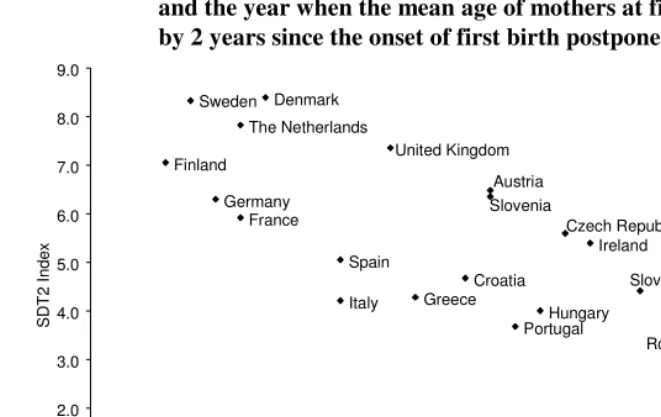
The relationship between delayed childbearing and the second demographic transition has been relatively firmly established; the onset of the recent long-standing fertility postponement also constitutes a suitable indicator of the onset of the SDT (Sobotka 2004: 58). A number of indicators capturing different aspects of the shift towards late timing of childbearing are closely correlated with the second demographic transition. This can be illustrated with the use of an SDT index constructed on the basis of characteristic changes in values and attitudes, as captured in the 1999 round of the European Values Surveys (data reported in Halman 2001). This index, termed SDT2, ranges from 0 to 10 (10 represents the highest possible score on ‘SDT-related’ values and attitudes). It is introduced in more detail in Sobotka (2008), and its components are listed in the Appendix. The SDT2 index is relatively closely correlated with the timing of the onset of fertility postponement, with the mean age at first birth (in 1999 and in 2006), and negatively correlated with fertility rates below age 25 (see also below). A close correlation (r = -0.78) also emerges with the calendar year when the mean age at first birth among women increased by two years since the onset of first birth postponement (Figure 1; the onset of postponement is measured since the year when the period mean age at first birth started a long-term rise; see Sobotka 2004: 57-58). In other words, the timing of the onset of first birth postponement, combined with the initial pace of this postponement, can serve as rather reliable ‘predictors’ of SDT-related values in 1999: the earlier the first birth postponement started, and the faster it subsequently progressed, the higher the SDT score that was reached in 1999.
Surprisingly, among different demographic manifestations of the SDT, the often emphasised association with (very) low fertility has become most questionable. Whereas the ‘model countries’ of the spread of the SDT values and behaviour, such as the Netherlands and Sweden, have experienced a prolonged
8 In addition, an increasing importance of immigrants for childbearing discussed in Overview Chapter 7
Figure 1: Index of the second demographic transition in 1999 (index SDT2) and the year when the mean age of mothers at first birth increased by 2 years since the onset of first birth postponement
Sweden Finland The Netherlands Germany Denmark United Kingdom France Spain Italy Greece Croatia Slovenia Austria Portugal Hungary Czech Republic Ireland Poland Latvia Romania Slovakia Estonia Bulgaria Belarus Russia Lithuania 0.0 1.0 2.0 3.0 4.0 5.0 6.0 7.0 8.0 9.0
1980 1985 1990 1995 2000 2005 2010 Year when mean age at first birth increased by 2 years
S D T 2 I n d e x
SOURCE: Own computations based on Council of Europe (2006), Eurostat (2008), Sobotka (2004), France and Russia chapters, and Halman (2001).
period of first birth postponement and an intensive rise in the proportion of children born outside marriage, their period fertility rates surpass fertility in most other parts of Europe, and their cohort fertility remains relatively close to the replacement level threshold (see also Overview Chapters 1 and 4). Several distinct findings and arguments that cast doubt on the second demographic transition – low fertility connection may be outlined:
• Some countries retain cohort fertility close to the replacement level. The
France suggests that the cohorts born in the early 1970s will have 2.0 children on average (trend projection in Prioux 2006: 351, T. 5). This finding indicates that the second demographic transition does not necessarily lead to below-replacement cohort fertility levels. This argument, which I further elaborate in another publication (Sobotka 2008), is also reflected in several country chapters. For example, the authors of the chapter on France note that this country has maintained a relatively high level of fertility in spite of experiencing many characteristic social and demographic changes commonly thought as conducive to low fertility, such as delayed entry into parenthood, rising couple instability, increasing number of births outside marriage, or the spread of modern contraception (Overview Chapter 4). Similarly, the Sweden chapter mentions a puzzling contradiction that Sweden, which is often viewed as a forerunner of the second transition, also “exhibits one of the highest fertility levels in Europe, with a completed fertility close to replacement.”
• This finding is also linked to another distinct line of reasoning, which
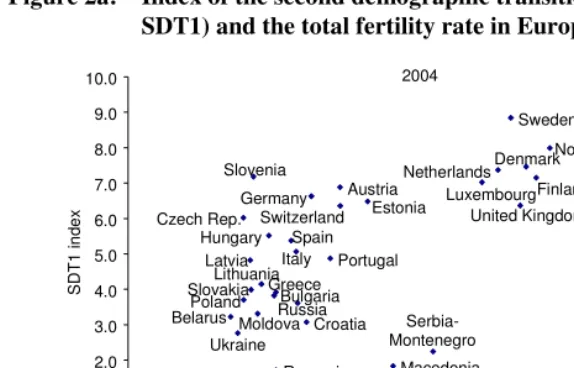
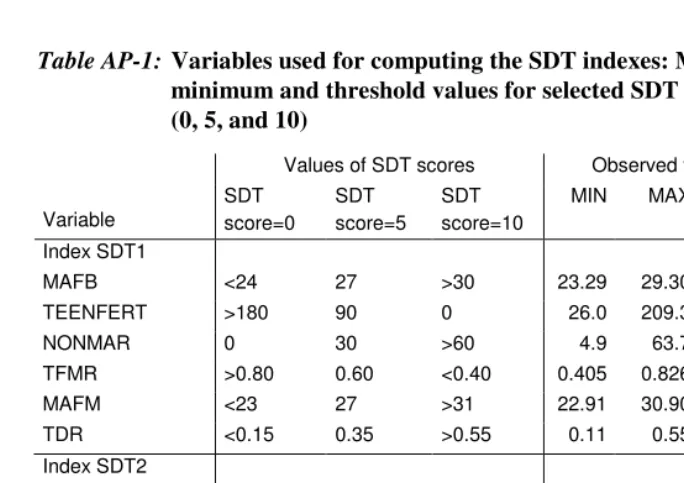
emphasises the lack of cross-sectional correlation between the second demographic transition and low fertility in contemporary Europe (Coleman 2004). In fact, my analysis (Sobotka 2008) of cross-country association between selected behavioural and values components of the SDT and fertility indicates that there is a positive correlation between the second transition and fertility in contemporary Europe. This positive association emerges most clearly with respect to the period total fertility rate (TFR, Figure 2a), which is a very problematic indicator of the fertility level (Overview Chapter 1, Lutz and Sobotka 2008), but it also holds for the TFR adjusted for changes in the timing of childbearing and, to a smaller extent, for desired family size (Sobotka 2008). In contrast, there was no detectable association between the SDT index based on family-related behaviour (SDT1 index9) and the TFR level in 1990 for Europe as a whole (Figure 2b). Only the group of ‘Western’ countries (i.e., all European countries except the post-communist societies of Central and Eastern Europe) exhibited as early as 1990 a positive association between the
9 The SDT1 index is constructed in analogy to the SDT2 index introduced above. It combines six
SDT1 index and fertility, an association which was also found to be strong in 2004. This finding potentially suffers from all the weaknesses linked to such a simple bivariate cross-country analysis conducted at one point of time, such as the danger of ecological fallacy, an ignorance of country-specific trajectories over time, and the lack of adequate controls for important factors affecting this association. Nevertheless, it seems safe to conclude that the recent shift to low and very low fertility in Europe appears to be driven more by the structural factors (family and social policies, economic trends, employment patterns; see also Liefbroer and Fokkema 2008, Sobotka 2008, Adsera 2004), which are only indirectly linked to the second demographic transition.10
• The absence of a negative cross-sectional correlation between the second
demographic transition and desired family size among younger women (Sobotka 2008) is also significant. Van de Kaa’s (2001) analysis showed that, in a number of European countries, young women with a post-materialist value orientation had higher family size ideals than those with ‘materialist’ values, whereas fertility intentions did not differ between these two groups. Apparently, the spread of the second demographic transition may not lead to the spread of sub-replacement fertility intentions. In most of the countries that made the biggest advances along the SDT trajectory, the fertility desires of younger women remain at or above two, and the two-child family norm continues to enjoy an uncontested popularity. There are countries where fertility intentions declined below the replacement level among the younger cohorts (see, for example, the chapters on the Czech Republic, Poland, and Spain), but it remains unclear to what extent this is a reflection of new values, perceived obstacles to childbearing, or a delay in accommodation to the previous fall in fertility rates.
• Finally, some studies point out that the fall in period fertility rates in
numerous countries had preceded changes in the underlying attitudes towards family life and children. This is an especially common assertion in discussions of the former communist countries (see Section 4.2 below).
10 The association between the second demographic transition and fertility would become more
Figure 2a: Index of the second demographic transition (‘behavioural’ index SDT1) and the total fertility rate in Europe in 2004
Belarus Slovenia Iceland Ireland Serbia-Montenegro Macedonia Romania Ukraine Croatia MoldovaRussia Germany Portugal Czech Rep. Estonia
Austria Switzerland Hungary Italy Spain Latvia Lithuania Sweden Norway France Denmark Finland United Kingdom Netherlands Luxembourg Slovakia Greece Poland Bulgaria 0.0 1.0 2.0 3.0 4.0 5.0 6.0 7.0 8.0 9.0 10.0
1.0 1.1 1.2 1.3 1.4 1.5 1.6 1.7 1.8 1.9 2.0 2.1 2.2 Total fertility rate
S D T 1 i n d e x 2004
Figure 2b: Index of the second demographic transition (‘behavioural’ index SDT1) and the total fertility rate in Europe in 1990
Belarus Slovenia
Iceland
Ireland
Serbia - Mon.
Macedonia RomaniaUkraine Croatia Russia Germany Portugal Czech Rep. Estonia Austria Switzerland Hungary Italy Spain Latvia Lithuania Sweden Norway France Denmark Finland United Kingdom Netherlands Luxembourg Slovakia Greece Poland Bulgaria 0.0 1.0 2.0 3.0 4.0 5.0 6.0 7.0 8.0 9.0 10.0
1.0 1.1 1.2 1.3 1.4 1.5 1.6 1.7 1.8 1.9 2.0 2.1 2.2 Total fertility rate
S D T 1 i n d e x 1990
NOTE: See footnote 9 and the text for a definition of the SDT1 index. More details are provided in the Appendix and in Sobotka (2008).
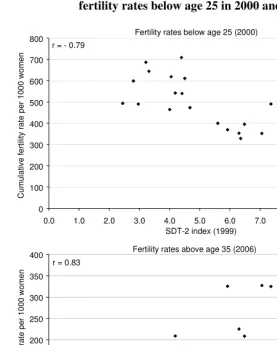
The surprising positive association between the second demographic transition and fertility can be better understood when the transition is related to fertility rates at younger and older childbearing ages. Specifically, the values and attitudes-based index SDT2 is negatively correlated with fertility rates of women below age 25, and positively correlated with fertility rates above age 35. This is illustrated in Figure 3, which looks at this association in 2000 for young-age fertility, and in 2006 for later-age fertility.11 The figure excludes Southern Europe and Ireland, where this
association was particularly weak, probably because factors other than SDT-linked values and attitudes were more relevant for fertility rates at younger and later childbearing ages. This simple analysis of the SDT-fertility link offers the following interpretation: the second demographic transition leads to a marked decline of fertility at younger ages (‘postponement’ component), but later becomes positively linked to fertility rates at higher childbearing ages (‘recuperation’ component). This recuperation is strong enough to bring an overall positive association between SDT and fertility, despite some fertility-inhibiting effects of progressively delayed childbearing. This association becomes clearly manifested only if and when fertility in the analysed countries falls to relatively low levels.
In sum, the low and very low fertility rates in contemporary Europe stand on three legs: fertility postponement, which is a long-lasting trend that should eventually come to an end12, numerous structural and institutional constraints that
negatively influence fertility decisions of individuals, and, in some cases, a shift in family-size norms and desires towards sub-replacement fertility (see also Overview Chapter 4). While the first factor (‘postponement’) has been losing in importance in many of the countries that advanced the most in the SDT progression, and the third factor (‘sub-replacement desires’) is far from universal, it seems that the impact of the second set of factors (different ‘constraints’) constitutes the most important explanation for very low fertility. These factors are not central to the changes in the
11 The SDT2 index is used here because its demographic (behavioural) counterpart SDT1 includes period
TFR that is linked with the analysed age-specific fertility rates. The selection of a later year, 2006, for a comparison of the SDT2 index and fertility rates at higher ages was motivated by the ‘recuperation’ argument: If the SDT is linked to fertility recuperation of cohorts that had postponed childbearing at younger ages, this link can be established only with a time lag, i.e., at the time when these cohorts actually reach later childbearing ages. If this argument holds, the positive association between SDT and late fertility may become even more apparent in the future.
12 Recently an increasing number of countries have recorded a slowing-down or even a stopping in an
Figure 3: Association between the ‘attitudinal’ index of the second
demographic transition (SDT 2, 1999) and the sum of age-specific fertility rates below age 25 in 2000 and above age 35 in 2006
0 100 200 300 400 500 600 700 800
0.0 1.0 2.0 3.0 4.0 5.0 6.0 7.0 8.0 9.0 10.0 SDT-2 index (1999)
C u m u la ti v e f e rt ili ty r a te p e r 1 0 0 0 w o m e n
Fertility rates below age 25 (2000) r = - 0.79
0 50 100 150 200 250 300 350 400
0.0 1.0 2.0 3.0 4.0 5.0 6.0 7.0 8.0 9.0 10.0 SDT-2 index (1999)
C u m u la ti v e f e rt ili ty r a te p e r 1 0 0 0 w o m e n
r = 0.83
Fertility rates above age 35 (2006)
NOTES: See the text and the Appendix for a definition of the SDT2 index (see also Sobotka 2008). The figure includes all European countries that participated in the European Values Study survey of 1999, except Ireland, Southern European countries (Greece, Italy, Portugal, and Spain) and countries with small population size (Luxembourg and Iceland). SOURCES: Own computations based on Council of Europe (2006), Eurostat (2008), Sobotka (2004), Halman (2001), Russian
values of family and children and, therefore, may not be seen as a part of the SDT ‘package’.13 Their importance may explain an unexpected outcome, namely, the
current positive association between the SDT and fertility ‘recuperation’ at higher childbearing ages, and hence also period fertility rates. This association is consistent with recent research by Myrskylä, Kohler, and Billari (2008), who reported a positive association between ‘development’ (as measured by the widely used human development index, HDI), and period total fertility for the countries that reached high levels of HDI (above 0.8).
However, at least one aspect of low fertility – the rise in childlessness – is closely linked to the transition. As parenthood ceases to be a ‘natural’ part of individual biographies and the main goal in a woman’s life, voluntary childlessness becomes a broadly accepted option. This has led to a rise in the proportion of people who are undecided about whether they will have children later in life. Sobotka and Testa (2008) show that a substantial proportion of childless men and women in Europe do not intend to have a child, or are uncertain about their parenthood intentions. So far, voluntary childlessness has spread most in western Germany, where it has become a broadly accepted lifestyle, and where childlessness, especially among higher-educated women, has reached the highest level in Europe (Germany chapter; see also Overview Chapter 2 and Sobotka 2005). The Germany chapter points out that there is a small group in the population that “does not regard children as an enrichment to life,” and for whom “children do not fit with their own identity” (Dorbritz 2008:590).
4. The second demographic transition in Central and Eastern
Europe
4.1 Regional economic and social differentiation and the changes in family-related behaviour after 1989
The discussion on the diffusion of the second demographic transition in the former state-socialist countries of Europe is closely linked to the analysis of the factors responsible for rapid changes in fertility and family patterns observed in this region
13 However, changes in values and attitudes that take place during the second demographic transition may
since the early 1990s (see Overview Chapter 5). A number of specific questions regarding the occurrence of the SDT in this region arise repeatedly: Are behavioural changes since the early 1990s qualitatively comparable to those that took place earlier in ‘Western’ societies? If so, are the underlying mechanisms similar as well, or are there constraining factors related to the political and economic changes prominent in Central and Eastern Europe? Do the typical normative and value changes accompany the changes in family and reproductive behaviour in these countries, or do changes in norms and values ‘lag’ behind behavioural changes? And, finally, how can shifts in values and attitudes that are typical of affluent societies take place in countries that have often been severely affected by economic crisis and political turmoil? Before delving deeper into any of these issues, it is important to stress the enormous cultural and economic diversity of the region, which is often overlooked in broad comparative studies (Sobotka 2003, Manning 2004). The region consists of countries that are very secularised and culturally rather ‘liberal’ (e.g., the Czech Republic, Estonia, Slovenia, the former GDR or East Germany, and, in many respects, also Hungary) and countries that are more culturally conservative, where people attach higher importance to traditional family values, and where religion often continues to play an important role (e.g., Poland, Romania, or Slovakia). It also consists of societies that are culturally close to Western Europe, and that considered themselves part of the ‘Western world’ before the Second World War (e.g., the Czech Republic and the Baltic countries); and of countries that had been historically distinct from the ‘West’, a category that includes most of the predominantly Christian Orthodox and Muslim countries. Finally, the economic restructuring of the 1990s led to widely divergent outcomes and a vast differentiation in the overall economic performance and living standards, despite many comparable pathways and policies, including large-scale economic privatisation, opening of the economy, and market reforms. For instance, the GDP per capita in US Dollars in 2005 (constant 2000 level) varied from 429 in Moldova, to 959 in Ukraine, 2,071 in Bulgaria, and up to 6,515 in the Czech Republic and 11,382 in Slovenia. (World Bank 2007).14 Keeping this diversity in mind, I review
the evidence of the typical changes in fertility, family, and living arrangements, as well as in values and attitudes to children, sexuality, and family life, and subsequently suggest an interpretation of the ongoing second demographic transition in Central and Eastern Europe.
14 This enormous difference becomes smaller when the GDP level is adjusted for purchasing power
A number of country chapters provide strong evidence of massive behavioural changes typically associated with the second transition. Although some of these changes started well before 1990 (Hungary chapter, Stankuniene and Maslauskaite 2008, Hoem et al. 2007, Katus et al. 2007, Gerber and Berman 2006)15, the period
after 1990 has seen a rapid acceleration of all the characteristic trends: first births and first marriages have been postponed (less intensively in Eastern and South-eastern Europe, more vigorously in Central Europe and the Baltic countries), fertility levels have fallen, the percentage of non-marital births has surged, marriage rates have plummeted, and divorce rates have remained high, or have further increased. Cohabitation has been spreading as well, although its significance differs widely across countries.16 Whereas in many countries, cohabitation mostly retains
the character of a ‘trial marriage,’ it has been rising fast in Bulgaria, the Czech Republic, Estonia, Hungary, Latvia, Russia, and Slovenia; often becoming a standard part in a partnership ‘career’ among younger cohorts (see the respective country chapters, Gerber and Berman 2006, Hoem et al. 2007, Katus et al. 2007, Spéder 2005, Philipov and Jasilioniene 2007). In other countries, such as Lithuania, Poland, Romania, and Ukraine, the diffusion of cohabitation has been rather slow, and is often typical of people in disadvantaged economic positions (Poland and Romania chapters, Muresan 2007). In almost all countries, however, cohabitation has been spreading most rapidly among younger people below age 30, and it has increasingly replaced marriage as a dominant form of the first union (Czech Republic and Hungary chapters, Spéder 2005, Katus et al. 2007, Hoem et al. 2007). In addition, the duration of cohabitation has risen over time, suggesting that it is gradually becoming a lasting alternative to marriage (Hungary chapter, Spéder 2005, Philipov and Jasilioniene 2007; see also Overview Chapter 4).
Following the collapse of the restrictive state-socialist regime in 1989, the countries of Central and Eastern Europe have experienced a full-blown sexual and contraceptive revolution, bringing a boom of information and messages on contraception, sex, and pornography (the Czech Republic chapter). This trend has also affected more traditional and more religious societies. For instance, in 1997,
15 Some behavioural features typical of the SDT have spread widely in Central and Eastern Europe
between the 1960s and the 1980s: premarital sex, marriage instability, and, in some countries, cohabitation (especially among divorced and separated people), and also a one-child family model (especially in urban areas of Russia; see Avdeev and Monnier 1995).
16 In several countries, including Estonia, Latvia, Hungary, Slovenia, and the former GDR, cohabitation
three-quarters of Slovak women of reproductive age were found to have a positive attitude towards premarital sex (Potančoková et al. 2008:997). An increasing acceptance of sex outside marriage is also noted in the Poland chapter. In many countries, the actual prevalence of premarital sex had already become almost universal during the post-war decades (the Czech Republic chapter) or increased rapidly after 1990: in Romania, the proportion of sexually experienced young adult women who began their sexual life prior to marriage rose from about one-half in 1993 and 1996, to 77% in 1999, and to around 90% in 2004 (RHS 2005). It is important to emphasise, however, that a ‘stealthy’ liberalisation of sexual morals and behaviour started in Central and Eastern Europe well before 1990, despite the limited spread of modern contraception there. As the Russia chapter notes, this sexual revolution “proceeded more quietly and less noticeably to the observer, by virtue of the taboo placed on the theme for research,” and also due to a general avoidance of this subject by the media (see also Binyon 1983). Sexual debut and regular sexual relations occurred at younger ages, and usually prior to marriage. In the absence of proper knowledge and availability of modern contraception, an early start of sexual life led to the surge in premarital conceptions, which gave rise to shotgun marriages at an early age (chapters on Russia, the Czech Republic, and Slovakia).17
4.2 Factors fuelling the changes in family behaviour
Individual chapters take a more nuanced view when discussing the factors responsible for the observed changes in family behaviour. Some of them emphasise the lack of evidence for a marked change in values that would progress in parallel with the changes in family-related behaviour, or that would precede it. The Poland chapter raises the question of whether the transition can explain family-related developments in Poland when “ideational change has not advanced until recently compared with its progress in other European countries” (Kotowska et al. 2008:845). The absence of a link between behavioural and value changes in fertility behaviour has been similarly noted by Rotariu (2006) in the case of Romania, and by Gerber and Cottrell (2006) in the case of Russia. The Romania chapter suggests that both ‘post-modern’ and conservative values have been advancing there: people
17 It is remarkable that the officially published advice literature on partnerships, sexuality, and family
started to “adopt Western values and to imitate modern and post-modern behaviour,” but, at the same time, material insecurity enhanced the importance of traditional values and favoured “conservative behaviour” (Muresan et al. 2008:895). In the absence of strong evidence of ideational changes, several chapters stress the importance of structural factors for initiating the change in family behaviour (e.g., the Bulgaria, Poland, and Ukraine chapters). The Ukraine chapter suggests that “the new trends may be the result of economic or cultural factors that have little to do with a shift towards SDT” (Perelli-Harris 2008:1165). Gerber and Cottrell (2006) posit that, despite the rapid increase in the proportion of non-marital births in Russia, there is a continuing traditionalism towards fertility (but not towards marriage, see Gerber and Berman 2006), and no clear evidence of a greater tolerance of extramarital childbearing. In contrast, the Hungary chapter points out that specific changes in values affecting family life, such as rise in consumer aspirations and social atomisation, had taken place during the period preceding the change of political regime in 1989. The Czech Republic chapter, on the other hand, emphasises the abrupt and multifaceted nature of social change after 1989, which makes it impossible to separate the contribution of different economic, structural, and cultural factors to fertility changes.18
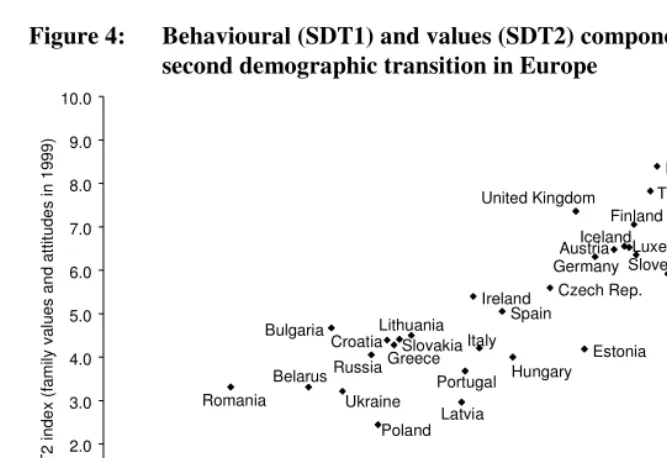
Three distinct findings support the idea that long-lasting changes in both family-related values and behaviour are reinforcing each other. First, both country-level evidence, as well as the research on household positions and value orientations in Central and Eastern Europe, show that, as is the case in ‘Western’ countries, there is a consistent relationship between changes in family behaviour and value orientations. Countries that have made greater progress on the SDT dimension also exhibit most clearly values and attitudes typical of the SDT (see also Section 4.5 and Figure 4 below). The profiles of ‘non-traditional’ value orientation are closely patterned by the living arrangements in which individuals live, with those who are divorced or who had ever cohabited displaying the most ‘non-conformist’ values, both in post-communist countries and in other regions of Europe (Lesthaeghe and Surkyn 2002). Second, as the Russian Federation chapter points out, the end of the economic crisis and an improvement in living conditions beginning in 1999 did not bring any signs of return to the previous pattern of family behaviour. Rather, very low fertility levels persisted, and the trend towards delayed family formation, decline in marriage, and the rise in cohabitation continued (see also Gerber and Cottrell 2006). Similar evidence for other countries casts doubt on the validity of the
18 Because of the emphasis on different sets of values and attitudes in various country chapters, and also
‘economic crisis’ explanation of the intensive demographic changes in Central and Eastern Europe after 1989 (see Overview Chapter 5 and Russia chapter). Finally, there are signs of a transformation in values and attitudes towards family and children, and the spread of individualism across the whole region, especially among the younger, better-educated, and urban populations. Lesthaeghe’s and Surkyn’s (2002: Table 6.7.2) analysis of European Values Study surveys in 1990 and 1999 shows that some of the family-related attitudes in Central and Eastern Europe moved in the expected direction envisioned by the SDT concept (while some other attitudes, especially acceptability of divorce and adultery, remained rather stable). This shift has been particularly notable in the Czech Republic, where the majority of people have become highly tolerant of abortion, premarital sex, divorce, or same-sex partnerships (Sobotka, Zeman, and Kantorová 2003 and the Czech Republic chapter). The Lithuania chapter suggests that Lithuanians have been “absorbing and adopting the life styles, value orientations, and norms of behaviour” typical of Western European societies (Stankuniene and Jasilioniene 2008:706; see also Bulgaria chapter). The Poland chapter has noted that younger generations are “less altruistic, more inclined to strive for self-fulfilment and appreciation outside the family,” and they attach less importance to family life and children (Kotowska et al. 2008:837). Several chapters emphasise that the ‘value change’ explanation best fits the highly educated group of the younger population (Romania and Ukraine chapters; see also below).
How can we reconcile the somewhat conflicting evidence on the progression of the second demographic transition in Central and Eastern Europe? As proposed by de Beer, Corijn, and Deven (2000), there indeed seems to be more than one model of the transition. Moreover, given the complexity and the fluidity of the SDT narrative, the assessment of its progression as reflected in individual country chapters is necessarily rather subjective. The ‘Central-Eastern European’ model of the transition is as diverse as the post-communist societies and their cultural heritage. Nevertheless, several shared features in their SDT may be outlined:
1) Late occurrence of many of the behavioural and value changes typical of the transition, especially those related to alternative living arrangements; 2) Rapidity with which many features of this transition emerged during the
1990s;
3) The importance of structural and economic factors, especially in the early stage of the transition; and
4.3 Explaining the peculiar progression of the SDT using the Readiness – Willingness – Ability framework
To get a better understanding of the peculiar and, at times, puzzling progression of the SDT in Central and Eastern Europe, I adopt a conceptual model proposed by Lesthaeghe and Vanderhoeft (2001), which elaborates on an idea first put forward by Coale (1973).19 This model, called RWA (an acronym for Ready, Willing, and Able), is built around the idea that widespread behavioural change occurs only if three different preconditions are simultaneously met. ‘Readiness’ (R) reflects the ‘cost-benefit calculation,’ namely, the economic, social, and psychological advantages of adopting a new behaviour. ‘Willingness’ (W) refers to the cultural and ethical acceptability, and thus also the legitimacy of the new form of behaviour. Finally, the ‘ability’ (A) refers to the technical or legal means that enable individuals to adopt new behaviour. The attractiveness of this model lies in its recognition of the joint importance of economic/structural factors (R), norms, values, and attitudes (W), as well as technology and legal regulation (A). This makes it particularly appropriate for understanding recent shifts in fertility and family behaviour in Central and Eastern Europe.
The RWA scheme makes it possible to outline the factors that had been conducive to the SDT, and that had already spread in the state-socialist countries between the 1950s and the 1980s, as well as the factors that had prevented the onset of a full-blown second demographic transition prior to 1990. With respect to
readiness, the creation of a relatively broad social security net during the decades following the Second World War had diminished in many countries the economic consequences for women of divorce or single motherhood. Similarly, the shift towards an almost universal employment of women enhanced their economic position, and reduced their dependence on male partners and relatives. On the other hand, the stalled expansion of tertiary education, the lack of alternatives for self-realisation outside the family, as well as the peculiar system of preferential housing distribution to married couples with children, discouraged cohabitation and supported early marriage and childbearing (see also Overview Chapter 4 and Chapter 8 in Sobotka 2004). Women’s emancipation had stalled halfway between tradition and modernity. On the one hand, women gained similar levels of education as men, they were entitled—and even pressed20— to participate in paid labour, and
19 Most recently, Lesthaeghe, Neidert and Surkyn (2006) have used this model to explain spatial
differences in the second demographic transition in the United States.
20 This pressure for employment was circumstantial, motivated by ‘financial necessity,’ as one income
their economic activity was “ideologically supported by equating emancipation with employment” (Kotowska et al. 2008:825). On the other hand, they were confronted with very traditional norms and expectations about their family and childrearing roles, and they were expected to take care of the household, shopping, cleaning, cooking, and childcare. Despite gaining more economic independence, women frequently worked in low-pay occupations (Bulgaria chapter) and they faced multiple burdens that were a far cry from the ideas of gender equality and ‘women’s liberation.’ Family life became highly idealised. Family relationships enhanced the well-being of individuals, as the mutual help of family members substituted for a deficient service economy (the Czech Republic and Hungary chapters). Moreover, family life provided a “shelter from the politicised public scene” (Potančoková et al. 2008:1001), and from the omnipresent eyes of the state (see also Sobotka 2004).
Concerning willingness, the official Communist ideology was strongly anti-religious, and thus helped to erode some of traditional norms related to marriage, family, and sexuality, which had previously been anchored in religious teachings. The destruction of various religious and civic organisations led to an ‘atomisation’ of the society (Hungary chapter). Despite the shortage of consumer goods, consumerist orientation had spread well before 1990 (Spéder 2005; Sobotka 2004). Moreover, even the media censorship and the limits placed on travel to ‘Western’ countries were not sufficient obstacles against the spread of new fashions, ideas, and aspirations associated with ‘Western’ culture, often progressing in a rather bizarre and deformed way.21 However, the new values were embraced in a selective
fashion. Even the relatively ‘conservative’ official ideology supporting traditional family values could not prevent the stealthy progress of the sexual revolution and the increase in family instability. At the same time, official ‘puritanism’ related to sexuality, gender roles, and the family probably helped to preserve the overwhelmingly positive image of marriage, childbearing, and family life, as well as widespread negative attitudes to feminism, homosexuality, and extramarital childbearing. This led to the development of a special form of secularised and pragmatic familism: family was of a paramount importance to individuals, but family dissolution through divorce or separation was increasingly accepted.
‘emancipation’ argument), and economically motivated by the permanent shortage of labour in an
ineffectively organised economy (e.g., Poland chapter).
21 The spread of ‘Western’ culture can be best illustrated by a widespread adoration of ‘Western’ pop
The picture is similarly mixed with respect to the ability dimension. On the one hand, legislative changes enabled some of the family changes typical of the SDT, for example, through relatively good access to divorce, and a wide availability of abortion in most state-socialist countries. At the same time, the widespread reluctance towards the production and distribution of the contraceptive pill, combined with a discouragement of abortion among childless young women (often explained on the grounds of the potential pregnancy complications later in life), and a lack of comprehensive education on sexuality and contraception, helped to sustain a pattern of early pregnancies and shotgun marriages, and of overall higher fertility due to unwanted and mistimed pregnancies.
On balance, the peculiar combination of the R-W-A factors during state socialism helps to explain why some types of family-related changes, such as an increase in divorce, had spread rapidly in many countries, while other behaviours typical of the SDT could not spread much because at least one factor of the R-W-A dimension acted as a bottleneck, preventing the diffusion of the new behaviour. For example, a combination of preferential housing distribution and special marriage loans (R dimension), the strong persistence of norms supporting traditional family (W dimension), and the low access to modern contraception, especially the pill (A dimension) helped to sustain an early and almost universal pattern of first marriage and first birth, with a pronounced peak among women in their late teens and early twenties.
A specific combination of R-W-A factors in Central and Eastern Europe prior to 1990 also affected the changes in family behaviour after the collapse of communism. The early erosion of some traditional norms related to the family helps to explain why the new demographic trends have spread with such intensity after the breakdown of the state-socialist system.22 In an environment in which traditional
norms had diminished, and the more recent communist ideology had been discredited, there was relatively little resistance to forms of behaviour that would have been deemed inappropriate in more traditional settings. Philipov (2003) stresses the importance of discontinuity and the resulting disorientation and anomie (normlessness) after the regime change around 1990. The lack of generally recognised norms of behaviour supported the diffusion of the less stable forms of partnership, and the postponement of union formation and parenthood (see also Bulgaria chapter). These factors explain why the W dimension did not constitute a
strong barrier to the spread of many new forms of behaviour. As was the case in Western and Northern Europe, many ‘traditional’ family norms had already eroded or had diminished in importance during the decades following the Second World War, or their importance had weakened significantly during the turbulent period of the late 1980s and the early 1990s.23 In this environment, many people openly
embraced values and living standards characteristic of Western European countries (see also below).
4.4 Emerging cultural and family divides in Central and Eastern Europe
A new family divide has (re-)emerged among post-communist countries after 1990, reflecting varying degrees of secularisation, modernisation, and traditionalism (especially in countries with a predominantly Roman Catholic tradition), as well as historical regional divisions (e.g., Fux 2008).24 These differences appear to have a lasting impact on the progression of the second demographic transition, and, more generally, on demographic patterns there. Selected chapters express a contrasting evaluation of the importance of religion, and the reputation enjoyed by religious authorities in the respective countries. On the one hand, a majority of the population in Romania believes that the (Orthodox) church provides the “right answers to family issues” (Muresan et al. 2008:895), the Catholic Church in Poland continues to enjoy “the highest ranks of social trust” (Kotowska et al. 2008:838), and the Catholic Church in Slovakia “plays an important role in the society and has an influence on reproductive behaviour” (Potančoková et al. 2008:1007). On the other hand, in Slovenia, the “position of the [Catholic] Church and the clergy on the confidence scale is low” (Stropnik and Šircelj 2008:1039) and religious affiliation, church attendance and the support of traditional religion are at very low levels in the Czech Republic (Sobotka et al. 2008:436; see also Stankuniene and Maslauskaite 2008). On an individual level, religiosity still exerts a substantial impact on the attitudes to marriage and childbearing. Less religious people in Europe tend to reject
23
Unfortunately, very little comparable data exist on family-related values and attitudes in Central and Eastern Europe during the state-socialist era. Thus, most of the literature on changes in values and attitudes in this region take the early 1990s as a starting point, often implicitly assuming that the surveys conducted in the early 1990s also provide a portrait of values prevalent before the collapse of state socialism.