University of New Orleans University of New Orleans
ScholarWorks@UNO
ScholarWorks@UNO
University of New Orleans Theses and
Dissertations Dissertations and Theses
Summer 8-6-2013
Where Do We Go From Here? Multiliteracy and the Future of
Where Do We Go From Here? Multiliteracy and the Future of
Narrative
Narrative
Dustin W. McCrory
Follow this and additional works at: https://scholarworks.uno.edu/td
Part of the English Language and Literature Commons, and the Other Film and Media Studies Commons
Recommended Citation Recommended Citation
McCrory, Dustin W., "Where Do We Go From Here? Multiliteracy and the Future of Narrative" (2013). University of New Orleans Theses and Dissertations. 1698.
https://scholarworks.uno.edu/td/1698
This Thesis is protected by copyright and/or related rights. It has been brought to you by ScholarWorks@UNO with permission from the rights-holder(s). You are free to use this Thesis in any way that is permitted by the copyright and related rights legislation that applies to your use. For other uses you need to obtain permission from the rights-holder(s) directly, unless additional rights are indicated by a Creative Commons license in the record and/or on the work itself.
Where Do We Go From Here? Multiliteracy and the Future of Narrative
A Thesis
Submitted to the Graduate Faculty of the University of New Orleans in partial fulfillment of the requirements for the degree of
Master of Arts in English
by
Dustin W. McCrory
B.A. University of New Orleans, 2010
ii Dedication
iii Table of Contents
Table of Contents ... iii
List of Figures ... iv
Abstract ...v
Introduction ...1
The Graphic Novel ...6
Communication ...29
Words and Meaning ...43
Literariness ...55
Conclusion ...63
References ...65
iv List of Figures
Figure 1 Batman:Through the Looking Glass ...12
Figure 2 AvX Round 5 ...13
Figure 3 AvXRound7 ...15
Figure 4 Hypernaturals no. 2 ...16
Figure 5 KillShakespeare ...17
Figure 6 TheDarkTower:Treachery ...18
Figure 7 KillShakespeare ...18
Figure 8 AstonishingX-Men ...19
Figure 9 Hypernaturals no. 8 ...20
Figure 10 We3 ...22
Figure 11 We3 ...23
Figure 12 Where is Jake Ellis? ...24
Figure 13 Locke and Key: Clockworks no. 6 ...26
Figure 14 Understanding Comics ...30
Figure 15 AvX Round 5 ...33
Figure 16 Comics and Sequential Art ...34
Figure 17 Who is Jake Ellis? ...38
Figure 18 Wonder Woman no. 9 ...41
Figure 19 Chew: Taster’s Choice ...47
Figure 20 Witch Doctor: Under the Knife ...50
v Abstract
Words on a page are insufficient vehicles for complex ideas. When images and words appear together on the page, as in comics, the process of meaning-making through narrative functions more efficiently. Building on this idea, we must establish a “graphic narratology” to understand the process whereby meaning is transmitted. Analysis of narratological conventions, as well as the conventions of mass-market comics, provides a framework for this new
narratology.
1 Introduction
By encouraging distinctions between graphic novels, comics, and words-only texts,
literary scholars privilege older forms of narrative that do not utilize graphic imagery and
marginalize comics/graphic novels as an inferior subset/offshoot/genre of narrative. Despite
these distinctions, universities and secondary schools are beginning to study comics in the
classroom. Academia has granted certain “graphic novels” like Art Spiegelman’s Maus (1991),
Marjane Satrapi’s Persepolis (2000, 2003), and Neil Gaiman’s The Sandman (1989-1996) the
elevate status of (high) literature – that is, highly valuable forms of artistic expression,
transcending the category of mass-market publications. Comics are increasingly seen as texts
worthy of literary and cultural analysis, but I believe there is a greater change occurring: this
trend towards graphic-with-text production results from a combination of the postmodern
complication of language and communication, globalization, and technological developments
like personal computers and the internet.
The evolution of communication – from grunting and pointing, to pictures, sounds, then
words – is probably not complete. We began with images on walls and progressed as far as we
could before “upgrading” to a phonetic system wherein symbols represented sounds, while
words “arbitrarily” representing ideas (Saussure). Perhaps, because of the development of certain
technologies (the internet, computers, etc), as well as increasing globalization, we have taken this
form of communication to its maximum level. I believe this is where graphic narrative enters the
picture. Just as the evolution of humanity, and the evolution of human thought, necessitated the
development of language, and eventually writing, so too must further advancement necessitate a
more efficient method of communication. It is unlikely that our current method of a literary
2
Many of us are familiar with the recent success of the comic book movie: dozens of
recent movies come from comics. Yet this is only the tip of the proverbial iceberg. Successful
movie franchises are crossing media boundaries to become graphic novels; television shows
become graphic novels, often online as webcomics (Burn Notice); popular children’s books have
also spawned graphic novels (Alice in Wonderland). It would appear that commercial success
hinges on the ability of an imprint to cross the media divide and become multimodal. Whereas
older texts are being “translated” into graphic novels, newer texts are created with multimodality
in mind. It appears these various modes of narrative are being rewritten as graphic novels for a
variety of reasons, such as globalization and technological advances. Michael McKeon
demonstrates how technology like the printing press changed society by making texts cheaper to
produce and thus more available and affordable. The increasing availability and affordability
created an industry with writers, editors, producers, and printers. The rise of the novel reflected
the rise of the middle class, a consumer class who had the luxury of time (and education) which
they could spend reading. I do not suggest the graphic novel prefaces a shift in class; rather that
it responds to a change in society. Today, the world has become smaller through technological
advances such as the internet; cultures separated by thousands of miles are brought into dialogue
with each other. Today we can open a program and juxtapose images with text in moments. We
can distribute this composition globally in an instant.
Yet a gulf remains between any two cultures in the form of idiomatic expressions,
common cultural histories, even language. In Culture and Society (1958), Raymond Williams
defines culture variously as “the general state or habit of the mind”; “the general state of
intellectual development, in a society as a whole”; “the general body of the arts”; and “a whole
3
constructed through years of intellectual, social, material, and personal development. Perhaps the
reason something ingrained in one culture seems so difficult to understand by another culture is
simply (if anything is simple) the ancestral cultural referents, those common histori-cultural
artifacts upon which a culture builds. Contemporary examples are memes, internet phenomena
that build on common cultural referents, satirizing them, such as captioning a picture of President
Obama, or subtitling a video of Hitler shouting. Comics function like memes, reproducing
culture and evolving along the way. Whereas memes are especially idiomatic, relying on
common cultural referents, graphic novels transcend this limitation, often instructing readers how
to read their coded packets of information.
In this post-postmodern moment, we understand that meaning is fluid, and therefore it
becomes difficult to fix ideas, especially complex ideas, with concrete, rational meaning.
Likewise, language is dynamic, as anyone who has traced the evolution of a word in the OED
can attest. To communicate on a global, intercultural scale more easily, we must invest ideas
with something more than (arbitrary) words alone. Words are inefficient at transmitting, from
one culture to another, complex, subtle aspects of another culture because meaning is often
confused or lost in translation. Thus, a new method of ideological and cultural exchange has
become necessary. Gabrielle Starr articulates the effectiveness of engaging various senses in the
transmission of ideas and the encoding of memories. Additionally, as cognitive and
neuroscientists demonstrate, the visual cortex is one of our largest sensory processors. Vision is
our most important (evolutionarily) sensory structure. If, as the adage claims, “a picture is worth
a thousand words,” perhaps we can illustrate the more complex ideas by marrying pictures with
words. Children’s books are illustrated, not only to hold the child’s attention, but also to help
4
By pairing images with text, graphic novels can do more than reinforce meaning; they
create deeper, more solid meaning, rather than watch it slip away. Furthermore, the rise of the
graphic novel demonstrates the beginning of a shift in values, from purely lexical texts, to
hybrids of graphic and lexical modes. Graphic novels and comics have many tools at their
disposal, such as the use of color and shape of text in a dialogue bubble to comment on a
character’s tone. Comics artists like Scott McCloud and Will Eisner have published a variety of
texts examining the various attributes of graphic literature using non-academic discourse, while
scholars like Thierry Groensteen have analyzed these attributes in an endeavor to systematize
graphic literature more formally. Hundreds of academic papers have likewise analyzed a variety
of graphic texts often granted literary status, like Maus, Persepolis, or Sandman. Rather than
analyzing one or two of these texts, this paper will demonstrate how effectively graphic
narratives communicate by looking at mass-market comics. If these features exist and function at
this level, across a variety of texts, the features become part of a system of graphic narratology, a
new grammar of graphic literature analysis. Beginning with a thorough examination of the
graphic novel – the history and evolution of graphic literary forms – followed by an analysis of
the evolution of communication, as well as the “problem” of words and meaning, I argue that,
rather than being an insignificant moment in cultural evolution, the graphic narrative explosion
represents an evolution in human (cultural and ideological) expression. I will conclude by
examining the literary value of graphic literature as well as the ways in which teachers and
scholars can utilize graphic narratives to educate students more effectively. By synthesizing
information from academic and non-academic discourse and analyzing mass-market art, we can
5
passing fad, nor are they an offshoot or genre of words-only literature; graphic novels are posited
6 The Graphic Novel
Comics have gained popularity over the past decades. What we think of as comic books,
starring superheroes like Superman, Batman, The X-Men, or The Avengers, experienced a
Golden Age in the mid-20th century. However, this is not when we first discover graphic
narratives. Instead, this point marks a shift in the medium; it is the beginning of the graphic
novel explosion. Researchers disagree about the earliest productions that we can call ancestors to
or proto-graphic novels. Scott McCloud is a comics artist who identifies Mesoamerican artwork
and Egyptian hieroglyphics as the earliest ancestors to comics, suggesting “the invention of
printing” is one of the most significant events in the 3000+ year history of sequential art (15).
Will Eisner also considers hieroglyphics, as well as Chinese and Japanese pictographs, to be the
precursors of the modern graphic narrative. Drawing on the “development” of these writing
systems, Eisner discusses the “ongoing simplification and abstraction of communicatory
pictures” that result in the formation of modern ideographic systems. Eisner further compares the
stylized artistic process in graphic narratives with calligraphy, further reinforcing the conclusion
that comics is a language (Round 318). If we fast-forward a few centuries, we encounter William
Hogarth (1697-1764), an artist McCloud credits as (one of) the first sequential artist(s).
Hogarth’s engravings tell a story when “viewed side-by-side – in sequence” (17). Nearly a
century later, a Swiss artist named Rodolphe Töpffer (1799-1846) produced “satirical picture
stories” that utilized features (like panels and the juxtaposition of words with images) that we
7
contributed to the development of comics, the medium owes as much to the “invention of
lithography” (8).1
Jorge Salgueiro engages with both McCloud’s and Groensteen’s assessments of the
graphic novel’s antecedents, but concludes that the “art form” is recent, whereas the
“communicative phenomenon” is ancient (381). Certainly, we see how these predecessors
employ images as narrative. However, the popular form of the comic strip dates to the late-19th
century with the Yellow Kid, while the “tradition of social critique via cartoons” predates even
this (Martin 171). Elaine Martin compares the cartoonist with a court jester, “who under the
guise of entertainment, could exercise sharp social critique” (171). Early political cartoons retain
this social criticism, essentially narrativizing a moment in history. The Standard Oil
octopus-monster and the Gerrymander are absurd cartoons, yet they are dense with meaning. Ole Frahm
suggests this humor was beyond ironic, that the laughter was anything but light-hearted. Yet the
“yellow press” became known as the funny pages quickly enough (6). These early comics were
drawn with the technology in mind, according to Eisner, accounting for the heavy black lines
that compensated for the “cheap newsprint or pulp paper” (165-6). It was much later when the
simple four-color system and “hand-separation” allowed greater artistic stylization. Our current
technology empowers artists to stylize their work further, while the process happens almost
entirely digitally now (167-8). Eisner tells us during these early years of four-color printing the
comics industry standard assumed a comics reader was a “ten-year-old from Iowa” (149). Adults
did not read comics; those who did had lower intelligence.2 While technology has improved
dramatically, many standards have remained the same. Webcomics, for example, delivered
1
See also: Lynd Ward, an American who many comics historians ignore, produced “woodcut novels” using images to tell a story; Frans Masereel author of wordless novels including Passionate Journey (1919); Max Ernst’s A Week of Kindness (1934) (McCloud 19).
2
8
through a digital medium, still limit what the reader sees. Instead of a page of panels, the reader
has a screen of panels. However, the reader can potentially see “the entire graphic novel” or the
collected works of a given artist through a digital archive (Zanfei 55-6). Anna Zanfei believes
this is a positive development, technologically, because it enables rapid consumption of art,
providing “immediacy” and “immersion into an already established community” (56). When
considering the “yellow pages” and the ten-year-old Iowan reader standard, we see how comics
were always products with mass appeal. Catherine Labio calls comics a “global genre” and a
“cross-cultural dissemination machine” (124). If we consider the occurrence of graphic literature
around the world, and the popularity of manga in the United States, we begin to understand what
Labio means.
To continue, we need to understand exactly what separates comics and graphic novels
from other art forms. What begins as a simple exercise of definition can become surprisingly
difficult – primarily because of the debated usage of the term we are trying to define. What are
we discussing, ultimately? It is the story, the idea, the information that an artist conveys through
the medium. The physical medium might change; it might be electronic rather than physical.
Other times, the medium might be both electronic and physical. Marvel has developed an
application for smartphones that scans a physical comic’s page or panel and provides additional
electronic content. Sometimes this content shows the development of a panel, or it can be an
audio clip of the creators saying something funny. Perhaps medium is incorrect; perhaps form is
a better term. What about the name for this form? Do we stick with McCloud’s collective
singular noun, comics? What about graphic novel or graphic narrative? James Bucky Carter
prefers the term “graphic novel,” which he defines as a “book-length sequential art narrative”
9
an original, stand-alone graphic narrative” (1). We see other critics disapproving of the term
“graphic novel,” primarily because “novel” denotes fiction, whereas many graphic narratives are
non-fiction. Chute and DeKoven argue, “Graphic narrative differs from the novel” because of its
hybrid nature (769). They prefer “graphic narrative,” leaving “novel” to remain a different genre.
Chute again rejects the term “graphic novel” in “Decoding Comics,” while David Coughlan cites
Spiegelman’s rejection of the term “comics” because the tone is not necessarily comic (834).
Spiegelman also “disdains the term [graphic novel] … seeing it ‘as a mere cosmetic bid for
respectability’” (qtd. in Coughlin 834).
Other critics decry the qualifier “graphic,” suggesting the term connotes “sexual” or
violent imagery (Martin 171). Furthermore, many “graphic novels” are shorter than a novel,
disqualifying them from the term (171). Labio argues that “graphic novel” should not be an
“umbrella term for a whole genre” but that it might be effective in delineating a sub-genre (124).
She adds, “‘Comics’ … reminds us” of the “stubborn refusal” of academics to “accept popular
works on their own terms,” that “‘graphic novel’ sanitizes comics; strengthens the distinction
between high and low” (126). Furthermore, she disdains “graphic narrative” as a way to
“privilege … the literary character of comics over the visual” (126). By calling comics anything
else, we allow literary scholars to place comics in an inferior position to non-graphic literature.
While I agree with much of Labio’s sentiment, I am more inclined to accept Chute’s distinction
that the term “graphic narrative” is a better umbrella term because it maintains the implied length
of “graphic novel,” but also accommodates “modes other than fiction.” Chute elaborates, “A
graphic narrative is a book-length work in the medium of comics” (453). Frahm stands out from
these, suggesting the term “bildergeschichten,” or picture-stories, arguing that comics are
10
a poem, the detail of a photograph, and the motion of film” (1-2). While I agree that comics are
distinct from these other media, to say graphic literature “lacks” implies it aspires to be any of
these. However, it is a multimodal form, not just a single medium. It draws on many elements of
representation without trying to be anything except informative or entertaining. Perhaps we
should instead consider the form in terms of biological classifications of life: graphic novels are
one species of the graphic narrative genus, which belongs to the family of comics, in the
literature order, under the class art. For simplicity, I will use the term “comics,” but I will
dispense with McCloud’s suggestion that this term will be a singular noun.
The debate amongst scholars and artist regarding the use of terms like comics, graphic
novel, graphic narrative, and graphic literature, universally revolves around one form of narrative
that can go by many names. So what is this form? We see the modern funny pages, the “comics”
section of the newspaper, weekly. We know that the evolution of the graphic narrative form
involved an iteration like these newspaper comic strips, but the form continued to evolve. Now
we have graphic novels, which are only distantly related to comic strips, much the way humans
are only distantly related to chimpanzees. McCloud defines comics as “juxtaposed pictorial and
other images in deliberate sequence, intended to convey information and/or produce an aesthetic
response in the viewer” (9). His definition excludes religious stained glass, film, and single-panel
cartoons like The Family Circus (20-1). Eisner uses similar wording to define graphic narratives,
yet his definition includes film. He considers comics a subgenre of the generic term “graphic
narrative” (Graphic Storytelling xvii). Both McCloud and Eisner use the word “sequence” or
“sequential.” In fact, the phrase “sequential art” is what excludes The Family Circus, and it is
this singular phrase that surfaces in many definitions. The process of composing a narrative
11
Marianne DeKoven suggest the “verbal and visual narratives” combine in unique ways,
transcending simple synthesis (“Introduction: Graphic Narrative” 769). Chute further defines
comics as “a hybrid word-and-image form in which two narrative tracks … register temporality
spatially” (“Comics as Literature?” 452). Many prefer to think of comics and graphic narratives
as more than a hybrid, but hybrid is not a pejorative. If a graphic narrative is a hybrid
text-and-image narrative, it is neither text-based nor text-and-image-based; it is both simultaneously. Without both
features working together, you would have an illustrated narrative or a proto-graphic narrative.
The “hybrid” signifier sufficiently articulates the role of text and image working together to
produce a richer narrative. Perhaps, then, a working definition of comics is “a hybrid form of text
and image that creates a narrative sequence.” Essentially the form is both text and still images
working together to tell a story; the story is not necessarily fiction. McCloud discusses comics in
terms of “pictorial and other images.” What are these other images? What do we see, besides
text, on a comic’s page?
The visual element of a comic’s page utilizes many conventions. Eisner says that the
visuals in comics “replace text,” whereas “an illustration simply repeats or amplifies, decorates
or sets a climate for mood” (Comics 165). These visuals tell a story that the words alone do not
or cannot. The basic, most fundamental image in comics is the “icon” (McCloud 27). The icon
can be both signifier or signified; it can be objective or subjective, diegetic or non-diegetic. The
icon comprises comics’ genes. There are different icons and different ways to arrange icons to
tell a story. The easiest icon to identify is the panel, or frame. The frame divides time and space.
The duration of time within a panel is determined primarily by the actions that occur within its
12
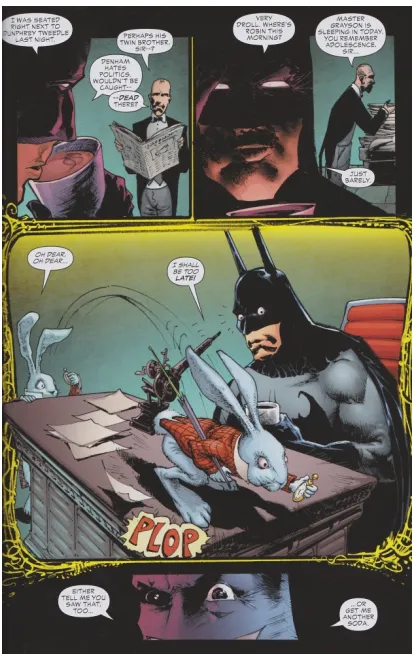
panel (McCloud 99).3 The most basic frame is a solid black line, but the artist can vary this to
demonstrate different moods.Eisner calls this a secondary function of the frame, wherein the
“panel border itself can be used as part of the non-verbal language” (Comics 44).
Figure 1. In the above page from Batman: Through the Looking Glass (2011), Batman has been surreptitiously dosed with a powerful psychotropic compound. His hallucinations begin early in the text, and the frame borders change to reflect his hallucinatory state of mind (Kieth).
The sequence of panels together on a page indicates a larger frame, the page itself. Occasionally
a single page may be a frame for simultaneous actions that occur in smaller frames superimposed
on the larger scene (Eisner, Comics 41). When the page is a frame’s border, this is called a
“bleed.” Bleeds play with the temporality and “timelessness depicted in a scene” (McCloud
102-3).
3
13
14
Words themselves are icons in many ways, too. The written words represent sounds or ideas, but
are not themselves the sounds or ideas. Lettering, which can be either hand-drawn or typed, can
15
/
16
oddly shaped dialogue bubbles indicates both that their voices are identical, and that theirs is an ethereal, otherworldly tone (Coipel; © 2013 MARVEL. Used with permission.).
Most words appear in a kind of a frame known as a balloon. Balloons are an ancient convention,
first seen as brackets depicting speech in Mayan friezes; “as the balloon form developed … it
took on meaning and contributed to the narration” (Eisner, Comics 24). Depending on the shape
of a balloon, the text inside can be spoken, shouted, or even thought. The background color
inside the balloon can indicate tone as well as the identity of the speaker.
17
Words that occur outside of dialogue balloons are typically onomatopoeia. Salgueiro suggests
onomatopoeia is one of several synesthetic effects used to represent sound visually (583). He
divides these effects into four phonophoremes: logonarrative, logographic, iconarrative, and
iconographic (585-6). Logonarrative phonophoremes are sequences of text that are not dialogue
nor are they onomatopoeia (i.e. spitting, sneezing).
Figure 5. In Kill Shakespeare (2010), the “hngg” and “ungh!” represent grunts or moans, vocalizations that are not words, emitted by the injured warrior (Belanger; used by permission).
Logographic phonophoremes are onomatopoeia, “a sequence of letters that describe a sound,”
rather than the use of letters to indicate a sound (logonarrative). Logographic phonophoremes
18
Figure 6. In the panel above, taken from The Dark Tower: Treachery (2008), the word “bang” is an iconic logographic phonophoreme. It is iconic because “bang” has cultural significance as the sound made by a gun (Lee and Isanove; © 2013 MARVEL. Used with permission.).
Iconographic phonophoremes are non-verbal communications such as movement lines, impact
(shock) waves, “seeing stars,” and musical notation (586).
19
Iconarrative phonophoremes are more difficult to distinguish as they are often “background” or
“foreground” sounds indicated through things like waves crashing on a beach, wind, or horses
galloping (587).
Figure 8. In Astonishing X-Men (2006), Ord (of the Breakworld) crashes through the glass. The iconarrative sound is not so much written as implied (Cassaday; © 2013 MARVEL. Used with permission.).
Salgueiro specifically regards iconographic and iconarrative phonophoremes non-linguistic
(593). These are untranslatable, and are unnecessary to translate. They contribute to comics’
ability to transcend culture, to universalize. However, certain cultures have utilized iconographic
phonophoremes differently. McCloud identifies the way in which Japanese manga use movement
lines and “subjective motion … [to place] the reader in the driver’s seat (113-4). Subjective
motion in manga functions as an autodiegetic iconographic phonophoreme; the reader
experiences the world as the subject; by contrast, American artists use “zip-ribbons” to indicate
20
21
Besides these physical features of comics, there are a number of narrative elements that
distinguish graphic literature from text-only literature. Among these are Groensteen’s terms
“arthrology,” “spaciotopia,” and “braiding.” These are the ways comics function, according to
his System of Comics (2007). “Closure” is the term McCloud uses to describe the dialogue
between the reader and the image/text that connects panels across the gutters, which parallels
Groensteen’s theory of braiding. Arthrology refers to the way the panels interact with each other
in terms of the narrative. This “relation between” the panels can be “restricted” or “general.”4
Restricted arthrology is linear and sequential; general arthrology is the total network (Venezia
184). Spaciotopia is differently defined as the relationship between time and space (Groensteen;
Beaty and Nguyen ix). Julia Round refers to the phenomenon as “a narrative morpheme that uses
space to represent time” (316). What we see, in a series of frames, is the appearance of a linear
progression. I say appearance because the reader imposes on the page of panels a subjective
sequence. It is hard not to look at the last panel, just as it is difficult not to look from the verso to
the recto pages of a novel, searching for clues to the outcome of a tense moment. Beyond even
this, a comics reader perceives all the moments contained on a page, represented by panels,
simultaneously. These moments cannot happen simultaneously; therefore, the reader must
organize the panels and understand the limits of time contained within each panel. Cultural
conventions, like reading left-to-right, top-to-bottom, are good ways to begin reading space and
time in comics. However, some comics’ artists play with these conventions, disrupting the
narrative flow, forcing the reader to work harder in order to participate in the construction of a
narrative (Round 316). This ultimately discourages passive comics reading.
4
22
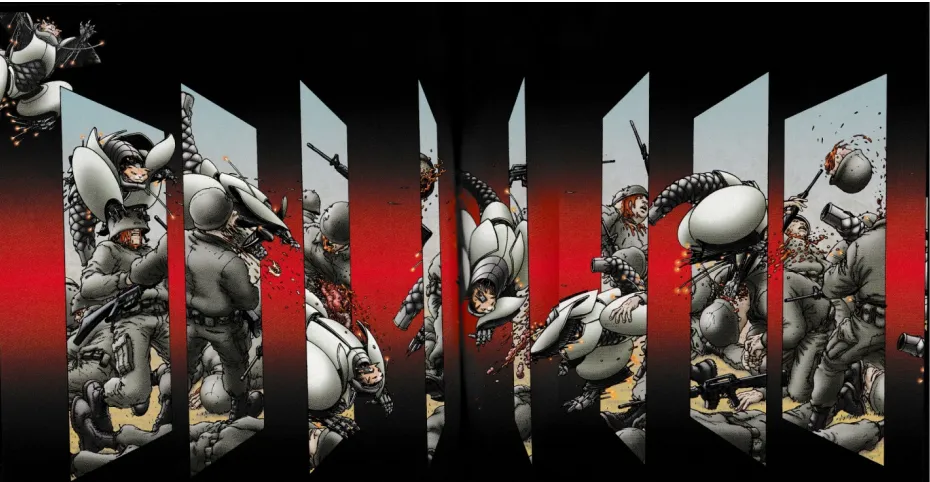
Figure 10. In We3 (2004), Frank Quitely experiments with both bleeds and parallel transitions by using foregrounded panels to show both a sequence that occurs quickly and the smaller moments that make up the scene. There is no correct way to read these two pages, since everything
happens so quickly. Quitely plays with narrative time by keeping the cat-cyborg stationary, while his target experiences the onslaught of his projectile claws.
McCloud reminds us that space and movement are similarly linked, citing the use of movement
lines to depict continuous action in a frame rather than singular moments (107). Some artists
might even use a sequence of panels to indicate motion, something akin to a cartoon flipbook,
with a character bleeding through the panels. Typically, a panel is a moment in time, or a brief
23
Figure 11. In this two-page panel from We3, we see the cat again moving with lightning speed
through the panels, faster than even the panels can show (Quitely).
It is worth noting that such temporal play encourages a plurality of narration, effectively telling
multiple stories in the same temporal space. Paul Crutcher refers to this effect as “layering” (61).
The effect of layering serves to produce a depth of story, as well as providing a narrative texture
24
25
Seeing two things occurring simultaneously expands the reader’s perception of the world – more
so than reading a few pages of a chapter and skipping ahead to a section entitled “Meanwhile…”
Certainly, novels can tell two simultaneous stories, but rarely (if ever) can the form present these
two narratives simultaneously to the reader. Yet another feature, which Groensteen identifies as
braiding, describes the unique capability of comics. Introducing Groensteen’s System of Comics,
Bart Beaty and Nick Nguyen define braiding as “the way panels (more specifically, the images in
the panels) can be linked in a series (continuous or discontinuous) through non-narrative
correspondences” (ix). Silke Horstkotte and Nancy Pedri elaborate on Groensteen’s theory,
26
27
one thing his father ever gave him (a fishhook) – in it he sees a possible solution. All three narratives are braided together; each plays a part; some (Bode, Tyler) know more than others (Kinsey, Bode) (Rodriguez; used by permission).
McCloud refers to the linkage between two panels, subjectively created in the reader’s mind,
as part of the process of closure. He defines this psychological phenomenon as “observing the
parts but perceiving the whole” (63). Closure could account for the temporal ordering of panels
on a page as well as the links between braided frames. McCloud further identifies six types of
transitions requiring varying degrees of closure by the reader:
• Moment-to-moment – requiring very little closure
• Action-to-action – single subject in distinct progression
• Subject-to-subject – stays within a scene or idea
• Scene-to-scene – uses deductive reasoning to transport us across space/time
• Aspect-to-aspect – bypasses time, shows different aspects of a place, idea, or mood
• Non-sequitur – no logical relationship (74)
The locus of closure is the comics gutter, the space between the panels. Starr’s explanation of
multisensory images and narrativity discusses a psychological process similar to closure:
“experiments have shown that a small blank space inserted into a recording of a well-known
song may trigger auditory imagery” (279). Essentially, when we hear a song, like “The Star
Spangled Banner,” and a gap is inserted, we sing through the gap. Through closure, we link two
lines (panels) together. What’s more, the brain thinks it hears the song. This works in film as
well as in comics, but closure in film requires less conscious participation from the audience
(passive), “showing” the narrative at twenty-four frames-per-second. In comics, during closure,
our brains actively create a visual connection between the panels. Starr suggests the visual
component is stronger, that non-visual stimuli are difficult to engage visually (through text that
is). Salgueiro argues comics are better equipped to handle these non-visual phenomena, although
28
Comics are a serial medium, traditionally, meaning the narratives are not complete upon
publication. Tony Venezia suggests the process of closure allows readers to link serial
publications, that the “inherent fragmentary quality” of comics resemble an “archival collage”
that readers engage within an ongoing process of narrativity (190). Reading comics requires a
different literacy, and analyzing comics’ narratives requires a different narratology (Round 316).
We may still understand comics in terms of defamiliarization, since they are so similar to
cartoons – a medium associated with youth and innocence – yet they often employ complex,
mature themes (Martin 178). Consider Art Spiegelman’s Maus, with its cartoony, cute mice,
pigs, and cats. Superficially, they are simple cartoons; however, seeing emaciated mouse corpses
stacked on each other works to defamiliarize the reader. We understand the mice are European
Jews, and we can comprehend the horror of Nazi concentration camps. Yet seeing these images
creates a new sense of horror in the reader. Round suggests, “The visual element transcends” the
detachment of the reader, imposing “a sense of immediacy on the narrative” (323). We cannot
help but become part of the narrative. That is what comics do. Horstkotte and Pedri remind us
that the combination of verbal and visual narrative “complicates … narration and focalization.”
This complication can be understood, even analyzed, through a new graphic narratology (350).
Some comics are representational, they look like what they represent, they are iconic; others look
like ideas of things, they are conceptual. Eisner privileges the iconic, representational image,
asking comics artists to “emulate … real experience” and to “be constantly concerned with
perspective” (Comics 93). This is a myopic view, but his opinion on what should be in comics
does not undermine the value of what often is in comics. Even if an artist prefers to experiment
29 Communication
Communication is a fundamental aspect of a species’ interaction, socialization,
adaptation, and survival. Human beings have developed a complex system of communication
comprised of words, images, and gestures. If one analyzes the evolution of our communicative
abilities, one necessarily arrives at a preverbal state wherein few (if any) complex ideas were
communicated. An argument can be made that complexity of thought and complexity of
communication necessitated or stimulated mutual adaptation and evolution. However, it is not
within the purview of this paper to discuss this kind of chicken-and-egg scenario. Instead, I bring
up our earliest ancestors’ ability to communicate to demonstrate the progression from a preverbal
state to a simple, and finally a complex, system of communication. Early cave paintings like
those in Lascaux, France, represent a phase of iconic communication, wherein non-abstract
(concrete) ideas like animals and hunting could be depicted by simple visual representation.
These paintings date back 17,000 years; our earliest evidence of written linguistic systems dates
to nearly 5,000 years ago with cuneiform in Babylon and Hammurabi’s code. This transition
from iconic communication to more abstract forms suggests a similar complication of linguistic,
verbal communication. For example, one might simply grunt to vocalize the presence of prey,
but in order to discuss laws of ownership and punishment, simple inarticulations would be
dramatically insufficient. Egyptian hieroglyphics and Babylonian cuneiform visually represented
30
Figure 14. In this example from Understanding Comics (1993), McCloud shows how early cuneiform was abstracted from an almost iconic representation of wheat or cattle (131, 142).
Egyptian hieroglyphics progressed through a similar process of abstraction, as did
Eastern languages like early Chinese and Japanese. Eventually, languages relied less on
pictographs, and shapes began to represent consonant and vowel sounds in the West, while
ideographs evolved to represent abstracted ideas metaphorically. Today we have hundreds of
languages with their own rules composed of various alphabets. This represents a complication in
communication necessitated by the slow abstraction of languages around the world. Just as what
we wanted to express or were capable of thinking gave rise to new media of communication, we
have recently experienced another new wave of thinking that likewise requires new media.
Gunther Kress and the New London School identify “the ways in which we communicate [that]
have changed,” calling for an engagement with this change in consideration of “texts and
literacies and in our pedagogies” (Jacobs 182-3). This suggests a kind of sympathetic feedback
between multimodalities and multiliteracies. Dale Jacobs discusses the changing “concept of
communication” using the New London School’s term “multiliteracies,” which “engages with
the multiplicity of communication channels and media [and the] increasing salience of cultural
and linguistic diversity” (Cope and Kalantzis, qtd. in Jacobs 183). These multiliteracies depend
31
icons to transcend language barriers. McCloud anticipates such multiliteracy may usher in a new
era of universal communication (58).
Such a universal language is predicated upon – or perhaps possible because of – the
existence of certain stimuli and phenomena. Cognitive scientists and linguists argue for the
necessity of narrative for determining causal relationships. This process or tendency to
narrativize, or narrativity, is an “adaptive tactic … correlated with a feeling of control and
mastery” (Easterlin 629). Narrativity allows humans to anticipate, learn, and interact within a
temporally linear fashion. That is, we understand the relationship of time and sequence from a
given result or consequence. Such linearity was fundamental to the survival of humans in the
ancestral evolutionary environment in terms of interacting with and understanding the
complexity of the world around them (Easterlin 629). Early humans learned to organize
information quickly and efficiently and retain ready access to this information. Through a
process known as habituation, tremendous amounts of sensory information could be processed
then ignored, freeing up precious cognitive resources to respond to new (potentially deadly)
information. Our complex brains adapted structures specifically to filter and process this
information. These structures became our various sensory organs like the visual cortex. Starr
reminds us:
The human visual system takes up a proportionally larger part of the brain than
other perceptual systems [and that] visual imagery, like visual activity, plays
perhaps the largest sensory role in our imaginative economies and is often
experienced as having the greatest vivacity. (277)
In other words, the visual cortex processes the greatest amount of our sensory perception, while
32
other senses, through a simultaneous stimulation (i.e. audiovisual), the memories are more
strongly encoded. Furthermore, when any of the information occurs singularly, the “entire
multisensory image is triggered” (Starr 289). What does this mean for comics’ scholars? Simply
this: any information perceived through a variety of sensory organs simultaneously works a more
profound effect on the brain. Comics are by definition a multimodal format relying on multiple
sensory processes. While primarily a visual medium, comics utilize certain visual phenomena
that are already linked to other sensory organs. Comics link form and thought with any
combination of sensory perception. Carter discusses a similar aspect of this multimodality
through the lens of semiotics, citing two different studies that “found that words and pictures
together produced better recall and transfer than either did alone” (6).
Other important aspects of universal communication are translation and the role of
language. We often hear the phrase “lost in translation” and accept it as a necessary casualty in
the ongoing battle of (multicultural) signification. When considering comics, however, there are
usually multiple narrative threads. If we want to translate comics into another language, the only
narrative thread translated is the text. The images and the narrative they convey are “considered
not to be the translator’s concern” according to Salgueiro (593). This explains cross-cultural
exchanges of media like manga, Japanese graphic literature that is widely read in the West. That
which is translated, again, is textual, the narrative conveyed through speech or onomatopoeia.
That which gets lost in translation will often be the subtle nuances of meaning, the idiomatic
expressions, and especially the ubiquitous onomatopoeic text that engages the reader’s aural
capacity. Salgueiro considers the relation between “a given language’s orthography” and
phonetics, concluding, “All written onomatopoeia is linguistic” (584). This means that, while a
33
orthographic aspects of language and phonetic systems, and between any two languages, there is
not necessarily enough of a cognate to facilitate translation.
Figure 15. In AvX Round 5, the explosions cannot easily be translated into another language, even if the two languages use similar systems (Romita; © 2013 MARVEL. Used with permission.).
However, the human body utilizes a language that often requires no translation. Granted, there
are cultural nuances associated with movement, such as head nods and shakes. Given these, we
still recognize a nearly universal “body language” whose grammar and syntax are formed by
what Eisner calls a “non-verbal vocabulary of gesture” (Comics 103). Smiles, frowns, worry
34
Figure 16. These gestures indicate a variety of emotions, but often the most expressive is the human face (Eisner 105, 107).
This brings us necessarily to the realm of the language of comics. We understand that
communication and language are very complex. Yet occasionally we can transcend subjectivity
and truly convey our ideas – with text alone at times, but more often by pairing words and
images. Frequently, we need a more diverse vocabulary than words alone can provide. Images
fill this void. Martin quotes Alissa Torres, author of American Widow (2002), to discuss the
problem with conveying raw emotion:
We were constantly bombarded by the same images over and over: the burning
towers. And I was bombarding myself with images of my husband. That’s all I
had … 9/11 was such a graphic event. Just writing about it wasn’t enough. I
needed to take control of the images. (Qtd. in Martin, 173)
Chute and DeKoven recall Donald Rumsfeld’s difficulty “detailing the trajectory of his own
response to prisoner abuse of the Abu Ghraib prison” when he said “words don’t do it … you
35
“words alone” fail to convey complex emotions or events, so too can solitary images. It is from a
sequence of images that we can derive meaning, forming a language much like sequences of
words (Carter 12). Groensteen famously introduces his System of Comics (2007) saying,
“Comics will be considered here as a language … as an organized ensemble or productive
mechanisms of meaning” (2). He continues to claim that comics’ “simultaneous mobilization” of
a variety of “visual and discursive” codes reinforces the unique language of comics (6). Taking
this to the next step, I suggest that it is not simply a combination of visual and discursive modes,
but that the visual is just as discursive, and the multiple modes weave together to form a complex
tapestry of narrative and discourse. Roger Sabin echoes this belief, suggesting comics “constitute
a weave of writing and art which has its own syntax, grammar, and conventions … Words and
images can be juxtaposed to generate a mood,” and time collapses or dilates in the same space
(qtd. in Martin, 174). The comics reader must not necessarily be fluent in all the ways one can
communicate for the medium to be effective. Often simple literacy is sufficient because of the
efficiency with which comics communicates or facilitates communication.
When discussing the interpretation of comics we necessarily must discuss the process
through which the story is revealed to the audience. If narrativity is a biological function, an
adaptation of cognitive capabilities passed down through countless generations, then the study of
narrative may illuminate the potential of the comics genre. Chute and DeKoven introduce a
special edition of Modern Fiction Studies, published in 2006, specifically comparing contributors
linked by the cognitive/narratology bridge: “Walsh is primarily concerned with how a cognitive
lexicon enriches our understanding of comics, Bredehof elaborates a version of comics own
lexicon by turning detailed attention to the grammar” (775). While none of the contributors
36
critical approaches helps explain the rising valuation of comics. Narratologists like Tzvetan
Todorov study the narrative structure of literature, paying particular attention to the grammar,
narrative, perspective (focalization), plot, and story. Obviously, this is an oversimplification, but
it is a sufficient springboard for analysis. In terms of structure, comics resemble traditional
literature in many ways: in both, there are plot and story, various subjects, and a narrator (of
sorts). However, many comics are empowered to deviate from this tradition. Perspective shifts
from first- to third-person; time ceases to be perceived linearly; “telling” and “showing”
functions blur together (Mikkonen 315). In fact, these features position graphic narratives
alongside more traditional (oral, written) forms of narrative. By pairing images with text, comics
can further reinforce meaning. However, this does not mean that images only provide structure
for the text. In fact, Groensteen suggests that even equating the image with the text presupposes
the primacy of text to the “vehicle of storytelling in general” (8). The visual aspect of any
graphic narrative is important, it is primary; without a visual narrative – and that is what the
images function as – the information would be purely textual or simply illustrated. Comics are a
form of “visual polyphony [combining] two narrative within one contextual space” (Kanenberg
184).
We can understand these unique aspects of graphic narrative by analyzing the use of
perspective, or focalization. Focalization is “the filtering of a story through consciousness prior
to and/or embedded within its narratorial mediation” (Horstkotte and Pedri 330). Whereas we
normally use the terms first-, second-, and third-person, modern narratologists like Gerard
Genette began using the terms “heterodiegetic” and “homodiegetic,” with “autodiegetic” being a
special case of the homodiegetic. Heterodiegetic narration utilizes a narrator who is not involved
37
shifts between these three perspectives with fluidity. Round suggests referring to comics using
either terms of perspective (first-, second-, or third-person) or focalization (auto-, homo-,
heterodiegesis) is “inadequate,” calling for a “critical terminology that combines both methods”
38
39
and Jon through Jake’s eyes (autodiegesis). The reader experiences first-, second-, and third-person in these panels (Zonjic).
Of course, if one reads a section of dialogue from a third-person perspective or heterodiegetic
focalization, one may encounter the use of personal pronouns. This does not indicate the
narrative changes perspective or focalization; at best, it represents a narrative within the
narrative. In the example, the perspective quite literally changes, complicating the subject/object
paradigm. The interaction of the reader is what creates the narrative, allowing the shift between
perspectives. Horstkotte and Pedri discuss this:
Visual content in multimodal narrative is not marked with grammatical pronouns
and thus cannot be attributed to a specific person with any degree of certainty.
Similarly, the visual track in multimodal narrative is not in and of itself
temporally marked, and so all attributions are interpretive much more so than in
linguistic narrative. (351)
The reader imposes on the text the focalization, rather than being subjected to it as with
traditional, words-only texts. Each panel is distinct with its own rules governing time, space, and
perspective. The reader is expected not only to understand the shifts, but also to create them in
between the panels, in the so-called “gutters” or the gaps between the panels (Round 323). Eisner
disagrees with the collaborative nature of reading graphic narratives, requiring the author or artist
to show what the reader would see (Comics 40). His expectation is fundamentally flawed
because it does not account for shifting focalization. Granted, the reader projects a sense of
causality onto the gutter, linking frames together. However, there is no causal link for a shift in
focalization; following this shift requires a “substantial degree of reader participation for
40
The reader does not just participate in the construction of the causality, linking panels in
sequence; a certain degree of time is brought to the interpretation of a given panel by the reader
as well. The sequence of panels on any given pages follows a predictable temporal linearity.
Other more experimental comics push the envelope in these regards, confusing the reader; but
we see this in words-only literature, also. McCloud refers to these complicated shifts between
panels as “non-sequiturs” (74).Yet the juxtaposition of so many narrative moments
simultaneously lends itself to a disruption of this linearity. This disruption plays with traditional
notions of narrative, causality, and chronology (Bredehoft 885). Narrative time is a function of
focalization in literature. Rather, focalization establishes time, yet in graphic literature, time is
non-diegetic.5 No narrator establishes time; instead, the reader subjectively creates it by
interpreting the juxtaposed panels of different temporal lengths.6 The rare moments of diegetic
time are typically limited to establishing when something happens at a specific time or date
(“Meanwhile…” or “Later…”). This is what Kai Mikkonen refers to as a “pure reflector mode of
narration,” which can indicate flashbacks or flashes forward (308-9). In graphic literature,
narrative flows unimpeded, even without the fixity of time. This is a curious aspect of graphic
literature because in non-graphic literature, disconnected temporality jars the reader and disrupts
narrative flow, creating a tension between the reader who must revise the narrative or resequence
the events. In graphic literature, the reader can engage and disengage with the visual or textual
information, progressing forward or backward in the narrative, slowly or quickly, through a
focalized, non-diegetic temporal sequence. In fact, the use of images facilitates this process, as
we read the two narratives individually and simultaneously. We track back and forth, reading and
5
“The two-dimensional architecture of the comics’ page allows simultaneous presence of the page of panels depicting various points within a chronological or narrative sequence” (Bredehoft 873).
6
41
re-reading, learning new information, what to read (or what we should have read), and how to
read it.
Figure 18. These images are taken from DC Comics “New 52” reboot of Wonder Woman no.9 (2012), showing War and Death meeting for lunch. The second image, on two pages, shows a massive explosion that the reader probably would not expect to encounter. Upon turning back to the first image, we see a van arrive in the background, from which a man emerges, and then runs away. Presumably, this terrorist has driven his car bomb to the location. War and Death bring war and death with them wherever they meet. The narrative thread in the background may go unnoticed until the reader encounters the massive explosion, causing us to find other causal relationships between the gutters (Chiang).
Groensteen suggests the images in a graphic narrative are “irreducible,” as they weave a
narrative thread independent yet crucial to the textual narrative: “the sequential image is seen to
be plainly narrative, without necessarily needing any verbal help” (9). The images are not simple
42
Like musical instruments playing different pieces of one composition, each is unique, distinct,
and necessary. Together they create a different whole. Chute and DeKoven refer to this as a
“cross-discursive” process, since the play between the two (image/text) narratives move the story
forward (769).
The tools of narratology, when applied to graphic narratives, function adequately, but
they need modification. When we modify these tools, we create prototypes for a new discourse.
Focalization, temporality, plot – analyses of these concepts still apply in the strictest sense.
However, examining a graphic narrative with a non-graphic narratological lens will necessarily
yield disappointing results; certainly, our analysis will be inadequate. Focalization and
perspective are not sustained processes in visual narratives, so we cannot perceive them in a
manner similar to our literary discourse (Mikkonen 316). The panels’ juxtaposition on a page
function like “windows onto another world” allowing readers a “more transparent, more
immediate” access to the characters, events, and world of the author/artist’s vision (Coughlan
845). Building towards a graphic narratology, we understand the need for a new grammar to
understand the relationship between time and space (spaciotopia), and the various other aspects
of graphic literature (arthrology). Horstkotte and Pedri recognize the need for a narratology
geared towards graphic narrative to account for a number of semiotic features that distinguish
comics from still or moving images and verbal narrative (336). Groensteen reminds us that the
scope of narratology is the “narrative genre” and insists we no longer exclude the visual stories
(160). While he may not have been the first to articulate a narrative genre (see Paul Ricoueur),
Groensteen is one of the first to call for a systematized analysis of the genre’s newest “species,”
43 Words and Meaning
In our post-poststructural moment, we have come to understand, even expect, a
fundamental disconnect between words and meaning. Semioticians like Ferdinand de Saussure
describe the production of meaning as a process of signification. A sign is necessarily composed
of two inseparable pieces, the signifier and the signified. The signifier is the sound-image; the
signified is the thing itself. Structuralism became poststructuralism under the influence of
philosophers like Derrida, who conclude meaning is endlessly deferred along a chain of
signification. As meaning slips away from us along this chain of deferral, we experience texts
deconstructing themselves while their messages are not transmitted. If a text cannot transmit a
message, the process of communication breaks down. McCloud addresses not only this problem,
but also the potential solution offered by comics. He argues that words and images were once
closely related, but they began drifting apart as language became increasingly abstracted and
images became increasingly realistic (artists focused on “realism”). McCloud suggests that a
tension developed, necessitating a reversal of sorts, drawing words and images back together. He
also analyzes shifting conventions in media and depictions of the world and other complex ideas,
essentially placing comics on a continuum of media evolution unhindered by the convention of
previous forms (150-2). By his definition, words and images combine to create meaning in seven
ways:
• Word-specific – pictures illustrate the text;
• Picture-specific – words add a soundtrack;
• Duo-specific – words and pictures send essentially the same message;
• Additive – words amplify or elaborate an image (or vice versa);
• Parallel – words and pictures follow different courses without intersecting;
• Montage – words are integral parts of the picture;
44
McCloud further articulates the processing of time in comics, something comics readers learn to
perceive as they read any given narrative. This analysis lacks a certain scholarly approach,
however, leading Jacobs to “discard” the simplistic concept of meaning-making “in favor of an
approach that views readers … as active creators of meaning, rather than passive consumers”
(200). Jacobs elaborates the New London School’s concept of “design” as the primary process of
meaning-making. Design consists of three elements: available design, designing, and the
redesigned (184). Available design refers to the information brought to a text by the reader and
the artist; designing is the use of this available information to produce meaning; the redesigned is
the result of exchange between a text and the reader (184-5). Granted, readers have a more active
role in the production of meaning (because they construct narratives across the gaps and gutters),
but to discard McCloud’s image/text paradigms is premature. Because comics utilizes both text
and image to convey information, individually and together, discussion of comics’ production of
meaning must not consider graphic literature to be “debased” literature and the requisite
multiliteracy a “debased form of print literacy” (Jacobs 182). The old cliché that a picture is
worth a thousand words helps us understand Chute’s discussion of the “density” of meaning in
Palestine (1993, 2001), suggesting the “thickness in verbal-visual form … transmits surplus
information,” while the back cover refers to each page as “an essay” (Chute 459-60). From the
simple cliché, let us transition to a discussion of the relationship between image and text.
Earlier we learned that the visual cortex processes more sensory information, but in
personal interaction it is difficult to produce images. Languages developed to communicate the
more complex ideas. Language has become the single most dominant transmitter of information
in literature and the world. Language is both the sound and shape of words spoken and written.
45
herring here, since it is the abstraction of ideas, symbols, and sounds (language) that is
important. Graphocentrism and logocentrism are tangential to this argument.7 In terms of
writing, Eisner reminds us that letters of a written alphabet contribute to meaning. However, the
way in which letters are written can change their meaning as surely as “inflection and sound
level” (9).
Words are composed of letters whose origins are in symbolic representation. According
to Eisner, as words became increasingly sophisticated, their components became “simplified and
abstract” (8). There is more discussion of the abstraction of language in previous sections, for
now let us simply conclude, “Words are the ultimate abstraction” (McCloud 47). This agrees
with structuralist and poststructuralist claims regarding the arbitrary nature of the sign. Since
meaning is fluid because of the “continuous interplay of text and context,” comics’ artists
concretize meaning by adding stability to the relationship between the word and the thing, thus
reducing the uncertainty of meaning (Smith 2). In fact, we have already seen how subjectivity is
crucial in the process whereby we derive meaning in comics. Pauline Uchmanowicz refers to our
subjectivity as “a pattern language [or] a process that collapses or subverts the space between
signifier and signified” (366). The issue taken with this definition is the privileging of words as
signifier. In graphic narratives, when images combine to create new, parallel narrative threads,
the image becomes the signifier. Groensteen envisions a comics system thusly, asserting it is “the
image [that] provides the example of a semiotic system devoid of signs, or at least not reliant on
a finished system of signs” (4). If a word or image can be either signifier and signified, the realm
of the sign begins to destabilize further. However, we do not exist in this Platonic realm of signs
(Forms). In fact, to impose semiotic discourse on comics would obfuscate our comprehension of
the object (Groensteen 2). In Coughlin’s analysis of City of Glass: The Graphic Novel (2004), he
7
46
warns us that the “visual is as capable of misdirection as the verbal”; for him, this represents the
“sign’s desire to play, not work” (845-6). If we modify the search for a system of signs, or stop
trying to pigeonhole words and images as signifiers and signifieds, we may be able to discuss a
system of interdependence and mutual reinforcement. Words and images are only insufficient
when they are not linked; together they provide more structure to a narrative than either could
alone. Seeking meaning through analysis of signification ultimately undermines the sign itself.
Semiotics privileges the word, subordinating the image, which Groensteen calls “the linguistic
hegemony of general semiotics” (10). We must remember that, in graphic literature, the image
and the word work together, that images are “descriptive” and words “explicative” (Salgueiro
47
48
The words and images work together to provide a different grounded meaning; they become a
kind of “hybrid signifier” (Round 320).8 By undermining the semiotic tendency to create binary
oppositions, we encourage graphic literature to engage the process of meaning-making both
visually and verbally. Through body language, onomatopoeia, speech, and other visual elements,
comics can communicate a diversity of meaning (Zanfei 58). There will be more discussion of
these various elements, called phonophoremes, in the following section. By bringing text and
image back together, we can engage in a dialogue with the ways in which comics or graphic
literature engages this dynamic (Martin 170). McCloud refers to both as “icons,” saying that
words and images are visual symbols that represent meaning. However, McCloud suggests they
are diametrically opposed, aligning himself with the semioticians who diminish the
communicative ability of images. In a way, McCloud disagrees with himself (Round 318). This
is the essential problem with comics’ scholarship. I agree with Venezia that there is “tension
between image and text” (185), but I disagree that the two are opposed to each other. We
understand the information words and images attempt to convey more easily when they occur in
juxtaposition. The tension comes not from their pull in opposite directions; instead, they are like
magnets, whose poles repulse and attract each other. Both image and text are unique, but they
attempt to do the same thing. By bringing them together, we generate tremendous force. The
information has less chance of being distorted the closer the image and text get to each. Martin
says, “Graphic novels … concretize literary ambiguity,” adding stability to the fluidity of
meaning (172). When text and image interweave, and comics readers engage with them to
construct meaning, audiences experience what Round refers to as the “hyperreal,” situating the
reader as both subject and object (328). Comics “distill” images and words into “distinct cultural
8
49
tapestries,” according to Uchmanowicz, who suggests twenty-first century comics are
universalizing, meaning they have the potential to appeal to a global audience, regardless of
nationality or other delimiting factors (366). This is the hallmark of a new era of mass
communication. In the introduction to The Language of Comics (2007), we learn the “balance of
power between word and image … shifted in favor of the word” thanks to technology like the
printing press. However, the power of the image to convey more information, as well as the
technological advances facilitating the immediate transmission of images, creates a “holistic”
style of communication (ix).
In comics studies, the realm of the image is not limited to pictures alone. To paraphrase
postmodernism, everything is image. Even the space between panels, the void known commonly
as the gutter, is a negative image that encourages the reader to create, to impose on the negative
space, a sequence of events or a single action. However, since “each reader fills in the gutter in
50