R E S E A R C H
Open Access
Ginger
DNA transposons in eukaryotes and their
evolutionary relationships with long terminal
repeat retrotransposons
Weidong Bao, Vladimir V Kapitonov, Jerzy Jurka
*Abstract
Background:In eukaryotes, long terminal repeat (LTR) retrotransposons such asCopia, BELandGypsy integrate their DNA copies into the host genome using a particular type of DDE transposase called integrase (INT). TheGypsy INT-like transposase is also conserved in thePolinton/Maverickself-synthesizing DNA transposons and in the‘cut and paste’DNA transposons known asTDD-4andTDD-5. Moreover, it is known that INT is similar to bacterial transposases that belong to the IS3, IS481, IS30and IS630families. It has been suggested that LTR retrotransposons evolved from a non-LTR retrotransposon fused with a DNA transposon in early eukaryotes. In this paper we analyze a diverse superfamily of eukaryotic cut and paste DNA transposons coding for INT-like transposase and discuss their evolutionary relationship to LTR retrotransposons.
Results:A new diverse eukaryotic superfamily of DNA transposons, namedGinger (for‘GypsyINteGrasE Related’) DNA transposons is defined and analyzed. Analogously to the IS3and IS481bacterial transposons, theGinger termini resemble those of theGypsy LTR retrotransposons. Currently,Gingertransposons can be divided into two distinct groups namedGinger1andGinger2/Tdd. Elements from theGinger1group are characterized by
approximately 40 to 270 base pair (bp) terminal inverted repeats (TIRs), and are flanked by CCGG-specific or CCGT-specific target site duplication (TSD) sequences. TheGinger1-encoded transposases contain an approximate 400 amino acid N-terminal portion sharing high amino acid identity to the entireGypsy-encoded integrases, including the YPYY motif, zinc finger, DDE domain, and, importantly, the GPY/F motif, a hallmark ofGypsyand endogenous retrovirus (ERV) integrases.Ginger1transposases also contain additional C-terminal domains: ovarian tumor (OTU)-like protease domain or Ulp1 protease domain. In vertebrate genomes, at least two host genes, which were previously thought to be derived from theGypsyintegrases, apparently have evolved from theGinger1 transposase genes. We also introduce a secondGingergroup, designatedGinger2/Tdd, which includes the previously reported DNA transposonTDD-4.
Conclusions:TheGingersuperfamily represents eukaryotic DNA transposons closely related to LTR
retrotransposons.Ginger elements provide new insights into the evolution of transposable elements and certain transposable element (TE)-derived genes.
Background
All transposable elements (TEs) can be divided into two major classes: retrotransposons and DNA transposons. Based on their transposition mechanisms, eukaryotic ret-rotransposons can be further divided into non-long terminal repeat (LTR) retrotransposons and LTR retro-transposons [1]. The latter include five clades:Copia,
BEL, Gypsy, endogenous retroviruses (ERV) andDIRS. DNA transposons in eukaryotes can be divided into‘cut and paste’ transposons, self-replicating transposons (Polinton/Maverick), rolling circle transposons (Helitron), and tyrosine recombinase transposons (Crypton) [2,3].
Cryptons were originally identified in fungi [4], and recently they were found in sea anemone (Nematostella vectensis), sea urchin (Strongylocentrotus purpuratus) [5] and insects [6,7].
* Correspondence: [email protected]
Genetic Information Research Institute, Mountain View, CA, USA
17 superfamilies [2,3,8]. Each superfamily encodes a superfamily-specific transposase (TPase), which is gener-ally referred to as DDE transposase for the universgener-ally conserved catalytic amino acids it contains: two aspartic acids (D) and one glutamic amino acid (E). TheCopia,
BEL, Gypsy and ERVLTR retrotransposons also code for DDE transposases responsible for integration of their cDNA copies into the host genome. The LTR retrotran-sposon-encoded transposases are similar to each other and are conventionally called integrases. The integrases are significantly related to bacterial transposases of IS3
and IS481insertion sequences, but their relationship to bacterial IS630 insertion sequences and eukaryotic
Tc1/Mariner DNA transposons appears to be more dis-tant [9-11]. It has been proposed that integrase-encod-ing LTR retrotransposons evolved from the combination of a non-LTR retrotransposon and a DNA transposon [1,10,12,13]. Also,Gypsyintegrase-like TPases have been found in rare eukaryotic DNA transposons,TDD-4 and
TDD-5 [14,15]. However, it is unclear whether these eukaryotic DNA transposons were derived directly from a Gypsy LTR retrotransposon or an ancestral DNA transposon. Moreover,PolintonDNA transposons also encode a conserved protein similar to the Gypsy inte-grase, and it was suggested that an ancestral Polinton
DNA transposon arose by recruiting either an LTR ret-rotransposon integrase or DNA transposase by a virus or linear plasmid [16].
In the present work, we describe a superfamily of cut and paste DNA transposons calledGinger(for‘Gypsy
INteGrasE Related’), coding for the transposase similar to
Gypsyintegrases. TheGingersuperfamily is composed of two distinctive groups,Ginger1andGinger2/Tdd. The
Ginger1group is reported in this paper, andGinger2/Tdd
represents elements phylogenetically related to the pre-viously reported DNA transposonTDD-4[14].
Results
Ginger1DNA transposons
A typical autonomousGinger1 element encodes a single approximately 500 to 800 amino acid long TPase that includes an approximately 400 amino acid N-terminal region highly similar to the integrase (INT) encoded by
GypsyLTR retrotransposon (Figure 1). The homologous regions include the H2C2 zinc finger domain, DDE cata-lytic domain, and the GPY/F motif that mediates multi-merization [17]. The latter is a hallmark of Gypsy and
ERV integrases [18]. The amino acid identity between
Ginger1 TPases and Gypsy integrases is up to 40% in the approximately 170 amino acid long DDE catalytic region (Figure 1c). Remarkably, in addition to the domains mentioned above, Ginger1 TPases and some
Gypsyintegrases further share an approximate 40 amino
domain (Figure 1a, b). This motif is not universal in
Gypsyintegrases; it is only present in a limited number of integrases belonging to the Athila/Tatgroup, Cer1
group and a few Athila/Tatrelated groups containing
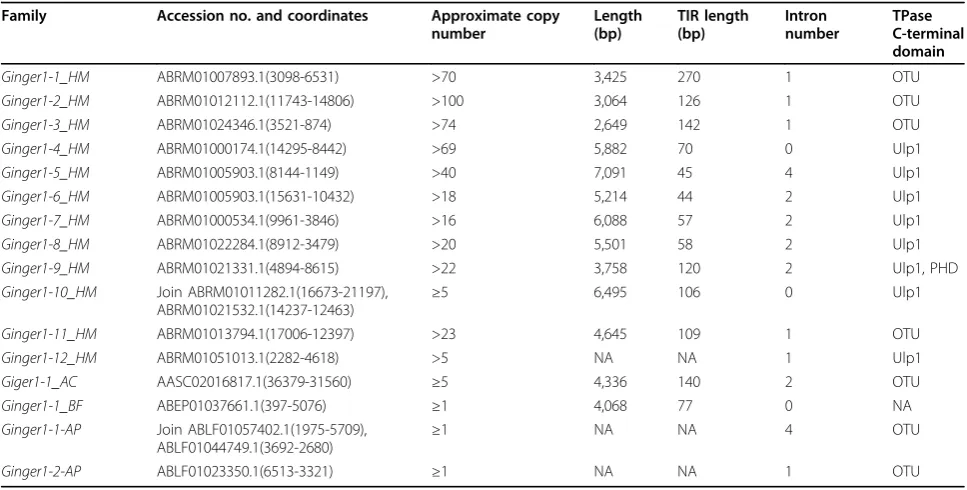
Gypsy-6-I_HM,Gypsy-15-I_NV,Gypsy-1-I_RO, Gypsy-1-I_DD andDGLT-A1_I(Figures 1b and 2). This motif is designated as YPYY for the four conserved amino acids: Y/F-P-Y/F-Y/F (Figure 1b). So far, we have identified dozens of Ginger1 families in four animal species, including hydra (Hydra magnipapillata), gastropod (Aplysia californica), lancelet (Branchiostoma floridae) and aphid (Acyrthosiphon pisum). The hydra genome harbors the most diverse and abundant Ginger1 ele-ments; a total of 12 Ginger1families were identified in this species (Table 1). In theGinger1-2_HM family, the divergence of some elements from the consensus is less than 1%, suggesting that Ginger1-2_HMelements are still active in H. magnipapillatagenome. In the current release ofB. floridae genome sequences, Ginger-1_BFis found as a single autonomous copy (Table 1), but a few non-autonomous copies carrying the same 5’and 3’end sequences are also found. In the genome of A. pisum, only degeneratedGinger1elements are recognizable, but complete elements are identified in the remaining three species. The full length Ginger1 elements vary from approximately 2.6 kb to 7 kb, and their terminal inverted repeats (TIRs) are approximately 40 to 270 base pairs (bp) long (Table 1). The target site duplica-tion (TSD) sequences ofGinger1are 4-bp long and the sequences are highly specific: CCGG (75%) or CCGT/ACGG (24%) (Figure 1a). The 5’ends ofGinger1
elements show the same conserved TGTNR pattern as those ofGypsyLTR retrotransposons.
In addition to the INT domains, extra domains are also found at the C-terminus of allGinger1TPases with the exception of Ginger1-1_BFTPase. These domains include the ovarian tumor (OTU) cysteine protease domain (pfam02338), the C-terminal catalytic domain of Ulp1 protease (pfam02902) and the plant homeodomain (PHD) finger motif (smart00249) from the Conserved Domain Database http://www.ncbi.nlm.nih.gov/sites/ entrez?db=cdd (Table 1, Figure 1a, e, f). Either OTU or Ulp1 is present in a particular Ginger1TPase, but not both. Ginger-1_BFTPase does not contain these extra C-terminal domains, however, it is not clear whether
Ginger-1_BFTPase itself lacks these C-terminal domains or this particular single copy element contains an inter-nal deletion. It is also worth noting that some Ginger1
TPase encoding sequences are interrupted by 1 to 4 introns (Table 1). Except for the first intron of Ginger-5_HM (GC-AG) and the first intron of Ginger-1_AC
Ginger2DNA transposons
To our knowledge, only two families of eukaryotic DNA transposons,TDD-4 andTDD-5, have been reported to code for aGypsy-like integrase. They are present in the protistDictyostelium discoideum, and are characterized by 5-bp TSD [14,15]. Their amino acid identity to Gin-ger1TPases is only approximately 24% in the DDE cata-lytic domain. To find out more members of this potentially new group of Gingerelements, we used the DDE core domain of the TDD-4 TPase as a query in Tblastn or Blastp searches against the available National Center for Biotechnology Information (NCBI) databases http://blast.ncbi.nlm.nih.gov/Blast.cgi. As a result, we identified >6 families of homologous DNA transposons from different metazoan species, including hydra (H. magnipapillata), sea anemone (Nematostella vecten-sis), aphid (A. pisum), nematode (Trichinella spiralis), sea snails (Littorina saxatilis) and lancelet (B. floridae) (Table 2). All these transposons contain approximately 50 to 180 bp long TIRs and produce 4 bp TSDs, instead of the 5 bp TSDs of TDD-4 and TDD-5. However, as shown below, all these elements andTDD-4or TDD-5
belong to the same group (Figure 2), referred to as Gin-ger2. In the fungusMalassezia globosa, we also found a protein named XP_001728957.1 closely related to the
Ginger2TPases. Neither of the two 5-kb regions flank-ing the XP_001728957.1-codflank-ing region encodes the ribonuclease H or reverse transcriptase. Therefore, even if the XP_001728957.1-coding region is not flanked by
TIRs, we classify it as aGinger2-1_MGDNA transposon vestige (Figure 2) rather than an LTR retrotransposon. Like Ginger1and the vast majority of GypsyLTR retro-transposons, the termini of Ginger2 follow the same conserved pattern, TGTNR. However, in contrast with the GC-rich 4-bpGinger1target sequences, Ginger2 ele-ments preferentially target 6-bp AT-rich sequences, RTATAY (Figure 1a).Ginger2TPases contain the H2C2 zinc finger domain and the DDE catalytic domain, but they lack the GPY/F and YPYY motifs present in Gin-ger1 TPases. The lowest pairwise amino acid identity in the DDE catalytic core region of theGinger2elements is approximately 30%, compared with the 36% identity within the same region of the Ginger1 group. This sug-gests that theGinger2 group is more divergent than the
Ginger1group and it is consistent with the observation that Ginger2elements are present in protists, fungi and animals, whereasGinger1elements were identified only in four animal species.
Phylogeny ofGinger1,Ginger2andGypsyintegrases To better understand the relationships betweenGinger1,
Ginger2, and theGypsy lineages, we performed phyloge-netic analyses of a wide collection of integrases from
Gypsy LTR retrotransposons, exogenous/endogenous retroviruses, and Polinton/MaverickDNA transposons.
Copiaand BELintegrases and some integrase-like trans-posases from bacteria and protozoan Trichomonas vagi-nalis were included as outgroups. These bacterial transposases are from the IS3and IS481elements, the
Table 1Ginger1DNA transposons.
Family Accession no. and coordinates Approximate copy number
Length (bp)
TIR length (bp)
Intron number
TPase C-terminal domain
Ginger1-1_HM ABRM01007893.1(3098-6531) >70 3,425 270 1 OTU
Ginger1-2_HM ABRM01012112.1(11743-14806) >100 3,064 126 1 OTU
Ginger1-3_HM ABRM01024346.1(3521-874) >74 2,649 142 1 OTU
Ginger1-4_HM ABRM01000174.1(14295-8442) >69 5,882 70 0 Ulp1
Ginger1-5_HM ABRM01005903.1(8144-1149) >40 7,091 45 4 Ulp1
Ginger1-6_HM ABRM01005903.1(15631-10432) >18 5,214 44 2 Ulp1
Ginger1-7_HM ABRM01000534.1(9961-3846) >16 6,088 57 2 Ulp1
Ginger1-8_HM ABRM01022284.1(8912-3479) >20 5,501 58 2 Ulp1
Ginger1-9_HM ABRM01021331.1(4894-8615) >22 3,758 120 2 Ulp1, PHD
Ginger1-10_HM Join ABRM01011282.1(16673-21197), ABRM01021532.1(14237-12463) ≥
5 6,495 106 0 Ulp1
Ginger1-11_HM ABRM01013794.1(17006-12397) >23 4,645 109 1 OTU
Ginger1-12_HM ABRM01051013.1(2282-4618) >5 NA NA 1 Ulp1
Giger1-1_AC AASC02016817.1(36379-31560) ≥5 4,336 140 2 OTU
Ginger1-1_BF ABEP01037661.1(397-5076) ≥1 4,068 77 0 NA
Ginger1-1-AP Join ABLF01057402.1(1975-5709),
ABLF01044749.1(3692-2680) ≥
1 NA NA 4 OTU
Ginger1-2-AP ABLF01023350.1(6513-3321) ≥1 NA NA 1 OTU
Figure 1Ginger1(for‘GypsyINteGrasE Related 1’) elements and transposases. (a) Schematic features of theGinger1DNA transposons. Target site duplications (TSDs) and target sequences preferences of theGinger1andGinger2groups are compared, which is based on the data of 112Ginger1elements fromHydra magnipapillataand 64Ginger2elements fromNematostella vectensis. (b-d) Alignment ofGinger1andGypsy
Table 2Ginger2DNA transposons.
Family Accession no. and coordinates Approximate copy number Length (bp) TIR length (bp)
TDD-4 AAFI02000006.1(356458-352615) >10 3,839 260
TDD-5 AF298206 ≥1 3,783 297
Ginger2-1_AP ABLF01002904.1(12456-9572) >2 2,885 166
Ginger2-1_TS ABIR01000229.1(194562-191746) >9 2,815 112
Ginger2-1_HM ABRM01019362.1(8091-14753) >6 6,676 45
Ginger2-1_BF ABEP02002130.1(2458-8567) ≥1 6,110 161
Ginger2-1_NV ABAV01011352.1(106952-104193) >13 2,751 52
Ginger2-1N1_NV ABAV01001774.1(757-1008) >50 252 52
Ginger2-2_NV ABAV01024827.1(8200-5455) >13 2,842 93
Ginger2-1_LS CT027673 (88612-94692) NA 6,081 180
Ginger2-1_MG AAYY01000016.1(145366-147069) NA NA NA
them. TPase from eukaryoticMariner/Tc1 andPogo ele-ments and bacterial IS630elements are not included for analysis because they are phylogenetically closer to each other [8], and are more distantly related to the inte-grases encoded by LTR retrotransposons and Ginger
than those encoded by IS3and IS481elements (data not shown). Although our phylogenetic tree is based on the limited sequence information from the zinc finger domain and the DDE core domain (see Additional file 1), most Gypsy integrases are clustered together away from other older groups, such as IS3/IS481,Copia,
BEL and retrovirus [1], with the exception of two lineages ofGypsy-like integrase from fungal species, clus-tering with Polinton group and retrovirus groups, respectively (Figure 2). Except for the Woot element being separated from theOsvaldoclade, the clades and the polytomy distribution of all knownGypsylineages are consistent with the other studies based on the analy-sis of multiple domains [20,21]. In addition to the known lineages, some extraGypsyclades also appear in our phylogeny, probably due to a larger data set; some of them might represent new lineages of theGypsy LTR retrotransposons. Remarkably, theGinger1andGinger2
groups are distinctly separated (Figure 2):Ginger2 inte-grases tend to group with the inteinte-grases of Polinton/ MaverickDNA transposons, while Ginger1are closely grouped with Athila/Tat lineage of Gypsy LTR retro-transposons. Although the YPYY motif is not included in the sequence information used to build the tree, the majority of YPYY motif-containing Gypsyintegrases apparently cluster together with theGinger1TPases that also contain the YPYY motif (Figure 2), indicating the YPYY motif is genetically significant. However, no
Gypsy lineages are found coclustering withGinger1or
Ginger2 TPases with significant bootstrap values. A similar pattern is also observed in the tree constructed using the different neighbor-joining method (see Addi-tional file 2).
Host genes derived fromGinger1TPases
Gypsy integrase-1 gene (Gin-1), encoding a Gypsy inte-grase-like protein, was thought to have evolved from a
Gypsy LTR retrotransposon related to the 412/Mdg1
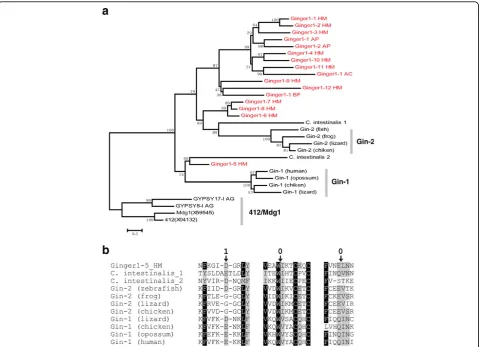
lineage [22]. However, Gin-1 genes and a number of other homologous genes actually evolved from the Gin-ger1elements. The most parsimonious scenario is that two independent exaptations ofGinger1took place dur-ing the evolution of vertebrates, which gave rise to two sets of orthologous genes designated here asGin-1and
Gin-2 (Figure 3). The first exaptation event gave rise to
Gin-2 genes and probably happened in the common ancestor of vertebrates, while the second gave rise to
Gin-1 genes and happened more recently in the com-mon ancestor of reptiles and mammals. For example,
(FG759656.1), chicken Gallus gallus (XP_424858.2), opossumMonodelphis domestica (XP_001380076.1) and human (NP_060146.2); Gin-2genes were found in fish
Danio rerio (CAM46974.1), frog Xenopus tropicalis
(AAI69154.1), lizard Anolis carolinensis(FG723791.1) and chicken Gallus gallus(XP_415124.1). Gin-2 genes are not found in any currently sequenced mammalian genomes and it is likely thatGin-2gene was lost in the early stage of mammal evolution. Consistent with this scenario, Gin-1 and Gin-2 encoded proteins form two clusters in the phylogenetic tree, and both cocluster within theGinger1families rather than any otherGypsy
lineages (Figure 3a, Additional file 3).
Of the six to eight introns in each of the host genes, only three are universally conserved: they are found at the same positions and have the same intron phases (Figure 3b). Strikingly, all the three conserved introns are found in
Ginger1-5_HMTPase gene (Figure 3b), which has four introns in total. In addition, the first conserved intron is also present in theGinger1-6,7,8_HMTPase genes (data not shown). The data strongly indicate thatGin-1 and
Gin-2genes are derived from aGinger1-5_HM-like ele-ment. In invertebrate tunicate Ciona intestinalis, two genes (XM_002130131.1 and FF869668.1) may also be host genes derived fromGinger1-5_HM-like elements. They also contain the three conserved introns (Figure 3b), and their upstream and downstream genes are only within the range of approximately 0.5 kb to 2.5 kb, within which no flanking TIRs are found.
Discussion
In the present work, we report a new eukaryotic super-family of DNA transposons, named Ginger, encoding transposases homologous to the integrases of Gypsy
LTR retrotransposon. To date, we have identified two distinct Gingergroups,Ginger1andGinger2/Tdd. These groups could also be viewed as different superfamilies based on their plausible independent origin. However, further classification is left open here, due to uncertain-ties inherent in the current phylogenetic data. Pre-viously,DIRSand Ngaroretrotransposons andCrypton
DNA transposons were also found to encode the same class of proteins (tyrosine recombinase). However, their evolutionary relationship is not well understood yet due to the scarcity of data [4,23]. Therefore, the relationship between theGypsyLTR retrotransposons and theGinger
DNA transposons is of particular interest from the evo-lutionary perspective.
and CA-5’termini, and by 3 to 5-bp TSDs, analogous to LTR retrotransposons [9,11]. It has also been proposed that in an early eukaryotic species a first LTR retrotran-sposon evolved from a non-LTR retrotranretrotran-sposon, which recruited a transposase from a DNA transposon [1,10,12,13]. Given the significant similarity between the integrases encoded byGinger1,Ginger2and various LTR retrotransposons, either theGinger1orGinger2groups of transposons, or both, can be viewed as descendants of the ancestral eukaryotic DNA transposons which provided a TPase transformed into the integrase of the first LTR ret-rotransposon in early eukaryotes. However, as suggested by the modular evolution model of transposable elements [13], the evolutionary scenarios ofGingerand LTR inte-grases may be multifold.
IfGypsywas first derived through the fusion of reverse transcriptase with a DNA transposase [1,10,12,13], one
possible scenario is a‘reverse evolution’in whichGinger1
elements originated from aGypsyLTR retrotransposon. This scenario is based on the remarkable similarity betweenGinger1TPase andGypsyINT, plus the fact that
Ginger1andGinger2/Tddare two distinct groups on the phylogenetic tree (Figure 2). Ginger1TPases not only share up to 40% amino acid sequence identity in the DDE region with someGypsyintegrases, but also contain a GPY/F domain, which has been found only inGypsy
and retroviral integrases so far [18]. Moreover,Ginger1
TPases and a subset ofGypsyintegrases contain the same YPYY motif (Figures 1b and 2). The figure of 40% amino acid sequence identity is comparable to the upper simi-larity level between integrases from different Gypsy
lineages (data not shown). In this scenario, theGinger2
elements may resemble the ancestor element that was recruited into the first LTR retrotransposon.
Figure 3Host genes evolved fromGinger1(for‘GypsyINteGrasE Related 1’) DNA transposon.(a)The phylogenetic relationship between
and BELLTR retrotransposons arose independently in early eukaryotes by recruiting three different transpo-sases from the sameGinger-like superfamily. According to this scenario, Ginger1transposase/transposons may be the ‘best preserved’ descendants/relatives of the eukaryotic transposon that‘gave birth’to the firstGypsy. Another variant of this scenario is that all LTR retro-transposon-encoded integrases arose from the common ancestor ofGinger1 and Ginger2TPases. Thus, among numerous hypothetical lineages of this ancestor DNA transposon, Ginger1 and Ginger2 may be the only lineages that survived from the times of early eukaryotic evolution, which took place over 1.6 billion years ago. According to this scenario, the ancient eukaryotic trans-posase that transformed into the integrase of the first LTR retrotransposon was likely composed of the H2C2 zinc finger, GPY/F motifs and YPYY motifs. During their evolution, the Ginger2, Copia and BEL lineages might have lost the last two motifs.
Of the variousGypsy lineages shown in Figure 2, no lineage clusters with Ginger1 groups with significant bootstrap support. This does not preclude the possibility that Ginger1 groups arose from particular Gypsy
lineages. It merely reflects the polytomy of GypsyLTR retrotransposons [1]. The true ancestral lineages leading toGinger1 may simply not be present in the available dataset, or they might have been lost in the evolutionary history, for example, due to the recombination process that produces the solo LTRs [24]. The chain of events that could lead to the hypothetical transformation of an LTR retrotransposon to a DNA transposon is also unclear. One simple possibility is that the TIRs of Gin-ger1transposons were derived from two LTRs inciden-tally flanking the integrase region in opposite orientations: one would be the original 3’ LTR of an LTR retrotransposon and the other coming from another LTR retrotransposon inserted upstream. The enzymatic mechanism underlying the excision of Gin-ger1 elements is also unknown (the same applies to
Polinton/Mavericktransposons). In the life cycle of LTR retrotransposons, integrases normally are responsible only for the integration process. However,in vivodata have shown that retrovirus integrases can reverse the initial strand-transfer reaction at the end of retroviral DNA [25]. Therefore, at least theoretically, Ginger1
DNA can be excised, but the excision process may not be as efficient as the excision of typical‘cut and paste’ DNA transposons, sinceGinger1are small families and the copy numbers of individual elements per host are relatively low.
Despite the phylogenetic proximity ofGinger2 and
Polinton/Mavericktransposons in the phylogenetic tree
ton/Maverickintegrases, becausePolinton/Maverick inte-grases lack the signature N-terminal C2H2 zinc finger. It cannot be resolved whetherPolinton/Maverickintegrases arose fromGinger2or an LTR retrotransposon, because it is unclear whether the two fungalGypsy-like lineages, clustering withPolinton/Maverickgroups and retrovirus groups, respectively (Figure 2), represent some oldGypsy
lineages or are just misplaced in the tree.
The Ulp1 protease C-terminal domain and OTU domain ofGinger1 transposases are also found in other transposable elements (Figure 1e, f). For example, Ulp1 domain is encoded in MutatorDNA transposons found in hydra [26], lancelet [27],Arabidopsis thaliana [28,29], maize [30], rice andCucumis melo [31]; OTU domains are found in the proteins encoded by some Helitron
DNA transposons in animals (Figure 1e) [32]. It has been suggested that Ulp1 proteases are functionally involved in the transposition process [29]. Interestingly, both the OTU and Ulp1 domains belong to the same C-protease family, and have similar functions in hydro-lysis of ubiquitin or the small ubiquitin-like modifier (SUMO) protein [33,34]. Moreover, ubiquitinyl hydro-lases are also found associated with other DNA transpo-sases, such as protein XP_001314237.1 in protist
T. vaginalis [35], which consist of transposase_11 domain (pfam01609) and Peptidase C19 (cd02657) domain. The latter domain participates in removing ubi-quitin molecules from polyubiquinated peptides. These data imply that the ubiquitin pathway may be exten-sively involved in transposition. One attractive possibility is that both Ulp1 and OTU domains play an active role in the transposition processes. For example, they may activate the downstream factors in the DNA repair sys-tem after or during transposition, thereby minimizing the damage in the host genome. Indeed, all the major DNA repair pathways, damage avoidance mechanisms and checking responses are regulated somehow by ubi-quitinylation, SUMOylation, or both [36].
Conclusions
Ginger is a new superfamily of cut and paste DNA transposons coding for the transposase homologous to the integrase encoded byGypsy LTR retrotransposons. The Ginger superfamily contains two distinct groups,
transforming a LTR retrotransposon to a cut and paste DNA transposon.
Methods Data sources
Genomic sequences and mRNA sequences of various spe-cies were mainly taken from NCBI GenBank.X. tropicalis
genome sequences (release 4.1 assembled scaffolds) were downloaded from Department of Energy (DOE) Joint Genome Institute (JGI) http://www.jgi.doe.gov/. For the phylogenetic analyses, integrase sequences were widely selected from theGypsyDatabase (GyDB) http://gydb.uv. es/index.php/Main_Page[20], Repbase Update database http://www.girinst.org/repbase/index.html[37] and Gen-Bank. Other transposable elements without specification of source in this paper are from the Repbase. Additionally, the sequences of TEs reported in this work have been deposited in Repbase with the same family names listed in Table 1 and Table 2.
Sequence analysis
The consensus sequence of each Ginger1 or Ginger2
family, if possible, was rebuilt for analyses. The protein coding region of individual DNA transposons or host genes was either deduced from corresponding mRNA sequences, or manually predicted based on the sequence similarities between homologous proteins; exons and introns were determined accordingly. Multiple protein sequence alignments were carried out using MUSCLE [38] and were adjusted manually. Sequence alignments were edited and illustrated with BioEdit [39]. Logo representation of the TSD sequences was created by the WebLogo [40]. The phylogenetic tree was constructed using neighbor-joining (NJ) method and minimum evo-lution (ME) method (Poisson correction model, pairwise deletion, 1,000 bootstrap replicates) implemented in the MEGA4 software [41]. The gamma parameter for the phylogenetic tree was estimated using PhyMl [42].
Additional file 1: Integrase alignments. Integrase sequences alignment in the zinc finger domain and the DDE domain.
Click here for file
[ http://www.biomedcentral.com/content/supplementary/1759-8753-1-3-S1.FAS ]
Additional file 2: Neighbor-joining phylogenetic tree. Neighbor-joining phylogenetic tree is constructed using Poisson correction model, pairwise deletion, gamma parameter = 2, 1,000 bootstrap replicates. Click here for file
[ http://www.biomedcentral.com/content/supplementary/1759-8753-1-3-S2.PDF ]
Additional file 3: Protein sequence alignments. Sequence alignments between host proteins,Ginger1Tpases andGypsyintegrases.
Click here for file
[ http://www.biomedcentral.com/content/supplementary/1759-8753-1-3-S3.FAS ]
Acknowledgements
This work was supported by the National Institutes of Health grant 5 P41 LM006252. We thank Matthew Jurka for help with editing the manuscript.
Authors’contributions
WB and JJ designed the initial research. WB prepared and processed the data. VVK contributed information onGinger2elements and suggested involvement of the ubiquitinylation and SUMOylation pathways in transposition. WB and JJ performed research and drafted the manuscript. All authors edited and approved the manuscript.
Competing interests
The authors declare that they have no competing interests.
Received: 30 June 2009
Accepted: 25 January 2010 Published: 25 January 2010
References
1. Eickbush T, Malik H:Origins and evolution of retrotransposons.Mobile DNA IIWashington, DC, USA: American Society for Microbiology PressCraig NL, Craigie R, Gellert M, Lambowitz AM 2002, 1111-1144.
2. Wicker T, Sabot F, Hua-Van A, Bennetzen JL, Capy P, Chalhoub B, Flavell A, Leroy P, Morgante M, Panaud O, Paux E, SanMiguel P, Schulman AH:A unified classification system for eukaryotic transposable elements.Nat Rev Genet2007,8:973-982.
3. Kapitonov VV, Jurka J:A universal classification of eukaryotic transposable elements implemented in Repbase.Nat Rev Genet2008,9:411-412. 4. Goodwin TJ, Butler MI, Poulter RT:Cryptons: a group of
tyrosine-recombinase-encoding DNA transposons from pathogenic fungi. Microbiology2003,149:3099-3109.
5. Jurka J, Kapitonov VV:First cryptons from invertebrates.Repbase Rep2008,
8:232-233.
6. Jurka J:First cryptons from insects.Repbase Rep2009,9:480-480. 7. Jurka J:First cryptons from insects.Repbase Rep2009,9:673-673. 8. Bao W, Jurka MG, Kapitonov VV, Jurka J:New superfamilies of eukaryotic
DNA transposons and their internal divisions.Mol Biol Evol2009,
26:983-993.
9. Fayet O, Ramond P, Polard P, Prere MF, Chandler M:Functional similarities between retroviruses and the IS3 family of bacterial insertion sequences?.Mol Microbiol1990,4:1771-1777.
10. Capy P, Vitalis R, Langin T, Higuet D, Bazin C:Relationships between transposable elements based upon the integrase-transposase domains: is there a common ancestor?.J Mol Evol1996,42:359-368.
11. Chandler M, Mahillon J:Insertion sequences revisited.Mobile DNA II
Washington, DC, USA: American Society for Microbiology PressCraig NL, Craigie R, Gellert M, Lambowitz AM 2002, 305-366.
12. Capy P, Langin T, Higuet D, Maurer P, Bazin C:Do the integrases of LTR-retrotransposons and class II element transposases have a common ancestor?.Genetica1997,100:63-72.
13. Capy P, Maisonhaute C:Acquisition/loss of modules: the construction set of transposable elements.Russian J Genet2002,38:594-601.
14. Wells DJ:Tdd-4, a DNA transposon ofDictyosteliumthat encodes proteins similar to LTR retroelement integrases.Nucleic Acids Res1999,
27:2408-2415.
15. Glockner G, Szafranski K, Winckler T, Dingermann T, Quail MA, Cox E, Eichinger L, Noegel AA, Rosenthal A:The complex repeats of
Dictyostelium discoideum.Genome Res2001,11:585-594.
16. Kapitonov VV, Jurka J:Self-synthesizing DNA transposons in eukaryotes. Proc Natl Acad Sci USA2006,103:4540-4545.
17. Ebina H, Chatterjee AG, Judson RL, Levin HL:The GP(Y/F) domain of TF1 integrase multimerizes when present in a fragment, and substitutions in this domain reduce enzymatic activity of the full-length protein.J Biol Chem2008,283:15965-15974.
18. Malik HS, Eickbush TH:Modular evolution of the integrase domain in the Ty3/Gypsy class of LTR retrotransposons.J Virol1999,73:5186-5190. 19. Burset M, Seledtsov IA, Solovyev VV:Analysis of canonical and non-canonical splice sites in mammalian genomes.Nucleic Acids Res2000,
28:4364-4375.
Ty3/Gypsy and retroviridae LTR retroelements and the three kings hypothesis.BMC Evol Biol2008,8:276.
22. Llorens C, Marin I:A mammalian gene evolved from the integrase domain of an LTR retrotransposon.Mol Biol Evol2001,18:1597-1600. 23. Poulter RT, Goodwin TJ:DIRS-1 and the other tyrosine recombinase
retrotransposons.Cytogenet Genome Res2005,110:575-588.
24. Vitte C, Panaud O:Formation of solo-LTRs through unequal homologous recombination counterbalances amplifications of LTR retrotransposons in riceOryza sativaL.Mol Biol Evol2003,20:528-540.
25. Chow SA, Vincent KA, Ellison V, Brown PO:Reversal of integration and DNA splicing mediated by integrase of human immunodeficiency virus. Science1992,255:723-726.
26. Bao W, Jurka J:MuDr-type DNA transposons fromHydra magnipapillata. Repbase Rep2008,8:2075-2075.
27. Bao W, Jurka J:MuDr-type DNA transposons fromBranchiostoma floridae. Repbase Rep2009,9:683-683.
28. Kapitonov VV, Jurka J:VANDAL20, a family of monstrous MuDR-like DNA transposons.Repbase Rep2001,1:31-31.
29. Hoen DR, Park KC, Elrouby N, Yu Z, Mohabir N, Cowan RK, Bureau TE:
Transposon-mediated expansion and diversification of a family of ULP-like genes.Mol Biol Evol2006,23:1254-1268.
30. Bao W, Jurka J:MuDR-type DNA transposon from maize.Repbase Rep
2008,8:739-739.
31. van Leeuwen H, Monfort A, Puigdomenech P:Mutator-like elements identified in melon, Arabidopsis and rice contain ULP1 protease domains.Mol Genet Genomics2007,277:357-364.
32. Kapitonov VV, Jurka J:Helitron-1_SP, a family of autonomous Helitrons in the sea urchin genome.Repbase Rep2005,5:393-393.
33. Mossessova E, Lima CD:Ulp1-SUMO crystal structure and genetic analysis reveal conserved interactions and a regulatory element essential for cell growth in yeast.Mol Cell2000,5:865-876.
34. Messick TE, Russell NS, Iwata AJ, Sarachan KL, Shiekhattar R, Shanks JR, Reyes-Turcu FE, Wilkinson KD, Marmorstein R:Structural basis for ubiquitin recognition by the Otu1 ovarian tumor domain protein.J Biol Chem
2008,283:11038-11049.
35. Gladyshev EA, Arkhipova IR:A single-copy IS5-like transposon in the genome of a bdelloid rotifer.Mol Biol Evol2009,26:1921-1929. 36. Bergink S, Jentsch S:Principles of ubiquitin and SUMO modifications in
DNA repair.Nature2009,458:461-467.
37. Jurka J, Kapitonov VV, Pavlicek A, Klonowski P, Kohany O, Walichiewicz J:
Repbase update, a database of eukaryotic repetitive elements.Cytogenet Genome Res2005,110:462-467.
38. Edgar RC:MUSCLE: multiple sequence alignment with high accuracy and high throughput.Nucleic Acids Res2004,32:1792-1797.
39. Hall TA:BioEdit: a user-friendly biological sequence alignment editor and analysis program for Windows 95/98/NT.Nucl Acids Symp Ser1999,
41:95-98.
40. Crooks GE, Hon G, Chandonia JM, Brenner SE:WebLogo: a sequence logo generator.Genome Res2004,14:1188-1190.
41. Tamura K, Dudley J, Nei M, Kumar S:MEGA4: Molecular Evolutionary Genetics Analysis (MEGA) software version 4.0.Mol Biol Evol2007,
24:1596-1599.
42. Guindon S, Gascuel O:A simple, fast, and accurate algorithm to estimate large phylogenies by maximum likelihood.Syst Biol2003,52:696-704. 43. Bae YA, Moon SY, Kong Y, Cho SY, Rhyu MG:CsRn1, a novel active
retrotransposon in a parasitic trematode,Clonorchis sinensis, discloses a new phylogenetic clade of Ty3/gypsy-like LTR retrotransposons.Mol Biol Evol2001,18:1474-1483.
44. Gladyshev EA, Meselson M, Arkhipova IR:A deep-branching clade of retrovirus-like retrotransposons in bdelloid rotifers.Gene2007,
390:136-145.
45. Peddigari S, Zhang W, Takechi K, Takano H, Takio S:Two different clades of copia-like retrotransposons in the red alga,Porphyra yezoensis.Gene
2008,424:153-158.
doi:10.1186/1759-8753-1-3
Cite this article as:Baoet al.:GingerDNA transposons in eukaryotes and their evolutionary relationships with long terminal repeat retrotransposons.Mobile DNA20101:3.
Submit your next manuscript to BioMed Central and take full advantage of:
• Convenient online submission
• Thorough peer review
• No space constraints or color figure charges
• Immediate publication on acceptance
• Inclusion in PubMed, CAS, Scopus and Google Scholar
• Research which is freely available for redistribution