Named Entity WordNet
Antonio Toral
∗Rafael Mu ˜noz
†Monica Monachini
∗∗Istituto di Linguistica Computazionale, Consiglio Nazionale delle Ricerche, Pisa, Italy
{antonio.toral, monica.monachini}@ilc.cnr.it
†Natural Language Processing and Information Systems Group, University of Alicante, Spain
Abstract
This paper presents the automatic extension of Princeton WordNet with Named Entities (NEs). This new resource is called Named Entity WordNet. Our method maps the noun is-a hierarchy of WordNet to Wikipedia categories, identifies the NEs present in the latter and extracts different information from them such as written variants, definitions, etc. This information is inserted into a NE repository. A module that converts from this generic repository to the WordNet specific format has been developed. The paper explores different aspects of our methodology such as the treatment of polysemous terms, the identification of hyponyms within the Wikipedia categorization system, the identification of Wikipedia articles which are NEs and the design of a NE repository compliant with the LMF ISO standard. So far, this procedure enriches WordNet with 310,742 NEs and 381,043 “instance of” relations.
1.
Introduction
Named Entity Recognition is a subtask of Information Ex-traction that seeks to locate and classify elements in text into a set of categories. Usually, Named Entities (NEs) re-fer to proper names (a.k.a. proper nouns) and numerical expressions (e.g. dates, quantities). Different NE sets of categories have been proposed, from the 4 category set (per-son, location, organisation, miscellaneous) of ConLL-2002 to the hierarchical proposal by Sekine with more than 100 subtypes (Sekine et al., 2002). Knowledge about NEs is important in order to tackle several Natural Language Pro-cessing (NLP) tasks. Examples include Question Answer-ing (Mann, 2002) and Dialogue (Levy et al., 1997). Even if mature resources of geographical NEs (gazetteers) do exist (e.g. geonames1), there is a lack of more general resources. WordNet is one of the most widely used Lexical Resource (LR) within the NLP area. It is manually built by expert lex-icographers and contains nouns, adjectives, verbs and ad-verbs organised in sets of synonyms called synsets (Miller, 1995). Several relations can be established between synsets (e.g. hyponymy, meronymy). Regarding nouns, WordNet distinguishes between common nouns (classes) and proper nouns (instances) from version 2.1. (Miller and Hristea, 2006). On the one hand, WordNet’s coverage about open domain common nouns is quite high, but on the other it contains very few proper nouns2. This is related with the
following statement: “building a proper noun ontology is more difficult than building a common noun ontology as the set of proper nouns grows more rapidly” (Mann, 2002). The problem is then that a proper noun resource should be constantly updated. Therefore it is unfeasible to manually populate LRs with proper nouns. In this paper, the terms proper nouns, instances and NEs are considered synony-mous and the same states for common nouns and classes. Wikipedia is an on-line multilingual encyclopedia that fol-lows the wiki philosophy. It is built in a collaborative way by a vast number of users3and contains a huge amount of
1www.geonames.org 2
7,669 synsets are tagged as being instances in WordNet 2.1.
3
On 2007/10/29 the English version has 5,682,580 registered
entries4. Apart from the encyclopedic entries, Wikipedia includes interesting additional information for linguistic processing such as a category taxonomy and multilingual links.
This paper presents Named Entity WordNet (NEWN), a new resource that extends WordNet with NEs automatically extracted from the English Wikipedia. Our hypothesis is that exploiting Wikipedia is a sensible choice to automat-ically populate LRs with proper nouns. The main reasons are that Wikipedia is a dynamic source, contains a huge amount of proper nouns and has some degree of structure that facilitates their extraction.
The rest of the paper is organised as follows. Next section summarises related work. This is followed by the descrip-tion of our method to extend WordNet with NEs. After-wards, we present the conclusions about the approach fol-lowed and outline future work lines.
2.
Related Work
There exist in the recent literature several publications re-garding the creation of specific LRs for proper nouns (ono-mastica) and the enrichment of generic LRs with proper nouns.
(Sheremetyeva et al., 1998) presents the structure of a mul-tilingual onomasticon made up of a set of monolingual ono-mastica cross–referenced by translation links. The entries are organised in a hierarchy made up of 45 semantic cate-gories. A semiautomatic population procedure is proposed, which is supported by an acquisition and administration in-terface.
Prolexbase, a multilingual database of proper names, was created within the Prolex project (Tran et al., 2004) (Krstev et al., 2005). It is based on an ontology which has four lay-ers (instances, linguistic, conceptual and meta-conceptual) and several relations (synonymy, meronymy, antonomasia, etc). Entries are linked to EuroWordNet’s Inter-Lingual In-dex. The population of Prolex seems to be done
manu-users.
4On 2007/10/29 the English version contains 2,066,619
character used in printing). The first sense has one instance (“Washington Monument”) while the second has none. In the category “Obelisks” we find the instance “Washington Monument”. Thus, the sense chosen for the mapping would be the first one.
As the taxonomy of Wikipedia is usually deeper than that of WordNet, we consider not only looking for instances in the mapped categories but also in their hyponyms (subcat-egories). However, the subcategory relation in the cate-gories taxonomy of Wikipedia does not always follow the hyponymy relation7. Therefore, in order to exploit
subcate-gories, we need to check whether they are hyponyms or not. We propose to apply regular expression patterns which can hold both lexical and Part-of-Speech elements. If a sub-category matches a pattern then it is considered as a hy-ponym. From studying the category structure of Wikipedia, we come up with the following patterns (for each pattern we provide an example of matching subcategory for the cate-gory “Philosophers”):
• ˆ category " by "
e.g. “philosophers by nationality”
• ˆ category " of "
e.g. “philosophers of mind”
• ˆ category " stubs" $
e.g. “philosophers stubs”
• ˆ (JJ|JJR|NN|NP)+ \ (CC(JJ|JJR|NN|NP)+)* \ " " category $
e.g. “Spanish philosophers”
As an example, we show how the word philosopher (1. spe-cialist in philosophy, 2. wise person who is calm and ratio-nal) is disambiguated with respect to the category “Philoso-phers”. The first sense contains several instances like “Averroes” while the second contains none. “Averroes” is not present in the mapped category but it is in a subcate-gory that follows the hyponymy relation (“philosophers by nationality”->“Spanish philosophers”).
From a set of 262 polysemous words from WordNet which are lexically mapped to Wikipedia categories, this algo-rithm disambiguates 102 (39%). This low recall, which is due to the low number of instances present in WordNet, is compensated by a very high precision. In fact, all the dis-ambiguated entries were correct. We analysed the reasons why 160 words (61%) where not disambiguated. There are two main cases:
• One of the senses from WordNet corresponds to the category but no common instance is found. This hap-pens for 78% of the 160 words. For 74% of the words there is simply no common instance in both resources. For the remaining 4% a common instance does exist but it is in a subcategory that although being a hy-ponym of the mapped category, the algorithm is not
7E.g. In the category “Philosophers” there are subcategories
that follow the hyponymy relation (e.g. “Philosophers by coun-try”) but there are also others that do not (e.g. “Philosophy aca-demics”).
able to identify as such. E.g. “Colosseum, Amphithe-atrum Flavium” is an instance of the second sense of “amphitheater”, which is mapped to the category “Amphitheaters”. “Colosseum” is present in the cate-gory “Roman amphitheatre buildings” which is a sub-category of “Amphitheaters”. However, the aforemen-tioned patterns do not identify “Roman amphitheatre buildings” as a hyponym of “amphitheater”.
• No sense from WordNet corresponds to the category or the category has been changed. This occurs for the remaining 22% of the 160 words. An example of no sense corresponding to the mapped category hap-pens for the word “assemblage” which has four senses: “a group of persons together in one place”, “a sys-tem of components assembled together for a particular purpose”, “the social act of assembling” and “several things grouped together or considered as a whole”. The mapped category, “Assemblage”, is “for assem-blage artists”. As an example of a category change, the word “college” is mapped to the category “Colleges” but it has been moved to “Universities and colleges”. Obviously we cannot map “college” to “College and Universities” as by doing so we would end up with instances of universities under the class college.
3.3. Instance–class classification
Another modification to our initial approach concerns the instance–class classification. The aim is to increase re-call (68.97%) without causing negative effects in precision (93.02%). We propose to take advantage of capitalisation norms as in the initial method but instead of looking for en-try occurrences in the Web, we look for them in the body article of the entry, as in (Bunescu and Pasca, 2006). How-ever, we do not only look for the entry in the article of the English Wikipedia, but in the article of several Wikipedias for other nine languages that follow these capitalisation norms (Catalan, Dutch, French, Italian, Norwegian, Por-tuguese, Romanian, Spanish and Swedish). This way the text size in which we look for occurrences of the entry is bigger and hence the results more representative. In order to obtain the entry title for each of these languages we use the multilingual links of Wikipedia that connect the same entry in different languages. This approach presents two advantages:
• Language independence. Whatever the language we are applying these procedures to, we can obtain the Wikipedia entry titles for languages which follow the aforementioned capitalisation norms.
and “machine” are classes. With the new method we look for “Children’s Machine” in the body of its ar-ticle and so it is really unexpected to find this string referring to the book.
We have evaluated this new approach both by looking for entry occurrences only in the English Wikipedia and in the English Wikipedia plus the other nine aforementioned Wikipedias. Tables 2 and 3 present the results obtained re-spectively for each of the scenarios over a test set of 100 entries.
Table 2: Instance–class classification results using only the English Wikipedia
Threshold Precision Recall Fβ=1 Fβ=0.5
0.81 73.24 89.66 80.62 78.00 0.83 72.86 87.93 79.69 77.27 0.85 72.86 87.93 79.69 77.27 0.87 73.91 87.93 80.32 78.06 0.89 73.91 87.93 80.32 78.06 0.91 73.91 87.93 80.32 78.06 0.93 73.91 87.93 80.32 78.06 0.95 73.91 87.93 80.32 78.06
Table 3: Instance–class classification results using Wikipedia for ten languages
Threshold Precision Recall Fβ=1 Fβ=0.5
0.81 77.62 89.66 83.2 81.26
0.83 77.62 89.66 83.2 81.26
0.85 78.79 89.66 83.88 82.11 0.87 78.79 89.66 83.88 82.11 0.89 79.69 87.93 83.61 82.26 0.91 79.69 87.93 83.61 82.26 0.93 79.37 86.21 82.64 81.53 0.95 79.37 86.21 82.64 81.53
The best F-measureβ=0.5 is obtained for the thresholds
0.87 to 0.95 when using only the English Wikipedia (78.06%) and for the thresholds 0.89 to 0.91 when using ten Wikipedias (82.26%). Therefore the best threshold value could be set to 0.91, which is exactly the same value for our previous approach. For this threshold, using more text allow us to obtain better precision (79.69% vs. 73.91%) and the same recall (87.93%), which supports our hypoth-esis of using different Wikipedias to increase the text size. Compared to our previous approach (web search) the cur-rent approach obtains 21.56% higher recall (87.93% vs. 68.97%) but 14.33% lower precision (79.69% vs. 93.02%). By analysing the results, we have found a drawback of the current approach compared to web search. The number of occurrences found per article is quite low: 6.03 when using only the English Wikipedia and 9.77 when using also the others. These values contrast with those obtained for the web search. In fact, for that experiment we set the num-ber of occurrences per article to 100 and found such a high number for all the 100 articles of the test set.
We conclude then that the advantages of both approaches could be combined by extracting significant terms from the entry body text in Wikipedia (e.g. by applying the tf-idf measure) and search in the Web pages in which the entry title and these terms appear. Following with the example of the entry “Children’s Machine”, from the ten first re-sults from Google six correspond to the computer and the remaining four to Papert’s book. However, if we extract significant terms from the body text of the Wikipedia en-try such as “OLPC” and “$100 laptop”, and we search in Google the three terms, then all the first 10 results corre-spond to the computer.
3.4. Increase of the number of extracted NEs
Regarding the number of NEs added to WordNet, it can be easily boosted just by extracting not only the NE entries that belong to the mapped categories but also the NE entries that belong to the subcategories that fulfil the hyponymy relation (see subsection 3.2.).
We have extracted NEs from Wikipedia for the 541 mapped synsets (see table 1) both considering hyponym subcate-gories and not considering them. Table 4 provides quanti-tative data about the NEs extracted. For each case, we show not only the number of NEs which is added to WordNet but also the amount of orthographic variants (written forms) of these NEs and the number of instance relations that Word-Net is enriched with. By considering subcategories we are able to enrich WordNet with more than 300,000 NEs and more than 380,000 instance relations.
Table 4: Extracted NEs Without
subcategories
With
subcategories
NEs 16,328 310,742
Written forms 16,672 452,017 Instance
rela-tions
26,438 381,043
Table 5 provides results about the nature of the NEs added to WordNet. It shows the number of instances added to the different noun lexicographic files of WordNet. For each lexicographic file to which instances are added we include an example of such an instance together with the synset it is attached to.
3.5. Standard-compliant Output
Table 5: Number of NEs per lexicographic file Lexicographic
File
Number of NEs
Example
act 4,214 Project Pluto instanceOf project0 4
animal 1 Power Animal (Gaoranger) instanceOf
fictional animal0 5 artifact 23,878 Akinada Bridge
instanceOf
suspension bridge0 6 communication 1,973 Flower of Scotland
instanceOf
national anthem0 10 event 58 Sino-Soviet split
instanceOf schism0 11
group 1,216 Medici instanceOf
family0 14
location 43,582 Incense Route instanceOf trade route0 15
object 28,180 Pyxis instanceOf
constellation0 17 person 277,941 Vladimir Kotelnikov
instanceOf
electrical engineer0 18
extracted NEs into this repository and to have modules for each specific LR in order to convert the information from the LMF compliant database to the specific format of the LR. For the current research in which the target LR to be en-riched is WordNet, we have developed a module which con-verts the information regarding the NEs of the repository to the specific format of the lexicographic files of WordNet (grind).
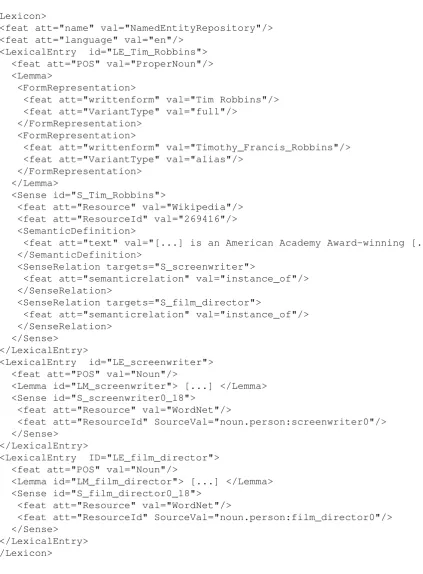
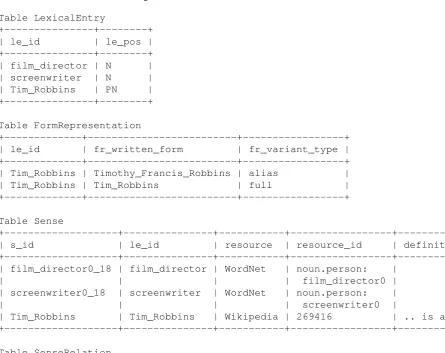
As an example, we include both the XML LMF code (see Figure 1), the database entries (see Figure 2) and the Word-Net specific format (see Figure 3) for the information ex-tracted regarding the NE “Tim Robbins”.
4.
Conclusions and Future Work
This paper has presented Named Entity WordNet, a NE rich LR for English. Several aspects regarding the construction of this resource have been discussed in detail. These in-clude the treatment of polysemous nouns, an analysis of mapped classes and of the results and the design of a stan-dard compliant output format. The resulting resource con-tains 310,742 NEs and 381,043 “instance of” relations and is publicly available8.It is important to mention also that NEWN has been au-tomatically built by applying a generic methodology. In fact, our approach could be applied to any LR that has a noun taxonomy. The only adjustment that needs to be done when applying this method to a different LR is to develop a module that converts the generic standard compliant for-mat of the NE repository into the forfor-mat of the specific LR.
8NEWN can be downloaded at http://dlsi.ua.es/ ∼atoral/#Resources
Moreover, the method has a high degree of language in-dependence; the only language dependent aspect is the set of lexical and Part-of-Speech patterns used for identifying hyponym subcategories.
Finally we sketch some future work lines. First, we will apply the presented methodology to another LR for another language to empirically prove the generic nature of our ap-proach. The other two lines regard increasing mapping re-call. On one hand, as in most of the cases in which a class is not mapped to any category it could be mapped against a Wikipedia entry (74%), we plan to exploit article content from Wikipedia, e.g. by applying state-of-the-art Informa-tion ExtracInforma-tion techniques in order to extract instances from the article body. On the other, we plan to apply Textual En-tailment techniques between classes’ glosses and articles’ abstracts in order to increase the disambiguation recall and therefore the mapping recall for polysemous classes.
5.
References
Razvan Bunescu and Marius Pasca. 2006. Using ency-clopedic knowledge for named entity disambiguation. InProceedings of the 11th Conference of the European Chapter of the Association for Computational Linguis-tics (EACL-06), Trento, Italy, pages 9–16, April. Claude de Loupy, Eric Crestan, and Elise Lemaire.
2004. Proper Nouns Thesaurus for Document Retrieval and Question Answering. InAtelier Question-R´eponse, Traitement Automatique des Langues Naturelles (TALN). G. Francopoulo, N. Bel, M. George, N. Calzolari, M. Monachini, M. Pet, and C. Soria. 2008. (forth-coming) Multilingual resources for NLP in the Lexical Markup Framework (LMF). Language Resources and Evaluation Journal.
ISO 24613. 2008. Languages Resources Manage-ment – Lexical Markup Framework (LMF), rev.15 ISOTC37SC4 FDIS. [Online; accessed 25-March-2008].
Cvetana Krstev, Dˇusko Vitas, Denis Maurel, and Micka¨el Tran. 2005. Multilingual Ontology of Proper Names. In Proceedings of the Language and Technology Con-ference, pages 116–119.
D. Levy, R. Catizone, B. Battacharia, A.Krotov, and Y. Wilks. 1997. CONVERSE: A conversational com-panion. In Proceedings of the 1st International Work-shop on Human-Computer Conversation, Bellagio, Italy. G. Mann. 2002. Fine-grained proper noun ontologies for
question answering.
G. A. Miller and F. Hristea. 2006. Wordnet nouns: Classes and instances.Computational Linguistics, 32(1):1–3. G. A. Miller. 1995. Wordnet: A lexical database for
en-glish.Communications of ACM, (11):39–41.
Satoshi Sekine, Kiyoshi Sudo, and Chikashi Nobata. 2002. Extended Named Entity Hierarchy. In Proceedings of Third International Conference on Language Resources and Evaluation.
Figure 1: XML LMF code for the NE “Tim Robbins”
<Lexicon>
<feat att="name" val="NamedEntityRepository"/> <feat att="language" val="en"/>
<LexicalEntry id="LE_Tim_Robbins"> <feat att="POS" val="ProperNoun"/> <Lemma>
<FormRepresentation>
<feat att="writtenform" val="Tim Robbins"/> <feat att="VariantType" val="full"/>
</FormRepresentation> <FormRepresentation>
<feat att="writtenform" val="Timothy_Francis_Robbins"/> <feat att="VariantType" val="alias"/>
</FormRepresentation> </Lemma>
<Sense id="S_Tim_Robbins">
<feat att="Resource" val="Wikipedia"/> <feat att="ResourceId" val="269416"/> <SemanticDefinition>
<feat att="text" val="[...] is an American Academy Award-winning [...]"/> </SemanticDefinition>
<SenseRelation targets="S_screenwriter">
<feat att="semanticrelation" val="instance_of"/> </SenseRelation>
<SenseRelation targets="S_film_director">
<feat att="semanticrelation" val="instance_of"/> </SenseRelation>
</Sense> </LexicalEntry>
<LexicalEntry id="LE_screenwriter"> <feat att="POS" val="Noun"/>
<Lemma id="LM_screenwriter"> [...] </Lemma> <Sense id="S_screenwriter0_18">
<feat att="Resource" val="WordNet"/>
<feat att="ResourceId" SourceVal="noun.person:screenwriter0"/> </Sense>
</LexicalEntry>
<LexicalEntry ID="LE_film_director"> <feat att="POS" val="Noun"/>
<Lemma id="LM_film_director"> [...] </Lemma> <Sense id="S_film_director0_18">
<feat att="Resource" val="WordNet"/>
<feat att="ResourceId" SourceVal="noun.person:film_director0"/> </Sense>
</LexicalEntry> </Lexicon>
Beth M. Sundheim, Scott Mardis, and John Burger. 2006. Gazetteer Linkage to WordNet. In Proceedings of the Third International WordNet Conference, pages 103– 104.
Antonio Toral and Rafael Mu˜noz. 2007. Towards a Named Entity Wordnet (NEWN). InProceedings of the 6th In-ternational Conference on Recent Advances in Natural Language Processing, pages 604–608, September.
Micka¨el Tran, Thierry Grass, and Denis Maurel. 2004. An
Figure 2: Database entries for the NE “Tim Robbins”
Table LexicalEntry
+---+---+
| le_id | le_pos |
+---+---+
| film_director | N |
| screenwriter | N |
| Tim_Robbins | PN |
+---+---+
Table FormRepresentation
+---+---+---+
| le_id | fr_written_form | fr_variant_type |
+---+---+---+
| Tim_Robbins | Timothy_Francis_Robbins | alias |
| Tim_Robbins | Tim_Robbins | full |
+---+---+---+
Table Sense
+---+---+---+---+---+
| s_id | le_id | resource | resource_id | definition |
+---+---+---+---+---+
| film_director0_18 | film_director | WordNet | noun.person: | |
| | | | film_director0 | |
| screenwriter0_18 | screenwriter | WordNet | noun.person: | |
| | | | screenwriter0 | |
| Tim_Robbins | Tim_Robbins | Wikipedia | 269416 | .. is an .. |
+---+---+---+---+---+
Table SenseRelation
+---+---+---+
| s_source_id | s_target_id | sr_relation |
+---+---+---+ | Tim_Robbins | film_director0_18 | instanceOf |
| Tim_Robbins | screenwriter0_18 | instanceOf |
+---+---+---+
Figure 3: WordNet specific code for the NE “Tim Robbins”
{ Tim_Robbins, Timothy_Francis_Robbins,