International Doctorate School in Information and Communication Technologies
DISI - University of Trento
models and systems for managing sensor
and crowd-oriented processes
Stefano Tranquillini
Advisors:
Prof. Fabio Casati and Dr. Florian Daniel
Universit`a degli Studi di Trento
Since I don’t want to forget anyone, I’ll not write any names here. I’m sure that if you have to be thanked you will find your place.
I would like to thank the people who gave me the opportunity to do the PhD and guided me until the end, losing their time but not wasting it. I will be always grateful to those who gave me the possibility to do a period abroad for the experiences it gave me. I want to thank all the beautiful people, colleagues and friends, who I met during these years: the mates, the freunde, and all the amici. I would like to thank all my friends because they are my friends. I want to thank the people who bear with me and support me every day, one in particular. I want to saygrazie to my family, especially to my parents that never asked me to find a real job and always supported me in whatever choice I made.
And I would like to thank you.
Stefano
Business process modeling refers to the design of business process models, using business processes languages, to orchestrate the work executed by employees, their interaction with external entities, and work items that are necessary to achieve a predefined goal. Model-driven development allows people, generally called modelers, to design also sophisticated application logic using high-level abstractions. Process modeling is typically connected with business, hence, existing process languages focus principally on the support and orchestra-tion of activities executed by employees, or by external entities like web services. However, there is a wide range of other application logics that are process-driven and that can benefit from high-level abstractions to model low-level details.
Our initial research focuses on distributed UIs, which are a distributed type of actors, and then particularly concentrated on Wireless Sensor Networks (WSNs) and crowdsourc-ing, which are distributed and also autonomous types of actors (they can execute a part of an application logic in an autonomous and isolated fashion). Developing applications in these areas requires a deep knowledge of the field and a non-trivial programming effort; domain experts have to code and orchestrate the logic executed by these actors. Since these applications are highly process-driven, domain experts could take advantage of high-level, process-oriented modeling conventions to design the internal logic of these kinds of appli-cations. However, the intrinsic complexity of these domains and the current state of the art of modeling paradigms make the design and execution of processes for these new actors challenging.
tool to design processes and a runtime environment to support the execution. The impact of this work is not only to the domains we focused on but also to the business process domain as we demonstrate how a process modeling is a flexible and suitable formalism to design processes with very diverging, domain-specific requirements.
Keywords
Process modeling, process languages, process language extensions, BPEL, BPMN,
dis-tributed UIs, mashup, Wireless Sensor Networks, crowdsourcing.
1 Introduction 1
1.1 Challenges . . . 5
1.2 Methodology . . . 8
1.3 Contributions and Results . . . 12
1.4 Structure of the thesis . . . 17
2 Distributed Orchestration of User Interfaces 19 2.1 Introduction . . . 20
2.2 State of the Art in Orchestrating Services, People and UIs 23 2.3 Distributed User Interface Orchestration: Definitions, Re-quirements, and Architecture . . . 27
2.3.1 Requirements and approach . . . 28
2.3.2 Architecture . . . 31
2.4 The Building Blocks: Web Services and UI Components . 35 2.5 The UI Orchestration Meta-Model . . . 41
2.6 Modeling Distributed UI Orchestrations . . . 46
2.6.1 Core UI orchestration design patterns . . . 47
2.6.2 Data transformations . . . 49
2.6.3 Message correlation . . . 49
2.6.4 Graphical layout . . . 51
2.7 Types of UI orchestrations . . . 51
2.7.1 Pure UI synchronizations . . . 52
2.7.2 Pure service orchestrations . . . 55
2.7.3 UI-driven UI orchestrations . . . 56
2.7.4 Process-driven UI orchestrations . . . 58
2.7.5 Complex UI orchestrations . . . 59
2.8 Implementing and Running UI Orchestrations . . . 59
2.9 Lessons Learned . . . 63
2.10 Conclusion . . . 65
3 Process-Based Design and Integration of Wireless Sensor Network Applications 67 3.1 Introduction . . . 68
3.2 Scenario: Convention Center HVAC Management . . . 70
3.3 Relevant Properties of Wireless Sensor Networks . . . 71
3.4 Requirements and Approach . . . 73
3.5 BPMN4WSN . . . 78
3.5.1 Process Logic . . . 79
3.5.2 WSN Task Specification . . . 81
3.6 Prototype . . . 84
3.7 Evaluation of the approach . . . 90
3.8 Discussion and Lessons Learned . . . 94
3.9 Related work . . . 95
3.10 Conclusion . . . 97
4 Modeling and Enacting Flexible Crowdsourcing Processes 99 4.1 Introduction . . . 100
4.2 Crowdsourcing: Concepts and State of the Art . . . 102
4.2.1 Core concepts . . . 102
4.2.2 Crowdsourcing tactics . . . 104
4.2.3 Crowdsourcing processes . . . 106
4.2.4 Problem statement . . . 107
4.3.1 Requirments . . . 110
4.3.2 Approach . . . 112
4.4 Modeling Crowdsourcing Processes: BPMN4Crowd . . . . 116
4.4.1 Crowd task . . . 116
4.4.2 Data transformation . . . 118
4.4.3 Modeling a crowdsourcing process with BPMN4Crowd . . . 123
4.5 The crowd computer . . . 124
4.6 Modeling crowdsourcing tactics . . . 129
4.6.1 Designing Tactics . . . 129
4.6.2 Tactic configurations . . . 138
4.7 Prototype implementation . . . 142
4.7.1 Model . . . 143
4.7.2 Compile . . . 146
4.7.3 Execute . . . 147
4.8 Evaluation . . . 148
4.8.1 Scenario: crowd-based pattern mining . . . 148
4.8.2 Implementation . . . 151
4.8.3 Analysis . . . 154
4.9 Discussion and Lessons Learned . . . 156
4.10 Related work . . . 158
4.11 Conclusion . . . 162
5 Conclusion 165 5.1 Lessons Learned and Limitations . . . 165
5.2 Future work . . . 169
5.3 Final Remarks . . . 172
Bibliography 173
1.1 The process model that summarizes our work methodology. 10
2.1 A home assistance application integrating both web services
and UI components into a process-like orchestration logic. 21
2.2 From design time to runtime: overall system architecture of
MarcoFlow. . . 30
2.3 Graphical rendering and internal logic of a UI component . 36
2.4 Simplified WSDL4UI meta-model (inspired by [23] and
ex-tended – via the gray boxes – toward UI components). . . 37
2.5 Example of WSDL/UI description of a UI component. . . 39
2.6 Simplified BPEL4UI meta-model in UML. White classes
correspond to standard BPEL constructs [89]; gray classes
correspond to constructs for UI and user management. . . 42
2.7 Excerpt of the BPEL4UI home assistance process (new
con-structs in bold) . . . 45
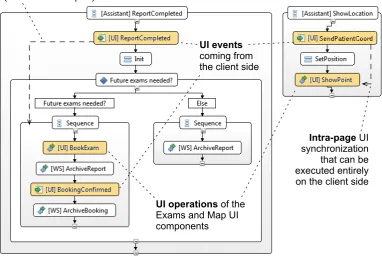
2.8 Part of the BPEL4UI model of the home assistance process
as modeled in the extended Eclipse BPEL editor (the dashed
and dotted lines/arrows have been overlaid as a means to
explain the model). . . 46
2.9 The HTML template of the assistant’s web page highlighting
the empty place holders for UI components. . . 52
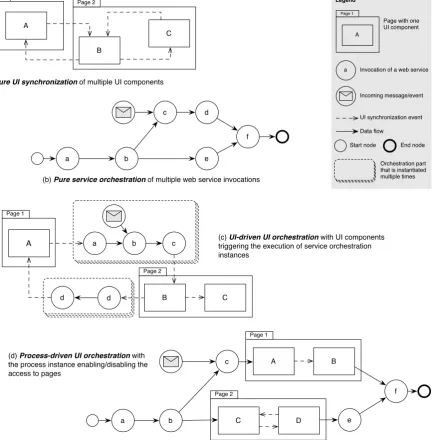
2.10 The four types of (UI) orchestration supported by BPEL4UI
and the MarcoFlow system. . . 53
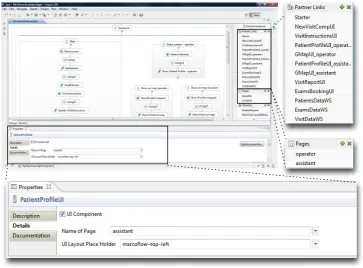
2.11 The extended Eclipse BPEL editor for developing UI
orches-trations at work. . . 61
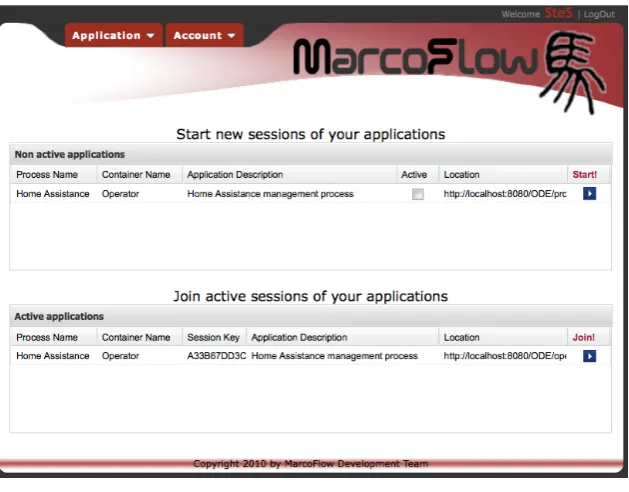
2.12 The management console for developers and users allowing them to deploy, instantiate, and participate in UI orchestra-tions. . . 62
3.1 Integration of a convention center’s BP engine with a WSN for HVAC. . . 70
3.2 Conceptual model of WSN operations . . . 76
3.3 Architecture . . . 78
3.4 WSN-specific modeling constructs in BPMN4WSN. . . 79
3.5 The Startup page for the configuration of the scenario. . . 84
3.6 The editor for the creation of the BPMN process. . . 85
3.7 The editor for the meta abstraction composition. . . 85
3.8 The HVAC process of the convention center. . . 86
3.9 The CO2 and ventilation operations modeled as a script task 87 3.10 The CO2 and ventilation operations modeled with the parametrized WSN logic constructs [81] . . . 88
3.11 Deployment of the ventilation scenario in Cadiz, Spain. On the left part an overview of the setup and on the right part an actuator with the flap. [25] . . . 90
3.12 Task Completion [33] . . . 93
4.1 The high-level steps of crowdsourcing and the respective actors103 4.2 The most prominent tactics to crowdsource work . . . 104
4.3 A simple crowdsourcing process in BPMN [67]: the text recognition task is iterated automatically until there are no doubts left about the correct wording . . . 106
machines and the crowd) and possibly different
crowdsourc-ing tactics . . . 108
4.5 The architecture of our approach. . . 113
4.6 The visual representation of the layer approach. . . 115
4.7 The crowd task. . . 118
4.8 The data transformation notations. . . 118
4.9 The data and object operations. . . 119
4.10 The different split data set operations. . . 120
4.11 The process of the photo scenario modeled with BPMN4Crowd.123 4.12 Functional architecture of the crowd computer. . . 125
4.13 The crowd computer task to interact with the API. . . 129
4.14 The process of the marketplace tactic. . . 130
4.15 The process of the contest tactic. . . 132
4.16 The process that models the collection of answers during a contest. . . 133
4.17 The process of the auction tactic. . . 135
4.18 The process that models the selection of the winner, in this case it is the worker that first bids less than the bid level. . 136
4.19 The process of the mailing list tactic. . . 137
4.20 On the left the process that assign to each worker an in-stance. On the right the process that collects the worker’s result and that validates and reward workers. . . 138
4.21 Processes of four validation configurations. . . 139
4.22 The implemented architecture of BPMN4Crowd solution. . 143
4.23 The crowdsourcing process of the crowd-based pattern min-ing pattern minmin-ing scenario. . . 151
4.24 The visual modeling editor with the process of the
crowd-based pattern mining scenario. The Figure has the BPMN4Crowd
palette and the properties window zoomed. . . 153
3.1 Exercise steps [33] . . . 92
4.1 List of the API. . . 128
Introduction
This dissertation gathers the outcomes of more than three years of research
in the context of business process management. During this time the focus
of the research evolved following a path driven by new possibilities and
applications that emerged in the field of business processes. The research
presented in this dissertation builds on background knowledge acquired
with the orchestration of distributed UIs, an investigation we started
al-ready before enrolling in the PhD program and that inspired the further
work on WSNs and crowdsourcing.
Creating applications that interact with distributed UIs, or a WSN, or
the crowd today requires a manual and non-trivial effort. Applications have
to be programmed to integrate these computational “resources”, which we
also call new actors, and exploit their capabilities. Each resource has its
own characteristics, yet they share a set of features that make them similar from a technical and conceptual prospective. In particular:
• User interfaces are the means by which people interact with machines.
Recently mashups [26] have focused on the integration and
coordina-tion of pieces of user interfaces, e.g., a Google map, inside simple web
pages. Thus, we have the possibility to combine pieces of UIs from
different sources and create new applications. Yet, mashups typically
only focus on single-user applications. With distributed UIs we refer
to the possibility to orchestrate different pieces of UIs that are
de-ployed and executed in a distribute fashion. This means having the
possibility to create an application that supports the collaboration of
multiple users via the orchestration of various pieces of UIs deployed
on separated pages. Yet, UIs can interact in various fashions. UIs can
be synchronized within the same page, as in a conventional mashup,
for example, a map that changes the displayed location when the user
selects a new address in a list. UIs can be synchronized among
differ-ent machines, for example, a chat application used by two users. UIs
can also trigger part of the process, for example, a user that sends a
form for a loan that triggers the process to validate the request.
• A WSN is a network of sensors and actuators able to interact with
the physical world. WSN applications are used in domains like
build-ing automation, control system, remote healthcare, and similar. For
example, a WSN can be used to sense the temperature in a room
and to open a window. Nodes inside a network have different
capa-bilities, for example a node can sense the temperature while another
node can sense the level of CO2. Sensors and actuators may join or
leave a network dynamically, for example, creating a sub set of the
network depending on the type of capabilities each node has. Nodes
may change their role over time, a node can become a getaway, which
is a node in charge of controlling the network and forwarding data
to a server, depending on characteristics evaluated at runtime (e.g.,
charge of the battery). Most importantly, WSNs may form
tempo-rary, ad-hoc self-collaborations for specific tasks, such as computing
an average temperature out of a large number of sensors.
• Crowdsourcing is an activity and business model that is based on
the outsourcing, i.e., externalization, of a unit of work to a crowd of
people via an open call for contributions [40]. Crowdsourcing can be
used to outsource tasks that require a huge amount of people to be
solved. For example, a person can divide a set of one million pictures
in small subsets and ask people from a crowd to tag each set of photos.
Crowdsourcing shares some characteristics of the WSNs, thus similar
problematics. Both are networks of executors: on one side we have
sensors and actuators, while on the other there are workers, which are
members of the crowd that perform of crowdsourced work. A worker
of a task is not known a priori when the application is created, he is
selected based on his capabilities and availability (thus if he is willing
to execute the task). Crowdsourcing brings also the need for
support-ing the management of data that each worker has to process. For
example, if the task is to tag one million pictures we have to support
the splitting of pictures into sets that each worker can process (e.g.,
set of 10 pictures), and later collect all the results. Additionally, tasks
for the crowd can have various execution logics, for example a task can
have many instances each of which executed by a single worker (e.g.,
the tagging of picture where each worker tags 10 pictures), or workers
may compete to solve a task (e.g., creating the logo for a company)
where workers submit results but only one is selected as winner. A
crowd task logic also specifies how the workers are rewarded (most of
the worker perform tasks in return of a monetary reward) and how
their work is validated, thus how results are checked by the person
who crowdsources the work.
With these three new actors we have now distributed actors that have their
interactions logic, different capabilities, and that are able to execute a task
of work in an rather autonomous fashion (especially WSNs and the crowd),
such as a WSN that is able to report the average temperature of a room
by querying various sensors and by computing the average value.
Most of the applications that include UIs, WSN, or the crowd as
ac-tors share a common characteristic: their logic is highly process-driven.
These applications are of interest for people and companies that already
use software instruments for the modeling, execution and management of
processes. For example, distribute UIs can be used to coordinate the work
of doctors, exchanging information on patients between different wards; a
WSN can be used to track items and rise an alarm when a hazard item is
placed nearby heat sources; a crowd can tag a large set of picture, or
tran-scribe an audio speech in a very short time. For these reasons we focused
the research on extensions of process modeling languages whose goal is to
provide instruments for modelers, people that design processes, to model
and execute processes that interact with the new actors, we called them
extended processes.
Today, instruments for modeling and executing processes are tailored
to different types of actors, namely a machine (e.g., a computer or a web
service) or a person (e.g., an employees). With machines or employees as
actors of a process there is a different type of modeling. Actors’ capabilities
are known and described a priori (e.g., what are the operations of a web
service), they execute one task at a time in an isolated fashion (without
interaction with others), thus one simply invokes them to execute a job.
Distributed UIs, WSNs, and the crowd as actors are different from what
usually is an actor of a process. Thus, to support applications that
lever-age these new actors we have to integrate and unify them within process
modeling and execution instruments. Integration refers to the capacity
of these new actors to execute part of the application logic (for example
a network of sensors that senses the temperature of a room and reports
the average value) whose result triggers the execution of other parts of a
bigger process. There is a need to achieve a tight integration between the
actors of a same process. Unification refers to the availability of a single
specification that allows one to create logics that are executed by a central
process and by distributed UIs, or by a WSN, or by the crowd.
1.1
Challenges
To unify and integrate the new actors into business process modeling and
execution languages we have several challenges to tackle. This
disserta-tion addresses the challenges of each research focus one at a time.
First, we started with the orchestration of distributed user interfaces.
The goal is to coordinate distributed mashups by using a process logic to
specify the orchestration of different UIs that are deployed and executed
in a distributed fashion. To do so, there is a need to unify the modeling
language to specify the orchestration of UIs, and tointegrate the execution
of processes with the orchestration of UIs. In particular we have to:
• Understand how to componentize UIs, thus how to abstract UIs
ca-pabilities (e.g., a list that can display data, a map that can display a
point) in a way that can be used to construct pages and to orchestrate
the various pieces of UIs in different pages.
• Provide a method to define the logic of an application, so that a
modeler can specify how the UIs interact, for example, how a form
in a page updates a list in another page. However, since most of the
applications are not only a composition of user interfaces this logic
should also give the possibility to interact with other actors, such as
web services, to support the creation of wider types of applications.
• Create a language and a tool to enable the modeling of distributed
UI applications. We aim at having a tool that allows developers to
design and execute their application.
1.1. CHALLENGES
• Develop a runtime system that is able to execute the orchestration
of UIs, thus a system that communicates with the UIs, supports the
exchange of data, and interacts with the actors of the process.
Next, we focused on the possibility to orchestrate and manage WSNs
with a process modeling language. As of today, WSN logic is mostly
cre-ated with programming languages [62] and the integration with business
processes is via web-services that expose sensor operations as a set of APIs
[7, 78]. In this focus of the research the goal is to support the creation and
execution of applications whose logic spans across the process and the
net-work of sensors. We do not want only to interact with the sensor, meaning
to have the possibility to query the nodes to gather information, but also
to program the logic of a WSN, thus create the operations that are later
executed by the WSN. For example, we have to find a solution that allows
a modeler to specify the logic to sense the CO2 value of meeting rooms
every 10 minutes without asking him to write code for the WSN. This
re-quires to integrate the execution of the process that runs in the back-end
and of the WSN and to unify the modeling language in a way that both
logics can be specified within a single modeling solution. We have thus the
following challenges:
• To provide an easy access to WSN capabilities. Each node of the
network has its own characteristics (e.g., where it is deployed) that
for a process modeler could be difficult to grasp but that are important
to create an application, for example how to specify a specific sensor
inside a specific room. We have to understand how to abstract the
characteristics of the network, such as sensor types, node locations
and the like, in an easy and understandable way that can be used by
a modeler, which is not an expert of WSNs.
• To provide a set of modeling concepts to enable the specification of
sensor network functionality. While a WSN expert could be
inter-ested in having control of the low-level functionality of the network, a
modeler would like to have a more high-level view. We have then to
find a trade-off between the complexity of the sensor network and the
high-level modeling language, hiding low-level network details without
limiting the possibility to specify WSN functionality.
• To provide a unified modeling for WSN applications that seamlessly
embraces the needs of the process applications and of the WSN logic
using a single modeling paradigm.
• To create a tool and a language for the creation of process-driven WSN
applications.
• To support the process execution. We have to enable the hybrid
ex-ecution (on the sensor and on the back-end) and we have to support
the exchange of information between the participants.
Then, we focus on the possibility of integrating the crowd as an actor
into a process. With this focus our goal is to give modelers the possibility
to create applications whose logic is partially executed by a crowd. To do
so, we have to give the modeler the possibility to specify what are the tasks
that are executed by the crowd and how the crowd has to execute them
(e.g, competing for a task, as for the logo creation; or submitting results for
an instance of a huge task, as in the photo tagging). Similarly, we have to
provide support for the management of data that the crowd produces and
consumes. This requires tounify the modeling of the crowd characteristics,
the management of data produced and consumed by crowd tasks within
what the process already supports, and to integrate the execution of crowd
tasks and processes. In detail we have to:
• Understand how to specify tasks for the crowd and how these tasks
1.2. METHODOLOGY
can be combined into a process logic.
• Define modeling constructs that allows a modeler to specify how each
task for the crowd is executed, that is, how the results are collected,
how workers are evaluated and rewarded.
• Define a modeling language that is able to orchestrate the crowd and
other participants, such as web services. This language has also to
support the management of the data that are produced and consumed
by the crowd.
• Provide a tool that enables the creation of crowd processes.
• Create a runtime environment that is able to execute the logic of the
application, thus that is able to crowdsource a task, collect the results
and manage the data to be used by other tasks.
1.2
Methodology
By analyzing the challenges of each focus we can see that they are similar
and can be summarized as the need for:
• Abstracting new actors, capabilities and characteristics;
• Defining suitable process modeling constructs to specify tasks for the
new actors;
• Enabling the design of the internal execution logic of each actor’s
tasks;
• Creating a language and tools for the creation of extended processes;
• Supporting the execution of processes that span between all the actors
involved in an extended process.
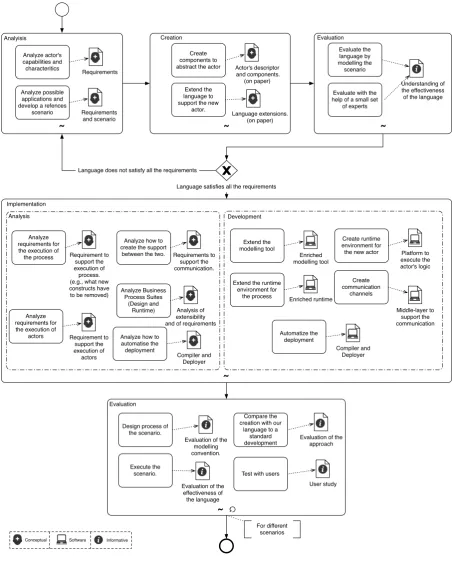
To address the challenges we adopt a similar approach in all the three cases. In Figure 1.1 we schematize the work methodology as a process
model, which is divided in phases:
• The first phase is the analysis of the requirements for the new actor.
We analyze its characteristics, its capabilities and functionalities that
later have to be abstracted in the language. A reference scenario,
taken from a real use-case, is analyzed to understand its composition
needs, deriving requirements for the process language. The output of
this first phase is a set of requirements, for both the components and
the language, that we have to satisfy.
• The second phase is the creation of the components for the new actor
and of the extensions for the language. The components abstract the
actor in a high-level modeling convention, for example a task specific
for the WSN that has dedicated parameters. These components are
paired with an actor’s descriptor, which is a reference document that
describes, at a high-level, the capabilities of each actor. For example,
an actor’s descriptor for a node of a WSN contains information on the
location where it is deployed and on the operations it can execute. In
this phase we conceptualize the extensions of the language to support
the creation of an extended process. The extensions of the language
have to support the design of extended processes and the design of
the actor’s task logic (e.g., the design of a WSN logic that specifies
the sensing of CO2 in a specific room). At the end of this phase we
have a conceptual set of extensions.
• The third phase is a first evaluation of the extended language. In this
phase we implement, on paper, the scenarios and other possible
appli-cations that we have identified. At the same time, when possible, we
test with the help of experts (e.g., our WSN partners) the effectiveness
1.2. METHODOLOGY
Automatize the deployment
Compiler and Deployer
Analyisis Creation Evaluation
Implementation Analysis Development Evaluation For different scenarios ~ ~ ~ ~ ~
Language satisfies all the requirements Language does not satisfy all the requirements
Conceptual Software Analyze actor's capabilities and characteritics Analyze possible applications and develop a refences
scenario Actor's descriptor and components. (on paper) Requirements and scenario Create components to abstract the actor
Extend the language to support the new
actor. Requirements Language extensions. (on paper) Evaluate the language by modelling the scenario
Evaluate with the help of a small set
of experts
Understanding of the effectiveness of the language
Analyze Business Process Suites (Design and Runtime) Extend the modelling tool Analysis of extensibility and of requirements
Enriched modelling tool
Extend the runtime environment for
the process Enriched runtime
Analyze requirements for the execution of
actors
Create runtime environment for
the new actor Platform to execute the actor's logic Analyze how to
create the support
between the two. Requirements to support the communication. Create communication channels Middle-layer to support the communication
Analyze how to automatise the deployment Compiler and Deployer Analyze requirements for the execution of
the process Requirement to support the execution of process. (e.g., what new constructs have to be removed)
Design process of the scenario.
Evaluation of the modelling convention.
Execute the scenario.
Evaluation of the effectiveness of the language
Test with users
User study Compare the
creation with our language to a
standard
development Evaluation of the approach Requirement to
support the execution of actors
Informative
Figure 1.1: The process model that summarizes our work methodology.
of the language. The output of this phase is a first assessment for the
extended modeling language. After this phase, if the language misses
some characteristics, we re-iterate from the first phase, otherwise we
move to the next phase.
• The fourth phase is the implementation of the extended language.
This phase has several activities that can be grouped in two
sub-groups: analysis and development. In the analysis group we analyze
existing tools and software systems to understand what are the
limita-tions we have to overcome and the requirements we have to satisfy to
enable the creation and execution of extended processes. As output of
the analysis phase we have a set of conceptual outputs that we use in
the second group, the development. The development group contains
the activities for the creation of the modeling tool, of the runtime for
the process and for the actors, and of the communication channels.
The output of this phase is a toolchain that enable the design and
execution of extended processes.
• The last phase is the evaluation of the overall solution. In this phase
we evaluate the modeling language, with the help of the tools, by
modeling and executing the scenario and other application logic. We
run user studies, when possible, to measure the effectiveness of the
language, and we apply our approach to the development of the
sce-narios to understand if our language simplifies its development. The
output of this phase is a set of informative documents from which
we can understand the success of our language. After this phase, if
problem arises or if we have new process logic to support, we iterate
from the first phase, otherwise the process is completed.
The technical solution, which enables the design and execution of
ex-tended processes, is similar in the three focuses. We created a framework
1.3. CONTRIBUTIONS AND RESULTS
that is divided in three layers (each of which is intended to support a step
for the the creation and execution of the processes): design, deployment
and execution. The design phase enables the creation of processes. In
this phase the process modeler creates the extended process by using our
modeling tool. In the deployment phase the compiler takes the modeled
processes and extracts the information needed to create the logic for the
new actors. For example, each WSN task is translated into code for
sen-sors. The compiler also establishes the communication channels to enable
the exchange of information among the involved actors. The deployer takes
the generated code and the process and deploys the former into the
run-time for the actors and the latter into the process engine. The runtime
phase supports the execution of the extended process: the process and the
actor run their logic autonomously, interacting when needed.
1.3
Contributions and Results
We applied this work methodology to the three research focuses. We
started first with distributed UIs. Later, leveraging on the knowledge
ac-quired from the work on distributed UIs, we focused on WSNs, and,
tak-ing advantage from the similarities that WSNs and the crowd have (e.g.,
they are networks of executors, both can execute tasks in an autonomous
fashion), on crowdsourcing. The contributions of the three works can be
summarized as follows.
Distributed UIs. For distributed UIs we developed a solution based on
WS-BPEL (Web Services Business Process Execution Language)[64], which
is the dominant solution to design and execute processes that interact with
participants through web service operations. The approach allows a
mod-eler to integrate UI components directly in a process model, to specify their
deployment, and to orchestrate their execution and interaction [27, 28, 29].
In particular, we contribute with:
• An abstraction of UIs that specifies the characteristics of each UI,
such as operations and events, in a way that can be used in a process
language (we called this WSDL4UI).
• An extension of a WS-BPEL to specify the orchestration of UIs (we
called this BPEL4UI). With this extension we enable the modeling of
distributed UI orchestration.
• A visual editor to model processes for distributed UIs. Thus we
im-plemented a tool that allows a modeler to use the BPEL4UI language
to create their processes.
• A runtime environment to support the execution of the process. This
runtime environment also contains the compiler and deployer for the
translation of the process and creation of the UI coordination logic.
These contributions found their application in the MarcoFlow project,
funded by and jointly conducted with Huawei, China (which also deposited
a patent in China [75]). The goal of the project was to solve the problem
of UI and service integration in the context of the service-oriented
archi-tecture for applications whose user interfaces are distributed over multiple
web browsers. In this project we contributed providing the languages and
a prototype.
The publications for this work are:
• A demo at the 8th international conference on Business Process
Man-agement (2010) titled: “MarcoFlow: Modeling, Deploying, and
Run-ning Distributed User Interface Orchestrations” [27].
• A paper at the 8th international conference on Business Process
Man-agement (2010), which was nominated for the best paper award, titled:
1.3. CONTRIBUTIONS AND RESULTS
“From People to Services to UI: Distributed Orchestration of User
In-terfaces” [29].
• An article published in the Information Systems journal, Elsevier
(2012), titled “Distributed orchestration of user interfaces” [28].
WSNs. For WSNs, we extended the BPMN (Business Process Modeling and Notation)[67], which is a standard notation for business process
mod-eling, adding specific constructs to support WSN characteristics and to
model the execution logic of WSN-dedicated tasks. In details we provide:
• An abstraction of WSN capabilities that allows one to describe, in a
high-level fashion, the characteristics of each node of a network. This
abstraction also enables the description of pre-defined operations that
the network can execute as a sort of library that a modeler can use
out of the shelf.
• An extension of BPMN to specify WSN tasks, thus the tasks that are
executed by the network, as part of a process model.
• A set of modeling constructs for WSNs to allow a modeler to specify
the internal logic of WSN tasks. This modeling solution, which we
called WSN task specification, provides high-level constructs for the
modeling of sensing or actuating operations.
• A graphical editor to model processes for WSNs.
These contributions found application in the makeSense project1 whose
goal was to ease the programming of WSNs and the integration with
busi-ness processes [15, 17, 18, 25, 83]. In this project we tightly collaborated
with SAP AG for the creation of the modeling language that we called
1
http://www.project-makesense.eu/
BPMN4WSN and the implementation of the graphical editor. The process
translator and process runtime environment was developed by SAP AG.
Other partners of the projects provided support for the WSN part, creating
the runtime environment for the sensor networks. The modeling solution
we proposed was tested with a user study run by professionals from SAP
[33]; the overall approach and relative outcomes were tested in a real-world
deployment [25].
The publications for this work are:
• A poster at the 8th European Conference on Wireless Sensor Networks
(EWSN 2011), titled “makeSense: Easy Programming of Integrated
Wireless Sensor Networks” [18].
• A demo at the 9th European Conference on Wireless Sensor Networks
(EWSN 2012), titled “From Business Process Specifications to Sensor
Network Deployments” [17].
• A paper at the 34th ACM/IEEE International Conference on Software
Engineering (ICSE), NIER track 2012, titled: “Towards business
pro-cesses orchestrating the physical enterprise with wireless sensor
net-works” [15].
• A paper at the 10th International Conference on Business Process
Management (2012), titled: “Process-Based Design and Integration
of Wireless Sensor Network Applications” [83].
• A paper at the 4th International Workshop on Networks of
Cooperat-ing Objects for Smart Cities 2013 (CONET/UBICITEC 2013), titled:
“makeSense: Real-world Business Processes through Wireless Sensor
Networks” [25].
1.3. CONTRIBUTIONS AND RESULTS
The crowd. To support the crowdsourcing of tasks, we extended BPMN to enable the modeling and execution of crowd processes, we called the
language BPMN4Crowd [50, 82]. In particular we contribute with:
• An extension of the language to support tasks for the crowd. This
extension contains a task specific for the crowd and tasks for the
management of data created and consumed by the crowd.
• A set of modeling constructs to specify the execution logic of crowd
tasks. That is how the crowd executes a task, if the workers compete
for the task (e.g., the creation of a logo), or if they contribute to a
bigger task (e.g., the tagging of pictures).
• A set of patterns that describe common crowd task logics. These
processes are part of the language and describe the execution logic of
a crowd task. A modeler can use the patterns to specify the execution
logic of each task.
• A visual editor to design crowdsourcing processes based on our
lan-guage.
• A runtime environment to support the execution of these processes.
It is composed of a crowdsourcing platform (crowd computer2), which
enables the crowdsourcing of tasks, a process engine, which executes
the process logic, and a communication mechanism to exchange
infor-mation between the two.
The outcomes of this focus of the research are part of the BPM4People3
project, which aims at providing software for the support of Social Business
Process Management. In this project we contributed with the process
2
http://www.crowdcomputer.org/ 3
http://www.bpm4people.org/
language for crowdsourcing and the implementation of the tool and runtime
environment to support the execution.
The publications for this work are:
• A paper at the 5th International Workshop on Business Process
Man-agement and Social Software(BPMS2 2012), titled “Business
Pro-cesses for the Crowd Computer” [50].
• An article to be submitted to the ACM Transactions on the Web
(TWEB) journal, titled “Modeling and Enacting Flexible
Crowdsourc-ing Processes” [82].
1.4
Structure of the thesis
The rest of this dissertation presents in details each of the three focuses.
Chapter 2 presents the work to orchestrate distributed UIs; this chapter
is based on the work presented in [28] and illustrates an initial step to
orchestrate distribute actors. Chapter 3, based on the work presented in
[83], focuses on distributed and autonomous actors and presents the
re-search work to design process-based WSN applications. Chapter 4 focuses
on distributed, autonomous, and intelligent actors, the crowd, presenting
the research to support the creation of crowd processes; this chapter is
based on the work presented in [82]4. In Chapter 5 we conclude the
dis-sertation with an analysis of the research and lessons learned, highlighting
possible future work. All the material of this thesis, plus videos, and
pro-totypes are available online at: http://phd.stefanotranquillini.me5.
4not yet published
5last time checked February 2014
1.4. STRUCTURE OF THE THESIS
Distributed Orchestration of User
Interfaces
In this chapter we present our research on the orchestration of distributed
UIs. This work is a first step toward the orchestration of actors that are
distributed and that interact with processes in a different way compared to
classical actors. With this work we enable the development of mashup-like
applications that require process support by integrating a process language
(BPEL) with the orchestration of distributed UIs. The content of the
chap-ter is an extract of the journal paper [28], which is an extension of the
paper presented at the Business Process Management conference in 2010
[29]. In the same conference we also presented a demo [27], which is the
implementation of the scenario presented in this chapter. A screen cast of
the demo is available online.
2.1. INTRODUCTION
2.1
Introduction
Workflow management systems support office automation processes,
in-cluding the automatic generation of form-based user interfaces (UIs) for
executing human tasks in a process. Service orchestrations and related
languages focus instead on integration at the application level. As such,
this technology excels in the reuse of components and services but does not
facilitate the development of UI front-ends for supporting human tasks and
complex user interaction needs, which is one of the most time consuming
tasks in software development [63].
Only recently, web mashups [90] have turned lessons learned from data
and application integration into lightweight, simple composition approaches
featuring a significant innovation: integration at the UI level. Besides web
services or data feeds, mashups reuse pieces of UI (e.g., content extracted
from web pages or JavaScript UI widgets) and integrate them into a new
web page. Mashups, therefore, manifest the need for reuse in UI
devel-opment and suitable UI component technologies. Interestingly, however,
unlike what happened for services, this need has not yet resulted in
ac-cepted component-based development models and practices.
This chapter tackles the development of applications that require
ser-vice composition/process automation logic but that also include human
tasks, where humans interact with the system via possibly complex and
sophisticated UIs that are tailored to help perform the specific job they
want to carry out. In other words, this work targets the development of
mashup-like applications that require process support, including
applications that require distributed mashups coordinated in real time,
and provides design and tool support for professional developers, yielding
an original composition paradigm based on web-based UI components and
web services.
Patient DB service yes no Further exams needed? Report DB service Archive report Get patients 1 3 4 5 6 7 8 9 12 13 14 10 11 2
Send info to book exam Register booking Exam DB service 15 11
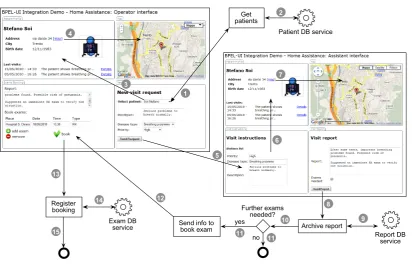
Figure 2.1: A home assistance application integrating both web services and UI compo-nents into a process-like orchestration logic.
This class of applications manifests a common need that today is
typ-ically fulfilled by developing UIs in ad hoc ways and using and manually
configuring a process engine in the back-end for process automation. As an
example, consider the scenario in Figure 2.1: The figure shows a home
assistance application for the Province of Trento whose development we
want to aid in one of our projects. A patient can ask for the visit of a
home assistant (e.g., a paramedic) by calling (via phone) an operator of
the assistance service. Upon request, the operator inputs the respective
details and inspects the patient’s data and personal health history in order
to provide the assistant with the necessary instructions (steps 1-5). There
is always one assistant on duty. The home assistant views the description,
visits the patient, and files a report about the provided service (steps 6-7).
The report is processed by the back-end system and archived (steps 8-9). If
no further exams are needed, the process ends (steps 10-11). If exams are
2.1. INTRODUCTION
instead needed, the operator books the exam in the local hospital asking
confirmation to the patient via phone (steps 12-13). Upon confirmation of
the exam booking, the system also archives the booking, which terminates
the responsibility of the home assistance service (steps 14-15).
The application in the scenario includes, besides the process logic, two
mashup-like, web-based control consoles for the operator and the assistant
that are themselves part of the orchestration, need to interact with the
process, and are affected by its progress. In addition, the UIs are
them-selves component-based and created by reusing and combining existing UI
components that are instantiated in the users’ web browsers (both web
pages in Figure 2.1 are composed of four components). The two
appli-cations, once instantiated, allow the operator and assistant to manage an
individual request for assistance; each new request requires starting a new
instance of the application.
In summary, the scenario requires the coordination of the individual
actors in the process and the development of the necessary distributed
user interface and service orchestration logic. Doing so requires addressing
a set of challenges (each leading to a specific contribution):
1. Understanding how to componentize UIs and compose them into web
applications;
2. Defining a logic that is able to orchestrate both UIs and web services;
3. Providing a language and tool for implementing distributed UI
com-positions; and
4. Developing a runtime environment that is able to execute distributed
UI and service compositions.
In Section 2.2 we introduce the state of the art of the related
composi-tion approaches and technologies. In Seccomposi-tion 2.3, we derive requirements
from the above scenario and outline the approach we follow in this chapter,
including the architecture of our MarcoFlow platform that will serve as a
guide throughout the rest of the chapter. In Section 2.4, we then introduce
the concept of HTML/JavaScript UI component and show how defining
a new type of binding allows us to leverage the standard WSDL [20]
lan-guage to abstractly describe them. We then build on existing composition
languages (in particular WS-BPEL [64]) to introduce the notions of UI
components, pages, and actors into service compositions (Section 2.5) and
explain how such extension can be used to model UI orchestrations
(Sec-tion 2.6). In Sec(Sec-tion 2.7 we discuss the different types of UI orchestra(Sec-tions
that can be implemented. In Section 2.8, we show how we extended the
Eclipse BPEL editor to support design, and we describe how to run UI
orchestrations. Finally, in Section 2.9 we report on the lessons we learned
with MarcoFlow and conclude the chapter in Section 2.10.
2.2
State of the Art in Orchestrating Services, People
and UIs
Workflow or business process management systems are the
tradi-tional solution to coordinate people; web services have been integrated
over the last decade, while support for UI development is still rather
weak. For instance, the Oracle BPEL Proccess Manager (http://www.
oracle.com/technetwork/middleware/bpel) uses Workflow Services to
handle the work-lists of each user and to allow them to perform their
tasks. The tool provides two solutions for creating user interfaces:
auto-matic generation, where the tool generates the forms, and custom
gener-ation, which enables the modeler to select the template and the
param-eters to display. Both solutions produce a JSP-based form. Bonita
Stu-dio (http://www.bonitasoft.com) has an extension of the tool to create
2.2. STATE OF THE ART IN ORCHESTRATING SERVICES, PEOPLE AND UIS
forms. The software allows the developer to use existing form templates;
alternatively, forms can be created using a WYSIWYG interface. Forms
can be customized by hand and exported as portlets. Similarly, also the
tool based on the popular workflow language YAWL [39] and its extension
(YAWL4Film [21]) do not go beyond custom or automatically generated
web forms (based on the Java Server Faces technology). WebRatio BPM
[9] allows the developer to generate WebML [19] web application templates
starting from BPMN process models. The templates can then be refined
by the developer to equip each page (for task execution) with the necessary
data and application functionality, which enables the tool to automatically
generate the necessary application code.
All these solutions provide good means to render input and output
pa-rameters of tasks as HTML forms, which can either be based on pre-defined
form templates or custom forms implemented by the developer. None of
the approaches, however, supports the reuse of third-party UIs (e.g., a
Google map) as first-class application components and, hence, they are
not able to orchestrate them. The synchronization of the two pages in our
reference scenario, requiring direct UI-to-UI communications, is thus out
of the reach of these tools.
In service orchestration approaches, such as BPEL [64], there is no
support for UI design. Many variations of BPEL have been developed,
e.g., aiming at the invocation of REST services [68] or at exposing BPEL
processes as REST services [53]. IBM’s Sharable Code platform [58] follows
a slightly different strategy in the composition of REST and SOAP services
and also allows the integration of user interfaces for the Web; UIs are
however not provided as components but as ad-hoc Ruby on Rails HTML
templates filled at runtime with dynamically generated content.
BPEL4People [3] is an extension of BPEL that introduces the concept
of people task as first-class citizen into the orchestration of web services.
The extension is tightly coupled with the WS-HumanTask [2] specification,
which focuses on the definition of human tasks, including their properties,
behavior and operations used to manipulate them. BPEL4People supports
people activities in the form of inline tasks (defined in BPEL4People) or
standalone human tasks accessible as web services. In order to control the
life cycle of service-enabled human tasks in an interoperable manner,
WS-HumanTask also comes with a suitable coordination protocol for human
tasks, which is supported by BPEL4People. The two specifications focus
on the coordination logic only and do not support the design of the UIs for
task execution.
The systematic development of web interfaces and applications
has typically been addressed by the web engineering community by means
of model-driven web design approaches. Among the most notable and
ad-vanced model-driven web engineering tools we find, for instance, WebRatio
[1] and VisualWade [37]. The former is based on a web-specific visual
mod-eling language (WebML), the latter on an object-oriented modmod-eling
nota-tion (OO-H). Similar, but less advanced, modeling tools are also available
for web modeling languages/methods like Hera [84], OOHDM [74], and
UWE [48]. These tools provide expert web programmers with modeling
abstractions and automated code generation capabilities for complex web
applications based on a hyperlink-based navigation paradigm. WebML has
also been extended toward web services [57] and process-based web
appli-cations [10]; reuse is however limited to web services and UIs are generated
out of dynamically filled HTML templates.
A first approach to component-based UI development is
repre-sented by portals and portlets [80], which explicitly distinguish between
UI components (the portlets) and composite applications (the portals).
Portlets are full-fledged, pluggable Web application components that
gen-erate document markup fragments (e.g., in (X)HTML) that can however
2.2. STATE OF THE ART IN ORCHESTRATING SERVICES, PEOPLE AND UIS
only be reached through the URL of the portal page. A portal server
typically allows users to customize composite pages (e.g., to rearrange or
show/hide portlets) and provides single sign-on and role-based
personal-ization, but there is no possibility to specify process flows or web service
interactions; also the WSRP [65] specification only provides support for
accessing remote portlets as web services.
Finally, the web mashup [90] community has produced a set of
so-called mashup tools, which aim at assisting mashup development by means
of easy-to-use graphical user interfaces targeted also at non-professional
programmers. For instance, Yahoo! Pipes (http://pipes.yahoo.com)
focuses on data integration via RSS or Atom feeds via a data-flow
compo-sition language; UI integration is not supported. Microsoft Popfly (http:
//www.popfly.ms; discontinued since August 2009) provided a graphical
user interface for the composition of both data access applications and
UI components; service orchestration was not supported. JackBe Presto
(http://www.jackbe.com) adopts a Pipes-like approach for data mashups
and allows a portal-like aggregation of UI widgets (so-called mashlets)
vi-sualizing the output of such mashups; there is no synchronization of UI
widgets or process logic. IBM QEDWiki (http://services.alphaworks.
ibm.com/qedwiki) provides a wiki-based (collaborative) mechanism to
glue together JavaScript or PHP-based widgets; service composition is not
supported. Intel Mash Maker (http://mashmaker.intel.com) features a
browser plug-in that interprets annotations inside web pages supporting
the personalization of web pages with UI widgets; service composition is
outside the scope of Mash Maker.
In the mashArt [24] project, we worked on a so-called universal
integra-tion approach for UI components and data and applicaintegra-tion logic services.
MashArt comes with a simple editor and a lightweight runtime
environ-ment running in the client browser and targets skilled web users. MashArt
aims at simplicity: orchestration of distributed (i.e., multi-browser)
appli-cations and complex features like transactions or exception handling are
outside its scope. The CRUISe project [69] has similarities with mashArt,
especially regarding the componentization of UIs. Yet, is does not support
the seamless integration of UI components with service orchestration, i.e.,
there is no support for complex process logic. CRUISe rather focuses on
adaptivity and context-awareness. Finally, the ServFace project [35] aims
to support even unskilled web users in composing web services that come
with an annotated WSDL description. Annotations are used to
automat-ically generate form-like interfaces for the services, which can be placed
onto one or more web pages and used to graphically specify data flows
among the form fields. The result is a simple, user-driven web service
or-chestration. None of these projects, however, supports the coordination of
multiple different actors inside a same process.
As this analysis shows, existing development approaches for web-based
applications lack an integrated support for service orchestration,
component-based UI development, and coordination of users, three ingredients that
instead are necessary to fully implement applications like the one described
in our example scenario.
2.3
Distributed User Interface Orchestration:
Defi-nitions, Requirements, and Architecture
If we analyze the home assistance scenario, we see that the envisioned
application (as a whole) is highly distributed over the Web: The UIs for
the actors participating in the application are composed of UI components,
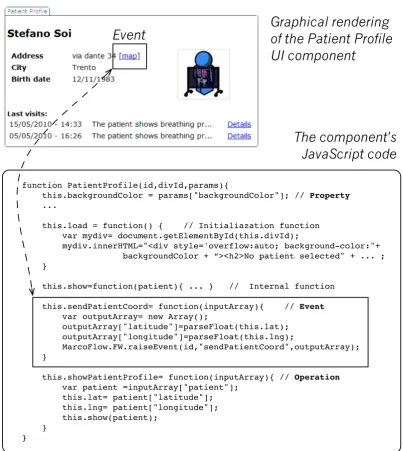
which can be components developed in-house (like the Patient Profile
component) or sourced from the Web (like the Map component); service
orchestrations are based on web services. The UI exposes the state of the
2.3. DISTRIBUTED USER INTERFACE ORCHESTRATION: DEFINITIONS, REQUIREMENTS, AND ARCHITECTURE
application and allows users to interact with the application and to enact
service calls. The two applications for the operator and the assistant are
instantiated in different web browsers, contributing to the distribution of
the overall UI and raising the need for synchronization.
The key idea to approach the coordination of (i) UI components inside
web pages, (ii) web services providing data or application logic, and (iii)
individual pages, as well as the people interacting with them, is to split the
coordination problem into two layers: intra-page UI synchronization and
distributed UI synchronization and web service orchestration. We call an
application that is able to manage these two layers in an integrated fashion
a distributed UI orchestration [29].
2.3.1 Requirements and approach
Supporting the development of distributed UI orchestrations is a complex
and challenging task. Especially the aim of providing a development
ap-proach that is able to cover all development aspects in an integrated fashion
poses requirements to the whole life cycle of UI orchestrations, in
particu-lar, in terms of design, deployment, and execution support.
Indeed, supporting thedesign of distributed UI orchestrations requires:
• Defining a new type of component, the UI component, which is able
to modularize pieces of UI and to abstract their external interfaces.
For the description of UI components, we slightly extend WSDL [20],
obtaining what we call WSDL4UI, a language that is able to deal
with the novel technological aspects that characterize UI components
by reusing the standard syntax of WSDL.
• Bringing together the needs of UI synchronization and service
orches-tration in one single language. UIs are typically event-based (e.g.,
user clicks or key strokes), while service invocations are coordinated
via control flows. In this chapter, we show how to extend the standard
BPEL [64] language in order to support UIs. We call this extended
language BPEL4UI.
• Implementing a suitable, graphical design environment that allows
developers to visually compose services and UI components and to
define the grouping of UI components into pages. BPEL comes with
graphical editors and ready, off-the-shelf runtime engines that we can
reuse. For instance, we extend the Eclipse BPEL editor with
UI-specific modeling constructs in order to design UI orchestrations and
generate BPEL4UI in output.
Supporting the deployment of UI orchestrations requires:
• Splitting the BPEL4UI specification into the two orchestration layers
for intra-page UI synchronization and distributed UI synchronization
and web service orchestration. For the former we use a lightweight
UI composition logic, which allows specifying how UI components are
coordinated in the client browser. For the latter we rely on standard
BPEL.
• Providing a set of auxiliary web services that are able to mediate
communications between the client-side UI composition logic and the
BPEL logic. We achieve this layer by automatically generating and
deploying a set of web services that manage the UI-to-BPEL and
BPEL-to-UI interactions.
Supporting the execution of UI orchestrations requires:
• Providing aclient-side runtime framework for UI synchronization that
is able to instantiate UI components inside web pages and to propagate
2.3. DISTRIBUTED USER INTERFACE ORCHESTRATION: DEFINITIONS, REQUIREMENTS, AND ARCHITECTURE
Event buffer/ proxy WSDLs
UI engine client (web browser) UI engine client (web browser)
BPEL4UI editor Web service WSDLs UI component WSDL4UIs BPEL4UI Compiler BPEL engine UI engine server (web server) UI engine client (web browser)
UI event bus
BPEL4UI BPEL UI2BPEL communication BPEL2UI communication JSON via HTTP XML via SOAP SOAP web services Application developer System configuration Design time Deployment time Runtime
JS via HTTP
Layout and UI logic generator BPEL generator Comm. services generator A B C UI components
A B C
UI component container
JSON via HTTP
XML via SOAP
XML via SOAP Layout
configurator UI partner link
configurator HTML templates UI compositions Layout and UI logic System components Document flows System/human communications Automatically generated elements
Event forwarderEvent forwarderEvent forwarders Notification handler Notification handler Notification handlers Event proxy Event proxy Event buffer Event proxy Event proxy Event proxy Users
component may be propagated to components running in the same
web page or in other pages of the application as well as to web services.
• Providing a communication middleware layer that is able to run the
generated auxiliary web services for UI-to-BPEL and BPEL-to-UI
communications. We implement this layer by reusing standard web
server technology able to instantiate SOAP and RESTful web services.
• Setting up a BPEL engine, in charge of orchestrating web services
and distributed UI-to-UI communications, and implementing a
man-agement console for both developers and participants in UI
orchestra-tions, enabling them to deploy UI orchestraorchestra-tions, to instantiate them,
and to participate in them as required.
These requirements and the respective hints to our solution show that
the main methodological goals in achieving our UI orchestration approach
are (i) relying as much as possible on existing standards (to start from a
commonly accepted and known basis), (ii) providing the developer with
only few and simple new concepts (to facilitate fast learning), and (iii)
implementing a runtime architecture that associates each concern with the
right level of abstraction and software tool (to maximize reuse), e.g., UI
synchronization is handled in the browser, while service orchestration is
delegated to the BPEL engine.
2.3.2 Architecture
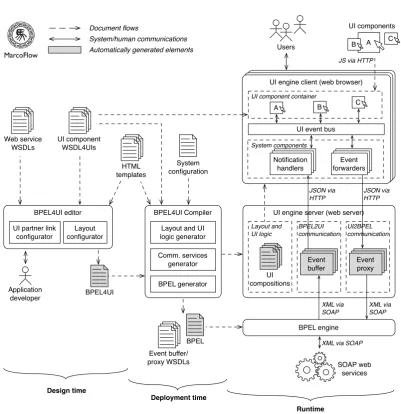
A possible system architecture that meets the above requirements is shown
in Figure 2.2. It is the architecture of our MarcoFlow platform, which
has been developed jointly by Huawei Technologies and the University of
Trento. For presentation purposes, we discuss a slightly simplified version
and partition its software components into design time, deployment time,
2.3. DISTRIBUTED USER INTERFACE ORCHESTRATION: DEFINITIONS, REQUIREMENTS, AND ARCHITECTURE
The design part comprises a BPEL4UI editor, which comes with a
UI partner link configurator, enabling the setup of UI components inside
a UI orchestration, and a layout configurator, assisting the developer in
placing UI components into pages. Starting from a set of web service
WSDLs, UI component WSDL4UIs, and HTML templates the application
developer graphically models the UI orchestration, and the editor generates
a corresponding BPEL4UI specification in output, which contains in a
single file the whole logic of the UI orchestration.
Thedeployment of a UI orchestration requires translating the BPEL4UI
specification into executable formats. In fact, as we will see, BPEL4UI is
not immediately executable neither by a standard BPEL engine nor by the
UI rendering engine (the so-called UI engine in the right hand side of the
figure). This task is achieved by the BPEL4UI compiler, which, starting
from the BPEL4UI specification, the set of used HTML templates and UI
component WSDL4UIs, and the system configuration of the runtime part
of the architecture, generates three kinds of outputs:
1. A set of communication channels (to be deployed in the so-called UI
engine server), which mediate communications between the UI engine
client (the client browser) and the BPEL engine. These channels are
crucial in that they resolve the technology conflict inherently present
in BPEL4UI specifications: a BPEL engine is not able to talk to
JavaScript UI components running inside a client browser, and UI
components are not able to interact with the SOAP interface of a
BPEL engine. For each UI component in a page, the compiler
there-fore generates (i) an event proxy that is able to forward events from
the client browser to the BPEL engine and (ii) an event buffer that is
able to accept events from the BPEL engine and store them on behalf
of the UI engine client. The compiler also generates suitable WSDL
2. A standard BPEL specification containing the distributed UI
synchro-nization and web service orchestration logic (see Section 2.6.1). Unlike
the BPEL4UI specification, the generated BPEL specification does no
longer contain any UI-specific constructs and can therefore be
exe-cuted by any standards-compliant BPEL engine. This means that all
references to UI components in input to the compilation process are
rewritten into references to the respective communication channels of
the UI components in the UI engine server, also setting the correct,
new SOAP endpoints.
3. A set of UI compositions1 (one for each page of the application)
con-sisting of the layout of the page, the list of UI components of the page,
the assignment of UI components to place holders, the specification
of the intra-page UI synchronization logic (see Section 2.6.1), and a
reference to the client-side runtime framework. Interactions with web
services or UI components running in other pages are translated into
interactions with local system components (the notification handlers
and event forwarders), which manage the necessary interaction with
the communication channels via suitable RESTful web service calls.
Finally, the BPEL4UI compiler also manages the deployment of the
gen-erated artifacts in the respective runtime environments. Specifically, the
generated communication channels and the UI compositions are deployed
in the UI engine server and the standard BPEL specification is deployed
in the BPEL engine.
The execution of a UI orchestration requires the setting up and
co-ordination of three independent runtime environments: First, the
inter-action with the users is managed in the client browser by an event-based
JavaScript runtime framework that is able to parse the UI composition
2.3. DISTRIBUTED USER INTERFACE ORCHESTRATION: DEFINITIONS, REQUIREMENTS, AND ARCHITECTURE
stored in the UI engine server, to instantiate UI components in their
re-spective place holders, to configure the notification handlers and event
forwarders, and to set up the necessary logic ruling the interaction of the
components running inside the client browser. While event forwarders are
called each time an event is to be sent from the client to the BPEL engine,
the notification handlers are active components that periodically poll the
event buffers of their UI components on the UI engine server in order to
fetch possible events coming from the BPEL engine.
Second, the UI engine server must run the web services
implement-ing the communication channels. In practice we generate standard Java
servlets and SOAP web services, which can easily be deployed in a common
web server, such as Apache Tomcat. The use of web server technology is
mandatory in that we need to be able to accept notifications from the BPEL
engine and the UI engine client, which requires the ability of constantly
listening. The event buffer is implemented via a simple relational database
(in PostgreSQL, http://www.postgresql.org) that manages multiple UI
components and distinguishes between instances of UI orchestrations by
means of a session key that is shared among all UI c
![Figure 2.4: Simplified WSDL4UI meta-model (inspired by [23] and extended – via thegray boxes – toward UI components).](https://thumb-us.123doks.com/thumbv2/123dok_us/542088.2053621/53.595.112.522.230.539/figure-simplied-wsdl-model-inspired-extended-thegray-components.webp)
![Figure 2.6: Simplified BPEL4UI meta-model in UML. White classes correspond to stan-dard BPEL constructs [89]; gray classes correspond to constructs for UI and user man-agement.](https://thumb-us.123doks.com/thumbv2/123dok_us/542088.2053621/58.595.89.476.260.572/figure-simplied-correspond-constructs-classes-correspond-constructs-agement.webp)