Real-time Resource Positioning System based on Wireless
Sensor Network in Manufacturing Workshop
https://doi.org/10.3991/ijoe.v13i06.6933
Shaobo Li
Chinese Academy of Sciences, Chengdu, China Guizhou Unversity, Guiyang, China
Jinglei Qu
Chinese Academy of Sciences, Chengdu, China [email protected]
Chenglong Zhang Guizhou Unversity, Guiyang, China
Abstract—Discrete manufacturing enterprise has a complex and varied pro-duction process, resulting in the dynamic characteristics of manufacturing re-sources. Aiming at the efficient collection and management of manufacturing resource information, improving the intellectualization of enterprises with a re-al-time resource positioning system based on wireless sensor network was pro-posed. First, a perceptual model for resource positioning, which can collect and analyze real-time resource information in the workshop, was designed. Second, the architectural structure of a real-time resource positioning system was de-signed based on wireless sensor network, and the resource positioning flow was illustrated. Third, a multi-sensor positioning data fusion algorithm based on fuzzy evidence theory was proposed to address the low positioning accuracy caused by the electromagnetic interference and obstacle in the manufacturing workshop environment. Finally, a prototype system was implemented to demonstrate the validity of the method in practice.
Keywords—resource positioning, wireless sensor network, intelligent work-shop, internet of manufacturing things
1
Introduction
tools, processing environments, and employees have dynamic characteristics [4,5]. To effectively manage manufacturing resources, ensure production safety, and improve production efficiency, as well as enhance the intelligent level of manufacturing, col-lecting real-time resource positioning information is necessary.
The global positioning system (GPS) is affected by the constraints of the manufac-turing workshop environment and the costs of installation; thus, it fails to effectively solve the positioning problem in discrete manufacturing workshops. With the rapid development of the wireless sensor network (WSN) technology, a low-consumption, low-cost sensor node is applied in many fields [6!9], including smart group network, smart industry, mine check and so on. However, the positioning system in manufac-turing workshops has low accuracy because of the influence of electromagnetic inter-ference and obstacle in such environment.
To locate manufacturing resources and to improve the positioning accuracy in workshops, this paper first proposes a perceptual model for resource position. Second, the architectural structure of a real-time resource positioning system is designed based on the perceptual model, and a multi-sensor positioning data fusion algorithm is then presented. Finally, a prototype system is implemented and demonstrated the solution is feasible and efficient.
2
Perceptual Model for Resource Positioning
To satisfy the requirement of the workshop resource positioning in discrete manu-facturing enterprises, the interconnection between the automatic control equipment and the manufacturing execution systems of the workshop is realized using IoMT technologies.
Resource Positioning Data Collection in Intelligent Workshop based on WSN
Location Data Collection Data Management Material information management Employee information management Product quality management Production environment control Equipment Information System Production task scheduling Process optimal control Process monitoring collaboration Manufacturing Data Application
Data Integration Interface Enterprise Resource Management Systems Manufacturing Process Control Systems
ERP
CRM WMS!!! SCM
PLM
PDM MES CAPP
PLC DCS DNC QMS!!! Basic Support Systems Database Computer operating system Computer hardware Network communication Others
Employee Equipment InformationStorage Production Phase Environmental Monitoring
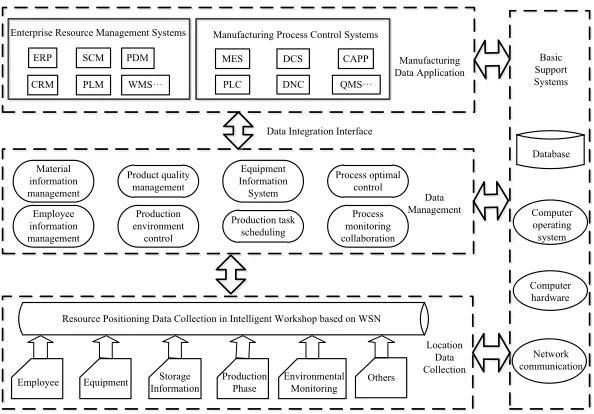
The perceptual model for resource positioning in manufacturing workshops, which is based on the intelligent workshop wireless acquisition terminal, is presented in Fig. 1. According to the matched effective resource tags, the real-time acquisition and analysis of the resource information in the workshop is realized. By improving the integrity of the manufacturing data and strengthening the management and business application of manufacturing information, the proposed model can monitor and ana-lyze the manufacturing process, predict product quality, and provide reference for decision-makers.
3
System Structure and Principle
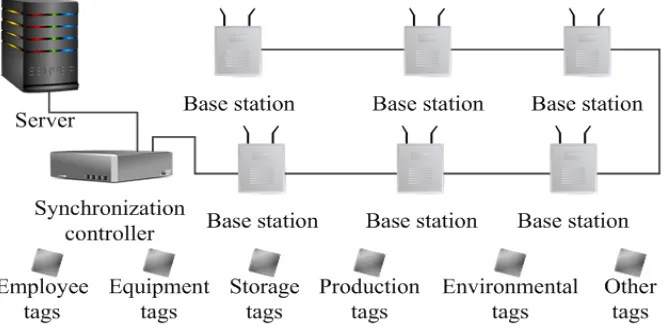
The real-time resource positioning system based on wireless sensor network is mainly composed of hardware and software systems. The hardware system includes tags, readers, uninterruptible power supply, network communication equipment and management servers. This system is used to identify and collect manufacturing re-source data, such as employee, material, and storage information. The collected in-formation is transmitted to the location software system for analysis and processing through a wireless communication network. The software system is mainly utilized for data acquisition, processing, display, and storage. Furthermore, the software sys-tem can communicate with the enterprise resource management and manufacturing process control systems to transmit data through the data integration interface. Work-shop managers can visually obtain the statuses of manufacturing resources through the graphical interface of the software.
The workshop environment has strong electromagnetic interference with widely distributed data collection points. Considering the actual demand, as well as the relia-bility, real-time caparelia-bility, and scalability of the system, a real-time resource position-ing system was proposed based on WSN. The architectural structure of the system is shown in Fig. 2.
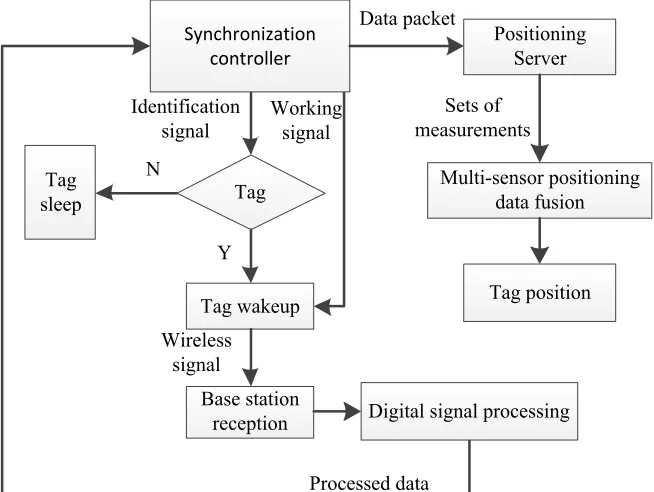
A working flow chart of the system is shown in Fig. 3. After entering the position-ing network, positionposition-ing tags are activated upon receivposition-ing the identification signal sent out by the synchronization controller. When the activated tags receive the work-ing signal, it will send out real-time wireless signals. Readers receive the signals from the tags through the antenna, and the signals that arrived at different times are pro-cessed to generate the time difference data packets. Data packets are transmitted to the synchronization controller through the network. The positioning server then calcu-lates the position of the tag according to the data packets. The practical application of the measurement data of each sensor is not completely reliable due to interference from the working environment and human factors. A large deviation measurement or even wrong information will affect the accuracy of data fusion and even lead to wrong fusion results. To solve this problem, multi-sensor position data fusion algo-rithm is designed. According to the measured position values obtained from multiple base stations, the system can improve positioning accuracy by filtering and fusing redundant information among multiple sets of measurements.
Positioning Server
Multi-sensor positioning data fusion Data packet
Tag Identification
signal
Tag sleep
Tag wakeup N
Y
Base station reception
Working signal
Wireless signal
Processed data
Digital signal processing Tag position Sets of
measurements !"#$%&'#()*+('#,
$'#+&'--.&
Fig. 3. Resource positioning flow chat
4
Multi-sensor Positioning Data Fusion Algorithm
= 1, 2, ..., n). Based on the principle of evidence theory, all measurements {Z1, Z2,...,
Zn} are used as discernment frame !, and then converted into evidence for further combination. Owing to the influence of ambient noise and the accuracy of sensors, the measurements can be regarded as the superposition of the true value and the noise. All the measurements within the normal deviation range are constantly centered on the true value and scattered in the neighborhood. The measurement error of sensors ap-proximation obeys a normal distribution, and we selected the normalized distribution function as the membership function.
µij is defined as the membership degree of Zj to Zi for the measurement Zi in the identification frame.
(
x xi j) (
2+y yi j)
2 ije
µ
! " #$ # # % & '
=
(1)The larger the µij, the nearer Zj is to Zi, which indicates that Zj has a higher degree of support to Zi. On the contrary, it has a lower degree of support. To the discernment frame !, the membership degree matrix of n measurements for each other is given as:
11 12 1 21 22 2
1 1
n n
n n nn
U
µ
µ
µ
µ
µ
µ
µ
µ
µ
!
"
#
$
#
$
=
#
$
#
$
%
&
!
!
"
"
"
!
(2)
Membership degree vector pi(i=1,2,…,n) is the i-th row of the membership matrix
U, pi=(µi1, µi2,…, µin), which indicates the membership degree vector of Zi to the discernment frame !. The length of vector
p p
i!
j is called the Euclidean distance of pi and pj, which represents the confidence distance measure of Zi and Zj, and it is denoted by:(
)
1
n
ij i j ik jk
k
d
p p
µ
µ
=
=
!
=
"
!
(3)The confidence distance of any two measurements should be symmetric; thus, dij =
dji, and the confidence distance from Zi to Zj is equal to the confidence distance from
Zj to Zi. The higher the confidence distance value, the greater the difference and the lower the mutual support between Zi and Zj.
The mean square Euclidean distance of Zi to all measurements is si, which refers to the difference degree between Zi and other measurements.
2 1
1
ni ij
j
s
d
n
=1
1
n i is
s
n
==
!
(5)A smaller si indicates that Zi has minimal difference with others, which means that
Zi has a high degree of reliability. On the contrary, a larger si represents the singulari-ty of measurement Zi; thus, it has low credibility.
Based on the reliability evaluation of the measurements, a basic trust assignment method is proposed to convert Zi to evidence ei. If the mean square Euclidean distance of the measurement is too large, then it has a large deviation that should be removed. Otherwise, it is an effective measurement, and the basic trust allocation should meet the following formula:
( )
( )
( )
1 2 1 20
i j j
i j j
j j
i j
m Z
,s
s
m Z
s
,s
s
s
m Z
!
!
"
=
>
##
$
=
%
#
#&
(6)where Zj1 and Zj2 are any two valid measurements, and " is the threshold coefficient.
After a number of groups of data fusion experiments, a generally better result is ob-tained by taking " = 1.25. In the actual operation of the process, (6) is used to obtain
the set of confidence coefficients {#i}(i=1,2,…,n).
Confidence coefficient is used to normalize and to revise the weight of the mem-bership degree of each measurement. The basic trust assignment is then obtained, and the measurement value is completely transformed in the evidence conversion.
( )
1
n
i j j ij k ik
k
m Z
!
µ
/
!
µ
=
=
"
(7)Equation (7) meets the quality of the basic trust distribution function in evidence theory. This method reduces the influence of a large deviation measurement on the fusion by evaluating the reliability of the sensor.
A high degree of conflict between the generated evidence, which leads to the para-dox of inference results, may be observed. Thus, the probability of supporting evi-dence conflict is distributed to each measurement in the evievi-dence combination process using the combination formula (8).
( )
( )
( )
1
n
i j i j i
j
m Z
m Z
cm Z
=
=
!
+
, (8)where c is the conflict factor.
( )
1 11
n n j ii j
c
m x
= =
( )
j im Z
is the mean value of basic trust assignment of Ziin the evidence.( )
( )
1
1
nj i j i
j
m Z
m Z
n
==
!
(10)The combined evidence m(Zi) is the weight coefficient of Zi. Finally, the position data fusion result is
( )
0 1
n
i i i
Z
Z m Z
=
=
!
(11)5
System Implementation
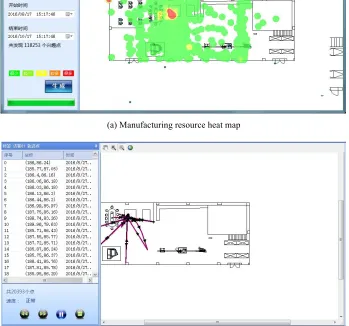
The real-time resource positioning system uses the hierarchical B/S structure de-sign, Visual Studio 2015 as the development platform and C# as the programming language. The resource position scenario is constructed based on Geographic Infor-mation System. The system development includes the interface design and implemen-tation, the database, and the software functions. The function module is mainly divid-ed into the information management, real-time positioning, management, and re-source tracking modules. Parts of the system application interface are shown in Fig. 4, where (a) is the manufacturing resource heat map and (b) is the manufacturing re-source positioning and tracking map.
6
Conclusion
Based on the wireless data acquisition terminal in the intelligent workshop, this paper established a resource positioning perceptual model. The architectural structure of real-time resource positioning system was designed based on WSN, and the re-source positioning flow was illustrated. To improve the positioning accuracy of the system, a multi-sensor positioning data fusion algorithm was proposed. Finally, the position system was developed. In the following work, how to use resource data to monitor and analyze the manufacturing process and provide reference for decision-makers will need to be further study.
7
Acknowledgment
(a) Manufacturing resource heat map
(b) Resource positioning and tracking map
Fig. 4. Part of the system application interface
8
References
[2] Chen Weixing, Li Shaobo, Huang Haisong. Active perception and management model for manufacturing data in discrete IoMT-based process. Computer Integrated Manufacturing Systems, vol. 22, no.1, pp. 166-176, 2016. https://doi.org/10.13196/j.cims.2016.01.016 [3] Pietro Gonizzi, Gianluigi Ferrari, Vincent Gay, and Jérémie Leguay, Data dissemination
scheme for distributed storage for IoT observation systems at large scale. Information Fu-sion, vol. 22, pp. 16-25, 2015. https://doi.org/10.1016/j.inffus.2013.04.003
[4] Asato Osvaldo L., Pessoa Marcosiris A. O., Junqueira Fabrício. Using the enhanced-mark flow graph for dynamic resource allocation in distributed manufacturing. International Journal of Computer Integrated Manufacturing, vol. 29, no. 11, pp. 1238-1251, 2016. https://doi.org/10.1080/0951192X.2015.1126000
[5] Su Kaikai, Xu Wensheng, Li Jianyong. Manufacturing resource allocation method based on bi-level programming in cloud manufacturing. Computer Integrated Manufacturing Systems, vol. 21, no. 7, pp. 166-176, 2016. https://doi.org/10.13196/j.cims.2016.01.016 [6] Hou Liqun, Yang Lei. Design and implementation of an industrial wireless sensor
net-work for temperature monitoring. International Journal of Online Engineering, vol. 12, no. 3, pp. 82-85, 2016. https://doi.org/10.3991/ijoe.v12i03.5322
[7] Hua Li, Da Xu, Jian Zhang. Design of a state monitoring system for equipment based on the Zigbee wireless sensor network. International Journal of Online Engineering, vol. 12, no. 6, pp. 20-23, 2016. https://doi.org/10.3991/ijoe.v12i06.5516
[8] Yu Xiaoqing, Han Wengting, Zhang Zenglin. Remote monitoring system for intelligent irrigation in hybrid wireless sensor networks. International Journal of Control and Auto-mation, vol. 8, no. 3, pp. 185-196, 2015. https://doi.org/10.14257/ijca.2015.8.3.20 [9] Zhang Lieping, Peng Fei, Cao Peng. An improved three-dimensional DV-Hop
localiza-tion algorithm optimized by adaptive cuckoo search algorithm. Internalocaliza-tional Journal of Online Engineering, vol. 13, no. 2, pp. 102-118, 2017. https://doi.org/10.3991/ijoe. v13i02.6358
9
Authors
Shaobo Li is currently a professor of School of Mechanical Engineering at Gui-zhou Unversity, Guiyang, China, 550025. His research interests include computation-al intelligence, manufacturing information system and internet things of technology. He is a member of the IEEE, CMES and CCF ([email protected]).
Jinglei Qu is now pursuing his doctor degree in Chengdu Institute of Computer Application at Chinese Academy of Sciences, Chengdu, China, 550025. His research interests include computational intelligence, manufacturing information system and data mining ([email protected]).
Chenglong Zhang is now pursuing his master degree in college of big data and in-formation engineering at Guizhou University, Guiyang, China, 550025. His research interests include wireless sensor network (995010174 @qq.com).