Energy Audit: A Case Study
Sanjay Kumar
#1, Tarlochan Kaur
#2#Electrical Engineering Department, University of Technology PEC INDIA
1
[email protected] [email protected]
Abstract— This India is the Fifth largest producer of Electrical energy in the world. Despite such achievements the gap between demand and supply of electrical energy is increasing every year and power sector is highly capital – intensive. Thus the deficit in installed capacity was nearly 10000MWper year. So the gap between demand and supply is continuously increasing day by day. An energy audit is a study of a plant or facility to determine how and where energy is used and to identify methods for energy savings. The opportunities lie in the use of existing renewable energy technologies, greater efforts at energy efficiency and the dissemination of these technologies and options. This thesis provides an overview of a general energy conservation measures (ECMs) that can be commonly recommended for NIT Hamirpur. It should be noted that the Energy auidut presented in this paper does not pretend to be exhaustive nor comprehensive. It provides merely to indicate some of the options that energy auditor can consider when performing an analysis of this institute. Energy conservation and exploration of new energy avenues are the well accepted solution to fulfil the demand in future. The total cost of energy plays a vital role in determining the product cost of a commodity. Therefore the identification of potential energy savings and implementation for a given institutional facility is unimportant to ensure its competitive advantage over other institute. This paper work presents such energy saving methods in a methodological approach, experienced during a detailed energy audit of NIT Hamirpur.
Keywords
—
Energy Audit, Energy Conservation, Data CollectionI. INTRODUCTION
Energy is one of the major inputs for the economic development of any country. Power capacity has risen at the rate of 5.87% per annum over the last 25 years. In 2011-12, India was the fourth largest consumer in the world of Crude Oil and Natural Gas, after the United States, China, and Russia. The total installed capacity for electricity generation in the country has increased from 16,271 MW as on 31.03.1971 to 2,36,387 MW as on 31.03.2012, registering a compound annual growth rate (CAGR) of 6.58% [1]. So some steps are required to conserve the energy globally using systematic approach. However a more comprehensive method in checking energy usage and wastage is the "Energy Audit". Energy audits do not provide the final answer to the problem. This identifies where the potential for improvement lies, and therefore, where energy management efforts must be directed. An energy audit is first step towards understanding how energy is being used in a given facility. Energy Audit is considered as one of the
comprehensive methods in checking the energy usage and wastage in buildings. The process of energy audit includes, historical energy data collection, formulation of energy audit programme to the actual implementation. There is now a universal recognition of the fact that new technologies and much greater use of some that already exist provide the most hopeful prospects for the future. The energy process is an organized approach to identify energy waste in a facility, determining how this waste can be eliminated at a reasonable cost with a suitable time frame. Energy audit is widely used and many have different meaning depending on energy service companies. Energy auditing of a building can range from a short a walkthrough of the facility to a detailed analysis. However, there is an occasion where coexisting of the saving of energy and the comfort of the life become difficult when promoting energy saving. In the present study, Electrical engineering Department of NIT Hamirpur located in India; that is very lookalike Institutional building used for the public welfare located in the Himachal Pradesh; is selected for the research object, and we intended on the energy saving of the department facilities. Regarding to the energy saving of the department, a energy audit was made and some directions leading to the energy saving as much as possible are proposed in this paper.
II. ENERGY AUDIT METHODOLOGY
Effective Energy audit is a process that consists of four steps:
Step 1. Identify all the Opportunities
Step 2. Prioritize the activities rationally
Step3.Accomplish the activities successfully
Step 4. Maintain the activities throughout the life of the facility
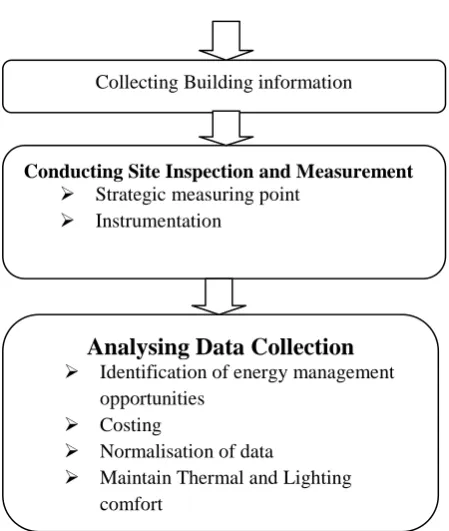
By using these simple steps the scopes of works and the available resources for conducting the energy audit should be determined. This part of energy audit specifies the scope and potential of energy saving through energy audit. A simple methodology implemented in this paper is defined by the flow chart infig.1
Forming Energy Audit Plan
Fig1. Flow Chart on Conducting Energy Audit
III.CASESTUDY
The purpose of the NIT Hamirpur Survey is to determine the general condition of the institution with respect to energy performance and the institutional potential willingness to improve the institute’s energy performance. This energy audit is aimed at obtaining a detailed idea about the various end use energy consumption activities and identifying, enumerating and evaluating the possible energy savings opportunities. The target is to achieve savings in the electrical energy consumption to the extent of 20%.
A. Energy auditing survey of electrical engineering department
The loads were segregated based on the end use as lighting and fans, air conditioning, Computer/printers, machines etc. The details are given below.
Fig 2.Total connected load in electrical engineering Department
B. Electrical lighting detail in electrical engineering department
The loads connected to the Electrical engineering department lecture halls are given in table below the load of EE-1 lecture hall are shown below. But the connected load for all three are same as of EE-1.The energy consumed by three lecture hall in perday is about 8.52 kWh.
Fig 3.Details of Electrical lighting in Electrical Engg. Department per Day
C. Details of fans and acs in electrical engineering department
Ceiling mount fans are a much better option for staying cool in summer, than rushing off to the big box store and buying a cheap room air conditioner. Cheap room air conditioners save money up front, but wind up paying way too much in the long run, because the "big box" stores focus on up-front price, not total operating cost, and more importantly, because even the most efficient ENERGY STAR room air conditioner is going to use way more electricity than most ceiling mount fans for the same amount of cooling. There are 14 ACs and174 fans.
Energy consumption due to fans and Acs in Electrical Engineering Department are shown in fig. below.
Fig 4. Energy consumption due to Fans and Acs in EE Department
Collecting Building information
Conducting Site Inspection and Measurement Strategic measuring point
Instrumentation
Analysing Data Collection
Identification of energy managementopportunities
Costing
Normalisation of data
D. Existing electrical configuration of lecture hall
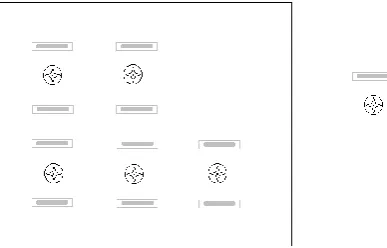
The existing electrical configuration of lecture hall of electrical engineering department is same for all lecture halls as shown in fig 5.
Fig 5. EE –I Classrooms existing configuration
E. Electricity bills data collection
For energy auditing of Electrical Engg. it is necessary to analysis of consumption of electrical energy previous years. The electricity bills data of electrical engineering department is collected from 2008 to 2010, April. The collected data is visualized through graph then only wastage of energy consumption can be easily identified for making recommendations to high authority. This collected data of electricity bills of electrical engineering department is taken from records of that department. The graph for units consumed by the electrical engineering department during collected period is shown below
Fig 6. Units Pattern Characteristics
The graph for electricity bill payment by the electrical engineering department during three years is plotted.
Fig 7. Electricity Bill Payment
F. Analysis of collected electricity bills
1. There is a sudden increase in the energy consumption during the months of Jan, Feb and mar of 2010 year because of construction work happened at that time.
2. But there a gradual increase in the energy consumption during months of August, September and Oct of 2009. The reason being of gradual increasing energy consumption is due to switching electricity lamps in the floors of civil engineering department even during afternoon periods. By this the gradual increase in energy consumption can be reduced and energy can be saved.
IV.MEASUREMENTSANDCALCULATION
G. LUX METER READING
The LUX meter reading in various department are shown in Table 1 .These measurement are compared with existing standard. So these are not appropriate as desired.
TABLE1LUX METER READINGS FOR DEPARTMENTS
LUX Measuring area
Only day light With daylight+lights
Machine Lab 120,113,98 141,151,148
Net lab 131,157 145,180
EE-1 210,176 224,207
EE-2 196,215 211,225
EE-3 192,209 214,218
H. Calculation for energy conservation in computers
Mostly the per day operating hours of computers in department are 7 hours.LCD consume 60 W and monitors consume 66W.The power consumption by the computer under different modes of operation. If we will consider that all these system will operate for 7 hour then energy consumption. If we will consider that all these system will operate for 7 hour then energy consumption. We can reduce operating to 5 hours by putting the entire computer to sleep mode for2 hours. Then yearly energy conservation can be achieved near about 37.5 KWH
.
TABLE2 ENERGY CONSUMED IN VARIOUS MODE OF OPERATION OF COMPUTER
Sr.No. System Equipment Mode of Operation
Power (watt) 1 ACER LCD
Monitor
ON 28.3
2 IBM CPU ON 58.3 3 ACER CPU ON 54 4 IBM Monitor ON 58.1 5 IBM System Sleep
Mode
4.0
I. Choosing a ceiling mount fan – size
The size of ceiling mount fan can choose will depend on room size, andfor very large rooms,on the number of fans you decide to install.
Under 36" Fans with a blade diameter under 3 feet are intended for compact rooms –less than 80 square feet or 7 square meter ,for instance an 8*10 or 9*9 rooms.
36 to 42" Fans with a blade diameter under 3 to 3.5 feet are suitable up to 150 square feet or 14 square meters-a 10*15 or 12*12 foot room.
42 to 48"Good for rooms of 150-225 square feet or 14-21 square meters.
Formula used to install two consecutive fans
Min. Clearance = 2 (Dia of the circle traced by fan blade)
J. Calculation for installing install occupancy sensors
In areas such as Classrooms, compressed air room, rest room, office rooms, conference room, etc.,sometimes lights are kept on when they are not occupied, resulting in wasted energy consumption. Since the best way to save energy on lighting is to switch off when it is not needed, installing
occupancy sensors will help to improve the situation so that lighting is on only when and where needed.
Assume that the total power drawn by the lighting fixtures are estimated as: 144 fixtures x 0.190 W/fixture = 27.36 kW For the purpose of illustration, assume a saving of just over 50% on average. Therefore the electrical usage savings from installing sensors will be approximately 15 kW. If the lighting is on for about 8,000 hours per year, annual electrical energy savings will be approximately:15 kW x 8,000 hours/year x $0.075/kWh = $9,000/year.
Simple pay back assuming that 8 sensors are needed for office environment and12 sensors for the industrial floor area. The cost of the office and the industrial environment is $50 and $150 respectively. It is also estimated that 30 hours are+ ($ required to install sensors with a labor cost of $25/Hour. Therefore, the implementation cost is ($50 x 8) 150 x 12) + (30 x $25) = $2,950A simple payback period for this recommendation will be $2,950/$9,000 = 0.32 Years
V. PROPOSED RECOMMENDATIONS FOR ENERGY CONSERVATION
The general recommendations are presented here. The savings due to their implementation could not be easily quantified, but their importance cannot be understated. Implementing all these measures, a total saving of 20-25% can be achieved without compromising much on the existing facilities and comforts.
K. Reduce lighting
There are a couple of ways to do this is to take advantage of natural daylight. Turning lights off or dimming them during the day allows for lower energy costs and a more comfortable environment. Need more light on a work surface use task lights?
L. Use timers and sensors
The installation of occupancy sensors, timers, or photocells will ensure that interior and exterior lights are turned off at the appropriate time. These inexpensive devices can reduce lighting costs by up to 40 percent by turning off lights in unoccupied areas. In closets and restroom install motion sensors or timers so that the lights are off when no one is using the room.
M. Replace incandescent bulbs with compact fluorescent lamps (CFLS)
This type of bulbs can last up to ten times longer and provide the same amount of light as standard incandescent bulbs. Replace incandescent lights in exit signs with LED fixtures, which can reduce costs of these signs by up to 95 percent.
N. Use of motion sensor
Sensor Do not detect movement for quite long time according to the area usage class, then it shall start to power down and reduce energy wastage. This is the main concept behind it. Actually there are two types of motion sensors, one
is
occupancy type and one is normal type. Each one of those types is also work in different topology, wither stand alone type, or part of a system.O. Motion sensor light switch
Fit a motion sensor light switch to automatically switch off lights when a room is empty. The Motion Sensor Light Switch pictured above is a new product which will only turn lights on in a room when it is occupied. By automatically turning off the lights when no-one is in the room, the manufacturers claim that an average of 128 hours of unnecessary lighting will be avoided reducing electricity consumption for the lighting by 10%.
VI.SIMPLE STEPS TOWARDS ENERGY CONSERVATION IN LIGHTING
Using task lighting to target work and leisure activities. This helps reduce overall room lighting levels. Using energy-efficient compact fluorescent bulbs—especially in fixtures that operate more than two hours a day. They cost more initially but use 75 percent less electricity and last about ten times longer than incandescent bulbs.
Long-life bulbs emit less light than standard incandescent bulbs of the same wattage. Use long-life bulbs only in hard-to-reach places. Selecting bulbs carefully; looking for the highest lumens at the lowest wattage. Wattage is the power needed to make a bulb work. Lumens measure brightness. Keep light fixtures clean to gain the most illumination. Cleaning the lamps & fixtures regularly; Illumination levels fall by 20-30% due to collection of dust. Switching of the lights when they are not in use. Photo sensors to be installed in department to utilize optimum day lighting. There are several types of sensors available in the market at affordable prices with the help of which we can save a plenty amount of energy. Natural lighting can be considered for corridors.
VII. CONCLUSION
A well-managed energy program can be a successful method to reduce energy consumption. There are many aspects involved in the aspect, equipment modification, installment of motion switches use of CFL, efficient use of resources. An effective energy program should be able to reduce energy consumption by 2% to 5% per year depending upon the resources available and the current level of energy efficiency. Over time, these energy savings will add up to improve the environment by reducing greenhouse gases and also the cost reduction in electricity bill of department bottom line.
REFERENCES
[1] http://mospi.nic.in/Mospi_New/upload/Energy_Statistics_2013.pdf 1998.
[2] Integrated Energy Policy Report of the Expert Committee Government
ofIndia,http://planningcommission.nic.in/reports/genrep/rep_intengy. pdf.
[3] Nissanga Nishad, Rasanajan Mendis, Nisal Perer, ―Energy Audit: A Case Study‖International Conference on Information and Automation, 2006 , pp: 45 – 50..
[4] Case on Sustainable Energy Audit, http://www.enviromentalentalauiding.
[5] Installation of Ceiling Fan, http://www.ec21.com/product-details/Ceiling-Fan3609910.html
org/portals/0/AuditFiles/China_s_eng Energy_1.pdf.S. Zhang, C. Zhu, J. K. O. Sin, and P. K. T. Mok, ―A novel ultrathin elevated channel low-temperature poly-Si TFT,‖ IEEE Electron Device Lett., vol. 20, pp. 569–571, Nov. 1999.
[6] Lightsensorshttp://www.apollodisplays.com/pdf/Ambient_Light_Sen sor.pdf.
[7] General Electric and lighting
products,http://www.gelighting.com/na/home_lighting/products/ener gy_smart.
[8] Motion Sensor Light Switch ,
http://morethanswitchingoffthelights.blogspot.com/
[9] Detailed information and case studies on energy audits, Sourcehttp:// www.energymanagertraining.com.