Extracting Relation Descriptors with Conditional Random Fields
Yaliang Li†, Jing Jiang†, Hai Leong Chieu‡, Kian Ming A. Chai‡ †School of Information Systems, Singapore Management University, Singapore
‡DSO National Laboratories, Singapore
{ylli,jingjiang}@smu.edu.sg,{chaileon,ckianmin}@dso.org.sg
Abstract
In this paper we study a novel relation extraction problem where a general rela-tion type is defined but relarela-tion extrac-tion involves extracting specific relaextrac-tion descriptors from text. This new task can be treated as a sequence labeling problem. Although linear-chain conditional random fields (CRFs) can be used to solve this problem, we modify this baseline solution in order to better fit our task. We propose two modifications to linear-chain CRFs, namely, reducing the space of possible la-bel sequences and introducing long-range features. Both modifications are based on some special properties of our task. Using two data sets we have annotated, we eval-uate our methods and find that both modi-fications to linear-chain CRFs can signif-icantly improve the performance for our task.
1 Introduction
Relation extraction is the task of identifying and characterizing the semantic relations between en-tities in text. Depending on the application and the resources available, relation extraction has been studied in a number of different settings. When relation types are well defined and labeled relation mention instances are available, supervised learn-ing is usually applied (Zelenko et al., 2003; Zhou et al., 2005; Bunescu and Mooney, 2005; Zhang et al., 2006). When relation types are known but little training data is available, bootstrapping has been used to iteratively expand the set of seed ex-amples and relation patterns (Agichtein and Gra-vano, 2000). When no relation type is pre-defined but there is a focused corpus of interest, unsu-pervised relation discovery tries to cluster en-tity pairs in order to identify interesting relation
types (Hasegawa et al., 2004; Rosenfeld and Feld-man, 2006; Shinyama and Sekine, 2006). More recently, open relation extraction has also been proposed where there is no fixed domain or pre-defined relation type, and the goal is to identify all possible relations from an open-domain cor-pus (Banko and Etzioni, 2008; Wu and Weld, 2010; Hoffmann et al., 2010).
These different relation extraction settings suit different applications. In this paper, we focus on another setting where the relation types are defined at a general level but a more specific relation de-scription is desired. For example, in the widely used ACE1data sets, relation types are defined at a fairly coarse granularity. Take for instance the “employment” relation, which is a major relation type defined in ACE. In ACE evaluation, extrac-tion of this relaextrac-tion only involves deciding whether a person entity is employed by an organization en-tity. In practice, however, we often also want to find the exact job title or position this person holds at the organization if this information is mentioned in the text. Table 1 gives some examples. We refer to the segment of text that describes the specific relation between the two related entities (i.e., the two arguments) as therelation descriptor. This pa-per studies how to extract such relation descriptors given two arguments.
One may approach this task as a sequence label-ing problem and apply methods such as the linear-chain conditional random fields (CRFs) (Lafferty et al., 2001). However, this solution ignores a use-ful property of the task: the space of possible la-bel sequences is much smaller than that enumer-ated by a linear-chain CRF. There are two impli-cations. First, the normalization constant in the linear-chain CRF is too large because it also enu-merates the impossible sequences. Second, the re-striction to the correct space of label sequence per-1Automatic Content Extraction http://www.itl.
nist.gov/iad/mig/tests/ace/
Relation Candidate Relation Instance Relation Descriptor Employment ... saidARG-1, a vice president atARG-2, which ... a vice president (PER, ORG) AARG-2spokesman ,ARG-1, said the company now ... spokesman
AtARG-2, by contrast ,ARG-1said customers spend on ... Nil Personal/Social ARG-1had an elder brother namedARG-2. an elder brother
(PER, PER) ARG-1was born at ... , as the son ofARG-2of Sweden ... the son
ARG-1later marriedARG-2in 1973 , ... married
Through his contact withARG-1,ARG-2joined the Greek Orthodox Church . Nil Table 1: Some examples of candidate relation instances and their relation descriptors.
mits the use of long-range features without an ex-ponential increase in computational cost.
We compare the performance of the baseline linear-chain CRF model and our special CRF model on two data sets that we have manually an-notated. Our experimental results show that both reducing the label sequence space and introducing long-range features can significantly improve the baseline performance.
The rest of the paper is organized as follows. In Section 2 we review related work. We then for-mally define our task in Section 3. In Section 4 we present a baseline linear-chain CRF-based solu-tion and our modificasolu-tions to the baseline method. We discuss the annotation of our data sets and show our experimental results in Section 5. We conclude in Section 6.
2 Related Work
Most existing work on relation extraction stud-ies binary relations between two entitstud-ies. For supervised relation extraction, existing work of-ten uses the ACE benchmark data sets for eval-uation (Bunescu and Mooney, 2005; Zhou et al., 2005; Zhang et al., 2006). In this setting, a set of relation types are defined and the task is to iden-tify pairs of entities that are related and to clas-sify their relations into one of the pdefined re-lation types. It is assumed that the rere-lation type itself is sufficient to characterize the relation be-tween the two related entities. However, based on our observation, some of the relation types defined in ACE such as the “employment” relation and the “personal/social” relation are very general and can be further characterized by more specific descrip-tions.
Recently open relation extraction has been proposed for open-domain information extrac-tion (Banko and Etzioni, 2008). Since there are no fixed relation types, open relation extraction aims at extracting all possible relations between pairs of
entities. The extracted results are (ARG-1, REL,
ARG-2) tuples. The TextRunner system based on (Banko and Etzioni, 2008) extracts a diverse set of relations from a huge Web corpus. These extracted predicate-argument tuples are presum-ably the most useful to support Web search scenar-ios where the user is looking for specific relations. However, because of the diversity of the extracted relations and the domain independence, open rela-tion extracrela-tion is probably not suitable for popu-lating relational databases or knowledgebases. In contrast, the task of extracting relation descriptors as we have proposed still assumes a pre-defined general relation type, which ensures that the ex-tracted tuples follow the same relation definition and thus can be used in applications such as popu-lating relational databases.
In terms of models and techniques, we use stan-dard linear-chain CRF as our baseline, which is the main method used in (Banko and Etzioni, 2008) as well as for many other information extraction problems. The major modifications we propose for our task are the reduction of the label sequence space and the incorporation of long-range features. We note that these modifications are closely re-lated to the semi-Markov CRF models proposed by Sarawagi and Cohen (2005). In fact, the modi-fied CRF model for our task can be considered as a special case of semi-Markov CRF where we only consider label sequences that contain at most one relation descriptor sequence.
3 Task Definition
denote the sequence of tokens in a sentence, where
wp is ARG-1 and wq is ARG-2 (1 ≤ p, q ≤ n,
p 6= q). Our goal is to locate a subsequence
(wr, . . . , ws)(1≤r≤s≤n) that best describes
the relation betweenARG-1andARG-2. IfARG-1
andARG-2are not related through the pre-defined general relation,Nilshould be returned.
The above definition constrains ARG-1 and
ARG-2 to single tokens. In our experiments, we will replace the original lexical strings of ARG-1 and ARG-2 with the generic tokens ARG1 and ARG2. Examples of sentences with the named en-tities replaced with argument tokens are shown in the second column of Table 1.
4 Method
4.1 Representation
The relation descriptor extraction task can be treated as a sequence labeling problem. Letx =
(x1, x2, . . . , xn) denote the sequence of
observa-tions in a relation instance, where xi is wi
aug-mented with additional information such as the POS tag of wi, and the phrase boundary
infor-mation. Each observation xi is associated with
a label yi ∈ Y which indicates whether wi is
part of the relation descriptor. Following the com-monly used BIO notation (Ramshaw and Mar-cus, 1995) in sequence labeling, we define Y =
{B-REL,I-REL,O}. Lety= (y1, y2, . . . , yn)
de-note the sequence of labels for x. Our task can be reduced to finding the best label sequence yˆ
among all the possible label sequences forx.
4.2 A Linear-Chain CRF Solution
For sequence labeling tasks in NLP, linear-chain CRFs have been rather successful. It is an undi-rected graphical model in which the conditional probability of a label sequenceygiven the obser-vation sequencexis
p(y|x,Λ) =
exp“P
i
P
kλkfk(yi−1, yi,x)
”
Z(x,Λ) , (1)
whereΛ = {λk} is the set of model parameters,
fkis an arbitrary feature function defined over two
consecutive labels and the whole observation se-quence, and
Z(x,Λ) =X
y0
exp“ X
i
X
k
λkfk(y0i−1, y0i,x)
” (2)
is the normalization constant.
Given a set of training instances{xj,y∗j}where
y∗j is the correct label sequence for xj, we can
learn the best model parametersΛˆ as follows:
ˆ
Λ = arg min
Λ −
X
j
logp(y∗j|xj,Λ) +β
X
k
λ2k
!
. (3)
HereβPkλ2
kis a regularization term.
4.3 Improvement over Linear-Chain CRFs
We note that while we can directly apply linear-chain CRFs to extract relation descriptors, there are some special properties of our task that allow us to modify standard linear-chain CRFs to better suit our needs.
Label sequence constraint
In linear-chain CRFs, the normalization constant
Z considers all possible label sequences y. For the relation descriptor extraction problem, how-ever, we expect that there is either a single relation descriptor sequence or no such sequence. In other words, for a given relation instance, we only ex-pect two kinds of label sequences: (1) AllyiareO,
and (2) exactly oneyi isB-RELfollowed by zero
or more consecutiveI-REL while all other yi are
O. Therefore the space of label sequences should be reduced to only those that satisfy the above con-straint.
One way to exploit this constraint within linear-chain CRFs is to enforce it only during testing. We can pick the label sequence that has the high-est probability in the valid label sequence space instead of the entire label sequence space. For a candidate relation instancex, letY˜ denote the set
of valid label sequences, i.e., those that have ei-ther one or no relation descriptor sequence. We then choose the best sequenceyˆ as follows:
ˆ
y= arg max
y∈Y˜
p(y|x,Λ).ˆ (4)
Arguably, the more principled way to exploit the constraint is to modify the probabilistic model itself. So at the training stage, we should also con-sider onlyY˜ by defining the normalization termZ˜
as follows:
˜
Z(x,Λ) = X
y0∈Y˜
exp“ X
i
X
k
λkfk(yi0−1, y0i,x)
”
The difference between Equation (5) and Equa-tion (2) is the set of label sequences considered. In other words, while in linear-chain CRFs the cor-rect label sequence competes with all possible la-bel sequences for probability mass, for our task the correct label sequence should compete with only other valid label sequences. In Section 5 we will compare these two different normalization terms and show the advantage of using Equation (5).
Adding long-range features
In linear-chain CRF models, only first-order la-bel dependencies are considered because features are defined over two consecutive labels. Inference in linear-chain CRFs can be done efficiently us-ing dynamic programmus-ing. More general higher-order CRF models also exist, allowing long-range features defined over more than two consecutive labels. But the computational cost of higher-order CRFs also increases exponentially with the order of dependency.
For our task, because of the constraint on the space of label sequences, we can afford to use long-range features. In our case, inference is still efficient because the number of sequences to be enumerated has been drastically reduced due to the constraint. Letg(y,x) denote a feature function
defined over the entire label sequence y and the observation sequencex. We can include such fea-ture functions in our model as follows:
p(y|x,Θ) = 1 ˜
Z(x,Θ) "
exp“P
i
P
kλkfk(yi−1, yi,x)
+P
lµlgl(y,x)
” #
, (6)
where Θ = {{λk},{µl}} is the set of all model
parameters. Both {λk} and {µl} are
regular-ized as in Equation (3). Note that although each
f(yi−1, yi,x)may be subsumed under ag(y,x),
here we group all features that can be captured by linear-chain CRFs under f and other real long-range features under g. In Section 5 we will see
that with the additional feature functions g,
rela-tion extracrela-tion performance can also be further im-proved.
4.4 Features
We now describe the features we use in the base-line base-linear-chain CRF model and our modified model.
Linear-chain features
The linear-chain features are those that can be for-mulated as f(yi−1, yi,x), i.e., those that depend
on x and two consecutive labels only. We use typical features that include tokens, POS tags and phrase boundary information coupled with label values. Let ti denote the POS tag of wi and pi
denote the phrase boundary tag ofwi. The phrase
boundary tags also follow the BIO notation. Ex-amples includeB-NP,I-VP, etc. Table 2 shows the feature templates covering only the observations. Each feature shown in Table 2 is further combined with either the value of the current labelyi or the
values of the previous and the current labelsyi−1
andyito form zeroth order and first order features.
For example, a zeroth order feature is “yiisB-REL
andwi isthe andwi+1 is president”, and a
first order feature is “yi−1 isO and yi is B-REL
andtiisN”.
Long-range features
Long-range features are those that cannot be defined based on only two consecutive labels. When defining long-range features, we treat the whole relation descriptor sequence as a single unit, denoted as REL. Given a label sequence y that contains a relation descriptor sequence, let
(wr, wr+1, . . . , ws)denote the relation descriptor,
that is, yr = B-REL and yt = I-REL where
r + 1 ≤ t ≤ s. The long-range features we
use are categorized and summarized in Table 3. These features capture the context of the entire re-lation descriptor, its rere-lation to the two arguments, and whether the boundary of the relation descrip-tor conforms to the phrase boundaries (since we expect that most relation descriptors consist of a single or a sequence of phrases).
5 Experiments
5.1 Data Preparation
Since the task of extracting relation descriptors is new, we are not aware of any data set that can be directly used to evaluate our methods. We there-fore annotated two data sets for evaluation, one for the general “employment” relation and the other for the general “personal/social” relation.2
The first data set contains150business articles from New York Times. The articles were crawled from the NYT website between November 2009
2http://www.mysmu.edu/faculty/
Description Feature Template Example
single token wi+j(−2≤j≤2) wi+1(next token) ispresident single POS tag ti+j(−2≤j≤2) ti(current POS tag) isDET
single phrase tag pi+j(−2≤j≤2) pi−1(previous phrase boundary tag) isI-NP two consecutive tokens wi+j−1&wi+j(−1≤j≤2) wiistheandwi+1ispresident
[image:5.595.97.499.64.144.2]two consecutive POS tags ti+j−1&ti+j(−1≤j≤2) tiisDETandti+1isN two consecutive phrase tags pi+j−1&pi+j(−1≤j≤2) piisB-NPandpi+1isI-NP
Table 2: Linear-chain feature templates. Each feature is defined with respect to a particular (current) position in the sequence. iindicates the current position and j indicates the position relative to the
current position. All features are defined using observations within a window size of 5 of the current position.
Category Feature Template Description Example
Contextual Features wordwr−1or POS tagtr−1preceding relation descriptor , REL wordws+1or POS tagts+1following relation descriptor REL PREP Path-based Features word or POS tag sequence betweenARG1and relation descriptor ARG1 is REL
word or POS tag sequence betweenARG2and relation descriptor REL PREP ARG2 word or POS tag sequence containingARG1,ARG2and relation descriptor ARG2 ’s REL , ARG1 Phrase Boundary whether relation descriptor violates phrase boundaries 1 or 0
Feature
Table 3: Long-range feature templates. r andsare the indices of the first word and the last word of the
relation descriptor, respectively.
and January 2010. After sentence segmentation and tokenization, we used the Stanford NER tag-ger (Finkel et al., 2005) to identify PER and ORG named entities from each sentence. For named en-tities that contain multiple tokens we concatenated them into a single token. We then took each pair of (PER, ORG) entities that occur in the same sen-tence as a single candidate relation instance, where the PER entity is treated asARG-1 and the ORG entity is treated asARG-2.
The second data set comes from a Wikipedia personal/social relation data set previously used in (Culotta et al., 2006). The original data set does not contain annotations of relation descrip-tors such as “sister” or “friend” between the two PER arguments. We therefore also manually an-notated this data set. Similarly, we performed sentence segmentation, tokenization and NER tag-ging, and took each pair of (PER, PER) entities occurring in the same sentence as a candidate re-lation instance. Because both arguments involved in the “personal/social” relation are PER entities, we always treat the first PER entity asARG-1and the second PER entity asARG-2.3
3Since many personal/social relations are asymmetric,
ideally we should assignARG-1andARG-2based on their semantic meanings rather than their positions. Here we take a simple approach.
We go through each candidate relation instance to find whether there is an explicit sequence of words describing the relation betweenARG-1and
ARG-2, and label the sequence of words, if any. Note that we only consider explicitly stated tion descriptors. If we cannot find such a rela-tion descriptor, even if ARG-1 and ARG-2 actu-ally have some kind of relation, we still label the instance as Nil. For example, in the instance “he is the son ofARG1 andARG2”, although we can infer thatARG-1andARG-2have some family re-lation, we regard this as a negative instance.
A relation descriptor may also contain multi-ple relations. For exammulti-ple, in the instance “ARG1 is the CEO and president of ARG2”, we label “the CEO and president” as the relation descrip-tor, which actually contains two job titles, namely, CEO and president.
Note that our annotated relation descriptors are not always nouns or noun phrases. An example is the third instance for personal/social relation in Table 1, where the relation descriptor “married” is a verb and indicates a spouse relation.
[image:5.595.72.539.216.332.2]Data Set total positive negative distinct descriptors
NYT 536 208 328 140
Wikipedia 700 122 578 70
Table 4: Number of instances in each data set. Positive instances are those that have an explicit relation descriptor. The last column shows the number of distinct relation descriptors.
5.2 Experiment Setup
We compare the following methods in our experi-ments:
• LC-CRF: This is the standard linear-chain CRF model with features described in Ta-ble 2.
• M-CRF-1: This is our modified linear-chain CRF model with the space of label sequences reduced but with features fixed to the same as those used in LC-CRF.
• M-CRF-2: This is M-CRF-1 with the addi-tion of the contextual long-range features de-scribed in Table 3.
• M-CRF-3: This is M-CRF-2 with the addi-tion of the path-based long-range features de-scribed in Table 3.
• M-CRF-4: This is M-CRF-3 with the addi-tion of the phrase boundary long-range fea-ture described in Table 3.
For the standard linear-chain CRF model, we use the package CRF++4. We implement our own version of the modified linear-chain CRF models.
We perform 10-fold cross validation for all our experiments. For each data set we first randomly divide it into 10 subsets. Each time we take 9 sub-sets for training and the remaining subset for test-ing. We report the average performance across the 10 runs.
Based on our preliminary experiments, we have found that using a smaller set of general POS tags instead of the Penn Treebank POS tag set could slightly improve the overall performance. We therefore only report the performance obtained using our POS tags. For example, we groupNN,
NNP, NNS and NNPS of the Penn Treebank set under a general tagN.
4http://crfpp.sourceforge.net/
We evaluate the performance using two differ-ent criteria: overlap match and exact match. Over-lap match is a more relaxed criterion: if the ex-tracted relation descriptor overlaps with the true relation descriptor (i.e., having at least one to-ken in common), it is considered correct. Ex-act match is a much stricter criterion: it requires that the extracted relation descriptor be exactly the same as the true relation descriptor in order to be considered correct. Given these two criteria, we can define accuracy, precision, recall and F1 mea-sures. Accuracy is the percentage of candidate re-lation instances whose label sequence is consid-ered correct. Both positive and negative instances are counted when computing accuracy. Because our data sets are quite balanced, it is reasonable to use accuracy. Precision, recall and F1 are defined in the usual way at the relation instance level.
5.3 Method Comparison
In Table 5, we summarize the performance in terms of the various measures on the two data sets. For both the baseline linear-chain CRF model and our modified linear-chain CRF models, we have tuned the regularization parameters and show only the results using the optimal parameter val-ues for each data set, chosen fromβ = 10γ for
γ ∈[−3,−2, . . . ,2,3].
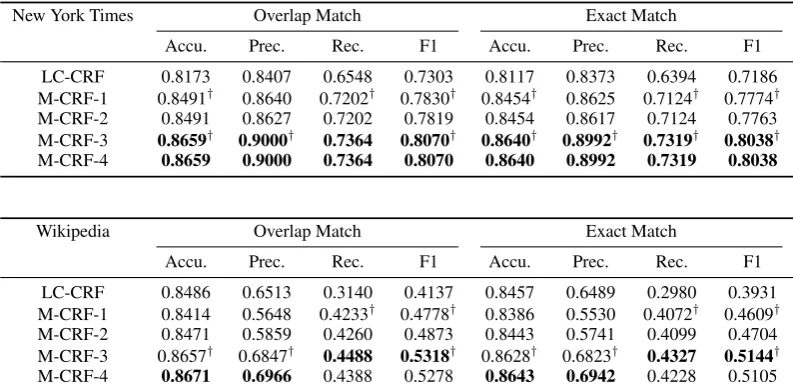
First, we can see from the table that by reduc-ing the label sequence space, M-CRF-1 can signif-icantly outperform the baseline LC-CRF in terms of F1 in all cases. In terms of accuracy, there is significant improvement for the NYT data set but not for the Wikipedia data set. We also notice that for both data sets the advantage of M-CRF-1 is mostly evident in the improvement of recall. This shows that a larger number of true relation descrip-tors are extracted when the label sequence space is reduced.
New York Times Overlap Match Exact Match
Accu. Prec. Rec. F1 Accu. Prec. Rec. F1
LC-CRF 0.8173 0.8407 0.6548 0.7303 0.8117 0.8373 0.6394 0.7186 M-CRF-1 0.8491† 0.8640 0.7202† 0.7830† 0.8454† 0.8625 0.7124† 0.7774† M-CRF-2 0.8491 0.8627 0.7202 0.7819 0.8454 0.8617 0.7124 0.7763 M-CRF-3 0.8659† 0.9000† 0.7364 0.8070† 0.8640† 0.8992† 0.7319† 0.8038† M-CRF-4 0.8659 0.9000 0.7364 0.8070 0.8640 0.8992 0.7319 0.8038
Wikipedia Overlap Match Exact Match
Accu. Prec. Rec. F1 Accu. Prec. Rec. F1
[image:7.595.99.496.62.257.2]LC-CRF 0.8486 0.6513 0.3140 0.4137 0.8457 0.6489 0.2980 0.3931 M-CRF-1 0.8414 0.5648 0.4233† 0.4778† 0.8386 0.5530 0.4072† 0.4609† M-CRF-2 0.8471 0.5859 0.4260 0.4873 0.8443 0.5741 0.4099 0.4704 M-CRF-3 0.8657† 0.6847† 0.4488 0.5318† 0.8628† 0.6823† 0.4327 0.5144† M-CRF-4 0.8671 0.6966 0.4388 0.5278 0.8643 0.6942 0.4228 0.5105
Table 5: Comparison of different methods on the New York Times data set and Wikipedia data set. Accu., Prec., Rec. and F1 stand for accuracy, precision, recall and F1 measures, respectively. † indicates that
the current value is statistically significantly better than the value in the previous row at a 0.95 level of confidence by one-tailed paired T-test.
significant impact. We hypothesize the following. For contextual long-range features, they have al-ready been captured in the linear-chain features. For example, the long-range feature “is REL” is similar to the linear-chain feature “wi−1=is&yi
= B-R”. For the phrase boundary long-range fea-ture, since phrase boundary tags have also been used in the linear-chain features, this feature does not provide additional information. In addition, we have found that a large percentage of relation descriptors violate phrase boundaries: 22% in the NYT data set, and 29% in the Wikipedia data set. Therefore, it seems that phrase boundary informa-tion is not important for relainforma-tion descriptor extrac-tion.
Overall, performance is much higher on the NYT data set than on the Wikipedia data set. Based on our observations during annotation, this is due to the fact that the “employment” relations expressed in the NYT data set often follow some standard patterns, whereas in Wikipedia the “per-sonal/social” relations can be expressed in more varied ways. The lower performance achieved on the Wikipedia data set suggests that extracting re-lation descriptors is not an easy task even under a supervised learning setting.
Presumably relation descriptors that are not seen in the training data are harder to extract. We would therefore also like to see how well our model works on such unseen relation descriptors. We find that with 10-fold cross validation, for the
NYT data set, on average our model is able to ex-tract approximately 67% of the unseen relation de-scriptors in the test data using exact match criteria. For the Wikipedia data set this percentage is ap-proximately 27%. Both numbers are lower than the overall recall values the model can achieve on the entire test data, showing that unseen relation descriptors are indeed harder to extract. However, our model is still able to pick up new relation de-scriptors.
5.4 The Effect of Training Data Size
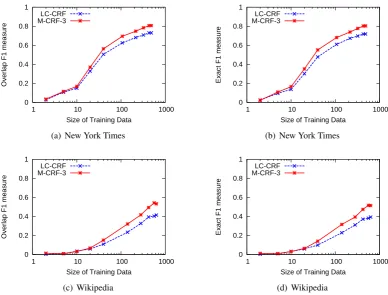
In the previous experiments, we have used 90% of the data for training and the remaining 10% for testing. We now take a look at how the perfor-mance changes with different numbers of training instances. We vary the training data size from only a few instances (2, 5, and 10) to 20%, 40%, 60% and 80% of the entire data set. The results are shown in Figure 1.
As we can expect, when the number of train-ing instances is small, the performance on both data sets is low. The figure also shows that the Wikipedia data set is the more difficult than the NYT data set. This is consistent with our observa-tion in the previous secobserva-tion.
0 0.2 0.4 0.6 0.8 1
1 10 100 1000
Overlap F1 measure
Size of Training Data LC-CRF
M-CRF-3
(a) New York Times
0 0.2 0.4 0.6 0.8 1
1 10 100 1000
Exact F1 measure
Size of Training Data LC-CRF
M-CRF-3
(b) New York Times
0 0.2 0.4 0.6 0.8 1
1 10 100 1000
Overlap F1 measure
Size of Training Data LC-CRF
M-CRF-3
(c) Wikipedia
0 0.2 0.4 0.6 0.8 1
1 10 100 1000
Exact F1 measure
Size of Training Data LC-CRF
M-CRF-3
[image:8.595.103.492.69.364.2](d) Wikipedia
Figure 1: Performance of LC-CRF and M-CRF-3 as the training data size increases.
For example, Figure 1(b) shows that the modi-fied linear-chain CRF model achieve 0.72 F1 with about 215 training instances, while the baseline linear-chain CRF model requires about 480 train-ing instances for a similar F1.
6 Conclusions
In this paper, we studied relation extraction un-der a new setting: the relation types are defined at a general level but more specific relation de-scriptors are desired. Based on the special prop-erties of this new task, we found that standard linear-chain CRF models have some potential lim-itations for this task. We subsequently proposed some modifications to linear-chain CRFs in order to suit our task better. We annotated two data sets to evaluate our methods. The experiments showed that by restricting the space of possible label se-quences and introducing certain long-range fea-tures, the performance of the modified linear-chain CRF model can perform significantly better than standard linear-chain CRFs.
Currently our work is only based on evaluation on two data sets and on two general relations. In the future we plan to evaluate the methods on other general relations to test its robustness. We also
plan to explore how this new relation extraction task can be used within other NLP or text mining applications.
Acknowledgments
This material is based on research sponsored by the Air Force Research Laboratory, under agree-ment number FA2386-09-1-4123. The U.S. Gov-ernment is authorized to reproduce and distribute reprints for Governmental purposes notwithstand-ing any copyright notation thereon. The views and conclusions contained herein are those of the au-thors and should not be interpreted as necessarily representing the official policies or endorsements, either expressed or implied, of the Air Force Re-search Laboratory or the U.S. Government.
References
Eugene Agichtein and Luis Gravano. 2000. Snow-ball: Extracting relations from large plain-text
col-lections. InProceedings of the Fifth ACM
Confer-ence on Digital Libraries, pages 85–94, June. Michele Banko and Oren Etzioni. 2008. The tradeoffs
between open and traditional relation extraction. In
Razvan Bunescu and Raymond Mooney. 2005. A shortest path dependency kernel for relation
extrac-tion. InProceedings of the Human Language
Tech-nology Conference and the Conference on Empiri-cal Methods in Natural Language Processing, pages 724–731, October.
Aron Culotta, Andrew McCallum, and Jonathan Betz. 2006. Integrating probabilistic extraction models and data mining to discover relations and patterns in
text. InProceedings of the Human Language
Tech-nology Conference of the North American Chapter of the Association for Computational Linguistics, pages 296–303, June.
Jenny Rose Finkel, Trond Grenager, and Christo-pher D. Manning. 2005. Incorporating non-local information into information extraction systems by
gibbs sampling. InProceedings of the 43rd Annual
Meeting of the Association for Computational Lin-guistics, pages 363–370, June.
Takaaki Hasegawa, Satoshi Sekine, and Ralph Grish-man. 2004. Discovering relations among named
entities from large corpora. In Proceedings of the
42nd Meeting of the Association for Computational Linguistics, pages 415–422, July.
Raphael Hoffmann, Congle Zhang, and Daniel S. Weld. 2010. Learning 5000 relational extractors. In
Proceedings of the 48th Annual Meeting of the As-sociation for Computational Linguistics, pages 286– 295, July.
John D. Lafferty, Andrew McCallum, and Fernando C. N. Pereira. 2001. Conditional random fields: Probabilistic models for segmenting and labeling
se-quence data. In Proceedings of the 18th
Interna-tional Conference on Machine Learning, pages 282– 289, June.
Lance A. Ramshaw and Mitchell P. Marcus. 1995. Text chunking using transformation-based learning. InProceedings of the Third ACL Workshop on Very Large Corpora, pages 82–94.
Benjamin Rosenfeld and Ronen Feldman. 2006.
URES : An unsupervised Web relation extraction
system. In Proceedings of the 21st International
Conference on Computational Linguistics and 44th Annual Meeting of the Association for Computa-tional Linguistics, pages 667–674, July.
Sunita Sarawagi and William W. Cohen. 2005. Semi-Markov conditional random fields for information
extraction. InAdvances in Neural Information
Pro-cessing Systems 17, pages 1185–1192.
Yusuke Shinyama and Satoshi Sekine. 2006. Preemp-tive information extraction using unrestricted
rela-tion discovery. In Proceedings of the Human
Lan-guage Technology Conference of the North Ameri-can Chapter of the Association for Computational Linguistics, pages 304–311, June.
Fei Wu and Daniel S. Weld. 2010. Open information
extraction using Wikipedia. In Proceedings of the
48th Annual Meeting of the Association for Compu-tational Linguistics, pages 118–127, July.
Dmitry Zelenko, Chinatsu Aone, and Anthony Richardella. 2003. Kernel methods for relation
ex-traction. Journal of Machine Learning Research,
3:1083–1106.
Min Zhang, Jie Zhang, and Jian Su. 2006. Explor-ing syntactic features for relation extraction usExplor-ing a
convolution tree kernel. InProceedings of the
Hu-man Language Technology Conference of the North American Chapter of the Association for Computa-tional Linguistics, pages 288–295, June.
GuoDong Zhou, Jian Su, Jie Zhang, and Min Zhang. 2005. Exploring various knowledge in relation
ex-traction. In Proceedings of the 43rd Annual