A. Bhattarai et al. / BIBECHANA 9 (2013) 63-68: BMHSS, p. 63 (Online Publication: Nov., 2012)
BIBECHANA
A Multidisciplinary Journal of Science, Technology and Mathematics ISSN 2091-0762 (online)
Journal homepage: http://nepjol.info/index.php/BIBECHANA
Effect of solvent composition on the critical micelle
concentration of sodium deoxycholate in ethanol-water
mixed solvent media
Ajaya Bhattarai*, Sujit Kumar Shah, Ashok Kumar Yadav, Janak Adhikari
Department of Chemistry, Mahendra Morang Adarsh Multiple Campus, Tribhuvan University, Biratnagar, Nepal
* Corresponding author: E mail: [email protected] Article history: Received 18 October, 2012; Accepted 3 November, 2012
Abstract
The precise measurement of the specific conductivity of sodium deoxycholate in pure water and ethanol-water mixed solvent media containing 0.10 and 0.20 volume fraction of ethanol at 303.15 K are reported. The concentration were varied from ~ 0.01 mol L-1 to ~ 0.0002 mol L-1.The conductivity of sodium deoxycholate decreases with the increase in the volume fraction of ethanol. The critical micelle concentration of sodium deoxycholate increases with the increase in the volume fraction of ethanol.
Keywords: sodium deoxycholate; conductivity; critical micelle concentration; ethanol-water mixed solvent media
1. Introduction
of selected physical or chemical properties of surfactant solutions. Because of the surface activity of these substances, measurements of the surface tension of surfactant solutions represent the principal method of cmc determination. However, it is rather tedious and time-consuming procedure. In the case of ionic surfactants, the utilization of electrochemical measurement is much more convenient, especially the measurements of the electrical conductivity of their solutions with varying concentration. The conductometric method is based on the finding of a breaking point on the curves, which describe the concentration dependence of conductivity [2]. It is well-known, that the conductivity of any solution is directly proportional to the concentration of its ions. The point, where the micelle formation starts, is indicated on the concentration dependence of specific conductivity (Κ) as a breaking point. It is easy to find the breaking point, because it marks a significant change of the linear slope of the dependence Κ =f(C). The requested value of cmc is the intercept of two linear functions with mutually different slopes.
Sodium deoxycholate (fig.1), the sodium salt of deoxycholic acid, is a water-soluble, bile-acid, ionic detergent commonly used in protein methods. It is most frequently used as a component of cell lysis buffers (e.g., RIPA buffer), but also has been used for liposome preparation, isolation of membrane proteins and lipids, preventing nonspecific binding in affinity chromatography and a cell culture media supplement.
Deoxycholic acid has been used since its discovery in various fields of human medicine. In the human body deoxycholic acid is used in the emulsification of fats for the absorption in the intestine. It has, in some countries (including Switzerland) been licensed as an emulsifier in food industry [3].
Fig.1: Structure of sodium deoxycholate.
Our aim of this paper is to determine the cmc of SDC in pure water and ethanol-water mixed solvent media containing 0.10 and 0.20 volume fraction of ethanol at 303.15 K by conductometric method.
2. Experimental Methods
A. Bhattarai et al. / BIBECHANA 9 (2013) 63-68: BMHSS, p. 65 (Online Publication: Nov., 2012) Conductance measurements were carried out on a Pye-Unicam PW 9509 conductivity meter at a frequency of 2000 Hz using a dip-type cell with a cell constant of 1.15 cm-1 and having an uncertainty of 0.01%. The cell was calibrated by the method of Lind and co-workers in 1959[9], using aqueous potassium chloride solution. The measurements were made at 303.15 K in a jacket containing conductivity cell of cell constant 1.002 cm–1. Water was circulated in the jacket from thermostat and the temperature was maintained within ± 0.1oC. The details of the experimental procedure have been described earlier [10-11]. Several independent solutions were prepared and runs were performed to ensure the reproducibility of the results. Due correction was made for the specific conductance of the solvent by subtracting the specific conductance of the relevant solvent medium from those of the electrolyte solutions.
In order to avoid moisture pickup, all solutions were prepared in a dehumidified room with utmost care. In all cases, the experiments were performed in three replicates.
3. Result and Discussions
Conductivity measurements were performed in pure water and ethanol -water mixed solvent media at 303.15 K in order to evaluate the cmc of Sodium deoxycholate. The cmc of Sodium deoxycholate found at different volume fraction of ethanol –water mixed solvent media are listed in Table 1.The cmc of Sodium deoxycholate in pure water was found to be 2.04 mM by fluorescence measurements at 298.15 K[12] which is almost matching with static light scattering measurements[13]. As the temperature increases of the solution of Sodium deoxycholate in water,the cmc also increases[13-14] and this is the best evidence for our conductivity measurements of Sodium deoxycholate in pure water.
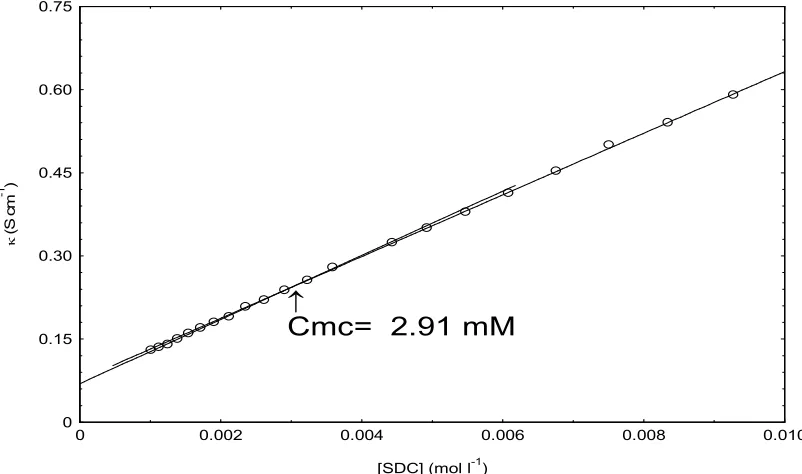
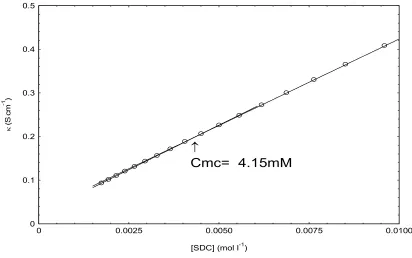
The experimental specific conductivities of Sodium deoxycholate as a function of the its molar concentration at 303.15 K of pure water and two different ethanol-water mixtures (containing 0.10 and 0.20 volume fractions of Ethanol) are depicted in fig. 2 to 4. It was observed that cmc of Sodium deoxycholate increases with the increase in the volume fraction of ethanol. This trend is due to decrease in the relative permittivity of the medium. The relative permittivity of the medium decreased at a given temperature with increasing in the Ethanol content and similar trends have been observed in the previous works [6-7]. The presence of Ethanol reduces the dielectric constant of the solvent phase and makes easier for the formation of ion-pairs in the solution phase.
It is also well known that addition of solvent which acts as water structure breakers decrease the hydrophobic effect result in to the increase in the cmc value of ionic surfactants [15]. Breaking of water molecules by ethanol molecules would facilitate interation between the hydrophobic tail of the surfactant molecule and the hydrophobic part of the ethanol and consequently the local concentration of ethanol molecules around the surfactants monomers becomes larger than the bulk solvation of the surfactant molecules by the hydrophobic part of the organic solvent would therefore lead to the delay aggregation of the surfactant monomers to form micelle and hence the increase in the cmc of the surfactant [16].
Table 1: The Critical Micellar Concentratiom (cmc) obtained from Conductometry of SDC in Pure water and Ethanol-Water Mixed Solvent Media Containing 0.10, 0.20 volume fraction of Ethanol at 303.15 K
T (K) water cmc
(mM)
0.10 volume fraction of ethanol
cmc
(mM)
0.20 volume fraction of ethanol
cmc
(mM)
0 0.15 0.30 0.45 0.60 0.75
0 0.002 0.004 0.006 0.008 0.010
Cmc= 2.91 mM
↑
[SDC] (mol l-1)
κ
(
S
c
m
-1 )
Fig. 2: Specific conductivities of SDC as a function of the surfactant concentration in 303.15 K: opened circles represent pure water.
0 0.1 0.2 0.3 0.4 0.5
0 0.002 0.004 0.006 0.008 0.010
↑
Cmc= 3.74mM
[SDC] (mol l-1)
κ
(
S
c
m
-1 )
A. Bhattarai et al. / BIBECHANA 9 (2013) 63-68: BMHSS, p. 67 (Online Publication: Nov., 2012)
0 0.1 0.2 0.3 0.4 0.5
0 0.0025 0.0050 0.0075 0.0100
↑
Cmc= 4.15mM
[SDC] (mol l-1)
κ
(
S
c
m
-1 )
Fig. 4: Specific conductivities of SDC as a function of the surfactant concentration in 303.15 K: opened circles represent 0.20 volume fractions of ethanol in the solvent mixture.
4. Conclusions
The following conclusions have been drawn from the above results and discussion. Experimental result for the conductivity of SDC solution in pure water and ethanol- water mixed solvent media has been presented as a function of salt concentration and different percentage composition of ethanol-water mixed solvent media. The cmc of SDC are found to increase with the increase in the volume fraction of ethanol in ethanol-water mixed solvent media.
Acknowledgements
The authors are thankful to Professor Dr. Sujeet Kumar Chatterjee at the department of Chemistry, Mahendra Morang Adarsh Multiple Campus, Tribhuvan University, Biratnagar, Nepal for the valuable suggestions and discussions. The authors are also thankful to Associate Professor Ghanashyam Shrivastav, the Head of Department of Chemistry, Mahendra Morang Adarsh Multiple Campus,Tribhuvan University, Biratnagar, Nepal for providing us the research facilities to conduct this research work.
References
[1] A. D. McNaught and A. Wilkinson, Compendium of Chemical Terminology, 2nd ed. Blackwell Scientific Publications, Oxford, IUPAC (1997).
[2] A. Bhattarai, S.K. Shah and A. K. Yadav,Nepal J. Sci. and Tech.,13 (2012) 89. [3] H. Streuli, et. al, SLMB - Schweizer Lebensmittelbuch, chapter 58, 4/3, (1992).
[4] N. A. Lange and J. A. Dean, Lange's Handbook of Chemistry, 10th ed. McGraw-Hill, New York, (1967).
[6] A. Bhattarai and S. K. Sah, Res. J. Chem. Sci., 1 (2011) 1. [7] A. Bhattarai and J. Raut, J. Alpine Chemistry, 2 (2011) 44.
[8] H. S. Harned and B. B. Owen, The physical chemistry of electrolytic solutions, Reinhold, New York, (1957) 234.
[9] J. E., Jr.Lind, J. J. Zwolenik and R.M. Fuoss, J. Am. Chem. Soc., 81 (1959) 1557. [10] B. Das and D. K. Hazra, Bull. Chem. Soc. Jpn., 65 (1992) 3470.
[11] B. Das and D. K. Hazra, J. Phys. Chem., 99 (1995) 269.
[12] S. Das, U. Thapa and K. Ismail, Bull. Chem. Soc. Jpn., 83 (2010) 1352.
[13] K. Matsuoka and Y. Moroi, Biochimica et Biophysica Acta, 1580 (2002) 189. [14] L. R. Bogdanovaa, O. I. Gnezdilovb, B. Z. Idiyatullina, R. Kh. Kurbanova,
Yu. F. Zueva, and O. G. Usyarovc, Colloid J., 74 (2012) 1.
[15] K. Gracie, D. Turner and R. Palepu, Can. J. Chem., 74 (1996) 1616.