Regular Associated Solution Model for the Estimation of Heat of
Mixing of Binary Liquid Alloys
D. Adhikaria, B.P. Singha , I.S. Jhab a
Univ. Dept. of Physics, T.M.Bhag. University, Bhagalpur, Bihar, India b
Dept. of Physics, M.M.A.M. Campus (Tribhuvan University), Biratnagar, Nepal
Abstract
We have determined the equilibrium constants and pairwise interaction energies between the species and the complexes of liquid CuSn, AgAl and FeSi, alloys on the basis of regular associated solution model. These parameters are then used to estimate the heat of mixing of each alloy. The observed asymmetry in the heat of mixing of each alloy with respect to concentration is well explained.
Key Words: Free energy of mixing; Asymmetry; Binary alloys, interaction energy
1. Introduction
Fe2Si complexes in liquid CuSn, AgAl and FeSi alloys respectively by studying their corresponding phase diagram in solid state[13].
Theoretical formalism is given in section 2, section 3 deals with the numerical result and discussion. Conclusion is provided in section 4.
2. Theory
Suppose there be three species in equilibrium in the liquid alloy, namely, monomers A, B and ApB molecules in the respective concentrations nA,nB, and nApB moles. Considering a solution of n1 atoms of A and n2 atoms of B, the formation of
ApB
n complex requires n1 =nA +pnApB and n2 =nB +nApB for conservation of mass in the partially associated solution. When there is association, the thermodynamic behaviour of complexes A and B components is governed by their true mole fractionsxA,xB and
ApB
x rather than their gross mole fraction x1 andx2, where x1 =n1/(n1+n2)etc. and ) n n n /( n
xA = A A + B + ApB etc.
Using above relations, the two sets of mole fractions are related to each other by the relations
ApB 2 1
A x px x
x = − ,xB =x2 −(1−px2)xApB (1) In regular associated solution solutions, the gross chemical potentials of components 1 and 2 are equal to the chemical potentials of the monomeric species A and B [14]. The activity coefficientsγA, γB and γApB of monomers and complex can be expressed in terms of pairwise interaction energies through [3]
) ω ω ω ( x x ω x ω x γ ln
RT A = 2B 12 + 2ApB 13 + B ApB 12 − 23 + 13 (2a) ) ω ω ω ( x x ω x ω x γ ln
RT B = ApB2 23 + 2A 12 + A ApB 23 − 13+ 12 (2b) ) ω ω ω ( x x ω x ω x γ ln
RT ApB = A2 13 + 2B 23+ B ApB 13 − 12 + 23 (2c) whereω12, ω13 and ω23 are interaction energies for the species A, B ; A, ApB and B, ApB respectively, T the temperature and R stands for the universal gas constant. The equilibrium constant in a regular associated can be obtained [6] as
] x ) px 1 ( x [ RT ] x ) x 1 ( px [ RT ] x ) x 1 ( px [ RT x x x ln k
ln ApB B B
23 A A ApB 13 A B B 12 ApB B P A − − ω + − − ω + + − ω +
Now using the equations listed above the integral excess free energy Gxs
∆ is given by
k ln RT ) px 1 ( x ) x ln x x ln x ( RT ) x ln x x ln x x ln x ( ) px 1 ( RT ) x x x x x x ( ) px 1 ( 1 G ApB ApB 2 2 1 1 ApB ApB B B A A ApB 23 ApB B 13 ApB A 12 B A ApB xs + + + − + + × + + ω + ω + ω + = ∆ (4)
Once the expressions for ∆G[ G RT(x1lnx1 x2lnx2)] xs
+ +
∆
= is obtained, heat of mixing
can be found using standard thermodynamic relation
P , T T G ∆ T G ∆ H ∆ ∂ ∂ −
= (4a)
The pairwise interaction energies and equilibrium constant are determined by the following method:
In a regular associated solution x1γ1 =xAγA andx2γ2 =xBγB, where γ1 and γ2 are respective gross activity coefficients of components 1 and 2. Thus
1 A A 1 x x ln ln
lnγ = γ + (5a) and 2 B B 2 x x ln ln
lnγ = γ + (5b) the pairwise interaction energies, the equilibrium constants and the activity coefficients at infinite dilution can be written as [9]
RT
lnγ10=ω12 (6a)
o 2 o 1 o 2 o 1 13 γ γ γ γ ) RT / ω exp( k −
= (6b) where o
γ1 and γo2 are activity coefficients of component A and that of B at zero
concentrations.
Solving equations (2a) and (2b) we obtain
2 ApB 12 B B A 1 B B 2 B 13 x RT ) x 1 ( x x a ln ) x 1 ( x a ln x RT ω − − − + = ω (7) 2 ApB 12 A A B 2 A A 1 A 23 x RT ) x 1 ( x x a ln ) x 1 ( x a ln x RT ω − − − + = ω (8)
Using equations (6), (16) and (17), we can derive
+ − + + = + ApB 2 p 1 12 B 2 ApB B A 1 ApB A 13 x a a ln RT ω x a ln x x x a ln x x 1 RT ω k
3. Results and Discussion
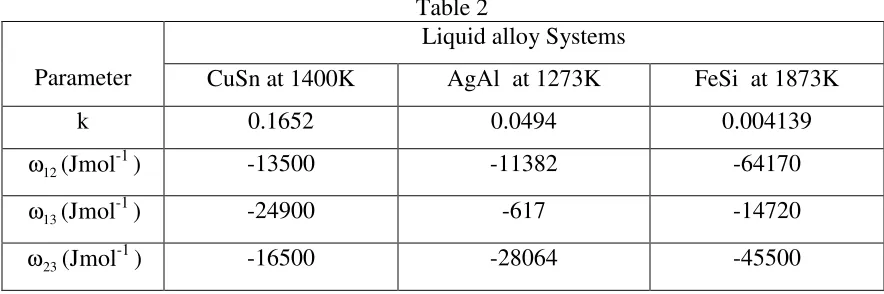
To find heat of mixing of binary alloys, we have found the complex concentration in a regular associated solution of respective alloys by using equations (6), (9) and observed data of corresponding activities [13]. The complex concentration of liquid alloys in molten state are presented in table 1. We have found the equilibrium constants and the pairwise interaction energies between the species and the complexes using equations (3), (4), (6), (7), (8), and observed data of corresponding integral excess free energies of mixing. The equilibrium constants and pairwise interaction energies of different binary alloys are listed in table 2.
3.1 CuSn alloys at 1400K
It is found from the analysis that the heat of mixing is negative at all concentration. Our theoretical calculation shows that the minimum value of the heat of mixing is -4.95 kJ at xCu = 0.8 which exactly matches with the experimental value [1]. Further it is observed that the concentration dependence of asymmetry in ∆Hcan be explained only when one considers the temperature dependence of the pairwise interaction energies. The agreement between the calculated and experimental values is also good. The calculated and observed values of heat of mixing are compared in figure 1.
Figure-1:Free energy of mixing (∆HRT) versus xCuof liquid CuSn solution (1400K) ;(–––) theory, (○○○)
3.2 AgAl alloys at 1273K
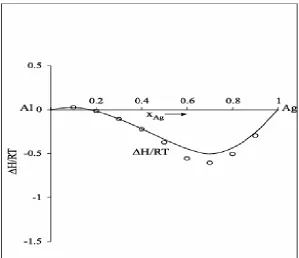
It is found from the analysis that the enthalpy of mixing is negative at all concentration, being minimum around stoichiometric composition (∆H= -0.611RT at xAg = 0.72). Further it is observed that the concentration dependence of asymmetry in ∆Hcan be explained only when one considers the temperature dependence of the pairwise interaction energies. The calculated and observed values heat of mixing is compared in figure 2.
Figure-2: Free energy of mixing (∆H/RT) versus xAg of liquid AgAl solution (1273K); (––––) theory, (○○○) experiment [1]
3.3 FeSi alloys at 1873K
pairwise interaction energies. Figure 3 show the comparison between the experimental and calculated values of heat of mixing and entropy of mixing.
Figure-3: Free energy of mixing (∆G/RT) versus xFe of liquid FeSi solution (1873K); (––––) theory, (○○○) experiment [13]
Table 1 xCu/ xAg/ xFe xCuSn
3 xAg3Al xFe2Si
0.1 0.001095 0.008257 0.01635
0.2 0.008378 0.03075 0.05294
0.3 0.02658 0.0656 0.1086
0.4 0.05146 0.1138 0.1869
0.5 0.08541 0.1803 0.2903
0.6 0.1240 0.2517 0.3337
0.7 0.1525 0.3075 0.3720
0.8 0.1650 0.2355 0.2968
0.9 0.1192 0.1056 0.1098
-3 -2.5 -2 -1.5 -1 -0.5
0
0.2 0.4 0.6 0.8 1
R
T
/
H
∆
Fe
Table 2
Liquid alloy Systems
Parameter CuSn at 1400K AgAl at 1273K FeSi at 1873K
k 0.1652 0.0494 0.004139
12
ω (Jmol-1 ) -13500 -11382 -64170
13
ω (Jmol-1 ) -24900 -617 -14720
23
ω (Jmol-1 ) -16500 -28064 -45500
4. Conclusion
The regular associated solution model is found to be suitable to estimate the heat of mixing for both weakly and strongly interacting binary liquid alloys. The observed asymmetries in the heat of mixing of binary liquid alloys with respect to the concentrations are well explained on the basis of regular associated solution models.
Acknowledgement
One of the authors (D. Adhikari) is thankful to University Grant Commission (UGC), Nepal, for providing financial support to pursue the research.
References
[1] Bhatia, A.B. and Hargoove, W.H. 1974.Phys. Rev. B-10:316 . [2] Singh, R.N. 1987. Can J. Phys. 65: 309.
[3] Jordan, A.S. 1970. Metall. Trans. 1:239.
[8] Jha, I.S. ,Singh, R. N. Shrivastava ,P.L. and Mitra, N.R. 1990.Phil. Mag. 61:8445. [9] Singh, R. N. , Jha, I.S. and Pandey, D.K. 1993.J. Condens. Matter 5: 2469 . [10] Bhatia,A.B. and Singh, R. N. 1980.Phys. Letters A-78:460 .
[11] Gerling, U. Pool ,M. J. and Predel, 1983.B. Z. Metallkde 74:616 . [12] Adhikari, D., Jha, I.S. and Singh, B. P. 2010.Physica B- 405 :1861 .
![Figure-3: Free energy of mixing (∆G/RT) versus xFe of liquid FeSi solution (1873K); (––––) theory, (○○○) experiment [13]](https://thumb-us.123doks.com/thumbv2/123dok_us/8978084.1887452/6.612.84.524.495.721/figure-energy-mixing-versus-liquid-solution-theory-experiment.webp)