Geschke Center
Doctor of Nursing Practice (DNP) Projects Theses, Dissertations, Capstones and Projects
2009
Health Literacy and Medication Adherence
Seanny Minn
University of San Francisco, [email protected]
Follow this and additional works at:https://repository.usfca.edu/dnp Part of theNursing Commons
This Project is brought to you for free and open access by the Theses, Dissertations, Capstones and Projects at USF Scholarship: a digital repository @
Recommended Citation
Minn, Seanny, "Health Literacy and Medication Adherence" (2009).Doctor of Nursing Practice (DNP) Projects. 9.
Putting Evidence into Practice: Creating Health
Literacy and Medication Adherence Tool
Seanny Min, DNP©, FNP, CNS, PA-C, MSN
University of San Francisco
Doctorate of Nursing Practice Project
Table of Contents
Professional Resume Pages i-iii
Creating Health Literacy and Medication Adherence Tool Power Point Pages iii-xiii
Comprehensive Exam
Putting Evidence into Practice: Health Literacy and Medication Adherence Tool 3-39
References 40-42
Table
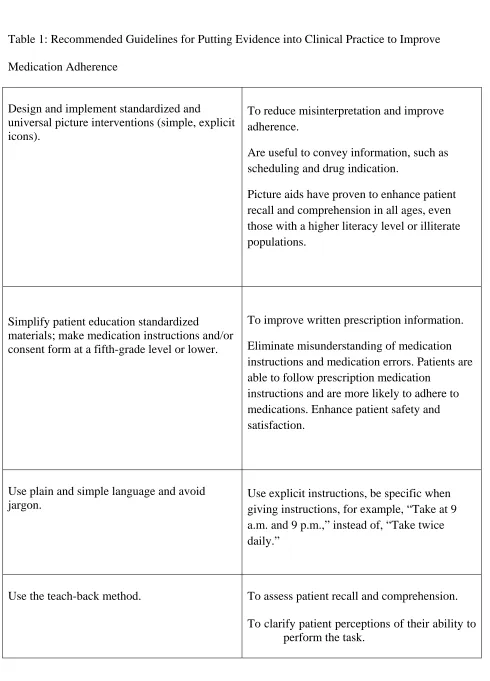
Recommended Guidelines for Putting Evidence into Clinical Practice to
Improve Medication Adherence Table 1 43-44 Appendices
Demographics Appendix A 45-46
Disease Statistics Appendix B 47
Informed Consent Form Appendix C 48-51
Participant Survey Scale in English (Pre-intervention) Appendix D 52 Participant Survey Scale in English (Post-intervention and post-intervention) Appendix E
53-54 Patient Pictorial Aids Calendar English/Cambodian and The Pictorial Aids
Creating Health Literacy and Medication
Adherence Tool
Can
you
read
your
medication
instructions?
Do
you
understand
your
medication
instructions?
How
often
do
you
need
someone
to
help
you
take
your
medicine?
Do
you
need
someone
to
read
your
medicine
bottle
for
you
when
you
take
your
medication?
How
often
do
you
need
help
reading
medication
instructions
when
taking
medicine?
Were
you
able
to
tell
what
this
medication
is
for?
this
medication?
Are
you
able
to
describe
what
your
doctor
told
you
to
expect
from
taking
this
medication?
When
you
feel
better,
do
you
sometimes
stop
taking
your
medicine?
Do
you
sometimes
stop
taking
your
medication
if
you
begin
to
feel
worse?
Creating Health Literacy and Medication
Adherence Tool
POST-INTERVENTION SURVEY
Do
you
understand
your
medication
instructions?
How
often
do
you
need
someone
to
help
you
Do
you
need
someone
to
read
your
medicine
bottle
for
you
when
you
take
you
medication?
Are
you
able
to
tell
what
this
medication
is
for?
Are
you
able
to
describe
how
you
should
take
this
medication?
When
you
feel
better,
do
you
sometimes
stop
taking
your
medicine?
Do
you
sometimes
stop
taking
your
medication
if
you
begin
to
feel
worse?
Creating
Health
Literacy
and
Medication
Adherence
Do
you
understand
your
medication
instruction?
How
often
do
you
need
someone
to
help
you
Do
you
need
someone
to
read
your
medicine
bottle
for
you
when
you
take
your
medication?
Are
you
able
to
tell
what
this
medication
is
for?
Are
you
able
to
describe
how
you
should
take
this
medication?
When
you
feel
better,
do
you
sometimes
stop
Do
you
sometimes
stop
taking
your
medication
if
you
begin
to
feel
worse?
Creating
Health
Literacy
and
Medication
Adherence
Demographic
What
is
your
age
group?
What
is
your
gender?
Have
you
ever
attended
school?
What
is
your
educational
background?
Disease
Statistics
Section I: Introduction
Poor adherence to medical treatment is a national burden in the United States, and a major cause for poor adherence is low literacy and reading skills. Current available interventions and studies leave many important questions unanswered, and additional research on the effects of low literacy is essential.1 Given the fact that barriers to medication adherence result from
deficient health literacy, millions of Americans suffer from adverse health outcomes each year.1 This DNP project will discuss the development of an effective pictorial, evidence-based medication tool for low literacy, illiterate and cognitively impaired patients to significantly improve quality of life, healthcare, clinical outcomes, understanding of medication instructions, patient safety related to medication adherence and the current and future U.S. financial burden.
Time for Change
Problems with properly adhering to medication are associated with many factors: health system issues, individual factors related to medical conditions, physical disability,
socio-economic status, the complexity of the medication therapy and low health literacy.2 While there are several non-adherence medication related factors, low health literacy has been widely recognized as a strong prediction of poor health outcomes and economic drain.
A key aspect of poor medication adherence is difficulty following medication instructions. Contributing to this aspect is a lack of health literacy, which is one of the most challenging factors to manipulate. Inadequate follow-through with treatment and medication plans results in a variety of adverse health outcomes, e.g. uncontrolled hypertension, diabetes, or hyperlipidemia, and a higher number of emergency services and hospital readmissions.
emergency room discharge, as it affects healthcare costs and mortality rates. While health literacy has been widely recognized as a strong predictor of medication adherence, the healthcare system continues to have significant gaps in the way health information is written and the
patient’s ability to understand and act on it. Addressing low health literacy can be expected to result in major financial savings in the healthcare industry.4
Section II: Examining the Clinical Relevance of the Problem
Clinically Relevant Problem “Don’t ask, don’t tell.”
A Case of Health Illiteracy, Not Noncompliance
A 65-year-old Asian woman, Mrs. S., visits her primary care provider for ongoing
treatment of hypertension and type 2 diabetes mellitus. Neither her diabetes nor her hypertension have been well controlled in the past. Her hemoglobin A1c level (the percentage of glucose that binds to hemoglobin in red blood cells, HbA1c) 4-6 has been abnormally high, ranging from 9% to 12% (normal < 7%), and her home blood sugar levels have fluctuated from as low as 60mg/dl to as high as 400 mg/dl (normal < 109 mg/dl).4-6 Mrs. S. frequents Asian Health Services with hypotensive or hypertensive symptoms, and hyperglycemic or hypoglycemic symptoms, regardless of adjustments to medications. Her primary provider notices that her medication bottles appear to differ at every visit; they are labeled with differing doses, and some are even one to two years old. When asked to describe how she takes her medications, she responds,
The aforementioned case is similar to the experiences of many other patients, who have been labeled non-adherent. However, the question remains: Is Mrs. S. really non-adherent, or does she have an undetected health illiteracy problem with cognitive or memory impairment? All healthcare providers may come across patients like Mrs. S. has, yet the problem of health illiteracy and cognitive impairment are often ignored. The effects of health illiteracy and cognitive or memory impairment and medication non-adherence significantly affect the health burden and expenditures of the entire United States.
Health Literacy and Its Consequences
The Institute of Medicine (IOM) defines health literacy as “the degree to which individuals have the capacity to obtain, process, and understand basic health information and services needed to make appropriate health decisions.”7 Health literacy affects people’s ability to navigate the healthcare system, including filling out complex forms, locating providers, sharing personal information with healthcare providers, understanding mathematical concepts, and engaging in self care and chronic disease management.8-9 Patients with basic or below basic health literacy skills do not have the ability to perform even the simplest of those tasks, nor are they able to provide information as to why and when certain illnesses might need to have a specified test. Adherence-related outcomes are expected to worsen as the global prevalence of people experiencing chronic diseases grows.
healthcare. Non-adherent behaviors have been linked to significantly higher healthcare costs, emergency room readmissions and patient mortality rates.10
An important aspect of non-adherence is unfilled prescriptions, which account for about 140 million prescriptions in the United States, worth about $2.8 billion per year. Furthermore, non-adherence to medical treatments and medication-related errors are a source of approximately 125,000 deaths, $106 billion to $238 billion in healthcare costs, more than 10% of geriatric hospital admissions, nearly one quarter of nursing home admissions, and 20% of preventable adverse effects in the United States annually.7-11 The estimated costs associated with low health literacy from the current lack of effective action are expected to range from $1.6 trillion to $3.6 trillion annually.9 In fact, medication adherence and health literacy problems have become so prevalent in the United States, the problem could be considered a modern-day epidemic.
Section III: Review of the Literature and Evidence
In 2003, a national study based on the National Assessment of Adult Literacy (NAAL) reported that 36% of American adults possess basic or below basic literacy skills, with other studies claiming that number to be as high as 40% to 60%.7, 12-14 Many patients may read at a fifth-grade level or below, which is classified as low literacy.7 Low health literacy affects all populations, but when comparing population proportions, ethnic minorities like Mrs. S. are disproportionately affected by low health literacy.13
and hypertension, which are commonly seen in geriatric populations.7, 14 Schillinger et al.12 compared health literacy levels in type 2 diabetic patients and found that nearly 80% of participants with a high school education or less developed poorly controlled diabetes and complications due to higher rates of non-adherence to medications, medical treatments and misunderstandings of lifestyle modifications.
Kripalani et al.13 conducted a study and estimated that only 50% of American adults properly adhere to their medications. Many patients do not take prescription medications as directed by missing or changing doses, and up to 60% may even discontinue medication use three months after beginning the prescription. Patients with a sixth-grade reading level or below have the greatest difficulty understanding prescription medication instructions.16 The greater the complexity of the medication regimen, which is affected by the number of medications
prescribed and the number of daily doses for each medication, the greater the risk for
misunderstanding instructions and not following them correctly. The case of Mrs. S. is a perfect example of how a complicated medication regimen can be difficult for an elderly minority patient suffering from chronic illnesses. Older patients like Mrs. S. may take five or more differing medications for their chronic medical conditions. In addition to having more complicated medication regimens, older adults commonly have problems resulting from impaired cognition, comprehension, recall of information on medications, and poor vision; it is estimated that as many as 55% of older patients fail to properly adhere to their medications.14
whether the oldest-old subjects (aged 90 to 97 years) were able to demonstrate PSE in retention and recall.17 Researchers indicate that pictures can be shown dually in one’s memory by visual and verbal codes, whereas words are primarily shown by verbal codes. Moreover, the sensory codes for pictures are richer than those for words; therefore, pictorial formats are much better remembered than verbal formats.17 The damage of episodic memory in geriatric patients is considered a central aspect of mild Alzheimer’s disease (AD) and amnestic-type mild cognitive impairment (MCI), found as a transitional state between normal aging and AD.19 Researchers indicate that clinical observations suggest that pictures may improve memory in Alzheimer’s disease, mild cognitive impairment, and mental retardation.19 For instance, patients with AD do not appear to remember their family members with hearing or reading their names, but AD patients do recognize their family members when presented with photographs of them.19
Pictured-Based Effects
Although many patients rely on medication labels and instruction leaflets, these patient education materials are often difficult to understand. Medication labels and instruction leaflets are in small print size, making them hard to read, especially for geriatric patients. Due to the PSE, pictorial aids have played an important role in enhancing recall, comprehension and understanding of medication instructions.16
prescribed medication for chronic illnesses to provide the medication’s purpose and dosing instructions. Results showed that 94% of all patient groups reported that, regardless of literacy and cognition level, the pill card was easy to understand and was useful as a reminder for their daily medication schedule.18
Section IV: Implementation Plan
The expected outcomes and objective measurements are guided by Theoretical Adult Learning, a concept for creating and implementing the pictorial aids tool in reducing medication errors and improving patient safety. Advanced Nursing Practice roles include collaboration of healthcare professionals with community-based clinics while implementing effective plans that have an impact on patient care.
Theoretical Adult Learning Concept
Many geriatric patients struggle to understand and adhere to their medication schedules and instructions due to poor visual acuity and chronic medical conditions that require them to take multiple medications. This difficulty may be compounded by cognitive decline associated with such medical conditions.16 Enhancing the accuracy of medication self-administration, improving patients’ understanding of prescribed medications, and improving health literacy can ameliorate health outcomes. The expected result of adults properly adhering to medical
treatments and management is a better identification and development of a solution that provides effective guidelines for pictorial aids labels. The theoretical Adult Learning Concept for
perspective.
Roy
In 1976, Sister Callista Roy developed the Adaptation Model that provides the following four models: physiological, self-concept, role function and interdependence.20 Roy’s model emphasizes the person as “a biopsychosocial being in constant interaction with a changing environment.”20 The Roy Adaptation Model discusses people in an open, adaptive system that use coping skills to deal with stressors. The implementation process uses Roy’s Adaptation Model to guide the nursing process in assessment of behavior, stimuli (stressors), nursing
diagnosis, goal setting, intervention and evaluation. Roy suggests that people strive to live within their comforts and with individuals with whom they can effectively deal. To apply the Roy Adaptation Model to nursing practice, the pictorial aids tool focuses on promoting the patient’s best adaptive strategies using all four adaptive models to successfully develop a qualified, effective medication adherence tool that will improve quality of life.
Knowles
become more self-directed learners as they mature. Adult learners who rely heavily on their experience, what they learned best will motivate and increase their confidence and readiness to perceive new educational tools. Since they are motivated to get well and to be independent in self management and care, and the superiority effects that enhance memory deficit or cognitively impaired patients by pictures. The pictorial aids tool is essential to assist adults to learn in a way that increases their capability to promote recall and comprehension in following medication regimens.
Paivio
Paivio, of the University of Western Ontario, authored the first advanced Dual-Coding Theory on cognition that provides a framework for using visuals to improve literacy, idea generation, and designs for the development of educational materials.21 In his Dual-Coding Theory, Paivio suggests that pictures can be dually represented in memory through visual and verbal codes, and sensory codes for pictures are richer than sensory codes for verbal information; pictures lead to greater benefits in enhancing information and interfere less with conceptual processing.17 In addition, it is assumed that two codes provide superior information processing and organization than one code alone.17 The Dual-Coding Theorysuggests that pictorial aids have significant advantages for long-term retention, which provides a direction for the development of mnemonic aids that can improve everyday memory retention and recall in geriatrics and cognitive impairment.17, 19, 22-23
Mayer
humans process separate information through a dual channel, visual and auditory, which processes, filters, selects, organizes, and integrates information that is held in one’s long-term memory. The limited capacity assumption is that humans are limited to the amount of
information that can be processed in each channel at one time. For instance, people can only store a few images and a few sounds at a time in a working memory process, which is referred to as the cognitive load theory.24 Finally, the active processing assumption says that humans
actively engage in cognitive processing to filter, select, and organize information. For these reasons, the pictorial aids tool becomes essential in promoting adult learners in their recall and improving their comprehension to achieve proper adherence to medication regimens.
The Intervention
To gain a better understanding of factors that contribute to and influence adult learners using the pictorial aids labels, this project grounded the adaptation, self-concept, readiness, motivation, and dual-coding theories. Research indicates that pictorial aids are superior to other interventions for improving medication adherence, medication recall and comprehension,
This Doctorate of Nursing Practice (DNP) project examines patient responses to a
pictorial aids label for medication instructions and their improvement of medication adherence in low income Cambodian adult patients in Oakland, California. The purpose of pictorial aids labels is to significantly improve patient understanding in medication instructions, taking medications as instructed, reducing medication errors, reducing poor health outcomes, and improving patient safety and quality of healthcare for those who are of a low socioeconomic status, as well as for underserved patients. The DNP-pictorial aids label project was conducted with the assistance of a Cambodian navigator and was under the supervision of a University of San Francisco DNP student who was appointed to be the primary researcher. A Cambodian navigator is a Cambodian individual employed at Asian Health Services (AHS) who is responsible for support services, answering questions, assisting and directing patients to appropriate services, interpreting, determining patient eligibility, patient and community health education, and conducting outreach/education activities on various health topics in the native language. During a normal clinic visit, the Cambodian navigator assisted with data collection by obtaining pre- and post-intervention screening. After pre-post-intervention screening was complete, the Cambodian navigator applied the customized pictorial aids labels on patients’ prescribed medication bottles and provided them with a personalized pictorial calendar.
Method
During normal clinic activity at AHS, a Cambodian navigator and DNP student collected data on medication knowledge and adherence from 35 patients. The subject population consisted of 35 adult Cambodian patients at Asian Health Services in Oakland, California, who had
impacts from a lack of effective medication adherence tools.
Thirty-five adults aged 40 to 80 years with heart disease and/or diabetes were enrolled in the study protocol at AHS and underwent survey question screening and interventions with pictorial aids labels within AHS twice over a three-month period. During the study period, 65 adult patients were approached, and 42 agreed to participate (64%). Of the 42 participants, 35 patients (83%) received interventions of pictorial aids labels, a calendar in both English and Cambodian, and pre- and post-intervention survey question screening. The Morisky Scale is a nine-item survey used to assess a patient’s understanding of the need for medications, how to take them, and the level of adherence with the prescribed protocol (Appendix D and E). Patients were rated on their perceived comprehension on a 10-point scale (non-adherence to adherence) at pre-intervention.
kept study records as confidential as possible. No individual identities were used in any reports or publications resulting from this study project. Study information was kept in a locked file at all times. Only researchers had access to confidential information
Section V: Evaluation
Pre- and post-intervention surveys and assessments of patient behavior in taking
may eventually lead to use of the pictorial aids labels and calendar by the U.S. healthcare industry.
Impact on Patient Outcomes
Who Is Affected by Low Health Literacy?
Many cultural and socioeconomic factors contribute to low health literacy. People like Mrs. S. with poor English language proficiency, limited access to education, and a low
socioeconomic status are most likely to be illiterate. Moreover, poor health literacy is most pronounced among patients with chronic medical conditions, like Mrs. S. with type 2 diabetes mellitus and hypertension. The pictorial-based model demonstrates its efficacy in the
Economic Impact on Healthcare
Cost-Effectiveness
Failure to act carries high costs, including individual poor health outcomes, preventable permanent disabilities, deaths, increased healthcare spending, a financial burden on future generations and a burden on the economic wellbeing of the nation as a whole. Improvement in medication adherence can be a considerable financial bailout. The estimated costs associated with low health literacy range from $1.6 trillion to $3.6 trillion annually.11These costs could be eliminated with proper healthcare reform, whose savings could potentially provide healthcare to the estimated 47 million uninsured Americans.4
Lessons Learned
Throughout the process of conducting a DNP project, there are many lessoned to be learned, not the least of which is that to be involved with a project of this scope and magnitude in a six-month time period is challenging. As one begins the project, one thinks of more and more things that could be accomplished. As a result, the members of the pictorial aids tool project plan to continue with the project so as to collect long-term outcomes, including monitoring HbA1c levels for diabetics, lipid panels for hyperlipidemia-affected patients and blood pressure screening for hypertensive patients during their regular office visits at AHS. This research will be conducted after my studies are completed.
recommend starting with a larger sample size than anticipated so as to account for possible dropouts and subjects who do not properly complete the procedure. It is also essential to have good collaboration, resources and support from school and clinical sites. Moreover, I worked closely with a supportive advisor and committee members. In every aspect and step of the project, researchers need good guidelines, effective communication lines and mentoring.
Dissemination Plan
Who Is Responsible and Why?
One of the advanced nursing practice roles is to collaborate and disseminate the findings of one’s work with other health professionals in order to improve patient outcomes. Our work does not end when the patient leaves our office; we must have justifiable confidence that the prescribed treatment will be followed correctly. An accurate diagnosis and poorly adhered to treatment is as ineffective as an inaccurate diagnosis. The healthcare professional’s responsibility is only finished when the disease is treated and resolved. Contributing to the United States’ medication and medical treatment adherence problems are numerous studies of low health literacy, as well as behavioral, social, economic, medical and policy-related factors, which need to be addressed if positive changes can be made and can be made a part of healthcare reform.
financial burden within the healthcare system cause by low health literacy. The AHS will continue to utilize the pictorial aids tool, and the tool will also be implemented at St. Mary’s outpatient clinic in San Francisco, where several underserved, minority patients are seen for primary care.
Conclusion
Research supports interventions that consist of a combination of pictograms with written and verbal communications to convey to the patient how to carry out medically related
1. Pignone, M, DeWalt, DA, Sheridans, S, Berkman, N, Lohr, KN. Interventions to improve health outcomes for patients with low literacy. A systematic review. The Journal General
Medicine. 2005;20:185-192.
2. Purcell, SD, Osborn, CY, Richard, R, Skripkauskas, S, Wolf, MS. Limited health literacy is a barrier to medication reconciliation in ambulatory care. The Journal General Internal
Medicine. 2007;22(11):1523-1526.
3. Engel, KG, Heisler, M., Smith, DM, Robinson, CH, Forman, JH, Ubel, PA. Patient
comprehension of emergency department care and instructions: Are patients aware of when they do not understand? The Annals of Emergency Medicine. 2009; 53(4):454-461. 4. Vernon, JA, Trujillo, A, Rosenbaum, S, DeBuono, B. Low Health Literacy: Implication for
National Health Policy.2003. Available at: http://www.iom.educ/project.asp:id=3827. Accessed February 8, 2009.
5. Baker, DW, Gazmararian, JA, Williams, MV, Scott, T, Parker, RM, Green, DR,, Peel, J. Functional health literacy and the risk of hospital admission among Medicare managed care enrollees. The Journal of General Internal Medicine. 2004;19:215-220.
6. Friedland, R. What did the doctor mean? Estimating the direct health costs of low functional literacy. Working Paper. 2002.
9. Echeverry, DM, Dike, MR, Washington, C, Davidson, MB. The impact of using a low-literacy patient education tool on process measures of diabetes care in a minority population.
Journal of the National Medical Association. 2003;11:1074-1081.
10. Howard, DH, Sentell, T, Gazmararian, JA. Impact of health literacy on socioeconomic and racial differences in health in an elderly population. The Journal ofGeneral Internal Medicine. 2006;21:857-861.
11. Davis et al. Literacy and Misunderstanding Prescription Drug Labels. Annals of Internal Medicine. 2006;145:887.
12. Schillinger, D et al. Association of health literacy with diabetes outcomes. The Journal of American Medical Association. 2002;288:475-482.
13. Kripalani, S, Robertson, R, Love-Ghaffari, MH et al. Development of an illustrated medication schedule as a low-literacy patient educational tool. Patient Education and Counseling. 2007;66:368-377. Doi:10.1016/j.pec.2007.01.020.
14. David, H, Garmararian, J, Parker, RM. The Impact of Low health literacy on the medical costs of Medicare managed care enrollees. The American Journal of Medicine. 2005; 118;371-377.
16. Katz, MG, Kripalani, S, Weiss, BD. Use of pictorial aids in medication instructions: A review of the literature. American Journal Health System Pharmacy. 2006;63:2391-2397. 17. Cherry KE, Hawley KS, Jackson EM, Volaufova J, Su J, Jazwinski SM. Pictorial Superiority
Effects in Oldest-Old People. National Institutes of Health. 2008;16(7):728-741.
disease and mild cognitive impairment. Neuropsychologia. Homepage: www.elsevier.com/locate/neuropsychologia. Accessed October 17, 2009.
20. Connerley K, Ristau S, Lindberg C, McFarland M. The Roy Model in Nursing Practice, The Roy Adaptation Model (2nd ed.). Stamford, CT: Appleton & Lange; 1999.
21. Knowles M. The adult learner: A neglected species (2nd ed.). Houston, Texas: Gulf Publishing; 1978.
22. Mayer. Cognitive Theory of Multimedia Learning. Homepage:
theories.com/cognitive-theory-of-multimedia-learning-mayer.html. Accessed October 19, 2009.
23. Kirk, JK, D’Agostino Jr., RB. Beel, RA et al. Disparities in HbA1c level between African-American and non-Hospanic white adults with diabetes. Diabetes Care. 2006;29:2130-2136.
24. Craig, JV, Smyth, RL. The Evidence-Based Practice Manual for Nurses (2nd ed.). Philadelphia, PA: Churchill Livingstone, Elsevier; 2007.
25. Yin, SH, Dreyer, BP, Van Schaick, L, Foltin, G, Dinglas, C, Mendelsohn, L. Randomized controlled trial of a pictogram-based intervention to reduce liquid medication dosing errors and improve adherence among caregivers of young children. Archives Pediatric
Adolescent Medicine. 2008;162(9):814-822.
Table 1: Recommended Guidelines for Putting Evidence into Clinical Practice to Improve Medication Adherence
Design and implement standardized and
universal picture interventions (simple, explicit icons).
To reduce misinterpretation and improve adherence.
Are useful to convey information, such as scheduling and drug indication.
Picture aids have proven to enhance patient recall and comprehension in all ages, even those with a higher literacy level or illiterate populations.
Simplify patient education standardized
materials; make medication instructions and/or consent form at a fifth-grade level or lower.
To improve written prescription information. Eliminate misunderstanding of medication instructions and medication errors. Patients are able to follow prescription medication
instructions and are more likely to adhere to medications. Enhance patient safety and satisfaction.
Use plain and simple language and avoid jargon.
Use explicit instructions, be specific when giving instructions, for example, “Take at 9 a.m. and 9 p.m.,” instead of, “Take twice daily.”
Limit instructions to three or fewer important points at a time.
Many patients with chronic medical conditions are elderly with cognitive impairment.
Encourage patients to ask questions.
Many patients feel ashamed to admit poor comprehension or are not aware of the gaps in following prescribed medication instructions.
Make medication adherence a critical healthcare issue.
All stakeholders, healthcare policy makers and practitioners must recognize the impacts, costs and contributions to negative health outcomes resulting from poor medication and medical therapy adherence.
Make patient adherence a national health priority.
To motivate practitioners and patients to take steps to improve medication and therapy adherence.
Implement a multidisciplinary approach to medication management and adherence.
To change interactions between providers and patients and by having all team members collaborate throughout the continuum care.
Increase funding to implement professional training and education on patient medication adherence.
Appendix A: Demographics
What is your age group?
Answer Options
Response
Percent
Response
Count
40—49 years old 11% 4
50‐59 years old 37% 13
60‐69 years old 29% 10
70‐79 years old 20% 7
Over 80 years old 3% 1
answered question 35
skipped question 0
How long have you lived in the United States?
Answer Options Response
Percent
Response
Count
1‐5 yrs 3% 1
6‐10 yrs 9% 3
10‐14 yrs 0.0% 0
15‐19 yrs 0.0% 0
20‐25yrs 54% 19
Over 25 yrs 34% 12
answered question 35
Answer Options Response
Percent
Response
Count
Female 63% 22
Male 37% 13
answered question 35
skipped question 0
Have you ever attended school?
Answer Options Response
Percent
Response
Count
Yes 20% 7
No 80% 28
If yes, please check one
Answer Options Response
Percent
Response
Count
No School 80% 28
Less than High School 20% 7
High School 0% 0
Appendix B Disease Statistics
Disease statistics intervention group
Gender DM HTN,HLD DM,HTN
HLD
PTSD
Female 62% 91% 60% 45%
Male 56% 86% 53% 13%
answered question 35
skipped question 0
Health Literacy and Medication Adherence Labels‐ Informed Consent Form
INFORMED
CONSENT
FORM
ASIAN HEALTH SERVICES
CONSENT TO BE A STUDY SUBJECT
Researcher/Doctoral Student: Seanny Min, FNP, CNS, MSN
STUDY PURPOSE AND BACKGROUND
Mrs. Seanny Min, FNP, CNS, MSN, is in the Doctorate of Nursing Practice program at the
University of San Francisco and Mrs. Lotida Sot, Cambodian Navigator, of Asian Health Services,
are conducting a project that leads to improvement s in the field of nursing. We are evaluating
the efficacy of picture aids labels as guideline tools in the improvement of medication
adherence within the Asian Health Services, which may eventually be offered to the health care
industry. Part of this study is to conduct a survey using customized pictorial aids labels for
medication instructions.
PROCEDURES
If you agree to be in this study, the following will happen:
You will talk with Mrs. Lotida Sot and complete the questionnaire about your level of
understanding in taking prescribed medications twice over a period that can vary from one to
two months.
You will ask to use pictorial aids labels for prescribed medication instructions.
Each interview may be up to 30 minutes.
RISKS/DISCOMFORTS
Participation in the study may involve a loss of privacy, but several precautions are taken to
avoid loss of confidentiality. Study records will be kept as confidential as possible. Only
COSTS/REIMBURSEMENT:
There will be no costs to you for being in the study.
There is no reimbursement for the interview(s).
QUESTIONS
This study has been explained to you by Mrs. Seanny Min and Mrs. Lotida Sot and your
questions were answered. If you have any other questions or concerns relating to this study or
surveys, you may contact Mrs. Seanny Min at 650.281.9108, or at [email protected] or Mrs.
Letida Sot at 510.986.6868.
CONSENT
PARTICIPATION IN RESEARCH IS VOLUNTARY. You have the right to decline to participate or to
withdraw at any point in this study. You decision as to whether or not to participate in this
study will have no influence on your present or future care at Asian Health Services.
If you wish to participate, you should sign below.
_______________________ _______________________________________________
Date Participant’s Signature
_______________________ _______________________________________________
Participant Survey Scale in English (Pre‐intervention)
Date:
Name: __________________________ Date of Birth________________________
Dx:_______________________________________________________________
1. Can you read your medication instructions?
Yes= 1 No= 0
2. Do you understand your medication instructions?
Yes= 1 No= 0
3. How often do you need someone to help you take your medicine?
All the time=0 Sometimes=0 Rarely=0 Never= 1
4. Do you need someone to read your medicine bottle for you when you take your medication?
Yes= 0 No= 1
5. How often do you need help reading medication instructions when taking medicine?
All the time=0 Sometimes=0 Rarely=0 Never=1
6. Were you able to tell what this medication is for?
Yes= 1 No= 0
7. Are you able to describe how you should take this medication?
Yes= 1 No= 0
8. Are you able to describe what your doctor told you to expect from taking this medication?
Yes= 1 No= 0
9. When you feel better, do you sometimes stop taking your medicine? Yes= 0 No= 1
10. Do you sometimes stop taking your medication if you begin to feel worse?
Appendix E
Participant Survey Scale in English (Post‐intervention)
Date:
Name: __________________________ Date of Birth________________________
Dx:_______________________________________________________________
1. Do you understand your medication instructions?
Yes= 1 No= 0
2. How often do you need someone to help you take your medicine?
All the time=0 Sometimes=1 Rarely=2 Never= 3
3. Do you need someone to read your medicine bottle for you when you take your
medication?
Yes= 0 No= 1
4. Are you able to tell what this medication is for?
Yes= 1 No= 0
5. Are you able to describe how you should take this medication?
Yes= 1 No= 0
6. When you feel better, do you sometimes stop taking your medicine? Yes= 0 No= 1
7. Do you sometimes stop taking your medication if you begin to feel worse?
Yes= 0 No= 1
Total Score: ________ Highest:9 Lowest: 0
Pictorial Aids Tool Calendar
Patient Name: _____________________________________
Diabetes
Lower back
pain
Leg Pain
Asthma
Cholesterol
Cholesterol
Painful Hand
Stomach painLower back
pain