VOLUME 37, ARTICLE 10, PAGES 251
,
294
PUBLISHED 8 AUGUST 2017
http://www.demographic-research.org/Volumes/Vol37/10/ DOI: 10.4054/DemRes.2017.37.10
Research Article
Physical attractiveness and women’s HIV risk in
rural Malawi
Margaret Frye
Sophia Chae
© 2017 Margaret Frye & Sophia Chae.
This open-access work is published under the terms of the Creative Commons Attribution NonCommercial License 2.0 Germany, which permits use, reproduction, and distribution in any medium for noncommercial purposes, provided the original author(s) and source are given credit.
1 Introduction 252
2 Background 253
2.1 HIV/AIDS, physical appearance, and partner selection 253
2.2 Attractiveness and sexual risk behavior 255
2.3 Attractiveness and women’s sexual agency 256
2.4 The setting: Rural Malawi 257
3 Data and methods 258
3.1 Measures 260
3.1.1 Dependent variables 260
3.1.2 Independent variables 261
3.2 Analytic strategy 266
4 Results 267
4.1 Descriptive statistics 267
4.2 Regression analyses 271
4.2.1 Models predicting HIV infection 271
4.2.2 Models predicting perceived likelihood of HIV infection 273 4.2.3 Assessing the association between attractiveness and HIV risk for
men 274
5 Discussion 275
6 Acknowledgements 280
References 281
Physical attractiveness and women’s HIV risk in rural Malawi
Margaret Frye1
Sophia Chae2
Abstract
BACKGROUND
Qualitative evidence from sub-Saharan Africa, where a generalized AIDS epidemic exists, suggests that attractiveness may play a role in shaping individual-level HIV risk. Attractive women, who are often blamed for the epidemic and stigmatized, are believed to pose a higher HIV risk because they are viewed as having more and riskier partners.
OBJECTIVE
We examine the association between perceived attractiveness and HIV infection and risk in rural Malawi in the midst of the country’s severe AIDS epidemic.
METHODS
We use interviewers’ ratings of respondents’ attractiveness, along with HIV test results and women’s assessments of their own likelihood of infection, to estimate the association between perceived attractiveness and HIV infection and risk for a random sample of 961 women aged 15‒35.
RESULTS
Results show that women who are rated by interviewers as ‘much less’ or ‘less’ attractive than other women their age are 9% more likely to test positive for HIV. We also find that attractiveness is associated with women’s own assessments of their HIV risk: Among women who tested negative, those perceived as ‘much less’ or ‘less’ attractive than average report themselves to be at greater risk of HIV infection.
CONCLUSIONS
These results suggest that attractiveness is negatively associated with HIV risk in Malawi, countering local beliefs that hold attractive women responsible for perpetuating the epidemic.
1 Princeton University, USA. E-Mail: [email protected].
2 Population Council, USA. The author’s affiliation is included for informational purposes only. This
CONTRIBUTION
This study highlights the need to consider perceived physical attractiveness, and sexual desirability more broadly, as an under-examined axis of inequality in HIV risk in high-prevalence settings.
1. Introduction
Physical appearance ‒ specifically perceived attractiveness ‒ has been shown across contexts to be a salient determinant of the social patterning of sexual relations (Agnew and Thompson 1994; Dijkstra, Buunk, and Blanton 2000; McClintock 2011; Zaikman et al. 2016). In Western settings, research shows that perceived attractiveness influences sexual relations, as well as sexual risk behaviors, through two distinct processes. First, attractiveness shapes people’s assessments of their own sexual desirability and determines their subjective positioning within a given sexual or social hierarchy (Green 2013; Hakim 2010). All else being equal, more attractive individuals approach their sexual lives with a greater sense of agency and choice, while their less attractive peers make choices under more constrained circumstances and perceive themselves as having more delimited options for potential partners (Martin and George 2006). Second, working within these boundaries of perceived agency and choice, people select their partners according to individually specific preferences and tastes, and physical attractiveness is an important criterion when making these selections (Luo and Zhang 2009; McClintock 2014).
their communities by observing that “there are more beautiful women than in the past.”
Despite this widespread cultural narrative, sociological evidence suggests that the association may run in the opposite direction ‒ that more attractive women may actually be less likely to become infected with HIV. Research in both Western and African contexts reveals that an attractive appearance is an important resource in the sexual and romantic arena, particularly for women. Attractive women have long been theorized to have greater bargaining power than less attractive women, and to be able to use their appearance to garner more desirable (and potentially safer) partners (Becker 1978; Jaeger 2011; Laumann et al. 2005; Martin and George 2006; Waller 1937). Evidence from Kenya and Tanzania suggests that young women invest in their appearance as a means to improve their status in the romantic and sexual field (Mojola 2014; Wamoyi 2010). If these efforts lead to a greater degree of agency in selecting potential partners or to more bargaining power in negotiating sexual relationships, then more attractive women may actually have a lower likelihood of contracting HIV.
We study this question in the context of rural Malawi’s widespread AIDS epidemic. Drawing on a unique data set that includes interviewer-assessed measures of attractiveness, we assess the association between women’s perceived attractiveness and HIV infection, as well as the association between perceived attractiveness and perceptions of HIV risk. Contrary to local popular beliefs (Kaler 2004; Stadler 2003), more attractive women are not at increased risk of HIV. Instead, women who are perceived as less attractive than average are at greater risk: They are more likely to be infected with HIV, and are also more likely to consider themselves at risk of infection if they are HIV negative. As the first to empirically assess the link between perceived attractiveness and the likelihood of HIV infection, this study highlights appearance as an important dimension in the social patterning of sexual relations, and thus of HIV risk, in an African setting.
2. Background
2.1 HIV/AIDS, physical appearance, and partner selection
aged 15‒24 were women (World Health Organization 2017). This is the point in the life course at which most women seek to get married and start families, and due to the widespread nature of the AIDS epidemic in moderate-to-high-prevalence countries, individuals have no choice but to navigate the HIV/AIDS epidemic when selecting sexual partners.
Qualitative research has shown that when considering a potential sexual partner, both men and women in Malawi make “social diagnoses” that seek to ascertain the likelihood that he or she might be infected (Santow, Bracher, and Watkins 2008). This strategy has also been observed outside of sub-Saharan Africa: Gay men in the United States engage in “sero-guessing” to attempt to identify lower risk partners based on visible markers and behaviors (Zablotska et al. 2009). Men and women rely on different strategies to make these social diagnoses. Psychological research shows that across contexts, when selecting partners and assessing potential risk, men tend to place a greater emphasis than women on physical attractiveness, including dress and other facets of physical appearance (Buss 1989; Fisman 2006; Li et al. 2002). In Malawi, through debates and discussion, men identify ways of determining a woman’s sexual history through her appearance ‒ signs that she may have had more previous partners or that her previous sexual experiences may have been more risky (Kaler 2004; Santow, Bracher, and Watkins 2008; Watkins 2004). Men in Malawi advise each other on the merits of choosing “unbeautiful” women (Frye and Gheihman 2015; see also Stadler 2003 for a similar finding from South Africa). Men also warn of the dangers that attractive women pose to the men’s self-control: They perceive themselves as unable to resist having unprotected sex if they find themselves alone with attractive women. As one man remarked to his friends in a bar, “You forget that there is either AIDS or condom use because of their beauty […] you just go for them regardless of what may come later on” (Frye and Gheihman 2015).
Women, by contrast, tend to place a greater emphasis on status and resources, seeking partners who can provide for them financially (Buss 1989; Fisman 2006; Li et al. 2002). A recent ethnographic study of women’s relationships in rural Malawi found that when discussing potential partners with one another, only young adolescents mentioned physical attractiveness, while most women instead focused on men’s behavior and economic situations (Verheijen 2013: 117). Women’s social diagnoses of men in their communities center around behavioral patterns that they believe indicate risk of infection, such as drinking, frequent travel away from home, and working near large markets or trading centers (Schatz 2005; Smith and Watkins 2005).
Tanzania, and Kenya indeed reveals that women invest time and money in augmenting their own appearance through fashion, cosmetics, and hairstyles, with the explicit goal of securing more desirable partners (Fiaveh et al. 2015; Mojola 2014; Wamoyi 2010).
2.2 Attractiveness and sexual risk behavior
Among the factors potentially driving a positive relationship between women’s attractiveness and HIV risk are differences in women’s sexual behavior. In the United States, women who are perceived to be more attractive tend to have sex more frequently (Agnew and Thompson 1994; Kelley 1978) and have a higher total number of sexual partners compared to average or unattractive people (McClintock 2011). One possible mechanism underlying this association between physical attractiveness and sexual activity is that women who are actively seeking to attract men may invest more time and money in their appearance. In African contexts, perceived attractiveness is indeed closely tied to consumption of clothing and cosmetics (Mojola 2014; Fiaveh et al. 2015). Attractive women may be more sexually active on average because those who are in the market for new partners invest more in these types of material goods. Regardless of the underlying mechanism, such an association between attractiveness and sexual activity would likely place attractive women in Malawi at a higher risk of HIV.
2.3 Attractiveness and women’s sexual agency
Other research predicts that women’s attractiveness will be negatively associated with HIV risk, because rather than having sex with more partners, attractive women may have access to better (i.e., safer) partners. While rural women living in sub-Saharan Africa are often portrayed as vulnerable and powerless, qualitative research has shown that many women display considerable autonomy in shaping their sexual and romantic lives (Poulin, Dovel, and Watkins 2016; Watkins and Swidler 2013). They choose which men to partner with and when to end relationships (Poulin 2007), leverage social networks to ascertain whether a potential partner is trustworthy and likely to treat them well (Kaler 2004), publicly confront both their male partners and other women in cases of suspected infidelity (Schatz 2005), and demand that their husbands change their behavior when they spend too much money on drinking or entertainment, threatening divorce if they do not (Smith and Watkins 2005). But not all women do these things: Relationship power and sexual agency are differentially distributed within the population. For example, we know that women who are more highly educated are more able to make autonomous decisions about who they partner with, while women facing more acute poverty are more constrained in their relationship choices (Conroy 2014; Verheijen 2013). Sexual agency also matters for HIV risk: Women who are better able to actualize their own relationship ideals are less likely to perceive themselves as being at risk of infection years later (Frye and Trinitapoli 2015).
2.4 The setting: Rural Malawi
Malawi is one of the poorest countries in Africa, and also one of the countries hardest hit by the AIDS epidemic (NSO-Macro 2017). In 2010, among the reproductive-age population (15‒49), 10.6% were HIV positive and prevalence levels were higher among women (12.9%) than men (8.1%) (NSO-Macro 2017). According to 2016 estimates, prevalence has declined slightly to 8.8% but the gender discrepancy has persisted (NSO-Macro 2017). Rates of HIV infection differ by region in Malawi: In both 2010 and 2016, prevalence was about twice as high in the southern region than it was in the northern and central regions (NSO-Macro 2017). HIV testing and counseling were not readily available in Malawi until 2005, when services spread to district hospitals and rural health clinics (UNAIDS and WHO 2006). District hospitals began providing free antiretroviral treatment (ART) between 2005 and 2006, and access has scaled up since then to rural locales (World
Health Organization 2009).3
In Malawi, marriage is nearly universal and occurs at relatively young ages, with women marrying about five years earlier than men (median age: 18.2 years for women and 23.0 years for men; NSO Macro 2017). The AIDS epidemic added a layer of complexity to relationship formation, which men and women are forced to navigate as they try to avoid HIV infection. In a study of unmarried adolescents in Malawi, men and women similarly report that evidence of a lack of HIV infection was the most important characteristic they sought in a future spouse (Clark, Poulin, and Kohler 2009). This study also demonstrates gender differentials in other characteristics desired in a future spouse: Women prefer an employed spouse while men strongly value an attractive spouse. Men’s remarks about women’s appearance demonstrate that Malawian men generally consider certain physical attributes to be attractive in women, such as a “plump” or “fat” physique, curvy body (often with references to the buttocks or legs), a light or brown complexion, and the wearing of Western-style or ‘modern’ clothing (Chiweshe and Bhatasara 2013; Coly 2015; Frye and Gheihman 2015; Gilman 2011; Hansen 2000; Hunter 2010; Kaler, Watkins, and Angotti 2015; Oloruntoba-Oju 2007; Smith and Watkins 2005).
3 In the study setting, ART became available between August 2007 and March 2008, after the data we
3. Data and methods
Our study draws on survey and biomarker data from the Malawi Longitudinal Study of Families and Health (MLSFH), formerly known as the Malawi Diffusion and Ideational Change Project (MDICP). Beginning in 1998, this survey has collected longitudinal data on a cohort of men and women in three rural sites in Malawi: Rumphi (northern region), Mchinji (central region), and Balaka (southern region). The variation found between these three sites in terms of language, ethnicity, kinship and lineage systems, and religion captures much of the diversity found in rural Malawi. Thus far, the MLSFH has conducted seven waves of data collection (1998, 2001, 2004, 2006, 2008, 2010, 2012). In 1998 the MLSFH interviewed approximately 1,500 ever-married women and 1,000 of their husbands. In subsequent surveys the MLSFH continued to re-interview respondents as well as any new spouses of male or female respondents who married between surveys. In 2004 a sample of approximately 1000 adolescents aged 15‒24 years was added to rejuvenate the sample, allowing for comparisons of married and unmarried adolescents; this sample was then incorporated into subsequent waves of data collection. (See Kohler et al. (2015) for further details on the study sample and data collection procedures in the MLSFH.)
Our study primarily uses data collected in the 2006 wave; however, we also incorporate data on several measures that was collected in the 2004, 2008, and 2010 waves (see Measures section for further details). Only the 2006 and 2008 waves collected data on both perceived physical attractiveness and HIV status; thus we were constrained to these two waves for this study. We chose the 2006 survey for two reasons. First, the majority of seroconversions that were documented in the MLSFH study occurred between 2004 and 2006, making 2006 the best option for examining newly diagnosed infections. Second, the 2006 survey provides data on interviewers, which we use as a robustness check for our measure of perceived attractiveness (see footnote 10; no available interviewer data exists for the 2008 survey wave).
The MLSFH survey is administered using face-to-face interviews. In each of the study sites the study team recruited interviewers who met the following criteria: fluency in English, completed secondary school, and a successful completion of a detailed training regimen (Anglewicz et al. 2009). The median age of MLSFH interviewers was 24 years, ranging from 19 to 39 years, and 68% were male. Due to the skewed gender ratio of interviewers, the study team permitted cross-gender interviewing in an effort to control budget costs. Approximately half of the women in our analytic sample were interviewed by male interviewers.
678 women with valid data on interviewer characteristics, we found that older interviewers evaluated respondents as significantly more attractive than did younger interviewers, but no significant differences were detected across interviewer
gender.4 We attempted to limit this bias by restricting the analytic sample to women
in a similar age range as the interviewers. Thus, we limited the analytic sample to
women aged 15‒35 years.5 In 2006, 1,059 women in this age range participated in
the survey interview.6 For the analysis predicting HIV infection our analytic sample
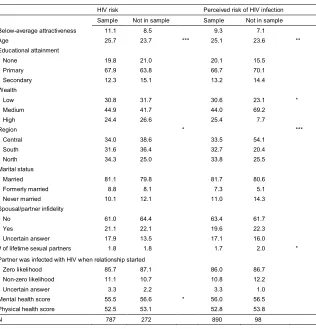
consists of 787 women, after the exclusion of 176 women for whom test results were not available, 57 women with missing data on at least one independent variable included in our models, and 39 who were missing information on both the outcome and control variables. For the analysis predicting perceived risk of HIV infection our analytic sample comprises 890 women: We excluded 71 women who tested positive for HIV in either 2004 or 2006, 5 women who had missing data on the outcome variable, 92 with missing data on key independent variables of interest, and 1 with missing data on both the outcome and control variables. In total, across
both sets of analyses, 961 women were included in our analytic sample.7
4 We also tested whether interviewer gender might mediate the effect of attractiveness by running
regression models of HIV infection and perceived risk of HIV infection with controls for interviewer characteristics, and again found that interviewer gender was not statistically significant. Finally, we compared the attractiveness ratings of 433 women in our analytic sample who were interviewed in 2010 and for whom interviewer gender data were available in both survey years. 199 of these women were interviewed by the opposite gender in 2010: 42% received the same rating and 43% received a rating that was within ±1 of the 2006 rating. The same pattern was observed among women who were interviewed by same-gender interviewers in 2006 and 2010. The fact that we find no gender differences is consistent with research examining interviewer assessments of physical attractiveness in US surveys: male interviewers tend to evaluate men as more attractive compared to female interviewers, but no interviewer gender differences are found for female respondents (Nedelec and Beaver 2011).
5 While the full age range of interviewers was from 19 to 39, the vast majority (88%) were under age 30
and only 7% were older than 35; thus we decided to restrict the sample to women aged 15‒35. Results were substantively identical to those presented here when we used the full age range of 15‒49.
6 In 2006 the overall response rate was 67.5%, with 19.8% attrition due mainly to migration. Among 15‒
35-year-old female respondents eligible to be interviewed, the response rate was 60% for the 2006 survey wave.
7 Findings may be biased if women who were excluded from analyses are different from those who were
3.1 Measures
3.1.1 Dependent variables
This study examines two dimensions of HIV risk: actual HIV infection and perceived risk of HIV infection. The first outcome variable, HIV infection, is constructed from results obtained through HIV testing of survey respondents in 2006. A few days after the survey interview was conducted a separate team of trained and certified HIV testing and counseling (HTC) counselors visited respondents’ homes to administer HIV testing. All information about HIV testing was kept confidential from the survey interviewers. In 2006 the MLSFH used finger-prick rapid HIV testing, which allowed respondents to learn their HIV status almost immediately. Of those interviewed in 2006, 92% of respondents participated in HIV testing and 98% of these opted to learn their HIV status. If respondents did
not get tested or received an indeterminate result,8 we checked to see if they were
tested in 2004. Of 73 respondents without a test result for 2006, 69 were tested in 2004 of whom 11 tested positive. We coded these 11 women as HIV positive in 2006 and coded the remainder as missing for HIV status, due to the possibility that they might have seroconverted during the inter-survey period.
The second outcome variable ‒ perceived risk of HIV infection ‒ is measured using an interactive technique that was designed to collect information on subjective expectations from respondents with limited numeracy (Anglewicz and Kohler 2009). Respondents were given ten beans on a plate and told: “Pick the number of beans that represents how likely you think it is that you are infected with HIV/AIDS now.” Possible responses ranged from zero to ten, with zero representing no risk of current infection and ten representing 100% risk of infection. Although Malawians tend to overestimate the likelihood of negative events, research using MLSFH and other survey data from Malawi confirms that this technique elicits assessments of child mortality, HIV prevalence, and food shortages that vary meaningfully with observable characteristics and reported experiences (Anglewicz and Kohler 2009; Delavande and Kohler 2009). Responses to this measure are highly skewed, with 62% of the sample choosing 0 beans and only 26
respondents selecting more than five beans (see Figure 1).9
8 Only two women received an indeterminate result in 2006.
9 As mentioned above, our analysis of perceived risk of infection excludes women who tested positive
Figure 1: Histogram of responses to question about perceived risk of HIV infection, 2006
3.1.2 Independent variables
Our key predictor variable measures the survey interviewers’ perception of the attractiveness of respondents. After completing the interview, interviewers filled out a short questionnaire consisting of ten questions about the interview. One of these questions asked interviewers to rate the respondent’s physical attractiveness: “Personally, how would you rank the respondent’s physical attractiveness relative to other persons of about the same age and sex?” Possible responses included: much less attractive than average, below average, average, more attractive, and much more attractive than average.
Because heterogeneity may exist in interviewers’ criteria for measuring attractiveness, we also utilized attractiveness data from the 2008 and 2010 waves (if
available) to generate a mean attractiveness rating for each respondent.10 Because
10 We also ran regression models using the 2006 measure of attractiveness and controlling for interviewer
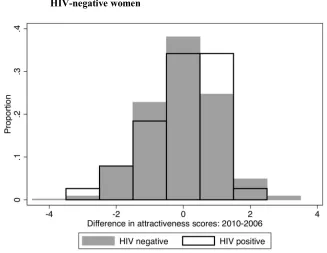
respondents were matched with different interviewers at each wave, averaging multiple ratings for each respondent allows us to smooth out discrepancies related to idiosyncrasies in particular interviewers’ assessments. Overall, attractiveness assessments were highly consistent over time for the majority of respondents (see Figure 2 for a comparison of attractiveness ratings for 2006 and 2010). In ancillary analyses we also tested whether women whose ratings across interviewers are more divergent might have a distinct pattern of outcomes, by controlling for the variance in attractiveness assessments across waves (available on request). The results did not change and the variance variable was not significant, suggesting that the minority of women who received attractiveness ratings that were discrepant by more than one value on the scale were not different in terms of either HIV infection or perceived HIV risk.
Averaging attractiveness ratings across waves could be a concern if HIV-positive respondents are more likely to experience declines in attractiveness between surveys. To examine whether this pattern was observed in the data, we created a variable subtracting the 2006 attractiveness score from that of 2010 and then plotted an overlay of histograms of this variable for positive and HIV-negative respondents, with HIV status measured in 2006 (Figure 2). Positive values indicate that women were rated as more attractive in 2010 than in 2006. For instance, with a value of positive two, a woman might be rated as below average (2) in 2006 and more attractive than average (4) in 2010. Comparing across the two HIV status groups, this figure shows that in contrast to HIV-negative women, women who tested positive for HIV in 2006 were more likely to have their attractiveness ratings increase over time rather than decrease (37% versus 29%), suggesting that attractiveness ratings were not impacted by physical manifestations
of illness for these women.11 This figure also shows that attractiveness ratings
stayed fairly constant across the four-year period for all women: Over 85% of both HIV-positive and HIV-negative respondents experienced no more than a one-level change in attractiveness ratings.
2006 sample), and a separate set of models clustering on interviewer IDs. The interviewer data was not missing at random (respondents in the central region were much more likely to be missing this information) and including these variables in our models would result in a significant reduction in sample size. For these reasons we opted to present analyses using mean attractiveness scores. While results using a 2006 measure of attractiveness with interviewer controls were qualitatively similar to those presented here, the coefficient of attractiveness was only marginally significant in models of HIV infection, likely due to the reduced sample size.
11 Using qualitative data on conversations about HIV in the same regions of Malawi where our survey
Figure 2: Histogram of the difference in interviewer-rated attractiveness between 2010 and 2006, graphed separately for HIV-positive and HIV-negative women
Notes:Positive values represent an increase in attractiveness ratings over time and negative values represent a decline in attractiveness ratings over time. Attractiveness ratings range from 1 (much less attractive than average) to 5 (much more attractive than average). HIV status is measured using results of MLSFH-administered HIV tests in 2006. Results show that HIV-positive women were more likely to experience an increase in attractiveness over time, relative to HIV-negative women.
attractiveness (below average attractiveness) and those who are rated greater than or
equal to 3 (average or more attractiveness).12
Figure 3: Bivariate associations between perceived attractiveness and HIV risk measures
Notes:Both panels were generated using a LOESS smoothing function, with the shaded region representing a 95% confidence interval around the mean estimate at each value of the interviewer-rated attractiveness scale. Both graphs show a strong negative trend at lower levels of the perceived attractiveness scale, with an evening out around the value of 3, corresponding to average ratings of perceived attractiveness.
We test three potential mechanisms that could mediate the relationship between attractiveness and HIV risk: spousal/partner infidelity, number of lifetime sexual partners, and women’s estimate of the likelihood that their partner was infected with HIV at the beginning of their relationship. If women who are more attractive enjoy more bargaining power in their relationships they may be less likely to say that they suspect that their partner has been unfaithful. Spousal or partner infidelity has been shown to be associated with HIV infection (Goodreau et al. 2012), and, due to the prominent public health campaigns in Malawi warning against the risks associated with concurrent partnerships, the perception that one’s partner is unfaithful is also likely to increase one’s perceived risk of HIV infection. Moreover, attractiveness may be related to whether one’s spouse is unfaithful, i.e.,
12 ROC score comparisons testing whether a binary or continuous specification of attractiveness provides
less attractive women may be at greater risk of having unfaithful spouses/partners than more attractive women. We used responses to two questions to create a variable measuring spousal/partner infidelity. Ever-married women were asked the following question about their current or most recent spouse: “During your time married together, did your husband have a girlfriend, or did he have sex with someone else apart from you and his other wife/wives?” Possible responses were: yes, I know; no; I suspect; I can’t know what he does; probably not; don’t know. We combined the latter four responses into the category “uncertain.” Among never-married respondents who reported ever having sex, we utilized responses to the question: “Do you think [NAME] had other sexual partners during the time you were in a sexual relationship with him?” Possible responses were: no, yes, and don’t remember. We renamed the last category as “uncertain”, to match the response categories of ever-married respondents. This question was not asked of never-married respondents who reported never having had sex. Prior studies have shown that female adolescents in sub-Saharan Africa tend to underreport sexual activity (Mensch, Hewett, and Erulkar 2003; Zaba 2004), and using survey data from Kenya, Mensch, Hewett, and Erulkar (2003) demonstrated that 7 out of 65 women who reported themselves to be virgins tested positive for HIV. Thus, we include these 49 women in our analytic sample and assign them “no” for the partner
infidelity question.13
The second mechanism we test is number of lifetime sexual partners. This variable might mediate the association between attractiveness and HIV risk if this association is due to differences in women’s own level of risky sexual behavior, and not partner characteristics or bargaining power. More attractive women may have had more lifetime partners, and having a larger number of lifetime sexual partners puts individuals at greater risk of HIV infection. This information was collected using the following question: “How many people overall have you ever had sex with?”
Finally, we examine whether the perceived likelihood that men were infected at the start of the relationship mediates the association between attractiveness and HIV risk. We view this variable as relating to women’s assessments of their partners’ desirability at initial stages of the relationship, and thus as related to partner selection. If more attractive women enjoy more agency in choosing their sexual partners, then they may be less likely to report that they believe their partners were infected when they first got together. This information was collected using the following question: “When you began your relationship with [NAME], what do you think was the likelihood [NAME] was infected with HIV?” Possible answers were no likelihood, low, medium, high, and don’t know. We combined low, medium, and
13 We also ran regression models excluding respondents who reported never having had sex and obtained
high into one value representing likelihood. Responses to this variable were missing for the 49 women in our sample who had never had sex, and we assigned these
women to “no likelihood.”14
We also include several control variables that are likely related to attractiveness and HIV risk. Previous research suggests that attractiveness is likely correlated with age, education, wealth, and marital status (Judge, Hurst, and Simon 2009; Langlois et al. 2000; Mojola 2014), so it is important to account for these factors in our analysis. Age is included in models as a continuous variable. Educational attainment is coded as none, primary, and secondary. To capture household economic status we used principal components analysis to construct a household wealth index, using information on 17 common household goods and
housing characteristics (Filmer and Pritchett 1999).15 We coded wealth scores into
three categories: low (bottom 25%), medium (middle 50%), and high (upper 25%). Marital status is categorized as currently married, formerly married (divorced, separated, or widowed), and never married.
We also control for physical and mental health, because health is likely to affect physical appearance (interviewers may be more likely to rate women in poor health as less attractive than those in better health) and to be associated with both actual HIV infection and perceived likelihood of HIV infection. The survey collected data on physical and mental health using the SF-12 questionnaire, a validated instrument composed of 12 questions capturing various dimensions of physical and mental health (Ware, Kosinski, and Keller 1996). Physical and mental health scores, which are continuous in nature, were computed using responses to these questions. Higher scores represent higher levels of physical and mental health. HIV prevalence varies widely by region, with rates highest in the south and lowest in the north (NSO-Macro 2017); thus we include a control for region of residence (central, south, or north). Finally, we controlled for the number of waves of attractiveness data (1, 2, or 3) used to construct our attractiveness measure.
3.2 Analytic strategy
We use logistic regression to examine the association between below average attractiveness and HIV infection. Following Frye and Trinitapoli (2015), we use negative binomial regression for our probabilistic measure of perceived risk of HIV
14 We also ran regression models excluding respondents who reported never having had sex and obtained
similar results to those presented here.
15 The household goods used in the index are a bed, sofa, table, lamp, tv, radio, cell phone, mosquito net,
infection, to account for the overdispersion displayed in Figure 1.16 To facilitate
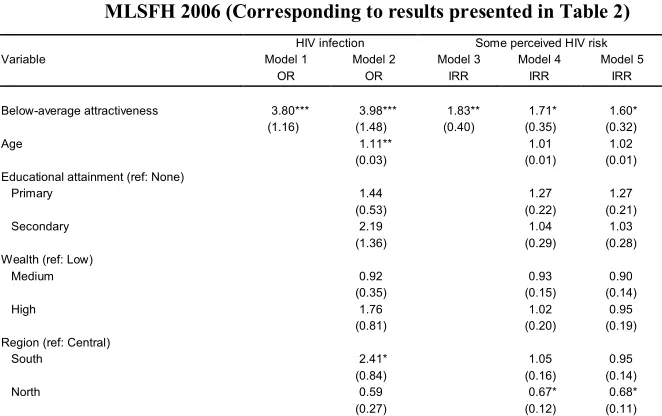
substantive interpretation of the results of the models we present average marginal effects (AMEs). For logistic regression models this measure can be interpreted as the change in probability of the outcome corresponding to a given change in the predictor variable while holding all other covariates at their sample values. For negative binomial regressions, AMEs can be interpreted as the change in the predicted count of the outcome variable (here, beans representing likelihood of infection) corresponding to a given change in the predictor variable, again holding all other covariates at their observed sample values. This method of reporting results is increasingly preferred over odds ratios and rate ratios for nonlinear models, because ratios are difficult to interpret in terms of relative magnitude (particularly for negative effects, when the ratios are less than one) and do not provide direct information about the probability of a given outcome occurring, which prevents readers from drawing inferences about the substantive significance of covariates (Deeks 1998; Hanmer and Kalkan 2013; Long and Freese 2006). We also report odds ratios (for logistic regression models) and incidence rate ratios (for negative binomial regression models) in Appendix A-3, for readers more accustomed to this method of communicating results.
To estimate each average marginal effect, predicted values were calculated twice for each respondent, first assigning a baseline value of the predictor variable (example: no education) to all respondents and then assigning a comparison value of the same predictor variable (example: secondary education) to all respondents, holding all other covariates at their observed values. The difference between these two estimates is the individual-level ‘marginal effect’ of primary education on the outcome variable. We calculated the average marginal effect by averaging this quantity across all respondents. For numeric variables we estimate the average
marginal effect by comparing women in the 75th percentile to those in the 25th
percentile.
4. Results
4.1 Descriptive statistics
Descriptive statistics for all variables are displayed in Table 1. In the analytic sample, 11% of women are rated below average attractiveness. HIV prevalence is 9%, and the mean value for our probabilistic measure of perceived risk of HIV
16 We also tried different specifications of perceived risk, including a binary indicator denoting no risk (0
infection is 1.2 beans. On average, respondents are 25.4 years old and most have at least some primary education. The analytic sample is evenly distributed across the three regions. With respect to marital status, 81% are currently married, 9% formerly married, and 10% never-married. More than 20% of respondents reported that their husband or partner was unfaithful and 17% reported being uncertain. The average number of lifetime sexual partners was 1.8. Eighty-six percent of women expressed certainty that their partner was not infected with HIV when they first became a couple. The mean mental and physical health scores are 56 and 53 respectively. The majority of respondents had three waves of attractiveness data available for use.
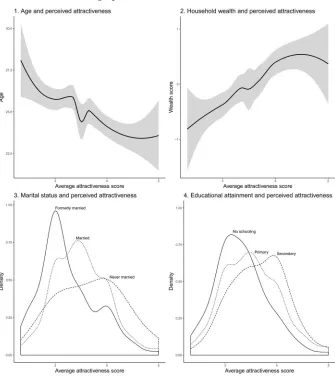
Figure 4 depicts the relationship between perceived attractiveness and four variables representing advantage and desirability in the sexual domain. Although our multivariate analysis focuses on a dichotomous measure of attractiveness due to the curvilinear relationship shown in Figure 3, here we use the continuous measure of attractiveness in order to better demonstrate these bivariate relationships. In the upper two panels we show a LOESS function of mean attractiveness scores across women’s age and household wealth scores, with 95% confidence intervals around the smoothed line. Panel 1 shows that younger women tend to be rated as more attractive than older women. In Panel 2 we use the wealth scores derived from the principal components analysis described above, and show that women residing in households with greater wealth are perceived to be more attractive on average. Because marital status and educational attainment are categorical variables we present density plots of mean attractiveness in the bottom two panels. As shown in Panel 3, never-married women tend to have higher attractiveness scores than married women, while formerly married women have lower scores than married or never-married women. Panel 4 shows that women with secondary education have higher attractiveness scores than women with primary education, while women with no schooling have lower scores relative to both groups.
Table 1: Descriptive statistics of female analytic sample, MLSFH 2006
Variable Mean/Percentage
Below Average Attractiveness (%) 10.6
HIV positive (%) 8.6
Perceived HIV riska(mean) 1.2
Age (mean) 25.4
Education (%)
None 20.6
Primary 66.5
Secondary 12.9
Wealth (%)
Low 24.9
Medium 50.1
High 25.1
Region (%)
Central 33.4
South 34.0
North 32.6
Marital status (%)
Married 80.9
Formerly married 8.8
Never married 10.3
Spousal/partner infidelity (%)
Nob 62.0
Yes 21.2
Uncertain answer 16.8
Number of lifetime sexual partners (mean) 1.8 Partner was infected with HIV when relationship started (%)
Zero likelihoodb 85.9
Non-zero likelihood 10.9
Uncertain answer 3.2
Mental health score (mean) 55.7 Physical health score (mean) 52.6 Waves of attractiveness data (%)
One 12.9
Two 28.2
Three 58.9
N 961
Notes: aExcludes HIV-positive women (N=68).
Figure 4: Bivariate associations between perceived attractiveness and sociodemographic variables
4.2 Regression analyses
4.2.1 Models predicting HIV infection
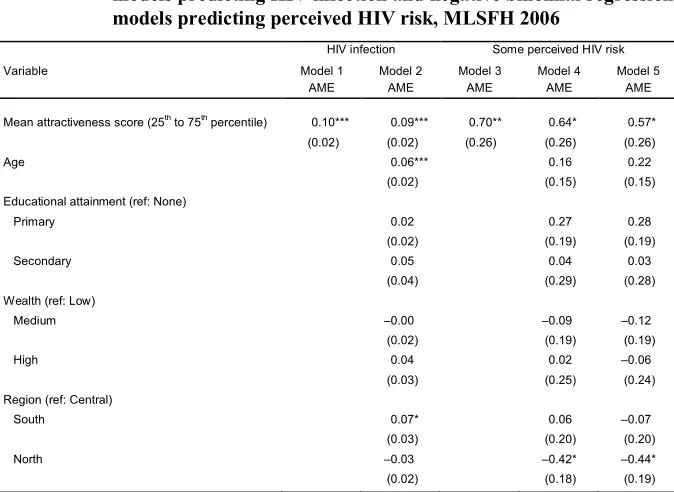
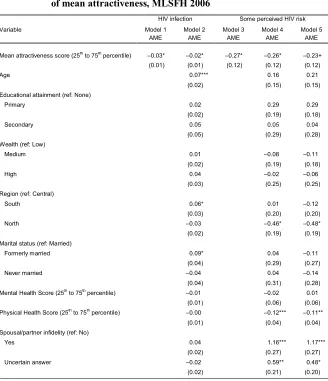
Average marginal effects (AMEs) from logistic regression models predicting HIV infection and perceived HIV risk are shown in Table 2. First, we examine the bivariate relationship between attractiveness and HIV infection (Model 1). Below-average attractiveness is strongly associated with HIV infection: The probability of HIV infection is 10% higher for women rated as below average in attractiveness compared to those rated as average or higher. In Model 2, with the full set of covariates included in the model and held at their observed values, women who are rated as less attractive than average are 9% more likely to be HIV positive. Given that the prevalence for this sample is less than 9%, the magnitude of this effect is quite substantial. Indeed, the magnitude of the change in predicted probability associated with a change in the attractiveness variable is larger than that of any other variable in the model.
Table 2: Average Marginal Effects (AMEs)a from logistic regression
models predicting HIV infection and negative binomial regression models predicting perceived HIV risk, MLSFH 2006
HIV infection Some perceived HIV risk
Variable Model 1
AME
Model 2 AME
Model 3 AME
Model 4 AME
Model 5 AME
Mean attractiveness score (25th to 75th percentile) 0.10*** 0.09*** 0.70** 0.64* 0.57*
(0.02) (0.02) (0.26) (0.26) (0.26)
Age 0.06*** 0.16 0.22
(0.02) (0.15) (0.15)
Educational attainment (ref: None)
Primary 0.02 0.27 0.28
(0.02) (0.19) (0.19)
Secondary 0.05 0.04 0.03
(0.04) (0.29) (0.28)
Wealth (ref: Low)
Medium ‒0.00 ‒0.09 ‒0.12
(0.02) (0.19) (0.19)
High 0.04 0.02 ‒0.06
(0.03) (0.25) (0.24)
Region (ref: Central)
South 0.07* 0.06 ‒0.07
(0.03) (0.20) (0.20)
North ‒0.03 ‒0.42* ‒0.44*
Table 2: (Continued)
HIV infection Some perceived HIV risk
Variable Model 1
AME Model 2 AME Model 3 AME Model 4 AME Model 5 AME Marital status (ref: Married)
Formerly married 0.08* 0.09 ‒0.06
(0.04) (0.31) (0.28)
Never married ‒0.05 ‒0.11 ‒0.20
(0.03) (0.29) (0.27)
Mental Health Score (25th to 75th percentile) ‒0.01 ‒0.02 ‒0.01
(0.01) (0.06) (0.06)
Physical Health Score (25th to 75th percentile) ‒0.00 ‒0.12** ‒0.10**
(0.01) (0.04) (0.04)
Spousal/partner infidelity (ref: No)
Yes 0.05+ 1.17*** 1.19***
(0.03) (0.27) (0.27)
Uncertain answer ‒0.01 0.59** 0.48*
(0.02) (0.21) (0.20)
Number of lifetime sexual partners 0.02** 0.13* 0.09
(0.01) (0.06) (0.06)
Partner was infected with HIV when relationship started (ref: no likelihood)
Non-zero likelihood ‒0.02 1.68***
(0.02) (0.44)
Uncertain answer ‒0.02 1.08+
(0.05) (0.63)
N 787 787 890 890 890
Notes: All models control for number of waves of attractiveness data. *** p<0.001, ** p<0.01, * p<0.05, + p<0.10
a In logistic regression models, AME represents the discrete change in predicted probability, and in negative binomial regression models, AME represents the discrete change in the predicted count of the outcome measure (here, beans representing perceived risk of HIV) associated with all observations moving from one value to another. For categorical variables, AME represents the discrete change associated with all observations moving from the reference category to the category displayed in each row. For binary variables, AME represents the discrete change associated with all observations moving from 0 to 1. For numeric variables (age, number of lifetime partners, mental health, physical health), AME represents the discrete change associated with moving from the 25th percentile to the 75th percentile. All other covariates are held at their observed values.
In ancillary analyses we added each potential mediator ‒ spousal/partner infidelity, number of lifetime sexual partners, perceived likelihood that partner was infected at the start of the relationship ‒ separately, in order to test whether they mediated the relationship between attractiveness and HIV infection. The coefficient of attractiveness changed minimally with the addition of these variables, providing no evidence of mediation. For simplicity, we therefore present the full version of the model, with all covariates included (Model 2).
increased likelihood compared to women who are currently married. Women who
are 30 years old (in the 75th percentile) are 6% more likely to have HIV than those
aged 20 (25th percentile). The likelihood of HIV infection also varies by region:
Relative to the central region, women in the south are 7% more likely to be infected with HIV. The probability of HIV infection is 5% higher for women who reported spousal/partner infidelity; this effect is marginally significant. No significant difference exists in the likelihood of HIV infection between women who reported no spousal/partner infidelity and those who reported being uncertain. Women who report 2 lifetime partners are 2% more likely to be currently infected than are those who report 1 lifetime partner. Educational attainment, wealth, mental health, physical health, and likelihood that partner was infected at the start of the relationship are not associated with HIV infection.
4.2.2 Models predicting perceived likelihood of HIV infection
Next, we examined the relationship between attractiveness and perceived risk of current HIV infection, using negative binomial regression for our probabilistic measure of perceived HIV risk (Models 3‒5). In ancillary analyses we again added each potential mediator ‒ spousal/partner infidelity, number of lifetime sexual partners, perceived likelihood that partner was infected at the start of the relationship ‒ separately, in order to test whether the coefficient for attractiveness changed substantially with the addition of these covariates. We found that the variable measuring women’s perceived likelihood that their partner was infected at the start of their relationship partially mediated the association between attractiveness and perceived risk of HIV, but no evidence of mediation for the other two measures. We therefore present three versions of this model: one with only the attractiveness measure (Model 3), one with all covariates except for perceived likelihood that partner was infected (Model 4), and one with all measures included (Model 5).
In addition to attractiveness and spousal infidelity, Model 4 shows that region is statistically significant: Women living in the north report 0.4 fewer beans, on average, compared to women living in the central region. Women report lower perceived risk of HIV if they are in better physical health: Respondents with a
physical health score of 57, corresponding to the 75th percentile, report 0.12 fewer
beans, on average, relative to respondents with a physical health score of 52,
corresponding to the 25th percentile. Women also report a higher perceived risk of
HIV if they report a greater number of lifetime sexual partners. Educational attainment, wealth, marital status, and mental health are not significantly associated with perceived risk of HIV.
Turning to Model 5, the average marginal effect of the below-average attractiveness measure decreases from 0.64 to 0.57 with the addition of the variable representing women’s perceived likelihood that their partner was infected at the start of the relationship, remaining statistically significant (p=0.04). This suggests that this measure partially mediates the association between attractiveness and perceived risk of infection, providing some support for the theory that partner selection (attractive women have more agency and choice over their sexual partners) may underlie this association. This variable is itself a highly significant predictor of perceived risk: Women who say there is some likelihood that their partner had HIV when they first got together place 1.7 more beans, on average, when assessing their own risk of infection (p<0.001), and women who respond “don’t know” to this question place 1.1 more beans than women who say there is no chance their partner was infected.
4.2.3 Assessing the association between attractiveness and HIV risk for men
While this study has primarily focused on the association between attractiveness and HIV risk for women, we conducted an identical set of analyses to examine
whether a similar association exists for the men in our data set (N=992). Consistent
infection, this evidence suggests that the strong association that we find between below-average attractiveness and HIV risk does not hold for male respondents. Future studies should further explore the gendered nature of this association.
5. Discussion
This study is the first to examine the association between perceived physical attractiveness and HIV risk. We do so in rural Malawi in the midst of the country’s generalized AIDS epidemic, using interviewers’ ratings of female respondents’ attractiveness. We find that physical attractiveness is an important axis of risk for women in this context. Women who were rated by interviewers as “much less” or “less” attractive than other women their age were considerably more likely to test positive for HIV. Among HIV-negative women, we also find that attractiveness is associated with women’s own assessment of their HIV risk: Women who are perceived as less attractive than average report themselves to be at higher risk of HIV infection. We found evidence that women’s assessment of the likelihood that their partner had HIV at the start of their relationship partially mediates the association between attractiveness and HIV risk, though we found no evidence that this measure mediates the association between attractiveness and HIV infection. Neither spousal/partner infidelity nor number of lifetime sexual partners was found to mediate the relationship between physical attractiveness and HIV risk.
Consistent with other research, we find that perceived attractiveness is not randomly distributed across the population but is associated with other dimensions of advantage and desirability in the sexual domain (Judge, Hurst, and Simon 2009; Langlois et al. 2000; Mojola 2014). On average, women who are perceived as more attractive are younger, less likely to have ever been married, have gone further in school, and have greater household wealth compared to women who are rated as less attractive. These descriptive findings show that women with greater access to capital are significantly more likely to be perceived by interviewers as more attractive, supporting qualitative studies from across sub-Saharan Africa showing that men tend to link women’s attractiveness to material consumption (Kaler 2006; Mojola 2014; Stadler 2003).
are only indirectly related to sexual behavior, and attractive women may still behave in ways that make them appear more risky to local observers. Indeed, despite being empirically invalid, it is possible that these cultural beliefs about HIV risk may actually be driving the pattern we document here, through a selection effect: Men may avoid sex with attractive women or be more likely to use condoms with them,
potentially contributing to the pattern that we observe. 17 Additionally, if
interviewers’ assessments of women’s physical attractiveness are dramatically different from those of typical Malawian men, it is possible that the cultural belief could be true, despite the fact that the association runs in the opposite direction in the survey data. We return to this point below.
Alternatively, these results could be driven by the opportunities and choices of women: Attractive women may enjoy advantages in the sexual domain that allow them to access more stable relationships with less risky partners. Physical attractiveness may be an important resource in the sexual domain that women can draw upon in order to assert agency and protect themselves from risk. Rather than attractiveness being associated with having more partners and more frequent sexual activity, as has been demonstrated in Western contexts (Agnew and Thompson 1994; Kelley 1978; McClintock 2011), in the context of Malawi’s AIDS epidemic, attractive women may draw upon “erotic capital” to negotiate safer sexual partnerships with less risky and more reliable men (Fiaveh et al. 2015; Green 2013; Hakim 2010). The fact that perceptions of partners’ HIV status at the start of the relationship partially attenuates the association between attractiveness and perceived HIV risk suggests that more attractive women at least perceive their partnerships to be safer, though we did not find evidence that this mechanism underlies the association between attractiveness and infection.
The idea that attractiveness is a resource or form of capital that women can draw upon to minimize their likelihood of infection may seem at odds with the consistent finding in the literature that wealth is positively associated with HIV infection among men (Poulin, Dovel, and Watkins 2016). We might expect attractive women to use this ‘capital’ to select wealthier men, thus putting themselves at greater risk. Yet research suggests that this association between men’s wealth and HIV status is likely due to wealthy men having a higher total number of sexual partners and, in particular, more casual or concurrent partners (Awusabo-Asare and Annim 2008; Berhan and Berhan 2013; Kohler and Thornton 2012). If less attractive women are able to exert less agency or control over their sexual lives, they may be more likely to engage in such casual and concurrent partnerships.
17 It is worth noting that, as mentioned above, an important component of the cultural beliefs linking
Evidence also suggests that when considering potential partners, women in Malawi try to avoid men who go to bars, travel frequently away from home, and work in town, all of which are indicators of relative wealth in rural Malawi (Schatz 2005; Smith and Watkins 2005). In other words, women may not view wealthy men as the most desirable, due to their reputation for having more extramarital partners and being less likely to be faithful, and may instead seek men with other attributes.
Of course, these results do not establish a causal association between attractiveness and HIV risk. An alternative interpretation of these results is that women who are infected with HIV could be rated as less attractive because they are already symptomatic and thus look unhealthy, or because they know they are infected and thus suffer from diminished mental health and take less care of their appearance. Though we cannot rule out this alternative, we point to four pieces of evidence that, when taken together, argue against this interpretation. First, we find that the results do not change with the inclusion of mental and physical health, and that neither physical nor mental health are themselves significant predictors of HIV infection. Second, we find that the values for interviewer-rated attractiveness for HIV-positive women do not decline either two or four years after they test positive: in fact they increase slightly on average over this time (see Figure 2). And third, we leveraged the longitudinal nature of our data to examine whether HIV infection or perceived risk of infection measured in 2006 are significantly associated with interview-rated attractiveness in 2010. We find no significant effects for either HIV
risk measure in these models (Appendix A-4).18 Together, these findings suggest
that the HIV infections documented here are largely presymptomatic and are not influencing women’s physical appearance during the observation period.
The final piece of evidence suggesting that these results are not driven by HIV infection leading women to be less attractive is that we find a similar pattern of results for the models predicting perceived risk of HIV infection, with the sample limited to women who did not test positive for HIV in 2004 or 2006. Specifically, being rated as less attractive than average is associated with an increased likelihood of reporting a non-zero risk of HIV infection. In short, women who are rated as less attractive perceive their own sexual histories to be considerably more risky than do women who are rated as average or above average in attractiveness. The fact that we find such a similar pattern for self-assessed risk suggests a behavioral or relational mechanism, i.e., differences in the sexual experiences or the sexual
18 We are grateful to an anonymous reviewer for suggesting this additional analysis. We use the 2010
partners of less attractive women that lead these women to be more likely to get HIV, rather than a biological effect of the disease on these women’s physical appearance.
The present study has some limitations, which should be carefully considered. First, our data was collected in 2006, and it is possible that the association between perceived attractiveness and HIV infection has changed over the past ten years. The 2006 round has the largest number of new HIV infections in the MLSFH longitudinal survey, and was one of only two rounds that included both attractiveness ratings and HIV testing (Kohler et al. 2015). Nonetheless, future research should investigate the association between perceived attractiveness and HIV infection using more recent data sets and in other contexts.
Another limitation of the present study is that our score for attractiveness reflects how the women in the sample were perceived by the individuals who interviewed them, who are likely to be considerably younger, more educated, and wealthier than the men who date or marry them. Hence, the magnitude of the relationship between female attractiveness and HIV risk may vary depending on how interviewers’ views on female attractiveness differ from those of ordinary Malawian men. Given that MLSFH collects information from both women and their male partners, a question that asks respondents to evaluate the physical attractiveness of their partners would allow us to gain additional insight into how HIV risk intersects with perceived attractiveness on the ground. Additionally, for future surveys that use interviewer-rated attractiveness measures, qualitative data asking interviewers to describe criteria used to make these assessments may help to shed additional light on what these subjective measures mean.
Attractiveness scores could have also been influenced by women’s responses to survey questions. In particular, interviewers may have perceived women who reported that they might be infected to be less attractive than women who expressed certainty about their serostatus. Our measure of HIV infection is not subject to this type of bias, as separate research staff administered HIV testing and interviewers were not informed of respondents’ infection status. However, the perceived risk variable was answered before interviewers rated respondents’ attractiveness, and thus these responses may have influenced their evaluations. We have no way of examining this issue empirically, and thus results for the perceived risk measure should be interpreted with some caution.
cross-sectional nature of our study makes it impossible to establish a causal relationship between attractiveness and HIV infection.
Despite these limitations, the observed negative association between attractiveness and both HIV infection and self-assessed HIV risk builds upon existing knowledge of the social and cultural factors contributing to HIV transmission, and underscores the importance of considering gendered power dynamics when designing effective HIV interventions. These results broadly support a deeper investigation into how sexual life is socially patterned in high-prevalence settings. The fact that physical attractiveness appears to be a strong protective factor against HIV infection suggests that more attention should be paid to understanding how differences in perceived sexual desirability may lead to inequities in women’s capacity to choose when and with whom they have sex. Programs aimed at increasing women’s autonomy and negotiating power within relationships might help to attenuate some of these inequities.
Additionally, these results suggest that local cultural understandings that portray attractive women as more likely to be infected and hold them responsible for the epidemic are false. While these local understandings of HIV risk are undeniably modern, they also echo enduring misogynistic tropes of ‘femme fatales’ ensnaring male victims and using their beauty for harm, which have been documented across contexts and over time (Dijkstra 1996; Goldenberg and Roberts 2004; Jankowiak and Ramsey 2000). The belief that the epidemic is driven by beautiful women also reflects a longstanding cultural anxiety around female beauty and sexual allure in sub-Saharan Africa that has recently been called into question. In Malawi, as well as in neighboring countries, women’s organizations and feminist activists have recently organized protests resisting miniskirt bans and other efforts to enforce conservative standards of dress for women (Cammack 2012; Tamale 2016). The findings presented here suggest that these beliefs are based not on perceptions of actual epidemiological trends but rather on structures of gendered power that scapegoat women and castigate them for ‘weakening’ men, and may support these movements’ efforts to challenge these dynamics.
degree to which perceived attractiveness is associated with outcomes such as relationship power, intimate partner violence, contraceptive use, and unwanted pregnancies.
Finally, this study highlights the need to consider physical attractiveness, and sexual desirability more broadly, as the under-examined axis of inequality shaping HIV risk. While scholars know that AIDS in Africa is primarily spread through sex and that sexual life is structured by desire, research has thus far failed to incorporate sexual desirability into models of HIV infection. Our study demonstrates that the negative association between attractiveness and HIV risk is not due to a distinct advantage in the sexual domain among women who are perceived as being particularly attractive, but instead is driven by the fact that women who are perceived as being less attractive are at a disadvantage compared to the rest of the population, in terms of their ability to avoid risky situations and protect themselves from infection. While much of the literature on attractiveness and sexual behavior focuses on the experiences of women who are at the higher end of the distribution in terms of perceived attractiveness (Agnew and Thompson 1994; Kelley 1978; Kruse and Fromme 2005; Zaikman et al. 2016), our study suggests that it may instead be women on the lower end of this distribution whose sexual experiences are most notably distinct, at least in ways that shape their HIV risk.
6. Acknowledgements
The Malawi Longitudinal Study of Families and Health (MLSFH) has been supported by the National Institute of Child Health and Development (grant numbers R03 HD058976, R21 HD050652, R01 HD044228, R01 HD053781), the National Institute on Aging (grant number P30 AG12836), the Boettner Center for Pensions and Retirement Security at the University of Pennsylvania, and the National Institute of Child Health and Development Population Research Infrastructure Program (grant number R24 HD-044964), all at the University of Pennsylvania. The MLSFH has also been supported by pilot funding received through the Penn Center for AIDS Research (CFAR), supported by NIAID AI 045008, and the Penn Institute on Aging. Research reported in this manuscript was supported by The Eunice Kennedy Shriver National Institute of Child Health and Human Development of the National Institutes of Health under Award Number P2CHD047879. The content is solely the responsibility of the author and does not necessarily represent the official views of the National Institutes of Health.
References
Agnew, C.R. and Thompson, V.D. (1994). Causal inferences and responsibility attributions concerning an HIV-positive target: The double-edged sword of
physical attractiveness. Journal of Social Behavior and Personality 9(1):
181‒190.
Agocha, V.B. and Cooper, M.L. (1999). Risk perceptions and safer-sex intentions: Does a partner’s physical attractiveness undermine the use of risk-relevant
information? Personality and Social Psychology Bulletin 25(6): 751–765.
doi:10.1177/0146167299025006009.
Anglewicz, P., adams, j., Obare, F., Kohler, H.-P., and Watkins, S. (2009). The Malawi Diffusion and Ideational Change Project 2004–06: Data collection,
data quality, and analysis of attrition. Demographic Research 20(21): 503–
540.doi:10.4054/DemRes.2009.20.21.
Anglewicz, P. and Kohler, H.-P. (2009). Overestimating HIV infection: The construction and accuracy of subjective probabilities of HIV infection in
rural Malawi. Demographic Research 20(6): 65–96. doi:10.4054/DemRes.
2009.20.6.
Awusabo-Asare, K. and Annim, S.K. (2008). Wealth status and risky sexual
behaviour in Ghana and Kenya. Applied Health Economics and Health
Policy 6(1): 27–39.doi:10.2165/00148365-200806010-00003.
Baranov, V., Bennett, D., and Kohler, H.-P. (2015). The indirect impact of antiretroviral therapy: Mortality Risk, mental health, and HIV-negative labor
supply. Journal of Health Economics 44: 195–211. doi:10.1016/j.jhealeco.
2015.07.008.
Becker, G.S. (1978). The economic approach to human behavior. Chicago:
University of Chicago Press.
Berhan, Y. and Berhan, A. (2013). Meta-analysis on risky sexual behaviour of men:
Consistent findings from different parts of the world.AIDS Care 25(2): 151–
159.doi:10.1080/09540121.2012.689812.
Buss, D.M. (1989). Sex differences in human mate preferences: Evolutionary
hypotheses tested in 37 cultures.Behavioral and Brain Sciences 12(1): 1–14.
doi:10.1017/S0140525X00023992.
Cammack, D. (2012). Malawi in crisis, 2011–12. Review of African Political
Chiweshe, M.K. and Bhatasara, S. (2013). Ndezve Varume Izvi: Hegemonic
masculinities and misogyny in popular music in Zimbabwe. Africa Media
Review 21(1): 151–170.
Clark, S., Poulin, M., and Kohler, H.-P. (2009). Marital aspirations, sexual
behaviors, and HIV/AIDS in rural Malawi. Journal of Marriage and Family
71(2): 396–416.doi:10.1111/j.1741-3737.2009.00607.x.
Coly, A.A. (2015). Un/Clothing African womanhood: Colonial statements and
postcolonial discourses of the African female body. Journal of
Contemporary African Studies 33(1): 12–26. doi:10.1080/02589001.2015. 1021209.
Conroy, A.A. (2014). Gender, power, and intimate partner violence: A study on
couples from rural Malawi. Journal of Interpersonal Violence 29(5): 866–
888.doi:10.1177/0886260513505907.
Deeks, J. (1998). When can odds ratios mislead? British Medical Journal
317(7166): 1155–1157.doi:10.1136/bmj.317.7166.1155a.
Delavande, A. and Kohler, H.-P. (2009). Subjective expectations in the context of
HIV/AIDS in Malawi.Demographic Research 20(31): 817–874.doi:10.405
4/DemRes.2009.20.31.
Dijkstra, B. (1996). Evil sisters: The threat of female sexuality and the cult of
manhood. New York: Alfred A. Knopf. http://www.weibnc.com/wp- content/uploads/brkpdfs2014/Evil-Sisters-The-Threat-of-Female-Sexuality-and-the-Cult-of-Manhood-by-Bram-Dijkstra-Shadow-History.pdf.
Dijkstra, P., Buunk, B.P., and Blanton, H. (2000). The effect of target’s physical
attractiveness and dominance on STD-risk perceptions. Journal of Applied
Social Psychology 30(8): 1738–1755. doi:10.1111/j.1559-1816.2000.tb0246 5.x.
Farrer, J. (2010). A foreign adventurer’s paradise? Interracial sexuality and alien
sexual capital in reform era Shanghai.Sexualities 13(1): 69–95.doi:10.1177/
1363460709352726.
Feingold, A. (1990). Gender differences in effects of physical attractiveness on
romantic attraction: A comparison across five research paradigms.Journal of
Fiaveh, D.Y., Izugbara, C.O., Okyerefo, M.P.K., Reysoo, F., and Fayorsey, C.K. (2015). Constructions of masculinity and femininity and sexual risk
negotiation practices among women in urban Ghana. Culture, Health and
Sexuality 17(5): 650–662.doi:10.1080/13691058.2014.989264.
Filmer, D. and Pritchett, L. (1999). The effect of household wealth on educational
attainment: Evidence from 35 countries. Population and Development
Review 25(1): 85–120.doi:10.1596/1813-9450-1980.
Fisman, R. (2006). Gender differences in mate selection: Evidence from a speed
dating experiment. The Quarterly Journal of Economics 121(2): 673–697.
doi:10.1162/qjec.2006.121.2.673.
Frye, M. and Gheihman, N. (2015). Bees to a flower: Men’s activation of sexual
culture in Malawi. Paper presented at the 7thAfrican Population Conference,
Johannesburg, 30 November‒4 December 2015.
Frye, M. and Trinitapoli, J. (2015). Ideals as anchors for relationship experiences.
American Sociological Review 80(3): 496–525. doi:10.1177/00031224155 81333.
Gilman, L. (2011). The dance of politics: Gender, performance, and
democratization in Malawi. Philadelphia: Temple University Press.
Goldenberg, J.L. and Roberts, T.-N. (2004). The beast within the beauty: An existential perspective on the objectification and condemnation of women.
In: Greenberg, J., Koole, S.L., and Pyszczynski, T. (eds.). Handbook of
experimental existential psychology. New York: Guilford Press: 71–85. Goodreau, S.M., Cassels, S., Kasprzyk, D., Montaño, D.E., Greek, A., and Morris,
M. (2012). Concurrent partnerships, acute infection and HIV epidemic
dynamics among young adults in Zimbabwe. AIDS and Behavior 16(2):
312–322.doi:10.1007/s10461-010-9858-x.
Green, A.I. (ed.) (2013).Sexual fields: Toward a sociology of collective sexual life.
Chicago: University of Chicago Press. doi:10.7208/chicago/9780226085
043.001.0001.
Hakim, C. (2010). Erotic capital. European Sociological Review 26(5): 499–518.
doi:10.1093/esr/jcq014.
Hanmer, M.J. and Kalkan, K.O. (2013). Behind the curve: Clarifying the best approach to calculating predicted probabilities and marginal effects from
limited dependent variable models. American Journal of Political Science