University of New Orleans University of New Orleans
ScholarWorks@UNO
ScholarWorks@UNO
University of New Orleans Theses and
Dissertations Dissertations and Theses
Spring 5-13-2016
A Numerical Study of Compressible Lid Driven Cavity Flow with a
A Numerical Study of Compressible Lid Driven Cavity Flow with a
Moving Boundary
Moving Boundary
Amer Hussain
UNIVERSITY OF NEW ORLEANS, [email protected]
Follow this and additional works at: https://scholarworks.uno.edu/td
Part of the Heat Transfer, Combustion Commons, and the Other Mechanical Engineering Commons
Recommended Citation Recommended Citation
Hussain, Amer, "A Numerical Study of Compressible Lid Driven Cavity Flow with a Moving Boundary" (2016). University of New Orleans Theses and Dissertations. 2155.
https://scholarworks.uno.edu/td/2155
This Thesis is protected by copyright and/or related rights. It has been brought to you by ScholarWorks@UNO with permission from the rights-holder(s). You are free to use this Thesis in any way that is permitted by the copyright and related rights legislation that applies to your use. For other uses you need to obtain permission from the rights-holder(s) directly, unless additional rights are indicated by a Creative Commons license in the record and/or on the work itself.
A Numerical Study of Compressible Lid Driven Cavity Flow with a
Moving Boundary
A Thesis
Submitted to the Graduate Faculty of the University of New Orleans in partial fulfillment of the requirements for the degree of
Master of Science in
Engineering Mechanical
by
Amer Hussain
B.Tech., Jawaharlal Nehru Technological University, 2014
ii
DEDICATION
To
My Parents
who brought me in this world and taught me never to lose hope and always try to the end without
expecting anything for earning an honest living
and
My Brother
who always encourages me to listen to my mind to do things as I think is good and always keeps
iii
ACKNOWLEDGMENT
First of all, I would like to express my sincere gratitude to my advisor, Dr. Kazim M
Akyuzlu for the continuous support of my Master’s study and research, for his patience,
motivation, enthusiasm, and immense knowledge. I am thankful for his guidance on fostering my
professional problem-analyzing, problem-solving, and reporting skills. His advice helped me a
lot to complete this work.
Besides my advisor, I would like to thank the rest of my thesis committee; Dr. Ting Wang
and Dr. Martin J Guillot for their encouragement and insightful comments.
I thank my fellow lab mates M Shafiqur Rahman, Anvesh Nallaballi, Mine Kaya, Jose E.
Rubio, Seda Aslan, and Pratik Sarker at the University of New Orleans for the stimulating
discussions, sleepless nights we worked together before deadlines, and for all the fun we have
had in the last two years.
Last but not the least, I would like to thank my family, my father Hussain Rafi Ullah and
my mother Shameem Akhtar for bringing forth me in this world and supporting me unanimously
iv
ABSTRACT
A two-dimensional (2-D), mathematical model is adopted to investigate the development
of circulation patterns for compressible, laminar, and shear driven flow inside a rectangular
cavity. The bottom of the cavity is free to move at a specified speed and the aspect ratio of the
cavity is changed from 1.0 to 1.5. The vertical sides and the bottom of the cavity are assumed
insulated. The cavity is filled with a compressible fluid with Prandtl number, Pr =1. The
governing equations are solved numerically using the commercial Computational Fluid
Dynamics (CFD) package ANSYS FLUENT 2015 and compared with the results for the
primitive variables of the problem obtained using in house CFD code based on Coupled
Modified Strongly Implicit Procedure (CMSIP). The simulations are carried out for the unsteady,
lid driven cavity flow problem with moving boundary (bottom) for different Reynolds number,
Mach numbers, bottom velocities and high initial pressure and temperature.
Keywords: Lid Driven Cavity Flow, Compressible, Unsteady, Laminar, CFD models, Moving
v
Table of Contents
Abstract iv
Nomenclature viii
List of Figures ix
List of Tables xviii
1. Introduction 1
2. Literature Survey 3
3. Description of a Physical Model 5
4. Description of a Mathematical Model 7
4.1 2-D Mathematical Model (FLUENT) 7
4.1.1 Assumption of 2-D Mathematical model 7
4.1.2 Mathematical Formulation for 2-D Model 8
i. Governing Differential Equations 8
ii. Initial Conditions 9
iii. Boundary Conditions 9
4.2 2-D Mathematical Model (CMSIP) 9
4.2.1 Assumption of 2-D Mathematical model 9
4.2.2 Mathematical Formulation for 2-D Model 10
i. Governing Differential Equations 10
ii. Initial Conditions 11
iii. Boundary Conditions 11
5. Numerical Formulation and Solution Procedures 13
vi
5.1.1 Discretization 13
5.1.2 Solutions Technique 14
5.2 Coupled Modified Strongly Implicit Procedure (CMSIP) 16
5.2.1 Transformation 17
5.2.2 Discretization 18
5.2.3 Linearization 19
6. Steady State Lid Driven Cavity Flow 21
6.1 Results for Steady State Lid Driven Cavity Flow Using Fluent 21
6.2 Comparison of Present Results (FLUENT) with CMSIP and Benchmark Case 23
6.3 Grid Independence Study 28
6.4 Effects of Different Reynolds Number (using FLUENT and CMSIP) 30
7. Mesh Motion Study for the Moving Bottom Boundary 37
7.1 Mesh Motion using Layering Technique 38
7.2 Mesh Motion using Spring-Based Technique 39
7.3 Mesh Motion using User-Defined Function (UDF) 40
7.4 Results and Comparison of Mesh Motion Techniques 41
8. Results of Unsteady Lid Driven Cavity Flow with a Moving Bottom Boundary 52 8.1 Results of Unsteady Lid Driven Cavity Flow using FLUENT 53
8.2 Time Increment Independence Study 67
8.3 Grid Independence Study 69
vii
9. Parametric Study for Unsteady Lid Driven Cavity Flow with a Moving Bottom
Boundary 81
9.1 Effects of Different Bottom Boundary Velocities 81
9.2 Effects of Different Reynolds Numbers 84
9.3 Effect of Different Mach-Numbers 89
9.4 Effects of Different Temperatures and Pressures 91
10. Conclusions 95
11. Recommendations 97
List of References 98
Appendices I. Vector Form of Governing Differential Equation 100
II. Coupled Modified Strongly Implicit Procedure (CMSIP) 101
III. Run Matrix for the simulation 102
IV. User-Defined function for mesh motion 105
viii
NOMENCLATURE
Symbols
AR cp
H k L M Pr p R Re T t u v x y
Aspect Ratio, H/L
Specific Heat
Height of the cavity
Thermal conductivity
Width of the cavity
Mach number
Prandtl number
Pressure
Gas Constant
Reynolds number
Temperature
Time
Velocity in x direction
Velocity in y direction
Horizontal distance
Vertical distance
Greek Symbols
γ Isentropic constant
µ Viscosity
ρ Density
𝜙 Viscous dissipation
𝜉 Transformed x coordinate
𝜎 Transformed y coordinate
Superscripts
ix
List of Figures
Figure 1 – Schematic of a square cavity with a moving bottom
Figure 2 – Mesh of the computational domain
Figure 3 – Overview of pressure-based coupled algorithm
Figure 4 – Computational Molecule for the Elements of A Matrix
Figure 5 – Computational Mesh for the Transformed () Domain
Figure 6 – Computational mesh of the domain
Figure 7 – u velocity contour for Re = 400
Figure 8 – Vectors of velocity magnitude for Re=400
Figure 9 – Streamlines of velocity magnitude for Re=400
Figure 10 – Contour plot of pressure for Re=400
Figure 11 – Contour plot of temperature for Re=400
Figure 12 – u velocity distribution along vertical centerline for Re=400
Figure 13 – v velocity distribution along horizontal centerline for Re=400
Figure 14 –Distribution of Horizontal Velocity (𝑢̅) along Centerline Vertical Distance for
Re = 100 and AR 1.0.
Figure 15 –Distribution of Horizontal Velocity (𝑢̅) along Centerline Vertical Distance for
Re = 400 and AR 1.0
Figure 16 –Distribution of Horizontal Velocity (𝑢̅) along Centerline Vertical Distance for
Re = 1000 and AR 1.0
Figure 17 –Distribution VerticalVelocity (𝑣̅) along Centerline Horizontal Distance for
x
Figure 18 –Distribution of VerticalVelocity (𝑣̅) along Centerline Horizontal Distance for
Re = 400 and A.R 1.0
Figure 19 –Distribution of VerticalVelocity (𝑣̅) along Centerline Horizontal Distance for
Re = 1000 and A.R 1.0
Figure 20 –Distribution of Horizontal Velocity (𝑢̅) along Centerline Vertical Distance for
Re = 400 and A.R 1.0 for different mesh sizes
Figure 21 –Distribution of Vertical Velocity (𝑣̅) along Centerline Horizontal Distance for
Re = 400 and A.R 1.0 for different mesh sizes.
Figure 22 –Distribution of Horizontal Velocity (𝑢̅) along Centerline Vertical Distance for
Re = 100 and A.R 1.0
Figure 23 –Distribution of Horizontal Velocity (𝑢̅) along Centerline Vertical Distance for
Re = 400 and A.R 1.0
Figure 24 –Distribution of Horizontal Velocity (𝑢̅) along Centerline Vertical Distance for
Re = 1000 and A.R 1.0
Figure 25 –Distribution of Vertical Velocity (𝑣̅) along Centerline Horizontal Distance for
Re = 100 and A.R 1.0
Figure 26 –Distribution of Vertical Velocity (𝑣̅) along Centerline Horizontal Distance for
Re = 400 and A.R 1.0
Figure 27 – Distribution of Vertical Velocity (𝑣̅) along Centerline Horizontal Distance for
Re = 1000 and A.R 1.0
Figure 28 – Pressure contour plot for Re = 100 (FLUENT)
xi
Figure 30 – Pressure contour plot for Re = 400 (FLUENT)
Figure 31 – Pressure contour plot for Re = 400 (CMSIP)
Figure 32 – Pressure contour plot for Re = 1000 (FLUENT)
Figure 33 – Pressure contour plot for Re = 400 (CMSIP)
Figure 34 – Temperature contour plot for Re = 100 (FLUENT)
Figure 35 – Temperature contour plot for Re = 1000 (CMSIP)
Figure 36 – Temperature contour plot for Re = 400 (FLUENT)
Figure 37 – Temperature contour plot for Re = 400 (CMSIP)
Figure 38 – Temperature contour plot for Re = 1000 (FLUENT)
Figure 39 – Temperature contour plot for Re = 1000 (CMSIP)
Figure 40 – Schematic of the infinite rectangular cavity of AR 3.0
Figure 41 – Dynamic Layering
Figure 42 – Computational mesh of the domain before moving of the bottom boundary (A.R 3.0)
Figure 43– Deforming of mesh using Spring-Based Smoothing technique
Figure 44 – 𝑣̅ velocity histogram for the motion of bottom boundary at at node at
𝑥̅ = 0.0, 𝑦̅ = 0.0 for different mesh motion studies.
Figure 45 – Computational mesh of the domain after moving of the bottom boundary using
layering technique (AR 3.0)
Figure 46 – Computational mesh of the domain after moving of the bottom boundary using
Spring-Based technique (AR 3.0)
Figure 47 – Computational mesh of the domain after moving of the bottom boundary using user-
defined technique (A.R 1.5)
xii
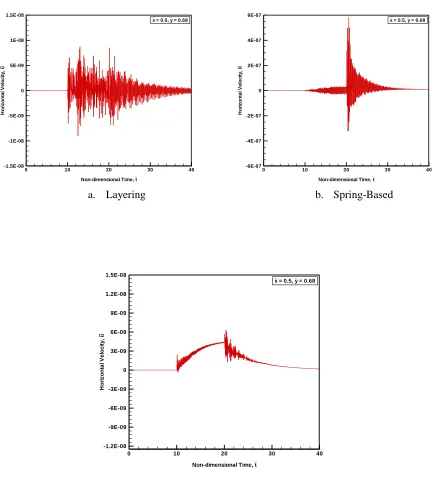
(a. using Layering, b. Using Spring-Based and c. Using UDF)
Figure 49– 𝑣̅ velocity histogram at node at 𝑥̅ = 0.5, 𝑦̅ = 0.68 for different mesh motion studies.
(a. using Layering, b. Using Spring-Based and c. Using UDF)
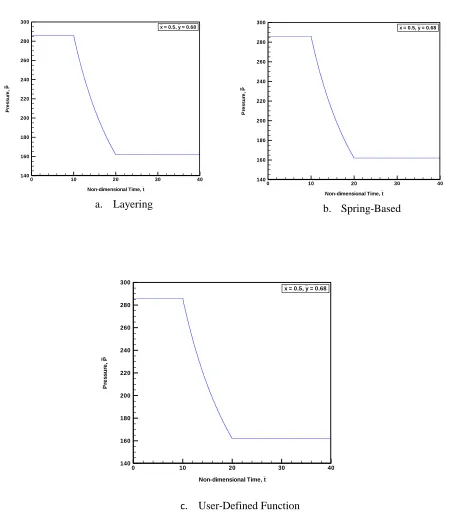
Figure 50 – 𝑃̅ pressure histogram at node at 𝑥̅ = 0.5, 𝑦̅ = 0.68 for different mesh motion studies
(a. using Layering, b. Using Spring-Based and c. Using UDF)
Figure 51 – 𝑇̅ Temperature histogram at node at 𝑥̅ = 0.5, 𝑦̅ = 0.68 for different mesh motion
studies. (a. using Layering, b. Using Spring-Based and c. Using UDF)
Figure 52 – 𝜌̅ Density histogram at node at 𝑥̅ = 0.5, 𝑦̅ = 0.68 for different mesh motion studies
(a. using Layering, b. Using Spring-Based and c. Using UDF)
Figure 53 – u̅ velocity distribution along centerline vertical distance ( y̅ = 0.0 to 1. 0) at 𝑥̅ = 0.5
for different mesh motion studies. (a. using Layering, b. Using Spring-Based and
c. Using UDF)
Figure 54 – v̅ velocity distribution along centerline vertical distance ( x̅ = 1.0 to 2. 0) at 𝑥̅ = 0.5
for different mesh motion studies (a. using Layering, b. Using Spring-Based and
c. Using UDF)
Figure 55 – Comparison of u̅ velocity distribution along centerline vertical distance for
( y̅ = 0.0 to 1. 0) at 𝑥̅ = 0.5 and time t̅ = 12 for different mesh motion studies and AR 1.1
Figure 56 – Comparison of u̅ velocity distribution along centerline vertical distance for
( y̅ = 0.0 to 1. 0) at 𝑥̅ = 0.5 and time t̅ = 14 for different mesh motion studies and AR 1.2
Figure 57 (a – d) – Histogram of the Horizontal Velocity (u)at x = 0.000255, y = 0.000346
before, during, and After the Motion of the Bottom Boundary of the Cavity for AR = 1.5
and Re = 400.
xiii
Re = 400
Figure 59 – Vertical Velocity (v) Distribution along Centerline Vertical Distance (x) for Re = 400
Figure 60 – Vector plot of velocity magnitude at t = 0 sec and AR 1.0
Figure 61 – Vector plot of velocity magnitude at t = 0.0000035 sec and AR 1.0
Figure 62 – Vector plot of velocity magnitude at t = 0.0000455 sec and AR 1.0
Figure 63 – Vector plot of velocity magnitude at t = 0.000105 sec and AR 1.0
Figure 64 – Vector plot of velocity magnitude at t = 0.000154 sec and AR 1.0
Figure 65 – Vector plot of velocity magnitude at t = 0.0002555 sec and AR 1.0
Figure 66 – Vector plot of velocity magnitude at t = 0.0005005 sec and AR 1.0
Figure 67 – Vector plot of velocity magnitude at t = 0.00106 sec and AR 1.0
Figure 68 – Vector plot of velocity magnitude at t = 0.001119 sec and AR 1.1
Figure 69 – Vector plot of velocity magnitude at t = 0.001178 sec and AR 1.2
Figure 70 – Vector plot of velocity magnitude at t = 0.001237 sec and AR 1.3
Figure 71 – Vector plot of velocity magnitude at t = 0.001295 sec and AR 1.4
Figure 72 – Vector plot of velocity magnitude at t = 0.001354 sec and AR 1.5
Figure 73 – Vector plot of velocity magnitude at t = 0.0020611 sec and AR 1.5
Figure 74 – Streamline plot of velocity magnitude at t = 0 sec and AR 1.0
Figure 75 – Streamline plot of velocity magnitude at t = 0.0000035 sec and AR 1.0
Figure 76 – Streamline plot of velocity magnitude at t = 0.0000455 sec and AR 1.0
Figure 77 – Streamline plot of velocity magnitude at t = 0.000105 sec and AR 1.0
Figure 78 – Streamline plot of velocity magnitude at t = 0.000154 sec and AR 1.0
Figure 79 – Streamline plot of velocity magnitude at t = 0.0002555 sec and AR 1.0
xiv
Figure 81 – Streamline plot of velocity magnitude at t = 0.00106 sec and AR 1.0
Figure 82 – Streamline plot of velocity magnitude at t = 0.001119 sec and AR 1.1
Figure 83 – Streamline plot of velocity magnitude at t = 0.001178 sec and AR 1.2
Figure 84 – Streamline plot of velocity magnitude at t = 0.001237 sec and AR 1.3
Figure 85 – Streamline plot of velocity magnitude at t = 0.001295 sec and AR 1.4
Figure 86 – Streamline plot of velocity magnitude at t = 0.001354 sec and AR 1.5
Figure 87 – Streamline plot of velocity magnitude at t = 0.0020611 sec and AR 1.5
Figure 88 – Pressure Contour at t = 0.00106 sec and AR 1.0
Figure 89 – Temperature Contour at t = 0.00106 sec and AR 1.0
Figure 90 – Pressure Contour at t = 0.001119 sec and AR 1.1
Figure 91 – Temperature Contour at t = 0.001119 sec and AR 1.1
Figure 92 – Pressure Contour at t = 0.001178 sec and AR 1.2
Figure 93 – Temperature Contour at t = 0.001178 sec and AR 1.2
Figure 94 – Pressure Contour at t = 0.001237 sec and AR 1.3
Figure 95 – Temperature Contour at t = 0.001237 sec and AR 1.3
Figure 96 – Pressure Contour at t = 0.001295 sec and AR 1.4
Figure 97 – Temperature Contour at t = 0.001295 sec and AR 1.4
Figure 98 – Pressure Contour at t = 0.001354 sec and AR 1.5
Figure 99 – Temperature Contour at t = 0.001354 sec and AR 1.5
xv
Figure 101 – Temperature Contour at t = 0.0020611 sec and AR 1.5
Figure 102 - 𝑢̅ velocity comparison at 𝑡̅ = 35 and AR 1.0 for different time increments Figure 103 - 𝑢̅ velocity comparison at 𝑡̅ = 46 and AR 1.5 for different time increments Figure 104 - 𝑣̅ velocity comparison at 𝑡̅ = 35 and AR 1.0 for different time increments Figure 105 - 𝑣̅ velocity comparison at 𝑡̅ = 46 and AR 1.5 for different time increments Figure 106 - 𝑢̅ velocity comparison at 𝑡̅ = 35 and AR 1.0 for different grid sizes Figure 107 - 𝑢̅ velocity comparison at 𝑡̅ = 46 and AR 1.5 for different grid sizes Figure 108 - 𝑣̅ velocity comparison at 𝑡̅ = 35 and AR 1.0 for different grid sizes Figure 109 - 𝑣̅ velocity comparison at 𝑡̅ = 46 and AR 1.5 for different grid sizes
Figure 110– Comparison of 𝑢̅ velocity between CMSIP and FLUENT at 𝑡̅ = 35 and AR 1.0
Figure 111– Comparison of 𝑢̅ velocity between CMSIP and FLUENT at 𝑡̅ = 38 and AR 1.1
Figure 112– comparison of 𝑢̅ velocity between CMSIP and FLUENT at 𝑡̅ = 46 and AR 1.5
Figure 113 – comparison of 𝑢̅ velocity between CMSIP and FLUENT at t̅ = 70 and AR 1.5
Figure 114 – Comparison of 𝑣̅ velocity between CMSIP and FLUENT at 𝑡̅ = 35 and AR 1.0
Figure 115 – Comparison of 𝑣̅ velocity between CMSIP and FLUENT at 𝑡̅ = 38 and AR 1.1
Figure 116 – comparison of 𝑣̅ velocity between CMSIP and FLUENT at 𝑡̅ = 46 and AR 1.5
Figure 117 – comparison of 𝑣̅ velocity between CMSIP and FLUENT at t̅ = 70 and AR 1.5
Figure 118 – Streamline plot for velocity magnitude at AR 1.0 (FLUENT)
Figure 119 – Streamline plot for velocity magnitude at AR 1.0 (CMSIP)
Figure 120 – Streamline plot for velocity magnitude at AR 1.1 (FLUENT)
Figure 121 – Streamline plot for velocity magnitude at AR 1.1 (CMSIP)
Figure 122 – Streamline plot for velocity magnitude at AR 1.5 (FLUENT)
xvi
Figure 124 – Streamline plot for velocity magnitude at AR 1.5 Steady State (FLUENT)
Figure 125 – Streamline plot for velocity magnitude at AR 1.5 Steady State (CMSIP)
Figure 126 – Bottom velocity profiles
Figure 127 - 𝑢̅ velocity histogram at node 𝑥̅ = 0.5, 𝑦̅ = 0.68
Figure 128 – Streamline plot of velocity magnitude at AR 1.3 with 𝑣̅𝑏 = −0.025
Figure 129 – Streamline plot of velocity magnitude at AR 1.3 with 𝑣̅𝑏 = −0.05
Figure 130 – Streamline plot of velocity magnitude at AR 1.3 with 𝑣̅𝑏 = −0.1
Figure 131 - Comparison of the 𝑢̅ velocities for different bottom boundary velocities
at 𝑡̅ = 42, 𝐴𝑅 1.3
Figure 132 - Comparison of the 𝑣̅ velocities for different bottom boundary velocities
at 𝑡̅ = 42, 𝐴𝑅 1.3
Figure 133 – Streamline plot of velocity magnitude at AR 1.0 for Re 100
Figure 134 – Streamline plot of velocity magnitude at AR 1.0 for Re 400
Figure 135 – Streamline plot of velocity magnitude at AR 1.0 for Re 1000
Figure 136 – Streamline plot of velocity magnitude at AR 1.5 for Re 100
Figure 137 – Streamline plot of velocity magnitude at AR 1.5 for Re 400
Figure 138 – Streamline plot of velocity magnitude at AR 1.5 for Re 1000
Figure 139 - Comparison of the 𝑢̅ velocities for different Re number 𝑡̅ = 36, 𝐴𝑅 1.0
Figure 140 - Comparison of the 𝑢̅ velocities for different Re number 𝑡̅ = 46, 𝐴𝑅 1.5
xvii
Figure 142 - Comparison of the 𝑣̅ velocities for different Re number 𝑡̅ = 46, 𝐴𝑅 1.5
Figure 143 - Comparison of the 𝑣̅ velocities for different M number 𝑡̅ = 36, 𝐴𝑅 1.0
Figure 144 - Comparison of the 𝑣̅ velocities for different M number 𝑡̅ = 46, 𝐴𝑅 1.5
Figure 145 – Streamline plot of velocity magnitude at AR 1.0 for P = 100kpa,T = 300K
Figure 146 – Streamline plot of velocity magnitude at AR 1.0 for for P = 100kpa,
T = 700K
Figure 147 – Streamline plot of velocity magnitude at AR 1.0 for for P = 506kpa,
T = 300K
Figure 148 – Streamline plot of velocity magnitude at AR 1.5 for for P = 100kpa,T = 300K
Figure 149 – Streamline plot of velocity magnitude at AR 1.5 for for P = 100kpa,T = 700K
Figure 150 – Streamline plot of velocity magnitude at AR 1.5 for for P = 506kpa,T = 300K
xviii
List of Table
Table 1 – Fluent solver settings
Table 2 – Common simulation Parameters for Lid Driven Cavity flow for Re = 400 by FLUENT
Table 3 – Results for Lid Driven Cavity flow for Re = 400 by FLUENT
Table 4 – Comparison of the results for u velocities obtained from the benchmark, CMSIP, and
FLUENT at different values of Re
Table 5 – Comparison of the results for v velocities obtained from the benchmark, CMSIP, and
FLUENT at different values of Re
Table 6 –Results for grid independence study for steady state driven cavity flow
Table 7 –Results for different Reynolds number Study for Steady
State Driven Cavity Flow
Table 8 – Simulation parameters for infinite rectangular cavity
Table 9 – Comparison of 𝑢̅ and 𝑣̅ velocities for different time increments
Table 10.a – Comparison of 𝑢̅ velocities for different grid sizes at A.R 1.0 and 1.5
Table 10.b - Comparison of 𝑣̅ velocities for different grid sizes at A.R 1.0 and 1.5
Table 11 – Comparison of distribution of 𝑢̅ velocity at AR 1.0 and 1.1 for FLUENT and CMSIP.
Table 12 – Comparison of distribution of 𝑢̅ velocity at AR 1.5 and 1.5 (steady state) for FLUENT
and CMSIP.
Table 13 – Comparison of distribution of 𝑣̅ velocity at AR 1.0 and 1.1 for FLUENT and CMSIP.
Table 14 – Comparison of distribution of 𝑣̅ velocity at AR 1.5 and 1.5 (steady state) for FLUENT
and CMSIP.
xix
at 𝑡̅ = 42, 𝐴𝑅 1.3
Table 16 – Comparison of the 𝑣̅ velocities for different bottom boundary velocities
at 𝑡̅ = 42, 𝐴𝑅 1.3
Table 17 – Comparison of the results (maximum velocities) of the unsteady lid driven cavity flow
with different Re = 100, 400 and 1000 at different aspect ratios
Table 18 – Comparison of the results (maximum velocities) of the unsteady lid driven cavity flow
with different Re = 100, 400 and 1000 at different aspect ratios
Table 19– Comparison of the 𝑢̅ velocities for Ma = 0.01, 0.03 and 0.05 at different aspect ratios
Table 20 – Comparison of the 𝑣̅ velocities for Ma = 0.01, 0.03 and 0.05 at different aspect ratios
1
1.
Introduction
Lid Driven cavity flow has been used extensively in the past as a benchmark case for the
study of computational methods to solve Navier-Stokes equations. In this problem the side and
bottom walls (boundaries) surrounding the cavity are fixed but the upper surface (lid) of the
cavity is moved at a uniform velocity. Many investigators [1-8] have solved this problem
assuming an incompressible fluid at low Mach numbers inside a cavity. This incompressible
flow version of the driven cavity problem seems to be the benchmark case which is widely used
by other investigators who study compressible flow inside cavities or channels. Some researchers
[9] have used this classical problem to benchmark their solutions to unsteady compressible
Navier-Stokes equations for low and high Mach number laminar flows. (Experimental data is
also available for this problem. See references [10-12].)
Other benchmarking cases include flow in a channel, flow though an expansion, and external
flows over various types of solid surfaces. All of these cases, including the driven cavity
problem, represent examples of fixed boundary problems where steady state solutions to
incompressible (and compressible) Navier-Stokes equations are of concern. No attempt has been
made yet to establish a benchmark case to study various solution techniques for moving
boundary problems.
So far there is no available benchmarking solutions to unsteady, compressible Navier-Stokes
equations where the flow domain is not enclosed by fixed boundaries. An example of such type
of problems is the case of natural convection inside the ullage of a cryogenic storage tank where
2
moving boundary problems is the flow of combustion gases inside the combustion chamber of a
hybrid rocket motor where the chamber boundaries move (enlarge) with the continuous ablation
of the solid fuel surface [14]. Both of these problems require the solution of the unsteady,
compressible Navier-Stokes equations and the coupled energy equation to predict, accurately, the
velocity field as well as the temperature and pressure distributions inside the flow domain.
An attempt has been made to simulate a lid driven cavity flow at aspect ratio 1.0 with a
moving boundary using Coupled Modified Strongly implicit Method (CMSIP) by Akyuzlu et. al
[15], where the bottom of the cavity is assumed to move at a constant speed until the aspect ratio
of 1.5 is reached.
Here a commercial CFD package ANSYS FLUENT is used to simulate the similar case [15]
and compare the results, to illustrate the accuracy of the simulation for better characterizations of
3
2.
Literature Survey
Assuming incompressible flow inside the cavity, numerous investigations have been done
[1−7] with low M and variable Re values to solve the problem. This study of incompressible
flow has been the benchmark for years with widespread applications for the researchers
including the study of channel flows, cavity flows, low and high Mach number laminar
compressible flows [8−10]. Ghia et al. used the vorticity-stream function formulation of the
two-dimensional incompressible Navier- Stokes equations to study the effectiveness of the coupled
strongly implicit multigrid (CSI-MG) method in the determination of high-Re fine-mesh flow
solutions. This work has been considered as a benchmark research to be studied by many fellow
researchers in the last few decades [2−8].
Chen and Pletcher [9] used the classical problem to benchmark their solutions to unsteady
compressible Navier-Stokes equations for low and high Mach number laminar flows. Other
benchmarking cases include flow in a channel, flow through an expansion, and external flows
over various types of solid surfaces. All of these cases, including the driven cavity problem,
represent examples of fixed boundary problems where steady state solutions to incompressible
(and compressible) Navier-Stokes equations are of concern. There is a need for benchmarking
solutions to unsteady, compressible Navier-Stokes equations where the flow domain is not
enclosed by fixed boundaries. An example of such type of problems is the case of natural
convection inside the ullage of a cryogenic storage tank where the ullage volume increases with
the discharge of the liquid propellant [13]. Another example of moving boundary problems is the
flow of combustion gases inside the combustion chamber of a hybrid rocket motor where the
chamber boundaries move (enlarge) with the continuous ablation of the solid fuel surface [14].
4
equations and the coupled energy equation to predict, accurately, the velocity field as well as the
temperature and pressure distributions inside the flow domain.
A study with moving bottom boundary for compressible flow has also been conducted by
Akyuzlu et al, [11] where the change of aspect ratio of the driven cavity due to the moving
bottom wall has been analyzed. In that study, the set of algebraic equations corresponding to the
problem have been solved by using the Coupled Modified Strongly Implicit Procedure (CMSIP)
for the unknown primitive variables. Again, other mentionable attempts relating to this field are
the numerical study of natural convection of compressible fluid inside an enclosed cavity [12],
5
3.
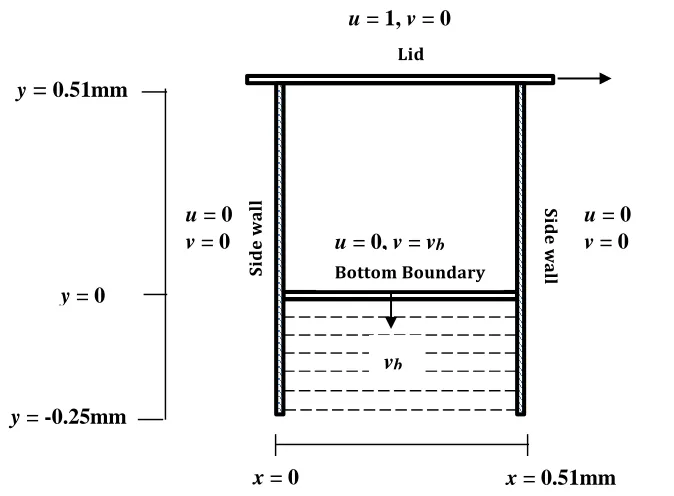
Description of The Physical Model
In the present study, a square cavity of aspect ratio 1.0 filled with compressible fluid at Pr = 1.0 is used as working fluid at standard temperature and pressure (STP). The top, left, right, and
bottom walls of the cavity are considered to be adiabatic walls with no slip condition. Initially,
everything is stationary inside the square cavity. The flow becomes steady at time (t1), then the
bottom boundary is moved with a constant velocity (vb) in negative y direction which stops at
time (t2) when the square cavity reaches the aspect ratio of 1.5 and becomes steady again at time
(t3). Evaluating the values M and Re, the flow inside the cavity can be categorized as laminar and subsonic. The physical model of the square cavity is shown in Figure 1.
Figure 1 – Schematic of a square cavity with a moving bottom
y = 0.51mm
y = 0
y = -0.25mm
x = 0 x = 0.51mm
u = 1, v = 0
u = 0, v = vb
u = 0
v = 0
u = 0
v = 0
𝛛𝐓
𝛛𝐱 v
b
𝐋𝐢𝐝
𝐁𝐨𝐭𝐭𝐨𝐦 𝐁𝐨𝐮𝐧𝐝𝐚𝐫𝐲
𝐒𝐢
𝐝𝐞
𝐰
𝐚𝐥
𝐥
𝐒𝐢
𝐝𝐞
𝐰
𝐚𝐥
6
No slip boundary conditions are assumed on the walls of the cavity and also considered to be
impermeable. There is no heat transfer through the walls since they are adiabatic. With constant
7
4.
Description of a Mathematical Model
The mathematical formulation of the driven cavity including the conservation equations
together with the initial and boundary conditions in second order accurate in time models is
given in this chapter. The dimensional governing equations used is derived from the respective
vector form of continuity, momentum, and energy equations (refer to Appendix I). The initial
and boundary conditions are then applied to well pose the mathematical formulation.
4.1 2-D Mathematical Model (FLUENT)
4.1.1 Assumption of 2-D Mathematical Model
The following assumptions were made for the present study.
1. The physical domain is Two-dimensional and the equations are in Cartesian Coordinates.
2. The working fluid forms a continuum.
3. The flow is subsonic, unsteady, laminar, and viscous.
4. The working fluid is compressible with Pr = 1 (the density of the fluid is a function of
temperature and pressure) and can be treated as an ideal gas.
5. The working fluid behaves like a Newtonian fluid with stokes assumptions.
6. The kinetic and potential energy terms in the energy equations are very small and can be
neglected except viscous dissipation term.
7. Radiation heat transfer is ignored.
8. There are no internal heat sources.
9. The physical and transport properties of the fluid are assumed to be constant
8
4.1.2 Mathematical Formulation for 2-D Model
i. Governing Differential Equations
The conservation equations for 2-D, unsteady, viscous, compressible, subsonic, and
laminar flow can be written in terms of primitive variables ρ, u, T, and P as follows:
For 2-D Cartesian, unsteady, compressible fluid, the conservative form of these equations are
given as follows:
The continuity equation is given by:
0 ) ( ) ( v y u x
t
(4.1)
The momentum equation in the x-direction is given by:
) ( ) 2 ( 3 2 ) ( ) ( ) ( 2 x v y u y y v x u x x p uv y u x u t (4.2)
The momentum equation in the y-direction (normal to fuel surface) is given by:
) 2 ( 3 2 ) ( ) ( ) ( ) ( 2 x u y v y x v y u x y p y p v y v u x v t (4.3)
The energy equation is given by:
] ) ( 3 2 ) ( ) ( 2 ) ( 2 [ ) ( ) ( ) ( ) ( ) ( 2 2 2 2 y v x u y u x v x v x u y T k y x T k x T v c y T u c x T R ct p p p
9
The equation of state is given by
p RT (4.5)
ii. Initial Conditions
1 0 , 1 0 0 , 1 0 , 1 0 0 , 0 , 0 y x and t at P P T T y x and t at v u o i o i o i
iii. Boundary conditions
Therefore, the governing equations are Non-Linear, second order and coupled.
4.2 2-D Mathematical model (CMSIP)
4.2.1 Assumption of 2-D Mathematical Model
The following assumptions were made for this mathematical model.
1. The physical domain is Two-dimensional and the equations are in Cartesian Coordinates.
2. The working fluid forms a continuum.
3. The flow is subsonic, unsteady, laminar, and viscous.
10
4. The working fluid is compressible with Pr = 1 (the density of the fluid is a function of
temperature and pressure) and can be treated as an ideal gas.
5. The working fluid behaves like a Newtonian fluid with stokes assumptions.
6. The kinetic and potential energy changes of the fluid, viscous dissipation, and the work
done by the pressure changes are small. (The terms representing these changes are ignored
in the energy equation.) These assumptions are valid for low Mach number flows (M< 0.1).
7. There are no internal heat sources.
8. The physical and transport properties of the fluid are assumed to be constant
9. No effect of gravity is assumed on the enclosed fluid.
4.2.2 Mathematical Formulation for 2-D Model
i. Governing Differential Equations
The non-dimensional conservation equations for a two-dimensional, unsteady, viscous,
compressible flow for low Mach numbers can be written in terms of non-dimensional form of the
primitive variables 𝑢̅, 𝑣,̅ 𝑝̅ and 𝑇̅ by replacing density by pressure and temperature using the
equation of state ( ρ = p/RT ) for ideal gases as follows: The continuity equation is given by:
0 T v p y T u p x T p
t (4.6)
The momentum equation in the x-direction is given by:
2 011
The momentum equation in the y-direction is given by:
2 03 2 2 y v x u y e R R x v y u x e R R p R y T v p y T v u p x T v p t (4.8)
The energy equation is given by:
0 y T y r P e R c R x T x r P e R c R c v p y c u p x R C p t p p p p p (4.9)
ii. Initial conditions
The governing equations of the present problem are solved for the initial conditions at
which the fluid inside the cavity is assumed stagnant and isothermal (at atmospheric conditions).
The initial pressure distribution inside the cavity is determined from solution of the hydrostatic
equation.
iii. Boundary conditions
The mathematical formulation is closed by the following boundary conditions for time t > 0:
12
The non-dimensional variables used in the above formulation are defined as follows:
ref ref ref ref ref ref p ref ref p p ref ref ref ref ref ref ref ref ref ref ref ref ref μ L u ρ e R , T R γ u M , k μ c r P , /T u c c , /T u R R , μ μ μ , ρ ρ ρ , T T T , u ρ p p , u v v , u u u , L y y , L x x , /u L t t 2 2 2
13
5.
Numerical Formulation and Solution Procedures
In this study, a 2-D model is simulated using ANSYS FLUENT 2015 under the given boundary
conditions. The working fluid in the cavity is at STP with M = 0.05 and Pr = 1.
5.1The Pressure-Based Coupled Algorithm
5.1.1 Discretization
ANSYS FLUENT uses a control-volume-based technique to convert the governing equations
to algebraic equations that can be solved numerically by integrating the governing equations
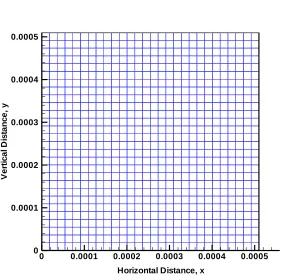
about each control volume, yielding discrete equations that conserve each quantity on a
control-volume basis. The governing equations are discretized for the mesh (29 x 29) as shown in the
figure 2.
Figure 2 – Mesh of the computational domain
Horizontal Distance, x
V
e
rt
ic
a
l
D
is
ta
n
c
e
,
y
0 0.0001 0.0002 0.0003 0.0004 0.0005 0
14
5.1.2 Solutions Technique
The discretized governing equations are solved using Pressure-Based solver [17] as the
governing equations are non-linear and coupled. Therefore, the solution is carried out iteratively
in order to obtain a converged numerical solution. The Pressure-based solver uses a solution
algorithm which can solve the non-linear equations. There are four algorithms available in this
technique namely Semi-Implicit Method for Pressure-Linked Equations (SIMPLE),
SIMPLE-Consistent (SIMPLEC), Pressure Implicit with Splitting of Operators (PISO), and Coupled. In
this Study “Coupled” algorithm was used since the momentum and continuity equations are
solved in a closely coupled manner except energy equation which is solved in a decoupled
fashion and therefore, the rate of solution convergence significantly improves when compared to
the other techniques. Second-order upwind scheme is used for the spatial discretization of
governing equation while the Second-order implicit scheme is used for transient formulation.
With the Pressure-Based Coupled Algorithm, each iteration consists of the steps illustrated in
figure 2. The algorithm is outlined below:
1. Update fluid properties (e.g., density, viscosity, specific heat) based on the current
solution.
2. Solve a coupled system of equations comprising the momentum and pressure-based
continuity equation. The remaining equations are solved in decoupled fashion.
3. Update mass fluxes, pressure and the velocity field.
4. Solver energy equation.
5. Check for the convergence of the equations.
15
16
The solver settings used in ANSYS FLUENT are mentioned in table 1
Table 1 – Fluent solver settings
CFD SOLVER SETTINGS
Description Settings
Problem Setup – Solver Pressure Based
Viscous Laminar
Pressure-Velocity Coupling Coupled
Gradient Discretization Green Gauss Cell Based
Pressure Discretization Second Order upwind
Density Discretization Second Order upwind
Momentum Discretization Second Order upwind
Energy Second Order upwind
Transient formulation Second Order upwind
Residual Criteria 1E-15
5.2 Coupled Modified Strongly Implicit Procedure (CMSIP)
A modified version of the Coupled Strongly Implicit Procedure (CSIP), developed by
Akyuzlu et al. [15] and details of this procedure the reader should refer to Appendix [II]
It is assumed that the changes in kinetic and potential energy of the fluid, viscous
dissipation, and the work done by the pressure changes are small. The density in the governing
17
5.2.1 Transformation
The 𝑥̅ and 𝑦̅ oordinate system used in development of the conservations equations,
(Equations 4.6 to 4.9), are transformed to the rigid (non-moving) coordinate 𝜉̅ and σ̅ system as
follows [15]:
H y
(5.1)
where H is defined as ( h and r are normalized using Lref )
x,tr h
H
(5.2)
and
x
(5.3)Based on the transformation given above the first order derivatives of any variable are given by:
) ( t ) ( t ) (
t
(5.4)
where
r H t
) t , x ( r H t
t
(5.5)
and
) ( x ) ( ) (
x
(5.6)
where
x ) t , x ( r H x
x
18
and
) ( y ) (
y
(5.8)
where
H 1 y
y
(5.9)
The second order partial derivative with respect to x is given by:
)] ( ) x
) t , x ( r H ( [ ))
( ( ))
( x (
x
(5.10)
The second order partial derivative with respect to y is given by:
) ) ( H
1 ( )
) ( y (
y 2
(5.11)
The final version of the transformed form of the non-dimensional conservation equations is
given in the Appendix [III].
5.2.2 Discretization
First, the governing differential equations (in non-dimensionalized and transformed form)
are discretized using first order forward differencing for the time derivative terms, central
differencing (second order accuracy) for all spatial derivatives (that is convective, viscous, and
thermal diffusion terms) and pressure terms. Central differencing of flux (momentum and
19
flux quantities at each opposing side of the computational cell. See [15] for details of the
discretization.
5.2.3 Linearization
The discretized non-dimensional conservation equations are linearized by Newton’s linearization
method. For example, the nonlinear term (P/T) in the continuity equation is linearized for the
(n+1)th time (where n indicates the discretized time level and k indicates the iteration index) as follows:
k 1 k
1 k k 1 k 1 k k 1 k T T T ) T p ( p p p ) T p ( ) T p ( ) T p ( (5.12)
After linearization, the conservation equations are put into following form for any nodal
point (i, j) of the computational domain [15] :
j , i 1 j , 1 i 2 j , i 1 j , i 1 j , i 1 j , 1 i 8 j , i j , 1 i 3 j , i j , i 9 j , i j , 1 i 7 j , i 1 j , 1 i 4 j , i 1 j , i 5 j , i 1 j , 1 i 6 j , i
b
x
A
x
A
x
A
x
A
x
A
x
A
x
A
x
A
x
A
(5.13)Similar equations are generated for the rest of the inner nodal points of the computational
domain. The resulting set of algebraic equations (as many as the number of inner nodes) is then
put into block matrix form [15]
A
x
b
(5.14)
Where [A] is the coefficient matrix with a 4x4 block in each element, x is the unknown vector,
20
Figure 4 – Computational Molecule for the Elements of A Matrix
Figure 5 – Computational Mesh for the Transformed () Domain
Horizontal Distance,
V
e
rt
ic
a
l
D
is
ta
n
c
e
,
0 0.25 0.5 0.75 1
0
0.1
0.2
0.3
0.4
0.5
0.6
0.7
0.8
0.9
1
j+1
j
j-1
21
6.
Steady State Lid Driven Cavity Flow – Results for Benchmark Case
Study
In this study, numerical studies have been carried out to obtain the steady state solution of
compressible lid driven cavity flow for various Reynolds number (100, 400, and 1000). The results
obtained using FLUENT and CMSIP are validated by comparing with the benchmark case [1] by
Ghia et.al [1] which solves for incompressible flow using vorticity equation and is shown in
Figures through 6. Also a grid independence study is done to establish the accuracy of the solution.
6.1 Results for Steady State Lid Driven Cavity Flow Using Fluent.
In this study a compressible fluid at Ma = 0.05 and Pr = 1 is enclosed in a square cavity
of aspect ratio 1.0 (L = H = 0.00051m in this case) at STP is assumed. The lid of the cavity is
given a constant velocity at Re = 400 (17.3205m/ in this case) and the steady state solution using
grid size of 39 x 39 obtained from FLUENT is shown in Figure 6.1. The parameters used and
results for maximum u and v velocities are quantified in Table 2.
Table 2 – Common simulation Parameters for Lid Driven Cavity flow for Re = 400 by FLUENT
Simulation Parameters
Parameter Unit Value
Length, L [m] 0.00051
Height, H [m] 0.00051
Lid Velocity, 𝑢𝑙𝑖𝑑 [m/s] 17.3205
Operating Pressure, Po [pascals] 101325
Initial Temperature, Ti [K] 300
Thermal Conductivity, k [W/m-K] 0.02624
Specific Heat, cp [j/kg-K] 1004.9
Absolute Viscosity, 𝜇 [N-s/m2] 0.000026112
Mach Number, Ma 0.05
22
Table 3 – Results for Lid Driven Cavity flow for Re = 400 by FLUENT
Results Maximum velocity, 𝒖̅ Minimum velocity, 𝒖 ̅ Maximum velocity, 𝒗̅ Minimum velocity, 𝒗̅
17.3205 -5.4190 4.9787 -7.1208
Figure 6 – Computational mesh of the domain Figure 7 – u velocity contour for Re = 400
Figure 8 – Vectors of velocity magnitude for Re=400
Figure 9 – Streamlines of velocity magnitude for Re=400
Horizontal Distance, x [m]
V e rt ic a l D is ta n c e , y [m ]
0 0.00025 0.0005 0 0.0001 0.0002 0.0003 0.0004 0.0005
Horizontal Distance, x [m]
V e rt ic a l D is ta n c e , y [m ]
0 0.00025 0.0005 0 0.0001 0.0002 0.0003 0.0004 0.0005 17 15.5 14 12.5 11 9.5 8 6.5 5 3.5 2 0.5 -1 -2.5 -4 u [m/s]
Horizontal Distance, x [m]
V e rt ic a l D is ta n c e , y [m ]
0 0.00025 0.0005 0 0.0001 0.0002 0.0003 0.0004 0.0005
Horizontal Distance, x [m]
V e rt ic a l D is ta n c e , y [m ]
23
Figure 10 – Contour plot of pressure for Re=400
Figure 11 – Contour plot of temperature for Re=400
Figure 12 – u velocity distribution along vertical centerline for Re=400
Figure 13 – v velocity distribution along horizontal centerline for Re=400
6.2 Comparison of Present Results (FLUENT) with CMSIP and Benchmark Case
The distribution of non-dimensional horizontal velocity (𝑢̅) and vertical velocity (𝑣̅) are
plotted along non-dimensional centerline vertical distance (𝑦̅) and centerline horizontal distance
(𝑥̅) respectively for comparing the results obtained using FLUENT, CMSIP and benchmark case
(GHIA) for Re 100, 400, and 1000. The results are in good agreement for Re = 100 and 400 but
there is a little deviation in magnitude of maximum velocities for Re = 1000 with the benchmark
Horizontal Distance, x
V e rt ic a l D is ta n c e , y
0 0.0001 0.0002 0.0003 0.0004 0.0005 0 0.0001 0.0002 0.0003 0.0004 0.0005 101550 101540 101520 101500 101480 101460 101440 101420 101400 101380 101360 101340 101320 101300 101280 P
Horizontal Distance, x
V e rt ic a l D is ta n c e , y
0 0.0001 0.0002 0.0003 0.0004 0.0005 0 0.0001 0.0002 0.0003 0.0004 0.0005 300.075 300.07 300.065 300.06 300.055 300.05 300.045 300.04 300.035 300.03 300.025 300.02 300.015 300.01 300.005 T
Horizontal Velocity. u [m/s]
C e n te rl in e V e rt ic a l D is ta n c e , y [m ]
-3.4641 0 3.4641 6.9282 10.3923 13.8564 17.3205 0 0.0001 0.0002 0.0003 0.0004 0.0005
Re = 400
Centerline Horizontal distance, x [m]
V e rt ic a l V e lo c it y , v [m /s ]
0 0.0001 0.0002 0.0003 0.0004 0.0005 -8 -6 -4 -2 0 2 4 6
24
case as the fluid used is incompressible by Ghia et al. [1] and shown in the Figures 14 through
19.
Figure 14 –Distribution of Horizontal Velocity (𝑢̅) along Centerline Vertical Distance for
Re = 100 and AR 1.0.
Figure 15 –Distribution of Horizontal Velocity (𝑢̅) along Centerline Vertical Distance for
Re = 400 and AR 1.0
Horizontal Velocity, u
C
e
n
te
rl
in
e
V
e
rt
ic
a
l
D
is
ta
n
c
e
,
y
0 0.5 1
0 0.1 0.2 0.3 0.4 0.5 0.6 0.7 0.8 0.9 1
GHIA et al (129x129) CMSIP (39x39) Present Results (39x39)
_ I
Horizontal Velocity, u
C
e
n
te
rl
in
e
V
e
rt
ic
a
l
D
is
ta
n
c
e
,
y
0 0.5 1
0 0.1 0.2 0.3 0.4 0.5 0.6 0.7 0.8 0.9 1
GHIA et al (129x129) CMSIP (39x39) Present Results (39x39)
25
Figure 16 –Distribution of Horizontal Velocity (𝑢̅) along Centerline Vertical Distance for
Re = 1000 and AR 1.0
Figure 17 –Distribution of VerticalVelocity (𝑣̅) along Centerline Horizontal Distance for
Re = 100 and A.R 1.0
Horizontal Velocity, u
C
e
n
te
rl
in
e
V
e
rt
ic
a
l
D
is
ta
n
c
e
,
y
0 0.5 1
0 0.1 0.2 0.3 0.4 0.5 0.6 0.7 0.8 0.9 1
GHIA et al (129x129) CMSIP (39x39) Present Results (39x39)
_ I
Centerline Horizontal Distance, x
V
e
rt
ic
a
l
V
e
lo
c
it
y
,
v
0 0.25 0.5 0.75 1
-0.25 -0.2 -0.15 -0.1 -0.05 0 0.05 0.1 0.15
GHIA et al (129x129) CMSIP (39x39) Present Results (39x39)
26
Figure 18 –Distribution of VerticalVelocity (𝑣̅) along Centerline Horizontal Distance for
Re = 400 and A.R 1.0
Figure 19 –Distribution of VerticalVelocity (𝑣̅) along Centerline Horizontal Distance for
Re = 1000 and A.R 1.0
Centerline Horizontal Distance, x
V
e
rt
ic
a
l
V
e
lo
c
it
y
,
v
0 0.25 0.5 0.75 1
-0.4 -0.3 -0.2 -0.1 0 0.1 0.2 0.3
GHIA et al (129x129) CMSIP (39x39) Present Results (39x39)
_ I
Centerline Horizontal Distance, x
V
e
rt
ic
a
l
V
e
lo
c
it
y
,
v
0 0.25 0.5 0.75 1
-0.5 -0.4 -0.3 -0.2 -0.1 0 0.1 0.2 0.3
GHIA et al (129x129) CMSIP (39x39) Present Results (39x39)
27
Table 4 and 5 show the comparison of the results (maximum and minimum velocities) of
present results (FLUENT), CMSIP, and benchmark studies for the values of Re 100, 400, and
1000. The computational mesh size used in FLUENT and CMSIP results is 39 x 39 while the
benchmark case (GHIA) is 129 x 129.
Table 4 – Comparison of the results for u velocities obtained from the benchmark, CMSIP, and
FLUENT at different values of Re
Re Value GHIA
u
CMSIP
u
FLUENT
u
CMSIP % dev
FLUENT % dev
100 max 1.00000 1.00000 1.00000 0.00 0.00
min -0.21090 -0.20804 -0.21194 1.35 0.49
400 max 1.00000 1.00000 1.00000 0.00 0.00
min -0.32726 -0.29616 -0.31379 9.50 4.11
1000 max 1.00000 1.00000 1.00000 0.00 0.00
min -0.38289 -0.31434 -0.33775 17.90 11.79
Table 5 – Comparison of the results for v velocities obtained from the benchmark, CMSIP, and
FLUENT at different values of Re
Re Value GHIA
v
CMSIP
v
FLUENT
v
CMSIP % dev
FLUENT % dev
100 Max 0.17527 0.17418 0.17727 0.62 1.14
Min -0.24533 -0.24796 -0.24826 1.07 1.19
400 Max 0.30203 0.27292 0.28770 9.64 4.74
Min -0.44993 -0.40974 -0.41968 8.93 6.72
1000 Max 0.37095 0.31883 0.33774 14.05 8.95
28
6.3 Grid Independence Study
The grid independence study is done for different mesh sizes of 19 x 19 (coarse),
29 x 29, 39 x 39 (medium) and 81 x 81 (fine). The distribution of non-dimensional
horizontal velocity (𝑢̅) and vertical velocity (𝑣̅) are plotted along non-dimensional
centerline vertical distance (𝑦̅) and centerline horizontal distance (𝑥̅) respectively for
comparing the results obtained using FLUENT for Re 400 shown in figure 20 and 21.
The results are quantified in Table 6. The results obtained for mesh size of 39 x 39 and 81
x 81 are very much similar when compared to coarse mesh size of for 19 x 19 and
29 x 29. The geometrical, operational, and physical parameters for this case study are
similar to that of the previous case studies.
Table 6 –Results for grid independence study for steady state driven cavity flow
Results Maximum velocity,
𝒖̅ Minimum velocity, 𝒖̅ Maximum velocity, 𝒗̅ Minimum velocity, 𝒗̅
1.00000 -0.26623 0.22964 -0.32868
1.00000 -0.29390 0.27216 -0.38738
1.00000 -0.31287 0.28745 -0.41112
29
Figure 20 –Distribution of Horizontal Velocity (𝑢̅) along Centerline Vertical Distance for
Re = 400 and A.R 1.0 for different mesh sizes.
Figure 21 –Distribution of Vertical Velocity (𝑣̅) along Centerline Horizontal Distance for
Re = 400 and A.R 1.0 for different mesh sizes.
Horizontal Velocity, u
C
e
n
te
rl
in
e
V
e
rt
ic
a
l
D
is
ta
n
c
e
,
y
-0.5 0 0.5 1
0 0.1 0.2 0.3 0.4 0.5 0.6 0.7 0.8 0.9 1
19x19 29x29 39x39 81x81 I
_
Centerline Horizontal Distance, x
V
e
rt
ic
a
l
V
e
lo
c
it
y
,
v
0 0.5 1
-0.5 -0.4 -0.3 -0.2 -0.1 0 0.1 0.2 0.3 0.4
19x19 29x29 39x39 81x81 I
30
6.4 Effects of Different Reynolds Number using FLUENT and CMSIP
A Parametric study is conducted and results are compared between FLUENT and CMSIP
to see the effects of flow inside the cavity for different Reynolds numbers 100, 400, and 1000.
The Table 6 shows the maximum 𝑢̅ and 𝑣̅ velocities for various Reynolds numbers. The
distribution of non-dimensional horizontal velocity (𝑢̅) and vertical velocity (𝑣̅) are
plotted along non-dimensional centerline vertical distance (𝑦̅) and centerline horizontal
distance (𝑥̅) respectively are shown Figures 22 through 27 and the results are quantified
in Table 7. The geometrical, operational and physical parameters for this case study are
similar to that of the previous case studies. The results obtained are in good agreement
with each other and the contour plots are generated (Figure 28) to see the distribution of
primitive variables in the cavity. It can be seen that the primary circulation (center)
moves towards the center of the cavity as Reynolds number increases and the formation
of secondary circulation (corner) increases in size with increase in Reynolds number and
is shown in the vector and streamline plots as shown in figure 29 and 30.
Table 7 –Results for different Reynolds number Study for Steady State Driven Cavity Flow
Results Reynolds
No.
Value CMSIP
𝒖̅
FLUENT
𝒖 ̅
dev % CMSIP
𝒗̅
FLUENT
𝒗̅
dev %
100 max 1.00000 1.00000 0.00 1.00000 1.00000 0.00
min -0.20714 -0.21198 -2.34 -0.24678 -0.24948 -1.09
400 max 1.00000 1.00000 0.00 1.00000 1.00000 0.00
min -0.29854 -0.31595 -5.83 -0.41166 -0.41960 -1.93
1000 max 1.00000 1.00000 0.00 1.00000 1.00000 0.00
31
Figure 22 –Distribution of Horizontal Velocity (𝑢̅) along Centerline Vertical Distance for
Re = 100 and AR 1.0
Figure 23 –Distribution of Horizontal Velocity (𝑢̅) along Centerline Vertical Distance for
Re = 400 and AR 1.0
Horizontal Velocity. u
C
e
n
te
rl
in
e
V
e
rt
ic
a
l
D
is
ta
n
c
e
,
y
0 0.5 1
0 0.1 0.2 0.3 0.4 0.5 0.6 0.7 0.8 0.9 1
CMSIP FLUENT
_ I
Horizontal Velocity. u
C
e
n
te
rl
in
e
V
e
rt
ic
a
l
D
is
ta
n
c
e
,
y
0 0.5 1
0 0.1 0.2 0.3 0.4 0.5 0.6 0.7 0.8 0.9 1
CMSIP FLUENT