Are “the semantic aspects” actually “irrelevant to the
engineering problem”?
José María Díaz Nafría
1, Basil M. Al Hadithi
2Universidad Alfonso X el Sabio, Information and Communication Technologies, 28691 Villanueva de la Cañada (Madrid), SPAIN; E-mail: 1 [email protected], 2 [email protected]
Abstract: At the beginning of his famous “Mathematical Theory of Communication” (MTC), Shannon removes the semantic questions from the technical task, and such exoneration seems to be commonly accepted, even for those who certainly care for ‘semantic questions’. However, the MTC communication model itself is built upon this fundamental assumption, which at the same time is used in other information theories and –even with wider practical consequences– as a design pattern for the Information Technologies.
At the present time, when human communication is more and more dependant with respect to information technologies, the suitability of the communication model used to design the technological systems has to be put into scope. None essential element needed to establish a proper human communication should be omitted; otherwise this technology could isolate people, betraying its hypothetical purpose. Comparing the technological model to others based on several pragmatic theories of communication (emerged in linguistics, semiotic, psychology and anthropology), the insufficiency of the technological model is shown, pointing out some elements that a new model should not forget.
Keywords: Mathematical Theory of Communication, Communications and Information Technologies
Acknowledgement: The authors wish to express their gratitude to Professor Mercedes Osorio for her generous effort in revising the article.
he fundamental problem of
communication is that of reproducing at one point either exactly or approximately a message selected at another point. Frequently the messages have meaning; that is they refer to or are correlated according to some system with certain physical or conceptual entities. These semantic aspects of communication are irrelevant to the engineering problem.” (Shannon, 1948)
We assume that Information and
Communication Technologies (ICT)enrich the communication abilities of people and societies having access to them. This assumption, going along with the intrinsic benefit of having the ability to communicate better, lead us to a simple equation according to which these technologies may only be
good, and therefore the only quest to solve is usually how to maximize them –optimizing, of course, the resources that are needed-.1 How ever, according to the communication model used for technical design, these technologies just mediate in a communication system (between source and destination) which exists previously. The virtue of this mediating system is –as a good glass- to be transparent, or even to achieve that communicants can be further away, or in circumstances without direct visibility. Hence, as a system of glasses and mirrors properly polished and structured as to become non-visible.
1
If the virtue of the information transmission system is measured with regard to the transparency property, it has much sense for the technique to forget the goodness of the communication, which it mediates. That should be just a problem for system users, while the system itself has to carry out the neat function of delivering in one side what was given on the other. Therefore, it does not have to report in case the users do not understand each other. This is, in our opinion, the background of the feigning ignorance with regard to the semantic aspects that Shannon and Weaver preach for technical duties. In this sense their recommendation is honest (Shannon, 1949, 1964; Weaver, 1972). However, in order to validate the transparency model, this should be sustained by a previous communication model according to which something is –in essence- emitted in an extreme and it is immediately afterwards received in the other. From this point of view, transparency would be perfectly possible. But, what about if communication might respond to a much more complex reality, in which it is not possible to consider information as something just traveling in the sequences of signals (no matter how intricate its structure is). What about if ICT, assuming this fundamental mechanism of communication, might cut down some of its essential elements? If that were the case, what might happen is that the trust put on these technologies would actually isolate people and social groups?
Undoubtedly, the number of signals or data interchange is incomparably larger than without ICT. Nevertheless, what about if the absence of means that allow to stage essential components of communication would have the consequence that the magnificent flow of transmitted signals would not easily participate –or even were just impossible to do it– in a genuine communication process?
As it can be seen, what we are calling into question, is not the usage given to technologies (which can always be regarded as something external to them), but the possible fact that they would just commit a planning error. We try to show how the contrast of the simple model of communication –massively used in the design of communication technologies- with more
complex models as those arisen from linguistic pragmatic theory, cultural semiotics, schizophrenia, etc., may help to discuss these questions (Bustos, 1999; Eco, 1979; Bateson, 1956). Using these models, it could be said that an appropriate channel to transmit communicative intention or what may be called –in extension of Austin notion- communicative force… is frequently missing. These absences might have the consequence that the magnificent torrent of sign-vehicles, which arrives to afflicted audiences, would finally lose its authentic communicative potential, and these would not know what to do with it. Moreover –being under the urgency of communicating– so many gadgets would not help –as it is believed– in order to achieve the desired effect of representations, requests, advices, declarations, claims...
With respect to these reasons, a communication system model closer to the communicative reality may be essayed. We believe (in spite of the laudable Shannon’s intention of simplicity) that this model should not give up semantic questions so lightly.
1. Simple (technical) communication model
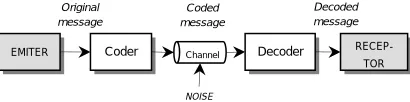
We will call “simple model” to that essentially used in the realm of communication technologies, as the one described by Shannon (1949). This model –as it will be shown later- enjoys a long-lived history which rests sinks probably in some rationalism excesses. According to this model, communication is basically a process in which codified messages are sent by means of a certain code, known or agreed by the source and destination of such messages. They reach the receiver relatively polluted and, depending on code quality as well as noise amount, messages will be decoded with better or worse luck in the receiver2. If the system is properly designed, messages are decoded just as they were in the source (or with an
2
irrelevant variation) and therefore communication succeeds joyfully.
According to the model, it does not seem to be needed much more than the clean arrival of the messages to destination in order to diagnose the success of communication.3 The technician says that going further is getting mixed up in matters to which he has not been called, and therefore he washes his hands. He supposes that everything else are sense problems probably appealing philosophy or even users, and he ensures his roll can only be honestly played if the technological tools deal with carrying the messages to destination not getting mixed up in content questions. In other words, he must behave as a good postman who does not rake into the content of the post he is carrying. However, it is possible that the assumptions sustaining this model have consequences in the actual success of communication that the technician does not suspect, lying in a simple perspective error.
Figure 1: Simple Communication Model
From some semiotic points of view this model describes technical communication properly, but it has a limited metaphorical value for general human communication. This objection, which critical value sides with semiotics may lead us to believe that the simple model is approved for technical developments.4 However, the fact that Morse code or, in general, digital communication matches perfectly with this model, it is not so
3
According to the early medieval revelation concept, it is enough for the saint to avoid those noises hindering the neat reception of divine illumination in order to be flooded with wisdom (O´Donell, XL, §66; Ortega, 1996, pp. 229-235)
4
Indeed, it can usually be found that from a semiotics perspective the simple model is considered as technologically suited (Bidon-Chanal, 1971). Floridi refers to this common acceptance of the Shannonesque model in his article “Semantic Conceptions of Information” (Floridi, 2005) as one of the two stable connections between MTC and other information approaches. The other is the inverse relation principle between probability and information.
much a success of the model itself, but probably of those engineers who achieve it – starting from the objective of developing the model as design pattern–.
One of the radical simplifications carried by this model is the assumption that information or the semantic content travels wrapped by the clothing of the message, and once it is received by the consignee, this is self-sufficient for retrieving the semantic content. It is obviously necessary a good synchronization between codes in both extremes for a fruitful retrieving. However, the reality of human communication shows that what we materially transmit is absolutely non-sufficient to interpret the actual references that the emitter wanted to mean or what this tried to do by communicating. In this sense, there are other elements with a relevant ability to signify or to act:
• The circumstance;
• The communications that were held till now;
• The nuances given to emissions by
intonation or gestures (which could also be considered as other types of emissions or parallel messages but with a different logical type, since they may indicate ‘what to do with respect to enunciations’);
• Shared knowledge;
• Usage of empathy by emitter or receptor.
All of them are master keys for the revealing of the semantic and pragmatic meaning. Considering this point, it will be hard to say that information is just contained in transmitted messages, instead of this, we may consider messages as a key to access information (which may be considered as more complex process), which is probably the core of communication (Bustos, 1999, p. 652).5
An examination to the genetic of the simple model (through the semiotics path or the one of the MTC) remits us to the Locke’s theory of
5 If these considerations would be taken into account,
when, for example, developing the telephone, the terminals would be probably located in special places imitating a shared circumstance. In any case, it would be settled down that only certain types of communication were suited to be mediated by this technique.
EMITER Coder RECEP-
TOR Decoder
Original message
Coded message
Decoded message
NOISE
language. According to Locke, it can only be spoken about general words if they are
“the signs of general ideas: and ideas become general, by separating from them the circumstances of time and place, and any other ideas that may determine them to this or that particular existence.” (Locke, 1690, B.III, §3.6).
Communication is made possible in Locke by means of the simple interchange of those words associated to clear and distinct ideas (achieving then a mental content traffic) with no other requirement than similarity between ideas, in which the reference to world is attained in virtue of the relation between words and things (better said, “sort of things”) (Ibidem, §3.12). This approach can easily be led up to the formulation of the simple model but containing a clearer set of assumptions.
The avoidance of the circumstance –as supposed by Locke- is perhaps one of the first and deepest consequences of the empire of simple model, which has been perceived as essential not only by the linguistic pragmatics but also by some logic theories (cf. Goddard and Routley, 1973; van Benthem et al, 2008). Notice that in telegraph, telephone, radio or television, the reference to the immediate circumstance of receptor has disappeared, carrying a sort of mutilation of communication whose consequences may go from individuals (who have become relatively impermeable from the incessant arrival of messages) to heritage culture (which having lost its original development space, it has been invaded by several symbolic empires while its constitutive elements are transformed into lifeless museum pieces), and going through society and family (whose structures have been drastically influenced by the appearance – among others– of television) (Dufour, 2001).
2. Inferential communication model
According to the technical model of digital communication, probably the closest one to linguistic communication:
1) the emitter (according to some
convention) to communicate X sends Z; 2) the receptor, after receiving Z
accompanied by a certain amount of noise, holds the hypothesis that the emitter tried to communicate X.
This hypothesis will be also characterized by a certain error probability, which – technically– may be reduced as much as it is desired but it can not be removed.
Nevertheless, if we contrast this model with the Sperber and Wilson’s inferential model (1986) we would immediately notice two decisive aspects: 1st, the reference to context is essential to grasp the actual relation with the word expected by emitter; 2nd, the grasp of the pre-codified message should not be the only top priority in communication, or even the ideas of the emitter, but also ‘what was tried to be done’ with emissions.
Therefore, the inferential model, using a terminology as close as possible to the previous digital model, may be formulated as:
1') the emitter (according to some
convention) ‘to do X’, being C the context perceived by emitter, sends Z;
2') the receptor, after receiving Z accompanied by a certain amount of noise, being C’ the context perceived by receptor, holds the hypothesis that the emitter tried ‘to do X’.
Where the inferential model of Sperber and Wilson has been blended to stress that more than an objective circumstance for emitter and receptor, what is actually in action –in order to select and to interpret emissions–, is the context perception at both sides. Obviously, if a person bumps into another dressed with a police uniform and the first one took him for the one who might wear the uniform, the type of things that can be said are very different to those that would be said in case he was recognized as an actor: The same thing would happen with the interpretation of the emissions of the hypothetical police.
1st the amount of noise is low enough so that receptor is not mistaken, which will depend on the difference among the signals used in the code.
2nd the perceived contexts at both sides are close enough, and
3rd the code is complex enough in order to make possible not only the perception of the semantic content but also what may be considered of a higher logic level: ‘what is tried to be done when a signal Z is sent’.
Among these restrictions only the first one (that is to say, the one claiming for a non-noisy channel) was already present in the simple model. With regard to the second one and according to the cultural semiotics analysis, the success of communication depends on a certain cultural homogeneity. For cultural semiologists, cultures have available what Lotman and Uspenskij called a stereotyping device, which assigns the open world of realia to the close world of names (Lotman, 1979; Eco, 1979). This perspective is also considered by many anthropologists – such as the structuralists (Keesing, 1974; Leach, 1993)– and it does not necessary lead to the famous incommunicability among cultures (Whorf, 1956), but to the consideration of cultures as belonging to a high complex structure, where interconnections among different cultures are produced and individuals may participate in several cultures (which necessarily happens in different grade and somehow separately, so that reality is actually interpreted alternatively by using the different “optics” offered by each culture). Nevertheless, it results unavoidable – as Ortega showed– that certain fundamental elements of the culture to which an individual belongs take place at any moment, because it is about the non-questioned assumptions that we are not conscious of –Ortega’s beliefs–, and from which we interpret reality.6 This
6
According to Ortega’s comparison, with beliefs happens something like with the floor sustaining us: to be actually sustained we may not question it; if we raise our feet –bringing it into question- we are not sustained anymore by that specific portion of floor but by other one, which in that moment is not questioned anymore (Ortega, 1987).
makes that whenever an essential discrepancy takes place between two assumed beliefs of speakers, who are trying to communicate about an issue concerning such beliefs, their communication is almost impossible (something similar occurs when even a mathematical problem is tried to be solved using two theories with non-compatible sets of axioms: no kind of agreement can be reached neither in posing, nor in solution).
To sum up, according to this semiotic perspective, it cannot be said that two individuals of different cultures are unable to communicate with each other, but the amount of things that they can do while communicating will be in function of the degree of cultural interpenetration they achieve.7 On the other hand, people who exactly share the same culture were the optimal participants of a communication process (whenever the dynamics due to the confrontation of cultural world-views – Weltanschauung– is not considered of major importance in communication process considered from a wider historical perspective).8
With regard to the third efficiency factor, the exclusively semantic concept of communication has to be transcended – according to the inferential model–. That conception, which continues the Lockean correspondence words-world, may be superseded to embrace the pragmatic reality of communication, in which we always communicate to do something (including, of course, the case in which this action aims to modify the beliefs of receiver). For that purpose, communication should have a code, articulated according to referential and conative aspects (Watzlawick, 1981), and at the same time, containing signals different enough in order to succeed against noise.
7
Perhaps –analogous to what is done in linguistics–, we may talk about “symbolic registers”, which may change within individuals in function of usage.
8
2.1. Critic of ICT with regard inferential model
Let us go back to the issue about reference to context: since it is not an optional, but a structural element of communication, the usage of media, as telephone or television, implies some mechanism of circumstance creation. That is the case of: television constantly fighting to build a symbolic universe; the epistolary correspondence persisting between two persons when they succeed establishing a symbolic universe of common references; the fluent telephonic conversations between speakers who know each other well enough as to ideally reconstruct their mutual circumstances (it is here remarkable how mobile telephone users employ –as they start conversation– explicit place references about speaker’s location); or the Internet utopias in which the building of a symbolic universe appropriate to this medium aspires to the category of planet culture (Etxeverria, 1999).
Nevertheless, the building of these circumstances, afterwards the medium has been designed, has several drawbacks: in the case of telephone it is only possible the maintenance of fluent communications with a certain density if the symbolic reference previously exists. This entails that people can not establish those spontaneous relations which are occasionally and frequently built, for example, on the public square and which development of interpersonal ties feeds the social structure. The harm is then of personal nature (causing, for example, a higher trouble in establishing personal relations) and also social (a thinner social structure, in the sense of having a fewer number and density of ties between individuals). But the harm may also be in the cultural realm, since the symbolic universe is intrinsically interpersonal. Knowing cultural life is nowadays less developed in social and face-to-face contexts, this culture has fewer possibilities to be maintained alive, or at the level of the current community problems (Castillo del Pino, 1970; Wolton, 2005).
In case of television, or even the press, the ability to take part in the creative process of the symbolic universe is in few hands and with a very well defined set of economical
interests. They are put upon any other criteria, causing that the symbolism itself stays at the mercy of such interest, and not of the common ones of audience communities, not even of those of creators’ community. These groups –involved in an atmosphere of predatory competency– are more and more joined to economical interests of communication oligarchies and indirectly to the interest of publicity industry (Bourdieu, 1996; Ramonet, 2001; Dufour, 2001; Steven, 2005).
In the case of Internet, it has been observed for several years an unbalanced battle among big communication empires flooding the ‘virtual space’ with commercial objects and the emblematic, but minority, association of hackers trying to build a democratic culture not only being in the hands of commerce. However, in this building, only a minority of quasi-specialists is able to participate. Their contents have not yet the critical size that would be needed to become an echo of community (Váden, 2002; Mattelart, 2001, 2003, 2007). Consequently, the forging Internet culture does not have the sufficient connection to social reality and their problems, making that it disregards the living torrent which might contribute to it.9
9
3. Other models
A critical exploration to the alternative communication models with respect to the simple one could not leave apart the Austin’s pragmatic theory (systemized by Strawson and Searle) about speech acts (Bystos, 1999; Searle, 1969; Strawson, 1983), but because of the extension we would need, we will not tackle it. Such theory could easily be translated into a theory of ‘communicative acts’ –using, of course, only those elements which are susceptible to be generalized–. Here, the emissive and receiving phenomena may be considered into a complete executive dynamic mediated by what could be called ‘communicative force’ –generalizing the Austinian concept of illocutionary force–. In virtue of this model and the refined analysis that Austin devotes to infelicities (failures of ‘what is done’ in a communicative act), a fruitful critical instrument could be developed to assess communication system quality.
Other pragmatic theory that could provide a valuable point of view on communication is the Grice’s intentional theory of meaning, which is sustained upon the interesting principle of communicative cooperation and implicatures (Grice, 1989). These –carefully generalized– may illuminate fundamental parts of the communication process being non-visible for the simple model. Indeed, the issue of intentionality in a general sense (wider than the one used by Grice, for example, the one proposed by Searle, 1983) may lead to a radical consideration of the information notion. This one has been masked since Shannon –in hands of the MTC– behind a notion better suited for data than for information (Floridi, 2005a, 2005b).
In order to emphasize the recursiveness of communication, the former inferential model may be modified to propose a recursive one using a unique rule:
1'') Perceiving Zn-1 in a context C’, to do Xn is decided. In order to reach it and according with a convention CV’, Zn (communicative act) is done.
Where convention CV’ (as the participant understands it) should be considered as an open and dynamic set of rules.
If trying to humanize the model even more, we brought it into the executive dynamic of a person’s life, instead of context we might speak about vital situations or just life (including its particular environment and, of course, all their interpersonal relations). In this case, the sequence of decisions {..., Xn-2, Xn-1, Xn, ...} which are taken towards a sequence of objectives {..., On-2, On-1, On, ...}, together with the actions that are done {..., Zn-2, Zn-1, Zn, ...} may be considered as an schema of life.
No doubt, all the considerations here remarked would require a more detailed discussion, but let us leave here what has been said as brushstrokes of what could be said and as a simple probe that the painting of the communicative reality may be filled with many more colors and lights than those shed by the simple model. If somehow these models honor the truth, then the honest technician should worry for those questions posed at the beginning, since the assumed transparent system would not be possible.
Conclusions
References
Bateson, G., Jackson, D. D., Haley, J. & Weakland, J. (1956). Toward a theory of schizophrenia, en Behavioral Science,
1(4), pp. 251-264.
Benthem, J. van; Martínez, M. (2008). The stories of logic of information. In Adriaans & Benthem (Eds.). Philosophy of Information. Amsterdam: Elsevier.
Bidon-Chanal, C. (1971). Tratamiento científico de la información. Convivium, 34 (1971/II), 77-92,
Bourdieu, P. (1996). Sur la télévision, suivi de L’emprise du jornalisme. Paris: Liber Editions. [Engl. trans. by P. P. Ferguson. (1999). On Television. New York: New Press]
Bustos Guadaño, E. (1999). Filosofía del lenguaje. Madrid: UNED.
Castells, Manuel (1996). The Rise of the Network Society, The Information Age: Economy, Society and Culture. Vol. I. Oxford: Blackwell.
Castells, M. The Internet Galaxy: Reflections on the Internet, Business and Society. Oxford: Oxford University Press, 2001. Castillo del Pino, C. (1970). La incomunicación. Barcelona: Península.
Dufour, Dany-Robert. (2001). La fabrique de l'enfant «post-moderne». Malaise dans l'éducation. Le Monde Diplomatique,
572, p. 11.
Eco, U. (1973). "Social Life as a Sign System". In David Robey (Ed.) Structuralism. Oxford: Clarendon, pp. 57-72. Etxeverría J. (1999). Los señores del aire. Telépolis y el Tercer Entorno. Barcelona: Destino.
Floridi, L. (2005a). Information. In C. Mitcham, (Ed.). Encyclopedia of Science, Technology and Ethics, Macmillan Reference.
— (2005b). Semantic Conceptions of Information. in Stanford Encyclopedia of Philisophy, [Online]
<http://plato.stanford.edu/entries/information-semantic/> [accesed: 25/10/2009]
Goddard, L. and Routley, R. (1973), The logic of Significance and Context. Edinburgh: Scottish Academic Press.
Grice, H. P. (1989). Studies in the way of words, Cambridge, Mass.: Harvard U.Press.
Habermas, J. (1991). Erläuterungen zur Diskursethik. Frankfurt am Main: Suhrkamp. [English, 1993]
Halliday, M.A.K. (1982). “Una interpretación de la relación funcional entre el lenguaje y la estructura social” in El lenguaje como semiótica social, México: FCE.
Homer-Dixon, T. (2001). The ingenuity gap. Canada: Vintage.
Keesing, R. (1974). “Theories of culture”, Annual Review of Anthropology, pp. 73-97.
Leach, E. (1976). Culture and Communications. The logic by which symbols are connected. London: Cambridge University Press.
Locke, J. (1690). An essay concerning human understanding, Jones-edition. [online] China: Humanities Computing & Methodology Program (RIH), the Chinese University of Hong Kong
<http://humanum.arts.cuhk.edu.hk/Philosophy/Locke/echu/> [consulted: 03/03/2009].
Lotman, Y. & Uspenskij, B. A. (1978). On the semiotic mechanism of culture. New Literary History9(2), 211–232. O’Donell, J. (1992). Confessions of Augustine. Oxford: Clarendon Press. [Online] http://www.stoa.org/hippo/ [consulted:
02/03/2009].
Ortega y Gasset, J. (1987). Ensayo de estética a manera de prólogo. In La deshumanización del arte y otros ensayos, Madrid: Espasa-Calpe. [Translated from the Spanish by Helene Weyl, et al. (1956). The Dehumanization of Art, and other writings on art and culture. New York: Doubleday Anchor Books.]
Ortega y Gasset, J. (1996). Estadios del Pensamiento Cristiano. In Entorno a Galileo, Madrid: Espasa Calpe, pp. 227-247. [Engl. transl. (1958). In transition form Christianity to Rationalism. In Man and Crisis. New York, Norton].
Ramonet, I. (2001). La Fabrique des désirs. In Le Monde Diplomatique, 566, 9 [Engl. transl. “Manufacturing desire” in LMD English edition, may 2001]
Searle, J. (1983). Intentionality: An Essay in the Philosophy of Mind. Cambridge (UK): Cambridge University Press Searle, J. (1969). Speech Acts. Cambridge: Cambridge U.Press.
Shannon, C. E. (1948). A mathematical Theory of Communication. The Bell System Technical Journal,27, 379-423, 623-656.
Shannon, C. E. (1949). Communication in the presence of noise. Proc. IRE,37(1), pp. 10-21, Jan. 1949.
Shannon, C. E., y Weaver, W. (1964). The mathematical theory of communication. Urbana: The University of Illinois Press. Sperber, D. & Wilson, D. (1986). Relevante, Oxford: B.Blackwell.
Strawson, P. F. (1983). Intención y convención en los actos de habla. in Ensayos lógico-lingüisticos, Madrid: Tecnos. [Engl. (1964). Intention and Convention in Speech Acts. Philosophical Review, 73(4), 439-460]
Vadén, T. & Stallman, R. M. (2002). Koodi vapaaksi - Hakkerietiikan vaativuus. Tampere University Press. [Engl. Transl.: The Hacker Community and Ethics: An Interview with Richard M. Stallman [online] Free Software Foundation <http://gnu.mirrorspace.org/philosophy/rms-hack.html> [consulted: 05/03/2009]
Whorf, B. (1956). Language, Thought and Reality. New York: Wiley. Wolton, D. (2005). Il faut sauver la communication. Paris: Flammarion.
Mattelart, Armand. (2001). Histoire de la société de l’information. Paris : La Découverte. [Engl. transl. (2003). The information society : an introduction. London : Sage]
— (2003). Sommet mondial sur la société de l'information: Les laissés-pour-compte du cyberespace. Le Monde Diplomatique,50 (593), p. 26.
— (2007) Communication - Qui contrôle les concepts?. In Le Monde Diplomatique, 54(641), pp. 22-23.
About the Authors
José María Díaz Nafría
Obtained M.Sc. in telecommunication engineering from the Universidad del País Vasco, Bilbao, Spain, in 1996. He received his PhD in telecommunication engineering from the Universidad Politécnica de Madrid with a dissertation on "Contributions to the electromagnetic inverse problem". He was also awarded with a M.A. in Philosophy by the Universidad Nacional de Educación a Distancia (UNED). He was research fellow at the Vienna University of Technology and at the Technical University of Madrid. He also served as assistant professor at the University Alfonso X el Sabio in Madrid, where he is now a university lecturer. He has been visiting lecturer at the University of Furtwangen, University of Applied Sciences of St.Pölten and University of Saltzburg. Co-director of the “First International Meeting of Experts in Information Theories” currently coordinates an interdisciplinary research group meted around the BITrum project (Elucidation of the information concept).
Basil Al Hadithi