RESEARCH
Health care providers’ perceptions
regarding antimicrobial stewardship
programs (AMS) implementation—facilitators
and challenges: a cross-sectional study
in the Eastern province of Saudi Arabia
Mohamed A. Baraka
1*, Hassan Alsultan
1, Taha Alsalman
1, Hussain Alaithan
1, Md. Ashraful Islam
1and Abdulsalam A. Alasseri
2Abstract
Background: Infections result from invasions of an organism into body tissues leading to diseases and complica-tions that might eventually lead to death. Inappropriate use of antimicrobials has led to development of antimicro-bial resistance (AMR) which has been associated with increased mortality, morbidity and health costs. Antimicroantimicro-bial stewardship (AMS) programs are designed to ensure appropriate selections of an effective antimicrobial drugs and optimizing antibiotic use to minimize antibiotic resistance by implementing certain policies, strategies and guidelines. The aim of this study was to investigate practitioners’ perceptions regarding AMS implementation and to identify challenges and facilitators of these programs execution.
Methods: Cross-sectional study among health care providers in Eastern province of Saudi Arabia Hospitals. The data was collected using a survey including questions about demographic data and information about clinicians’ (physi-cians, pharmacists and nurses) previous experience with AMS and prescribing of antibiotics, the level of knowledge and attitudes regarding AMS programs’ implementation.
Results: More than 50% of clinicians (N = 184) reported lack of awareness of AMS programs and their components, whereas 71.2% do not have previous AMS experience. The majority of clinicians (72.3%) noticed increasing number of AMR infections over the past 5 years and (69.6%) were involved in care of patients with an antibiotic-resistant infection. Around 77.2% of respondents reported that formulary management can be helpful for AMS practice and majority of respondents (79.9%) reported that the availability of pathogens and antimicrobial susceptibility testing can be helpful for AMS. Major barriers to AMS implementation identified were lack of internal policy/guidelines and specialized AMS information resources. Lack of administrative awareness about AMS programs; lack of personnel, time limitation, limited training opportunities, lack of confidence, financial issue or limited funding and lack of specialized AMS information resources were also reported 65.8%, 62.5%, 60.9%, 73.9%, 50%, 54.3 and 74.5%, respectively.
Conclusion: Our study identified comprehensive education and training needs for health care providers about AMS programs. Furthermore, it appears that internal policy and guidelines need revision to ensure that the health care
© The Author(s) 2019. This article is distributed under the terms of the Creative Commons Attribution 4.0 International License (http://creat iveco mmons .org/licen ses/by/4.0/), which permits unrestricted use, distribution, and reproduction in any medium, provided you give appropriate credit to the original author(s) and the source, provide a link to the Creative Commons license, and indicate if changes were made. The Creative Commons Public Domain Dedication waiver (http://creativecommons.org/ publicdomain/zero/1.0/) applies to the data made available in this article, unless otherwise stated.
Open Access
*Correspondence: [email protected]; [email protected]
1 Pharmacy Practice Department, College of Clinical Pharmacy, Imam
Abdulrahman Bin Faisal University (University of Dammam), Dammam, Saudi Arabia
Background
Infections result from invasions of an organism into body tissues leading to diseases and complications that might eventually lead to death [1]. Antimicrobials have the uniqueness of treating infections, as they have the capability of not only restoring the patient’s quality of life but have also proven to be lifesaving in several severe infective conditions [1]. Inappropriate use of antimicro-bials has led to development of antimicrobial resistance (AMR) which has been associated with increased mor-bidity, mortality and health costs [2]. Several factors have been reported to be associated with inappropriate prescribing of antimicrobials such as physicians with lit-tle experience and knowledge, uncertain diagnosis and patient influence on physician’s decision [3].
Proper use of antimicrobials leads to enhancing patient health outcomes, reducing drug consumptions and limiting the development of AMR [4]. A recent study conducted in Saudi Arabia from 2010 to 2015 revealed that most commonly used medications were antibiotics [5]. It has been reported in another study that certain classes of drugs like chemotherapeutic agents and antipsychotics are exclusively prescribed by concerned specialists, while in contrast, antibiotics are enthusiastically prescribed by all clinicians, as well as the allied healthcare personnel irrespective of their knowledge or training concerning antibiotics prescrip-tion [6]. In an attempt from the World Health Organi-zation (WHO) to reduce AMR, several initiatives and programs have been established to educate providers about appropriate antimicrobial prescribing for appro-priate indications [4]. In Saudi Arabia, the national AMS program has been activated in 2014 as a part of the pharmacy strategic plan of Ministry of Health [7]. The program started in governmental hospitals and expanded to include private hospitals 2 years later [8]. One of the challenges against AMS implementation was that majority of pharmacists were dispensing anti-biotics without prescription as evidenced by national studies [9, 10]. However, this is no longer allowed after enforcing the rules that prohibit by Saudi ministry of health in 2018. It has been documented that implemen-tation of AMS programs in the Gulf region including Saudi Arabia has led to decline in healthcare associated infections and reduction in the hospitalization period and mortality indices, in addition to tangible reduction
in antibiotics cost [11]. AMS programs are designed to ensure appropriate selection of an effective antimi-crobial prescribing and optimizing antibiotic use to minimize antibiotic resistance by implementing certain policies, strategies and guidelines. For the AMS pro-gram to be effective, it requires a team leader with full and ongoing financial support from the hospital admin-istration. This also includes a staff of infectious diseases trained clinical pharmacists, as a vital component of AMS. Ongoing antibiotic education tailored to each clinical service is essential for the acceptance of AMS interventions [12]. In fact, effective hospital AMS pro-grams need multidisciplinary engagement.
Several national and international studies revealed that inappropriate use of antimicrobials result in spreading of AMR [13–18]. Researchers have con-cluded that implementing AMS programs is very important to reduce antimicrobial resistance. AMS programs have been implemented in order to limit use of antibiotics, sharing of best practices and support the development of regional guidelines, also reducing the cost [13, 14]. Barriers of AMS programs include lack of collaboration and communication among healthcare providers, lack of compliance with guidelines, delay in updating knowledge, in addition to electronic system errors [2]. According to literature, general physicians are the most common prescribers of antibiotics in Saudi Arabia compared to specialists and residents [15, 16]. It was also reported that antimicrobials prescrip-tion was influenced by several factors such as; the phy-sician’s experience especially with general physicians, patients or parents’ demand and cost. Many doctors favor treating the infections rather than colonization without being more critical in diagnosis that might lead to AMR [15, 16]. However, from the above literature survey, we highlight the presence of a gap in knowl-edge regarding AMS programs implementation in our country. According to the national AMS strategic plan, last stage and full implementation of AMS should have been accomplished in 2018 [8]. This constitutes a golden opportunity to conduct such kind of studies in early stages of AMS implementation. Therefore, the aims of our study were to investigate health care pro-viders’ perceptions regarding AMS program implemen-tation and to identify facilitators and challenges against their implementation.
providers work consistently with AMS. Future research must focus on the benefit of implementing AMS as many hos-pitals are not implementing AMS as revealed by the clinicians. We recommend policy makers and concerned health authorities to consider the study findings into account to optimize AMS implementation.
Materials and methods
Data collection procedure
Data collection was done using self-administered ques-tionnaires that were distributed among healthcare pro-viders (physicians, pharmacists and nurses) in 6 large hospitals (4 governmental and 2 private more than 500 beds hospitals) in Eastern province of Saudi Arabia. To enhance data collection process, we also used online sur-veys (QuestionPro) that have been distributed through hospitals’ administration, pharmacy directors and nurs-ing supervisors usnurs-ing emails and relevant social media pages. Several visits have been paid by the study inves-tigators to the hospitals in addition to sending reminder emails and telephone calls to facilitate the process.
Sample size
To determine sample size and to prove the sample size adequacy, we used power study which is a very useful and frequently used tool in medical research. Since our popu-lation size is unknown, to obtain an appropriate sample size from this population, we used the following formula [19]:
where n = required sample size, Z1−β= Z value at power 1 − β (at power 90% this value is 1.24), p = preferred pop-ulation proportion (0.5), d = margin of error (ideal value is 0.05).
Considering 90% power of test, 5% marginal error and 0.5 population proportion, use of this formula resulted in a sample size of 153.76.
In practice we may need to enroll more participants to compensate for potential missing sample or level error [20]. The formula of adjustment sample size is:
where n = required sample size as per formula, n1= is adjusted sample size, e = potential missing sample or
level error.
Considering 10% dropout rate, the adjusted sample size is 170.84. This is the minimum sample size we calculated, finally, our targeted sample size for this study would be 190.
Data collection instrument
To develop the questionnaire an in-depth literature review was carried out to assess clinicians’ percep-tions about AMS programs. Among few sets of adapted questionnaires, an initial version of a structured ques-tionnaire was drafted while receiving help of expert advisory group (other three pharmacy staff including a
n=
Z1−β
2
[p(1−p)]
d2
n1=n/(1−e)
statistician in addition to the director of clinical phar-macy services). After compiling and adopting relevant questions from previously validated questionnaires in published literature [21–23]. To ensure the question-naire that fulfils the study objectives and the require-ments of the quality assessment domain, as well as to gain insights into its appropriateness, expert’s comments and suggestions were addressed accordingly. Whole questionnaire was divided into five parts; firstly, part A including respondents’ characteristics and experience with AMS (Cronbach’s Alpha 0.70). Second part was (named part B) covered clinicians’ perceptions (Cron-bach’s Alpha 0.66 and attitudes (Cron(Cron-bach’s Alpha 0.71) toward AMS programs including 24 items of five point Likert scale (responses: strongly agree, agree, uncertain, disagree and strongly disagree). To describe the factors related to clinicians antimicrobial prescribing/dispens-ing practices, a total of six factors with different options (allowed to choose multiple options) were undertaken and named it as part C (Cronbach’s Alpha for different factors obtained 0.61, 0.65, 0.74, 0.54, 0,84, and 0.65 for factor-1 to factor-6 respectively). Fourth part of the ques-tionnaire was related to helpful practices that are con-sidered as facilitators of AMS (12 items, named part D) including three responses; helpful, somewhat helpful and not helpful (Cronbach’s Alpha 0.81). Fifth and final part (named part E) of the questionnaire was to consider the major barriers of AMS implementation (eight items with five point Likert scale, Cronbach’s Alpha 0.87). To ensure face validity, the questionnaire was piloted to address all the correction about wording and ease of use, in addition to assessing the feasibility of the questionnaire. Beside this, content validity was ensured by the expert panel including three pharmacy staff, one clinicians and a stat-istician with the full agreement of all experts. However, data gathered from the pilot study were not included in final analysis. In terms of reliability, a number of consid-erations were made when designing this study to reduce threats to the reliability, including: the data collection process that was clearly documented and research cedures that were followed as per the data collection pro-tocol during the research conduction. To ease the capture of responses from participants, the data were gathered on one occasion, and to help reduce any unintentional bias in interpreting responses from closed-ended questions were deliberately chosen for this survey design.
Variables management
no and don’t know = 0; as well as for future: correct answer helpful = 1 and wrong answer somewhat and not helpful = 0) for measuring clinicians practice and divided into two categories; good practice and bad practice using k-mean cluster statistical method. To calculate clinicians’ attitude and perception score five point Likert scale was used as 5 to 1 for strongly agree, agree, uncertain, disa-gree and strongly disadisa-gree respectively. Finally using k-mean cluster statistical method, it was divided into two categories; good perception for higher score and bad per-ception for lower score. Major barriers’ variables were divided into three categories; agree (strongly agree and agree), uncertain (as usual) and disagree (disagree and strongly disagree).
Statistical analysis
Statistical analyses were carried out using Statistical Package for Social Sciences (IBM SPSS version 23.0) and Excel software. Data ware checked and cleaned using informal technique. As this was online survey (Ques-tionPro) missing cases were found, some of them were treated using ‘last-observation-carried-forward method’ (which is commonly used in pharmaceutical research) and some of them were excluded them from final analy-sis. Descriptive statistics was used to describe the study variables and items and frequencies and corresponding
percentages have been reported. For statistical signifi-cance p < 0.05 was considered as acceptable range of type-I error.
Results
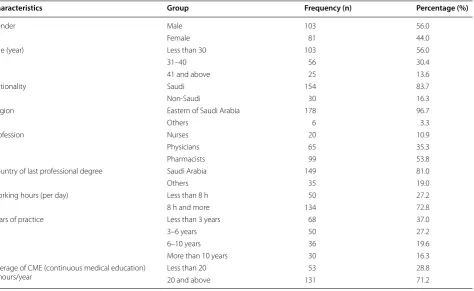
Data were analyzed for a total of 184 clinicians where 99 participants, more than half of them (53.8%) were phar-macists, 35.8% were physicians, and 10.9% were nurses. Overall, 56% were males whereas 44% were females. Same proportion found for the respondents whose age was less than 30 years. Regarding years of practice, 37% of the clinicians had less than 3 years of clinical experi-ence. Only 16% of respondents reported that their expe-rience exceeds 10 years. When we studied average of continuous medical education (CME) hours/year results, it revealed that more than 70% of the respondents (71%) had more than 20 continuous medical education hours per year (Table 1).
Table 2 represents the results of previous involve-ment and experience with antimicrobial resistance and antimicrobial stewardship (AMS) programs. Results demonstrated that among all, more than 50%, 52.7% cli-nicians reported they are not aware of antimicrobial stewardship (AMS) programs and their components, whereas 71.2% do not have previous AMS experience. But many clinicians (72.3%) noticed increasing number
Table 1 Descriptive statistics for socio-demographic characteristics of respondents (n = 184)
Characteristics Group Frequency (n) Percentage (%)
Gender Male 103 56.0
Female 81 44.0
Age (year) Less than 30 103 56.0
31–40 56 30.4
41 and above 25 13.6
Nationality Saudi 154 83.7
Non-Saudi 30 16.3
Region Eastern of Saudi Arabia 178 96.7
Others 6 3.3
Profession Nurses 20 10.9
Physicians 65 35.3
Pharmacists 99 53.8
Country of last professional degree Saudi Arabia 149 81.0
Others 35 19.0
Working hours (per day) Less than 8 h 50 27.2
8 h and more 134 72.8
Years of practice Less than 3 years 68 37.0
3–6 years 50 27.2
6–10 years 36 19.6
More than 10 years 30 16.3
Average of CME (continuous medical education)
of antimicrobial-resistant infections over last 5 years and (69.6%) were involved in care of patients with an antibi-otic-resistant infection. Almost 66% (65.8%) of healthcare providers agreed that their hospitals provide guidelines/ policy for diagnosis and management of patients with infective problems, and nearly same percentage (69.6%) of respondents ensure that they follow the recommen-dations of their hospital about antimicrobial guidelines/ policy, while only a very low number of clinicians (10.9%) received a specialized training in AMS programs.
The results of Presence and implementation of spe-cific antimicrobial stewardship (AMS) program poli-cies were presented in Table 3. Most of the respondents (70.1%) reported that the policy requiring prescribers to document indication for antibiotic. Almost three-fourth (73.4%) of the respondents agreed that indi-vidual patient care is improved by having an antibiotic approval program. Almost 70% (70.7%) of the respond-ents found having to call for approval makes the team
think more carefully about choosing an antibiotic. However, 66.8% of the respondents found that is not the primary purpose of the antibiotic approval program is to reduce the amount of money the hospital spends on antibiotics.
Opinion on different practice which can be helpful as facilitators of AMS were obtained and expressed in Table 4. Results demonstrated that 77.2% of respondents have agreed that formulary management can be help-ful for AMS practice. a large percentage of respondents reported that the availability of pathogens and antimicro-bial susceptibility testing can be helpful for AMS practice and the stated results were (79.9%). Real-time feedback, IT department support, time and Incentives/fund-ing were found almost similar percentage 58.7%, 53.3% and 54.3%, respectively to support helpful opinion on AMS practice. Finally, almost 70% (69.6%) of clinicians reported that didactic education is helpful for practices in AMS.
Table 2 Previous involvement and experience with antimicrobial resistance and antimicrobial stewardship (AMS) programs
Items Responses
Yes (n & %) No (n & %)
Are you aware of antimicrobial stewardship (AMS) programs and their components? 87 (47.3) 97 (52.7)
Do you have previous AMS experience? 53 (28.8) 131 (71.2)
Have you noticed increasing number of antimicrobial-resistant infections over last 5 years? 133 (72.3) 51 (27.7) Have you ever been involved in care of patients with an antibiotic-resistant infection? 128 (69.6) 56 (30.4)
Have you worked in health care facilities with AMS programs? 51 (27.7) 133 (72.3)
Have you received specialized training in AMS programs? 20 (10.9) 164 (89.1)
Does your hospital provide guidelines/policy for diagnosis and management of patient with infective
problems? 121 (65.8) 63 (34.2)
Do you follow the recommendations of your hospital antimicrobial guidelines/policy? 128 (69.6) 56 (30.4) Do you believe that antimicrobials are used too much in clinical settings? 146 (79.3) 38 (20.7) Have you ever been forced to choose antibiotics you feel are inappropriate because of the antibiotic
approval program? 65 (35.3) 119 (64.7)
Is the infectious diseases service in your hospital easily accessible and helpful? 114 (62.0) 70 (38.0)
Does your hospital contain drug information services/centers? 113 (61.4) 71 (38.6)
Table 3 Presence and implementation of specific antimicrobial stewardship (AMS) program policies
Items Responses
Yes (n & %) No (n & %)
Policy requiring prescribers to document indication for antibiotic 129 (70.1) 55 (29.9)
Individual patient care is improved by having an antibiotic approval program 135 (73.4) 49 (26.6) Having to call for approval makes the team think more carefully about choosing an antibiotic 130 (70.7) 54 (29.3) The primary purpose of the antibiotic approval program is to reduce the amount of money the hospital spends on
antibiot-ics 61 (33.2) 123 (66.8)
The clinician who is seeing the patient is in a more appropriate position to pick the correct antibiotic than someone on the
Almost two-third (74.5%) of respondent agreed that the major barriers could be the lack of internal policy/guide-lines and lack of specialized AMS information resources. Response on other barriers like: administrative awareness about AMS program; lack of personnel, time limitation, limited training opportunities, lack of confidence, finan-cial issue or limited funding and lack of spefinan-cialized AMS information resources were found 65.8%, 62.5%, 60.9%, 73.9%, 50%, 54.3 and 74.5%, respectively. It was noticed that maximum supporting barrier on AMS reported (74.5%) on two items firstly, lack of internal policy/guide-lines and secondly, lack of specialized AMS information resources (Table 5).
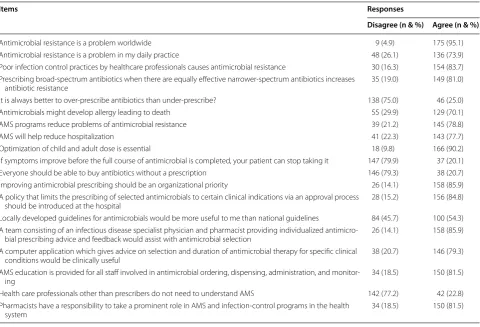
For assessment to the perceptions toward antimicro-bial stewardship programs, 19 questions were utilized and represented in the Table 6. Most of them agreed that Antimicrobial resistance is a problem worldwide (95.1%),
whereas (83.7%) agreed that poor infection control prac-tices by healthcare professionals causes antimicrobial resistance. A great proportion of respondents (78.8%) were supporting the statement that AMS programs reduce problems of antimicrobial resistance. The major-ity of respondents agreed on the importance of generat-ing a policy to limit prescribgenerat-ing of antimicrobials, also they agreed that there must be a team consisting of an infectious disease specialist physician and pharmacist by the proportion 84.8%, 85.9%, respectively. In addition, almost 80% of respondents (77.2%) rejected the state-ment that the Health care professionals other than pre-scribers do not need to understand AMS.
For assessment to the attitudes toward antimicro-bial stewardship programs, 5 questions of Likert scale were used. For the first question “I am concerned about antibiotic resistance in my hospital when I prescribe or Table 4 How helpful the following practices are as facilitators of AMS
Items Responses (n & %)
Helpful Somewhat helpful Not helpful
Formulary management (i.e. selection of antimicrobials for inclusion on hospital formulary based on
efficacy, toxicity and cost) is essential 142 (77.2) 40 (21.7) 2 (1.1)
Real-time feedback (contact from a pharmacist by page/phone regarding an antimicrobial
prescrip-tion) should be provided 108 (58.7) 60 (32.6) 16 (8.6)
Didactic education (lectures from infectious disease specialists and pharmacists) and training should
be available 128 (69.6) 48 (26.1) 8 (4.3)
Supplemental online AMS resources Clinical guidelines should be accessible 136 (73.9) 43 (23.4) 5 (2.7) Annual antibiogram (available electronically while prescribing/dispensing) should be prepared and
circulated to prescribers/dispensers 137 (74.5) 42 (22.8) 5 (2.7)
Availability of AMS team 134 (72.8) 46 (25.0) 4 (2.2)
Leadership support 116 (63.0) 63 (34.2) 5 (2.7)
IT department support 98 (53.3) 69 (37.5) 17 (9.2)
Time and incentives/funding 100 (54.3) 66 (35.9) 18 (9.8)
Addition of antibiotic indication field (which lists numerous indications and includes an option for
other) to the computerized prescription/order entry 128 (69.6) 51 (27.7) 5 (2.7)
Pharmacists suggestion for an alternative therapeutic agent for treatment of infection 121 (65.8) 55 (29.9) 8 (4.3) Availability of pathogens and antimicrobial susceptibility test results 147 (79.9) 35 (19.0) 2 (1.1)
Table 5 Major barriers of AMS
Items Responses (n & %)
Agree Natural Disagree
Lack of internal policy/guidelines 137 (74.5) 36 (19.6) 11 (6.0)
Administration not aware of AMS program 121 (65.8) 43 (23.4) 20 (10.9)
Lack of personnel 115 (62.5) 50 (27.2) 19 (10.3)
Limited time 112 (60.9) 48 (26.1) 24 (13.0)
Limited training opportunities 136 (73.9) 35 (19.0) 13 (7.1)
Lack of confidence 92 (50.0) 62 (33.7) 30 (16.3)
Financial issue or limited funding 100 (54.3) 48 (26.1) 36 (19.6)
dispense antibiotics” 73.4% of clinicians agreed on this statement. Almost two-thirds of the respondents (58.7%) agreed with the second question “I feel confident about my knowledge and practice in the area of antimicrobial prescribing”. More than 80% (83.2%) agreed on “I would be willing to participate in any activities to improve the quality of antimicrobial use at my hospital”. Around 64% and 78% clinicians agreed with the fourth question “I take part in antimicrobial-awareness campaigns to promote the optimal use of antimicrobials and the fifth
question” “I educate patients on the use of antimicrobials and resistance-related issues” respectively (Table 7).
Discussion
The study assessed the perception of health care provid-ers regarding implementation, facilitators and barriprovid-ers of AMS implementation in Eastern province of Saudi Ara-bia hospitals. It is obvious that without understanding health care providers’ perceptions and attitudes regard-ing AM, any educational interventions concernregard-ing AMR Table 6 Clinicians’ perceptions toward antimicrobial stewardship programs
Items Responses
Disagree (n & %) Agree (n & %)
Antimicrobial resistance is a problem worldwide 9 (4.9) 175 (95.1)
Antimicrobial resistance is a problem in my daily practice 48 (26.1) 136 (73.9)
Poor infection control practices by healthcare professionals causes antimicrobial resistance 30 (16.3) 154 (83.7) Prescribing broad-spectrum antibiotics when there are equally effective narrower-spectrum antibiotics increases
antibiotic resistance 35 (19.0) 149 (81.0)
It is always better to over-prescribe antibiotics than under-prescribe? 138 (75.0) 46 (25.0)
Antimicrobials might develop allergy leading to death 55 (29.9) 129 (70.1)
AMS programs reduce problems of antimicrobial resistance 39 (21.2) 145 (78.8)
AMS will help reduce hospitalization 41 (22.3) 143 (77.7)
Optimization of child and adult dose is essential 18 (9.8) 166 (90.2)
If symptoms improve before the full course of antimicrobial is completed, your patient can stop taking it 147 (79.9) 37 (20.1)
Everyone should be able to buy antibiotics without a prescription 146 (79.3) 38 (20.7)
Improving antimicrobial prescribing should be an organizational priority 26 (14.1) 158 (85.9) A policy that limits the prescribing of selected antimicrobials to certain clinical indications via an approval process
should be introduced at the hospital 28 (15.2) 156 (84.8)
Locally developed guidelines for antimicrobials would be more useful to me than national guidelines 84 (45.7) 100 (54.3) A team consisting of an infectious disease specialist physician and pharmacist providing individualized
antimicro-bial prescribing advice and feedback would assist with antimicroantimicro-bial selection 26 (14.1) 158 (85.9) A computer application which gives advice on selection and duration of antimicrobial therapy for specific clinical
conditions would be clinically useful 38 (20.7) 146 (79.3)
AMS education is provided for all staff involved in antimicrobial ordering, dispensing, administration, and
monitor-ing 34 (18.5) 150 (81.5)
Health care professionals other than prescribers do not need to understand AMS 142 (77.2) 42 (22.8) Pharmacists have a responsibility to take a prominent role in AMS and infection-control programs in the health
system 34 (18.5) 150 (81.5)
Table 7 Clinicians’ attitudes toward antimicrobial stewardship programs
Items Responses
Disagree (n & %) Agree (n & %)
and AMS programs will lead to failure of these initiatives [1].
Similar to health care providers from other parts of the world, the vast majority of our respondents agreed that AMR is a global problem [17]. Perceiving AMR as a major health problem is the first step in resolving the problem. Otherwise, it will be very challenging to change the clinicians practice towards AMR prevention [21]. In addition to that, our results conform with other studies that using antimicrobials unnecessarily, using antimicro-bials without physician prescription (self-medication) and not completing the full course of antimicrobials are key factors contributing to antimicrobial resistance [24, 25]. In response to this and based on clinicians’ responses here and in previously published literature, we may argue that educating healthcare providers on selecting appro-priate antimicrobial therapy, providing local antimicro-bial guidelines and consulting with infectious diseases experts may be warranted for successful implementation of AMS [21, 26, 27]. Educating health care providers on providing rational antimicrobial prescribing was also rec-ommended by the WHO in order to prevent AMR [26, 27]. Our study findings revealed also that availability of pathogens and antimicrobial susceptibility testing can be helpful for AMS practice and that Real-time feedback, IT department support, time and Incentives/funding were perceived as facilitators for AMS practice.
Most of our respondents agreed that antimicrobial stewardship programs will reduce problems of antimicro-bial resistance. Although there are many studies agreed that AMS is a key strategy to improve the appropriate-ness of antimicrobial use [2–4]. In contrast, the major-ity of respondents had no previous AMS experience and only 10.9% of them had received specialized training in AMS programs. This might be because implementation of AMS in Saudi Arabia is still new. The majority of our respondents agreed that policy requiring prescribers to document indication for antibiotic is a key factor for implementing (AMS) programs.
Since the majority of health care providers think that lack of internal policy/guidelines is a barrier for AMS implementation, for that reason, we think that every hos-pital should generate their internal policy or their internal guidelines if the international guidelines are not applica-ble for their practice. In addition to this and in concord-ance with our findings, it was also recommended by other studies to provide local surveillance to identify bacteria responsible for nosocomial infections and development of AMR [13, 14]. Although this plays a vital role in devel-oping the local guidelines, this does not always translate into utilization for such guidelines in practice [23]. Fur-thermore, lack of specialized AMS information resources is a major challenge for proper AMS implementation so
the hospitals should initiate committee responsible to create policy focusing on infections management [5]. In addition to this, local drug information centers should expand their role to provide specialized antimicrobial precise information to empower clinicians while making their choices regarding antimicrobials prescribing, dis-pensing and administration [23].
Clinicians recognize Antimicrobial resistance as a global problem and agreed that poor infection control practices by healthcare providers cause AMR. They agree that AMS programs reduce developing AMR. They are also supporting the team work in AMS implementation and believe that these teams should include an infectious disease specialist physician and pharmacist. However, they were against the statement that the Health care pro-fessionals other than prescribers do not need to under-stand AMS.
Many of clinicians assure that rational selection of drugs list to the hospitals formulary management is a facilitator for AMS. Most of respondents support that antimicrobial susceptibility test results, Supplemen-tal online AMS resources Clinical guidelines should be accessible as this would be helpful for proper AMS implementation. A recent study conducted in Saudi Ara-bia by AlKhamees et al. was in line with our result in the importance of interprofessional networks and collabora-tions between healthcare providers, such as committee work and guideline composition as facilitators for AMS programs implementation [5].
The good news in our study is that clinicians have posi-tive attitudes towards AMS implementation as they feel confident about their knowledge and practice in the area of antimicrobial prescribing. They will be happy to par-ticipate in any activities to improve the quality of antimi-crobial use at their hospitals. Clinicians are also willing to take part in antimicrobial-awareness campaigns to promote the optimal use of antimicrobials and are will-ing to educate patients on the use of antimicrobials and resistance-related issues.
clinicians’ groups such as physicians versus pharmacists and nurses in terms of perceptions and attitudes towards AMS implementation. However, we are planning to assess these differences in addition to factors affecting clinicians’ attitudes in coming studies.
In fact, further studies are warranted to investigate the real reasons behind the lack of knowledge, experience and skills as revealed by clinicians and that are required for AMS successful conduction in our region.
Conclusion
Our study identified a comprehensive education and training needs for health care providers about AMS programs. It appears that internal policy and guidelines need revision to ensure that the health care providers work consistently with AMS requirements. More stud-ies are warranted to further enhance our understand-ing about AMS programs optimization to benefit from the positive attitude of the clinicians towards this issue. Future research must focus on predictors of clinicians’ perceptions and attitudes and the benefits of implement-ing AMS. The study showed that hospitals are not fully implementing AMS as revealed by the clinicians, there-fore, we recommend policy makers and concerned health authorities to consider our study into account when they planning to implement AMS.
Acknowledgements
We would like to thank the deanship of scientific research of IAU and all clinicians who participated in the study. Our thanks also go to our colleagues in Pharmacy Practice department for their help during the survey validation process and for their constructive feedback during the proposal discussion and approval in the department.
Authors’ contributions
MAB, HAlsultan, TA, and HAlaithan contributed to the conception and design of the study. MAB, HAlsultan, TA, HAlaithan, MAI, and AA contributed to the generation, collection, assembly, analysis and/or interpretation of data. All authors have contributed to drafting and revision of the manuscript. All authors read and approved the final manuscript.
Funding
This is a non-funded project conducted in Imam Abdulrahman Bin Faisal University (IAU).
Availability of data and materials
All data and materials are available upon request.
Ethics approval and consent to participate
The study received an ethical approval from the University IRB under the fol-lowing number (IRB–UGS–2019–5–088).
Consent for publication
All authors have given verbal consent for publication.
Competing interests
The authors declare that they have competing interests.
Author details
1 Pharmacy Practice Department, College of Clinical Pharmacy, Imam
Abdul-rahman Bin Faisal University (University of Dammam), Dammam, Saudi Arabia.
2 Pharmacy Services Department, King Fahd Hospital of the University (KFHU),
Imam Abdulrahman Bin Faisal University (University of Dammam), Dammam, Saudi Arabia.
Received: 20 April 2019 Accepted: 11 September 2019
References
1. Al-Harthi SE, Khan LM, Abed HH, Alkreathy HM, Ali AS. Appraisal of antimi-crobial prescribing practices of governmental and non-governmental dentists for hospitals in the western region of Saudi Arabia. Saudi Med J. 2013;34:1262–9.
2. Nasr ZG. Practice implications of an antimicrobial stewardship interven-tion in a tertiary care teaching hospital, Qatar. http://www.emro.who.int/ in-press /resea rch/pract ice-impli catio ns-of-an-antim icrob ial-stewa rdshi p-inter venti on-in-a-terti ary-care-teach ing-hospi tal-qatar .html. Accessed 5 Apr 2019.
3. Suaifan G, Shehadeh M, Darwish D, Al-Ije H, Darwish R. A cross-sectional study on knowledge, attitude and behavior related to antibiotic use and resistance among medical and non-medical university students in Jordan. Afr J Pharm Pharmacol. 2012;6(10):763–70.
4. Vickers H. International antibiotic resistance crisis. Better training needed to maintain therapeutic arsenal. BMJ. 2011;342:207.
5. AlKhamees OA, AlNemer KA, Bin Maneea MW, AlSugair FA, AlEnizi BH, Alharf AA. Top 10 most used drugs in the Kingdom of Saudi Arabia 2010–2015. Saudi Pharm J. 2018;26:211–6.
6. Edgar T, Boyd SD, Palamé MJ. Sustainability for behaviour change in the fight against antibiotic resistance: a social marketing framework. J Antimi-crob Chemother. 2009;63:230–7.
7. Alomi Y. National antimicrobial stewardship program in Saudi Arabia: experiences and future vision. Clin Pharmacol Biopharm. 2015;4(4):49. 8. Alomi YA. National Antimicrobial Stewardship Program in Saudi Arabia;
initiative and the future. Open Access J Surg. 2017;4(5):1–7.
9. Bin Abdulhak AA, Al Tannir MA, Almansor MA, Almohaya MS, Onazi AS, et al. Non-prescribed sale of antibiotics in Riyadh, Saudi Arabia: a cross-sectional study. BMC Public Health. 2011;11(1):538.
10. Aljadhey H, Assiri GA, Mahmoud MA, Al-Aqeel S, Murray M. Self-medica-tion in central Saudi Arabia: community pharmacy consumers’ perspec-tives. Saudi Med J. 2015;36(3):328–34.
11. Enani MA. The antimicrobial stewardship program in Gulf Coopera-tion Council (GCC) states insights from a regional survey. J Infect Prev. 2016;17(1):16–20.
12. Cunha CB. Antimicrobial Stewardship Programs. clinicalkey. 2018;105:797–803.
13. Zowawi HM. Antimicrobial resistance in Saudi Arabia. An urgent call for immediate action. Saudi Med J. 2016;37(9):935–40.
14. Zowawi HM, Balkhy HH, Walsh TR, Paterson DL. β-Lactamase production in key gram-negative pathogen isolates from the Arabian Peninsula. Clin Microbiol Rev. 2013;26:361–80.
15. Alghamdi S, Shebl NA, Aslanpour Z, Shibl A, Berrou I. Hospital adoption of antimicrobial stewardship programmes in Gulf Cooperation Council countries: a review of existing evidence. J Glob Antimicrob Resist. 2018;15:196–209.
16. Dellit TH, Owens RC, McGowan JE, Gerding DN, Weinstein RA, Burke JP, et al. Infectious Diseases Society of America and the Society for Healthcare Epidemiology of America guidelines for developing an insti-tutional program to enhance antimicrobial stewardship. Clin Infect Dis. 2007;44:159–77.
17. Al Anazi M, Salam M, Al-Jeraisy M. Incidence and predictors of antibiotic prescription errors in an emergency department of a tertiary care facility, Central Saudi Arabia. J Infect Public Health. 2015;8:394–5.
18. Alghamdi S, Atef-Shebl N, Aslanpour Z, Berrou I. Barriers to implementing antimicrobial stewardship programmes in three Saudi hospitals: evidence from a qualitative study. J Glob Antimicrob Resist. 2019. https ://doi. org/10.1016/j.jgar.2019.01.031.
19. Lind DA, Marchal WG, Wathen SA. Statistical techniques in business & economics, vol. 11. New York: McGraw-Hill/Irwin; 2012.
•fast, convenient online submission •
thorough peer review by experienced researchers in your field • rapid publication on acceptance
• support for research data, including large and complex data types •
gold Open Access which fosters wider collaboration and increased citations maximum visibility for your research: over 100M website views per year •
At BMC, research is always in progress.
Learn more biomedcentral.com/submissions
Ready to submit your research? Choose BMC and benefit from:
21. Sutthiruk N, Considine J, Hutchinson A, Driscoll A, Malathum K, Botti M. Thai clinicians’ attitudes toward antimicrobial stewardship programs. Am J Infect Control. 2018;46:425–30.
22. Baadani AM, Baig K, Alfahad WA, Aldalbahi S, Omrani AS. Physicians’ knowledge, perceptions, and attitudes toward antimicrobial prescribing in Riyadh, Saudi Arabia. Saudi Med J. 2015;36:613–9.
23. Al-Harthi SE, Khan LM, Osman AM, Alim MA, Saadah OI, Almohammadi AA, Khan FM, Kamel FO. Perceptions and knowledge regarding antimi-crobial stewardship among clinicians in Jeddah, Saudi Arabia. Saudi Med J. 2015;36(7):813–20.
24. Laxminarayan R. Antibiotic effectiveness: balancing conservation against innovation. Science. 2014;345:1299–301.
25. Morgan DJ, Okeke IN, Laxminarayan R, Perencevich EN, Weisenberg S. Non-prescription antimicrobial use worldwide: a systematic review. Lancet Infect Dis. 2011;11:692–701.
26. World Health Organization. The evolving threat of antimicrobial resist-ance. Options for action. http://www.who.int/patie ntsaf ety/imple menta tion/amr/publi catio n/en/index .html. Accessed 5 Aug 2019.
27. Vickers H. International antibiotic resistance crisis. Better training needed to maintain therapeutic arsenal. Stud BMJ. 2011;19:d3207.
Publisher’s Note