A new rare and endemic species of
Sloanea
(Elaeocarpaceae) from the Chocó region of Ecuador
Juan Ernesto Guevara Andino1,2, Diana Fernandez-Fernandez3
1 Grupo de Investigación en Biodiversidad, Medio Ambiente y Salud-BIOMAS- Universidad de las Américas, Campus Queri, Quito, Ecuador 2 Keller Science Action Center, The Field Museum, 1400 South Lake Shore Dr., Chicago, IL 60605-2496, USA 3 Instituto Nacional de Biodiversidad, Herbario Nacional del Ecuador QCNE, Quito, Ecuador
Corresponding author: Juan Ernesto Guevara Andino ([email protected])
Academic editor: Hugo De Boer | Received 3 June 2020 | Accepted 10 August 2020 | Published 8 September 2020
Citation: Guevara Andino JE, Fernandez-Fernandez D (2020) A new rare and endemic species of Sloanea (Elaeocarpaceae) from the Chocó region of Ecuador. PhytoKeys 160: 131–139. https://doi.org/10.3897/phytokeys.160.54993
Abstract
A new species collected in the lowland forests of the Chocó region of Ecuador, Sloanea cayapensis, is described and illustrated and its morphological similarities with other species of Sloanea are discussed.
Keywords
Chocó, Ecuador, endemic, lowland humid forest, Sloanea
Introduction
The genus Sloanea L. is the second largest within the family Elaeocarpaceae and com-prises approximately 200 species in the tropics and more than 120 species in the Neo-tropics (Smith 1954; Smith 2001; Sampaio 2009). Smith (1954) proposed that the centre of diversity for this group is the northern portion of the Amazon basin, includ-ing the Guiana Shield, but the genus is as diverse in Central and Western Amazonia as in the previously mentioned region (Castañeda 1981; Boeira 2010).
The most recent taxonomic study of Sloanea in Ecuador revealed that 25–30 spe-cies of the genus occur in the country (Jaramillo 2003, Pennington and Wise 2017) and this number has increased with recent new descriptions (Guevara Andino et al. 2016; Guevara Andino et al. 2017). The genus is very diverse in Amazon lowland
http://phytokeys.pensoft.net
Copyright J.E. Guevara Andino, D. Fernandez-Fernandez. This is an open access article distributed under the terms of the Creative Commons At-tribution License (CC BY 4.0), which permits unrestricted use, disAt-tribution, and reproduction in any medium, provided the original author and source are credited.
J.E. Guevara Andino & D. Fernandez-Fernandez / PhytoKeys 160: 131–139 (2020)
132
forests and in the Chocó forests on Ecuador’s Pacific coast. As the southernmost exten-sion of Colombia’s Chocó forests, Ecuador’s coastal Chocó is strikingly diverse (Gentry 1982) but remains poorly studied, despite several new species of the genus having been recently described (Palacios-Duque 2004a, b, 2005).
Materials and methods
We describe a new species of Sloanea from the Ecuadorian Chocó region, based on an anal-ysis of morphological characters from material deposited in four Ecuadorian herbaria: the Herbario de la Pontificia Universidad Católica del Ecuador (QCA), Herbario Nacional del Ecuador (QCNE), Herbario Alfredo Paredes (QAP) and Herbario Amazónico del Ecua-dor (ECUAMZ). We also compared the new species with images of type specimens depos-ited in JStor and reviewed voucher specimens in the virtual herbaria of the Field Museum (F), the New York Botanical Garden (NY), the Herbario Nacional de Colombia (COL) and the Herbário do Instituto Nacional de Pesquisas da Amazônia (INPA); herbaria abbre-viations follow Thiers 2016. In this work, we used the sub-generic classification developed by Smith (1954) for the circumscription of the new taxa. Earlier works have demonstrated that a single diagnostic character, the position of the calyx in relation to the bud, is the only consistent character in the group and may be considered diagnostic for the circumscription of taxa to the subgenus level (Sampaio 2009; Guevara Andino et al. 2016).
Taxonomic treatment
Sloanea cayapensis J.Jaram. & J.E. Guevara, sp. nov.
urn:lsid:ipni.org:names:77211422-1
Figs 1–4
Diagnosis. Sloanea cayapensis resembles S. grandiflora Smith and S. fragrans Rusby, the most morphologically similar taxa, but can be differentiated from them by having short petioles (2–7.5 cm), obovate-spatulate leaves, 6–8 free sepals, shorter thick and acute-obtuse anthers (1.5–2 mm), densely hirsute filaments and styles and by having capsules with large, flexible, curled bristles (2.8–6 cm).
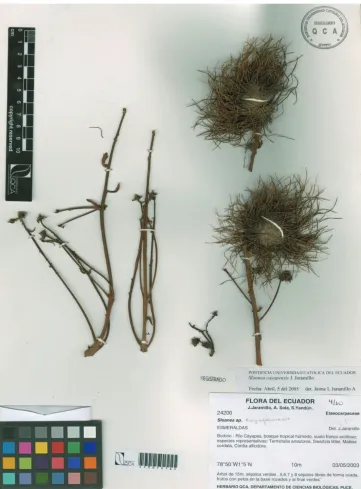
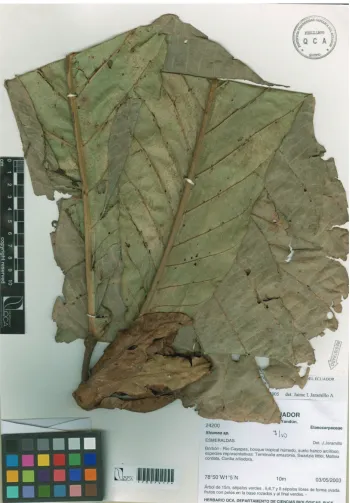
Type. Ecuador. Esmeraldas: Borbón-Río Cayapas, 78°50'W, 1°5'S, 10 m elev., 3 May 2003, Jaime Jaramillo, A. Sola, S. Yandun 24200 (holotype [2 sheets]: QCA7007914! (fl, fr); QCA7007917!; isotypes QCA7007915!,QCA7007916! (fl), QCA204513!).
obtuse-retuse at apex, the margins entire, slightly revolute; foliaceous stipules persistent at the top of the individual branchlets, 3.9–13 cm long, 2.1–3.9 cm wide, elliptical with acuminate apex, the margin entire or shallowly sinuate; primary vein prominent on the adaxial surface, very prominent and angular on the abaxial surface, secondary venation eucamptodromous, 11–20 secondary veins, prominent on the abaxial surface and ascendant (angle > 45°), flat on the adaxial surface, tertiary veins prominent on the abaxial surface, slightly flat on the adaxial surface. Inflorescence axillary, racemose; peduncles 2–6 cm long; rachis 5–18.5 cm long, slightly pubescent, deeply striated and quadrangular; pedicels 1–7 cm, stout, shortly pubescent, finely striate and quad-rangular, pedicels, 1–1.5 cm long, navicular bracts at the base of individual pedicels, 4–4.5 mm long, dense appressed pubescence on both abaxial and adaxial surfaces, apex acute, commonly deciduous. Flowers with the receptacle large, expanded; sepals 6–8, free, 3–5 mm long, 2.5–3 mm wide, greenish coloured, ovate, apex acute-acuminate, margins entire, slightly involute, yellow on the outer surface, not covering the repro-ductive organs before anthesis. Stamens 5–6 mm long, yellow with orange anthers; filaments 3–3.5 mm long, densely hirsute, striated and angulate; anthers 1.5–2 mm long, densely hirsute, thick, the connective thin on the abaxial surface of the anther
J.E. Guevara Andino & D. Fernandez-Fernandez / PhytoKeys 160: 131–139 (2020)
134
sacs, extended as an acute or obtuse awn, very short, up to 0.5 mm long; anther sacs not opening widely along entire length. Ovary 2–4 mm long, 1.5–2.7 wide, with four loc-ules, 4-angled, ovoid, densely hirsute; placentation axillary; style to 8 mm long, densely hirsute at the base, becoming sparsely hirsute towards the apex. Fruits globose capsules
1.2–2.5 cm long, 1–2 cm wide, rounded, opening by 4 rigid valves; bristles 2.8–6 cm long, curled, contorted and flexible, laterally flattened, densely hirsute at the base, more sparse and appressed pubescence towards the apex, easily detached. Seeds not studied.
J.E. Guevara Andino & D. Fernandez-Fernandez / PhytoKeys 160: 131–139 (2020)
136
Specimens examined. Paratypes. Ecuador: Esmeraldas: La Chiquita, bosque se-cundario, 45 m elev., Jaime Jaramillo 24422 (QCA-236170!); Esmeraldas: Localidad Borbón, entre Punta Piedra y Maldonado, 78°58'W, 1°4'S, 60 m elev., febrero 13 de 1993, Jaime Jaramillo 15016 (QCA-204514!).
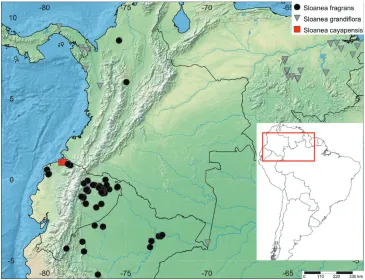
Distribution and habitat.Sloanea cayapensis is a medium-sized tree only known from two localities on high alluvial terraces along the Cayapas River in the Lowland Evergreen Forests of Equatorial Chocó (Ministerio del Ambiente del Ecuador 2013). This area lies in the Chocó floristic province, where forest structure is characterised by a canopy 25–30 m high, with occasional emergent trees reaching 40 m. High levels of endemism and dominance of families, such as Moraceae, Fabaceae, Meliaceae, Myristicaceae and Lecythidaceae, have been reported for this area (Gentry 1982; Ministerio del Ambiente del Ecuador 2013) and the label of the type specimen indicates that S. cayapensis co-occurs with the following tree species: Terminalia amazonia (Combretaceae), Swartzia littlei (Fabaceae), Matisia cordata (Malvaceae) and Cordia alliodora (Boraginaceae). The climate of this area is rainy near the Ecuador-Colombia border and becomes more seasonal to the south, where it transitions into the Lowland Seasonal Evergreen Forests of the Equatorial Chocó (Ministerio del Ambiente del Ecuador 2013).
Etymology. From the Spanish word Cayapa, with reference to the Chachi indig-enous group that inhabits a great portion of the evergreen lowland forests of the Equa-torial Chocó in Ecuador. The word Chachi means ‘pure’ in the Cha’palaachi language. The species name was first proposed by the late Ecuadorian botanist J. Jaramillo as a written annotation on herbarium specimens, but was never validly published.
Conservation status. Sloanea cayapensis may be catalogued as Endangered (EN) following IUCN (2012) criterion A2c, which indicates: “An observed, estimated, in-ferred or suspected population size reduction of ≥ 50% over the last 10 years or three generations, whichever is the longer, where the reduction or its causes may not have ceased or may not be understood or may not be reversible” and criterion B1ab(iii), which indicates: “Extent of occurrence (EOO) estimated to be less than 5,000 km2 and estimates indicating continuing decline, observed, inferred or projected, in area, extent and/or quality of habitat”. The analysis using the GeoCat tool for geospatial conserva-tion assessment determined an EOO of 2000 km2 (Bachman et al. 2011). Sloanea cayapensis is only known from two localities on the banks of the Cayapas River, in the lowland evergreen forest of the Equatorial Chocó. The area has suffered extensive clear-cutting in the last 30 years, leading to a drastic reduction of native forests and expansion of oil palm plantations and illegal logging, these being the major threats faced by the species. Since collection of the types in 2003, no other specimens of this species have been recorded despite the fact that subsequent field trips have sampled the same habitat occupied by this species. Over the last 26 years, the annual rate of deforestation in the lowland evergreen forest of the Equatorial Chocó in Ecuador has been 1.7–2.9% and the remnant forests in this area cover just 24% of their original extent (Sierra 2013). Consequently, the habitat occupied by this species in Ecuador has been drastically re-duced. However, the species is likely to occur in similar habitats in the Colombian Chocó where the dynamic of deforestation is less drastic but a cause for concern.
Discussion
Based on our description, Sloanea cayapensis is morphologically similar to S. grandiflora
and S. fragrans, both members of the subgenus Sloanea. The new species can be readily distinguished from S. fragrans by having longer (3–3.5 mm vs. 1.5–2 mm long) and densely hirsute angle-striated filaments (vs. cylindrical puberulent filaments). It also differs from S. fragrans by having shorter anthers (1.5–2 mm vs. 2–3 mm long), acute or obtuse awn-shaped (vs. lanceolate) anthers densely hirsute (vs. glabrous to sub-gla-brous), lanceolate stipules with entire margins (vs. navicular with remarkable irregular serrate margins) and shorter petioles (2–7.5 cm vs. 5.5–20(–25) cm long) (see Table 1).
J.E. Guevara Andino & D. Fernandez-Fernandez / PhytoKeys 160: 131–139 (2020)
138
having lanceolate stipules (vs. navicular stipules with finely dentate margins), shorter pedicels (4–11 mm vs. 7–25 mm) and strongly ascendant numerous secondary veins (11–20 vs. 13–15 slightly ascendant secondary veins).
Acknowledgements
We thank the staff at the herbaria ECUAMZ, QCA, QAP and QCNE for their sup-port and permission to access material deposited in these institutions. This work hon-ours Jaime Jaramillo Asanza, a professor in the Biology Department at the Catholic University of Ecuador who made a great contribution to our knowledge of the Ecua-dorian flora and who started a taxonomic revision of the genus Sloanea for Ecuador. Katya Romoleroux provided insightful comments to earlier versions of the manuscript.
References
Bachman S, Moat J, Hill AW, de Torre J, Scott B (2011) Supporting Red List threat assessments with GeoCAT: Geospatial conservation assessment tool. ZooKeys 150: 117–126. https:// doi.org/10.3897/zookeys.150.2109
Boeira ASP (2010) O gênero Sloanea L. (Elaeocarpaceae) na Reserva Florestal Adolpho Ducke. Dissertação de mestrado, Instituto Nacional de Pesquisas da Amazonia, Manaus.
Castañeda MDA (1981) Revisão taxonômica do gênero Sloanea Linnaeus (Elaeocarpaceae) na Amazônia Brasileira. Dissertação de mestrado, Fundação Universidade do Amazonas/ Instituto Nacional de Pesquisas da Amazonia, Manaus.
Table 1. Diagnostic characters for Sloanea cayapensis and its closest relatives, as well as their geographical distribution in the Neotropics: Western Amazon (WA), Central Amazon (CA), Chocó region (Chocó), Central America (CAm) and the Guiana Shield (GS).
Characters Sloanea cayapensis Sloanea grandiflora Sloanea fragrans Leaf size (18.8–)42–52(–61.8) long, (9.5–)17–
26(–32) cm wide 21–43.5 cm long, 15–25.5 cm wide 45–65 cm long, 21–29.5 cm wide Leaf shape Obovate-spatulate Elliptic to elliptic-bovate Obovate
Leaf margins Entire to shallowly sinuate Irregularly dentate Irregularly undulate Stipules Lanceolate with entire margins navicular with irregular serrate margins navicular with finely dentate margins
Stamens 5–6 mm long 7–9 mm long 4–8 mm long
Filaments 3–3.5 mm long densely hirsute
angle-striated 2–4 mm long angled or laterally flattened 1.5–2 mm long cylindrical puberulent Anthers 1.5–2 mm long, thick and obtuse 3–4 mm long, linear-lanceolate 2–3 mm long, lanceolate Ovary Ovoid, 2–4 mm long, 1.5–2.7 mm
wide Ovoid, 4 mm long, 2.5 mm wide Globose, 3 mm long, 3 mm wide Style Densely hirsute in its entire length
up to 8 mm long Pubescent at the base glabrous above, 7–9 mm long Pubsecent in its entire length, 5–10 mm long Capsule Globose densely covered by curled
flexible spines Ellipsoidal covered by stramineous flexible curled spines Globose densely covered by short spines
Elevation 0–500 m 0–1500 m 0–1100 m
Geographic
Gentry AH (1982) Phytogeographic patterns as evidence for a Chocó refuge. In: Biological Diver-sification in the Tropics. In: Prance GT (Ed.) Columbia University Press, New York, 112–136. Guevara J, Pitman NCA, Mogollón H, García-Villacorta R, Cerón C, Palacios W (2009) Floris-tic variation in Ecuadorian Amazonia terra firme tree communities. Cinchonia 9(1): 75–93. Guevara Andino JE, Fernandez-Fernandez D, Palacios WA (2016) A new species of Sloanea (Elae-ocarpaceae) subgenus Quadrisepala from Ecuadorian Amazonia. Phytotaxa 263(2): 147–153. https://doi.org/10.11646/phytotaxa.263.2.7
Guevara Andino JE, Fernandez-Fernandez D, Pitman NCA (2017) An undescribed and overlooked species of Sloanea (Elaeocarpaceae) from the Ecuadorian Amazon. Brittonia 70(2): 221–226. https://doi.org/10.1007/s12228-017-9511-3
IUCN (2012) IUCN Red List Categories and Criteria: Version 3.1. Second edition. Gland, Switzerland and Cambridge, [iv +] 32 pp.
Jaramillo J (2003) La taxonomía del género Sloanea L. (Elaeocarpaceae) en Ecuador. Ph.D. thesis. Pontíficia Universidad Católica del Ecuador, Quito.
Ministerio del Ambiente del Ecuador (2013) Sistema de Clasificación de los Ecosistemas del Ecuador Continental. Subsecretaría de Patrimonio Natural. Quito.
Palacios-Duque L (2004a) Dos nuevas especies de Sloanea (Elaeocarpaceae) del Chocó (Colom-bia). Caldasia 26(2): 429–432.
Palacios-Duque L (2004b) Una nueva especies de Sloanea (Elaeocarpaceae) del Chocó (Colom-bia). Hickenia 3(49): 201–204.
Palacios-Duque L (2005) Sloanea pacuritana Pal.-Duque, sp. nov. (Elaeocarpaceae) del Chocó (Colombia). Anales del Jardin Botanico de Madrid 62(2): 191–193. https://doi. org/10.3989/ajbm.2005.v62.i2.23
Pennington TD, Wise R (2017) The genus Sloanea (Elaeocarpaceae) in America. dh Books, England, 432 pp.
Sampaio D (2009) Revisão taxonômica das espécies neotropicais extra-amazônicas de Sloanea L. (Elaeocarpaceae) na América do Sul. PhD thesis, Universidade Estadual de Campinas, Instituto de Biologia, Campinas/SP, Brazil.
Sierra R (2013) Patrones y factores de deforestación en el Ecuador continental, 1990–2010. Y un acercamiento a los próximos 10 años. Conservación Internacional Ecuador y Forest Trends. Quito.
Smith CE (1954) The new world species of Sloanea (Elaeocarpaceae). Contr. Gray Herb. 175: 1–144.
Smith DA (2001) Elaeocarpaceae. In: Stevens WD, Ulloa-Ulloa C, Pool A, Montiel OM (Eds) Flora de Nicaragua (Vol. 1). Acanthaceae-Euphorbiaceae. Monographs in systematic bota-ny from the Missouri Botanical Garden 85: 816–820.