New taxa of Rhododendron tschonoskii alliance 97
New taxa of
Rhododendron tschonoskii
alliance
(Ericaceae) from East Asia
Watanabe Yoichi1, Tadashi Minamitani2, Sang-Hun Oh3, Atsushi J. Nagano4,
Harue Abe5, Tomohisa Yukawa6
1 Graduate School of Horticulture, Chiba University, Matsudo 648, Matsudo, Chiba 271-8510, Japan 2 Tsunehisa 5-4-7, Miyazaki, Miyazaki 880-0913, Japan 3 Department of Biology, Daejeon University, 62 Daehak-ro, Dong-gu, Daejeon 34520, South Korea 4 Faculty of Agriculture, Ryukoku University, Yokotani 1-5, Seta Oe-cho, Otsu, Shiga 520-2194, Japan 5 Faculty of Agriculture, Niigata University, Koda 94-2, Sado, Niigata 952-2206, Japan 6 Tsukuba Botanical Garden, National Museum of Nature and Science, Amakubo 4-1-1, Tsukuba, Ibaraki 305-0005, Japan
Corresponding author:Watanabe Yoichi ([email protected])
Academic editor:P. de Lange | Received 19 July 2019 | Accepted 9 September 2019 | Published 23 October 2019
Citation: Yoichi W, Minamitani T, Oh S-H, Nagano AJ, Abe H, Yukawa T (2019) New taxa of Rhododendron tschonoskii
alliance (Ericaceae) from East Asia. PhytoKeys 134: 97–114. https://doi.org/10.3897/phytokeys.134.38216
Abstract
Three new taxa, Rhododendron sohayakiense Y.Watan. & T.Yukawa (Ericaceae), and its two varieties, var.
kiusianum Y.Watan., T.Yukawa & T.Minamitani and var. koreanum Y.Watan. & T.Yukawa are described and illustrated from Japan and South Korea. They can be distinguished from each other and from the other members of the R. tschonoskii alliance, i.e. R. tschonoskii, R. tetramerum, R. trinerve and R. tsusiophyl-lum, through their combination of leaf size, leaf morphologies including lateral nerves on abaxial leaf sur-face, corolla morphologies including number of corolla lobes, style length and anther form. Phylogenetic inferences based on chloroplast DNA and genome-wide sequences revealed that each of the three new taxa is monophyletic and they further form a clade. Distributions of the three taxa are also clearly separated from each other and also from the other members of the R. tschonoskii alliance.
Keywords
Ericaceae, new species, phylogeny, Rhododendron
Introduction
The genus Rhododendron L. (Ericaceae) is morphologically diverse, comprising about 1,000 woody species (Chamberlain et al. 1996). The genus is mostly distributed across the Northern Hemisphere and members of subgenus Vireya extend into the
South-PhytoKeys 134: 97–114 (2019) doi: 10.3897/phytokeys.134.38216 http://phytokeys.pensoft.net
Copyright Watanabe Yoichi et al. This is an open access article distributed under the terms of the Creative Commons Attribution License (CC BY 4.0), which permits unrestricted use, distribution, and reproduction in any medium, provided the original author and source are credited.
RESEARCH ARTICLE
ern Hemisphere via the Indo-Australian Archipelago. The subgenus Tsutsusi is mostly found in East Asia (Yamazaki 1996; Kron and Powell 2009). Although most species of this subgenus occur in warm-temperate to subtropical regions, some are present in cold and alpine regions.
Rhododendron tschonoskii Maxim., R. tetramerum (Makino) Nakai, R. trinerve
Franch. ex Boisser and R. tsusiophyllum Sugim. are closely related species placed within the subgenus Tsutsusi, which grow on exposed rocks or open sites in slopes and ridges on mountains. Among them, R. tsusiophyllum was originally described as a species of an independent genus Tsusiophyllum tanakae Maxim. (1870), because anthers of this species open through longitudinal slits while anthers of all other species in Rho-dodendron open through apical pores. The first taxonomic reappraisal of this group except R. tsusiophyllum was conducted by Takahashi (1975) in which he recognized the aforementioned four taxa at species rank. Subsequently, Yamazaki (1996) treated these two taxa as varieties of R. tschonoskii, i.e. R. tschonoskii var. tetramerum (Makino) Komatsu and R. tschonoskii var. trinerve (Franch. ex Boisser) Makino. In this study, we tentatively adopt Takahashi’s (1975) concept.
Rhododendron tschonoskii sensu Takahashi (1975) is widely distributed across the Japanese Archipelago and extends to the southern part of the Korean Peninsula. De-spite the wide distribution, the species is absent from the central part of the Japanese Archipelago. As pointed out by Takahashi (1975) and Minamitani (1993), morpho-logical characters of the species are distinct between eastern and western parts of the Japanese Archipelago. To evaluate these previous observations, we investigate morpho-logical and macromolecular characters of R. tschonoskii and its related species by using the samples covering the entire species ranges.
Methods
The morphological characters were observed and measured based on living materi-als in the field and herbarium specimens listed in the sections “Additional speci-mens examined”.
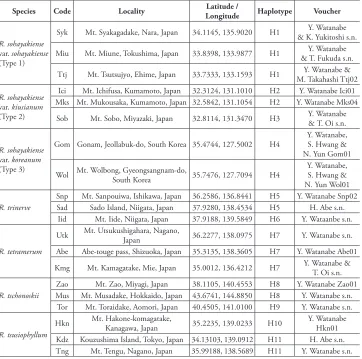
Samples for DNA analyses were collected from three individuals for Rhododendron tschonoskii, R. tetramerum, R. trinerve, R. tsusiophyllum and new entities, respectively. Three samples for each species and two entities and two samples for one entity (see Results and Discussion) were selected for covering entire range, and a holotype for each entity was included (Table 1). In addition, one individual for each species was collected from other relatives, i.e. R. dilatatum, R. kaempferi, R. macrosepalum, R. reticulatum,
R. serpyllifolium and R. tashiroi belonging subgenus Tsutsusi (Kron and Powell 2009). For phylogenetic analysis, genomic DNA was extracted from silica-dried leaf samples using a DNeasy Plant mini kit (Qiagen, Hilden, Germany) after treatment with sorbi-tol buffer (Wagner et al. 1987). Five non-coding regions of chloroplast DNA (trnL-F,
New taxa of Rhododendron tschonoskii alliance 99
Table 1.Locations of samples used for phylogenetic analyses.
Species Code Locality LongitudeLatitude / Haplotype Voucher
R. sohayakiense
var. sohayakiense
(Type 1)
Syk Mt. Syakagadake, Nara, Japan 34.1145, 135.9020 H1 & K. Yukitoshi s.n.Y. Watanabe
Miu Mt. Miune, Tokushima, Japan 33.8398, 133.9877 H1 & T. Fukuda s.n.Y. Watanabe
Ttj Mt. Tsutsujyo, Ehime, Japan 33.7333, 133.1593 H1 M. Takahashi Ttj02Y. Watanabe &
R. sohayakiense
var. kiusianum
(Type 2)
Ici Mt. Ichifusa, Kumamoto, Japan 32.3124, 131.1010 H2 Y. Watanabe Ici01 Mks Mt. Mukousaka, Kumamoto, Japan 32.5842, 131.1054 H2 Y. Watanabe Mks04
Sob Mt. Sobo, Miyazaki, Japan 32.8114, 131.3470 H3 Y. Watanabe & T. Oi s.n.
R. sohayakiense
var. koreanum
(Type 3)
Gom Gonam, Jeollabuk-do, South Korea 35.4744, 127.5002 H4 Y. Watanabe, S. Hwang & N. Yun Gom01
Wol Mt. Wolbong, Gyeongsangnam-do, South Korea 35.7476, 127.7094 H4 Y. Watanabe, S. Hwang & N. Yun Wol01
R. trinerve
Snp Mt. Sanpouiwa, Ishikawa, Japan 36.2586, 136.8441 H5 Y. Watanabe Snp02
Sad Sado Island, Niigata, Japan 37.9280, 138.4534 H5 H. Abe s.n.
Iid Mt. Iide, Niigata, Japan 37.9188, 139.5849 H6 Y. Wataanbe s.n.
R. tetramerum
Utk Mt. Utsukushigahara, Nagano, Japan 36.2277, 138.0975 H7 Y. Watanabe s.n. Abe Abe-touge pass, Shizuoka, Japan 35.3135, 138.3605 H7 Y. Watanabe Abe01
Kmg Mt. Kamagatake, Mie, Japan 35.0012, 136.4212 H7 Y. Watanabe & T. Oi s.n.
R. tschonoskii
Zao Mt. Zao, Miyagi, Japan 38.1105, 140.4553 H8 Y. Watanabe Zao01
Mus Mt. Musadake, Hokkaido, Japan 43.6741, 144.8850 H8 Y. Watanabe s.n.
Tor Mt. Toraidake, Aomori, Japan 40.4505, 141.0100 H9 Y. Watanabe s.n.
R. tsusiophyllum
Hkn Mt. Hakone-komagatake, Kanagawa, Japan 35.2235, 139.0233 H10 Y. Watanabe Hkn01 Kdz Kouzushima Island, Tokyo, Japan 34.13103, 139.0912 H11 H. Abe s.n.
Tng Mt. Tengu, Nagano, Japan 35.99188, 138.5689 H11 Y. Watanabe s.n.
Haplotype, Haplotype codes detected by chloroplast DNA sequences, corresponding to those in Fig. 3. Specimens of all of the analysed samples were deposited in TNS.
using DNA Baser 4 (Heracle BioSoft, Pitești, Romania) and aligned using the MUS-CLE algorithm implemented in MEGA 7 (Edgar 2004; Kumar et al. 2016).
ligase (Enzymatics, Beverly, USA). The ligated product was purified with AMPure XP (Beckman Coulter, Brea, USA). The purified adaptor-ligated DNA was subse-quently amplified by PCR. The PCR was performed in a 10 μL volume containing 2 μL of adaptor-ligated DNA, 2 μL of 5 μM index primer including 6-mer variable sequences for identifying different samples, 1 μL of 10 μM TruSeq universal primer, 5 μL of ×2 KAPA HiFi HotStart ReadyMix (KAPA Biosystems, Wilmington, USA). The PCR was performed with an initial denaturation for 4 mins at 94 °C, followed by 20 cycles of 10 s at 98 °C, 15 s at 65 °C and 15 s at 68 °C. The PCR products from different samples were pooled and purified again with AMPure XP. Fragments of 350–400 bp in the purified DNA solution were retrieved by electrophoresis using a 2.0% of E-Gel SizeSelect (Life Technologies, Carlsbad, USA). After quantity assess-ment using a QuantiFluor dsDNA System (Promega, Madison, USA) and quality assessment using an Agilent 2100 Bioanalyzer (Agilent Technologies, Santa Clara, USA), the libraries were sequenced with 51-bp single-end reads in two lanes of an Illumina HiSeq2000 (Illumina, San Diego, USA). After removing reads contain-ing low-quality bases and adaptor sequences from the raw data uscontain-ing Trimmomatic v. 0.33 (Bolger et al. 2014), sequences with polymorphic SNPs were assembled by pyRAD v. 3.0 (Eaton 2014). Parameters for the assembly were set as follows: the minimum depth coverage for creating a cluster from reads was set to 6, the similar-ity threshold of clusters within and across individuals was set to 0.85, the maximum number of samples with shared heterozygous sites in a locus for filtering potential paralogs was set to 3, and polymorphic loci sequenced in more than half of the sam-ples were finally exported as consensus sequences (Eaton 2014).
The phylogenetic relationships were inferred from two data sets, which were ob-tained from chloroplast DNA sequences and RAD-seq, based on the maximum likeli-hood method using RAxML v. 8.2.0 (Stamatakis 2014). In the analyses, the GTR-GAMMA model was used as a substitution model, and node supports were assessed by bootstrap analysis with 1000 replicates. Phylogenetic relationships among individuals for Rhododendron tschonoskii, R. tetramerum, R. trinerve, R. tsusiophyllum and new enti-ties based on RAD-seq were further evaluated by constructing a neighbor-net based on
p-distance using SplitTree4 (Huson and Bryant 2006).
Results and discussion
Morphological differences
New taxa of Rhododendron tschonoskii alliance 101
including lateral nerves on abaxial leaf surface, corolla morphologies and style length (Table 2, Figs 1, 2). Leaf sizes of Types 1, 2 and R. tschonoskii are medium (5–30 mm long), while Type 3 and R. trinerve are large (10–50 mm long). Lateral nerves on the abaxial surface of the leaf are pinnate but obscure for Type 1, while 1–3 pairs of
pin-Figure 1. Photographs of flowers and leaves for the new taxa described in this study. A, BRhododendron sohayakiense var. sohayakiense, Mt. Tsutsujo, Ehime Prefecture, Japan C, DRhododendron sohayakiense var.
nate lateral nerves are raised for Types 2 and 3. Corolla tube lengths of Types 1, 3,
R. tschonoskii and R. trinerve are short (2–4 mm long), while Type 2, R. tetramerum
and R. tsusiophyllum are long (3.5–7 mm long). Styles of Types 1, 3, R. tschonoskii and
R. trinerve are longer than the corolla tube and exserted from the corolla, while those of Type 2, R. tetramerum and R. tsusiophyllum are similar or shorter than the corolla tube and included within the corolla.
The three types share the following combination of characters as commonly de-rived character states, which can be distinguished from the other members of the R. tschonoskii alliance. The corolla form of the three types are tubular-funnelform and co-rolla lobes are tetramerous; in addition, lateral nerves on abaxial leaf surface are raised or obscure raised, and not prominent, such as R. trinerve.
Table 2.Diagnostic characters among the Rhododendron tschonoskii alliance.
Character var. R. sohayakiense sohayakiense
(Type 1)
R. sohayakiense
var. kiusianum
(Type 2)
R. sohayakiense
var. koreanum
(Type 3) R. tschonoskii R. tsusiophyllum R. trinerve R. tetramerum
Leaf length
(mm) 10–20 10–20 10–35 10–25 5–13 15–50 5–20
Leaf width
(mm) 4–7 5–10 5–15 5–12 2–5 5–20 5–10
Nerve on abaxial surface of leaf
pinnate 2–3 pairs,
obscurely raised pinnate 2–3 pairs, raised pinnate 1–3 pairs, raised reticulatenervules
nervules obscurely reticulate pinnate 1–2 pairs, prominent, nervules reticulate nervules obscurely reticulate
Hair of leaf
densely strigose on adaxial surface,
glabrous or sparsely strigose on abaxial surface
densely strigose on adaxial surface, sparsely strigose on abaxial surface densely strigose on adaxial surface, sparsely strigose on abaxial surface
strigose on both surfaces densely strigose on adaxial surface, glabrous on abaxial surface strigose on both surfaces densely strigose on adaxial surface, glabrous or sparsely strigose on abaxial surface
Corolla form funnelformtubular- funnelformtubular- funnelformtubular- funnelformtubular- tubiform funnelformtubular- tubiform Number of
corolla lobes 4 4 4 5 5 4 4
Corolla tube
length (mm) 2–3 3–4 2–3 2–4 5–7 2–4 3.5–4.5
Corolla lobe
length (mm) 3–5 2–5 3–5 4–6 ca. 2 4–6 2–3
Style length
(mm) 4–10 3–4 5–6 6–13 4–5 3–7 2.5–3.5
Style
condition exserted included exserted exserted included exserted included Anther opening by apical pores apical poresopening by apical poresopening by opening by apical pores longitudinal slitsopening by apical poresopening by apical poresopening by
Distribution Japan: Honshu (Kii Peninsula)
and Shikoku Japan: Kyushu
New taxa of Rhododendron tschonoskii alliance 103
Phylogenetic relationships
Phylogenetic relationships of the R. tschonoskii alliance based on chloroplast DNA se-quences (2,847 bp with 76 polymorphic sites) and genome-wide sese-quences (RAD-seq, 316,455 bp with 37266 SNPs) were almost concordant including outgroup species (Fig. 3). The R. tschonoskii alliance formed a monophyletic group (95% for chloroplast DNA and 100% for RAD-seq). The chloroplast DNA sequences identified four hap-lotypes from the three types, Types 1 and 3 had one haplotype respectively and Type 2 had two haplotypes. Although the monophyly of the clade comprising Types 1, 2 and 3 was supported with high bootstrap probability (80%), the monophyly of two hap-lotypes in Type 2 was not supported. The monophyly of the clade comprising Types 1, 2 and 3 and the monophyly of each type were supported with the highest bootstrap probabilities (100%) based on RAD-seq. The neighbor-net for a data set, which
Figure 3. Comparative phylogenies for A haplotypes based on chloroplast DNA sequences and B geno-types based on restriction site associated DNA sequences (RAD-seq). Bootstrap probabilities (> 70%) are shown above nodes. Gray boxes indicate three new taxa described in this study and light gray boxes indicate the other members of the Rhododendron tschonoskii alliance.
0.003 R. macrosepalum Sob Miu Mus R. reticulatum Syk Kdz Kmg R. serpyllifolium Iid Utk Abe Ici R. dilatatum R. tashiroi Tng R. kaempferi Snp Ttj Zao Gom Wol Hkn Sad Tor Mks 100 100 100 100 100 100 100 100 100 100 100 93 100 100 100 100 100 100 100 97 97 0.001 R. dilatatum H11 H7 R. reticulatum R. tashiroi R. macrosepalum H10 H8 H9 H6 H4 H2 H5 H3 H1 R. serpyllifolium R. kaempferi 95 78 95 80 100 96 79 100 96 95 72 100
A Chloroplast DNA
B Genome-wide
R. tschonoskii R. tsusiophyllum
R. tetramerum
R. trinerve
R. sohayakiense var. koreanum
R. sohayakiense var. kiusianum
R. sohayakiense var. sohayakiense
Type 3
Type 2
Type 1
cluded only the R. tschonoskii alliance, identified three groups corresponding to Types 1, 2 and 3, which can be clearly distinguished from each other (Fig. 4).
New taxa of Rhododendron tschonoskii alliance 105
Taxonomic treatments
Rhododendron sohayakiense Y.Watan. & T.Yukawa, sp. nov.
urn:lsid:ipni.org:names:77202559-1
Figs 1, 5, 6
Diagnosis. This species is similar to Rhododendron tschonoskii Maxim, but is distin-guishable through its 4 corolla lobes and its pinnate nerves on the adaxial leaf surface.
Type. JAPAN. Shikoku: Ehime Pref., Kumakogen Town, Mt. Tsutsujo-yama, 33°44'00.01"N, 133°09'33.40"E, on ridge of the mountain, 1800 m, 20 July 2016 (fl), Y. Watanabe and M. Takahashi Ttj02 (holotype TNS; isotypes TNS, KYO).
Additional specimens examined. JAPAN. Kii Peninsula, Honshu: Nara Pref., Yoshino County, Kamikitayama Village, Mt. Oodaigahara, Daijyagura, 1500 m, 23 Aug 1956 (fr), G. Murata 10133 (KYO); Nara Pref., Yoshino County, Kamikitayama Village, Mt. Oodaigahara, Daijyagura, 1600 m, 18 Jul 2012 (fl), K. Yamawaki 4869 (KYO); Nara Pref., Yoshino County, Shimokitayama Village, Mt. Kujyaku, 1800 m, 17 Jul 1954 (fl), G. Murata & T. Shimizu 104 (KYO); Shikoku: Tokushima Pref.,
Figure 4. Neighbor-net for members of the Rhododendron tschonoskii alliance reconstructed from p -distance among individuals based on RAD-seq.
0.001 Gom
Wol
Iid
Sad Snp
SobMks Ici
Ttj Miu
Syk
Kdz Hkn
Tor Mus Zao
Kmg Abe
Utk
Tng
R. tschonoskii R. tsusiophyllum
R. tetramerum
R. trinerve R. sohayakiense
var. koreanum
R. sohayakiense var. kiusianum
R. sohayakiense var. sohayakiense
Type 3
Type 2
130 E 135 E 140 E 145 E
30 N
35 N
45 N
40 N
0 100 500 (km)
R. tschonoskii R. tsusiophyllum R. tetramerum R. trinerve R. sohayakiense var. soyahakiense R. sohayakiense var. kiusianum R. sohayakiense var. koreanum
Figure 5. Distribution of the Rhododendron tschonoskii alliance. Circles and squares showed locations of herbarium specimens (KYO, TNS).
New taxa of Rhododendron tschonoskii alliance 107
Figure 6.Rhododendron sohayakiense var. sohayakiense. A Flower, side view B Stamen C Pistil D Fruit
Mt. Higashiakaishi, 33°52'31.03"N, 133°22'26.31"E, 1700 m, 15 Jul 2017 (fl), Y. Watanabe Hga03 (TNS).
Description. Much branched semi-evergreen shrubs 1–1.5 m tall. Branchlets and petioles with dense appressed flattened brownish strigose hairs. Spring leaves scattered or crowded on upper branchlets; petioles 0.5–1 mm long; blade thick chartaceous, ob-long, 10-20 mm long (at maximum within each individual), 4–7 mm wide, apex acute and terminating in a gland, base acute, adaxial surface green, abaxial surface pale green, densely strigose on adaxial surface, glabrous or sparsely strigose on abaxial surface with-out midrib; midrib prominent abaxially; lateral nerves pinnate, 2–3 paired, obscure raised abaxially. Summer leaves oblanceolate, 5–10 mm long, 1–6 mm wide, densely strigose on both surfaces. Flower buds terminal, single, broadly ovoid, acute, ca. 2 mm long, 2 mm wide; scales widely ovate, densely strigose on upper outer surface. Inflores-cences umbel-like, 2–4 flowers. Pedicel 2–4 mm long at flowering, densely appressed hirsute. Calyx saucer-shaped, ca. 1.5 mm in diam., densely strigose, shallowly 4-lobed; lobes semiorbiculate, ca. 0.5 mm long. Corolla white, no blotches, openly tubular-funnelform, 8–12 mm long and wide, dissected 1/2 corolla length into 4 lobes; tube 2–3 mm long, ca. 2 mm wide, glabrous outside, pilose on upper inside; lobes elliptic to oblong, rounded, 3–5 mm long, 2–4 mm wide. Stamens 4, subequal, 5–8 mm long, exserted; filaments densely pilose on lower three-quarters; anthers yellow, oblong, ca. 1 mm long. Ovary ovoid, densely soft strigose, ca. 1.5 mm. Style 4–10 mm long, ex-serted, glabrous. Capsule ovoid, 2–5 mm long, 2–3 mm wide, densely strigose.
Distribution. JAPAN: Honshu (Kii Peninsula), Shikoku.
Ecology. The plants inhabit sunny places and grow on mountain ridges and slopes at altitudes over 1000 m above sea level. In such places, there are few trees and estab-lished communities of shrubs and dwarf bamboos (Sasa sp.). Flowering specimens have been collected from July to August; fruiting specimens have been collected from October to November. Bumblebees are frequent visitors to the flowers, suggesting that they are pollinators of the species.
Etymology. The specific epithet refers to ‘Sohayaki’ a floristic region in Japan that covers Kii Peninsula of Honshu, Shikoku and Kyushu (Koidzumi 1931), where the new species is distributed.
Rhododendron sohayakiense var. kiusianum Y.Watan., T.Yukawa & T.Minamitani, var. nov.
urn:lsid:ipni.org:names:77202565-1
Figs 1, 5, 7
New taxa of Rhododendron tschonoskii alliance 109
Figure 7.Rhododendron sohayakiense var. kiusianum. A Flower, side view B Stamen C Pistil D Fruit
Type. JAPAN. Kyushu: Kumamoto Pref., Kamimashiki County, Yamato Vil-lage, Mt. Mukosaka, 32°35'03.22"N, 131°06'19.30"E, on rocky ridge of the moun-tain, 1500 m, 23 July 2016 (fl), Y. Watanabe Mks04 (holotype: TNS; isotypes: TNS, KYO).
Additional specimens examined. JAPAN. Kyushu: Ooita Pref., Mt. Katamuki, 2 Aug 1921 (fl), Z. Tashiro (KYO); Miyazaki Pref., Higashi-Usuki County, Shiiba Village, Mt. Eboshi, 1690 m, 18 Jul 2007 (fl), T. Minamitani (TNS); Miyazaki Pref., Higashi-Usuki County, Shiiba Village, Mt. Ougi, 1200–1661 m, 7 Jul 1994 (fl), T. Minamitani 049666 (TNS); Miyazaki Pref., Nishi-Usuki County, Hinokage Town, Mt. Goyou, 1570 m, 11 Aug 1990 (fr), T. Minamitani (TNS); Miyazaki Pref., Nishi-Usuki County, Hinokage Town, Mt. Katamuki, 1500 m, 25 Aug 1970 (fr), T. Mi-namitani (TNS); Miyazaki Pref., Nishi-Usuki County, Takachiho Town, Mt. Tengu, 1700 m, 24 Jun 1993 (fl), T. Minamitani (TNS); Miyazaki Pref., Nishi-Usuki Coun-ty, Takachiho Town, Mt. Tengu, 1600–1700 m, 16 Aug 1992, T. Minamitani 44119 (TNS); Miyazaki Pref., Nishi-Usuki County, Takachiho Town, Mt. Shoji, 1600–1700 m, 16 Aug 1992, T. Minamitani 44128 (TNS); Miyazaki Pref., Nishi-Usuki County, Gokase Town, Mt. Mukosaka, Tsutsujigaoka, 1570 m, 12 Jul 1993 (fl), T. Minamita-ni (TNS); Miyazaki Pref., Nishi-Usuki County, Gokase Town, Mt. Mukosaka, Kita, 1550 m, 24 Sep 1996 (fl, fr), T. Minamitani B-T-052838 (TNS); Miyazaki Pref., Higashi-Usuki County, Kitakata Town, Mt. Hoko, 1100–1200 m, 26 Jun 1994 (fl), T. Minamitani (TNS); Miyazaki Pref., Higashi-Usuki County, Kitakata Town, Mt. Hoko, 1270 m, 23 Sep 1989 (fr), T. Minamitani (TNS); Miyazaki Pref., Nobeoka City, Kitakata, Mt. Ohkue, Kozumidaki, 1340 m, 6 Aug 1992 (fr), T. Minamitani (TNS); Kumamoto Pref., Kuma County, Mt. Ichifusa, 1700 m, 6 Aug 1960 (fl), M. Tagawa & K. Iwatsuki 3676 (KYO); Kumamoto Pref., Kuma County, Yunomae Town, Mt. Ichifusa, 26 Jul 1992 (fl), T. Minamitani 43478 (TNS); Kumamoto Pref., Kuma County, Mizukami Village, Mt. Ichifusa, 32°18'44.65"N, 131°06'03.50"E, on summit of the mountain, 1600 m, 24 July 2016 (fl), Y. Watanabe Ici02 (TNS).
Description. Spring leaves scattered or crowded on upper branchlets; petioles 0.5–1 mm long; blade thick chartaceous, oblong-ovate, 10–20 mm long (at maximum within each individual), 5–10 mm wide, apex acute and terminating in a gland, base acute, strigose on both surfaces; midrib prominent abaxially; lateral nerves pinnate, 2–3 paired, raised abaxially. Summer leaves oblanceolate, 3–10 mm long, 1–5 mm wide, densely strigose on both surfaces. Calyx saucer-shaped, ca. 1.5 mm in diam., densely soft strigose, shallowly 4-lobed; lobes semiorbiculate, ca. 0.5 mm long. Corolla white, no blotches, tubular-funnelform, 7–13 mm long and wide, 4 lobes; tube 3–4 mm long, ca. 3 mm wide, glabrous outside, pilose on upper inside; lobes elliptic to oblong, round-ed, 2–5 mm long, ca. 2 mm wide. Stamens 4, irregular, 3–5 mm long, as long as or shorter than corolla; filaments densely pilose on lower half; anthers yellow, oblong, ca. 1 mm long. Ovary ovoid, densely soft strigose, ca. 1.5 mm. Style 3–4 mm long, glabrous, shorter than corolla. Capsule ovoid, 3–4 mm long, 2.5 mm wide, densely strigose.
New taxa of Rhododendron tschonoskii alliance 111
Ecology. The plants inhabit sunny and rocky mountain ridges and slopes at alti-tudes over 1000 m above sea level. Flowering specimens have been collected from July to August; fruiting specimens have been collected from October to November.
Etymology. The specific epithet refers to ‘Kyushu’ where the new variety is distributed.
Note. Although the style of this variety is included within the corolla, this part is exserted from the corolla in individuals from Mt. Ichifusa.
Rhododendron sohayakiense var. koreanum Y.Watan. & T.Yukawa, var. nov.
urn:lsid:ipni.org:names:77202566-1
Figs 1, 5, 8
Diagnosis. This variety is similar to Rhododendron sohayakiense var. sohayakiense Y. Watan. & T. Yukawa and R. sohayakiense var. kiusianum Y. Watan., T. Yukawa & T. Mi-namitani, but is distinguished by its large leaf size. Further, it differs from the former through its raised lateral nerves on the abaxial leaf surface and from the latter through its shorter corolla tube and by its longer style exserted from the corolla.
Type. SOUTH KOREA. Gyeongsangnam-do: Hamyang County, Mt. Wolbong, 35°44'51.31"N, 127°42'33.99"E, on slope of the mountain, 1000 m, 15 June 2017 (fl), Y. Watanabe, S. Hwang and N. Yun Wol06 (holotype: TNS; isotypes: TNS, KB).
Additional specimens examined. SOUTH KOREA. Jeollabuk-do: Namwon City, Mt. Gonam, 35°28'27.74"N, 127°30'00.82"E, 800 m, 15 Jun 2017 (fl), Y. Wa-tanabe, S. Hwang and N. Yun Gom01 (TNS); Mt. Jirisan, Banyabong peak, 1700 m, 20 Aug 1982 (fr), T. Yamazaki & F. Yamazaki 3294 (KYO); Gyeongsangnam-do: Mt. Gayasan, 23 Aug 1935 (fr), G. Koidzumi (KYO).
Description. Spring leaves scattered or crowded on upper branchlets; petioles 0.5–1 mm long; blade thick chartaceous, oblong, 10–35 mm long (25–35 mm long at maximum within each individual), 5–15 mm wide, apex acute and terminating in a gland, base acute, strigose on both surfaces; midrib prominent abaxially; lateral nerves pinnate, 1–3 paired, raised abaxially. Summer leaves oblanceolate, 6–20 mm long, 1–8 mm wide, densely strigose on both surfaces. Calyx saucer-shaped, ca. 1.5 mm in diam., densely soft strigose, shallowly 4-lobed; lobes semiorbiculate, ca. 0.5 mm long. Corolla white, no blotches, openly tubular-funnelform, 8–12 mm long and wide, dissected 1/2 corolla length into 4 lobes; tube 2–3 mm long, ca. 2 mm wide, glabrous outside, pilose on upper inside; lobes elliptic to oblong, rounded, 3–5 mm long, 2–4 mm wide. Stamens 4, subequal, 6–9 mm long, exserted; filaments densely pilose on lower three-quarters; anthers yellow, oblong, ca. 1 mm long. Ovary ovoid, densely soft strigose, ca. 2 mm. Style 5–6 mm long, exserted, glabrous. Capsule ovoid, 3–4 mm long, 2.5 mm wide, densely strigose.
Distribution. SOUTH KOREA: Jeollabuk-do, Gyeongsangnam-do.
Figure 8.Rhododendron sohayakiense var. koreanum. A Flower, side view B Stamen C Pistil D Fruit
E Abaxial and F adaxial sides of leaf. Scale bars: 1 mm (A–D); 3 mm (E, F). Drawings by Kumi Hamasaki from Y. Watanabe, S. Hwang and N. Yun Wol01 (holotype, TNS).
specimens have been collected from October. Honeybees are frequent visitors to the flowers, suggesting that they are pollinators of the variety.
New taxa of Rhododendron tschonoskii alliance 113
Key to the Rhododendron tschonoskii alliance, expanded from Yamazaki (1996)
1 Corolla 4 lobes ...2
– Corolla 5 lobes ...6
2 Corolla tubiform ...R. tetramerum
– Corolla tubular-funnelform ...3
3 Spring leaves 25–50 mm long at maximum within each individual ...4
– Spring leaves 10–20 mm long at maximum within each individual ...5
4 Lateral nerves of spring leaf 1 paired, prominently raised abaxially, grooved adaxially, nervules reticulate ...R. trinerve
– Lateral nerves of spring leaf 1–3 paired, raised abaxially, not grooved adaxially ...R. sohayakiense var. koreanum
5 Style 4–10 mm long, exserted from corolla; lateral nerves of spring leaf ob-scurely raised ...R. sohayakiense var. sohayakiense
– Style 3–4 mm long, included within corolla; lateral nerves of spring leaf raised ...R. sohayakiense var. kiusianum
6 Corolla tubular-funnelform, tube 2–4 mm long; style 6–13 mm long, ex-serted from corolla ...R. tschonoskii
– Corolla tubiform, tube 5–7 mm long; style 4–5 mm long, included within corolla ...R. tsusiophyllum
Data accessibility
DNA sequences of chloroplast DNA haplotypes reported in this study were deposited in GenBank under accession numbers; LC499847–LC499863 for trnL-F, LC499864– LC499880 for trnL intron, LC499830–LC499846 for trnS-G, LC499813–LC499829 for trnG intron, LC499796–LC499812 for rpl32-trnL. Genotype data for RAD-seq were deposited in Dryad: https://doi.org/10.5061/dryad.5tm6680.
Acknowledgements
We are grateful to Osamu Takahashi for providing a beautiful photograph; and Seung-Hyun Hwang and Narae Yun in South Korea, Takao Oi, Kyohei Yukitoshi, Takumi Fukuda, Minami Takahashi in Japan for their help in collecting plant material. This study was supported by a Grant-Aid for Scientific Research (15K07473, 16K18714) from the Japan Society for the Promotion of Science, JSPS.
References
Chamberlain D, Hyam R, Argent G, Fairweather G, Walter K (1996) The genus Rhododendron its classification and synonymy. The Royal Botanic Garden Edinburgh, Edinburgh, UK. Eaton DAR (2014) PyRAD: Assembly of de novo RADseq loci for phylogenetic analyses.
Bioinformatics (Oxford, England) 30(13): 1844–1849. https://doi.org/10.1093/bioinfor-matics/btu121
Edgar RC (2004) MUSCLE: Multiple sequence alignment with high accuracy and high throughput. Nucleic Acids Research 32(5): 1792–1797. https://doi.org/10.1093/nar/ gkh340
Huson DH, Bryant D (2006) Application of Phylogenetic Networks in Evolutionary Stud-ies. Molecular Biology and Evolution 23(2): 254–267. https://doi.org/10.1093/molbev/ msj030
Koidzumi G (1931) Zengen (Preface). In: Mayebara K (Ed.) Florula Austro-Higoensis. Private publication. [in Japanese]
Kron KA, Powell EA (2009) Molecular systematics of Rhododendron subgenus Tsutsusi (Rho-doreae, Ericoideae, Ericaceae). Edinburgh Journal of Botany 66(1): 81–95. https://doi. org/10.1017/S0960428609005071
Kumar S, Stecher G, Tamura K (2016) MEGA7: Molecular Evolutionary Genetics Analy-sis Version 7.0 for Bigger Datasets. Molecular Biology and Evolution 33(7): 1870–1874. https://doi.org/10.1093/molbev/msw054
Minamitani T (1993) Note on wild plants in Miyazaki -Rhododendron tschonoskii group (series
Tschonoskia) in Miyazaki-. Bulletin of the Miyazaki Prefectural Museum 18: 21–49. [in
Japanese]
Peterson BK, Weber JN, Kay EH, Fisher HS, Hoekstra HE (2012) Double digest RADseq: An inexpensive method for de novo SNP discovery and genotyping in model and non-model species. PLoS One 7(5): e37135. https://doi.org/10.1371/journal.pone.0037135
Stamatakis A (2014) RAxML version 8: A tool for phylogenetic analysis and post-analysis of large phylogenies. Bioinformatics (Oxford, England) 30(9): 1312–1313. https://doi. org/10.1093/bioinformatics/btu033
Takahashi H (1975) Notes on Japanese alpine plants (4) on Rhododendron tetramerum. Kanaga-wa Kenritsu Hakubutsukan Kenkyu Hokoku, Shizen Kagaku 8: 107–118. [in Japanese] Wagner DB, Furnier GR, Saghai-Maroof MA, Williams SM, Dancik BP, Allard RW (1987)
Chloroplast DNA polymorphisms in lodgepole and jack pines and their hybrids. Pro-ceedings of the National Academy of Sciences of the United States of America 84(7): 2097–2100. https://doi.org/10.1073/pnas.84.7.2097
Yamazaki T (1996) A revision of the genus Rhododendron in Japan, Taiwan, Korea and Sakha-lin. Tsumura laboratory, Tokyo, Japan.
Yoichi W, Jin XF, Peng CI, Tamaki I, Tomaru N (2017) Contrasting diversification history between insular and continental species of three-leaved azaleas (Rhododendron sect.
Brachy-calyx) in East Asia. Journal of Biogeography 44(5): 1065–1076. https://doi.org/10.1111/