777
Available online at http://ijdea.srbiau.ac.ir
Int. J. Data Envelopment Analysis (ISSN 2345-458X)
Vol.3, No.3, Year 2015 Article ID IJDEA-00333, 9 pages
Research Article
Efficiency of DMUs in Presence of
New Inputs and Outputs in DEA
Esmat Noroozi
a*, Elahe Sarfi
b,
Farhad Hosseinzadeh Lotfi
c(a) Department of Mathematics, East Tehran Branch, Islamic Azad University, Tehran, Iran (b) Department of Mathematics, Damghan Branch, Islamic Azad University, Damghan, Iran (c) Department of Mathematics, Science and Research Branch, Islamic Azad University, Tehran,
Iran
Received 2 January 2016, Revised 16 March 2016, Accepted 19 April 2016 Abstract
Examining the impacts of data modification is considered as sensitivity analysis. A lot of studies
have considered the data modification of inputs and outputs in DEA. The issues which has not heretofore been considered in DEA sensitivity analysis is modification in the number of inputs and
(or) outputs and determining the impacts of this modification in the status of efficiency of DMUs. This paper is going to present systems that show the impacts of adding one or multiple inputs or
outputs on the status of efficiency of DMUs and furthermore a model is presented for recognizing the minimum number of inputs and (or) outputs from among specified inputs and outputs which can be
added whereas an inefficient DMU will become efficient. Finally the presented systems and model have been utilized for a set of real data and the results have been reported.
Keywords
:
Data envelopment analysis; Sensitivity analysis; efficiency.*
Corresponding Author: [email protected]
1. Introduction
Data envelopment analysis (DEA) is a
nonparametric approach for evaluating the relative efficiency of DMUs with multiple
inputs and multiple outputs. The basic models of DEA (Charnes et al, 1978; Banker et al,
1984 and Charnes et al ,1985) are used for evaluating of relative efficiency in similar economical systems. DEA has been extended
in different areas these days. For example
consider sensitivity analysis. Sensitivity analysis of DEA models which is based on the
linear programming are both theoretically and practically important. The first DEA sensitivity analysis paper by (Charnes et al
,1985) determined change in a single output. later many studies have been conducted in
changing some ofthe inputs and (or) outputs simultaneously by (Seiford et al ,1998; Zhu
,2001; Cooper et al, 2001;G.R.Jahanshahloo et
al,2004; Jahanshahloo et al,2005a;
Jahanshahloo et al,2005b) and etc.Heretofore one of the important issues which has considered in DEA sensitivity analysis is
modification (increasing or decreasing) in the value of the inputs and (or) out puts. In this
paper is going to investigate the impact of
increasing the number of the inputs and (or) out puts on the status of efficiency in DMUs.
The present study has been organized as follows: First some basic DEA models and related concepts have been reviewed.
Thereafter the number of inputs and (or) outputs has been modified and the impact of
this modification (adding of one or multiple inputs and outputs) has been presented through
some systems show the status of efficiency or inefficiency in DMUs and a model is
presented for recognizing the minimum number of inputs and (or) outputs from among
specified inputs and outputs which can be added whereas an inefficient DMU will
become efficient. Then a set of DMUs have been presented. By changing (adding) the number of inputs and (or) outputs, the
presented systems and a model in former
section have been utilized for this set of DMUs and the results have been reported. Finally the
results have been synthesized and conclude. 2. preliminary
Suppose n DMUs are evaluated, each of them
consumes m inputs to produce s outputs.
Suppose. Xj = x1j , x2j, … , xmj T and Yj =
(y1j , y2j, … , ysj) Tare as the inputs and outputs
of DMUjfor j=1,…,n. For the first time (Charnes
et al, 1978) laid the foundation of DEA through introducing the CCR model. The multiplier form
of this model is as follows:
Max uryro s
r=1
S. t. vixio= 1 m
i=1
uryrj− vixij ≤ 0 m
i=1 s
r=1
j = 1, … , n (1)
ur≥0 r = 1, … , s
𝑣𝑖≥0 𝑖 = 1, … , 𝑚
That O is the index of the evaluated DMU and
U= (𝑢1, 𝑢2, … , 𝑢𝑠) є 𝑅𝑠and V= 𝑣1, 𝑣2, … , 𝑣𝑚 𝜖𝑅𝑚
Definition1. DMUois called CCR efficient if
E. Noroozi, et al /IJDEA Vol3, No.3, (2015). 777-785
779
1) sr=1ur∗yro = 1
2) At least in one optimal solution of this model ur > 0 𝑓𝑜𝑟 𝑒𝑎𝑐ℎ 𝑟 = 1,2, … , s and vi >
0 for each i=1,2,…,m.
If both conditions are acknowledged DMUo is called strong efficient and if just first condition is acknowledged DMUo is called weak
efficient.
Definition2. DMUo is called CCR inefficient if and only if sr=1ur∗yro < 1.
3. Adding of one or multiple inputs and (or)
outputs
Suppose 𝐷𝑀𝑈𝑜 with m inputs and s outputs
have been evaluated efficient. The optimal
value of objective function in model (1) will
not be worse through the addition of one or multiple inputs and (or) outputs because
adding input or output is equivalent to adding a new variable in model (1) ,so it is still preserved its efficiency. Then the inefficient
DMUs are considered. In this section some systems has been presented for adding of one
or multiple inputs and (or) outputs which by utilizing them it can be recognize the impact of
these modification. Furthermore a model is presented for recognizing the minimum
number of inputs and (or) outputs from among specified inputs and outputs which can be added whereas an inefficient DMU will
become efficient.
3.1 Adding of one input or output
Suppose 𝐷𝑀𝑈𝑜 is an inefficient DMU. Now
it’s going to present a system to find out
whether 𝐷𝑀𝑈𝑜 is preserved its inefficiency or
it has been changed to efficient with adding of one input ((m+1)th input). For this reason
consider the following system.
𝑢𝑟 𝑠
𝑟=1
𝑦𝑟𝑜= 1
𝑣𝑖 𝑚
𝑖=1
𝑥𝑖𝑜+ 𝑡𝑥 𝑚 +1 𝑜= 1
𝑢𝑟 𝑠
𝑟=1
𝑦𝑟𝑗− 𝑣𝑖 𝑚
𝑖=1
𝑥𝑖𝑗− 𝑡𝑥 𝑚+1 𝑗 ≤ 0
𝑢𝑟≥ 0 𝑗 = 1, … , 𝑛
𝑣𝑖≥ 0 𝑟 = 1, … , 𝑠
𝑡 ≥ 0 𝑖 = 1, … , 𝑚
(2)
In above system the new input 𝐷𝑀𝑈𝑗 for
𝑗 = 1, … , 𝑛 with 𝑥 𝑚 +1 𝑗 and its corresponding
weight is illustrated by t. The first constraint is the condition of efficiency for 𝐷𝑀𝑈𝑜 and the other constraints are the constrains of model (1)
in presences of the new input.
Theorem 1. Suppose that 𝐷𝑀𝑈𝑜 has been
evaluated inefficient with m inputs and s outputs.
a) If system (2) is feasible then 𝑡 > 0 and with
adding input (m+1)th, 𝐷𝑀𝑈𝑜will become
efficient.
b) If system (2) is infeasible then with adding input (m+1)th, 𝐷𝑀𝑈𝑜 will become inefficient. Proof a) Suppose that system (2) is feasible and t=0. Therefore model (1) has a feasible
solution with value of objective function equals one. This means 𝐷𝑀𝑈𝑜 has been
efficient in absence of the new input that is in
contradiction with inefficiency assumption of
𝐷𝑀𝑈𝑜. Now it should be proved that 𝐷𝑀𝑈𝑜
becomes efficient in presence of the new input. Consider the feasible solution of system (2)
with value of objective function equals one.
Max 𝑢𝑟𝑦𝑟𝑜 𝑠
𝑟=1
S. t. 𝑣𝑖𝑥𝑖𝑜+ 𝑡𝑥 𝑚+1 𝑜= 1 𝑚
𝑖=1
𝑢𝑟𝑦𝑟𝑗 − 𝑠
𝑟=1
𝑣𝑖𝑥𝑖𝑗− 𝑡𝑥 𝑚+1 𝑗 ≤ 0 𝑚
𝑖=1
𝑣𝑖≥ 0 𝑗 = 1, … , 𝑛 (3)
𝑢𝑟≥ 0 𝑖 = 1, … , 𝑚
𝑡 ≥ 0 𝑟 = 1, … , 𝑠
This means 𝐷𝑀𝑈𝑜 becomes efficient in
presence of the new input.
b) Suppose that system (2) is infeasible and
𝐷𝑀𝑈𝑜 has become efficient in presence of the new input .Therefore in optimal solution of model (3), the value of objective function
equals one. This solution is feasible for system (2) that is in contradiction with the
infeasibility assumption of it. ∎
It is worthwhile note this point that if system (2) has alternative optimal solutions, decision
maker can choose any one of these solutions. System (2) can be generalized for adding on
output as follows:
𝑢𝑟 𝑠
𝑟=1
𝑦𝑟𝑜+ 𝑤𝑦 𝑠+1 𝑜= 1
𝑣𝑖 𝑚
𝑖=1
𝑥𝑖𝑜 = 1
𝑢𝑟 𝑠
𝑟=1
𝑦𝑟𝑗 − 𝑣𝑖 𝑚
𝑖=1
𝑥𝑖𝑗+ 𝑤𝑦(𝑠+1)𝑗 ≤ 0
𝑢𝑟≥ 0 𝑗 = 1, … , 𝑛
𝑣𝑖≥ 0 𝑟 = 1, … , 𝑠
𝑤 ≥ 0 𝑖 = 1, … , 𝑚 (4)
3. 2 Adding of multiple inputs and (or)
outputs
Now the impact of adding multiple inputs and
(or) outputs on inefficient 𝐷𝑀𝑈𝑜 is
considered. Suppose inputs (m+1),…,(m+k) and outputs (s+1),…,(s+h) are added to find
out whether 𝐷𝑀𝑈𝑜 is still preserved its
inefficiency or it will become efficient.
The following system is presented through the generalization of system (2) and (4):
𝑢𝑟𝑦𝑟𝑜+ 𝑤𝑞 ℎ
𝑞=1
𝑦 𝑠+𝑞 𝑜= 1 𝑠
𝑟=1
5
𝑢𝑟𝑦𝑟𝑗+ 𝑠
𝑟=1
𝑤𝑞𝑦 𝑠+𝑞 𝑗− 𝑣𝑖𝑥𝑖𝑗− 𝑡𝑝𝑥 𝑚 +𝑝 𝑗 ≤ 0 𝑘 𝑝=1 𝑚 𝑖=1 ℎ 𝑞=1
𝑗 = 1, … , 𝑛
𝑣𝑖𝑥𝑖𝑜+ 𝑡𝑝𝑥 𝑚 +𝑝 𝑜= 1 𝑘
𝑝=1 𝑚
𝑖=1
𝑣𝑖≥ 0 𝑖 = 1, … , 𝑚
𝑢𝑟≥ 0 𝑟 = 1, … , 𝑠
𝑡𝑝 ≥ 0 𝑝 = 1, … , 𝑘
𝑤𝑞≥ 0 𝑞 = 1, … , ℎ
]
Where 𝑥 𝑚 +𝑝 𝑗 and 𝑦 s+q j are respectively the
𝑝(th) input and 𝑞(th) output of 𝐷𝑀𝑈𝑗 for
𝑝 = 1 … 𝑘 and 𝑞 = 1 … ℎ. Furthermore 𝑡𝑝 and
𝑤𝑞 are respectively related weights to 𝑝(th) input and 𝑞(th) output.
Theorem 2. Suppose that 𝐷𝑀𝑈𝑜 has been
evaluated inefficient with m inputs and s
outputs.
a) If system (5) is feasible then at least one
element of 𝑡1, … , 𝑡𝑘, 𝑤1, … , 𝑤ℎ is positive.
Furthermore by adding these k inputs and h outputs 𝐷𝑀𝑈𝑜 will become efficient.
b) If system (5) is infeasible then by adding these 𝑘 inputs and ℎ outputs, 𝐷𝑀𝑈𝑜 will still preserve its inefficiency.
Proof is similar to theorem 1.∎
4. Finding out the minimum number of
E. Noroozi, et al /IJDEA Vol3, No.3, (2015). 777-785
781
Suppose that inefficient 𝐷𝑀𝑈𝑜 has become
efficient by adding all of these 𝑘 inputs and ℎ
outputs. However it may be not necessary to add all these inputs and outputs for becoming
𝐷𝑀𝑈𝑜 efficient. Now the question that will be
raised is finding the minimum number of inputs and (or) outputs from among k inputs
and h outputs which can be added whereas inefficient 𝐷𝑀𝑈𝑜 becomes efficient. For this
reason the following model can be presented.
𝑧∗= 𝑀𝑖𝑛 𝑑
𝑝+ 𝑑𝑞′ ℎ
𝑟=1 𝑘
𝑝=1
S. t. 𝑢𝑟𝑦𝑟𝑜+ 𝑤𝑞 ℎ
𝑞=1
𝑦 𝑠+𝑞 𝑜= 1 𝑠
𝑟=1
𝑢𝑟𝑦𝑟𝑗+ 𝑠
𝑟 =1
𝑤𝑞𝑦 𝑠+𝑞 𝑗 ℎ
𝑞=1
− 𝑣𝑖𝑥𝑖𝑗− 𝑡𝑝𝑥 𝑚+𝑝 𝑗≤ 0 𝑘
𝑝=1 𝑚
𝑖 =1
𝑗 = 1, … , 𝑛 (6)
𝑣𝑖𝑥𝑖𝑜+ 𝑡𝑝𝑥(𝑚 +𝑝)𝑜= 1 𝑘
𝑝=1 𝑚
𝑖=1
0 ≤ 𝑡𝑝 ≤ 𝑀𝑑𝑝 𝑝 = 1, … , 𝑘
0 ≤ 𝑤𝑞≤ 𝑀𝑑𝑞′ 𝑞 = 1, … , ℎ
𝑑𝑝∈ 0,1 𝑝 = 1, … , 𝑘
𝑑𝑞′ ∈ 0,1 𝑞 = 1, … , ℎ
𝑣𝑖≥ 0 𝑖 = 1, … , 𝑚
𝑢𝑟≥ 0 𝑟 = 1, … , 𝑠
𝑡𝑝 ≥ 0 𝑝 = 1, … , 𝑘
𝑤𝑞≥ 0 𝑞 = 1, … , ℎ
Theorem 3. If 𝐷𝑀𝑈𝑜 becomes efficient with
adding all of these 𝑝 inputs and ℎ outputs then
Model (6) is feasible.
Proof Since 𝐷𝑀𝑈𝑜 has become efficient then
the following model has a feasible solution
with value of objective function equals one.
𝑧∗= 𝑀𝑖𝑛 𝑢
𝑟𝑦𝑟𝑜+ 𝑤𝑞 ℎ
𝑞=1
𝑦 𝑠+𝑞 𝑜
𝑠
𝑟=1
S. t. 𝑣𝑖𝑥𝑖𝑜+ 𝑡𝑝𝑥 𝑚 +𝑝 𝑜= 1 𝑘
𝑝=1 𝑚
𝑖=1
𝑢𝑟𝑦𝑟𝑗+ 𝑠
𝑟=1
𝑤𝑞𝑦 𝑠+𝑞 𝑗 ℎ
𝑞=1
− 𝑣𝑖𝑥𝑖𝑗− 𝑡𝑝𝑥(𝑚+𝑝)𝑗≤ 0 𝑘
𝑝=1
𝑚
𝑖=1
𝑗 = 1, … , 𝑛 (7)
𝑣𝑖≥ 0 𝑖 = 1, … , 𝑚
𝑢𝑟≥ 0 𝑟 = 1, … , 𝑠
𝑡𝑝 ≥ 0 𝑝 = 1, … , 𝑘
𝑤𝑞≥ 0 𝑞 = 1, … , ℎ
The optimal solution of the above model with
𝑑𝑝 = 1 for 𝑝 = 1, … , 𝑘 and 𝑑𝑞′ = 1 for 𝑞 =
1, … , ℎ is a feasible solution for model (6). ∎
Theorem 4 . The minimum number of inputs and (or) outputs among these 𝑘 inputs and ℎ
outputs which should be added whereas inefficient 𝐷𝑀𝑈𝑜 will become efficient, equals
𝑧∗.
Proof With regard to minimization of model (6) it’s evident that the binary variables 𝑑𝑝∗ and 𝑑′
𝑞 ∗
for 𝑝 = 1, … , 𝑘 and 𝑞 = 1, … , ℎ are preferred to
choose zero value. So by regarding to the
constraints 0 ≤ 𝑡𝑝 ≤ 𝑀𝑑𝑝 and 0 ≤ 𝑤𝑞 ≤
𝑀𝑑𝑞′, if 𝑑
𝑝∗ = 0 (𝑑′𝑞∗ = 0) then 𝑡𝑝∗ = 0 (𝑤𝑞∗ =
0). It means 𝑚 + 𝑝 th input( 𝑠 + 𝑞 th output)
cannot be added. On the other hand if 𝑑𝑝∗ = 1
(𝑑′𝑞∗ = 1) then 𝑡𝑝∗ > 0(𝑤𝑞∗> 0). It means the
corresponding input (output) should be added.
So 𝑘𝑝=1𝑑𝑝+ ℎ𝑟=1𝑑𝑞′ indicates the number of
added inputs and or outputs. With regard to this issue and feasibility of model (6), it can be concluded that 𝑧∗ equals the minimum number of inputs and (or) outputs among these 𝑘 inputs
that the inefficient 𝐷𝑀𝑈𝑜 will become
efficient.∎
5. Empirical example
Now the presented systems and model in this
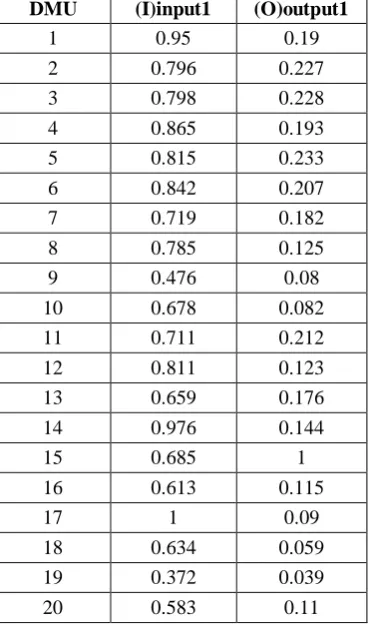
paper are used for the data of tables 1and 2 related to twenty DMUs with three inputs and
three outputs. These data are real and extracted from (Alder et al, 2002).The original data and
the data that are supposed to be add are given respectively in table 1 and table 2. Evaluating
the presented DMUs in table 1 through CCR model has been revealed that only 𝐷𝑀𝑈15 is
efficient.
Table 1. Data of input1 and output1of DMUs (Alder et al , 2002)
Table2. Data of input2,3 and output2,3 of DMUs (Alder et al, 2002)
DMU (I) input2
(I) input3
(O) output
2
(O) output
3
1 0.7 0.155 0.521 0.293
2 0.6 1 0.627 0.462
3 0.75 0.513 0.97 0.261
4 0.55 0.21 0.632 1
5 0.85 0.268 0.722 0.246
6 0.65 0.5 0.603 0.569
7 0.6 0.35 0.9 0.716
8 0.75 0.12 0.234 0.298
9 0.6 0.135 0.364 0.244
10 0.55 0.51 0.184 0.049
11 1 0.305 0.318 0.403
12 0.65 0.255 0.923 0.628 13 0.85 0.34 0.645 0.261
14 0.8 0.54 0.514 0.243
15 0.95 0.45 0.262 0.098 16 0.9 0.525 0.402 0.464
17 0.6 0.205 1 0.161
18 0.65 0.235 0.349 0.068
19 0.7 0.238 0.19 0.111
20 0.55 0.5 0.615 0.764
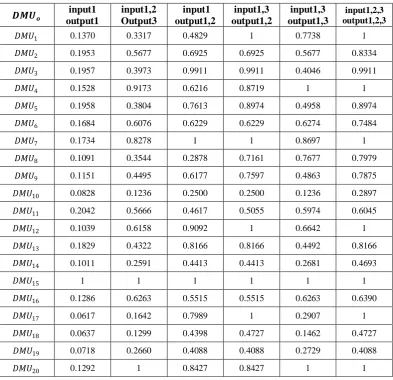
Now it’s going to present the results of adding
the inputs and outputs in table 2 on the status
of efficiency of DMUs in table 3. The results of table 3 are obtained through using the
software DEA-Solver.
Now systems (2), (4) and (5) for adding one or
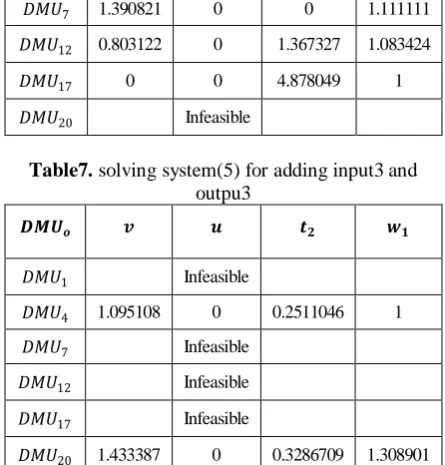
multiple inputs and or outputs are solved by using the software lingo. The related results for 𝐷𝑀𝑈𝑜 = 𝐷𝑀𝑈1, 𝐷𝑀𝑈4, 𝐷𝑀𝑈7, 𝐷𝑀𝑈12,
, 𝐷𝑀𝑈17𝑎𝑛𝑑 𝐷𝑀𝑈20 are presented in tables 4, 5, 6, 7 and 8.
DMU (I)input1 (O)output1
1 0.95 0.19
2 0.796 0.227
3 0.798 0.228
4 0.865 0.193
5 0.815 0.233
6 0.842 0.207
7 0.719 0.182
8 0.785 0.125
9 0.476 0.08
10 0.678 0.082
11 0.711 0.212
12 0.811 0.123
13 0.659 0.176
14 0.976 0.144
15 0.685 1
16 0.613 0.115
17 1 0.09
18 0.634 0.059
19 0.372 0.039
E. Noroozi, et al /IJDEA Vol3, No.3, (2015). 777-785
783 Table 4.solving system (4) for adding output2
𝑫𝑴𝑼𝒐 𝒗 𝒖 𝒘𝟏
𝐷𝑀𝑈1 Infeasible
𝐷𝑀𝑈4 Infeasible
𝐷𝑀𝑈7 1.390821 0 1.111111
𝐷𝑀𝑈12 Infeasible
𝐷𝑀𝑈17 Infeasible
𝐷𝑀𝑈20 Infeasible
Table 5.solving system (4) for adding output3
𝑫𝑴𝑼𝒐 𝒗 𝒖 𝒘𝟏
𝐷𝑀𝑈1 Infeasible
𝐷𝑀𝑈4 Infeasible
𝐷𝑀𝑈7 Infeasible
𝐷𝑀𝑈12 Infeasible
𝐷𝑀𝑈17 Infeasible
𝐷𝑀𝑈20 1.715266 0 1.308901
𝑫𝑴𝑼𝒐 output1 input1 input1,2 Output3 output1,2 input1 output1,2 input1,3 output1,3 input1,3 output1,2,3input1,2,3
𝐷𝑀𝑈1 0.1370 0.3317 0.4829 1 0.7738 1
𝐷𝑀𝑈2 0.1953 0.5677 0.6925 0.6925 0.5677 0.8334
𝐷𝑀𝑈3 0.1957 0.3973 0.9911 0.9911 0.4046 0.9911
𝐷𝑀𝑈4 0.1528 0.9173 0.6216 0.8719 1 1
𝐷𝑀𝑈5 0.1958 0.3804 0.7613 0.8974 0.4958 0.8974
𝐷𝑀𝑈6 0.1684 0.6076 0.6229 0.6229 0.6274 0.7484
𝐷𝑀𝑈7 0.1734 0.8278 1 1 0.8697 1
𝐷𝑀𝑈8 0.1091 0.3544 0.2878 0.7161 0.7677 0.7979
𝐷𝑀𝑈9 0.1151 0.4495 0.6177 0.7597 0.4863 0.7875
𝐷𝑀𝑈10 0.0828 0.1236 0.2500 0.2500 0.1236 0.2897
𝐷𝑀𝑈11 0.2042 0.5666 0.4617 0.5055 0.5974 0.6045
𝐷𝑀𝑈12 0.1039 0.6158 0.9092 1 0.6642 1
𝐷𝑀𝑈13 0.1829 0.4322 0.8166 0.8166 0.4492 0.8166
𝐷𝑀𝑈14 0.1011 0.2591 0.4413 0.4413 0.2681 0.4693
𝐷𝑀𝑈15 1 1 1 1 1 1
𝐷𝑀𝑈16 0.1286 0.6263 0.5515 0.5515 0.6263 0.6390
𝐷𝑀𝑈17 0.0617 0.1642 0.7989 1 0.2907 1
𝐷𝑀𝑈18 0.0637 0.1299 0.4398 0.4727 0.1462 0.4727
𝐷𝑀𝑈19 0.0718 0.2660 0.4088 0.4088 0.2729 0.4088
Table 6. solving system(5) for adding input3 and output2
𝑫𝑴𝑼𝒐 𝒗 𝒖 𝒕𝟐 𝒘𝟏
𝐷𝑀𝑈1 0.149183 2.311984 5.5372650 1.076244
𝐷𝑀𝑈4 Infeasible
𝐷𝑀𝑈7 1.390821 0 0 1.111111
𝐷𝑀𝑈12 0.803122 0 1.367327 1.083424
𝐷𝑀𝑈17 0 0 4.878049 1
𝐷𝑀𝑈20 Infeasible
Table7. solving system(5) for adding input3 and outpu3
𝑫𝑴𝑼𝒐 𝒗 𝒖 𝒕𝟐 𝒘𝟏
𝐷𝑀𝑈1 Infeasible
𝐷𝑀𝑈4 1.095108 0 0.2511046 1
𝐷𝑀𝑈7 Infeasible
𝐷𝑀𝑈12 Infeasible
𝐷𝑀𝑈17 Infeasible
𝐷𝑀𝑈20 1.433387 0 0.3286709 1.308901
Now by using model (6) is determined the
minimum number of inputs and or outputs that should be added in a way that the inefficient
units become efficient. For this purpose model (6) is solved through using the software Lingo
and the related results are presented in table 9 In table 9, 𝑧∗= 1 for 𝐷𝑀𝑈𝑜 = 𝐷𝑀𝑈7 and
𝐷𝑀𝑈20 . This means the minimum number of
inputs and outputs among
input2, input3, output2, output3 that
should be added in a way that 𝐷𝑀𝑈7 and
𝐷𝑀𝑈20 become efficient equals 1. The added inputs and (or) outputs for 𝐷𝑀𝑈7 and 𝐷𝑀𝑈20
are respectively outpt2 and output3. But
𝑧∗= 2 for 𝐷𝑀𝑈
𝑜 = 𝐷𝑀𝑈1, 𝐷𝑀𝑈4, 𝐷𝑀𝑈12
and 𝐷𝑀𝑈17. The added inputs and (or) outputs for 𝐷𝑀𝑈1, 𝐷𝑀𝑈12 and 𝐷𝑀𝑈17 are input3 and output2 whereas the added inputs and (or)
outputs for 𝐷𝑀𝑈4 are input3 and output3.
E. Noroozi, et al /IJDEA Vol3, No.3, (2015). 777-785
785 6. Conclusion
In this paper is presented a system for showing
that whether inefficient 𝐷𝑀𝑈𝑜 is still
preserved its inefficiency or it will become efficient through adding a given input or
output. Next this system has been generalized for adding given multiple inputs and (or)
outputs. Afterwards a model is presented that can be obtained the minimum number of
inputs and outputs among the given inputs and outputs which should be added whereas
inefficient 𝐷𝑀𝑈𝑜will become efficient. Finally
the mentioned systems and model have been utilized in a set of DMUs and the results have
been presented.
References
[1] Alder, N., Fridman, L., & Sinuany-Stern,
Z. (2002). Review of ranking methods in
thedata envelopment analysis context. European Journal of Operational
Research,140, 249–265.
[2] Banker R D, Charnes A and Cooper W W. (1984). Some model for estimating technical
and scale inefficiencies in data envelopment analysis, Manage. Sci. 30: 1078-1092.
[3] Charnes A, Cooper W W, Rhodes E. (1978).Measuring the efficiency of decision
making units. European Journal of
Operational Research 2 (6): 429–444.
[4] Charnes A, Cooper W W, Lewin A Y,
Morey R C and Rousseau J J.
(1985).Sensitivity and stability analysis in
DEA. Annals of Operations Research 2: 139–
156.
[5] Cooper W W, Li S, Seiford L M, Tone K,
Thrall R M, Zhu J .(2001). Sensitivity and Stability Analysis in DEA: Some Recent
Developments, Journal of Productivity Analysis 15: 217-246.
[6] Jahanshahloo G R, HosseinzadehLotfi F and Moradi M .(2004).Sensitivity and Stability
analysis in DEA with interval data. Applied Mathematics and Computation 156:463-477.
[7] Jahanshahloo G R, Hosseinzadeh F, Shoja N, Sanei M and Tohidi G. (2005a).Sensitivity
and stability analysis in DEA. Applied Mathematics and Computation 169: 897-904. [8] Jahanshahloo G R, HosseinzadehLotfi F,
Shoja N, Tohidi G and Razavyan S. (2005b).A one-model approach to classification and
sensitivity analysis in DEA.Applied
Mathematics and Computation 169: 887-896.
[9] Seiford L M, Zhu J. (1998).Stability regions for maintaining efficiency in data
envelopment analysis. European Journal of Operations research 108: 127-139.
[10] Zhu J. (2001).Super-efficiency and DEA
sensitivity analysis. European Journal of