BEYOND BEDS: THE VITAL ROLE OF A FULL CONTINUUM OF PSYCHIATRIC CARE 1
EXECUTIVE SUMMARY
Nearly 10 million individuals in the United States are estimated to live with a diagnosable -tioning. Hardly a day goes by without a study, headline, court case, or legislative action call-ing for reformcall-ing the mental health system to better serve this population. Often, these calls to action end in two words: “More beds.”
Largely missing from the outcry are answers to broader questions such as these:
◆ What do we mean by “beds”? More precisely, what types of beds are needed: acute, transitional, rehabilitative, long-term or other?
◆ Are there differences in the needs of different age groups – youth, adults, older
per-◆ What are the evidence-based outpatient practices that would reduce bed demand by reducing the likelihood that a crisis will develop or by diverting individuals in crisis to appropriate settings outside of hospitals?
Beyond Beds: The Vital Role of a Full Continuum of Psychiatric Care addresses these ques-tions and offers 10 public policy recommendaques-tions for reducing the human and economic costs associated with severe mental illness by building and invigorating a robust, intercon-nected, evidence-based system of care that goes beyond beds. Each recommendation is
representative young adult whose journey toward mental health recovery illustrates both the failings and the potential of the current continuum of psychiatric care.
Beyond Beds also launches a year of National Association of State Mental Health Program Directors (NASMHPD) publications reporting on aspects of psychiatric care that together can enhance the capabilities of a robust continuum. These include a review of comprehensive U.S. inpatient capacity, forensic bed capacity and number of beds; health integration and co-occurring substance use disorders; populations with intellectual and developmental dis-orders and other special needs; crisis intervention; homelessness; trauma-informed care; peer services; and health disparities and cultural competence. Each assessment is grounded in the premise that people with serious mental illness need and deserve access to the same levels of care that individuals with other medical conditions already commonly experience and that obstacles to such treatment need to be removed.
To lay the foundation for the detailed stakeholder recommendations that conclude each of these papers, policymakers at every level should take the following steps:
Recommendations
Recommendation #1: The Vital Continuum
Prioritize and fund the development of a comprehensive continuum of mental health care that incorporates a full spectrum of integrated, complementary services known to improve outcomes for individuals of all ages with serious mental illness.
Recommendation #2: Terminology
2 BEYOND BEDS: THE VITAL ROLE OF A FULL CONTINUUM OF PSYCHIATRIC CARE
Recommendation #3: Criminal and Juvenile Justice Diversion
Fund and foster evidence-based programs to divert adults with serious mental illness and youth with serious mental illness or emotional disorders from justice settings to the treatment system. These programs should operate at all intercept points across the sequential intercept framework and be required to function in collaboration with correctional and other systems.
Recommendation #4: Emergency Treatment Practices
Monitor hospitals for adherence to the Emergency Medical Treatment and Labor Act in their emergency departments and levy sanctions for its violation, including the withholding of public funding. Hospitals with licensed psychiatric beds that refuse referred patients should similarly be sanctioned if monitoring shows they have a record of refusing referred patients without legitimate cause.
Recommendation #5: Psychiatric Beds
Identify those policies and practices that operate as disincentives to providing acute inpatient and other beds or that act as obstacles to psychiatric patients’ accessing existing beds (e.g.,
dollar investments to directly provide or ensure timely access to inpatient psychiatric beds.
Recommendation #6: Data-Driven Solutions
Prioritize and fully fund the collection and timely publication of all relevant data on the role and intersystem impacts of severe mental illness and best practices.
Recommendation #7: Linkages
Recognize that the mental health, community, justice, and public service systems are
inter-should include providing “warm hand-offs” and other necessary supports to help individuals navigate between the systems in which they are engaged.
Recommendation #8: Technology
Create and expand programs that incentivize and reward the use of technology to advance care delivery, promote appropriate information sharing, and maximize continuity of care. Policymakers should require as a condition of such incentives that outcome data be utilized to help identify the most effective technologies, and they should actively incorporate proven technologies and computer modeling in public policy and practice.
Recommendation #9: Workforce
Initiate assessments to identify, establish, and implement public policies and public-private partnerships that will reduce structural obstacles to people’s entering or staying in the men-tal health workforce, including peer support for adults and parent partners for youth and their families. These assessments should include but not be limited to educational and train-ing opportunities, pay disparities, and workplace safety issues. The assessments should be conducted for the workforce across all positions.
Recommendation #10: Partnerships
BEYOND BEDS: THE VITAL ROLE OF A FULL CONTINUUM OF PSYCHIATRIC CARE 3
BACKGROUND
That access to psychiatric beds is a topic of national urgency is an understatement.
Emergency physicians regularly issue grim reports on the boarding of psychiatric patients in emergency departments (EDs), and states are being sued—sometimes repeatedly—over bed waits. In the academic literature and mass media, psychiatric bed shortages are often blamed for homelessness, mass incarceration, mass violence, and a host of other individual and societal consequences. At times, it can appear there is no poor outcome or social system failure that cannot be attributed to the number of psychiatric beds in general, the number of state hospital beds in particular, and the trend known as deinstitutionalization.
The National Association of State Mental Health Program Directors (NASMHPD) is a member-ship organization of the state executives responsible for the nation’s public mental health delivery system, including state hospitals. In the current environment, NASMHPD is fre-quently asked questions like these:
◆ How many psychiatric beds exist in the United States, where are they, who operates them, and who do they serve?
◆ How many psychiatric beds does the nation need, of what kind and where?
◆ What is the quality of care in these inpatient settings, and what are the outcomes they produce for patients, staff, and the public?
◆ Why do states continue eliminating psychiatric beds (or why are they not creating more) if these beds are in short supply?
◆ To what degree can homelessness; mass incarceration; violence—including suicide and homicide—substance use disorder prevalence; and a host of other clinical, social, and public health issues be attributed to the number of psychiatric beds available?
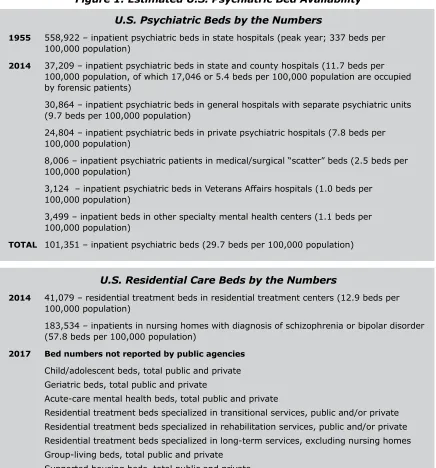
Authoritative answers have been hard to come by. No government agency publishes a com-prehensive national census that includes all categories of available mental health beds— child/adolescent, adult and geriatric, forensic, public and private, crisis and rehabilitation, mental health and substance use, and all the others that serve patients with behavioral health conditions (see Figure 1). No evidence-based target number exists for how many psychiatric beds are needed at each level of care, either in the United States or elsewhere. Causality between deinstitution-alization and social trends that developed in the same time frame (e.g., increased incarceration and home-lessness) is complicated by so many confounding fac-tors that it is never beyond debate. At the same time,
make answering any of these questions easier does not exist.
As crucial as these questions and their answers are, what is too often lost in the clamor surrounding them is the reality that 24/7 inpatient care represents only a single component of a well-functioning continuum of care for any life-threatening health condition. We readily acknowledge that patients with cancer, stroke, congestive heart failure, and an endless number of WHY BEYOND BEDS?
The Vital Continuum
Timely and appropriate supports are the
realized, they reduce the demand for the inpatient beds which provide essential backup when psychiatric needs cannot be met in the community.
4 BEYOND BEDS: THE VITAL ROLE OF A FULL CONTINUUM OF PSYCHIATRIC CARE
other medical conditions may require hospitalization at some point, but we do not expect hospitals to provide all the care required for those patients to survive and recover.
Indeed, the U.S. health care system generally has moved to a model that prioritizes the swiftest possible return to the medical patient’s natural environment. From 2005 to 2014, the total number of hospital stays for all causes fell by 6.6%; for mental health/substance use conditions, hospital admissions rose by 12.2% in the United States—the only category of hospitalization that increased in the time period.1
Figure 1: Estimated U.S. Psychiatric Bed Availability
U.S. Psychiatric Beds by the Numbers
1955 558,922 – inpatient psychiatric beds in state hospitals (peak year; 337 beds per
100,000 population)
2014 37,209 – inpatient psychiatric beds in state and county hospitals (11.7 beds per
100,000 population, of which 17,046 or 5.4 beds per 100,000 population are occupied by forensic patients)
30,864 – inpatient psychiatric beds in general hospitals with separate psychiatric units (9.7 beds per 100,000 population)
24,804 – inpatient psychiatric beds in private psychiatric hospitals (7.8 beds per 100,000 population)
8,006 – inpatient psychiatric patients in medical/surgical “scatter” beds (2.5 beds per 100,000 population)
3,124 – inpatient psychiatric beds in Veterans Affairs hospitals (1.0 beds per 100,000 population)
3,499 – inpatient beds in other specialty mental health centers (1.1 beds per 100,000 population)
TOTAL 101,351 – inpatient psychiatric beds (29.7 beds per 100,000 population)
U.S. Residential Care Beds by the Numbers
2014 41,079 – residential treatment beds in residential treatment centers (12.9 beds per
100,000 population)
183,534 – inpatients in nursing homes with diagnosis of schizophrenia or bipolar disorder (57.8 beds per 100,000 population)
2017 Bed numbers not reported by public agencies
Child/adolescent beds, total public and private Geriatric beds, total public and private
Acute-care mental health beds, total public and private
Residential treatment beds specialized in transitional services, public and/or private Residential treatment beds specialized in rehabilitation services, public and/or private Residential treatment beds specialized in long-term services, excluding nursing homes Group-living beds, total public and private
Supported housing beds, total public and private Psychiatric emergency room beds
Source: Substance Abuse and Mental Health Services Administration. (2014). 2014 national mental health services survey, Tables 2.3 and 2.3.
BEYOND BEDS: THE VITAL ROLE OF A FULL CONTINUUM OF PSYCHIATRIC CARE 5 Prior to the late 20th century, the psychiatric hospitals operated by the individual states essentially were the U.S. mental health system. In 2014, NASMHPD issued The Vital Role of State Psychiatric Hospitals
hospitals in the continuum of recovery services for this population.
However, the era of state mental health authorities’ holding the keys to the system is over.
organizations and other insurers, courts and other justice stakeholders, corrections systems, community partners such as faith-based organizations, policymakers and budgeters at every government level, special interest advocacy groups, and of course, the individuals living with
health service delivery and recovery.
The opportunities and options for improving mental health care have perhaps never been greater. The Mental Health Parity and Addiction Equity Act, the Comprehensive Addiction and Recovery Act, the 21st Century Cures Act, and other federal and state initiatives have been enacted largely in response to growing recognition by the public and policymakers that
poor outcomes for a large and vulnerable population. Nonetheless, consensus on priorities, strategies, and steps to achieve this end has proven elusive. In this debate, few subjects have been as fraught as the issue of psychiatric beds.
Despite cries for more of them, the term “psychiatric bed” has no commonly recognized
In the most basic sense, a bed is a place where an individual can sleep at night, but that
In the behavioral health world, beds were once
hospitals. The term “psychiatric bed” continues to be used interchangeably with “state hospital bed,” and also generically, as if all beds serve the same purpose. Yet, most mental health beds in the United States today are located outside state hospitals, and they serve a variety of pur-poses for distinct subpopulations, critical distinc-tions that are often lost in the larger beds nar-rative. Beds that provide the around-the-clock psychiatric nursing and psychiatric care once found only in state hospitals now also exist in university and community hospitals, charity and
entirely to mental health care, and other
con-dementia who once were housed almost exclu-sively in state hospitals now are accommodated in a variety of community settings. Persons with substance use challenges are often treated in TERMINOLOGY
Shared terminology for core components of mental health care is essential to discussing,
Society of Addiction Medicine (ASAM) level-of-care guidelines for substance use and the Level of Care Utilization System (LOCUS) for psychiatric and addiction services are examples
and researchers of using a common language.
6 BEYOND BEDS: THE VITAL ROLE OF A FULL CONTINUUM OF PSYCHIATRIC CARE
and a place to sleep are often delivered in the same setting, such as nursing homes and supported housing, a dual purpose that is often missed in the beds conversation. Similar overlaps are seen in the child/adolescent behavioral health and welfare systems.
Beds where psychiatric care is delivered also exist outside hospital psychiatric units altogether:
◆ Crisis stabilization beds for a level of care short of hospitalization, generally for very brief lengths of stay (several hours to a few days)
◆ Transitional or respite beds in residential or other settings for 24-hour non-medical
hospitalization
◆ Long-term beds in group living environments or adult foster care settings, board-and-care facilities, nursing homes and a variety of other placements for individuals with chronic mental illness who are not ready or able to reenter the community
◆ Jail or prison hospital beds operated by correctional systems for incarcerated individu-als with mental illness, along with placements for youth in the delinquency system
◆ “Scatter beds” where psychiatric patients are treated in hospital medical-surgical and pediatric units2
These bed descriptions recognize functional differences and durations of stay, but funding also differentiates and complicates the examination of psychiatric beds. When virtually all psychiatric beds were in state hospitals, they were often called “public” beds because they were funded by state budgets. In today’s world of managed care contracts and expanded Medicaid coverage, where psychiatric care in private settings may be provided through public insurance, the phrase “public bed” is antiquated, and even the notion of “publicly funded” can be problematic.
is occupied by a patient whose treatment is publicly insured by Medicaid or Medicare, is that a private or public bed? The lack of a shared language for discussing psychiatric beds and the historical scarcity of comprehensive data about them has immeasurably complicated and obscured our understanding of the beds, their numbers, and their role in the continuum of psychiatric care.
Beyond terminology, philosophical differences also bedevil the beds conversation. More than 50 years after deinstitutionalization began, bed critics continue to fear that bed expansion on any scale could precipitate a return to the 19th-century model of institutional care that peaked in 1955. At the same time, after 50 years of watching state hospital bed numbers inexorably shrink, bed proponents fear that beds will continue to be closed until none are left. It is time to retire the extremes of both viewpoints. Three generations of pharmacologi-cal treatment development3 and federal laws and programs such as the Social Security
BEYOND BEDS: THE VITAL ROLE OF A FULL CONTINUUM OF PSYCHIATRIC CARE 7 At the same time, a recognition that hospital beds continue to play a vital role in providing acute and chronic care for a segment of the population with serious mental illness at times of need is widespread. This recognition has prompted some states and providers to reexamine bed numbers, and generated unprecedented support for repealing federal limits on Medicaid reimbursement to adult psychiatric facilities of more than 16 beds. Halting bed closures has been another approach.4 With the extremes laid to rest, we will be better prepared to discuss
the full continuum of psychiatric care in all its aspects.
STATE HOSPITAL BEDS AT THEIR PEAK…
It is 1955. There are nearly 560,000 state hospital beds in the United States – 337 for every 100,000 men, women, and children.
The beds are occupied by patients with a wide variety of medical, neurological, and psychiatric conditions, including epilepsy, neurosyphilis, developmental and intellectual disabilities,
schizophrenia, depression, and geriatric dementia, among others. Monuments to a 19th-century period of social reform and a century of construction, many are sprawling clusters of buildings – the urban ones set in vast manicured lawns, the rural ones operated as self-sustaining communities with their own farms and factories. In heavily populated areas like Southern California, it is nearly impossible to cross a county line without coming across a state hospital complex. Some patients
the state hospital grounds.
While the pendulum has continually swung between permissive and restrictive admission criteria, access has generally tilted toward allowing families to admit their young and adult children, spouses, and elderly parents to state institutions with little legal scrutiny, process, or question. Individuals may self-admit as well. Patients are also committed by the courts because they meet civil commitment criteria that are typically broad and focused on a need for treatment, or because of simultaneous criminal justice involvement, a circumstance that ultimately becomes known as forensic or criminal justice involvement.
The quality and condition of the facilities and the treatment they provide is as varied as the patient population itself, some infamously decrepit and abusive, others therapeutic. Outside the hospitals, relatively few community centers have emerged to replicate, supplement or sustain the functions of the state hospitals.
8 BEYOND BEDS: THE VITAL ROLE OF A FULL CONTINUUM OF PSYCHIATRIC CARE
HOW WE GOT HERE
The period of state hospital downsizing and closure that has come to be known as deinsti-tutionalization began in the United States in the 1950s and, with a few exceptions, eventu-ally became a worldwide phenomenon.5,6 Although federal legislation in the 1960s vastly
ideological, clinical, economic, and other forces that began to emerge two decades earlier.7
By the 1940s, physical deterioration of many state hospitals nearing the century mark and deplorable conditions inside them were prompting media exposés and congressional hear-ings. Returning World War II veterans with psychiatric injuries expected to receive care in their home communities, not in institutions.8 In 1953, the discovery of the antipsychotic
moving toward a decentralized, community-based model of care and opened community mental health centers. Already by 1955, state hospital bed numbers had peaked.
Fuel for the nascent shift came in the 1960s from the federal government. The Commu-nity Mental Health Centers Construction Act (CMHCA) of 1963 established commuCommu-nity-based treatment as the national standard of care for people with mental illness and intellectual disabilities by authorizing construction of a national system of community mental health cen-ters. Two years later, in 1965, the Social Security Disability Insurance program established Medicaid insurance for low-income individuals and those with mental health disabilities. By the early 1970s, lawsuits were restricting civil commitment. The ethos of society at the same time was shifting toward recognition of individual empowerment and autonomy. Due to these and the earlier developments, the pendulum swung away from the state hospital model and toward community-based care.
Had the community mental health centers envisioned by the CMHCA been developed to meet the needs of the full spectrum of psychiatric patients, including those with special needs, the system would likely have evolved differently. Instead, a succession of U.S. presidents and Congresses reduced and eventually eliminated federal funding for community-based mental health centers.
Meanwhile, Medicaid reimbursement was and has since been prohibited for treatment of individuals aged 22 to 64 hospitalized in psychiatric facilities of more than 16 beds, a provi-sion known as “the institutions of mental disease (IMD) excluprovi-sion.” This economic
disincen-private enterprise from developing alternatives of more than 16 beds. In 2014, NASMHPD’s The Vital Role of State Psychiatric Hospitals described this evolution of state hospitals. The report found that although some states had succeeded in building community-based systems or aspects of them, and peer-provided recovery services had begun to emerge, demand for mental health services had often outstripped community resources.9
BEYOND BEDS: THE VITAL ROLE OF A FULL CONTINUUM OF PSYCHIATRIC CARE 9 held in the prior century. For individuals with intellectual disabilities, policies and institutions
serve the population.
For many individuals with serious mental illness, community settings and systems produced the positive results envisioned in the beginning with many people with mental illness living successfully in the community. However, other subgroups of state hospital patients became underserved or unserved and began to cycle in and out of acute care settings or migrate to jails, prisons, homeless shelters, and similar settings, a trend that has come to be known as “trans-institutionalization” or “cross-institutionalization.”
impacted people with co-occurring disorders, routing them to jails rather than treatment. Housing market forces, restrictions on funding for housing, and “not-in-my-backyard” atti-tudes toward neighborhood housing contributed, too. Legislation to restrict criteria for com-mitment made it harder to intervene with individuals who declined or did not seek treatment until they became a risk of harm to themselves or others, at which point they increasingly attracted law enforcement response.
The net effect is problems like the following, which are widely recognized as symptoms of these and other system failures, including the lack of a full continuum of accessible psychi-atric care:
◆ Psychiatric boarding, in which children and adults presenting in EDs are held for days and even weeks awaiting an open community hospital bed
◆ ED “streeting,” in which ED patients are discharged without supports
10 BEYOND BEDS: THE VITAL ROLE OF A FULL CONTINUUM OF PSYCHIATRIC CARE
INTRODUCING “TAYLOR”
Taylor is 20 and diagnosed with schizoaffective disorder. He lives with his divorced mother in a tidy home not far from the suburban high school where he graduated two years ago. His story will be used throughout Beyond Beds to illustrate both the gaps and the opportunities in the continuum of psychiatric care.
It is midnight, and Taylor has just returned to his mother’s home after several hours of drinking in a local park with his “friends,” the per-sonalities that his mother and other people claim do not exist but he knows are real. He knows he shouldn’t drink a bottle of vodka like this, but once he starts, it’s hard to stop. The house is quiet, his mother asleep or pretending to be, but he feels nervous and harassed. Some-times his friends whisper commands him to do things in exchange for their friendship that get him in trouble with his mother, even the police, and they get mad when he does not obey. Tonight, they want to hear glass breaking, and the compulsion to satisfy them is haunting and troubling but feels too powerful to overcome.
pane of glass at the front window before backing away and going to the kitchen. Beside the sink, he opens the cabinet where his mother keeps the dishes. So many dishes! Plates, bowls, glasses of all sizes. He chooses a small glass, the kind they use for orange juice, looks around for a target, and then hurls it against the farthest wall. The
next one and then another.
-tently received treatment, psychotherapy and educational support after his hospitalization for a suicide attempt while hearing voices. But his safety network fractured when he turned 18. The adult mental health system required a re-review of his eligibility for the community
produced a lapse in his support.
BEDS BEFORE ADULTHOOD
The child/adolescent mental health system is as complicated as the adult system but in different
of families, schools, child welfare systems and the juvenile justice system add different nuances and contexts.
In the child/adolescent service system, program goals relate to maximizing the tenure of youth
albeit inconsistently across and within the states. Interventions include mobile crisis intervention with in-home follow-up supports, parent-peer support and coordinator/system supports, therapies and navigators to help the family. In the more robust continuums, pediatricians may have access to child psychiatrists, and clinical, residential and transitional systems work together through family-centered, youth-guided planning in a system that is sensitive to cultural differences.
BEYOND BEDS: THE VITAL ROLE OF A FULL CONTINUUM OF PSYCHIATRIC CARE 11 Eventually, Taylor was assigned to a new clinic, but psychiatrists were in short supply, and it took three months for him to get an appointment there. In the interim, he stopped taking
were called because he refused to stop an aggressive rant at a neighbor he believed was plotting to kidnap him. He eventually returned to the mental health clinic, but it was not par-ticularly specialized in working with emerging adults. Taylor’s adherence to medication and his engagement with treatment never returned to the consistency he achieved while in the children’s behavioral health system.
its treatment in the service delivery system: onset of symptoms in adolescence, disruptive -cation and other treatment in adulthood, worsened symptoms when not treated, behaviors that frighten others even when not intended to be dangerous, and suicidal thinking and behavior. From here through the conclusion of this assessment, he will be the human face illustrating where gaps in the psychiatric care continuum persist and where strategies for addressing them exist beyond merely building more beds.
In her bedroom, where she rarely sleeps when her son is out at night, Taylor’s mother is jolted upright by the sound of shattering glass. For one merciful moment, she hopes the sound merely signals an accident in the kitchen; with the next crash, she feels sick with fear and dread.
but as one glass after another hits the wall on the other side of her wall, she takes comfort in the dead bolt she has reluctantly installed on her door.
that these episodes occurred only during business hours on weekdays. -ing the phone, she presses 9-1-1, desperately hop-ing tonight is one of
10 where evidence-based practices are provided as a
-tomatic. In 2017, after nearly a decade of federal initiatives to expand such programs, they are growing in number, but most adolescents and young adults still live without access to one.
“Where is your son now, Mrs. Wilson? Can you still hear him?”
on the scene. To Taylor’s mother, the voice is a lifeline.
“I think he’s throwing something bigger now, maybe cups. The sound is louder when they hit the wall.”
to a door to let them in?”
12 BEYOND BEDS: THE VITAL ROLE OF A FULL CONTINUUM OF PSYCHIATRIC CARE
MENTAL ILLNESS IN THE CRIMINAL JUSTICE SYSTEM
Mental illness is global, but mental illness response is local, and whether a 911 call is made
of the circumstances and local conditions. These circumstances include:
◆ the individual’s behavior at the time;
◆ the state where the person lives and its laws, policies, and practices related to who can be held for psychiatric evaluation and where they may go for one;
◆ the robustness of the community’s mental health services and their accessibility;
◆ the existence of emergency, crisis stabilization, inpatient, and recovery beds and per-sonnel;
◆ the training of local law enforcement in de-escalation tactics;
◆ access to crisis stabilization centers and police drop-off sites;
◆ the availability of jail diversion programs for individuals with mental illness;
◆ insurance status;
◆ —and many others.
A crisis like Taylor’s will usually mobilize one of the types of responses described in Figure 2.
The sequential intercept model is a framework based on the premise that criminal justice involvement of individuals with mental illness can be reduced by identifying and redirecting them into treatment at various intercept points along the criminal justice continuum (e.g., during police encounters and court proceedings, upon jail or prison entry or reentry, while on community probation or parole supervision).13 This framework, which was incorporated in the
21st Century Cures Act, has led to the development of many innovative diversion strategies as a means of reducing the likelihood that individuals with conditions like Taylor’s will end up charged with a crime or in law enforcement custody.14 That many individuals at risk of
crimi-nal involvement also have substance use challenges is widely recognized.
Because his mother did not have the option of calling for a mobile mental health cri-sis response, Taylor’s cricri-sis has become a police incident, delivering him to this new “intercept” crossroads. Acting on the basis of their training and experience, the laws of their state, and practical realities such as the availability of acute-care options within their jurisdiction and how Taylor
will decide whether Taylor’s actions war-rant his arrest on criminal charges, his transport to an emergency medical facility or their departure without further action. During the encounter, Taylor’s risk of inju-ry or death will be 16 times greater than that of members of the public without seri-ous mental illness15 and his risk of arrest
six times greater.16
CRIMINAL AND JUVENILE JUSTICE DIVERSION
Though individuals with serious mental illness make up an estimated 4% of the population, “severe
psychological distress” is reported to affect 26% of jail inmates and 14% of prison inmates overall and 20–33% of women inmates. Similar overrepresentation is seen in the juvenile justice system.
Evidence-based practices have been developed to prevent or diminish the prevalence of serious mental illness in the criminal and juvenile justice systems, but they are not universally available and remain underused.
RECOMMENDATION: Policymakers should fund and foster evidence-based programs to divert adults and youth with serious mental illness or emotional disorders from justice settings to the treatment
BEYOND BEDS: THE VITAL ROLE OF A FULL CONTINUUM OF PSYCHIATRIC CARE 13
EXAMPLES OF
PSYCHIATRIC
CRISIS RESPONSE
Default Law
Enforcement
Crisis Response
Specialized
Police
Response
Collaborative
Police-based /
Mental Health
Response
Mental
Health-based
Response
Most commonly practiced
Response by law enforcement officer
Little training in mental health crisis or response
With or without emergency medical backup
Available in approximately half of US counties
Response by specially trained officers Immediate or near-immediate
response time
24/7/365 response capability`
Emerging model; usage data not available
Joint response by police and mental health professionals Crisis response with mental
health follow-up and
guidance for police department
Promising model if goal is to directly link to mental health system; usage data not available Part of mental health system; partnership
with police
Mental health responder(s) only
14 BEYOND BEDS: THE VITAL ROLE OF A FULL CONTINUUM OF PSYCHIATRIC CARE
Taylor’s episode occurs on a Friday night. If he is arrested and his mother is too fearful to post bail for his release, Taylor will be kept in jail custody over the weekend, without access to prescribed medication or other mental health supports, waiting to go to court. He will be at risk of victimization,17 suicide18 and other violence.19 If symptoms of the psychiatric state
that led him to the dish-smashing episode are still evident when he reaches the courtroom (e.g., Taylor appears confused/disorganized/aggressive, makes statements that seem out of touch with reality, does not understand why he is before a judge or cannot communicate with his counsel), the judge may order an evaluation of Taylor’s competence to stand trial before the matter can move forward in the criminal justice system.
Although practices vary by state, criminal competency evaluations typically take place in the jail, in the community or, less commonly, at the courthouse or state hospital. Once an indi-vidual is adjudicated incompetent to stand trial, laws in almost all states require restoration to legal competence before trial. Most states provide such restoration services in their state hospitals20 even when the services are legally authorized for other settings, such as the
com-munity.21 These services include medications and individual and classroom therapies but also
explicitly teach information about courts and criminal processes.
When the number of pretrial jail detainees court-ordered into the state hospital for com-petency services exceeds available beds, forensic waits develop. These waits average from weeks in some states to more than a year in others,22 and their numbers have been
grow-ing.23 State mental health directors report that court-ordered restoration services are the
single greatest source of pressure on state hospital bed supplies. States are attempting to reduce or eliminate their bed waits, but waitlists remain common, and many states have been sued—sometimes repeatedly—or threatened with lawsuits over the situation.24 Some
innovations hold promise for reducing forensic bed waits. Miami-Dade County in Florida has implemented a successful strategy for reducing bed waits by diverting individuals with psy-chiatric symptoms who commit minor criminal offenses directly to crisis stabilization units in the community instead of booking them into the county jail,25 for example, and computer
modeling is being explored as a tool for identifying small changes in common practices that would reduce forensic bed waits without adding beds.26
Family caregivers of individuals in crisis often call police under the assumption that law enforcement involvement will ensure their loved ones’ safety and get them into treatment. Police say they arrest individuals in crisis for the same reasons and for public safety, and judges say they order competency restoration because there are no other accessible treat-ment options.27 However, restoring criminal competence to stand trial is fundamentally a
and security, not treatment, are the priorities in correctional systems, and recent
govern-inmates.28 Some pretrial defendants spend far more time waiting for competency services
or undergoing them than they would have spent if convicted of their alleged offenses. Oth-ers are restored and returned to jail, where they relapse, return to the hospital, and cycle through the process anew, trapped in a revolving door of personal suffering and public cost.
A continuum of care that promotes mental health stability before law enforcement encoun-ters occur and diverts individuals with mental illness from jail if they do occur (e.g., through mental health training for law enforcement, mental health specialty courts, or forensic asser-tive community treatment [ACT] teams) reduces the risk of arrest. However, such
BEYOND BEDS: THE VITAL ROLE OF A FULL CONTINUUM OF PSYCHIATRIC CARE 15
MENTAL ILLNESS IN THE EMERGENCY DEPARTMENT
to his mother’s 911 call are experienced in crisis intervention. They even know Taylor, having been called to the family home in previous emergencies. Though they are aware that calls involving psychiatric
him, “What’s happening, man?” and giving him ample time and space to respond. They suggest that getting some sleep and a checkup at the local hospital might help him feel better.
Taylor stands, silent, arms slack at his sides, staring at his mother’s
me to go to Community General with them.”
The lock clicks open and his mother steps into the room. Taking in the
It’s such a mess here, and it’s already so late. Why don’t you go with
into bed.”
Taylor squeezes his eyes shut, gives an exaggerated shoulder roll. Fi-nally, with a sigh, he mutters, “Okay. Just for one night.”
When there is an incomplete continuum of care, law enforcement and families rely on the Emergency Departments (EDs) of their local hospitals for psychiatric crisis intervention. The demand this creates contributes to ED crowding and often results in psychiatric “boarding,” a practice in which psychiatric patients whose condition merits hospital admission are held in the ED because no inpatient bed is available to admit them.
The American College of Emergency Physicians (ACEP) reports that 90% of hospital EDs board psychiatric patients,29 with bed wait times averaging three times what non-psychiatric
patients experience.30 Bed waits in EDs can last days or even weeks, and lawsuits, court
orders, and costly settlements have resulted, just as they have with jail waits.31 Studies of
boarding patterns indicate that psychiatric patients who have the most extreme symptoms or are the most suicidal often wait the longest for admission or are discharged without care
32 Virginia State Senator Creigh Deeds
tragically became the face of this phenomenon when his son, Gus, stabbed and slashed him in the head and then killed himself hours after being released from an ED because personnel
33
ACEP for two decades has been proposing strategies to reduce ED crowding, but reports only “minor gains” from the efforts.34 The intractability of the problem despite efforts by this and
resources that are not balanced. These needs include
◆ patient access to preventative and access to supports in the community that reduce the likelihood of crisis (e.g., ACT teams);35
◆ hospital access to real-time information about where and what kinds of beds are avail-able (e.g., state bed registries);
16 BEYOND BEDS: THE VITAL ROLE OF A FULL CONTINUUM OF PSYCHIATRIC CARE
◆
-counters like Taylor’s are de-escalated at the scene (e.g., crisis intervention training)
◆
health evaluations and hospital admissions initiated through EDs;
◆ the absolute number of beds available within the hospital or within transport distance;
◆ the licensing and distribution of those beds (e.g., by gender, age, purpose); and
◆
-als willing to treat the population whether patients are in the public or private sector.
Changes in practice at any point on the continuum of care connected to the ED can impact boarding dramatically. One 2017 study, based on computer modeling, found that adding a single half-time clinician during the 8 a.m. to 4 p.m. shift could cut average wait time to dis-charge by 35% and average wait time to admission by 13%.36 Conversely, when
Sacramen-to, California, closed an outpatient crisis stabilization unit and eliminated 50 of 100 inpatient beds in 2009, the number of ED visits requiring psychiatric consultation at the city’s univer-sity hospital tripled, and the average time psychiatric patients spent waiting to be seen by a psychiatric clinician in the ED increased from an average of 14 hours to nearly 22 hours.37
that patients in psychiatric crisis do not receive the same quality of health care in the ED that patients presenting with other medical conditions receive. Provider biases and prejudices that result in inferior intervention are reported.38, 39 Misinterpretations and over-interpretations of
in psychiatric cases often leave caregivers out of treatment discussions that family members of other medical patients are afforded.40
EDs under-equipped to handle mental health emergencies may be even less prepared to expeditiously evaluate and place patients with co-morbid conditions such as substance use, intellectual/developmental disabilities including autism, sensory issues including deafness, and others.41 “Emergency in the emergency room” is how more than a few observers have
described the situation.
broken-leg patient in the wheelchair and not far from the stabbing victim with a blood-soaked T-shirt wrapped around his wounds, Tay-lor grows increasingly anxious. The lights, bustle, and sounds add to the sensory overload he is already experiencing from his psychotic symptoms. He begins rocking in his chair, his lips moving as he talks
empty. When he jumps to his feet and begins gesticulating in his inner conversation, surrounding patients begin to look alarmed. The
stab-Taylor’s mother wavers between staying next to her son and leaving to
BEYOND BEDS: THE VITAL ROLE OF A FULL CONTINUUM OF PSYCHIATRIC CARE 17 Each year, there are an estimated 800,000 ED visits in the United States where the cause is symptoms of schizophrenia and 1.5 million visits where the presenting problem is associat-ed with a mood disorder.42 Optimally, psychiatric
patients are seen in an area of the ED where they can be evaluated and cleared medically, then examined by a mental health specialist in no more time than a stroke or sepsis patient would wait for comparable services. At a mini-mum, a private space to distance them from the tumult of the ED, which can intensify symptoms is available, an accommodation that is especially
and activity of the typical ED overwhelming. In practice, most psychiatric patients are seen in the general ED, where, like Taylor, they are giv-en a seat or a gurney and may spgiv-end hours or days in a public hallway.
An ED visit is another crossroads. What tran-spires there determines the patient’s next step along the continuum of care, or off it. Figure 3 displays the most common ED outcomes for psy-chiatric patients.
The outcome that any individual patient experiences, like arrival at the ED itself, is a func-tion of multiple factors, including the gravity of the symptoms; the patient’s behavior; the availability of appropriate beds; the clinical assessment of the evaluator; the tenacity of the patient’s advocates, who may include family members, outpatient providers and caretakers; and transient factors such as whether the hospital has a psychiatrist on staff.
All other factors being equal, however, if the supply of appropriate beds does not match the demand for them at this juncture, hospital admission likely will be delayed or denied altogether.
EMERGENCY TREATMENT PRACTICES
The Emergency Medical Treatment and Labor Act (EMTALA) is a federal law that requires stabilization and treatment of all persons coming to an ED prior to transfer, regardless of their insurance status or ability to pay. Nonetheless, psychiatric patients wait longer in EDs than other medical patients for admission and experience other disparities, including discharge without treatment or even arrest. Potential receiving hospitals are not obligated to accept patients from EDs.
RECOMMENDATION: Federal, state and local agencies should monitor hospitals for adherence
18 BEYOND BEDS: THE VITAL ROLE OF A FULL CONTINUUM OF PSYCHIATRIC CARE
EMERGENCY
DEPARTMENT
OUTCOMES
Discharge
With
Support
Hospital
Admission
U Admission to same hospital or elsewhere in the community USymptoms have abated; return to
community is reasonable and safe U Appropriate follow-up and outpatient
support have been secured
Discharge by Arrest
Discharge Without
Support
UDeparture from the ED in police custody
U Perceived as relatively uncommon
U Used when patient’s behavior escalates beyond ED’s capacity
UAlso known as “streeting” U Perceived as relatively uncommon
U Discharged to the community without outpatient support
Boarding
UBed waits of days, weeks or months in the ED UÊNo appropriate placement is available
Responding states reported
ED boarding in 2015
of ED physicians report
boarding psychiatric patients
29
of
46
90
%
38
%
8
%
5.8
%
Patients admitted to non-
psychiatric “scatter” beds
of psychiatric ED patients
admitted to the same
hospital in 2015
Patients admitted to
short-term-beds in another community hospital
ED patients with
schizophrenia or
mood disorders were
1
in
5
BEYOND BEDS: THE VITAL ROLE OF A FULL CONTINUUM OF PSYCHIATRIC CARE 19
PSYCHIATRIC HOSPITALIZATION
It is nearly 7 a.m. Taylor has been evaluated and determined to need hospitalization for monitoring and stabilization. Once she was assured he would have a bed, his mother went home to get some sleep. Taylor
where he waits. He rejected the food his nurse brought him and is drowsy after accepting medication to relieve his anxiety.
-der a contract with the county, the private hospital accepts patients held involuntarily as a danger to themselves or others, which makes voluntary patients like Taylor a lower priority for admission. There is no real-time bed registry for acute hospitals in his state. This leaves the crisis triage worker to hunch over a telephone in a cubicle off the nurs-ing station, maknurs-ing call after call, huntnurs-ing for a placement, a routine she follows several times in a single shift.
Most hospitals report that they are full or their units are currently too active, and maybe it will be better in the morning. A hospital two hours
another hour for the ambulance to arrive to transport him and two
-dentiality protections, Community General will not tell her where her
not to the streets.
Even so, Taylor is again fortunate: His wait to admission lasted less than half a day. The nurse in the psychiatric unit when he arrives is
therapy session because he has earned some peace and quiet.
Inpatient treatment remains a vital component of the continuum of care.49,50,51,52 At a
mini-mum, emergency hospitalization allows time for stabilization of acute psychiatric symptoms, much as intensive care in a cardiac bed promotes stabilization of acute cardiac symptoms. When state hospitals functioned as virtually the entire mental health system, they were the
PSYCHIATRIC BEDS
long-term needs of those individuals with mental illness who require more intense or specialized services than are available in the community. Currently, statutory, licensing, funding and other policies are combining to limit bed supply and access in most states. Hospitals receiving public funding are not required to have psychiatric beds to serve their communities, and patients are often then hospitalized at sites far away from home.
RECOMMENDATION: Identify those policies and practices that operate as disincentives to providing acute inpatient and other beds or that act as obstacles to psychiatric patients accessing existing beds
20 BEYOND BEDS: THE VITAL ROLE OF A FULL CONTINUUM OF PSYCHIATRIC CARE
main disposition point for patients transferred from community hospital EDs, whether vol-untarily or involvol-untarily. It is largely a result of this model that state hospitals continue to be viewed as synonymous with psychiatric hospitalization.
Today, however, inpatient care extends far beyond state hospitals and far beyond hospitaliza-tion in other settings as well. Psychiatric hospitalizahospitaliza-tion itself has been transformed. In 2014, approximately 75% of residential psychiatric beds were located outside of state and county hospitals,53 and fewer than 2% of all public mental health care clients were treated in state
hospitals.54 Individuals 65 years of age or older, who made up 29% of the state and county
hospital population in 1970, were being largely cared for in the community.55 Although some
state hospitals continue to accept voluntary patients, the majority of state and county beds are reserved for civil patients deemed by a court to meet criteria established by each state for involuntary commitment or, increasingly, by forensic patients involuntarily committed through the criminal justice system.56,57
In the hospital, Taylor is seen every day by a psychiatrist on rounds and goes to group therapy sessions led by an occupational therapist. The groups are mixed, some interesting and some not. He spends time in the day room, which is better than some he has seen, with a foosball
familiar lists about “triggers” that upset him, his goals, and where he sees himself in a year. Already, she is talking to him about discharge.
Taylor’s social worker asks him about the medications he has been on over the years and what he likes and does not like about them. He says he noticed that he mostly stays out of trouble when taking medication and makes plans for getting a job, saving up money for his own car, and having a girlfriend. What he does not like is that the medications make him gain weight, but do not make the voices stop ordering him to do things he probably should avoid, like breaking his mom’s dishes.
Various members of his team describe a drug the doctor discussed with him at a treatment team meeting called clozapine. The nurses tell him people who have a history of drugs that do not eliminate
symp-There are cons, too: regular blood testing, drooling at night and, prob-ably, continued struggles to keep his weight down. His social worker asks him to consider going on clozapine despite the cons because it could control his symptoms better and make it easier to follow through on his plans and dreams. He says he will consider it.
As with other medical conditions, insurers require clinical evidence that a continued hospital
BEYOND BEDS: THE VITAL ROLE OF A FULL CONTINUUM OF PSYCHIATRIC CARE 21 clinical notes that he is ready for a step-down placement. The insurer lowers payment to the hospital based on this
covered. Discharge becomes imminent.
In 2014, the federal government reported 800,000 hospital discharges of patients with schizophrenia and 1.5 million discharges of those with mood disorders, including bipolar disorder and major depression. Discharge practices vary by
state laws, public policy priorities, state and local budgets and a host of other factors. While two to three weeks are necessary for antipsychotic medications such as
clozap-reduce symptoms, few patients outside of state hospitals remain inpatients long enough for that to happen. In 1980, the median length of stay (LOS) for an acute episode was 42 days.58 By 2014, it was about seven days.59 At 77 days,
the average LOS is much longer in state hospitals,60 one
of the reasons that some researchers, advocacy groups, family members and others continue to call for more state hospital beds.
One analysis compared state data and found shorter state hospital LOS to be associated with higher rates of readmis-sion,61 but the link between LOS and outcomes is largely unexplored at the patient level.
to determine whether LOS is more critical for some diagnoses or symptoms than others. This dearth of information deprives all the stakeholders of an essential ingredient for
evi-outcome- or cost-based rationale for expanding transitional residential beds as a means of reducing the demand for hospital beds and improving mental health outcomes overall.
In a more complete continuum of care, Taylor’s episode likely would have been avoided entirely, or he would have gained immediate access to the level of care needed, avoiding the encounter with police, visit to the ED, and hospitalization. The next stage of his journey illustrates how an integrated approach with a full spectrum of appropriate services works to achieve better outcomes.
DATA-DRIVEN SOLUTIONS
Evidence-based public policy and practice require reliable, comparable, scalable data from which to identify, quantify, and analyze individual and community outcomes and thus implement best practices. Under new federal direction, more such data are becoming available, but their value to policymakers and the public continues to be limited by the lack of common
delays in publication, and by barriers to public access.
22 BEYOND BEDS: THE VITAL ROLE OF A FULL CONTINUUM OF PSYCHIATRIC CARE
TRANSITIONAL BEDS
LINKAGES
Outpatient supports could effectively increase bed capacity by reducing the number of patients in need of inpatient care. However, because these often are unevenly distributed and operate in silos
occur that create barriers to recovery as individuals are left to themselves to navigate a complex array of interventions despite their
RECOMMENDATION: Policymakers should recognize that mental health, community, justice and public service systems are interconnected and
between them. Practices should include providing “warm hand-offs” and other necessary supports to help individuals navigate between the systems in which they are engaged.
Taylor’s social worker is the one who tells him about Stepping Stones House. He will eat and sleep there temporarily, but it is not a hospital, she promises. It is small – only six beds in a real house, in his home county. He will see some of the same kinds of people he does in the hospital – a social worker, a psychiatrist, a caseworker – but he will meet new ones. Stepping Stones’ staff will introduce him to an entire team that will be “his” once he moves back to his mother’s home or to another setting. They will link him to the clozapine clinic that operates at an academic medical center he will be able to reach by public tran-sit. While his medications are still being adjusted and his psychiatric symptoms continue to subside, Stepping Stones will work with Taylor to map his next steps and provide the linkages to services that will support his further recovery.
Taylor also will be connected with a young adult peer with a serious mental illness diagnosis who has been trained to support others with similar disorders and help them navigate their own recovery journeys. As long as Taylor attends group sessions and stays on the plan his treatment team has developed with him, he will be able to go on un-supervised outings with his mother or the trained peer. And after two weeks, maybe less, he will move to an even less restrictive setting that his team inside and outside Stepping Stones will work with him to select. His mother says he is welcome to come back home, but the Stepping Stones House staff also can introduce him to group living op-tions near his home if he wants to try something different until he is ready to live more independently.
Residential treatment beds are the fastest-growing category of capacity in the United States. Since 1970, the number of such beds has doubled, from 6.8 beds per 100,000 peo-ple to 13.5 per 100,000 in 2014.62
Terminol-ogy differs by locale. They may be described as “respite,” “transition” or “step-down” services, or by another name, but their essential char-acteristic is providing a place to stay that is monitored by non-medical staff who are trained in medication administration and who provide transportation and other support and structure. They generally do not have a psychiatrist or a nurse on-site but may have medical personnel on call in the case of an emergency. The stays are short-term, typically four weeks or less.
BEYOND BEDS: THE VITAL ROLE OF A FULL CONTINUUM OF PSYCHIATRIC CARE 23 or other public agencies; individuals and private providers cannot access them. Had Taylor still been engaged with the mental health system when symptoms that led to his latest psychotic episode began, he could have been referred to Stepping Stones to head off the emergency. Respite, structure, abstention from alcohol and other substances, refocusing on his goals, medication adjustments, and other supports might have stabilized him
suf-and hospital stay would have been averted, along with the resulting stress on Taylor suf-and his mother and the costs to the systems involved. Had he continued to destabilize, he could have been transferred from Stepping Stones to the inpatient unit, and perhaps back again before returning home.
There have been few studies to assess the effectiveness of transitional resi-dential programs in producing measur-ably improved outcomes, but their role in linking people with mental illness to evidence-based programs and other promising supports strongly suggests an indirect association. For example, Stepping Stones staff makes sure every qualifying resident moves on with an active application for services such as mobile ACT teams, and members of the ACT team for his area will come to Stepping Stones to meet Taylor. Some-times called “hospitals without walls,” the ACT model has repeatedly been found to reduce re-hospitalization and improve other outcomes.
Because of the nation’s psychiatrist shortage, Taylor may have to wait a month or two for an appointment with a supervising psychiatrist, as he did when he transitioned from youth to adult ser-vices. To bridge that gap, the staff at Stepping Stones introduces Taylor to a tele-psychiatrist from a different region who is on contract to provide interim services. Taylor also is introduced to some of the new-est mobile apps for mental health. Although still to be fully studied, apps show promise in monitoring symptoms and keeping patients connected to their community providers.63 He
is allowed to use his mobile phone for an extra hour each day if he downloads at least two apps and works at becoming familiar with them. Interestingly, Stepping Stones staff also are encouraged to use apps to manage their own stress and mitigate compassion fatigue.
Stepping Stones is able to bill Medicaid for Taylor’s medication supervision and some of its services, but the rest of its services are funded by Taylor’s county. By tracking and analyz-ing intersystem costs, the county was able to determine that fundanalyz-ing Steppanalyz-ing Stones 24/7, 365 days a year costs less than maintaining the status quo without hospital diversion and hospital step-down.
TECHNOLOGY
Mental health applications for computer and other technologies are proliferating and hold promise for promoting more precise, timely and effective treatment for individuals with serious mental illness. At the same time, computer models are emerging that equip decision makers to analyze large data sets and project the impact of small changes to systems of care to better tailor interventions toward positive outcomes. Technology-assisted medical record keeping has increasingly been constructed to preserve and draw down clinical information, while maximizing allowable sharing of such information between clinicians through health information exchanges.
24 BEYOND BEDS: THE VITAL ROLE OF A FULL CONTINUUM OF PSYCHIATRIC CARE
-ing the previous year driv-ing people in psychiatric crisis to EDs, between EDs and admitting hospitals, and more rarely, to the state hospital, four hours away. The county’s costs for psychiatric emergencies also included paramedic hours, ED, and local hospital charges for patients held for emergency evaluation, the costs of medication for inmates in the county jail, and medical costs for citizens and law enforcement injured during encounters.
A majority of the county commissioners eventually decided that every county resident with a serious mental illness who did not have a crisis in any given year represented a dollar–or many dollars–saved. By the time Taylor entered Stepping Stone House, the county mental health department had already been
a second Stepping Stone House could be opened. WORKFORCE
The capacity of any system to deliver
impaired by workforce shortages. Both outpatient and inpatient mental health services and supports are being limited in many locations because there are not
neglected services include psychiatric beds that cannot be used because they are unstaffed. Limiting services in turn limits opportunities for recovery and the
communities.
BEYOND BEDS: THE VITAL ROLE OF A FULL CONTINUUM OF PSYCHIATRIC CARE 25
LIVING IN THE COMMUNITY
PARTNERSHIPS
A growing number of advocacy organizations, faith-based
communities and others outside the
as able and willing to support and supplement public resources. In some circumstances, such as with children, families are being included in treatment and policy development in new and more vigorous ways.
RECOMMENDATION: Policymakers should recognize the vital role that families and non-traditional partners outside the mental health system can play in improving mental health outcomes and should encourage and support the inclusion of a broader range of invited stakeholders around mental illness policy and practice.
Taylor leaves Stepping Stones after three weeks. He goes back to his mother’s home for the time being, but he is on a waiting list for a room in a staff-supported group living environment not far from where she lives. He has mixed feelings about leaving his boyhood home because there he knows what to expect, and his mom’s food is good. But most of the friends with whom he went to high school went away to college after graduating. For now, this is a step in a similar and hopeful direction.
Taylor’s trajectory is unlikely to be without further set-backs. He lives with a serious mental illness that can be unpredictable, with symptoms that come and go and can be more or less impairing at different times. He will be more stable and successful while consistent with medications, but there can be breakthrough symptoms or incomplete remis-sion and, like most people with chronic conditions, it is likely he will periodically go off his prescribed medicine.
Depending on the symptoms he develops when he rejects treatment, civil or criminal courts may become involved in his care. He will have a range of side effects from annoying to, in very rare cases with clozapine, life-threatening. The weight gain associated with his medications places him at risk for developing comorbid health conditions, such as dia-betes. His cigarette smoking compounds his risks.
Taylor’s trajectory will, to some extent, depend on how thor-oughly and successfully his local mental health agency is funded and how it is equipped to invest in programs that
access to integrated health care in which his medical and mental health providers collaborate on his treatment and care. His mother will remain a critical foundation of his sta-bility, as family members can be, but she will need support and encouragement, too. Ulti-mately, Taylor’s recovery will be a product of how completely the continuum of care serves him, along with his own courage and determination.
the local community college, he enrolls in a psychology class. On his
becomes his girlfriend.
Taylor has one short relapse after he decides he has recovered be-yond any need for medication and stops taking his clozapine, but he stabilizes quickly during a brief stay at Stepping Stones and returns to his group living environment, job, and girlfriend. Occasionally, the old voices break through and speak up again, but he has learned tactics for ignoring them, and he no longer gets into trouble when they do. As he works his way to the top of the list for a supported housing apart-ment, he and his case manager agree he is ready for less frequent appointments, and his meetings with the peer support worker from Stepping Stones shift from weekly to twice-monthly.
Taylor is on his way.
CONCLUSION
and serious mental illness. His role in this paper is to illustrate both the gaps and the opportunities in the continuum of mental health care. We depict him as having received excellent supports as a young adolescent with youth-guided and family-driven care, and then, when our story begins, experiencing symptoms and personal setbacks after the tran-sition to adult services.
Comparatively, his narrative illustrates more positive than negative outcomes: He was not arrested during his crisis, spent less than a day in the ED, was admitted to a psychiatric bed for treatment of his acute symptoms, accepted new medication, and was discharged to tran-sitional care, which became a turning point. “More positive than negative,” however, should not be considered acceptable for someone like Taylor, but more psychiatric beds alone would not have improved the outcome.
A robust system of care for individuals with serious mental illness must look beyond beds and offer comprehensive and quality treatment and services before, during, and after acute illness episodes. Without a broader view of what is needed, individuals with mental illness will remain at risk of negative outcomes, including hospitalization and rehospitalization, arrest and re-arrest, homelessness, and even early death. Efforts across the country are underway to build successful alternatives to these outcomes–a good start–but validation, replication, and proliferation of effective treatment practices for individuals of all ages are urgently needed in communities of every size nationwide.
The era of mental health care that is centralized and provided primarily through government-operated inpatient facilities is over. For more people with serious mental illness to survive and thrive, we need better early detection and prevention practices, more precise diagnostic methods, more targeted and effective medications with fewer side effects, more parity with care for other medical conditions, and less isolation for individuals with psychiatric illness. We need to know more about why devastating co-occurring substance use is so common in mental illness and develop effective approaches to reducing it.
On every level, the rush to “more beds” needs to be tempered with illumination and clarity about patient need, the kinds of beds best suited to meet those needs, and the recognition that bed capacity is a function of more than sheets on a mattress. Only a complete con-tinuum of psychiatric care can reduce the human and economic costs associated with mental illness.