A Framework of Reference for Teaching English as a Foreign
Language at the Threshold of I.R. of Iran
Sajjad Askari Matin
PhD candidate, Tarbiat Modares University, Tehran, Iran
Gholamreza Kiany
1Associate Professor, Tarbiat Modares University, Tehran, Iran
Reza Ghafar Samar
Associate Professor, Tarbiat Modares University, Tehran, Iran
Abstract
Advancements in theory and practice of Teacher Evaluation maintain that effective teaching is the most important factor in realization of success or failure of an education system. Therefore, any attempt to explore the dynamic and complex nature of teachers' performance is considered critical. In the same vein, this paper is an attempt to introduce a Framework of Reference for Teaching English as a Foreign Language (FRTEFL) at the threshold of I.R. of Iran; a local model aligned with global perspectives. To this end, adapting a qualitative meta-synthesis approach, all possible dimensions of teachers' performance criteria reflected in 17 High-stake resources were explored; scrutinizing the twofold mapping of both curriculum and evaluation standards. For the application of meta-synthesis, grounded coding and thematic analysis was carried out by two research assistants also fifteen teacher training experts participated in validation analysis. The output of meta-synthesis resulted in emergence of overall 6293 Grounded Codes, 1655 Themes, and 218 Super-themes. Based on the results, the framework contains 8 Domains, 35 Key Areas, along with their validation measures: Planning and Preparation for General Pedagogy, Planning and Preparation for Language Pedagogy, Planning and Design for Learning, Management of Learning Environment, Effective Instruction, Organizational Responsibility and Professionalism, Socio-cultural Capital and Social Agency, and Spirituality, Morality and Theism. The proposed framework is believed to represent a localized framework of teachers' practice in the context of an Islamic Education System, provide considerable implications for enhancement of teachers' professional development, and to be a major step in validation of local and large-scale Teacher Evaluation programs.
Keywords: Professional Development, Qualitative Meta-synthesis, TEFL, Teacher Evaluation
Received on February 23, 2017 Accepted on February 10, 2018
1. Introduction
Ensuring quality of teaching (e.g., accountability, effectiveness, competency, etc.) and promoting quality of teachers (e.g., professional learning, professional development, efficiency, growth, etc.) are the most important factors in realization of the effectiveness and productivity of teacher evaluation approaches. Now, it is also the common sense that elevation of an education system is limited to extent of its teachers' quality performance and qualified teachers are essential to equitable quality education and lifelong learning opportunities for all (CEART, 2015; Clotfelter, Ladd & Vigdor, 2007; Goodwin, 2017; Hattie, 2002; Haycock, 1998; Nye, Hedges & Konstantopolos, 2004; Rivkin, Hanuschek & Kain, 2005; Sanders & Rivers, 1996). Respectively, this urge adds to the significance of quality assurance for teacher education programs; Now, teachers' accountability, credibility, effectiveness, innovation, and professionalism (to name a few) are constructs under the attention of policymakers to make informed decisions and adopt effective strategies and methods to improve the overall quality of education systems. With the consensus that students' achievement is the most important factor in realization of success or failure of an education system (Hattie, 2008; Hanushek, 2004; Ingvarson, Schwille, Tatto, & Rowley, 2013; Van Damme & Bellens, 2017), operations to insure quality performance of teachers must be considered critical.
quality education still is undermined by several factors among which lack of resources (i.e., teacher deficit & budget deficit) and employment of ineffective strategies for stepwise development of teachers can be enumerated. Given the international agenda for improvement of education quality and the competitive atmosphere of human resource development among countries both at regional and global level, a change in all facets of education infrastructures that are providing low quality results is inevitable. Thinking of change in Iran's teacher training tradition the following gaps are rendered:
a) Lack of systematic standard setting for professional practice The need for standard setting for an integrated approach is more and more felt as numerous local and international institutions are involved or becoming involved in the process of quality assurance for education. In this regard, policymakers are dealing with the decisions that could affect the lives, careers, and the future of preservice and inservice teachers. Any subjective, nonsystematic approach based on intuitions and individual experiences can lead to violation of teachers' right and would jeopardize the quality of educational system at large.
b) Deficit in professional quality assurance procedures
A number of studies and the status quo of teaching reveals the fact that certification, per se, does not guarantee quality teaching (Gordon, Kane & Staiger, 2006; Lam, 2001). Lack of a comprehensive system of quality assurance for pre and inservice teachers will compromise the effectiveness of teacher training institutions.
c) Lack of systematic and continuous feedback
Darling-Hammond, 2000, 1998, 1990, 1986; Darling-Hammond, Wise & Pease, 1986; House, 1986; Oliva & Pawlas, 2004). Hence, the systematic and informed feedback provision for policymakers responsible for making large scale decision is significant.
As the first step to address the above mentioned gaps, a Framework of Reference for Teaching English as a Foreign Language (FRTEFL) at the threshold of I.R. of Iran is proposed; this framework will fill the void in the areas of quality assurance for accreditation, certification and professional development of EFL teachers and will be useful for balance, fairness and more importantly validation of national/local assessment and evaluation systems.
2. Teacher Evaluation
The genesis of teacher evaluation can be traced back to the time of Socrates (Danielson & McGreal, 2000; Shinkfield & Stufflebeam, 1995). However, in spite of a long tradition the body of research on teacher evaluation is still struggling to form a consistent and steady paradigm. Technical complications and opposing views and conceptions of 'teachers' and 'teaching' along with the diverse and adversary approaches toward 'evaluation' and 'assessment' has made the field of 'teacher evaluation' one of the most complex and challenging fields of inquiry in education and language teaching in particular.
teachers and theoretical approaches and developments are rendered as decisive factors for providing a unifying typology.
2.1 Conceptions of Teachers
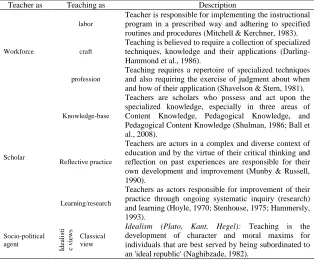
When it comes to evaluation of teachers, the very first question rises at the level of epistemology. In fact, the ways of viewing teachers and teaching envisions what lies behind different methods and theories of teacher evaluation (Darling-Hammond et al., 1986). After a comprehensive review of manuscripts that have tried to describe what and who of teachers, the following five conceptions of teachers are revealed; teacher as workforce, scholar, socio-political agent, artist, and clergy. Table 1 shows the synopsis of the five visions.
Table 1
Synopsis of Conceptions about Teachers
Teacher as Teaching as Description
Workforce
labor
Teacher is responsible for implementing the instructional program in a prescribed way and adhering to specified routines and procedures (Mitchell & Kerchner, 1983).
craft
Teaching is believed to require a collection of specialized techniques, knowledge and their applications (Darling-Hammond et al., 1986).
profession
Teaching requires a repertoire of specialized techniques and also requiring the exercise of judgment about when and how of their application (Shavelson & Stern, 1981).
Scholar
Knowledge-base
Teachers are scholars who possess and act upon the specialized knowledge, especially in three areas of Content Knowledge, Pedagogical Knowledge, and Pedagogical Content Knowledge (Shulman, 1986; Ball et al., 2008).
Reflective practice
Teachers are actors in a complex and diverse context of education and by the virtue of their critical thinking and reflection on past experiences are responsible for their own development and improvement (Munby & Russell, 1990).
Learning/research
Teachers as actors responsible for improvement of their practice through ongoing systematic inquiry (research) and learning (Hoyle, 1970; Stenhouse, 1975; Hammersly, 1993).
Socio-political agent
Id
ea
lis
ti
c v
iew
s
Classical view
Realism (Aristotle, Avicenna, Ibn Tufail): Teaching is the cultivation of nature, habit and reason in youth to produce good and virtuous citizens for society (Naghibzade, 1982).
Democratic view
'Democracy' is the ultimate goal of education and in teaching, is the only method of instruction that is helping to reach a community of self-determined individuals with justice, respect and trust as principal values (Dewy, 1916; Rousseau, 1979).
Critical view
Teachers are agents for change and liberation of the oppressed by means of awareness raising and advocating, and resistance for emancipation and freedom from authoritarian ideologies (Friere, 1970; Giroux, 1988; Shor, 1996).
Islamic view
Teacher is the main character in individual and societal excellence and sublimation in 'Hayat-e-Tayebeh' (i.e., Pure Life) by means of facilitating the revival of 'Islamic norm system' for realization of a unified Muslim community (Al-Kilani, 1998; Motahari, 1961).
N o rm at iv e v iew s Neo-liberal view
Based on principles of free market, teaching is the main factor in development of modern liberal societies by means of competitiveness, accountability, and creation of materialistic value (Carnoy, 2002, 1995).
Progressiv e- democrati c view
In contrast to strict, per ordained delivery of knowledge approach, teaching in its broadest sense is a guide for 'social continuity' of life for individuals through understanding, experiencing, and therefore learning (Kilpatrick, 1951; Dewey, 1916).
Social reconstruc tion view
Teaching is viewed as the platform for reconstruction of identities, a reciprocating change from community to individuals and from individuals to community in the socio-political context of education (Bramled, 1956; Counts, 1934).
Artist Looking at teacher as the creator of novel, exquisite, and exceptional 'learning opportunities' through timely, expressionist, and inspirational learning activities (Gage, 1976).
Clergy Teachers are the sole instructor, agent, and messenger to man and are responsible for cultivating virtues and values such as divine knowledge and wisdom, altruism, excellence, piety, devotedness, so on (Shahid-e-Sani, 1986).
2.2 Theoretical Approaches and Developments
Table 2
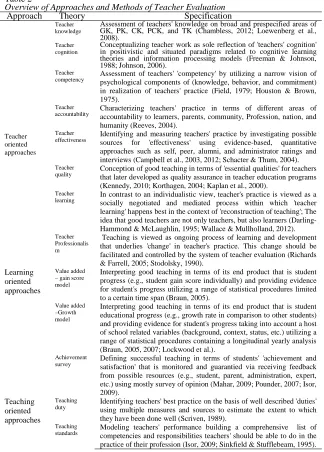
Overview of Approaches and Methods of Teacher Evaluation
Approach Theory Specification
Teacher oriented approaches
Teacher knowledge
Assessment of teachers' knowledge on broad and prespecified areas of GK, PK, CK, PCK, and TK (Chambless, 2012; Loewenberg et al., 2008).
Teacher cognition
Conceptualizing teacher work as sole reflection of 'teachers' cognition' in positivistic and situated paradigms related to cognitive learning theories and information processing models (Freeman & Johnson, 1988; Johnson, 2006).
Teacher
competency Assessment of teachers' 'competency' by utilizing a narrow vision of psychological components of (knowledge, behavior, and commitment)
in realization of teachers' practice (Field, 1979; Houston & Brown, 1975).
Teacher
accountability Characterizing teachers' practice in terms of different areas of accountability to learners, parents, community, Profession, nation, and
humanity (Reeves, 2004).
Teacher
effectiveness Identifying and measuring teachers' practice by investigating possible sources for 'effectiveness' using evidence-based, quantitative
approaches such as self, peer, alumni, and administrator ratings and interviews (Campbell et al., 2003, 2012; Schacter & Thum, 2004).
Teacher
quality Conception of good teaching in terms of 'essential qualities' for teachers that later developed as quality assurance in teacher education programs
(Kennedy, 2010; Korthagen, 2004; Kaplan et al., 2000).
Teacher
learning In contrast to an individualistic view, teacher's practice is viewed as a socially negotiated and mediated process within which 'teacher
learning' happens best in the context of 'reconstruction of teaching'; The idea that good teachers are not only teachers, but also learners (Darling-Hammond & McLaughlin, 1995; Wallace & Mullholland, 2012).
Teacher Professionalis m
Teaching is viewed as ongoing process of learning and development that underlies 'change' in teacher's practice. This change should be facilitated and controlled by the system of teacher evaluation (Richards & Farrell, 2005; Stodolsky, 1990).
Learning oriented approaches
Value added – gain score model
Interpreting good teaching in terms of its end product that is student progress (e.g., student gain score individually) and providing evidence for student's progress utilizing a range of statistical procedures limited to a certain time span (Braun, 2005).
Value added –Growth model
Interpreting good teaching in terms of its end product that is student educational progress (e.g., growth rate in comparison to other students) and providing evidence for student's progress taking into account a host of school related variables (background, context, status, etc.) utilizing a range of statistical procedures containing a longitudinal yearly analysis (Braun, 2005, 2007; Lockwood et al.).
Achievement
survey Defining successful teaching in terms of students' 'achievement and satisfaction' that is monitored and guarantied via receiving feedback
from possible resources (e.g., student, parent, administration, expert, etc.) using mostly survey of opinion (Mahar, 2009; Pounder, 2007; Isor, 2009).
Teaching oriented approaches
Teaching
duty Identifying teachers' best practice on the basis of well described 'duties' using multiple measures and sources to estimate the extent to which
they have been done well (Scriven, 1989).
Teaching
standards Modeling teachers' performance building a comprehensive list of competencies and responsibilities teachers' should be able to do in the
2.3 Toward an Integrated Approach for Local Practice
No doubt that different theories and approaches of teacher evaluation have followed their own ambitions in improvement of teachers' practice, however, all have ended up using rather on an extreme and unrealistic notion of teachers' performance (i.e., effectiveness, quality, accountability, etc.). Although in short run these approaches appeared to be useful, in long run, this has given rise to many concerns regarding practicality, validity, and effectiveness of teacher evaluation programs.
The rationale for integration of approaches came from the fact that local policy makers aligned with international and regional agendas of reform movement in education are making pressing demands on improvement and advancement of teacher education programs. Much in the same way, teacher educators put the pressure on teachers by setting unrealistic and ambitious goals for teachers' learning and development; overlooking the fact that teachers have diverse and different needs for improvement. Notwithstanding that almost all approaches toward assessment of teachers' performance lack extensive and reliable research basis, especially one that successfully links teachers' performance with students' gains and progress. This situation has marked the idea of developing an inquiry based standard framework. An eclectic approach that is all inclusive in terms of theories of good practice, diverse and dynamic in meeting all teachers' needs, is based on observation of the local values and provisions aligned with global policies and perspectives, and more importantly is tailored toward guarantee of students' optimum achievement and progress.
3. Research Questions
2. What are the key parameters (general domains, specific key areas, & specific criteria) of a theory-driven, context-based conceptual model for EFL teachers' practice at threshold of I.R. of Iran?
4. Methodology
Following the qualitative paradigm and in line with the nature of our study, Meta-synthesis approach was adapted. To fully serve the purpose of the study a meta-ethnography (Noblit & Hare, 1988) method was adopted for synthesizing.
4.1 Participants
Based on purposive sampling, participants of the study were; a) Two research assistants: expert in grounded analysis and thematic studies related to language teacher education. b) Group of experts: fifteen teacher education officials active in Iran's language teacher education programs (men & women with minimum of ten years of experience & a related PhD. degree).
4.2 Instrumentation
The instruments used are related to those suitable for meta-synthesis approach. Specifically, a Semantic Differential scale was developed for prioritization of resources to be used in synthesizing, ATLAS.ti software was used for coding and thematic analysis of resources, and a five point Likert scale was used to measure the conceptual validity of criteria in the model.
4.3 Materials
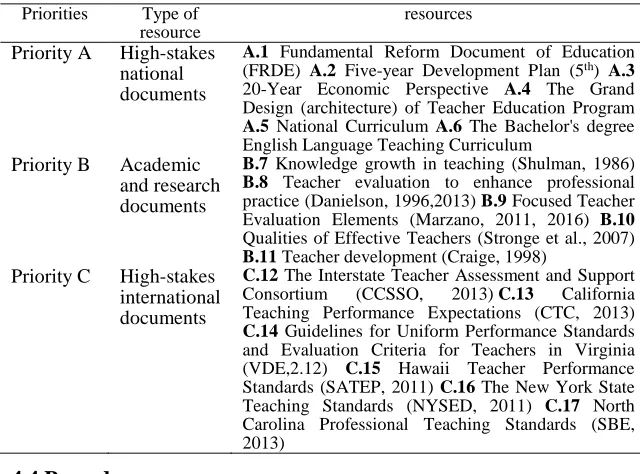
Table 3
Priorities of Selected Resources
Priorities Type of resource
resources
Priority A High-stakes national documents
A.1 Fundamental Reform Document of Education (FRDE) A.2 Five-year Development Plan (5th) A.3
20-Year Economic Perspective A.4 The Grand Design (architecture) of Teacher Education Program A.5 National Curriculum A.6 The Bachelor's degree English Language Teaching Curriculum
Priority B Academic and research documents
B.7 Knowledge growth in teaching (Shulman, 1986) B.8 Teacher evaluation to enhance professional practice (Danielson, 1996,2013) B.9 Focused Teacher Evaluation Elements (Marzano, 2011, 2016) B.10 Qualities of Effective Teachers (Stronge et al., 2007) B.11 Teacher development (Craige, 1998)
Priority C High-stakes international documents
C.12 The Interstate Teacher Assessment and Support Consortium (CCSSO, 2013) C.13 California Teaching Performance Expectations (CTC, 2013) C.14 Guidelines for Uniform Performance Standards and Evaluation Criteria for Teachers in Virginia (VDE,2.12) C.15 Hawaii Teacher Performance Standards (SATEP, 2011) C.16 The New York State Teaching Standards (NYSED, 2011) C.17 North Carolina Professional Teaching Standards (SBE, 2013)
4.4 Procedure
Based on Cooper and Hedges (1988, 1994, 2009, & 2017) seminal work on meta-analysis 'qualitative meta-synthesis' procedures were followed. This approach generally serves the purpose when the phenomenon under question requires a cumulative and exhaustive body of knowledge of separate parts to make a whole; when the created whole is greater than the sum of its parts.
More specifically, the focus was on accumulation and aggregation of major body of knowledge on teacher evaluation with the aim of integration, generalization and conflict resolution of existing models and theories; proposing a context based, theory driven, comprehensive framework for teacher evaluation.
4.3). Next, the data base documents were evaluated for quality of their content in terms of suitability of their insights, methods, and theories relevant to answering research questions.
4.4.2 Step two, Rating: At this stage, the group of experts, rated each document based on a thirteen item check list specifying the criteria and the relevant parts of the document to be included and pooled for analysis.
4.4.3 Step three, Synthesizing: For this stage (i.e., the main stage of analysis), meta-ethnography (Nobilt & Hare, 1988) approach was adopted. The selected parts of the rated documents were converted into rich text format and pooled into ATLAS.ti software for reliability and facilitation of synthesis procedures. Synthesis took place in three stages;
1- Reciprocal translation analysis: Identifying key concepts /themes in each document separately (with the help of free coding strategy). Then, developing the generated codes into 'descriptive themes'.
2- Refutational synthesis: Generating 'analytical themes' that emerge form descriptive themes related to each document. Then, trying to reconcile contradiction and finding patterns of consolidation emerging form all documents holistically.
3- Interpretive synthesis: Developing a general interpretation of phenomena under study in form of a model, theory or concept that is grounded in the free codes and descriptive and analytic themes of all documents.
4.4.4 Step four, reporting: Reporting the result of synthesis.
5. Results of Meta-Synthesis
In order to maintain a clear trail of procedures, synthesis result are reported in three steps: quantitative results of synthesis, qualitative results of generated framework, and judgment validations.
5.1 Quantitative Results of Synthesis
Table 4
Quantity of Codes Retrieved From Selected Resources
Doc. Codes Doc. Codes Doc. Codes Doc. Codes
A1 1560 A6 195 B11 186 C16 153
A2 228 B7 117 C12 267 C17 77
A3 135 B8 354 C13 102
A4 528 B9 282 C14 183
A5 1011 B10 213 C15 702
From the accumulation and analysis of free codes the total 1655 descriptive themes and total of 218 super themes emerged.
5.2 Qualitative Results: A Framework
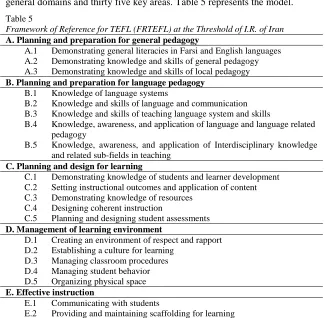
Based on the results of meta-synthesis, this framework is introduced in eight general domains and thirty five key areas. Table 5 represents the model. Table 5
Framework of Reference for TEFL (FRTEFL) at the Threshold of I.R. of Iran A. Planning and preparation for general pedagogy
A.1 Demonstrating general literacies in Farsi and English languages A.2 Demonstrating knowledge and skills of general pedagogy A.3 Demonstrating knowledge and skills of local pedagogy B. Planning and preparation for language pedagogy
B.1 Knowledge of language systems
B.2 Knowledge and skills of language and communication B.3 Knowledge and skills of teaching language system and skills
B.4 Knowledge, awareness, and application of language and language related pedagogy
B.5 Knowledge, awareness, and application of Interdisciplinary knowledge and related sub-fields in teaching
C. Planning and design for learning
C.1 Demonstrating knowledge of students and learner development C.2 Setting instructional outcomes and application of content C.3 Demonstrating knowledge of resources
C.4 Designing coherent instruction
C.5 Planning and designing student assessments D. Management of learning environment
D.1 Creating an environment of respect and rapport D.2 Establishing a culture for learning
D.3 Managing classroom procedures D.4 Managing student behavior D.5 Organizing physical space E. Effective instruction
E.1 Communicating with students
E.3 Using questioning and discussion techniques E.4 Engaging students in learning
E.5 Using assessment in instruction E.6 Instructional delivery
F. Organizational responsibility and professionalism F.1 Reflecting on teaching
F.2 Ensure student progress F.3 Communicating with families F.4 Teacher professional development
F.5 Participating in the professional community F.6 Teachers demonstrate leadership and collaboration G. Sociocultural capital and social agency
G.1 Advocacy for national development and progress G.2 Advocacy for individual development and progress G.3 Development & maintenance of education equality H. Spirituality, morality and theism
H.1 Theological and religious accountability H.2 Promotion of spiritual and moral sublimation
5.3 Conceptual Validity of the Framework
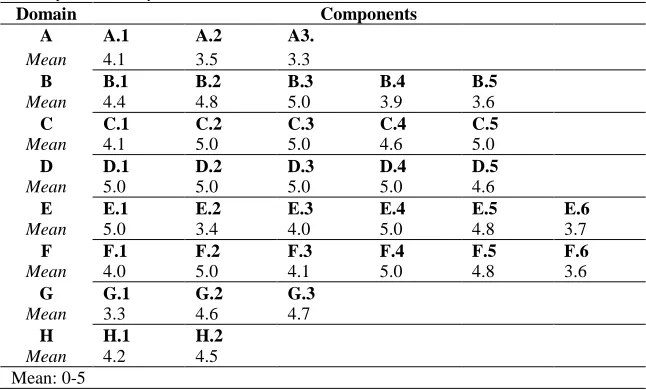
Validity of the proposed framework (FRTEFL) was obtained utilizing experts' judgment. The group of experts rated the validity using a five point Likert scale. Table 6 reveals the details of conceptual validity.
Table 6
Conceptual Validity Means
Domain Components
A A.1 A.2 A3.
Mean 4.1 3.5 3.3
B B.1 B.2 B.3 B.4 B.5
Mean 4.4 4.8 5.0 3.9 3.6
C C.1 C.2 C.3 C.4 C.5
Mean 4.1 5.0 5.0 4.6 5.0
D D.1 D.2 D.3 D.4 D.5
Mean 5.0 5.0 5.0 5.0 4.6
E E.1 E.2 E.3 E.4 E.5 E.6
Mean 5.0 3.4 4.0 5.0 4.8 3.7
F F.1 F.2 F.3 F.4 F.5 F.6
Mean 4.0 5.0 4.1 5.0 4.8 3.6
G G.1 G.2 G.3
Mean 3.3 4.6 4.7
H H.1 H.2
Mean 4.2 4.5
Based on the result of Table 6 all the thirty five key areas passed the threshold of +3.0 and then are validated.
6. Discussion and Conclusions
Following the two great traditions; analytic approach (i.e., standard performance), and holistic approach (i.e., Reflective practice), the framework of reference (FRTEFL) was introduced as an integrative approach toward teacher evaluation. FRTEFL also provides a local model for teachers' practice in line with global standards and policies. Respectively semantic links between FRTEFL and existing standards for teaching can be explored in seven emerging themes:
1- Optimal Learner Development
Learner Development in terms of teachers' performance means the ability of teacher to understand how learners grow and develop, recognize that patterns of learning and development vary individually within and across the cognitive, linguistic, social, emotional, and physical areas, and design and implement developmentally appropriate and challenging learning experiences (FRTEFL, 2017; InTASC, 2013). Furthermore, scholars believe that this quality is a multidisciplinary and cross-disciplinary knowledge that requires not only teachers involvement as the main component but also pertains to other roles and functions research, and the design and production of learning materials, as well as involvement in staff development, policy-making and other consultative activities (Gosling, 2008; Hilson, 2011; Rust et al., 2003). 2- Observing Learning Differences
educational counselors to constantly monitor and suggest innovative ways to ensure observation of learners' profiles, differentiated instruction, learner and teacher accountability systems, multiple sources of measurement for learning as well as student engagement and parental understanding to enable students to follow their own individual paths to lifelong learning and success (Arends, 2014; Harlen & James, 1997; Jarvis & Prker, 2006; Siegelman et al., 2017). 3- Dynamic Learning Environment
The teachers' ability to work with others to create environments that support individual and collaborative learning, and that encourage positive social interaction, active engagement in learning, and self-motivation are prerequisites of a dynamic learning environment (FRTEFL, 2017; InTASC, 2013). This theme is believed to play a major role in and form the context for scaffolding (Greene & Land, 2000; Simons & Klein, 2007). Basically, the learning environment refers to interactive and diverse context and culture in which learning happens. It also encompasses the culture of educational setting (other than classroom) in which individuals interact and encounter to form a social learning space (Abbott et al., 2017; Tam, 2000; Wilson, 1996). 4- Pure and Specialized Content Knowledge
5- Learning Oriented Assessment
The teacher ability to understand and use multiple methods of assessment to engage learners in their own growth and learning, to monitor learner progress, and to guide the teacher's and learner's decision making (FRTEFL, 2017; InTASC, 2013). In this theme the main focus is on student involvement in assessment so that they develop a better understanding of learning goals and engage more actively in learning process (Carless, 2007; Orsmond et al., 2002; Sadler, 1989). Hence, the aim of assessment is on evaluating student achievement, the learning element, and strengthening the learning aspects of assessment.
6- Professional Learning and Ethical Practice
The teacher ability to engage in ongoing professional learning and using evidence to continually evaluate his/her practice, particularly the effects of his/her choices and actions on others (learners, families, other professionals, & the community), and to adapt practices to meet the needs of each learner (FRTEFL, 2017; InTASC, 2013). This theme is viewed as a complex process requiring cognitive, affective, and ethical involvement of teachers in terms of willingness to reflection, enactment of appropriate alternatives, and facilitation of change in own/other practice (Basma & Savage, 2017; Darling-Hammond, 2000; Gamrat et al., 2014; Gusky, 2002). Effectiveness of this factor is a key consideration for teacher learning and refinement of pedagogies and educational change.
7- Leadership and Collaboration
encouragement of other teachers to engage in collaboration, advocacy for policies and visions, implementing collaboration that impacts student learning and professional practice are among the key factors for successful leadership and collaboration of teachers (Bolman & Deal, 1994; Conyers & Wilson, 2015; Crowther, Ferguson & Han, 2009; Harris, 2003; Wenner & Campbell, 2017).
It can also be concluded that this framework is an advancement in comparison to its precedents in the following areas:
1- It is the first teacher evaluation framework embedded in an Islamic education system.
2- The framework derives strong associations with teacher education curriculum.
3- It also provides a comprehensive reference for validation and development of large-scale assessment of teachers' performance.
4- The framework provides a local model for teachers’ practice in line with global standards and policies.
5- It is developed in compliance to the context of Iran's public education policies and practices; what official documents refer to as 'threshold of Islamic Republic of Iran'.
References
Arends, R. I., & Rigazio-DiGilio, A. J. (2000). Beginning teacher induction: research and examples of contemporary practice. Paper presented at the annual meeting of the Japan-United States Teacher Education Consortium (JUSTEC), USA.
Aseltine, J. M., Faryniarz, J. O., & Rigazio-DiGilio, A. J. (2006). Supervision for learning: A performance-based approach to teacher development and school improvement. Alexandria: ASCD.
Berliner, D. C. (2000). A personal response to those who bash teacher education. Journal of Teacher Education, 51(5), 358-371.
Bloom, B. S. (1971). Handbook on formative and summative evaluation of student learning. New York: McGraw-Hill.
Brophy, J. (1999). Teaching. Geneva, Switzerland: International Academy of Education.
Campbell, E. (2000). Professional ethics in teaching: Towards the development of a code of practice. Cambridge Journal of Education, 30(2), 203-221.
Campbell, J., Kyriakides, L., Muijs, D., & Robinson, W. (2012). Assessing teacher effectiveness: Developing different models. London: Routledge Falmer.
Campbell, R., Kyriakides, L., Muijs, R., & Robinson, W. (2003). Differential teacher effectiveness: Towards a model for research and teacher appraisal. Oxford Review of Education, 29(3), 347-362.
Chambless, K. S. (2012). Teachers' oral proficiency in the target language: Research on its role in language teaching and learning. Foreign Language Annals, 45(1), 141-162.
Clarke, D., & Hollingsworth, H. (2002). Elaborating a model of teacher professional growth. Teaching and Teacher Education, 18(8), 947-967. Clotfelter, C. T., Glennie, E. J., Ladd, H. F., & Vigdor, J. L. (2008). Teacher
bonuses and teacher retention in low-performing schools: Evidence from the North Carolina. Public Finance Review, 36(1), 63-87.
Clotfelter, C. T., Ladd, H. F., & Vigdor, J. L. (2010). Teacher credentials and student achievement in high school a cross-subject analysis with student fixed effects. Journal of Human Resources, 45(3), 655-681.
Cochran-Smith, M., Piazza, P., & Power, C. (2013). The politics of accountability: Assessing teacher education in the United States. The Educational Forum, 77(1), 6-27.
Danielson, C. (2011). Enhancing professional practice: A framework for teaching. Virginia: ASCD.
Danielson, C., & McGreal, T. L. (2000). Teacher evaluation to enhance professional practice.Virginia: ASCD.
12(3), 339-347.
Darling-Hammond, L. (1997). Doing what matters most: Investing in quality teaching. New York: National Commission on Teaching & America's Future.
Darling-Hammond, L. (2000). Teacher quality and student achievement. Education Policy Analysis Archives, 8, 1.
Darling-Hammond, L. (2012). Powerful teacher education: Lessons from exemplary programs. New York: John Wiley & Sons.
Darling-Hammond, L., & Bransford, J. (2007). Preparing teachers for a changing world: What teachers should learn and be able to do. New York: John Wiley & Sons.
Darling-Hammond, L., & McLaughlin, M. W. (1995). Policies that support professional development in an era of reform. Phi Delta Kappan, 76(8), 597.
Darling-Hammond, L., & McLaughlin, M. W. (2011). Policies that support professional development in an era of reform. Phi Delta Kappan, 92(6), 81-92.
Field, H. (1979). Competency based teacher education (CBTE): A review of the literature. Journal of In-Service Education, 6(1), 39-42.
Fishman, B. J., Marx, R. W., Best, S., & Tal, R. T. (2003). Linking teacher and student learning to improve professional development in systemic reform. Teaching and Teacher Education, 19(6), 643-658.
Freeman, D., & Johnson, K. E. (1998). Reconceptualizing the knowledge‐base of language teacher education. TESOL Quarterly, 32(3), 397-417.
Freire, P. (1970). Pedagogy of the oppressed, trans. Myra Bergman Ramos. New York: Continuum.
Frost, D., & Durrant, J. (2003). Teacher leadership: Rationale, strategy and impact. School Leadership & Management, 23(2), 173-186.
Guasch, T., Alvarez, I., & Espasa, A. (2010). University teacher competencies in a virtual teaching/learning environment: Analysis of a teacher training experience. Teaching and Teacher Education, 26(2), 199-206.
Hanushek, E. A., Kain, J. F., Rivkin, S. G., & Branch, G. F. (2007). Charter school quality and parental decision making with school choice. Journal of Public Economics, 91(5), 823-848.
Harris, A. (2003). Teacher leadership as distributed leadership: heresy, fantasy or possibility? School Leadership & Management, 23(3), 313-324.
Hattie, J. (2008). Visible learning: A synthesis of over 800 meta-analyses relating to achievement. London: Routledge.
Houston, W. R., & Brown, K. W. (1975). Competency-Based Education: Past, Present and Future. Journal of Industrial Teacher Education. Ingvarson, L., Schwille, J., Tatto, Teresa, M., Rowley, G., Peck, R., & Senk,
S. L. (2013). An analysis of teacher education context, structure, and quality-assurance arrangements in TEDS-M countries. Amsterdam: MultiCopy Netherlands.
Johnson, K. E. (2006). The sociocultural turn and its challenges for second language teacher education. TESOL Quarterly, 40(1), 235-257.
Kaplan, L. S., & Owings, W. A. (2001). Teacher quality and student achievement: Recommendations for principals. NASSP Bulletin, 85(628), 64-73.
Kennedy, M. (2010). Approaches to annual performance assessment. Teacher assessment and the quest for teacher quality: A handbook. San Francisco: Jossey-Bass.
Kerchner, C. T., & Mitchell, D. E. (1983). Unionization and the shaping of teacher work. Teacher Education Quarterly, 10(4), 71-88.
Ladson-Billings, G., & Darling-Hammond, L. (2000). The Validity of Assessments for Effective Urban Teachers: Findings and Implications for Assessments. National Board for Professional Teaching Standards (NBPTS)/Interstate New Teacher Assessment and Support Consortium (INTASC).
Lieberman, A. (1995). Practices that support teacher development. Phi Delta Kappan, 76(8), 591.
Lockwood, J., McCaffrey, D. F., Hamilton, L. S., Stecher, B., Le, V. N., & Martinez, J. F. (2007). The sensitivity of value‐added teacher effect estimates to different mathematics achievement measures. Journal of Educational Measurement, 44(1), 47-67.
Lokan, J., & McKenzie, P. (1989). Teacher appraisal: Issues and approaches (ACER Report 53). Retrieved from Monash University, Australian Council for Educational Research website: http://works.bepress.com/phil_mckenzie/115/
Mathers, C., & Oliva, M. (2008). Improving instruction through effective teacher evaluation: Options for states and districts. TQ Research & policy brief (RNCCTQ Report ED520778). Retrieved from http://files.eric.ed.gov/fulltext/ED520778.pdf
Michael, J., Cliff, W., McFarland, J., Modell, H., & Wright, A. (2017). Conceptual assessment of student learning. Advances in Physiology Education, 33(1), 10-16.
Noblit, G. W., & Hare, R. D. (1988). Meta-ethnography: Synthesizing qualitative studies. London: Sage Publications.
Parkay, F. W., Stanford, B. H., & Gougeon, T. D. (2010). Becoming a teacher. London: Pearson & Merrill.
Pounder, J. S. (2007). Is student evaluation of teaching worthwhile? An analytical framework for answering the question. Quality Assurance in Education, 15(2), 178-191.
Psyccritiques, 38(9), 1000-1001.
Reeves, D. B. (2004). Accountability for learning: How teachers and school leaders can take charge. Virginia: ASCD.
Rosenthal, R. (1991). Meta-analytic procedures for social research. London: Sage Publications.
Rousseau, J.-J. (1979). On education. Allan Bloom. New York: Basic Books. Sanders, W. L., & Horn, S. P. (1994). The Tennessee value-added assessment system (TVAAS): Mixed-model methodology in educational assessment. Journal of Personnel Evaluation in education, 8(3), 299-311.
Sanders, W. L., Wright, S. P., & Horn, S. P. (1997). Teacher and classroom context effects on student achievement: Implications for teacher evaluation. Journal of Personnel Evaluation in Education, 11(1), 57-67. Scriven, M. (1989). The state of the art in teacher evaluation. In J. Lokan &
P. H. McKenzie (Eds.), Teacher Appraisal Issues and Approaches. Retrieved from http://works.bepress.com/phil_mckenzie/115/
Shinkfield, A. J., & Stufflebeam, D. L. (1995). School Professionals' Guide to Improving Teacher Evaluation Systems. Teacher Evaluation. In
Madaus
, G.F & Stufflebeam, D. L. (Eds.), Evaluation in education and human services. New York: Kluwer Academic Publishers.Shinkfield, A. J., & Stufflebeam, D. L. (2012). Teacher evaluation: Guide to effective practice. New York: Kluwer Academic Publishers.
Shulman, L. (1987). Knowledge and teaching: Foundations of the new reform. Harvard Educational Review, 57(1), 1-23.
Shulman, L. S. (1986). Paradigms and research programs in the study of teaching: A contemporary perspective. In L. S.
Shulman
& M.C. Wittrock. Handbook of research on teaching. New York: Macmillan. Shulman, L. S. (1986). Those who understand: Knowledge growth inteaching. Educational Researcher, 15(2), 4-14.
Stodolsky, S. S. (1990). Classroom observation. In Millman, J. & Darling-Hammond, L. The new handbook of teacher evaluation: Assessing elementary and secondary school teachers. California: Corwin Press, Inc. Stufflebeam, D. L., & Shinkfield, A. J. (2012). Systematic evaluation: A self-instructional guide to theory and practice. Boston: Kluwer-Nijhoff Publishing.
Tamblyn, P. (2000). Qualities of success: Lessons from a teaching career. Education Canada, 40(1), 16-19.
Tucker, P. D., & Stronge, J. H. (2005). Linking teacher evaluation and student learning. Virginia: ASCD.
Van Driel, J. H., & Berry, A. (2012). Teacher professional development: Focusing on pedagogical content knowledge. Educational Researcher, 41(1), 26-28.
Wallace, J., Mulholland, J., (2012). A multi-metaphorical model for teacher knowledge and teacher learning. In Kooy, M., & Veen, K. (Eds.). Teacher learning that matters: International perspectives. London: Routledge. Wenden, A. L. (2002). Learner development in language learning. Applied