Characteristics
and Needs
of Children with Disruptive
Behavior Disorders and
Their Families
Interventions
for Disruptive
Behavior
Characteristics
and Needs
of Children with Disruptive
Behavior Disorders and
Their Families
Interventions
for Disruptive
Behavior
Acknowledgments
This document was produced for the Substance Abuse and Mental Health Services Administration (SAMHSA) by Abt Associates, Inc., and the National Association of State Mental Health Program Directors (NASMHPD) Research Institute (NRI) under contract number 280‑2003‑00029 with SAMHSA, U.S. Department of Health and Human Services (HHS). Sylvia Fisher and Pamela Fischer, Ph.D., served as the Government Project Officers.
Disclaimer
The views, opinions, and content of this publication are those of the authors and contributors and do not necessarily reflect the views, opinions, or policies of the Center for Mental Health Services (CMHS), SAMHSA, or HHS.
Public Domain Notice
All material appearing in this document is in the public domain and may be reproduced or copied without permission from SAMHSA. Citation of the source is appreciated. However, this publication may not be reproduced or distributed for a fee without the specific, written authorization from the Office of Communications, SAMHSA, HHS.
Electronic Access and Copies of Publication
This publication may be downloaded or ordered at http://store.samhsa.gov. Or, please call SAMHSA’s Health Information Network at 1-877-SAMHSA-7 (1‑877‑726‑4727) (English and Español).
Recommended Citation
Substance Abuse and Mental Health Services Administration. Interventions for Disruptive Behavior Disorders: Characteristics and Needs of Children with Disruptive Behavior Disorders and Their Families. HHS Pub. No. SMA‑11‑4634, Rockville, MD: Center for Mental Health Services, Substance Abuse and Mental Health Services Administration, U.S. Department of Health and Human Services, 2011.
Originating Office
Characteristics and Needs of Children
with Disruptive Behavior Disorders
and Their Families
This booklet addresses the first step in selecting evidence‑based practices: understanding the population of interest. It identifies risk factors, protective factors, behavioral manifestations across three developmental stages, diagnostic criteria, co‑occurring conditions, and the course of these disorders.
Interventions
for Disruptive
Behavior
This KIT is part of a series of Evidence‑Based Practices KITs created by the Center for Mental Health Services, Substance Abuse and Mental Health Services Administration, U.S. Department of Health and Human Services.
This booklet is part of the Interventions for Disruptive Behavior Disorders KIT, which includes six booklets:
How to Use the Evidence-Based Practices KITs
Characteristics and Needs of Children with Disruptive Behavior Disorders and their Families
Selecting Evidence-Based Practices for Children with Disruptive Behavior Disorders to Address Unmet Needs: Factors to Consider in Decisionmaking
Implementation Considerations
Evidence-Based and Promising Practices
What’s in Characteristics and Needs
of Children with Disruptive Behavior
Disorders and Their Families
Introduction ... 1
Risk Factors ... 2
Protective Factors ... 2
Behavioral Manifestations of Risk Factors by Developmental Stage ... 2
Diagnostic Criteria ... 3
Prevalence of Condition ... 4
Co‑Occurring Conditions ... 4
Course of Condition ... 4
References ... 5
Interventions
for Disruptive
Behavior
Introduction
This KIT focuses on evidence-based interventions for children and adolescents with disruptive behavior disorders, specifically, Oppositional Defiant Disorder (ODD) and Conduct Disorder (CD). These diagnostic categories basically mean that a child’s or adolescent’s behavior is causing trouble at home, at school, or in the community. Such behavior may first appear in any of three developmental stages: early childhood, school age, or adolescence.
These behavioral problems have historically been considered difficult to treat effectively, and many professionals have been pessimistic about the
Characteristics and Needs
effectiveness of usual care—normally, individual therapy. Previously, access to interventions with an evidence base was limited, but such interventions are now becoming more widely available.
The opportunity to intervene early is now feasible with new treatments that have been developed and tested for all three developmental stages.
Characteristics and Needs of Children with Disruptive Behavior Disorders and Their Families identifies risk factors, protective factors, behavioral manifestations across three
Risk Factors
Considerable research has identified family, neighborhood, school, and societal factors that may place a youth at risk for long-term negative outcomes. Although these factors do not fully explain why disruptive behavior emerges in a child, they may point to areas for intervention (Walker and Sprague, 1999). See Table 1.
Table 1: Risk Factors
n Poverty
n Abuse and neglect
n Harsh and inconsistent parenting
n Drug and alcohol use by caregivers
n Emotional and physical or sexual abuse
n Modeling of aggression
n Media violence
n Negative attitude toward school
n Family transitions (death or divorce)
n Parent criminality
Protective Factors
A report from the Surgeon General (2001) outlined protective factors that may buffer or lower the risks of antisocial behavior or general delinquency. See Table 2.
Table 2: Protective Factors Individual domain
n High IQ
n Being born female
n A positive social orientation
Family domain
n A warm supportive relationship with parents or older adults
n Parental monitoring or supervision activities
School domain
n Extracurricular activities
Behavioral Manifestations
of Risk Factors by
Developmental Stage
Risk factors may result in behavioral difficulties, which increase in severity as a child ages. See Table 3.
Table 3: Behavioral Manifestations of Risk Factors by Developmental Stage Early on, such behaviors include the following (Walker and Sprague, 1999):
n Defiance of adults
n Lack of school readiness
n Coercive interactive styles
(for example, threatening, manipulation)
n Aggression toward peers
n Lack of problem‑solving skills
Behavior that is more problematic is observed in elementary and early secondary school age youth (Walker and Sprague, 1999):
n Truancy
n Peer and teacher rejection
n Low academic achievement
n High number of school discipline referrals
n Large number of different schools attended
n Early involvement with drugs and alcohol
n Early age of first arrest (under 12 years)
By adolescence and early adulthood, long-term and severe consequences include the following (Walker and Sprague, 1999):
n School failure and dropout
n Delinquency
n Drug and alcohol use
n Gang membership
n Violent acts
n Adult criminality
n Lifelong dependence on welfare system
Diagnostic Criteria
Children who show the types of behavior identified on this page and who are brought into the mental health system are likely to be evaluated and identified as meeting criteria for a diagnosis
of Oppositional Defiant Disorder or, less
frequently, the more severe disorder of Conduct Disorder. These disorders are found in the
Diagnostic and Statistical Manual of Mental Disorders (DSM-IV) (2000). See Table 4.
Table 4: DSM Diagnostic Criteria for Oppositional Defiant Disorder and Conduct Disorder 313.81 Oppositional Defiant Disorder
A. A pattern of negativistic, hostile, and defiant behavior lasting at least 6 months, during which four (or more) of the following are present: 1. Often loses temper
2. Often argues with adults
3. Often actively defies or refuses to comply with adults’ requests or rules 4. Often deliberately annoys people
5. Often blames others for his or her mistakes or misbehaviors 6. Is often touchy or easily annoyed by others
7. Is often angry and resentful 8. Is often spiteful or vindictive
Note: Consider a criterion met only if the behavior occurs more frequently than is typically observed in individuals of comparable age and developmental level.
B. The disturbance in behavior causes significant clinical impairment in social, academic, or occupational functioning.
C. The behaviors do not occur exclusively during the course of a Psychotic or Mood Disorder.
D. Criteria are not met for Conduct Disorder.
312.8 Conduct Disorder
A. A repetitive and persistent pattern of behavior in which the basic rights of others or major age‑appropriate societal norms or rules are violated, as manifested by the presence of three (or more) of the following criteria in the past 12 months, with at least one criterion present in the past 6 months.
Aggression to people and animals 1. Often bullies, threatens, or intimidates others 2. Often initiates physical fights
3. Has used a weapon that can cause serious physical harm to others (for example, a bat, brick, broken bottle, knife, gun) 4. Has been physically cruel to people
5. Has been physically cruel to animals
6. Has stolen while confronting a victim (for example, mugging, purse snatching, extortion, armed robbery) 7. Has forced someone into sexual activity
Destruction of property
1. Has deliberately engaged in fire setting with the intention of causing serious damage 2. Has deliberately destroyed others’ property (other than by fire setting)
Deceitfulness or theft
1. Has broken into someone else’s house, building, or car
2. Often lies to obtain goods or favors or avoid obligations (that is, “cons” others)
3. Has stolen items of nontrivial value without confronting a victim (for example, shoplifting, but without breaking and entering; forgery)
Serious violations of rules
1. Often stays out at night despite parental prohibitions, beginning before age 13 years
2. Has run away from home overnight at least twice while living in parental or parental surrogate home (or once without returning for a lengthy period) 3. Often truant from school, beginning before age 13 years
Prevalence of Condition
Both ODD and CD occur fairly frequently among children and represent a large proportion of the youth seeking mental health services. It is estimated that ODD occurs in 2 percent to 16 percent of youth, depending on the population being examined and the method of diagnosis (for example, measured in research as opposed to existing clinical diagnosis).
For conduct disorder, which is more common in younger boys, the rates range from 6 percent to 9 percent.
Co-Occurring Conditions
Youth with either ODD or CD may also experience other emotional or behavioral conditions. Most common are the following:
n Attention-deficit/hyperactivity and trauma symptoms in younger children;
n Anxiety and depressive disorders in children of school age; and
n Substance abuse among children in early adolescence.
A comprehensive assessment is indicated for youth presenting serious behavioral problems and, as is appropriate, clinical treatments for conditions that co-occur with ODD and CD.
Course of Condition
Both ODD and CD are likely to become evident at a young age, before a child is 8 years old for ODD and as early as 5 to 6 years old for CD.
Early onset of CD is likely to result in more serious long-term consequences than onset in adolescence which is rare (after 16 years of age). Early
Characteristics and Needs
References
American Psychiatric Association. (2000). Diagnostic and statistical manual of mental disorders (4th ed., text rev.). Washington, DC: American Psychiatric Association.
U.S. Department of Health and Human Services. (2001). Youth violence: A report of the Surgeon General. Rockville, MD: Author. Retrieved from
http://www.surgeongeneral.gov/library/ youthviolence/default.htm
Evidence-Based
and Promising
Practices
Interventions
for Disruptive
Behavior
Evidence-Based
and Promising
Practices
Interventions
for Disruptive
Behavior
Acknowledgments
This document was produced for the Substance Abuse and Mental Health Services Administration (SAMHSA) by Abt Associates, Inc., and the National Association of State Mental Health Program Directors (NASMHPD) Research Institute (NRI) under contract number 280-2003-00029 with SAMHSA, U.S. Department of Health and Human Services (HHS). Sylvia Fisher and Pamela Fischer, Ph.D., served as the Government Project Officers.
Disclaimer
The views, opinions, and content of this publication are those of the authors and contributors and do not necessarily reflect the views, opinions, or policies of the Center for Mental Health Services (CMHS), SAMHSA, or HHS.
Public Domain Notice
All material appearing in this document is in the public domain and may be reproduced or copied without permission from SAMHSA. Citation of the source is appreciated. However, this publication may not be reproduced or distributed for a fee without the specific, written authorization from the Office of Communications, SAMHSA, HHS.
Electronic Access and Copies of Publication
This publication may be downloaded or ordered at http://store.samhsa.gov. Or, please call SAMHSA’s Health Information Network at 1-877-SAMHSA-7 (1-877-726-4727) (English and Español).
Recommended Citation
Substance Abuse and Mental Health Services Administration. Interventions for Disruptive Behavior Disorders: Evidence-Based and Promising Practices. HHS Pub. No. SMA-11-4634, Rockville, MD: Center for Mental Health Services, Substance Abuse and Mental Health Services Administration, U.S. Department of Health and Human Services, 2011.
Originating Office
Evidence-Based and Promising Practices
This booklet provides indepth information about each intervention to help stakeholders identify and select evidence-based practices (EBPs) that might best fit the needs and preferences of communities, providers, practitioners, families, and youth.
Interventions
for Disruptive
Behavior
This KIT is part of a series of Evidence-Based Practices KITs created by the Center for Mental Health Services, Substance Abuse and Mental Health Services Administration, U.S. Department of Health and Human Services.
This booklet is part of the Interventions for Disruptive Behavior Disorders KIT, which includes six booklets:
How to Use the Evidence-Based Practices KITs
Characteristics and Needs of Children with Disruptive Behavior Disorders and their Families
Selecting Evidence-Based Practices for Children with Disruptive Behavior Disorders to Address Unmet Needs: Factors to Consider in Decisionmaking
Implementation Considerations
Evidence-Based and Promising Practices
What’s in Evidence-Based Practice
and Promising Practices
Introduction ... 1 Triple P – Positive Parenting Program ... 3 Project ACHIEVE ... 11 Second Step ... 19 Promoting Alternative Thinking Strategies ... 25 First Steps to Success... 31 Early Risers: Skills for Success ... 37 Adolescent Transitions Program ... 43 Incredible Years ... 49 Helping the Noncompliant Child ... 55 Parent-Child Interaction Therapy ... 61 Parent Management Training — Oregon ... 67 Brief Strategic Family Therapy ... 73 Problem-Solving Skills Training ... 79 Coping Power... 83 Mentoring ... 89 Multisystemic Therapy ... 95 Functional Family Therapy ... 107 Multidimensional Treatment Foster Care ... 113
Interventions
for Disruptive
Behavior
Evidence-Based
and Promising Practices
Introduction
In Selecting Evidence-Based Practices for Children with Disruptive Behavior Disorders to Address Unmet Needs: Factors to Consider in Decisionmaking in this KIT, several tables summarize information about some of the main features of the KIT’s 18 EBPs. This booklet has indepth information about each intervention to help stakeholders identify and select EBPs that might best fit the needs and preferences of communities, providers, practitioners, families, and youth.
18 Evidence-Based Practices Summarized in This Booklet Prevention / Multilevel Intervention
Triple P—Positive Parenting Program Project ACHIEVE
Second Step
Promoting Alternative Thinking Strategies First Steps to Success
Early Risers: Skills for Success Adolescent Transitions Program
Incredible Years
Helping the Noncompliant Child Parent Child Interaction Therapy Parent Management Training — Oregon Brief Strategic Family Therapy™ Problem-Solving Skills Training Coping Power
Mentoring
Multisystemic Therapy Functional Family Therapy
The interventions are each presented in the same format with the following information, when applicable:
Intervention Description
Background
Characteristics of the intervention Research Base and Outcomes Implementation and Dissemination
Infrastructure issues
Training/coaching and materials Cost of training/consulting Developer involvement
Monitoring fidelity and outcomes Financing the intervention Resources/Links
References
The Intervention Description covers background information about the origin of the intervention, the developers, the population of interest, and essential characteristics of the intervention.
A key part of Research Base and Outcomes for each EBP is a summary table that allows for quick access to information about the researchers, the design, and outcomes. These tables include important information from relevant studies, and culturally and linguistically relevant information from the research studies is highlighted. For most interventions, this means that the populations used in the studies have been noted. For some, this means that research on cultural and linguistic adaptations of the intervention has been included. For example, the booklet notes that a culturally adapted version of Parent Management Training— Oregon is being evaluated with Spanish-speaking Latino parents and is called Nuestras Familias.
Implementation and Dissemination covers such topics as: infrastructure issues, training/coaching and materials, the cost of training/consultations, current developer involvement and contact information, the monitoring of fidelity and
outcomes, and means of financing the intervention. This information was obtained in large part
through telephone interviews with the developers of the EBPs and was then verified through edits and review.
Intervention Description
Background
Triple P — Positive Parenting Program is a multi-level system of parenting and family support programs that apply to prevention, early intervention, and treatment. Triple P was developed by Matthew R. Sanders, Ph.D., and colleagues from the Parenting and Family Support Centre in the School of Psychology, University of Queensland in Australia.
During the past few years, Triple P has been disseminated to approximately 25 organizations within the United States and to 15 countries. Dissemination has been carried out as follows:
Statewide in Wyoming as the centerpiece of the Wyoming Parenting Initiative (more than 500 practitioners trained to date).
In 18 counties in South Carolina through the U.S. Triple P System Population Trial. Funded by the Centers for Disease Control and Prevention, this trial is being conducted by the University of South Carolina and the University of Queensland.
At the Children’s Medical Center of Akron, Ohio, and other parts of Ohio.
Through organizations in California, Delaware, Florida, Georgia, Missouri, and Pennsylvania. In 14 countries in North America, Europe, and the Asia-Pacific region, where Triple P
International is disseminated.
Figure 1
Triple P – Positive Parenting Program Type of EBP Prevention/Multilevel Setting Clinic
Home School
Age 0–16
Gender Males Females Training/Materials
Available
Yes
Outcomes Increase in parental confidence Improvements in dysfunctional
parenting styles
Reduction in child behavior problems
Characteristics of the intervention
Triple P aims to prevent or reduce severe behavioral, emotional, and developmental
problems in children by enhancing the knowledge, skills, and confidence of parents. It is designed for families with children from birth to 16 years of age. Triple P can be delivered by a range of specialists in the field of primary care (for example, nurses, physicians), mental health (for example, social workers, psychologists, counselors), and education (for example, family/parent liaisons, day care administrators, school counselors).
It has been translated into 10 languages, most recently Spanish. Adaptations can be made for different cultural groups by using examples specific to the culture of a group.
Triple P offers five different levels of service that increase in intensity as child and family needs increase (Sanders, Markie-Dodds, & Turner, 2003):
Level 1
Level 1 is a universal prevention approach and is intended for all parents interested in information about their child’s development. Level 1 is intended to support communities that have already begun to implement the other levels of Triple P. Strategies include the following:
Media resources (newspaper-, radio-, or television-disseminated community service announcements);
Self-directed information resources (parenting tip sheets and videos) with information about how to solve developmental and minor behavior problems;
Group presentations; and
Telephone referral services.
Level 2
Level 2 is a brief selective intervention aimed at parents with specific concerns about their child’s behavior and development. Services include advice for specific child behavior problems and may be self-directed or involve telephone or face-to-face interaction with a clinician or participation in group sessions.
Level 2 usually consists of one or two 20-minute sessions. The settings can be maternal and child health services, physician practices, daycare centers, or schools. Practitioners who deliver the intervention are parent-support staff in their respective settings.
Level 3
Level 3 is a more narrowly focused intervention designed for parents with specific concerns about their child’s behavior and development that require consultations or active parent-skills training. Services include one to four brief intervention sessions combining advice, rehearsal, and self-evaluation to learn how to manage specific behavior problems (for example, toilet training, tantrums, and sleep disturbances). The settings and practitioners are the same as in Level 2.
Level 4
Level 5
Level 5 is the Enhanced Triple P and is an intensive, individually tailored intervention for families that have children with behavior problems and other family stressors (for example, parent depression, partner conflict). Services include the following:
Active parenting-skills training;
Home visits;
Mood management;
Stress coping skills; and
Partner support skills.
Services may involve self-directed strategies, telephone or face-to-face meetings with a clinician, or group sessions. Practitioners are mental health, child welfare, or other health care professionals.
Modified levels are also available to meet the developmental needs of the children and parents, such as a self-directed workbook for parents.
Research Base and Outcomes
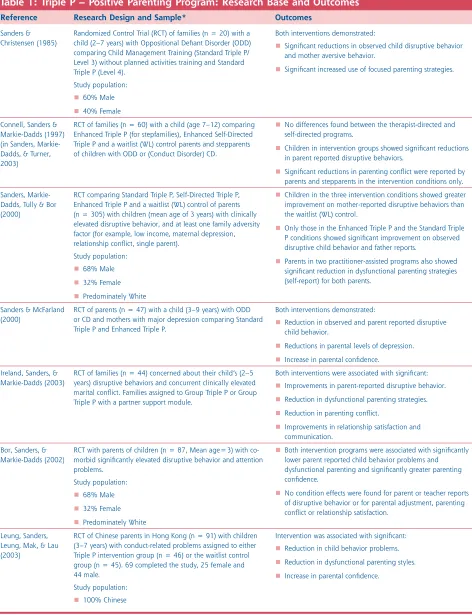
Triple P has a strong research base that includes multiple studies and evaluations dating back to 1977. The research assesses the effectiveness of various levels of Triple P for children from infancy to 16 years of age.
Research designs include 29 randomized clinical trials (RCT), 11 controlled single-subject
Table 1: Triple P – Positive Parenting Program: Research Base and Outcomes Reference Research Design and Sample* Outcomes
Sanders & Christensen (1985)
Randomized Control Trial (RCT) of families (n = 20) with a child (2–7 years) with Oppositional Defiant Disorder (ODD) comparing Child Management Training (Standard Triple P/ Level 3) without planned activities training and Standard Triple P (Level 4).
Study population: 60% Male 40% Female
Both interventions demonstrated:
Significant reductions in observed child disruptive behavior and mother aversive behavior.
Significant increased use of focused parenting strategies.
Connell, Sanders & Markie-Dadds (1997) (in Sanders, Markie-Dadds, & Turner, 2003)
RCT of families (n = 60) with a child (age 7–12) comparing Enhanced Triple P (for stepfamilies), Enhanced Self-Directed Triple P and a waitlist (WL) control parents and stepparents of children with ODD or (Conduct Disorder) CD.
No differences found between the therapist-directed and self-directed programs.
Children in intervention groups showed significant reductions in parent reported disruptive behaviors.
Significant reductions in parenting conflict were reported by parents and stepparents in the intervention conditions only. Sanders,
Markie-Dadds, Tully & Bor (2000)
RCT comparing Standard Triple P, Self-Directed Triple P, Enhanced Triple P and a waitlist (WL) control of parents (n = 305) with children (mean age of 3 years) with clinically elevated disruptive behavior, and at least one family adversity factor (for example, low income, maternal depression, relationship conflict, single parent).
Study population: 68% Male 32% Female Predominately White
Children in the three intervention conditions showed greater improvement on mother-reported disruptive behaviors than the waitlist (WL) control.
Only those in the Enhanced Triple P and the Standard Triple P conditions showed significant improvement on observed disruptive child behavior and father reports.
Parents in two practitioner-assisted programs also showed significant reduction in dysfunctional parenting strategies (self-report) for both parents.
Sanders & McFarland (2000)
RCT of parents (n = 47) with a child (3–9 years) with ODD or CD and mothers with major depression comparing Standard Triple P and Enhanced Triple P.
Both interventions demonstrated:
Reduction in observed and parent reported disruptive child behavior.
Reductions in parental levels of depression. Increase in parental confidence.
Ireland, Sanders, & Markie-Dadds (2003)
RCT of families (n = 44) concerned about their child’s (2–5 years) disruptive behaviors and concurrent clinically elevated marital conflict. Families assigned to Group Triple P or Group Triple P with a partner support module.
Both interventions were associated with significant: Improvements in parent-reported disruptive behavior. Reduction in dysfunctional parenting strategies. Reduction in parenting conflict.
Improvements in relationship satisfaction and communication.
Bor, Sanders, & Markie-Dadds (2002)
RCT with parents of children (n = 87, Mean age=3) with co-morbid significantly elevated disruptive behavior and attention problems.
Study population: 68% Male 32% Female Predominately White
Both intervention programs were associated with significantly lower parent reported child behavior problems and dysfunctional parenting and significantly greater parenting confidence.
No condition effects were found for parent or teacher reports of disruptive behavior or for parental adjustment, parenting conflict or relationship satisfaction.
Leung, Sanders, Leung, Mak, & Lau (2003)
RCT of Chinese parents in Hong Kong (n = 91) with children (3–7 years) with conduct-related problems assigned to either Triple P intervention group (n = 46) or the waitlist control group (n = 45). 69 completed the study, 25 female and 44 male.
Implementation and Dissemination
Infrastructure issues
Readiness
Triple P America does not have specific readiness assessments, but relies instead on initial information-gathering conversations with sites to clarify their needs and determine how Triple P interventions might address these needs.
Stakeholder buy-in:
The intervention focuses on five developmental periods from infancy to adolescence. Within each period, the reach of the intervention can vary from being very broad (focusing on an entire population) to quite narrow (focusing only on high-risk children). Stakeholders must buy into the approach of specifying developmental periods.
It is important to have buy-in of managers, supervisors, families and family advocacy groups, and executive level decisionmakers that control funds.
Triple P should be integrated into a community or organization’s strategic plan.
Possible barriers:
A specific barrier to successful implementation occurs when the agency or staff do not work with families at times that are convenient for families. This potential barrier is not specific to Triple P but rather to any parenting or family intervention.
Training/coaching and materials
The level of the Triple P intervention that is implemented and the setting determines the preservice level of training. For Levels 2 and 3 (described previously) paraprofessionals that consult with families around parenting are eligible for training, whereas Levels 4 and 5 require more clinically trained professionals.
Training consists of two onsite visits of 2 to 3 days each in which intensive training is followed by practice and competency demonstrations. There are 8 to 10 weeks between the first and second onsite training visits. The training methods include didactic presentation, self-study with practitioner manuals, videos, active practice and discussion in small groups, and roleplaying. People who successfully complete the training become accredited Triple P providers.
All of the training is delivered by Triple P America. No established structure exists for training trainers. To deal with staff turnover, agencies may send staff to other sites where training is being held and pay for the individual training slots used.
Manuals, facilitator kits, and training are available through the Triple P Institute.
The Triple P Web site is easy to navigate and offers a detailed explanation about the intervention and cost involved (http://www.triplep-america.com).
For information about accessing training, contact Dr. Ron Prinz.
Cost of training/consulting
According to Triple P America, the most cost- efficient way of implementing the Standard Triple P (Level 4) is to train a group of 20 practitioners. The cost for training a group this size is $21,000, which includes two training visits involving 3 days for the first visit and 2 days (10 practitioners per day) for the second visit. This amount also covers the practitioner manuals, a practitioner kit, and a video for parents, as well as all of the trainer’s travel costs.
For small organizations that do not have 20 staff members, an alternative is to develop collaborative training with other agencies.
Triple P America does not encourage long-term or intensive ongoing consultation. Consultation services are available on a contractual basis.
Additional costs must be considered for the self-directed parenting resource materials. In addition, at higher levels of Triple P, there will be a cost for covering home visits if these are required at the level being implemented.
Developer involvement
Triple P America is the primary disseminator of Triple P in the United States.
Triple P America’s trainer staffing pattern is flexible. It can usually expand its capacity to accommodate new sites.
The goal of Triple P America is for sites to become independent through their initial training and consultation, through the quality of their materials and Web site, and by using a self-regulatory framework in peer support networks and supervision.
For ongoing implementation, Triple P attempts to meet sites’ needs through telephone, email, or site visits when needed, but they do not encourage long-term dependence.
Monitoring fidelity and outcomes
Fidelity checklists are included in the manuals for every level of the Triple P intervention. These checklists facilitate self and supervisor tracking of intervention implementation and fidelity.
Triple P does not have any requirements related to ongoing fidelity monitoring. It is the responsibility of each organization to ensure fidelity and to measure outcomes. However, every Triple P manual has designated measurement instruments that are suitable for outcome measurement.
Financing the intervention
Resources/Links
Triple P-America Web site:
http://www.triplep-america.com.
References
Bor, W., Sanders, M. R., & Markie-Dadds, C. (2002). The effects of Triple P–Positive Parenting Program on preschool children with co-occurring disruptive behavior and attentional/ hyperactive difficulties. Journal of Abnormal Child Psychology, 30, 571–587.
Connell, S., Sanders, M. R. & Markie-Dadds, C. (1997). Self-directed behavioral
family-intervention for parents of oppositional children in rural and remote areas. Behavioral
Modification, 21(4), 379–408.
Ireland, J. L., Sanders, M. R. & Markie-Dadds, C. (2003). The impact of parent training on marital functioning: A comparison of two group versions of the Triple P–Positive Parenting Program for parents of children with early-onset conduct problems. Behavioural and Cognitive
Psychotherapy, 31, 127–142.
Leung, C., Sanders, M., Leung, S., Mak, R., & Lau, J. (2003). An outcome evaluation of the implementation of Triple P–Positive Parenting Program in Hong Kong. Family Process, 42(4), 531–544.
R. Prinz (personal communication, March 22, 2006).
Sanders, M. R. & Christiansen, A. P. (1985). A comparison of the effects of child management and planned activities in five parenting
environments. Journal of Abnormal Child Psychology, 13, 101–117.
Sanders, M. R., Markie-Dadds, C., & Turner, K. M. T. (2003). Theoretical, scientific, and clinical foundations of the Triple-P Positive Parenting Program: A population approach to the
promotion of parenting competence. Parenting Research and Practice Monograph, 1, 1–24.
Sanders, M. R., & McFarland, M. (2000).
Project ACHIEVE
Intervention Description
Background
Project ACHIEVE is a universal, school-based intervention that applies to many educational settings. Howard M. Knoff, Ph.D., developed Project ACHIEVE and is its director. He also works as the director of the federally funded State Improvement Grant for the Arkansas Department of Education’s Special Education Unit in Little Rock, Arkansas.
Project ACHIEVE training has been conducted in more than 1,500 schools and districts in 40 states since its inception in 1990.
Characteristics of the intervention
Project ACHIEVE is a comprehensive school-based prevention program that focuses on several different areas, including academic engagement and achievement, positive behavioral support systems, school safety, and parent and community involvement. It was designed for use in preschools and elementary and middle schools for children 3 to 14 years of age, and has been implemented in alternative schools, charter schools, self-contained special education facilities, and select high schools.
Teachers and school administrators are responsible for delivering and sustaining Project ACHIEVE, which is implemented over a 3-year period by following carefully sequenced steps.
The intervention uses professional development, inservice training, and onsite technical assistance and consultation to train school personnel at each facility. Consultation and training services are provided directly by Dr. Knoff and his master trainers. Most work is completed onsite, with offsite technical assistance available. All materials are available in English with some also available in Spanish.
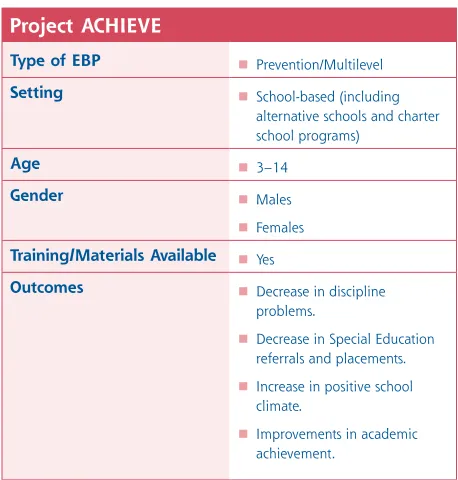
Figure 2
Project ACHIEVE
Type of EBP
le
Prevention/Multilevel Setting School-based (including
alternative schools and charter school programs)
Age 3–14
Gender Males
Females Training/Materials Availab Yes
Outcomes Decrease in discipline problems.
Decrease in Special Education referrals and placements. Increase in positive school climate.
Project ACHIEVE’s seven components are as follows:
1. The Strategic Planning, Organizational Analysis, and Development Component focuses on assessing the organizational climate, administrative style, staff decisionmaking, and other interactive and interpersonal processes within a school. Important to this component is developing 1- and 3-year school improvement plans.
2. The Problem Solving, Teaming, and Consultation Processes Component focuses on the causes of students’ behavior and on assessment leading to intervention to improve behavior. This response-to-intervention component emphasizes a problem-solving/consultation/ intervention mode of operation that directly contrasts with past wait-to-fail and refer-test-place approaches, and is applied with students experiencing academic and behavioral concerns.
3. The Effective School, Schooling, and Professional Development Component focuses on helping students maximize their time spent on academics and other school-related tasks. Professional- and development-related activities are highlighted in this component to increase the knowledge, skill sets, and confidence of teachers, administrators, or counselors who implement the program.
4. The Academic Instruction Linked to Academic Assessment, Intervention, and Achievement Component matches students’ current academic challenges to the appropriate curriculum to improve their overall performance. The instructional environment consists of the interdependent interactions in a classroom of the teacher-instructional process, the student, and the curriculum.
behavioral interventions and classroom management procedures. Using Project ACHIEVE’s evidence-based Positive Behavioral Self-Management System, this whole-school approach involves students, staff, administration, and parents building and reinforcing the following:
Students’ interpersonal, problem-solving and conflict-resolution skills and interactions;
Positive, safe, supportive, and consistent school climates and settings; and
School and district capacity such that the entire process becomes self-sustaining.
6. The Parent and Community Training, Support, and Outreach Component connects parents to the school to promote collaboration and improve the chances of students’ success in school. The theory is that using coordinated community-based efforts will increase support, resulting in more positive outcomes.
7. The Data Management, Evaluation, and Accountability Component assesses outcomes collected through consumer satisfaction methods and other data, such as time and cost-effectiveness of the overall Project ACHIEVE intervention, as well as students’ academic and behavioral progress.
Research Base and Outcomes
Project ACHIEVE’s effectiveness has been demonstrated through the following:
One quasi-experimental design;
Continued longitudinal studies from research school sites. Project ACHIEVE results are also reported annually in Arkansas as a part of its state improvement grant, through which approximately 45 schools are implementing
Project ACHIEVE as part of a 5-year grant from the U.S. Department of Education’s OSEP.
As seen in Table 2, research has included White, African American, and Hispanic participants.
Table 2: Project Achieve: Research Base and Outcomes
Reference Research Design and Sample* Outcomes
Knoff & Batsche (1995) Quasi-experimental design with matched comparison of one elementary-level treatment school and one control school. Data collected in treatment school for 1 year pretreatment and 3 years posttreatment. Data collected in control school for 1 year. Study population:
Treatment school:
60% White
30% African American
10% Other Comparison school:
41% White
54% African American
6% Other
For the treatment school:
Decrease in referrals for special education.
Decrease number of students placed in special education.
Decrease in disciplinary referrals.
Decrease in student grade retention, decrease in incidences of out-of-school suspension, positive gains on the California Test of Basic Skills.
Killian, Fish, & Maniago (2006)
Pre-post study with a comparison group. Participants were students in grades 3–6, and their parents and guardians. Students in the treatment school received Project ACHIEVE curriculum. Date collected before implementing the curriculum and at 1-year post- implementation.
For the treatment school:
Consistent decreases in undesirable behaviors occurred across all grades in both classroom and non-classroom settings.
Decreases in serious offenses—for example, in the areas of theft and students’ use of physical force.
Decreased discipline referrals to the principal’s office.
School suspensions for disciplinary reasons decreased. Project ACHIEVE
research school results Knoff personal communications (2006)
Longitudinal data collection from designated research schools. No control group comparison.
Study populations by school: Jessie Keen Elementary School
60% White
30% African American
10% Other
Cleveland Elementary School
20% White
62% African American
17% Hispanic
1% Other
Hotchkiss Elementary School
14% White
42% African American
39% Hispanic
5% Other
Overall discipline referral to office decreased 16%.
School-based discipline referrals decreased 11%.
School bus discipline referrals decreased 26%.
Out-of-school suspension decreased 29%.
Grade retention decreased 47%.
Special Education referrals decreased 61%.
Implementation and Dissemination
Infrastructure issues
Readiness:
Sites undergo a formal readiness assessment to determine their organizational and motivational readiness and ability to implement the program. Project ACHIEVE will work with sites
for 12 to 18 months to build their capacity for implementation, should they not already have the capacity to implement the program.
Staffing:
Project ACHIEVE has a set of broad-based criteria for sites to use to help them hire staff to implement the program.
One prerequisite is an organizational analysis and realignment (if needed) of the committee structure of the school and the development of a master calendar of meetings and professional development activities.
A resource analysis is completed to identify the instructional, assessment, and intervention skills of staff in and available to the school.
School administration and teachers are actively involved in implementing the program. Facilitators are chosen to receive additional training so they can guide the program and interventions in future years, at times through the DVD series, along with the ongoing support training provided by Dr. Knoff and his master trainers.
Family and child involvement:
Consumers play a role in implementation, especially in designing and implementing the Positive Behavioral Self-Management System and through activities organized and implemented by the Community and Family Outreach Committee. Students are involved in the core components of the process but are not directly involved in the decision about whether Project ACHIEVE is brought to the school.
Dr. Knoff is involved with the community, especially when social and cultural norms within the community make it important (for example, in American Indian communities). He often presents at Parent Nights to discuss home-based discipline and behavior management, and he attempts to engage families through his involvement in individual intervention-focused cases in the school.
Implementation timeline:
Project ACHIEVE is a 3-year intervention with carefully sequenced steps that must be followed. A sample timeline is as follows (H. Knoff, personal communication, June 22, 2006):
Pre-Year 1: Organizational development and strategic planning; writing of Project ACHIEVE goals and objectives in the School Improvement Plan; evaluating the school’s mission statement, organizational/committee structure, and resources; completing articulation activities and audits relative to problem areas in the school, early intervention referrals, and identifying students who need interventions for the next school year.
Year 2: Social skills/SPRINT training and booster sessions, Behavioral Observation and Instructional Environment Assessment training, Curricular-Based Assessment and Measurement (CBA/CBM) training, academic and behavioral intervention training; release time for planning, meetings, and technical assistance.
Year 3: Booster sessions in all components; parent-involvement planning; training and facilitation; grade-level intervention planning and implementation; leadership and facilitators’ training; release time for planning, meetings, and technical assistance.
Beyond Year 3: Continued, sustained
implementation of all components; academic and behavioral intervention focus for students not responding to interventions; continued release time for all grade-level teams to plan and implement the activities identified on their Action Plans; additional consultation and technical assistance as needed.
Possible barriers:
Some of the barriers to effective
implementation are as follows (H. Knoff, personal communication, June 22, 2006):
Organizational, administrative, financial, and resource limitations.
The lack of personnel skilled in implementing and providing consultation and technical assistance in academic and behavioral interventions for students not responding to effective instruction and preventative strategies.
Administrative personnel taking the time to learn about the program to make it the central feature of the School Improvement Plan and process. Not focusing attention to proactive versus reactive activities.
Systemic barriers that may be locally driven.
Certain mandates when the school focuses largely on classroom instruction, academic assessment, and academic outcomes to the detriment of other Project activities that more effectively support these important areas.
The availability of trained personnel and the willingness of administrators to rethink using these personnel as consultants, along with their direct service responsibilities.
The loss of principals, other administrators, and staff who leave the school or system after being trained, only to be replaced by new staff who need training. This occurs sometimes in the first year of the project.
Training/coaching and materials
Depending on the existing status and skills of school staff, training typically involves 5 to 8 days during Year 1; 4 to 8 days during Year 2; and 4 to 6 days during Year 3. With consultation, travel, and material costs, Year 1 costs average approximately $30,000 to $35,000; Year 2 costs average approximately $20,000 to $25,000; and Year 3 costs average approximately $15,000.
Dr. Knoff and his five to six master trainers are available for onsite consultation, booster sessions, and offsite assistance such as web-based training, teleconferencing, and web conferencing.
Training may vary according to the site, but ultimately it is a three-pronged approach aimed at providing knowledge, skills, and confidence. Demonstrations, consultation, technical assistance, and supervision are also provided.
There are materials for the Stop and Think Social Skills program that are readily available for purchase. Schools are advised to commit to implementing Project ACHIEVE fully, as opposed to just purchasing the materials.
The following items are available for purchase:
Stop & Think Social Skills Program (book, cue cards, stickers, stamps, t-shirts, pencils, and other materials for use in the classroom). Materials available for purchase at Sopris West Publishers (1-800-547-6747) or
http://www.sopriswest.com.
The Stop & Think Social Skills Program for Parents (involving a manual and 75-minute training DVD) is available through Dr. Knoff. Information on training and materials can be obtained at: http://www.projectachieve.info.
Cost of training/consulting
Costs will vary, but on average it costs $25,000/ year ($75,000 total) to implement (see above).
Cost per pupil to implement ranges from $30 to $150/per student, many times it depends on the need and cost of substitute teachers to release staff for training and other activities.
All of these costs include consulting services, travel, and materials (printed and DVD).
Developer involvement
Dr. Knoff is still actively involved in providing consultation services (onsite/offsite), writing research reports, and assessing readiness for a school to implement Project ACHIEVE.
Dr. Knoff has a fully prepared grant insert that can be provided to those writing state, Federal, and foundation grants that will involve Project ACHIEVE implementation.
For information about implementing Project ACHIEVE, contact Dr. Knoff.
Howard M. Knoff, Ph.D. 49 Woodberry Road Little Rock, AR 72212 Phone: (501) 312-1484 Fax: (501) 312-1493
Email: [email protected]
Monitoring fidelity and outcomes
A series of implementation check sheets address the different facets of the project to be used in monitoring adherence to the protocol.
Two formal questionnaires for evaluating the discipline and behavior management attitudes and staff interaction characteristics of the school are used as pre- and post-measures of
organizational development and change.
Discipline data is collected through a free software program, the Automated Discipline Data Review and Evaluation Software System (ADDRESS), which is loaded directly onto a school’s computer system and used in-house.
Through the onsite consultation services, the developer and master trainer develop other outcome measures designed to sensitively evaluate each year’s Project ACHIEVE goals and objectives as written into the School Improvement Plan.
Financing the intervention
Schools and districts have used several different funding sources to help finance Project ACHIEVE:
Title I funds of the Elementary and Secondary Education Act of 1965 (20 U.S.C. 6301 et seq.)
Special education funds
School improvement funds
Safe and Drug-Free School funds
Safe Schools/Safe Community funds
Counseling in the Schools funds
Private foundation funding
No Child Left Behind funds
Medicaid dollars for services that are part of the program (but cannot reimburse for the entire program itself)
Resources/Links
For more indepth information about Project ACHIEVE, please visit the following Web sites:
Helping America’s Youth:
http://www.findyouthinfo.gov/
Project ACHIEVE Home Page:
http://www.projectachieve.info
U.S. Department of Health and Human Services/Substance Abuse and Mental Health Services Administration, National registry of Evidence-Based Programs and Practices:
http://www.nrepp.samhsa.gov/
U.S. Department of Justice/Office of Juvenile Justice and Delinquency Prevention:
http://www.ojjdp.gov.mpg
American Institutes for Research/Center for Effective Collaboration and Practice:
http://cecp.air.org/
U.S. Department of Health and Human Services, Substance Abuse and Mental Health Services Administration, Center for the Application of Prevention Technologies:
http://captus.samhsa.gov/
Collaborative for Academic and Social-Emotional Learning: http://www.casel.org
The Arkansas State Improvement Grant:
References
Killian, J. M., Fish, M. C., & Maniago, E. B. (2006). Making schools safe: A system-wide school intervention to increase student prosocial behaviors and enhance school climate. Journal of Applied School Psychology, 23(1), 1–30.
Knoff, H. (personal communication, June 22, 2006).
Knoff, H. M., & Batsche, G. M. (1995). Project ACHIEVE: Analyzing a school reform process for at-risk and
Second Step
Intervention Description
Background
The Second Step program is a universal prevention and intervention program for children ages 4 to14. The program, developed in the mid-1980s, is disseminated by the Committee for Children, an organization based in Seattle, Washington. With wide implementation throughout the United States and 21 other countries and regions, the Second Step program is currently being taught to more than 7 million children with over 21,000 trained practitioners.
Characteristics of the intervention
The Second Step program is a classroom-based prevention program designed to reduce impulsive and aggressive behavior. It is classified as a prevention program and is therefore appropriate for most children.
The program is divided into the following three main skill-building areas:
Empathy;
Impulse control and problem solving; and
Anger management.
It is delivered in sequential lessons by classroom teachers or counselors using curriculum kits.
The Second Step program focuses on the following three age groups:
Preschool/kindergarten;
First through fifth grade; and
Middle school.
In the youngest group, students are exposed to photo-lesson cards, puppets, and sing-alongs that facilitate group discussions, skill practice, and transfer of learning. In the elementary age group, students are exposed to videos, photo-lesson cards, teacher-led discussions, role plays, and homework, all addressing the three skill areas.
The middle school curriculum uses fully scripted lessons, videos, and reproducible activity sheets. Also, a family guide helps families reinforce social and emotional skills at home, including communicating feelings, solving problems, and managing conflict.
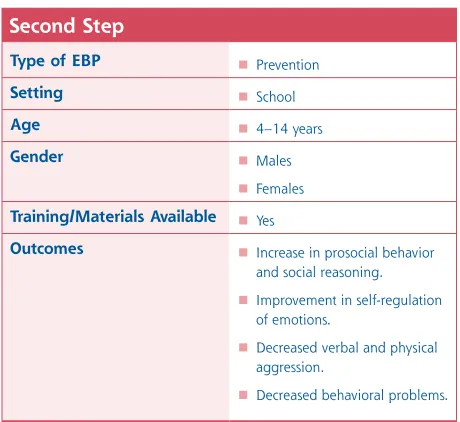
Figure 3 Second Step
Type of EBP Prevention
Setting School
Age 4–14 years
Gender Males
Females Training/Materials Available Yes
Outcomes Increase in prosocial behavior and social reasoning.
Improvement in self-regulation of emotions.
Decreased verbal and physical aggression.
Research Base and Outcomes
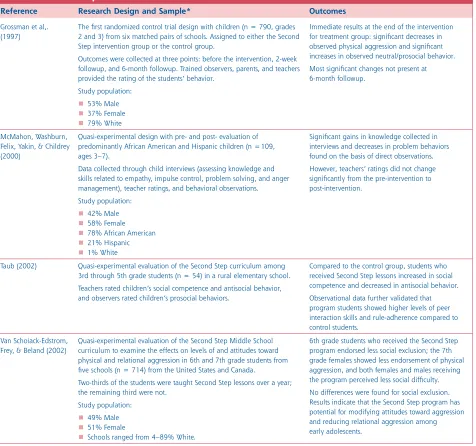
At least a dozen research studies examined the Second Step program. In outcome measures collected from direct observations and child interviews, support exists for the intervention in reducing behavior problems, decreasing physical aggression, and increasing prosocial behavior.
Outcome measures collected from teacher ratings were either not supported by the research or not present over time. Studies have included White, African American, and Hispanic participants.
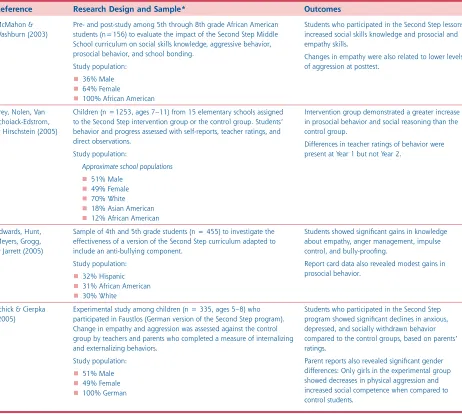
Information about research conducted on the Second Step program is shown in Table 3.
Table 3: Second Step: Research Base and Outcomes
Reference Research Design and Sample* Outcomes
Grossman et al,. (1997)
The first randomized control trial design with children (n = 790, grades 2 and 3) from six matched pairs of schools. Assigned to either the Second Step intervention group or the control group.
Outcomes were collected at three points: before the intervention, 2-week followup, and 6-month followup. Trained observers, parents, and teachers provided the rating of the students’ behavior.
Study population: 53% Male 37% Female 79% White
Immediate results at the end of the intervention for treatment group: significant decreases in observed physical aggression and significant increases in observed neutral/prosocial behavior. Most significant changes not present at 6-month followup.
McMahon, Washburn, Felix, Yakin, & Childrey (2000)
Quasi-experimental design with pre- and post- evaluation of predominantly African American and Hispanic children (n =109, ages 3–7).
Data collected through child interviews (assessing knowledge and skills related to empathy, impulse control, problem solving, and anger management), teacher ratings, and behavioral observations. Study population:
42% Male 58% Female 78% African American 21% Hispanic 1% White
Significant gains in knowledge collected in interviews and decreases in problem behaviors found on the basis of direct observations. However, teachers’ ratings did not change significantly from the pre-intervention to post-intervention.
Taub (2002) Quasi-experimental evaluation of the Second Step curriculum among 3rd through 5th grade students (n = 54) in a rural elementary school. Teachers rated children’s social competence and antisocial behavior, and observers rated children’s prosocial behaviors.
Compared to the control group, students who received Second Step lessons increased in social competence and decreased in antisocial behavior. Observational data further validated that program students showed higher levels of peer interaction skills and rule-adherence compared to control students.
Van Schoiack-Edstrom, Frey, & Beland (2002)
Quasi-experimental evaluation of the Second Step Middle School curriculum to examine the effects on levels of and attitudes toward physical and relational aggression in 6th and 7th grade students from five schools (n = 714) from the United States and Canada.
Two-thirds of the students were taught Second Step lessons over a year; the remaining third were not.
Study population: 49% Male 51% Female
Table 3: Second Step: Research Base and Outcomes
Reference Research Design and Sample* Outcomes
McMahon & Washburn (2003)
Pre- and post-study among 5th through 8th grade African American students (n=156) to evaluate the impact of the Second Step Middle School curriculum on social skills knowledge, aggressive behavior, prosocial behavior, and school bonding.
Study population: 36% Male 64% Female
100% African American
Students who participated in the Second Step lessons increased social skills knowledge and prosocial and empathy skills.
Changes in empathy were also related to lower levels of aggression at posttest.
Frey, Nolen, Van Schoiack-Edstrom, & Hirschstein (2005)
Children (n =1253, ages 7–11) from 15 elementary schools assigned to the Second Step intervention group or the control group. Students’ behavior and progress assessed with self-reports, teacher ratings, and direct observations.
Study population:
Approximate school populations
51% Male 49% Female 70% White 18% Asian American 12% African American
Intervention group demonstrated a greater increase in prosocial behavior and social reasoning than the control group.
Differences in teacher ratings of behavior were present at Year 1 but not Year 2.
Edwards, Hunt, Meyers, Grogg, & Jarrett (2005)
Sample of 4th and 5th grade students (n = 455) to investigate the effectiveness of a version of the Second Step curriculum adapted to include an anti-bullying component.
Study population: 32% Hispanic 31% African American 30% White
Students showed significant gains in knowledge about empathy, anger management, impulse control, and bully-proofing.
Report card data also revealed modest gains in prosocial behavior.
Schick & Cierpka (2005)
Experimental study among children (n = 335, ages 5–8) who participated in Faustlos (German version of the Second Step program). Change in empathy and aggression was assessed against the control group by teachers and parents who completed a measure of internalizing and externalizing behaviors.
Study population: 51% Male 49% Female 100% German
Students who participated in the Second Step program showed significant declines in anxious, depressed, and socially withdrawn behavior compared to the control groups, based on parents’ ratings.
Parent reports also revealed significant gender differences: Only girls in the experimental group showed decreases in physical aggression and increased social competence when compared to control students.
The Second Step Staff Training is a 1-day course designed to help participants learn to teach the Second Step curriculum to students. This training provides hands-on experience with the curriculum and helps teachers strengthen social-skills teaching techniques and identify opportunities to model and reinforce skills. As part of the program, each site receives a set of four staff-training videos that can be used to reinforce the skills that were learned and train new staff. (This training is available only onsite.)
Information about training and materials can be obtained at:
http://www.cfchildren.org/programs/ssp/overview/
Cost of training/consulting
The regional Second Step Training for Trainers costs $499 per person ($399 per person if registered by Early Bird Discount deadline designated for each location).
The maximum number of people recommended for the onsite Second Step Training for Trainers is 40 people. The cost for 25 people is $4,975. Each additional person is $100. The total cost for a training of 40 is $6,475 plus travel-related expenses.
The onsite Second Step Staff Training costs $1,600 plus travel-related expenses.
After participants have attended one initial training session, Committee for Children trainers are available to provide onsite consultation, booster sessions, or additional training. The fee for this service is $125 per hour.
The cost for materials will vary according to the curriculum kits purchased and ranges from $159 to $289. Volume discounts are available for orders over a certain size.
Developer Involvement
The organization’s program developers dedicate themselves to ongoing revision of the programs to maintain their effectiveness. The Committee for Children also remains focused on sustained partnerships with clients anchored in outstanding customer support and training and directed to clients’ long-term success.
For more information, visit the Committee for Children’s Web site:
http://www.cfchildren.org/programs/ssp/overview/
Monitoring fidelity and outcomes
Evaluation instruments are available for school and district administrators to gauge fidelity of implementation and assess outcomes of the Second Step program.
Sites are not required to submit fidelity or outcome data. The Committee for Children monitored the outcomes during the pilot phase for the Second Step program.
Financing the intervention
According to C. Glaze (personal communication, June 21, 2006):
Approximately 80 percent of those who implement the Second Step program use Safe and Drug Free Schools funding to purchase the curriculum.
Resources/Links
Committee for Children: http://www.cfchildren.org.
Training Information:
http://www.cfchildren.org/programs/ssp/overview/
Office of Juvenile Justice and Prevention Programs: http://www.dsgonline.com/mpg2.5// TitleV_MPG_Table_Ind_Rec.asp?id=422
References
Cooke, M. B., Ford, J., Levine, J., et al., (2007). The effects of city-wide implementation of Second Step on elementary school students’ prosocial and aggressive behaviors. The Journal of Primary Prevention, 28, 93–115.
Edwards, D., Hunt, M. H., Meyers, J., Grogg, K. R., & Jarrett, O. (2005). Acceptability and student outcomes of a violence prevention curriculum. Journal of Primary Prevention, 26, 401–418.
Frey, K. S., Nolen, S. B., Van Schoiack-Edstrom, L., & Hirschstein, M. K. (2005). Effects of a school-based social-emotional competence program: Linking children’s goals, attributions, and behavior. The Journal of Applied
Developmental Psychology, 26, 171–200.
Glaze, C. (personal communication, June 21, 2006).
Grossman, D. C., Neckerman, H. J., Koepsell, T. D., et al., (1997). Effectiveness of a violence prevention curriculum among children in elementary school. The Journal of the American Medical Association, 277, 1605–1611.
Larsen, T., & Samdal, O. (2007). Implementing Second Step: Balancing fidelity and program adaptation. Journal of Educational and Psychological Consultation, 17, 1–29.
McMahon, S. D., & Washburn, J. J. (2003). Violence prevention: An evaluation of program effects with urban African American students.
Journal of Primary Prevention, 24, 43–62.
McMahon, S. D., Washburn, J. J., Felix, E. D., et al., (2000). Violence prevention: Program effects on urban preschool and kindergarten children.
Applied and Preventive Psychology, 9, 271–281.
Orpinas, P., Parcel, G. S., Mcalister, A., Frankowski, R. (1995). Violence prevention in middle schools: A pilot evaluation. Journal of Adolescent Health, 17, 360–370.
Schick, A., & Cierpka, M. (2005). Faustlos: Evaluation of a curriculum to prevent violence in elementary schools. Applied and Preventive Psychology, 11, 157–165.
Sprague, J., Walker, H., Golly, A., et al., (2001). Translating research into effective practice: The effects of a universal staff and student intervention on indicators of discipline and school safety. Education & Treatment of Children, 24, 495–511.
Taub, J. (2002). Evaluation of the Second Step violence prevention program at a rural
elementary school. School Psychology Review, 31, 186–200.