Ralph D. Hector, PhD Vera M. Kalscheuer, PhD Friederike Hennig, MSc Helen Leonard, MBChB Jenny Downs, PhD Angus Clarke, DM Tim A. Benke, MD, PhD Judith Armstrong, PhD Mercedes Pineda,
MD, PhD
Mark E.S. Bailey, PhD Stuart R. Cobb, PhD
Correspondence to Dr. Hector: [email protected]
CDKL5
variants
Improving our understanding of a rare neurologic disorder
ABSTRACT
Objective:To provide new insights into the interpretation of genetic variants in a rare neurologic disorder, CDKL5 deficiency, in the contexts of population sequencing data and an updated characterization of theCDKL5gene.
Methods:We analyzed all known potentially pathogenicCDKL5variants by combining data from large-scale population sequencing studies withCDKL5variants from new and all available clinical cohorts and combined this with computational methods to predict pathogenicity.
Results: The study has identified several variants that can be reclassified as benign or likely benign. With the addition of novelCDKL5variants, we confirm that pathogenic missense variants cluster in the catalytic domain of CDKL5 and reclassify a purported missense variant as having a splicing consequence. We provide further evidence that missense variants in the final 3 exons are likely to be benign and not important to disease pathology. We also describe benign splicing and nonsense variants within these exons, suggesting that isoform hCDKL5_5 is likely to have little or no neurologic significance. We also use the available data to make a preliminary estimate of minimum incidence of CDKL5 deficiency.
Conclusions:These findings have implications for genetic diagnosis, providing evidence for the reclassification of specific variants previously thought to result in CDKL5 deficiency. Together, these analyses support the view that the predominant brain isoform in humans (hCDKL5_1) is crucial for normal neurodevelopment and that the catalytic domain is the primary functional domain.Neurol Genet2017;3:e200; doi: 10.1212/NXG.0000000000000200
GLOSSARY
dbSNP5Single Nucleotide Polymorphism database;ExAC5Exome Aggregation Consortium;NMD5nonsense-mediated decay;RettBASE5Rett Syndrome Database;RT5reverse transcription;UTR5untranslated region;VEP5Variant Effect Predictor;XCI5X-chromosome inactivation;1000G51000 Genomes Project.
The phenotype associated with CDKL5 deficiency (MIM: 300203) has become increasingly well
defined over the last decade. Its cardinal features are early-onset seizures, often presenting as
infan-tile spasms and usually occurring within the first 3 months of life, global developmental delay, and
severely impaired gross motor function.
1CDKL5 deficiency is caused by dominantly acting
loss-of-function variants in the X-linked gene
CDKL5
(cyclin-dependent kinase-like 5), which plays
a crucial role in brain development.
2–6The epidemiology of CDKL5 deficiency has not been
studied, and no incidence or prevalence data are available. Nevertheless, the frequency of patients
From the Institute of Neuroscience & Psychology (R.D.H., S.R.C.), University of Glasgow, UK, Drs. Hector and Cobb are currently with the Patrick Wild Centre and Centre for Discovery Brain Science, University of Edinburgh, UK; Group Development and Disease (V.M.K., F.H.), Max Planck Institute for Molecular Genetics, Berlin, Germany; Telethon Kids Institute (H.L., J.D.), The University of Western Australia, Perth, Western Australia; School of Physiotherapy and Exercise Science (J.D.), Curtin University, Perth, Australia; Institute of Medical Genetics (A.C.), School of Medicine, Cardiff University, Cardiff, Wales, UK; Departments of Pediatrics, Pharmacology, Neurology and Otolaryngology (T.A.B.), University of Colorado School of Medicine, Aurora, CO; Paedriatic Neuroscience (J.A., M.P.), Institut de Recerca Sant Joan de Déu, Esplugues de Llobregat, Spain; Hospital Sant Joan de Déu Barcelona (J.A.), Esplugues de Llobregat, Spain; CIBERER (J.A.), Barcelona, Spain; Neuropediatrics (M.P.), Fundació Sant Joan de Déu, Esplugues de Llobregat, Spain; and School of Life Sciences (M.E.S.B.), College of Medical, Veterinary and Life Sciences, University of Glasgow, UK.
Funding information and disclosures are provided at the end of the article. Go to Neurology.org/ng for full disclosure forms. The Article Processing Charge was funded by CDKL5 UK.
diagnosed with CDKL5 deficiency is increasing
due to growing awareness of the disorder and
the inclusion of
CDKL5
in routine genetic
test-ing of early-onset epileptic encephalopathies.
7,8For rare Mendelian diseases caused by
de
novo
variants, such as CDKL5 deficiency, data
from large-scale screening of patient and
pop-ulation samples can be mined to enhance
clar-ification of clinically relevant variants. The
Exome Aggregation Consortium (ExAC)
9ana-lyzed high-quality exome DNA sequence data
of 60,706 individuals of diverse ancestries,
providing opportunities to refine the clinical
interpretation of
CDKL5
variants. Here, we
analyze all known variants observed in
CDKL5 patients to date, including novel
var-iants described in this study, along with data
from ExAC, the 1000 Genomes Project
(1000G),
10and the Single Nucleotide
Poly-morphism database (dbSNP).
11All variants
are analyzed in the context of the updated
characterization of the
CDKL5
gene
12to
pro-vide new insights into the clinical
interpreta-tion of variants in CDKL5 deficiency.
METHODS Standard protocol approvals, registrations, and patient consents.Written informed consent was obtained from all individuals who participated in this study, and the study was approved by the ethics committees of the respective institu-tions: University of Western Australia Human Research Ethics Committee (reference # RA/4/1/5024); the Institute of Medical Genetics, University Hospital of Wales (Cardiff, UK) as part of the British Isles Rett Syndrome Survey (REC reference # 15/WA/ 029); Children’s Hospital Colorado (Aurora, CO) (COMIRB 13-2020); established protocols to access clinical data of Sant Joan de Déu Children’s Hospital (Barcelona, Spain).
CDKL5variant data collection.CDKL5variants in clinical cohorts (see above) were analyzed by combining data from the CDKL5 variation database at Rett Syndrome Database (RettBASE),13Database of Chromosomal Imbalance and
Pheno-type in Humans Using Ensembl Resources,14and all published
reports ofCDKL5variants. Population data onCDKL5variants were sourced from ExAC,91000G,10and dbSNP.11
Computational analysis.The effects of missense and splicing variants in CDKL5 were predicted using several algorithms (missense: SIFT, PolyPhen, MutationTaster, and PROVEAN; splicing variants: MaxEntScan and dbscSNV), provided within the Ensembl Variant Effect Predictor (VEP).15
Assignment criteria. The assignment of pathogenicity was based on guidelines for the interpretation of sequence variants.16
The following criteria were used: pathogenic—the same amino acid change as an established pathogenic variant; likely patho-genic—the allele is absent in population data sets and the pa-tient’s phenotype is highly specific for CDKL5 disorder, and computational evidence supports a deleterious effect on the gene; uncertain significance—evidence for benign and pathogenic clas-sification is contradictory; likely benign—the variant is detected in a healthy mother and/or sister, and computational evidence suggests no effect on the gene; and benign—the variant is de-tected in a healthy father and/or brother, or the allele frequency is detected in population data sets at levels too high to explain the prevalence of a rare disorder.
Minigene splicing assay.DNA fragments of wild-type and mutantCDKL5exon 14 with flanking intron sequence were synthesized (IDT, Coralville, IA) and cloned into the exon trap vector pET01 (MoBiTec, Göttingen, Germany). Minigenes were transfected into HEK293T cells using jetPRIME (PEQLAB, Erlangen, Germany) according to the manufacturer’s in-structions. After 24 hours, total RNA was extracted using the RNeasy Plus Mini Kit (Qiagen, Hilden, Germany). Total RNA was generated, and reverse transcription PCR (RT-PCR) ex-periments were performed as described previously.17 Further
details of these experiments are described in e-Methods.
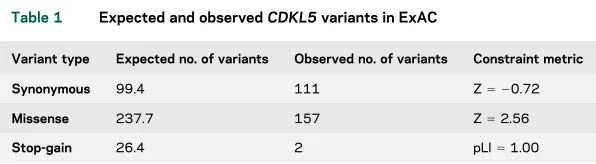
RESULTS CDKL5 variants in the population. The number of expected and observed variants inCDKL5
from the recent large-scale analysis of genetic varia-tion by ExAC is described in table 1.9Synonymous variants inCDKL5are reported to occur at approxi-mately the expected frequency and are found throughout the coding region ofCDKL5 (figure 1). By contrast, the number of missense variants observed (n5157) is lower than expected (table 1). The population sample analyzed in the ExAC study was devoid of severe pediatric disease; therefore, none of these 157 missense variants is, on its own, patho-genic and causative for CDKL5 deficiency. Only 15 (;10%) of these missense variants are located in the catalytic domain of CDKL5, a 286-amino acid region (;30% of protein length) crucial for protein func-tion2 (figures 1 and 2). No frameshift or splicing variants were identified in ExAC; however, 2 non-sense variants (described as stop-gain in table 1) were identified: p.Arg952Ter and p.Arg970Ter. Both nonsense variants are found in exon 21 and therefore affect only the hCDKL5_5 isoform, which is ex-pressed almost exclusively in the testis.12,18
Some known exonic coding and untranslated re-gions (UTRs) of CDKL5, recently identified and present only in minor transcript isoforms,12 are not included in the exonic regions covered by ExAC. For example, exon 17 (originally termed 16b19) is present
Table 1 Expected and observedCDKL5variants in ExAC
Variant type Expected no. of variants Observed no. of variants Constraint metric
Synonymous 99.4 111 Z5 20.72
Missense 237.7 157 Z52.56
Stop-gain 26.4 2 pLI51.00
Abbreviation: ExAC5Exome Aggregation Consortium.
in thehCDKL5_2isoform and is expressed only at low levels in the developing and adult brain.12Only 2 exon 17 variants have been identified, both in dbSNP (rs289269000 and rs181987256), neither of which is associated with a disease phenotype.
CDKL5missense variants in patients.Missense variants reported in patients are found throughout the portions of CDKL5 that encode the major brain transcript
isoform,hCDKL5_1(figure 1). Only 1 of the 15 mis-sense variants identified within the catalytic domain in ExAC has been reported in a patient with CDKL5 deficiency: c.719G.C (p.Ser240Thr; figure 2). This exon 9 variant has recently been reported as the first familial case of CDKL5-related disease20in a het-erozygous female, who displayed global psychomotor delay and autistic disturbances but no epilepsy. The same variant was detected in her asymptomatic
Figure 1 Distribution of exonicCDKL5variants
A cartoon of the gene structure is given at the top, with exons ofhCDKL5_1, the dominant brain transcript isoform, colored blue-green (coding regions) and black (UTRs). Introns are not drawn to scale. In the diagram beneath, variant types are grouped together, and individual variants are plotted according to their location in the gene. Red indicates pathogenic or likely pathogenic variants; green indicates benign or likely benign variants; and amber indicates variants of uncertain significance.
Figure 2 PathogenicCDKL5missense variants cluster in the catalytic domain
Functional domains in the CDKL5 protein are color coded. Numbers refer to the positions of amino acids. Variants in red (upper) are pathogenic or likely pathogenic. Variants in black (lower) are benign or likely benign.aVariant with a splicing consequence.bVariant of uncertain significance. NES5putative
mother, and a skewed X-chromosome inactivation (XCI) ratio was thought to account for this phenotypic difference. We further identified 2 individuals with this variant (1 in ExAC and 1 in 1000G), neither individual having displayed signs of a neuro-developmental disorder phenotype, consistent with the
inclusion criteria in those studies. It is unlikely that 3 asymptomatic carriers of this variant would all have similarly skewed XCI, suggesting that this variant may not in fact be causative. Current evidence suggests that the p.Ser240Thr should be classified as being of “uncertain significance.”
Table 2 NovelCDKL5variants in our clinical cohorts
Mutation
type Exon Gene variant GRCh38 ExAC AF 1000G MAF dbSNP
Protein
consequence Sex
CDKL5 clinical diagnosis
Computational prediction
Missense 2 c.37T.C 18507133 — — — p.Phe13Ser Female Yes Pathogenic
Missense 3 c.71A.G 18510826 — — — p.Tyr24Cys Female Yes Pathogenic
Missense 4 c.104C.T 18564481 — — — p.Thr35Ile Female Yes Pathogenic
Missense 5 c.200T.C 18575408 — — — p.Leu67Pro Female Yes Pathogenic
Missense 6 c.364G.A 18579929 — — — p.Ala122Thr Female Yes Uncertain significance
Missense 6 c.377G.A 18579942 — — — p.Cys126Tyr Female Yes Uncertain significance
Missense 7 c.454T.C 18581941 — — — p.Cys152Arg Female Yes Pathogenic
Missense 9 c.605G.A 18588004 — — — p.Gly202Glu Female Yes Pathogenic
Missense 10 c.784T.C 18595387 — — — p.Tyr262His Female Yes Uncertain significance
Missense 11 c.853A.G 18598489 — — — p.Arg285Gly Female Yes Pathogenic
Missense 11 c.950A.Ga 18598586 2.28E-05 — rs756537286 p.His317Arg Male — Uncertain significance
Missense 12 c.1188T.Aa 18604112 1.14E-05 — rs772076629 p.Asp396Glu Female — Uncertain significance Missense 15 c.2243A.Ga 18613242 6.84E-05 0.0003 rs748459878 p.Asn748Ser Female — Benign
Missense 20 c.2716G.A 18646009 2.28E-05 — rs369009993 p.Gly906Ser Female — Benign
Missense 21 c.2980G.Aa 18650592 — — — p.Gly994Arg Female — Benign
Nonsense 5 c.205C.T 18575413 — — — p.Gln69Ter Female Yes —
Nonsense 5 c.258C.G 18575466 — — — p.Tyr86Ter Female Yes —
Nonsense 11 c.858C.A 18598494 — — — p.Tyr286Ter Female Yes —
Nonsense 14 c.2112C.G 18609530 — — — p.Tyr704Ter Female Yes —
Nonsense 15 c.2276G.A 18613275 — — — p.Trp759Ter Female Yes —
Nonsense 21 c.2941C.T 18650553 — — — p.Arg981Ter Female Yesb —
Splicing IVS2 c.65-2A.T 18510818 — — — — Female Yes Pathogenic
Splicing IVS2 c.65-2A.G 18510818 — — — — Female Yes Pathogenic
Splicing IVS6 c.404-1G.C 18581890 — — — — Female Yes Pathogenic
Splicing IVS10 c.82511G.A 18595429 — — — — Female Yes Pathogenic
Splicing IVS10 c.82511G.A 18595429 — — — — Female Yes Pathogenic
Splicing IVS10 c.826-1G.A 18598461 — — — — Female Yes Pathogenic
Splicing IVS15 c.227611G.T 18613276 — — — — Female Yes Pathogenic
Splicing IVS20 c.279712T.C 18664209 — — — — Male — Pathogenic
Triplication 1–15 X:18370935-18634410 x3
— — — — — Female — —
Duplication 3–12 X:18510568-18605032 x2
— — — — — Female — —
Duplication IVS1 X:18488669-18516147 x2
— — — — — Female — —
Abbreviations: dbSNP5Single Nucleotide Polymorphism database; ExAC5Exome Aggregation Consortium; VEP5Variant Effect Predictor; 1000G5 1000 Genomes Project.
Variants are grouped into types. GRCh38 indicates the X-chromosome coordinate in the GRCh38/hg38 assembly.
aVariant inherited from an asymptomatic mother.
Frequencies of variants in population databases are shown as ExAC allele frequency (AF) and 1000G minor allele frequency (MAF). CDKL5 clinical diagnosis was made by the clinical center to which the patient presented (bmilder-than-average CDKL5 symptoms). Computational prediction is based on
Combining all known CDKL5variant data, there are 59 missense variants in the catalytic domain, which we consider pathogenic or likely pathogenic for CDKL5 deficiency based on our assignment criteria (figure 2). This includes 11 novel missense variants identified in the clinical cohorts in this study (table 2). In each case, the patient received a clinical diagnosis of CDKL5 defi-ciency, and, in most cases, VEP analysis supported the prediction of a pathogenic variant.
Outside the catalytic domain, there are 179 differ-ent missense variants (figure 1). Upstream of the cat-alytic domain, 3 variants (p.Ile3Phe, p.Asn5Asp, and p.Ile6Thr) are known to be present in ExAC and 1000G, not associated with CDKL5 patients and predicted to be benign by VEP analysis. Fifty-one different missense variants have been found in the last 3 exons (20, 21, and 22). Forty of these are present in ExAC, often in hemizygous males. c.2995G.A (p.Val999Met), previously thought to be pathogenic, is found at notable frequency in ExAC (0.01178) and should therefore be classed as a benign polymorphism. A further 10 are present in dbSNP; none of these variants appear to be responsible for a CDKL5-like phenotype, and VEP analysis predicts these variants to be benign. This is consistent with these exons being absent in the primary brain tran-script isoform. In our clinical cohorts, a variant in exon 21, c.2980G.A (p.Gly994Arg), was identified in a patient with developmental delay, but was not clinically diagnosed with CDKL5 deficiency (table 2). The variant was inherited from her asymptomatic mother and, combined with VEP analysis, should therefore be classified as benign.
The remaining missense variants are distributed between exons 11 and 19 (figure 1). Ninety-seven of these are found in ExAC, many occurring in
hemizygotes. In some cases, such as p.Ile508Thr and p.Thr734Ala, the ExAC allele frequency and the presence of these variants in hemizygotes allow them to be reclassified as likely benign. Additional variants present in dbSNP (but not in ExAC) are not associated with any clinical phenotype. In our clinical cohorts, we identified further missense var-iants in patients, where a clinical diagnosis of CDKL5 deficiency was not given (table 2). p.His317Arg, p.Asp396Glu, p.Asn748Ser, and p.Asp797Asn are present in ExAC/1000G, and all variants were iden-tified as being inherited from a healthy mother or father (table 2), suggesting that they are all benign variants. In our analysis, there are 7 missense variants outside the catalytic domain that should, at present, be classified as “of uncertain significance” pending more information (figure 2). p.Val351Ile is recorded in dbSNP (rs587783150) and p.Thr538Ala is re-corded in the RettBASE,13for which no clinical or screening information is available. p.Leu302Phe and p.Asp422Glu are unique variants that have been asso-ciated with seizure phenotypes, although the pheno-type of these cases is atypical in comparison to other CDKL5 patients reported in these studies.21,22 p. Asn399Thr and p.Val793Ala have also been associ-ated with epilepsy phenotypes4,23; these variants have also been observed as singletons in ExAC.
The most compelling evidence of a pathogenic missense variant outside the catalytic domain con-cerns the c.2152G.A (p.Val718Met) variant. This variant has been identified in 3 unrelated CDKL5 patients in 3 independent studies.24–26In each case, the patient presented with symptoms consistent with CDKL5 deficiency and harbored no known variants in other epilepsy-related genes. This variant is not present in the 1000G or the ExAC population
Figure 3 CDKL5variant c.2152G>A causes skipping of exon 14 in HEK293T cells
databases. VEP analysis of c.2152G.A, which affects the last base of exon 14, predicted a detrimental effect on splicing (MaxEntScan diff: 2.89). We assessed this variant in vitro using a minigene splicing assay, show-ing that splicshow-ing is disrupted, resultshow-ing in exon 14 being omitted from the transcript (figure 3). We therefore suggest that the c.2152G.A variant be cat-egorized as a splicing rather than a missense variant. The consequence (r.2047_2152del) is a frameshift variant that would generate a premature stop codon in exon 16. This finding removes evidence supporting the existence of pathogenic missense variants outside the catalytic domain of CDKL5, and we therefore conclude that caution should be applied in interpre-tations of pathogenicity whenever an apparent mis-sense variant is found outside the catalytic domain.
Nonsense, frameshift, and splicing variants.Pathogenic nonsense, frameshift, and splicing variants are found throughout the coding region ofhCDKL5_1, the pre-dominant brain transcript isoform (figure 1). Efforts have been made to establish genotype-phenotype re-lationships based on the position of these variants in the gene, by predicting structural and functional consequences.8 However, the levels of functional CDKL5 in patients with truncating variants at dif-ferent points throughout the gene are still not known. Novel nonsense and splicing variants identified in the clinical cohorts in this study are described in table 2, and novel frameshift variants in table e-1, http://links. lww.com/NXG/A2.
In exon 19, the last exon utilized by the
hCDKL5_1transcript, a variant described in dbSNP (rs863225289) has been identified in a patient with early infantile epileptic encephalopathy 2 (MIM: 300672). This variant lies downstream of the internal splice donor site in exon 19 and so would not be ex-pected to affect the protein product made from the testis-specifichCDKL5_5transcript isoform. However, in relation tohCDKL5_1, the major brain transcript isoform, this is a nonsense variant (c.2176C.T, p.Gln906Ter, with respect tohCDKL5_1). This may trigger nonsense-mediated decay (NMD; due to the presence of a long 39-UTR27) and result in typical CDKL5 deficiency. Additional observations of this var-iant would be required to validate this conjecture, but it is consistent with the idea that truncating variants in exon 19 may be pathogenic.
Three nonsense variants have been detected in exon 21, which is specific to isoform hCDKL5_5: c.2854C.T, p.Arg952Ter; c.2908C.T, p. Arg970Ter; and c.2941C.T, p.Arg981Ter. Both p.Arg952Ter and p.Arg970Ter variants have been described in patients with CDKL5-like symp-toms.28,29 However, in both cases, delay in seizure onset and an absence of other features of
CDKL5-associated pathology were reported. p.Arg952Ter was identified in the patient’s mother, grandmother, and half-sister, and in 6 individuals in a control pop-ulation.28 A further 12 instances of this allele are present in ExAC, including 3 hemizygotes (allele fre-quency 0.0001367). A recent case study also identi-fied this variant in an asymptomatic hemizygous male.30p.Arg970Ter occurs in a single heterozygous female in ExAC (in the case study, the variant was not detected in the mother and the father was deceased29). Together, these findings suggest that variants in these late exons do not cause a CDKL5 deficiency phenotype.
A c.2941C.T, p.Arg981Ter variant was identi-fied in our clinical cohorts (table 2). A girl presented with a phenotype consistent with CDKL5 deficiency —profound cognitive impairment, mild dysmorphic appearance, stereotypical hand wringing, and epilepsy (from age 6 months). Both parents were deceased; therefore, it is unknown whether this variant was in-herited or occurredde novo.This variant is not pres-ent in ExAC or in 1000G, and the clinical evidence would suggest defining this as a pathogenic variant. However, this variant lies immediately downstream of the 2 nonsense variants described above, both of which have considerable evidence suggesting that they should be classified as benign. We conclude that, at present, p.Arg981Ter should be classified as being of“uncertain significance.”
It is important that no pathogenic frameshift or splicing variants were found affecting exons 20, 21, and 22 (figure 1). A novel splicing variant was identified in our clinical cohorts (table 2): c.279712T.C. The patient, a boy, was not clini-cally diagnosed with CDKL5 deficiency and was found to have inherited the variant from his asymp-tomatic mother. VEP analysis of this variant predicts the abolition of the splice donor site of exon 20, which would be likely to result in a premature stop codon.
Copy number variations andCDKL5duplication. Sev-eral studies have reported duplications of Xp22 asso-ciated with intellectual disability and autism phenotypes,31–34but the duplicated regions reported (spanning 8–21 Mb) included as many as 80 genes, and interpretation of gene-specific overexpression effects in such circumstances is problematic. A more recent study described 3 unrelated families with more compact duplication regions incorporatingCDKL5.35 Four different duplicated regions were described, ranging from 540 to 935 kb in size. In the case of the 683-kb duplication harbored by three of the patients, the duplicated region does not include exon 1 of
overexpressed in these individuals. The authors point out that the alternativehCDKL5_5transcript may be expressed and overexpression effects during fetal development may result in the observed phenotype. Three patients also harbored additional duplicated regions on other chromosomes, and parents harbor-ing these sameCDKL5-containing duplications were either phenotypically unaffected or displayed mild intellectual disability.35Therefore, the pathway lead-ing to the phenotypes in these individuals remains somewhat unclear, as experimental confirmation of effects onCDKL5transcript and protein levels is not yet available. Here, we report 2 duplications and 1 triplication in our clinical cohorts (table 2). However, in each of these copy number variations, only a part of the gene is duplicated; therefore, it is extremely unlikely that an increased level of CDKL5 would be present in these individuals.
Variants in regulatory and UTRs.The recent identifica-tion of novel exons and transcripidentifica-tion start sites at the 59end of the gene suggests the presence of multiple promoter regions.12However, most brain transcripts are driven by a putative promoter upstream of exon 1. Several variants in the 59-UTR have been reported, but so far only those associated with the deletion of exon 1 or 2, or the disruption of splicing from exon 1 to exon 2 (c.-162-2A.G36), have been shown to be pathogenic. Only 2 variants in the putative promoter region, c.-440G.T and c.-189C.T, have so far been found in patients with a CDKL5-like pheno-type,3 but at present their significance remains uncertain. The large 6.6 kb 39-UTR ofhCDKL5_1
has only recently been defined,12so the region has not been analyzed in patients either by targeted sequencing or by exome analysis, and we found no evidence for the presence of clinically relevant variants in the 1000G data.
Incidence of CDKL5 deficiency. The incidence of CDKL5 deficiency is unknown. We have analyzed data from the International CDKL5 Disorder Data-base8to provide a lower estimate of birth prevalence in Australia of 0.21 cases per 100,000 live births (95% CI 0.12–0.33) for the years 1982–2014. Although a birth prevalence in this range would indi-cate that CDKL5 deficiency is an ultra rare disorder, it is likely that this figure will increase, as targeted next-generation sequencing for investigation of early-onset epileptic encephalopathy becomes more common.7,25
In our analysis, the most frequent CDKL5 deficiency–causing variants are 2 nonsense variants in exon 12: c.1648C.T (p.Arg550Ter) and c.1675C.T (p.Arg559Ter). Each of these variants affects only 3% of all patients, highlighting the high degree of allelic heterogeneity in CDKL5 deficiency.
DISCUSSION Large-scale sequencing studies are powerful tools for the analysis of genetic variants in rare diseases, such as CDKL5 deficiency. Analysis of
CDKL5variants in this study reinforces the work of recent studies that propose hCDKL5_1 as being the predominant functional isoform required for normal neurodevelopment and brain function. We have shown that missense variants outside the catalytic domain are unlikely to be pathogenic. We have also highlighted specific cases that should currently be classified as being of“uncertain significance”and have functionally reclassified a pathogenic missense variant as a splicing variant. Furthermore, we saw no evi-dence that missense variants outside the catalytic domain were overrepresented in patient populations compared with their allele frequencies in population databases. However, we cannot rule out the possibil-ity that this lack of association is the result of some missense variants having reduced penetrance and thus existing in unaffected individuals in population co-horts. An analysis of male and female variants sepa-rately (in a compact subset of 15 missense variants in the catalytic domain) was suggestive of no significant sex differences in allele frequency (not shown). How-ever, further analysis of all missense variants would be recommended in a future study.
There is a lack of evidence for pathogenic variants in exons 20, 21, and 22. Early studies of theCDKL5
gene had deemed hCDKL5_5 (formerly known as
hCDKL5115) to be the predominant CDKL5
tran-script and protein isoform. However, we now know that this isoform utilizing exons 20–22 is expressed almost exclusively in the testis and found only at extremely low levels in the adult brain.2,12,18A recent analysis of missense variants in these exons concluded that genetic variation in this C-terminus was likely to have little or no significance to a CDKL5 disorder phenotype.37We find further evidence of this in our study. Furthermore, the identification of nonsense variants in these exons in the population is an impor-tant observation, consistent with a previous study in which patients with a 136-kb deletion lost only these 39CDKL5exons and the overlappingRS1gene.38All patients in the study showed only a retinoschisis phenotype, consistent withRS1deficiency. Together, the data reinforces the view that variants identified at the 39end of theCDKL5gene should be interpreted with caution.
Although there is substantial evidence that
hCDKL5_1 is the predominant brain isoform,
diagnosis, and it is possible that pathogenic variants in these exon regions are therefore underreported. It is possible that the presence of isoform hCDKL5_2
(which contains exon 17) is not crucial for normal CDKL5 function, given that the levels of this isoform are only 10% (or less) ofhCDKL5_1, at all stages of development.12 It may be critical to analyze full-length exon 19, as nonsense and frameshift variants even at the 39end of the gene are likely to be path-ogenic. The presence of long 39-UTRs is known to be a major factor in triggering the NMD process,27and the recent identification of 6.6 kb and 9.9 kb 39 -UTRs in CDKL5 brain isoforms12 suggests that NMD could play an important role in the downre-gulation of mRNA in the event of a premature ter-mination codon, even in the last coding exon (exon 19 in allCDKL5brain isoforms). Therefore, we sug-gest that exon 17 and the full-length form of exon 19 should be included in all molecular diagnostic screens forCDKL5variants, whether by targeted gene panels or by exome sequencing.
The pathogenicity ofCDKL5variants can ultimately be tested in animal models or engineered human cell lines.39However, this study provides evidence for the reclassification of specificCDKL5variants and insights for genetic diagnosis. Although pathogenicCDKL5 var-iants are found across the majority of the coding regions of the gene, missense variants clearly cluster in the N-terminal catalytic domain. Missense variants outside this domain and all variants in exons 20, 21, and 22 are likely to be benign. In contrast to the well-described duplication syndromes involving closely related genes
MECP2andFOXG1,40,41we believe that more evidence is required to conclude that there is a well-defined
CDKL5 duplication syndrome. Continued evaluation of cases investigating both genotypic and phenotypic expressions as well as diagnoses of copy number varia-tions involvingCDKL5may help to elucidate this aspect of CDKL5 biology.
AUTHOR CONTRIBUTIONS
Ralph D. Hector: study concept and design, analysis and interpretation of data, and drafting of the manuscript. Vera M. Kalscheuer and Friederike Hen-nig: analysis and interpretation of data, in vitro experiments, and critical revi-sion of the manuscript for intellectual content. Helen Leonard Jenny Downs, Angus Clarke, Tim A. Benke, Judith Armstrong, and Mercedes Pineda: acqui-sition of patient data, analysis and interpretation of data, and critical revision of the manuscript for intellectual content. Mark E.S. Bailey and Stuart R. Cobb: analysis and interpretation of data and drafting of the manuscript.
STUDY FUNDING
The study was funded by CDKL5 UK.
DISCLOSURE
R.D. Hector has received travel funding from the LouLou foundation and has received research support from CDKL5 UK and the LouLou Foundation. V.M. Kalscheuer has received research support from the Max Planck Society, the German Federal Ministry of Education and Research #01EW1408A, and the University of Pennsylvania Orphan
Disease Center on behalf of the Loulou Foundation #CDKL5-17-103-01. F. Hennig reports no disclosures. H. Leonard has served on the editorial board ofChildren; received research support from an NHMRC Senior Research Fellowship #1117105; has received funding for the maintenance of the International Rett syndrome Database (InterRett) from Rettsyndrome.org and the International CDKL5 Disorder Database from the International Foundation for CDKL5 Research, NHMRC Pro-gram grant 572742, and an NHMRC Senior Research Fellowship #572568; has received an honorarium and travel funding to attend the International Rett Syndrome Symposium; and has received travel funding from the Italian, Russian, and Australia Rett syndrome parent associa-tions, Newron Pharmaceuticals, and the LouLou Foundation. J. Downs has received travel funding/speaker honoraria from the Rett Syndrome Association of Australia and Biogen; has been an employee of Telethon Kids Institute and Curtin University; has received funding from NHMRC project grants (1103745 and 1103746); and has received research support from Telethon Kids Institute and the International Foundation for CDKL5 Research. A. Clarke has received research sup-port from ESRC, CDKL5 UK, and the UK FOXG1 Supsup-port Group; has received travel funding from the Nuffield Council on Bioethics and the European Society of Human Genetics; has served on the editorial boards ofHuman Genetics,European Journal of Human Genetics,Communication & Medicine, theJournal of Community Genetics,Wiley’s Encyclopedia of Life Sciences, andGenome Medicine; is a medical adviser to the (UK) Ectodermal Dysplasia Society and Rett UK; and has been supported by Edimer Pharmaceuticals in relation to a clinical trial of treatment for a form of ectodermal dysplasia. T.A. Benke has served on the scientific advisory boards of AveXis and Marinus; has received research support from Questcor Pharmaceuticals, NIH grants RO1 NS076577, U10NS077277, and U54 HD061222, unrestricted research grant from Mallinckrodt pharmaceuticals (not related to this study); has received research support from the Rett Syndrome Research Trust, the Citizens United for Research in Epilepsy (CURE), and International Foundation for CDKL5 Research (IFCR); and has received institutional support from the University of Colorado School of Medicine, Children’s Hospital Colorado, and the Children’s Hospital of Colorado Foundation Ponzio Family Chair for Neurology Research. J. Armstrong reports no disclo-sures. M. Pineda has received consulting fees or honoraria and payment for lectures from Actelion Pharmaceuticals Ltd and BioMarin and has been a consultant of a child neurologist on NPC for Actelion during the last 5 years. M.E.S. Bailey has received research support from RETTCO Inc., CDKL5 UK, the Rett Syndrome Research Trust, the Rett Syn-drome Association Scotland, the Rosetrees Trust, the Stoneygate Trust, and the Chief Scientist Office (Scottish Government Health Directorate; grants ETM/334 and CGA/16/3). S.R. Cobb has received research sup-port from CDKL5 UK, the Rett Syndrome Research Trust, the Rett Syndrome Association Scotland, the Chief Scientist Office, the Rosetrees Trust, and the R.S. Macdonald Charitable Trust. Go to Neurology.org/ ng for full disclosure forms.
Received May 2, 2017. Accepted in final form September 28, 2017.
REFERENCES
1. Fehr S, Wilson M, Downs J, et al. The CDKL5 disorder is an independent clinical entity associated with early-onset encephalopathy. Eur J Hum Genet 2013;21:266–273. 2. Kalscheuer VM, Tao J, Donnelly A, et al. Disruption of
the serine/threonine kinase 9 gene causes severe X-linked infantile spasms and mental retardation. Am J Hum Genet 2003;72:1401–1411.
3. Evans JC, Archer HL, Colley JP, et al. Early onset seizures and Rett-like features associated with mutations in CDKL5. Eur J Hum Genet 2005;13:1113–1120. 4. Archer HL, Evans J, Edwards S, et al. CDKL5 mutations
cause infantile spasms, early onset seizures, and severe mental retardation in female patients. J Med Genet 2006;43:729–734.
(CDKL5/STK9) gene are associated with severe neurode-velopmental retardation. Am J Hum Genet 2004;75: 1149–1154.
6. Ricciardi S, Ungaro F, Hambrock M, et al. CDKL5 ensures excitatory synapse stability by reinforcing NGL-1-PSD95 interaction in the postsynaptic compartment and is impaired in patient iPSC-derived neurons. Nat Cel Biol 2012;14:911–923.
7. Gokben S, Onay H, Yilmaz S, et al. Targeted next gener-ation sequencing: the diagnostic value in early-onset epileptic encephalopathy. Acta Neurol Belg 2017;117: 131–138.
8. Fehr S, Wong K, Chin R, et al. Seizure variables and their relationship to genotype and functional abilities in the CDKL5 disorder. Neurology 2016;87:2206– 2213.
9. Lek M, Karczewski KJ, Minikel EV, et al. Analysis of protein-coding genetic variation in 60,706 humans. Nature 2016;536:285–291.
10. Genomes Project C, Auton A, Brooks LD, et al. A global reference for human genetic variation. Nature 2015;526: 68–74.
11. Sherry ST, Ward MH, Kholodov M, et al. dbSNP: the NCBI database of genetic variation. Nucleic Acids Res 2001;29:308–311.
12. Hector RD, Dando O, Landsberger N, et al. Character-isation of CDKL5 transcript isoforms in human and mouse. PLoS One 2016;11:e0157758.
13. Christodoulou J, Grimm A, Maher T, Bennetts B. Re-ttBASE: the IRSA MECP2 variation database-a new mutation database in evolution. Hum Mutat 2003;21: 466–472.
14. Firth HV, Richards SM, Bevan AP, et al. DECIPHER: database of chromosomal imbalance and phenotype in humans using Ensembl resources. Am J Hum Genet 2009;84:524–533.
15. McLaren W, Gil L, Hunt SE, et al. The Ensembl variant effect predictor. Genome Biol 2016;17:122.
16. Richards S, Aziz N, Bale S, et al. Standards and guide-lines for the interpretation of sequence variants: a joint consensus recommendation of the American College of Medical Genetics and Genomics and the Association for Molecular Pathology. Genet Med 2015;17:405–
424.
17. Musante L, Kunde SA, Sulistio TO, et al. Common path-ological mutations in PQBP1 induce nonsense-mediated mRNA decay and enhance exclusion of the mutant exon. Hum Mutat 2010;31:90–98.
18. Williamson SL, Giudici L, Kilstrup-Nielsen C, et al. A novel transcript of cyclin-dependent kinase-like 5 (CDKL5) has an alternative C-terminus and is the predominant transcript in brain. Hum Genet 2012;131:187–200.
19. Fichou Y, Nectoux J, Bahi-Buisson N, Chelly J, Bienvenu T. An isoform of the severe encephalopathy-related CDKL5 gene, including a novel exon with extremely high sequence conservation, is specifically expressed in brain. J Hum Genet 2011;56:52–57.
20. Allou L, Julia S, Amsallem D, et al. Rett-like phenotypes: expanding the genetic heterogeneity to the KCNA2 gene and first familial case of CDKL5-related disease. Clin Genet 2016;91:431–440.
21. Liang JS, Shimojima K, Takayama R, et al. CDKL5 alter-ations lead to early epileptic encephalopathy in both gen-ders. Epilepsia 2011;52:1835–1842.
22. Roche Martínez A, Armstrong J, Gerotinab E, Fonsa C, Campistola J, Pineda M. CDKL5 in different atypical Rett syndrome variants: description of the first eight patients from Spain. J Pediatr Epilepsy 2012;1: 27–35.
23. Sprovieri T, Conforti FL, Fiumara A, et al. A novel muta-tion in the X-linked cyclin-dependent kinase-like 5 (CDKL5) gene associated with a severe Rett phenotype. Am J Med Genet A 2009;149A:722–725.
24. Bahi-Buisson N, Nectoux J, Rosas-Vargas H, et al. Key clinical features to identify girls with CDKL5 mutations. Brain 2008;131:2647–2661.
25. Trump N, McTague A, Brittain H, et al. Improving diagnosis and broadening the phenotypes in early-onset seizure and severe developmental delay disorders through gene panel analysis. J Med Genet 2016;53: 310–317.
26. Lilles S, Talvik I, Noormets K, et al. CDKL5 gene-related epileptic encephalopathy in Estonia: four cases, one novel mutation causing severe phenotype in a boy, and overview of the literature. Neuropediatrics 2016;47: 631–367.
27. Yepiskoposyan H, Aeschimann F, Nilsson D, Okoniewski M, Muhlemann O. Autoregulation of the nonsense-mediated mRNA decay pathway in human cells. RNA 2011;17:2108–2118.
28. Intusoma U, Hayeeduereh F, Plong-On O, et al. Muta-tion screening of the CDKL5 gene in cryptogenic infantile intractable epilepsy and review of clinical sensitivity. Eur J Paediatr Neurol 2011;15:432–438.
29. Psoni S, Willems PJ, Kanavakis E, et al. A novel p.Arg970X mutation in the last exon of the CDKL5 gene resulting in late-onset seizure disorder. Eur J Paediatr Neu-rol 2010;14:188–191.
30. Wang T, Guo H, Xiong B, et al. De novo genic mutations among a Chinese autism spectrum disorder cohort. Nat Commun 2016;7:13316.
31. Froyen G, Van Esch H, Bauters M, et al. Detection of genomic copy number changes in patients with idiopathic mental retardation by high-resolution X-array-CGH: important role for increased gene dosage of XLMR genes. Hum Mutat 2007;28:1034–1042.
32. Tzschach A, Chen W, Erdogan F, et al. Characterization of interstitial Xp duplications in two families by tiling path array CGH. Am J Med Genet Part A 2008;146A:197– 203.
33. Thorson L, Bryke C, Rice G, et al. Clinical and molecular characterization of overlapping interstitial Xp21-p22 du-plications in two unrelated individuals. Am J Med Genet Part A 2010;152A:904–915.
34. Sismani C, Anastasiadou V, Kousoulidou L, et al. 9 Mb familial duplication in chromosome band Xp22.2-22.13 associated with mental retardation, hypotonia and devel-opmental delay, scoliosis, cardiovascular problems and mild dysmorphic facial features. Eur J Med Genet 2011; 54:e510–e515.
35. Szafranski P, Golla S, Jin W, et al. Neurodevelopmental and neurobehavioral characteristics in males and females with CDKL5 duplications. Eur J Hum Genet 2015;23: 915–921.
37. Diebold B, Delepine C, Gataullina S, Delahaye A, Nec-toux J, Bienvenu T. Mutations in the C-terminus of CDKL5: proceed with caution. Eur J Hum Genet 2014; 22:270–272.
38. Huopaniemi L, Tyynismaa H, Rantala A, Rosenberg T, Ali-talo T. Characterization of two unusual RS1 gene deletions segregating in Danish retinoschisis families. Hum Mutat 2000;16:307–314.
39. Wang IT, Allen M, Goffin D, et al. Loss of CDKL5 disrupts kinome profile and event-related potentials
leading to autistic-like phenotypes in mice. Proc Natl Acad Sci USA 2012;109:21516–21521.
40. Seltzer LE, Sohnee A, Paciorkowski AR, et al. Devel-opmental and epilepsy follow-up of children with du-plications of FOXG1 on 14q12. Ann Neurol 2013;74: S161.
DOI 10.1212/NXG.0000000000000200
2017;3;
Neurol Genet
Ralph D. Hector, Vera M. Kalscheuer, Friederike Hennig, et al.
variants: Improving our understanding of a rare neurologic disorder
CDKL5
This information is current as of December 15, 2017
Services
Updated Information &
http://ng.neurology.org/content/3/6/e200.full.html including high resolution figures, can be found at:
References
http://ng.neurology.org/content/3/6/e200.full.html##ref-list-1 This article cites 41 articles, 4 of which you can access for free at:
Subspecialty Collections
http://ng.neurology.org//cgi/collection/infantile_spasms Infantile spasms
http://ng.neurology.org//cgi/collection/developmental_disorders Developmental disorders
http://ng.neurology.org//cgi/collection/all_genetics All Genetics
following collection(s):
This article, along with others on similar topics, appears in the
Permissions & Licensing
http://ng.neurology.org/misc/about.xhtml#permissions its entirety can be found online at:
Information about reproducing this article in parts (figures,tables) or in
Reprints
http://ng.neurology.org/misc/addir.xhtml#reprintsus Information about ordering reprints can be found online:
reserved. Online ISSN: 2376-7839.
Published by Wolters Kluwer Health, Inc. on behalf of the American Academy of Neurology.. All rights an open-access, online-only, continuous publication journal. Copyright Copyright © 2017 The Author(s).