Please cite this article as: P. Narasimha reddy, J. Ahmed Naqash, Experimental study on TGA, XRD and SEM Analysis of Concrete with Ultra-fine Slag, International Journal of Engineering (IJE), IJE TRANSACTIONS B: Applications Vol. 32, No. 5, (May 2019) 679-684
International Journal of Engineering
J o u r n a l H o m e p a g e : w w w . i j e . i rExperimental Study on TGA, XRD and SEM Analysis of Concrete with Ultra-fine
Slag
P. Narasimha Reddy*, J. Ahmed Naqash
National institute of Technology, Srinagar, Jammu & Kashmir, India
P A P E R I N F O
Paper history:
Received 23 February 2019
Received in revised form 25 April 2019 Accepted 02 May 2019
Keywords:
Alccofine
Thermogravimetric Analysis X-ray diffraction
Scanning Electron Microscope
A B S T R A C T
The performances of cementitious materials as well as the efficiency of construction are adversely affected at high temperatures. Previous studies have already demonstrated that ultra-fine (alccofine) material accelerates the hydration of cement particles and subsequently improves the mechanical and durability properties of the concrete at normal temperature. Moreover, at higher temperatures the performance of the concrete with the addition of alccofine is still unknown. This paper presents the effect of analytical properties of concrete with alccofine (25%) as a replacement of cement for various W/B ratios (i.e. 0.38, 0.4 and 0.45). The effect of addition of alccofine dosage on the thermogravimetric analysis was carried out in which not only mass loss and decomposition of hydration products from concrete with respect to temperature was found but also bound water (%) and calcium hydroxide (%) present in the concrete were determined. From X-ray diffraction it was observed that alccofine improved the formation of calcium silicate hydrate and calcium silicate aluminum hydrate in concrete and scanning electron microscope (SEM) analysis showed the formation of ettringite needles and calcium silicate hydrate in voids which made concrete denser. Therefore, it was concluded from this study that alccofine can be used as a viable substitute to cement in normal concrete considering its positive effects on property enhancement and an eco-friendly product.
doi: 10.5829/ije.2019.32.05b.09
1. INTRODUCTION1
The most regularly utilized building material is concrete, generally made from Portland cement [1]. Every material utilized for making concrete affects the environment and gives rise to sustainability issues [2]. However, the manufacture of Portland cement creates a problem such as emission of CO2 (approximately 7 to 8% of total man-made) to the atmosphere and global warming [3]. By the addition of a few alternative (pozzolanic) materials, the diverse properties of concrete i.e. strength, workability, durability, and permeability may be improved [4]. Researchers have developed different cementing material which can be used fully or partially to replace cement which will decrease the emission of greenhouse gases [5]. These alternative materials can be added to concrete mixes as
*Corresponding Author's Email: [email protected] (P. Narasimha Reddy)
replacement of cement or aggregate depending on their physical and chemical properties [6].
According to available literatures, the replacement of cement by industrial by-products which possess pozzolanic nature such as red mud, fly ash [7,8], metakaolin, silica-fume [9], rice-husk ash [10], mine waste , granulated blast furnace slag, etc., have shown improved results than the conventional concrete in terms of fresh, mechanical properties and durability [11]. Recently, some of the researchers have reported that the ultra-fine material namely alccofine (ALC) [12-14], obtained as a by-product from iron ore industry in India also possess pozzolanic nature and can be used as a fully or partial replacement by weight of cement in concrete.
Chopra and Siddique [15] have studied the effect of rush husk ash (RHA) on strength, durable and microstructural properties were studied. At 15% RHA replacement showed huge formation of calcium silicate hydrate and steady state hydration were obtained. Other investigators have studied the microstructural,
hydration, mechanical properties with metakaolin. The portlandite changes into calcium silicate hydrate showed better formation by XRD analysis at 15% of metakaolin in the concrete. Rathore and Chawda [16] have done an experimental investigation on high-performance concrete with the replacement of sand by M-sand and partial replacement of cement by alccofine and fly ash for M60 grade of concrete. From the study, they conformed that the strength improvement in concrete with alccofine is higher than that of fly ash. Gayathri et al. [17] conducted research on the performance of concrete with partial replacement with alccofine by weight of cement for M30 grade of concrete and she observed improvement in the strength of concrete at 15% replacement.
The effect of alccofine on the durability and strength properties of the conventional concrete has been investigated [13] but its effects on the thermogravimetric analysis, X-ray diffraction analysis and scanning electronic microscopy analysis of the concrete with alccofine have not been well investigated. Therefore, this study was designed to assess the effectiveness of alccofine as constant replacement to the cement on the aforementioned properties of mass concrete.
2. RESEARCH SIGNIFICANCE
The Ordinary Portland Cement, which is a major constituent of conventional concrete, plays a significantly important role in attaining the strength properties. However, now-a-days manufacturing of cement had become a major source for pollution, which propels the researchers to replace cement by some alternative pozzolanic materials that can provide the desirable mechanical and durability properties to concrete as well as address the pollution menance. Previous researchers focused on the use of alccofine in concrete mix to improve the mechanical and durability properties of concrete. In the present study, an attempt has been made to study the effect of alccofine as partial replacement of cement on analytic properties of concrete so that their scope to address on thermal and microstructural properties can be explored.
3. MATERIALS
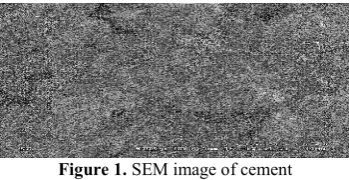
3. 1. Cement In this investigation, OPC 43 grade was used and it was tested as per Indian standard specifications [12]. Figure 1 shows the SEM image of cement.
3. 2. Alccofine AL-1203 was obtained from Ambuja Cement Ltd, Goa having the specific gravity of 2.9 confirming to ASTM C989-1999 was used in entire
Figure 1. SEM image of cement
investigation. The physical and chemical properties of AL are given in Tables 1 and 2. Figures 2 and 3 are shown SEM and EDX images of alccofine.
TABLE 1. Physical properties of Alccofine
Characteristics Test Results
Specific gravity 2.9 Specific surface area [m2/kg] 1200
Bulk density [kg/m3] 680
Particle Size in Micron
D10 1.5
D50 5
D90 9
TABLE 2. Chemical Properties of AL form EDAX
Characteristics of Element Results for EDAX
Weight % Atomic %
C K 45.69 57.64
O K 35.26 33.39
Al K 4.01 2.25
Si K 6.38 3.44
Ca K 8.66 3.27
Figure 2. SEM image of Alccofine
3. 3. Aggregates Natural river sand with specific gravity 2.68 was used conforming to zone II as per Indian standard specification. The crushed stone angular aggregate was used as coarse aggregate with the specific gravity of 2.79. The maximum size of the aggregate was limited to 20 mm.
3. 4. Water In this investigation, ordinary tap water available in campus was used for all concrete mixes.
4. DATA, AND EXPERIMENTAL INVESTIGATION
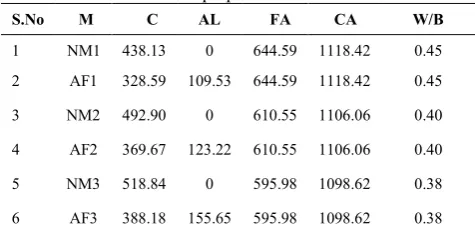
4. 1. Mix Proportion The ingredients of concrete i.e. Cement, coarse aggregate, and fine aggregate were mixed in the proper proportion by addition of water as shown in Table 3. Alccofine was added to the mixes as a replacement of cement by 25% mass.
4. 2. Preparation of Sample Mixing procedure and
curing method was kept the same for TGA, XRD and SEM samples. For TGA and XRD, the samples were ground and sieved through 63 lm sieve. To stop hydration and to remove physically bound water the solvent exchange method was adopted using acetone. A 100 mL of acetone was added to 30 g of the sieved sample in a plastic bottle and mixed vigorously by hand for about 3 min. Excess acetone was drained out and the process was repeated. The samples were then dried overnight in an oven at 40⁰C temperature. The dried samples were collected and stored in a sealed plastic container till the time of testing.
4. 3. Methods
4. 3. 1. Thermogravimetric analysis Total of twelve samples (with and without alccofine) were studied by Thermogravimetric analysis. Small samples were taken from the concrete cube and heat was applied from 25ºC to 1000ºC in a thermal analyzer with a rate of heating 10ºC/min. From TGA experiment, weight losses with respect to increasing temperature and peak temperature for the decomposition of hydrates like Ca (OH)2, calcite, calcium silicate hydrate and C-A-S-H.
TABLE 3. Mix proportions for trail mixes
S.No M C AL FA CA W/B
1 NM1 438.13 0 644.59 1118.42 0.45 2 AF1 328.59 109.53 644.59 1118.42 0.45 3 NM2 492.90 0 610.55 1106.06 0.40 4 AF2 369.67 123.22 610.55 1106.06 0.40 5 NM3 518.84 0 595.98 1098.62 0.38 6 AF3 388.18 155.65 595.98 1098.62 0.38
Units: M-Mix, C-Cement, AL-Alccofine, FA- Sand and CA-Gravel
W/B-Water to binder ratio in kg/m3
4. 3. 2. X-Ray Diffraction Analysis (XRD) XRD
is an important method used for the quantitative and qualitative analysis of hydrated cement concrete samples. The X-Ray diffraction is based on Bragg’s law. By using X-Ray diffraction test results, a graph between the angle at which the wave was diffracted and intensity of X-ray was determined. The XRD test was conducted on samples on the 28th day. The diffractometer with CuKu source having a wavelength of χ = 1.54À at the scanning speed of 2s/ step and the diffraction angle between 7° and 60° was employed for test conduction.
4. 3. 3. Scanning Electronic Microscope Analysis (SEM analysis) SEM analysis was used to determine the microstructure of the hardened concrete with and without alccofine. The concrete samples were taken in a small size of 5 mm, which consist of fine aggregate and mortar.
5. RESULTS AND DISCUSSION
5. 1. Thermogravimetric Analysis From
thermogravimetric analysis results, the mass loss along with the decomposition of all components with temperature was found. The thermogravimetric analysis showed that significant weight loss can occur in many ways. The primary effect from 25ºC to 100ºC had to do with the residual pore water which evaporated from capillary pores [13]. In this stage, the weight loss depended upon the adsorbed water, interlayer water and capillary pores. The second effect from 100 to 450ºC had to do with dehydration of calcium silicate hydrates, ettringite and C-A-H. The third at about 475-750ºC is due to the decomposition of calcium hydroxide formed during hydration as shown in Equation 1 [18].
Ca(OH)2 → CaO + H2O (1)
The last weight loss effect around 800ºC can be attributed to decarbonization of CaCO3 as shown in Equations (2) and (3).
Ca(OH)2+CO2 → CaCO3 + H2O (Carbonation) (2)
CaCO3 → CaO + CO2 (Decarbonation) (3)
Calcium hydroxide (%) = x x 100 (4)
The molecular weight of Calcium hydroxide is 74 and that of water is 18.
Bound water (%) = x 100 (5)
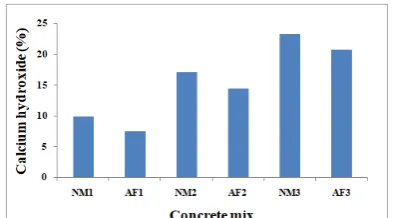
From obtained results percentage of calcium hydroxide was more in normal concrete but the percentage of bound water had more values in high dosage alccofine concrete compared to normal concrete [20] as shown in Figures 6 and 7. The percentage of calcium hydroxide was less in alccofine concrete because alccofine reacts with calcium hydroxide to form additional CSH gel whereas no such entity exists in normal concrete to react with the same thereby increasing the percentage of calcium hydroxide in normal concrete [21].
Figure 4. DSC curves of the concrete for different water to
binder ratios
Figure 5. Percentage of weight loss curves of the concrete for
different W/B ratio
Figure 6. Calcium hydroxide (%) of the concrete for various
W/B ratio
Figure 7. Bound water (%) of the concrete for various W/B
ratio
5. 2. X-Ray Diffraction Analysis (XRD) XRD analysis is a one of the method to find mineral composition like calcium silicate hydrate (C-S-H), calcium aluminosilicate hydrate (C-A-S-H), portlandite (Ca(OH)2) and ettringite present in the concrete [22]. Figures 8, 9 and 10 shows the peak intensities for control and alccofine concrete at different water to binder ratio (i.e. 0.38, 0.4 and 0.45).
The intensity of calcium hydroxide (Ca(OH)2) in the presence of alccofine at 2θ= 20.64 has increased compared to normal concrete for all water to binder ratios. Formation of Ca(OH)2 is more in normal concrete compared to alccofine concrete [14]. Further, the intensity of ettringite in the presence of alccofine at 2θ=22.87 has decreased compared to without alccofine. The peak intensity of calcium silicate hydrate at 2θ=26.46 has increased more in the presence of alccofine compared to normal concrete and the intensity of calcium aluminosilicate hydrate is more in normal concrete at 2θ=28.29 indicating rapid hydration. The formation of CSH is more in with high dosage alccofine concrete due to Ca(OH)2 converted to secondary CSH and therefore enhancing strength of the concrete[18-24].
Figure 8. XRD analysis of the concrete at W/B = 0.45
Figure 10. XRD analysis of the concrete at W/B = 0.38
5. 3. Scanning Electronic Microscope Analysis
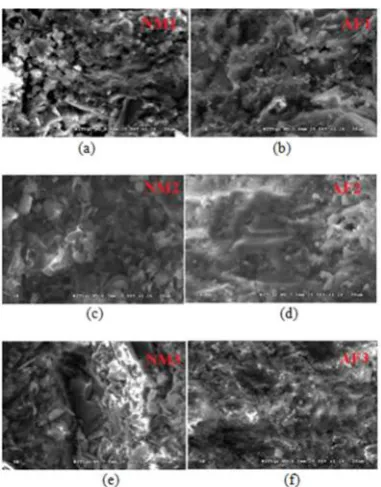
SEM images give information regarding the microstructure and surface morphology of calcium silicate hydrate and ettringite in concrete. It was observed that alccofine concrete gives less porous structure due to the formation of needles in voids compared to normal concrete at all water to binder ratios. With the addition of alccofine, concrete gives maximum strength compared to normal concrete due to full compact packing as a result of the filling of voids by alccofine [14]. Figure 11 SEM images of normal and high dosage alccofine concrete for different water to binder ratios.
6. CONCLUSION
In this research, the effects of alccofine on the thermal and microstructural properties of concrete were studied.
Figure 11. (a) Normal concrete at W/B is 0.45 (b) alccofine
concrete at W/B is 0.45 (c) Normal concrete at W/B is 0.4 (d) alccofine concrete at W/B is 0.4 (e) Normal concrete at W/B is 0.38 (f) alccofine concrete at W/B is 0.38
From the thermogravimetric analysis, alccofine concrete was found to have more bound water and less calcium hydroxide (due to pozzolanic action) with respect to normal concrete at different water to binder ratio. It was also found that alccofine concrete had less weight loss and decomposition of hydrates compared to normal concrete thereby making it more stable. From XRD and SEM analysis, alccofine decreased the porous microstructure and improved the formation of calcium silicate hydrate and calcium silicate aluminum hydrate in the concrete. Hence, from the results obtained in this study it can be concluded that substituting the cement in concrete by alccofine is a feasible mean considering enhanced properties and eco-friendly nature of concrete.
7. REFERENCES
1. Kumar SR, Amiya K. Samanta DKSR. An experimental study on the compressive strength of alccofine with silica fume based concrete. Applied Mechanics and Materials. Vol. 857, (2017), 36-40.
2. Jindal BB, Jindal BB, Singhal D, Sharma SK, Parveen. Suitability of Ambient-Cured Alccofine added Low-Calcium Fly Ash-based Geopolymer Concrete. Indian Journal of Science
and Technology, Vol. 10, No. 12, (2017):1-10.
doi:10.17485/ijst/2017/v10i12/110428
3. Saxena SK, Kumar M, Singh NB. Effect of Alccofine powder on the properties of Pond fly ash based Geopolymer mortar under different conditions. Environmental Technology and
Innovation, Vol. 9, (2018):232-242.
4. Pawar, M. S., and A. C. Saoji. "Effect of Alccofine on self compacting concrete." International Journal of Engineering
and Science, Vol. 2, No. 6 (2013): 05-09.
5. Suthar S, Shah SBK, Patel PPJ. Study on effect of Alccofine & Fly ash addition on the Mechanical properties of High performance Concrete, International Journal for Scientific
Research & Development, Vol. 1, no. 3 (2013): 464-467.
6. Sharma, S.K., Kumarb, P. and Roya, A.K., "Comparison of permeability and drying shrinkage of self compacting concrete admixed with wollastonite micro fiber and flyash",
International Journal of Engineering, Transactions B:
Applications, Vol. 30, No. 11, (2017), 1681-1690.
7. Bouzoubaa, N., Zhang, M. and Malhotra, V., "Mechanical properties and durability of concrete made with high-volume fly ash blended cements using a coarse fly ash", Cement and
Concrete Research, Vol. 31, No. 10, (2001), 1393-1402.
8. Zhang, D., Zhang, Y., Cheng, T. and Yuan, J., "New analytic method for subgrade settlement calculation of the new cement fly-ash grave pile-slab structure", International Journal of
Engineering-Transactions A: Basics, Vol. 29, No. 10, (2016),
1364-1371.
9. Palou, M.T., Kuzielová, E., Novotný, R., Šoukal, F. and Žemlička, M., "Blended cements consisting of portland cement– slag–silica fume–metakaolin system", Journal of Thermal
Analysis and Calorimetry, Vol. 125, No. 3, (2016), 1025-1034.
10. Mostari, M.S., Zaman, T., Sen, A. and Al Hassan, M.R., "Synthesis and characterization of porcelain body developed from rice husk ash", International Journal of
EngineeringTransactions A: Basics, Vol. 31, No. 1, (2017),
25-31.
reinforced concrete with supplimentary cementitious materials",
International Journal of Engineering-Transactions A: Basics,
Vol. 30, No. 7, (2017), 964-971.
12. Bode Venkata Kavyateja, J. Guru Jawahar and C. Sashidhar, “Investigation on Ternary Blended Self Compacting Concrete using fly ash and Alccofine”, International Journal of Recent
Technology and Engineering, Vol. 7, No. 6S, (2019), 447-451.
13. P. Narasimha Reddy and J. Ahmed Naqash, “Durability and Mechanical Properties of Concrete Modified with Ultra-Fine Slag”, International Journal of Innovative Technology and
Exploring Engineering, Vol. 8, No. 5, (2019), 875–881.
14. R. Ramachandra, and S. Mandal. "Prediction of Compressive Strength of High-Volume Fly Ash Concrete Using Artificial Neural Network." In Sustainable Construction and Building
Materials, Springer, Singapore, (2019), 471-483.
15. Chopra, D. and Siddique, R., Strength, permeability and microstructure of self-compacting concrete containing rice husk ash, BiosystemsEngineering, Vol. 130, (2015) 72-80.
16. Rathore, Rituraj S., and Arpit Chawda. "Partial Replacement of OPC by Silica Fume with M60 Grade Concrete." Journal of
Civil Engineering and Environmental Technology, Vol. 3, No.
8; (2016) 684-689.
17. Gayathri, K., K. Ravichandran, and J. Saravanan. "Durability and cementing efficiency of Alccofine in concretes." International Journal of Engineering Research &
Technology, Vol. 5, No. 5 (2016): 460-467.
18. BIS. 8112, Indian Standard 43 Grade Ordinary Portland Cement—Specification, Bureau of Indian Standards. 1989.
19. Alessandra Etuko Feuzicana de Souza Almeida, Eduvaldo Paulo Sichieri, “Thermogravimetric Analyses and Mineralogical Study of Polymer Modified Mortar with Silica Fume”, Materials
Research, Vol. 9, No. 3, (2006) 321-326,
20. Tao Long, Qingyuan Wang, Zhongwei Guan, Yu Chen, and Xiaoshuang Shi, “Deterioration and Microstructural Evolution of the Fly Ash Geopolymer Concrete against MgSO4 Solution”,
Advances in Materials Science and Engineering, 2017.
doi.org/10.1155/2017/424721
21. Neven Ukrainczyk, Marko Ukrainczyk, Juraj Sipusic, Tomislav Matusinovic, “Xrd And Tga Investigation of Hardened Cement Paste Degradation”, Conference on Materials, Processes, Friction and Wear MATRIB’06, Vela Luka, (2006).
22. Qi Zhang and Guang Ye, “Microstructure Analysis of Heated Portland Cement Paste”, Procedia Engineering, Vol. 14 (2011) 830–836.
23. Nuruddeen Muhammad Musa, “Thermal Analysis of Cement Paste Partially Replaced With Neem Seed Husk Ash”,
International Journal of Scientific & Engineering Research,
Vol. 5, No. 1, (2014): 1101-1105.
24. Alma Delia Rodríguez Martínez, Martha Lilia Domínguez Patiño, Rosa María Melgoza Alemán, Gerardo Antonio Rosas Trejo, “Characterization by Thermogravimetric Analysis of Polymeric Concrete with High Density Polyethylene Mechanically Recycled”, Journal of Minerals and Materials
Characterization and Engineering, Vol. 2, (2014): 259-263.
Experimental Study on TGA, XRD and SEM Analysis of Concrete with
Ultra-Fine Slag
TECHNICAL NOTE
P. Narasimha Reddy, J. Ahmed Naqash
National institute of Technology, Srinagar, Jammu & Kashmir, India
P A P E R I N F O
Paper history:
Received 23 February 2019
Received in revised form 25 April 2019 Accepted 02 May 2019
Keywords:
Alccofine
Thermogravimetric Analysis X-ray diffraction
Scanning Electron Microscope
. ! " ! # $ % &'() ! ( * + (, -. # / *" * $ 01 ! ( 2 * ) - 3 , 4, (% 6*+ 7) % 9& :*6 *
*&) % 6*+ 7 . -6 ; %< + (, ) =%> #! , . *? @ %< A ! ! + + % 6*+ 7 %< / *" - B %> . -<" &? )
25
٪
) E ( &>F9> G *&, - (
H <3
W / B (
& > 0,38 = 0,4 ! 0,45 N& O ! ->FN ! ! % 6*+ 7 !F6 . ) -P (
= ? 6 > Q -G - -G* %< * ) *R ->FN ! $& - 7 -. # > A N ) OR< S7 % &'() -+
٪
) T E . E.! ) ! (
٪
-. ? # ) 0+> - ? U V . > % %< *G* (
O ! ->FN ! %< T E . + A* & * 7 ) ! ) + T E . ) O + % 6*+ 7 ) %+ ! <+ W*+ ! +
SEM)
O + -. # XQ T E . + ) ! 9&> $ )
Y> *&, - * % 6*+ 7 -. # ? -<6 -N < - %> =%> & . &&. Z> E %< -. > ) [*R Y> ! ( \ B * $ 7 ] - -G* *( %< ( ^ & %>F9> G
. # X< * E> _