Development of a Sensorized Timber
Processor Head Prototype – Part 1: Sensors
Description and Hardware Integration
Jakub Sandak, Anna Sandak, Stefano Marrazza, Gianni Picchi
Abstract
Forest operations are in constant development to provide increasingly higher standards of economic and environmental sustainability. The latest innovation trends are concentrated in the generation, storage and management of data related to the harvesting process, timber products and logistics operations. Current technologies provide productivity and position, but only physical parameters are made available for timber products. The possibility of providing a comprehensive quality evaluation of roundwood early in the supply chain and linking the information to each log provides a new tool for optimization of the whole forest-timber supply chain. Current in-field methods for grading logs are based on visual rating scales, which are subjective, operator-dependent and time-consuming. As an alternative, a sensorized processor head was developed, featuring the following sensors: near infrared (NIR) spectrometer and hyperspectral cameras to identify surface defects, stress wave and time of flight sensors to estimate timber density, hydraulic flow sensor to estimate cross-cutting resistance and delimb-ing sensors to estimate branches number and approximate position. The prototype also de-ployed an RFID UHF system, which allowed the identification of the incoming tree and indi-vidually marked each log, relating the quality parameters recorded to the physical item and tracing it along the supply chain. The tested sensors were installed and designed to be inde-pendent, nevertheless, their integrated use provides a comprehensive evaluation of timber quality. This paper presents the technical solutions adopted, the main hindrances found and some preliminary results of the operative prototype as tested in laboratory and in forest op-erational conditions.
Keywords: timber quality, processor head, sensors, NIR, cutting forces
sions). The possibility to provide a comprehensive quality evaluation of roundwood early in the supply chain (at forest landing or roadside) and link the infor-mation to individual items (logs) provides a new tool for optimization of the whole forest-timber supply chain. Current in-field methods for grading logs are based on visual rating scales, which are subjective, operator-dependent and time-consuming. Assessment of commercial value of timber lots is a cumbersome activity. It implies the estimation of volume of log piles, segregated per different quality classes or assort -ments, where applicable. This practice is common in most countries and is essential for an effective value recovery of the produced round timber, being a pos-sible alternative for the sale of the whole standing or
1. Introduction
dimen-harvested lot based on a rough expert-based estimate of its value. As a drawback, accurate volume and qual-ity assessment has a high cost, which in the case of Italian Alps has been estimated at a value of 6–10 €/m3
(Forest Service of Autonomous Province of Trento, personal information). This higher value is also due to the practice of commercial counterparts to compare the assessment of two or more expert evaluators (one for each party), repeating the same measures twice and occasionally with contrasting results. Most EU countries lack a third neutral party providing a unique and mutually accepted value estimation for timber and biomass assortments such as the Swedish VMF association. Timber volume estimation and geometri-cal characteristics are regulated by the standard EN 1309-2:2006, while timber quality is assessed according to standard EN 1927-1:2008 (for Picea and Abies spe-cies). Both standards are based on manual measure-ments and visual grading, thus leading to high costs per unitary volume and, to a certain degree, to the subjectivity of results.
The introduction of timber processor heads has provided an instrument for automatic measurement of several geometrical properties of roundwood and, most of all, its volume based on piece length, top and base end diameter. Commercial processors install sen-sors to measure these parameters while processing trees and store the resulting data using the StanForD format standard (Skogforsk 2018).
Processors have been studied as a possibility to provide reliable volume data as an alternative to man-ual measurements. If properly and frequently cali-brated, timber processors proved to be sufficiently effective when dealing with larger assortments, while reliability decreased with pulpwood (Nieuwenhuis and Dooley 2006). A similar study on poplar planta-tions proved that processors may provide the same measuring precision as manual systems (Spinelli et al. 2011). Nevertheless, none of these experiences consid-ered quality parameters of timber assortments.
Innovation in this sector has frequently focused in the introduction of sensors and automation, with dif-ferent purposes (Lindroos et al. 2017). For instance, processor and forwarder booms have been equipped with sensors for precise recording of the head position (Lindroos et al. 2015), allowing detailed recording of the actions performed by the machine (e.g. each boom movement, including the position of the loads with respect to the machine), but also providing informa-tion useful for timber traceability. Miettinen et al. (2010) experimentally installed a stereo camera to test the feasibility of measuring the size and shape of pro-cessed logs, returning a digital model of logs even if
irregular light conditions proved to be an important limiting factor for this technology. Dowding et al. (2014) tested with encouraging results the possibility of estimating timber quality with acoustic sensors, simulating the deployment on processor heads. This application had been successfully installed on com-mercial processors, proving their capacity to segregate timber assortments according to wood stiffness in the forest (Walsh et al. 2014). Acuna and Murphy (2006) found that NIR could be used to predict Douglas fir wood density from chainsaw chips, which indicated the potential of this technique to be used to segregate logs on the basis of their density.
Focusing timber processing activity on maximum value recovery is a possible approach to increase the overall benefit while addressing one of the key aspects of Sustainable Forest Operations (SFO) (Marchi et al. 2018). Nevertheless, this also increases the complexity of the operation and as a consequence increases costs by reducing productivity. This calls for a compromise between the number of assortment classes and pro-ductivity (Tolan and Visser 2015). The same authors suggested that significant value and productivity ben -efits could be found if other parts of the supply chain were considered. For instance, early detailed determi-nation of log quality may provide a powerful tool to optimize the whole supply chain, by guaranteeing to end users the provision of the exact desired quality of timber. Based on this background and following the concept of supply-chain-level benefit of automated detection of quality parameters, a prototype of sen-sorized processor head had been developed in the framework of the EU project SLOPE (www.slopepro-ject.eu).
The prototype featured the following sensors: near infrared (NIR) spectrometer and VIS-NIR hyperspec-tral cameras to identify surface defects (e.g. resin pock-ets, rotten areas, etc.), stress wave and time of flight sensors to estimate timber density, hydraulic flow and pressure sensors to estimate cross-cutting resistance and delimbing sensors (on stroke piston and below delimbing knives) to estimate branch number and ap-proximate position on the log. The sensors were in-stalled and designed in order to be independent, thus leaving the option to install one or more of them, ac-cording to the specific requirements of the market, owner and end-users. Nevertheless, the whole set of sensors was designed to provide a comprehensive evaluation of timber quality, returning a »Quality In-dex« for each log as an alternative to visual grading performed according to the current standard.
automatic tagger. The former allows identification of the incoming tree, gathering information from the dig-ital forest inventory (Pichler et al. 2017) and, where available, cutting instructions to provide maximum value recovery (Picchi et al. 2015). The automatic tagger marks each log, relating the quality parameters record-ed to the physical it. Finally, a Wi-Fi communication system enables the machine to exchange data in real-time with logistic operators and end-users for online purchase. By relating to each log quality and quantity parameters automatically collected (thus impartially measured), an alternative service could be offered to manual measurement, reducing overall costs. Further-more, geographical and time data can be included, al-lowing for an effective traceability of timber products from the forest to the industry.
This paper presents the technical solutions adopt-ed, the main hindrances found and some preliminary results of the operative prototype as tested in labora-tory and in forest operational conditions.
2. Material and Methods
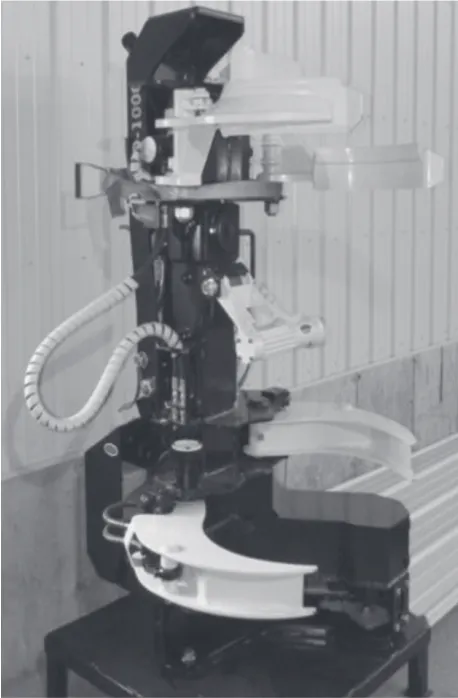
For the development of the prototype, a suitable base machine was identified through a comprehen -sive analysis among commercial timber processor heads. Creating a sensorized processor head is a con-siderable challenge, thus one of the desired features was an inherent construction simplicity, simplifying the tasks of reverse engineering and installation of new sensors and motors. Stroke processors were pre-ferred since the peculiar delimbing and measurement system could provide a series of benefits that will be described in the following paragraphs (2.4). Given these constraints, the model ARBRO 1000 S was cho-sen as the best suited base machine to develop the prototype (Fig. 1, for more details refer to www.pow-erforest.fi). To host the sensors, the base processor head was modified by extending the height of the chainsaw holding frame by 25 cm. This created an enclosed area, where a number of sensors and func-tions could be hosted and protected while benefiting from an optimal position to gather data from the cross section of processed logs.
The prototype was conceived as a system to test the most suitable technologies for timber quality sensing under real conditions. As such, in some cases, more than one system was installed to measure the same parameter, in order to assess the best perform-ing sensors considerperform-ing the quality of the results, robustness and reliability of the adaptation to the for-est environment.
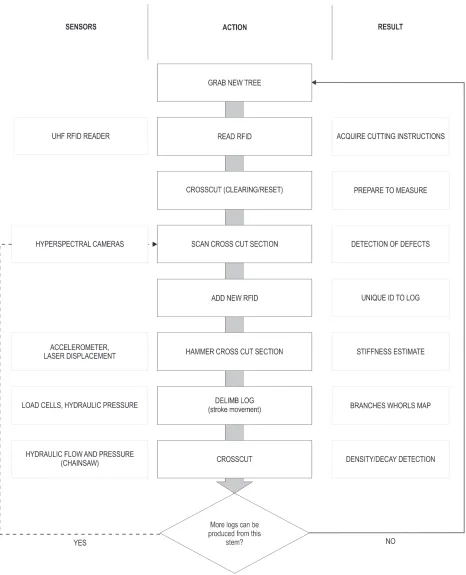
As previously mentioned, even if the sensors had been designed to be independent, the whole set was designed to provide a comprehensive evaluation of timber quality, returning a »Quality Index« QI for each log resembling the overall visual evaluation. The QI is a numerical indicator ranging from 0 to 1, indicating superior quality or resource suitability for a specific application with values close to 1. The complete evaluation was conceived as an automatic routine, starting with the incoming tree and final -ized after processing the last log and dropping the top of the tree on the slash pile (Fig. 2). Sensors will be described following the order programmed in the routine.
Each of the installed sensors consisted of a hard-ware component (sensor, case and supports, actuators or motors), controlling software to deploy the sensor, and an algorithm to interpret the raw data provided. The complete description of the system is too exten-sive to be included in this paper. Therefore, the paper will focus on hardware composition and technical so-lutions adopted.
Sensors provide raw data to the CompactRio NI-cRIO-9014 controller, connected to the industrial PC installed on the excavator. The latter also installs the
algorithms to interpret raw data into quality indexes, which are presented to the operator for decision mak-ing and stored on a portable hard disk (so called »black
box«). Optionally, all the data can be transmitted in real time via a GPRS connection, if available in the working location. The black box is a solution to pro-vide a backup of the acquired data, necessary when bad or no GPRS coverage is available in the area. In that case, the operator uploads the daily data to the central server by connecting the black box to the inter-net at his rest location.
2.1 RFID reader
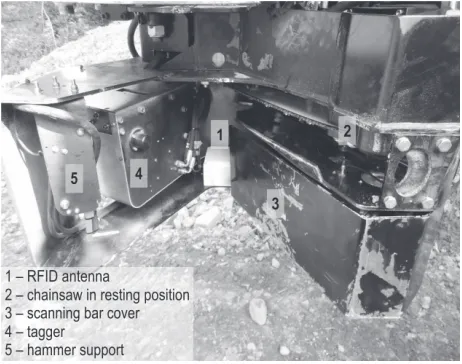
The processor was designed to work coupled with a cable yarder. In the work flow described by Picchi et al. (2015), felled trees are related to the digital forest inventory by manually applying a UHF RFID tag at the butt end of the trunk. This position provides a higher survival rate for the tags and the best condi-tions for automatic reading. For this purpose, an UHF RFID system was installed on the prototype, com-posed of a CAEN A528D Muon Compact embedded UHF RFID reader coupled with a X004 linearly polar-ized antenna (3 db gain) assembled in a protective PVC box (150x150x150 mm). The box was fixed on the frame wall opposite to the position of the incoming log (Fig. 3). This solution allowed for minimum dimen-sions and maximum reading capacity even if deployed with lower power limits (500 mW), generally imposed for handheld devices. The antenna has an angle of 32° downwards with respect to the main axle of the pro-cessor in order to effectively irradiate the whole cross -cut section of the log.
The system is completed by an automatic tagger, that inserts a new UHF RFID tag after each crosscut (new log). The tagger is located to the side during pro-cessing, and is moved in front of the log when acti-vated to mark the logs on the freshly cut surface.
2.2 Hyperspectral imaging camera and NIRS spectrometer
Hyperspectral and particularly Near Infra-Red spectroscopy have proved to have a high potential to identify timber characteristics (Sandak et al. 2016). De-ploying these tools on a processor would allow qual-ity determination of resources (logs) early in the pro-cessing chain, even before cross cutting of each log to the desired length. Measuring timber cross section with hyperspectral imaging provides a unique possi-bility to avoid production of low-quality logs (for ex-ample cutting out log sections containing rotten wood) and to determine the optimal path for use of the re-source. Coupled with chemometrics tools for raw data interpretation, hyperspectral imaging is regarded as capable of detecting several wood characteristics, such as presence of decayed wood, reaction wood, knots, resin pockets, as well as discriminating bark, sap and normal wood. Moreover, hyperspectral imaging tech-nology can be used for detailed determination of log diameter without bark.
This type of sensors was particularly challenging to install on a processor head due to their relative fra-gility, which has so far relegated them to laboratory use. Furthermore, it was necessary to identify sensors sensitive to the spectral characteristics of light reflect -ed from the rough surface of the section cross cut by the chainsaw. Also the selection and installation of optimal illumination for spectroscopic application was crucial, since illumination may vary greatly on a mov-ing machine in forest conditions. Finally, the develop-ment of chemometric models suitable to determine quality indexes was another crucial point for the suc-cess of the system.
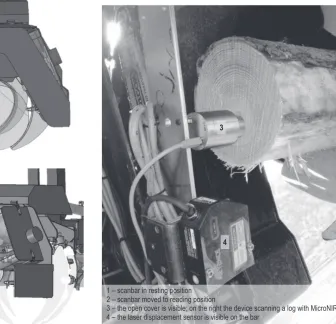
The objective of hyperspectral imaging is to create a picture as detailed as possible of the cross cut section. For this purpose, due to the limited focus distance of most cameras (few mm), it was decided to install the sensors on a scanning arm featuring a rotational move-ment similar to that of the chainsaw of the processor. Consequently, it becomes possible to produce lines of pixels representing different portions of the cross sur -face of the log, from bark to bark by installing one or more sensors on the scanning bar (Fig. 4).
For testing the prototype, two models of detectors were selected, featuring different characteristics. 2.2.1 Near infrared portable spectrometer MicroNIR PAT-U
this is a complete solution including spectrometer, il-lumination and base electronic in a single IP67 bundle. The sensor operates in a wavelength range of 950–1650 nm, with a focus distance of 0–15 mm, providing very high performance. Due to its present high unitary cost, just a single device was installed on the processor head prototype.
2.2.2 Hyperspectral imaging camera Hamamatsu C11708MA
This is an ultra-compact mini-spectrometer operat-ing in the spectral range from 640 to 1050 nm with a spectral resolution of 20 nm. The detector itself is com-pact (27.6×16.8×13 mm) and lightweight (9 g). How-ever, it does not include any focusing optics or built-in illumination, which must be added to the hardware configuration. Proper focus was achieved by installing a 60x Zoom Mini Phone Camera Lens Microscope Magnifier in front of each detector. The solution was cost effective and allowed an optimal distance be -tween lenses and measured surface (D=3 mm). The selection of the optimal illumination was more chal-lenging, and finally two complementary light sources
were adopted: a low-cost standard bulb with focusing lenses and a Visible-IR spectroscopic focused micro lamp T-3/4 as a supplementary source. This solution was optimal not only from the economic point of view, but also allowed finest cover of the whole spectral range for the sensor. Given the relatively low unitary cost of these sensors, it was possible to build an array of 16 mini-spectrometers, each with individual lenses and illumination, capable of spanning over the whole surface of the crosscut section.
The scanning bar was protected by a metal cover, which closes it completely when in idle (parking) po-sition. The cover is opened automatically when the scan bar is activated and starts rotating to gain the starting scanning position. Once it has reached the op-timal reading distance, the scan is executed all along the surface of the freshly cut log section. Finally, the scan bar returns to the idle position and the cover is closed. Inside the cover, the cameras were exposed to white and dark reference spectra, crucial to ensure proper sensor calibration and compensation for the temperature variation effect.
2.3 Sensors for timber stiffness assessment Although measurement of stress wave propaga-tion is not completely new in forest processors, it is foreseen to be a valuable source of information for the overall assessment of timber quality and grading of commercial assortments. The prototype tested two measuring systems, which assessed timber stiffness by measuring different parameters.
2.3.1 Stress wave propagation velocity measurement system
The physical basis for measurement of stress wave velocity is its close correlation with the modulus of elasticity of material. It is, therefore, possible to link high quality resources of superior mechanical charac-teristics with high velocity values. The usual sensor used for timber assessment is based on ultrasonic transducers. Such a solution was tested but it was finally rejected due to high attenuation of the ultra -sound by moist freshly cut wood. An important
limita-tion was also the poor coupling between the ultra-sonic sensor and the log, especially considering the presence of bark. Therefore, several pin shapes were tested in order to determine the optimal geometry to ensure the best contact between the accelerometer and the wood (Fig. 5). It was finally decided that the best coupling was achieved with sharp pins nailed directly to the wood through the bark layer.
Fig. 5 Accelerometers shapes tested (on the right side the best performing model)
The system implemented on the processor head was composed of a hammer fitted with a dynamic load cell. The hammer generated the impulse (or trigger) by hitting the crosscut section of the log freshly cut by the chain saw. Two accelerometers installed at the stroke (knives zone) and main body (grapples zone) of the processor allowed detection of the Time of Flight between the hammer and each accelerometer. The distance between both sensors varied depending on the stroke position and was between 1270 mm (stroke closed) and 1895 (stroke open). It is schemati-cally presented in Fig. 6. A prototype hydraulic system was developed to ensure proper coupling with the wood. This was achieved by pushing both accelerom-eters with a sharp pin toward the log side using hy-draulic actuators.
Measuring the stress wave is a separate technical operation, which requires the processor to idle for a short time while suspending the tree and tightening it to the machine body in order to minimize movements during measurement. The measurement sequence was implemented as a routine requiring the operator only to initiate the procedure by pushing a predefined but -ton. Once both accelerometer sensors were in contact with the wood, the hammer provided the impulse signal, which was detected by the sensors located in the zone of grapples and close to the knives. By know-ing the detailed position of the stroke durknow-ing measure-ment, it is possible to compute the stress wave veloc-ity as a ratio of the distance (hammer to accelerometer) and time of flight.
2.3.2 Free vibrations measurement system
An alternative to the stress wave velocity estima-tion by time-of-flight is to measure free vibraestima-tion of the trunk. In that case the stress wave propagates from the bottom of the log to its top and then part of the reflected energy turns back. It results in both acoustic effect and mechanical vibrations of the log. It can be measured by means of an interferometer or laser dis-placement sensor. The second option was selected for implementation on the prototype processor due to the relatively low cost of the hardware but most of all due to its compact size and light weight. The laser displace-ment sensor (Keyence LK-G87) was installed on the scan bar along with the hyperspectral camera and near infrared spectrometer. An additional accelerometer sensing vibrations of the scan bar itself was mounted in order to compensate for signals not related to the free vibrations of the tree.
The system deployed the same hammer (with dy-namic load cell) to provide the excitation to the tree grabbed by the processor. Prior to excitation, the scan bar moves from the idle/protected position to the front
of the freshly cross cut section (Fig. 3). Mechanical im-pact of the hammer causes audible effect and mechan -ical vibrations of the log. The laser displacement sen-sor records these vibrations together with compensation of the scan bar vibrations. The Fast Fourier Transforn is performed to determine the fre-quency spectrum and then to identify frequencies for diverse vibration modes. As a rule of thumb, highly stiff wood of high Modulus of Elasticity possesses high frequency of natural vibrations.
Similarly to the stress wave propagation velocity measurement system, the free vibrations procedure required a short interruption in the processing opera-tion. In this time the protective cover of the scan bar opened, the scan bar moved to the optimal scanning position, and the hammer impacted the log.
2.4 Load cells on knives, hydraulic pressure of stroke
The use of a stroke processor as base machine al-lowed for the implementation of a complete system of measurement of cutting forces while delimbing. This can be regarded as an important quality aspect, not yet implemented in any other machine (Fig. 7). This is pos-sible by means of two different sensors, acting in syn -ergy:
Þ load cells installed on the two moving delimb-ing knives
Þ hydraulic pressure of the stroke and log length with the overall external quality of the processed log.
For such purpose, the supports of the delimbing knives had been modified to host a load cell each, re -turning the longitudinal strain due to friction with the bark (base value) and to the impact with branches (goal value). Delimbing knives cover most of the cir-cumference of the trunk and nevertheless the
es removed by the fixed knives would not be recorded. This is the function of the second sensor, and hydrau-lic pressure meter, which allows to calculate the hy-draulic force required by the main piston to move the delimbing knives forward with the stroke movement. The returned value could be per se an index of »branchiness«, but it can be used to determine the de-limbing effort on the fixed knife according to the fol -lowing formula (Eq. 1):
force_central =
force_stroke – (force_left + force_right) (1)
Given the peculiar stroke system used by the pro-cessor head, it is also possible to determine the posi-tion of the branches on the length of the log by using a linear encoder integrated with the stroke, creating a map of location and size of branches or whorls on the trunk (Fig. 8).
This analysis does not require additional working time, as it is performed during the normal actions of delimbing, providing valuable information without hindering the productivity of the processor.
2.5 Cutting forces by chainsaw crosscutting The last action performed on each log is crosscut-ting. Even with this operation, it is possible to gather valuable quality information. In fact, by relating chain saw cutting forces, oil flow velocity, hydraulic pres -sure and log diameter, it is possible to estimate the quality (density) of the processed log. The hydraulic power is computed in [N*m/s = W] according to the following formula (Eq. 2):
hydraulic_power =
hydraulic_flow * (pressure_inlet – pressure_outlet)
[m3/s * N/m2] (2)
where data is provided by a hydraulic flow sensor, and the hydraulic motor inlet and outlet pressure. For
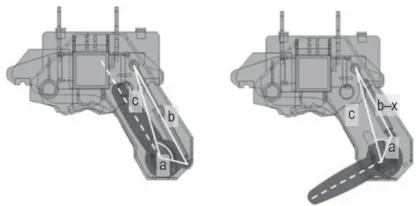
a precise estimate, the algorithm requires to be inte-grated with further data, such as the position of the saw bar, the log diameter at the position correspond-ing to cross cut location and the number of cross cuts done by the saw so far without tool re-sharpening. The hydraulic power is normalized according to the cut-ting length, defined here as the length of the chain saw contact with the log at any moment of cutting, com -puted according to the following formulas (Eq. 3): Saw_position =
q = 123° – arccos æçç + - - ö÷÷
è ø
2 2 ( )2
2
a c b x
ac (3)
Where:
a, b, c dimensions of the mechanical parts of the chain saw system as shown in Fig. 9
x extension of the hydraulic cylinder q chain saw angle (0° rest position).
3. Results and Discussion
The prototype was tested both in laboratory and in forest conditions within the framework of the demon-stration pilots of the SLOPE project, proving the gen-eral validity of the solutions adopted. However, the Fig. 8 Example of the knots map representation, potentially to be used by the operator for deciding optimal crosscut position and selection of the produced assortment
tests were not balanced for all sensors, since not all of them could be installed on all occasions. Furthermore, for most analysis, no reference data could be gathered to validate the system (e.g. stiffness of logs measured with an official system to be compared with the output of the prototype). For the same reason, the algorithms designed for the interpretation of raw data, still re-quire some calibration based on validation tests. Tests are ongoing for the validation of some of the promis-ing sensors, and the results, as well as the software of data interpretation, will be the subject of a future pub-lication. The main remarks and lessons learnt regard-ing each sensor system deployed are reported below.
3.1 RFID reader
Forest tests of the RFID system resulted in an effec -tive capacity to detect incoming trees. Nevertheless, reading rate was about 80%, while the target is to de-tect all active RFID tags. Further studies are ongoing on installing a circularly polarized antenna, which delivers less energy but is more suitable for operation with unpredictable reading angles, such as those of a tree landed by a cable yarder. The RFID tagger proved to have satisfactory reliability for a prototype designed Fig. 10 Identification of the new RFID tag applied by the tagger
from scratch. Further commercial development would greatly benefit from the experience gained from this first device.
3.2 Hyperspectral imaging camera and NIRS spectrometer
The hyperspectral system has not been fully in-stalled on the prototype for extensive testing in the forest. Manual simulations of the scanbar proved the validity of the concept, capable of discriminating sev-eral quality aspects, visible or not to human eye, such as detecting first stages of wood decay (Fig. 11). Nev -ertheless, some of the main challenges, such as envi-ronmental light variations, vibrations and resistance to shocks require further investigation.
3.3 Sensors for timber stiffness assessment
Stress wave measurements proved to be effective, returning consistent data regarding stiffness of the logs produced. The operation required 7–8 seconds, reducing the productivity of the processor. The geom-etry of the pins and the relative actuators require revi-sion since, by running the sensor in operational condi-tions, the spikes were frequently twisted. Raw data results have not been compared with reference meth-ods for assessing timber stiffness of the samples, but studies are ongoing to validate the system.
3.4 Load cells on knives, hydraulic pressure of stroke
Cutting forces as measured during debranching proved to be a valuable quality parameter. The related sensors are relatively easy to install and maintain, while representing a limited cost compared with oth-er systems tested. Furthoth-er research is ongoing to vali-date the system and provide an optimal interpretation of the raw data, filtering out the base resistance given by the friction of the knives with the tree bark. The robust structure of this sensor, coupled with the ab-sence of delays in the processing activity, makes this system one of the most promising among those tested.
3.5 Cutting forces by chainsaw crosscutting
Wood density measured by the cutting resistance of the chain saw during cross cutting benefits from the same advantages as delimbing forces: a robust sensor-ing structure and absence of delays in the timber pro-cessing activity. However, more refined estimate will require careful testing of the cutting edge dulling and other possible parameters affecting cutting forces (such as variations in wood moisture content, presence of reaction wood, temperature and viscosity of hy-draulic oil, among others).
4. Conclusions
Project SLOPE had the scope to develop intelligent machines to work in mountain forests. The resulting prototype of a sensorized timber processor is a demon-strative study of the potential of automated timber quality assessment early in the supply chain. The im-plementation of this pioneering concept could greatly optimize the forest-timber production process, with important cost reductions for the whole system and providing a tool to deliver to end users exactly the as-sortments of the required quality (and quantity) rather than woodlots to be further classified in the sawmill. The first stage demonstrated the practical feasibility of installing several sensors on a processor head and re-trieving raw quality data related to each produced log. Tests identified the best performing, or most reliable solutions for each of the parameters to be measured. The following steps of this research will be the valida-tion of each quality index generated by interpreting the raw data with a dedicated algorithm, and the creation of a weighted evaluation matrix. By interpolating all the quality indexes recorded by the sensorized proces-sor, the matrix will return a unique quality index, which may be a possible alternative to the visual qual-ity grading systems for roundwood currently in use.
Acknowledgements
This work has been conducted within the frame-work of the project SLOPE receiving funding from the European Union’s Seventh Framework Programme for research, technological development and demon-stration under the NMP.2013.3.0-2 (Grant number 604129). The authors also gratefully acknowledge the European Commission for funding the InnoRenew CoE project (GA #739574) under the H2020 Wide-spread-Teaming program and the Republic of Slove-nia (investment funding of the Republic of SloveSlove-nia and the European Union of the European Regional Development Fund).
5. References
Acuna, M.A., Murphy, G.E., 2006: Use of near infrared spec-troscopy and multivariate analysis to predict wood density
of Douglas-fir from chain saw chips. Forest products journal
56(11/12):67–72.
Dowding, B., Murphy, G., Murphy, G., 2014: Estimating Within Tree Spatial Changes in Acoustic Velocity in Felled
Douglas-fir Stems. International Journal of Forest Engineer -ing 22(1): 24–34.
Review of Technological Innovation. Croatian Journal of
Forest Engineering 38(2): 243–258.
Lindroos, O., Ringdahl, O., La Hera, P., Hohnloser, P., Hell-ström, T., 2015: Estimating the Position of the Harvester Head – a Key Step towards the Precision Forestry of the
Future? Croatian Journal of Forest Engineering 36(2): 147–
164.
Marchi, E., Chung, W., Visser, R., Abbas, D., Nordfjell, T.,
Mederski, P.S., McEwan, A., Brink, M., Laschi, A., 2018: Sus-tainable Forest Operations (SFO): A new paradigm in a changing world and climate. Science of the Total Environ-ment 634: 1385–1397.
Miettinen, M., Kulovesi, J., Kalmari, J., Visala, A., 2010: New
Measurement Concept for Forest Harvester Head. In: How-ard A., Iagnemma K. KA (ed) Field and Service Robotics. Springer Tracts in Advanced Robotics, 35–44 p.
Nieuwenhuis, M., Dooley, T., 2006: The Effect of Calibration
on the Accuracy of Harvester Measurements. International
Journal of Forest Engineering 17(2): 25–33.
Picchi, G., Kühmaier, M., Diaz Marques, J.D.D., 2015: Sur -vival Test of RFID UHF Tags in Timber Harvesting
Opera-tions. Croatian Journal of Forest Engineering 36(2): 165–174.
Pichler, G., Poveda Lopez, J.A., Picchi, G., Noland, E., Kast -ner, M., Stampfer, K., Kühmaier, M., 2017: Comparison of remote sensing based RFID and standard tree marking for timber harvesting. Computers and Electronics in Agriculture 140: 214–226.
Sandak, A., Sandak, J., Böhm, K., Hinterstoisser, B., 2016: Near infrared spectroscopy as a tool for in – field determina
-tion of log / biomass quality index in mountain forests. Jour -nal of Near Infrared Spectroscopy 24(6): 587–594.
Skogforsk, 2018: StanForD project. www.skogforsk.se/eng-lish/projects/stanford/
Spinelli, R., Magagnotti, N., Nati, C., 2011: Work quality and
veneer value recovery of mechanised and manual
log-mak-ing in Italian poplar plantations. European Journal of Forest
Research 130(5): 737–744.
Tolan, A., Visser, R., 2015: The effect of the number of log
sorts on mechanized log processing productivity and value
recovery. International Journal of Forest Engineering 26(1):
36–47.
Walsh, D., Strandgard, M., Carter, P., 2014: Evaluation of the Hitman PH330 acoustic assessment system for harvesters.
Received: April 30, 2018
Accepted: July 02, 2018
Authors’ addresses: Jakub Sandak, PhD
e-mail: [email protected] INNORENEW CoE
Livade 6 SI-6310 Izola SLOVENIA
Andrej Marušič Institute University of Primorska Muzejski trg 2
SI-6000 Koper SLOVENIA CNR-IVALSA via Biasi 75
I-38010 San Michele all’Adige ITALY
Anna Sandak, PhD
e-mail: [email protected] INNORENEW CoE
Livade 6 SI-6310 Izola SLOVENIA
Faculty of Mathematics
Natural Sciences and Information Technology University of Primorska
Glagoljaska 8 SI-6000 Koper SLOVENIA CNR-IVALSA via Biasi 75
I-38010 San Michele all’Adige ITALY
Stefano Marrazza
e-mail: [email protected] COMPOLAB
via dell’Artigianato 53 I-57121 Livorno ITALY
Gianni Picchi, PhD * e-mail: [email protected] CNR-IVALSA
via Madonna del piano 10 I-50019 Sesto Fiorentino ITALY