Issues
ISSN: 2146-4138
available at http: www.econjournals.com
International Journal of Economics and Financial Issues, 2015, 5(Special Issue) 379-384.
2nd AFAP INTERNATIONAL CONFERENCE ON ENTREPRENEURSHIP AND BUSINESS MANAGEMENT (AICEBM 2015), 10-11 January 2015, Universiti Teknologi Malaysia, Kuala Lumpur, Malaysia.
Enhancing Performance: Examining the Role Played by High
Performance Work System
Rabia Imran
1*, Mehwish Majeed
2, Abida Ayub
31Department of Management and Marketing, College of Commerce and Business Administration, Dhofar University, Salalah, Oman, 2University Institute of Management Sciences, University of Arid Agriculture, Rawalpindi, Pakistan, 3Government Postgraduate College, Rawalpindi, Pakistan. *Email: [email protected]
ABSTRACT
The aim of this study is to examine the role of high performance work system (HPWS) in increasing performance of the employees. It further explores the mediating role played by organizational citizenship behavior (OCB) and organizational commitment in HPWS and performance relationship. A purposive sample of 330 respondents from telecom sector of Pakistan is selected for the study. The results reveal the fact that HPWS has a strong positive impact on performance. The hypothesized mediating roles of organizational commitment and organizational OCB are also partially supported. Implications and future research are also discussed.
Keywords: High Performance Work System, Organizational Commitment, Organizational Citizenship Behavior, Performance
JEL Classifications: L2, L25
1. INTRODUCTION
Academic researchers are now paying extra attention on different human resource practices that can enhance performance of the business organization in the long run. Business organizations are also giving an extra emphasis on human resource practices in order
to increase profitability and productivity. High performance work
system (HPWS) has emerged as an interesting topic not only for practitioners but also for academician. Though, research scholars have examined how individual human resource practices affect
the performance and efficiency of any organization yet little focus
is being given on bundling these practices.
Though, past literature has confirmed the existence of a strong
association between human resource activities and performance (Boxall and Macky, 2007; Yasir et al., 2013) yet there are still a lot of things those needs to be focused upon (Purcell et al., 2009). The current body of knowledge still shows some doubts in this relationship probably because main factors that contribute to this relationship are still not discovered (Danford et al., 2008). More
than two decades are being dedicated to the research on human resource bundles but still academicians and research scholars have failed to answer several very basic questions about the interrelationship among HPWS and performance (Guest, 2011).
Careful analysis of existing academic literature on HPWS points out two different schools of thoughts. First being a strong supporter of the HPWS and its effect on performance, suggesting adoption of different human resource practices as they enhance performance (Boxall and Macky, 2009). The other one still claims the existence of a need for further research as there are still a lot of confusions and misconceptions (Dany et al., 2008). This confusion leads to an urge to explore this relationship in detail.
The relationship between HPWS and performance does not exist in
isolation. Future studies are needed for confirming or denying this
(Boxall and Purcell, 2011). The current study has tried to fill the
gap by introducing two variables; organizational commitment and organizational citizenship behavior (OCB) that explain the association between HPWS and performance in a better way.
A large number of researchers have studied high performance work practices and its impact on organizational output in European context ignoring the Asian context. There is a need of exploring this relationship in developing countries (Mihail et al.,
2013). This study is an attempt to fill this gap by conducting a
study on HPWS and performance in a developing country like Pakistan.
2. REVIEW OF LITERATURE
2.1. HPWS
HPWS generally constitutes as a bundle of different human resource practices, which are being adopted by the organization for carrying out its operations smoothly (Takeuchi et al., 2009; Searle et al., 2011a). The bundle thus creates synergy leading to different organizational outcomes (Purcell and Kinnie 2007; Wright and Nishii 2007). Performance is a key variable of interest for the researchers, academicians and managers as it is the ultimate outcome of all the efforts done by the organizations. It is useless to adopt a high performance system if it fails to increase employee performance (Kaufman, 2010). Existing literature is evident of the relationship between HPWS and performance outcomes (Jiang et al., 2012; Gardner et al., 2011; Kaufman, 2010). Critical analysis
of past literature identifies resource-based theory as a support of
exploring and understanding the unique interdependence among HPWS and performance (Barney, 2001; Boselie et al., 2005).
Different frameworks, approaches, measures and theories are developed in the past couple of years just to get more information about the HPWS-performance relationship and its impact on long term survival of the organization (Combs et al., 2006). Each of the studies investigated the impact of high performance management system on different variables like organizational productivity, employee turnover, employee performance, organizational OCB, organizational commitment etc. (Birdi et al., 2008). In the light of above literature following hypothesis is suggested:
H1: HPWS has a positive impact on performance.
2.2. Organizational Commitment
Organizational commitment is a complex term as it focuses on certain behavior and attitude of employees; this is why there are
several different definitions for this variable (Coyle-Shapiro et al.,
2006). Though, there are various determinants of organizational commitment such as managerial support, ethical leadership, organizational justice etc. (Meyer et al., 2002). However, it is strongly believed that bundle of HR practices if followed in an organization may lead to higher levels of commitment among its employees (Edgar and Geare, 2005). According to Allen et al. (2003) there exists a positive association between high performance work practices and various individual level variables such as job satisfaction and commitment.
The existing literature clearly indicates that organizations adopting group of human resource activities have more committed employees (Meyer and Smith, 2000). This means that there exists a strong correlation between skill enhancing work system and organizational commitment. Higher level of commitment among
employee is quite beneficial for the organization as committed
employees respect the goals and values of the organization and uses all their resources for achieving these goals (Meyer et al., 1993). Therefore, we anticipate following hypothesis:
H2: HPWS has a positive influence on organizational commitment.
Organizational commitment in simple words is a positive gesture shown by employees, it increases the bonding among employees and organization and it also creates an urge in the employees to
work harder and more efficiently (Meyer et al., 2012). It creates a
sense of closeness among employees as a result of which they start to feel positively about their organization. This also sometimes leads to the feeling of being proud to be a part of their organization (Meyer and Allen, 1984). Here, the question raises that why and when employees have this beautiful feeling. According to a study, employees feel committed towards organization only when their organization reaches up to or beyond their needs and expectations (Bagraim, 2003). It is believed that organizational commitment increase employee performance up to a great extent as committed employees consider organizational goals as their personal goals and work hard to achieve these goals (Guy and Michel, 2007). Following preposition is suggested:
H4: Organizational commitment is positively related to performance.
HPWS leads to different employee outcomes including organizational commitment that further leads to organizational level outcomes including an increase in organizational productivity (Combs et al., 2006). In fact, it is strongly assumed that skills enhancing work systems create positive feeling among employees about their organization, which leads to higher organizational commitment,
and as a result they start to perform more efficiently and effectively
which results in an increase in performance (Simard et al., 2005).
The existing literature reveals the importance of bundle of different human resource activities in enhancing the level of commitment and loyalty towards the organization (Gould-Williams, 2003). When an organization adopt bundle of human resource practices than its employees feel obligated to utilize all their intellectual resources
efficiently in order to help the organization achieve its strategic goals
and objectives (Meyer and Smith, 2000). In other words, presence of HPWS leads to an increase in the morale and commitment of employees leading to an increase in their performance (Guy and Michel, 2007; Simard et al., 2005). Therefore it is hypothesized that:
H6: Organizational commitment mediates the relationship between HPWS and performance.
2.3. Organizational OCB
Organizational OCB refers to certain behaviors shown by the
but also for the organization (Peloza and Hassay, 2006). These behaviors may include helping the coworker in performing his job duties, motivating other employees etc. HPWS is said to have a direct impact on organizational outcomes including productivity,
turnover, efficiency, customer satisfaction, organizational OCB
and financial outcomes (Becker and Gerhart, 1996). These practices not only increase employee’s motivation but also enhance organizational OCB among them (Becker and Huselid, 1998). Following hypothesis is suggested that:
H3: If there is HPWS then there will be higher OCB.
Organizational OCB is given great important as it enhances
performance and is highly beneficial for every organization
(Bolino and Turnley, 2003; Koys, 2001). If the employees are provided with efficient HR practices then they start to feel committed and they also develop organizational OCB that leads to an increase in their performance (Nishii et al. 2008).
Researches established that OCB s are the voluntary behaviors exhibited by the employees that are important for various organizational outcomes (Podsakoff et al., 1997). A positive relationship between OCB and performance is exhibited by past researches (Nishii et al., 2008; Whitman et al., 2010). The analysis of existing literature on HPWS and organizational OCB s leads to the development of following hypothesis to be tested in this study. Therefore, we suggested following hypothesis is anticipated:
H5: Organizational OCB has a positive relationship with performance.
Research conducted by Messersmith et al., (2011) anticipated that
HPWS influence performance through their ability to enhance
OCB. After an in-depth analysis of existing literature on HPWS and performance, this study suggest that there exists a positive impact of HPWS and Organizational OCB and OCB further leads to performance (Sun et al. 2007). Therefore, following hypothesis is suggested:
H7: The relationship between HPWS and performance is mediated by organizational OCB.
3. METHODS
3.1. Sample
A purposive sample of 330 respondents from telecom sector of Pakistan was selected for the study. The sample consisted of 74% male and 26% females. Majority of the respondents were from the age group of 31-40.
3.2. Measures
A 27 items scale developed by Sun et al. (2007); 18 items scale developed by Allen, (2003); 30 items scale developed by Kumar et al., (2009) and 5 items scale developed by Williams and Anderson (1991) were used to measure HPWS, Organizational commitment, OCB and employee performance respectively. All these variables are measured with 5 points likert-type scale ranges from 1 (strongly disagree) to 5 (strongly agree).
4. RESULTS
The results of the study are as follows in Table 1
The Table 1 shows that scales are highly reliable to be used with alpha values ranging from 0.74 to 0.85. The correlation matrix reveals that Performance and HPWS (r=0.81, p<0.01); Performance and organizational commitment (r=0.84, p<0.01); performance and organizational OCB (r=0.83, p<0.01); HPWS and organizational OCB (r=0.88, p<0.01); organizational commitment and organizational OCB (r=0.84, p<0.01) are positively and
significantly correlated.
4.1. Testing Mediation Effect
The hypothesized mediation effect was tested using assumptions of Baron and Kenny (1986).
Table 2 reveals the mediation analysis of Organizational Commitment as a mediator. The results show that after the inclusion of Organizational Commitment the beta weight of HPWS
substantially reduced (0.81-0.41) but remain significant. This is a
case of partial mediation (Baron and Kenny, 1986). The value of R² change= 0.134 explain variance of 13.4% by additional effect in performance due to organizational commitment.
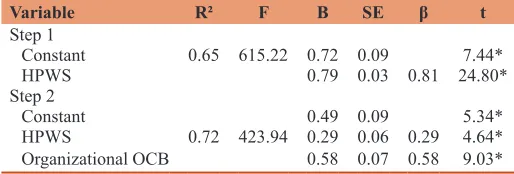
Table 3 reveals the mediation analysis of Organizational OCB as a mediator. The results show that after the inclusion of Organizational OCB the beta weight of HPWS substantially
reduced (0.81-0.29) but remain significant. This is a case of
partial mediation (Baron and Kenny, 1986). The value of R² change = 0.069 explains variance of 6.9% by additional effect in performance due to Organizational OCB.
5. DISCUSSION
The study was aimed at examining the effect of HPWS on the employee performance. It further explores the presence of two very important variables Organizational commitment and organizational citizen ship behavior as mediators in this relationship.
Hypothesis one anticipated a positive impact of high performance system on employee performance. The supposition held true as the results revealed a positive impact. The results were inline with the Past literature as HPWS was found to have a strong and positive impact on performance (Boxall and Macky, 2007; Gardner et al., 2011; Jiang et al. 2012; Kaufman, 2010; Paauwe, 2009). The bundle of human resource practices encourage employees to
increase their performance as they feel satisfied that all their HR
related issues are being addressed. Successful managers invest in their HR systems to boost organizational performance.
Third hypothesis of this study indicates a positive relationship between HPWS and organizational OCB, which is also proved by the result of this study. Employees start developing organizational OCB as a result of HPWS (Becker and Huselid, 1998; Nishii et al., 2008). The bundle of HR practices develops a feeling of security and care thus employees get involved in voluntary behaviors towards the organization.
Forth hypothesis suggest the positive relationship between organizational commitment and employee performance. Results of this study and results of past studies support this relationship. Employees feel committed towards organization only when their organizational policies are up to their needs and expectations. Committed employees consider organizational goals as their personal goals and work hard to achieve these goals (Bagraim, 2003; Guy and Michel, 2007). Thus in order to have boost performance organizations strives to have committed employees.
Fifth hypothesis predicted a positive relationship between OCB and employee performance. This hypothesis was accepted in the light of results of this study. Many past studies also proved
this relationship and reveal a positive and significant association
between OCB and performance (Nishii, Lepak and Schneider, 2008; Whitman et al. 2010).
The hypothesized mediating roles of organizational commitment (sixth hypothesis) and Organizational citizenship (Seventh hypothesis) behavior between HPWS and employee performance were partially supported. The organizations that adopt HPWS are able to develop a motivated feeling among the employees to utilize
all their intellect efficiently for the achievement of organizational
goals (Meyer and Smith, 2000). In other words, presence of HPWS leads to an increase in the morale and commitment of employees leading to an increase in their performance (Guy and Michel, 2007; Simard et al, 2005). On the other hand, HPWS creates a OCB among the employees that result in increased performance (Messersmith et al., 2011; Sun et al., 2007).
6. LIMITATIONS AND FUTURE RESEARCH
Despite its significance the study is limited due to certain reasons. Firstly, the variable of HPWS is uni-dimensional. Future researches may consider the various dimensions of HPWS for having a meaningful analysis with performance. Secondly, the results of the study are limited due to its self-reported measures.
Future researches may benefit from dyadic analysis for a clear
picture. Thirdly, the study is limited due to its cross-sectional study design. Future researches may examine similar relationships in a longitudinal design. Lastly, the research only focuses on one sector i.e., telecom sector of Pakistan. Future researches may replicate the study in other sectors.
6.1. Implications
This study offers theoretical as well as practical implications for business organizations in several ways. Firstly, it proves the existence of a strong relationship between HPWS and performance of employees, which teaches the business entrepreneurs to pay an extra attention on different human resource activities being used in their organizations.
This paper moves a step forward in explaining the concept of high performance work activities particularly with reference to Pakistani scenario. Pakistani businessmen can use the results of this study for achieving better performance by adopting bundle of human resource activities. This study has also tried to show a clear picture of the effectiveness of different human resource practices being followed in Pakistani telecom sector and their impact on the performance.
This study suggests that instead of using human resource practices individually, the companies should use bundle of different HR practices in order to get better results. It also focuses on the
importance of adopting efficient recruitment, training, performance
management and other related human resource practices. This study will surely help the human resource managers in devising
Table 2: Regression analysis for HPWS and organizational commitment with performance (n=330)
Variable R² F B SE β t
Step 1
Constant 0.72 0.09 7.44*
Performance
work systems 0.65 615.22 0.79 0.03 0.81 24.80* Step 2
Constant 0.29 0.08 2.89*
HPWS 0.78 110.81 0.41 0.04 0.41 10.96*
Organizational
commitment 0.56 0.04 0.54 14.36*
*p<0.000 (R² change=0.134), HPWS: High performance work systems, SE: Standard error
Table 3: Regression analysis for HPWS and organizational OCB with performance (n=330)
Variable R² F B SE β t
Step 1
Constant 0.65 615.22 0.72 0.09 7.44*
HPWS 0.79 0.03 0.81 24.80*
Step 2
Constant 0.49 0.09 5.34*
HPWS 0.72 423.94 0.29 0.06 0.29 4.64*
Organizational OCB 0.58 0.07 0.58 9.03*
*p<0.000 (R² change=0.069), HPWS: High performance work systems, OCB: Citizenship behavior, SE: Standard error
Table 1: Descriptive statistics, alpha reliabilities and correlation matrix of all variables (n=330)
S.no Variables Items Mean SD I II III IV
I Performance 5 3.30 1.40 (0.74)
II High performance work systems 27 3.34 2.63 0.81** (0.85)
III Organizational commitment 18 3.45 2.74 0.84** 0.73** (0.79)
IV Organizational citizenship behavior 30 3.94 2.44 0.83** 0.88** 0.84** (0.78)
efficient human resource strategies for the betterment of organization. This study has also contributed in resource-based view and social exchange theory as the result of this study is in consistent with both these theories.
This study is quite helpful for the top management of Pakistani telecom sector, as it has pointed out those factors that can directly affect the performance of employees in the long run. Employees are the assets of any organization and this study helps the business
enterprises to get maximum benefit from this asset. In short, this
study is quite helpful for the decision makers as the result of this study can be used to explore, identify and implement those human resource practices that are useful not only for the organization but also for employees.
REFERENCES
Allen, N. (2003), Organizational commitment in the military: A discussion of theory and practice. Military Psychology, 15, 237-253.
Allen, D.G., Shore, L.M., Griffeth, R.W. (2003), The role of perceived organizational support and supportive human resource practices in the turnover process. Journal of Management, 29(1), 99-118. Bagraim, J.J. (2003), The nature of measurement of multiple commitment
foci amongst South Africa knowledge workers. Management Dynamics, 12(2), 13-23.
Barney, J.B. (2001), Is the resource based “view” a useful perspective for strategic management research? Yes. Academy of Management Review, 26, 41-57.
Baron, R.M., Kenny, D.A. (1986), The moderator–mediator variable distinction in social psychological research: Conceptual, strategic, and statistical considerations. Journal of personality and social psychology, 51(6), 1173.
Becker, B., Gerhart, B. (1996), The impact of human resource management on organizational performance: progress and prospects. Academy of Management , 39(4), 779-801.
Becker, B.E., Huselid, M.A. (2006), Strategic human resources management: Where do we go from here? Journal of Management, 32(6), 898-925.
Birdi, K., Clegg, C., Patterson, M., Robinson, A., Stride, C.B., Wall, T.D., Wood, S.J. (2008), The impact of human resource and operational management practices on company productivity: a longitudinal study. Personnel Psychology, 61, 467-501.
Bolino, M.C., Turnley, W.H. (2003), Going the extra mile: Cultivating and managing employee citizenship behavior. Academy of Management Executive, 17(3), 60-71.
Boselie, P., Dietz, G., Boon, C. (2005), Commonalities and contradictions in HRM and performance research. Human Resource Management Journal, 15(3), 67-94.
Boxall, P., Macky, K. (2007), High-performance work systems and organization. Journal of Human Resource Management, 14(2), 15-35. Boxall, P., Purcell, J. (2011), Strategy and Human Resource Management.
3rd ed. Houndmills: Palgrave Macmillan.
Boxall, P., Macky, K. (2009), Research and theory on high performance work systems: Progressing the high involvement stream. Journal of Human Resource Management, 19(1), 3-23.
Combs, J., Liu, Y., Hall, A., Ketchen, D. (2006), How much do high-performance work systems matter? A meta-analysis of their effects on organizational performance. Journal of Personal Psychology, 59(3), 501-528.
Coyle-Shapiro, J.A.M., Morrow, C.P., Kessler, I. (2006), Serving two organizations: Exploring the employment relationship of contracted
employees. Journal of Human Resource Management, 45(4), 561-583. Danford, A., Richardson, M., Stewart, P., Tailby, S., Upchurch, M.
(2005), Partnership and the high performance workplace-work and employment relations in the aerospace industry. Journal of Human Resource Management, 48(8), 561-583.
Dany, F., Guedri, Z., Hatt, F. (2008), New insights into the link between HRM integration and organizational performance: The
moderating role of influence distribution between HRM specialists
and line managers. The International Journal of Human Resource Management, 19(11), 2095-2112.
Edgar, F., Geare, A. (2005), HRM practice and employee attitudes: Different measures – different results. Personnel Review, 34(5), 534-549.
Gardner, T.M., Wright, P.M., Moynihan, L.M. (2011), The impact of motivation, empowerment, and skill enhancing practices on aggregate voluntary turnover: The mediating effect of collective affective commitment. Journal of Personal Psychology, 64(2), 315-350.
Gould-Williams, J. (2003), The importance of HR practices and workplace trust in achieving superior performance: A study of public-sector organizations. International Journal of Human Resource Management, 14(1), 28-54.
Guest, D.E. (2011), Human resource management and performance: Still searching for some answers. Journal of Human Resource Management, 21(1), 3-13.
Guy, P., Michel, T. (2007), The influence of high-involvement human
resource practices, procedural justice, organizational commitment, and citizenship behaviors on information technology professionals’ turnover intentions. Group and Organizational Management, 32(3), 326-357.
Jiang, K., Lepak, D.P., Hu, J., Baer, J.C. (2012), How does human resource
management influence organizational outcomes? A meta-analytic
investigation of mediating mechanisms. Academy of Management Journal, 55, 1264-1294. doi:10.5465/amj.2011.0088.
Kaufman, B. (2010), A theory of the firm’s demand for HRM practices.
International Journal of Human Resource Management, 21(5), 615-636.
Koys, D.J. (2001), The effects of employee satisfaction, organizational citizenship behavior, and turnover on organizational effectiveness: A unit-level, longitudinal study. Personnel Psychology, 54, 101-114.
Kumar, K., Bakhshi, A., Rani, E. (2009), Linking the big five personality
domains to organizational citizenship behavior. International Journal of Psychological Studies, 1(2), 73.
Messersmith, J.G., Lepak, D.V., Patel, P.C., Gould-Williams, J.S. (2011), Unlocking the Black box: Exploring the link between high-performance work systems and high-performance. Journal of Applied Psychology, 96(6), 1105-1118.
Meyer, J.P. Allen, N.J. (1984), Testing the “side bet theory” of organizational commitment: Some methodological considerations. Journal of Applied Psychology, 69, 372-378.
Meyer, J.P., Smith, C.A. (2000), HRM practices and organizational commitment: Test of a mediation model. Canadian Journal of Administrative Sciences/Revue canadienne des sciences de l'administration, 17(4), 319-331.
Meyer, J.P., Stanley, L.J., Parfyonova, N.M. (2012), Employee commitment in context: The nature and implication of commitment
profiles. Journal of Vocational Behavior, 80(1), 1-16.
Meyer, J.P., Stanley, D.J., Herscovitch, L., Topolnytsky, L. (2002), Affective, continuance, and normative commitment to the organization: A meta-analysis of antecedents, correlates, and consequences. Journal of Vocational Behavior, 61(1), 20-52. Meyer, J.P., Stanley, D.J., Jackson, T.A., MCInnis, K.J., Maltin, E.R.,
commitment levels across cultures: A meta-analysis. Journal of Vocational Behavior, 80, 225-245.
Mihail, D., Mac Links, M., Sarvanidis, S. (2013), High performance work systems in corporate turnaround: A German case study. Journal of Organizational Change Management, 26(1), 9-9.
Nishii, L.H., Lepak, D.P., Schneider, B. (2008), Employee attributions of the “why” of HR practices: Their effects on employee attitudes and behaviors, and customer satisfaction. Journal of Personal Psychology, 61(3), 503-545.
Paauwe, J. (2009), HRM and performance: Achievements, methodological issues and prospects. Journal of Management Studies, 46(1), 129-142. Peloza, J., Hassay, D.N. (2006), Intra-organizational volunteerism: Good
soldiers, good deeds and good politics. Journal of Business Ethics, 64, 357-379.
Podsakoff, P.M., MacKenzie, S.B. (1997), The impact of organizational citizenship behavior on organizational performance: A review and suggestions for future research. Human Performance, 10, 133-151. Purcell, J., Kinnie, N. (2007), Human resource management and
business performance. The Oxford Handbook of Human Resource Management. Oxford: Oxford University Press. p533-551. Purcell, J., Kinnie, N., Swart, J., Rayton, B., Hutchinson, S. (2009), People
Management and Performance. London: Routledge.
Rayton, B.A. (2006), Examining the interconnection of job satisfaction and organizational commitment: An application of the bivariate probit model. International Journal of Human Resource Management, 17(1), 139-154.
Searle, R., Den Hartog, D.N., Weibel, A., Gillespie, N., Six, F., Hatzakis, T., Skinner, D. (2011), Trust in the employer: The role of high-involvement
work practices and procedural justice in European organizations. International Journal of Hum Resource Management, 22(05), 1069-1092.
Simard, G., Doucet, O., Bernard, S. (2005), HRM practices and employee commitment: the role of justice. Industrial Relations, 60(2), 296-319. Sun, L.Y., Aryee, S., Law, K.S. (2007), High-performance human resource
practices, citizenship behavior, and organizational performance: A relational perspective. Academy of Management Journal, 50(3), 558-577.
Takeuchi, R., Chen, G., Lepak, D.P. (2009), Through the looking glass of a social system: Crosslevel effect of high performance work systems on employees’ attitudes. Personnel Psychology, 62, 1-29. Whitman, D.S., Van Rooy, D.L., Viswesvaran, C. (2010), Satisfaction,
citizenship behaviors, and performance in work units: A meta-analysis of collective construct relations. Personnel Psychology, 63, 41-81.
Williams, L.J., Anderson, S.E. (1991), Job satisfaction and organizational commitment as predictors of organizational citizenship and in-role behaviors. Journal of Management, 17(3), 601-617.
Wright, P.M., Nishii, L.H. (2007), Strategic HRM and organizational behavior: Integrating multiple levels of analysis (CAHRS Working Paper #07-03). Ithaca, NY: Cornell University, School of Industrial and Labor Relations, Center for Advanced Human Resource Studies. Available from: http://digitalcommons.ilr.cornell.edu/cahrswp/468. Yasir, M., Imran, R., Irshad, M.K. (2013), Mediating role of organizational