Open Access
Research article
Characterisation of different polymorphs of
tris(8-hydroxyquinolinato)aluminium(III) using solid-state NMR and
DFT calculations
Mithun Goswami, Pabitra K Nayak, N Periasamy
†and PK Madhu*
†Address: Department of Chemical Sciences, Tata Institute of Fundamental Research, Homi Bhabha Road, Colaba, Mumbai 400 005, India Email: Mithun Goswami - [email protected]; Pabitra K Nayak - [email protected]; N Periasamy - [email protected];
PK Madhu* - [email protected]
* Corresponding author †Equal contributors
Abstract
Background: Organic light emitting devices (OLED) are becoming important and characterisation of them, in terms of structure, charge distribution, and intermolecular interactions, is important. Tris(8-hydroxyquinolinato)-aluminium(III), known as Alq3, an organomettalic complex has become a reference material of great importance in OLED. It is important to elucidate the structural details of Alq3 in its various isomeric and solvated forms. Solid-state nuclear magnetic resonance (NMR) is a useful tool for this which can also complement the information obtained with X-ray diffraction studies.
Results: We report here 27Al one-dimensional (1D) and two-dimensional (2D) multiple-quantum
magic-angle spinning (MQMAS) NMR studies of the meridional (α-phase) and the facial (δ-phase) isomeric forms of Alq3. Quadrupolar parameters are estimated from the 1D spectra under MAS and anisotropic slices of the 2D spectra and also calculated using DFT (density functional theory) quantum-chemical calculations. We have also studied solvated phase of Alq3 containing ethanol in its lattice. We show that both the XRD patterns and the quadrupolar parameters of the solvated phase are different from both the α-phase and the δ-phase, although the fluorescence emission shows no substantial difference between the α-phase and the solvated phase. Moreover, we have shown that after the removal of ethanol from the matrix the solvated Alq3 has similar XRD patterns
and quadrupolar parameters to that of the α-phase.
Conclusion: The 2D MQMAS experiments have shown that all the different modifications of Alq3 have 27Al in single unique crystallographic site. The quadrupolar parameters predicted using the
DFT calculation under the isodensity polarisable continuum model resemble closely the experimentally obtained values. The solvated phase of Alq3 containing ethanol has structural difference from the α-phase of Alq3 (containing meridional isomer) from the solid-state NMR studies. Solid-state NMR can hence be used as an effective complementary tool to XRD for characterisation and structural elucidation.
Published: 9 November 2009
Chemistry Central Journal 2009, 3:15 doi:10.1186/1752-153X-3-15
Received: 12 May 2009 Accepted: 9 November 2009
Background
In organic based semiconductor devices, molecular solids of organic molecules are used in active layers [1]. The properties of amorphous solid thin films can be different from the properties of isolated molecule, due to interac-tion among the molecules in solid state. The properties of amorphous solid thin films are mainly decided at the molecular level and modulated by intermolecular interac-tions and other bulk properties. Hence, it is important to have information about the structure of the organic mol-ecule, charge distribution on the molecular framework, and intermolecular interactions as they collectively gov-ern the performance of the device.
Following the experimental demonstration by Tang et al. [2] Tris(8-hydroxyquinolinato)- aluminium(III), known as Alq3, has become a workhorse material for organic light emitting devices (OLED) and/or electron transporting material in OLED. Alq3 is an octahedrally coordinated chelate complex, with an Al3+ ion in the center and three 8-hydroxyquinolinate ions octahedrally coordinated around it. It has mainly two types of geometrical isomeric forms, meridional and facial. Brinkmann et al. investi-gated the light emitting properties of the isomeric states and the polymorphs of Alq3 and determined that molecu-lar packing plays a significant role [3]. X-ray diffraction studies showed that the two crystalline polymorphs of Alq3, αand βforms, are mainly composed of the meridi-onal isomer [3]. Recently a new crystalline phase of Alq3, namely δ-Alq3, was discovered [4]. It shows blue lumines-cence which is markedly different from the meridional isomer which shows green luminescence. The quantum yield is also higher in the δ-phase. These results suggest that there is a clear correspondence between the crystal structure of Alq3 and the photoluminescence property. Extensive studies on the δ-phase of Alq3 have been carried out and it was suggested that δ-Alq3 is composed purely of facial Alq3 [5,6]. Again in the case of charge carrier trans-port in Alq3, intermolecular interactions play the most crucial role [7]. Also, it has been a practice to use different dopants in Alq3 emitting layers to obtain desired colours [1]. Such Alq3 systems which accommodate small solvent molecules within its crystal matrix are in general known as solvated Alq3. It was also reported that the unit crystal structure and the crystal packing change in Alq3 when it hosts small solvent molecules, which resulted in a small red shift in the fluorescence spectra [3].
Considering the above stated facts, it becomes important to have insight about the structure of Alq3 in both the sol-vated and the unsolsol-vated form and about the in-tramo-lecular and intermoin-tramo-lecular interactions. Though X-ray diffraction is a powerful tool to yield insight into the structure of crystalline material, solid-state NMR can be as
good in providing similar information. In addition, solid-state NMR is particularly suitable for studying disordered or amorphous materials [8-13]. Since Alq3 has an Al3+ ion in the centre, one can make use of it as a probe to monitor the electronic distribution in the molecule. 27Al is well suited for solid-state NMR because of its high natural abundance (100%) and relatively large gyromagnetic ratio. Since 27Al has spin I = 5/2, it possesses a quadrupo-lar moment [14]. It is possible to record and analyse solid-state 27Al MAS NMR spectra, observing the central m = +1/ 2↔-1/2 magnetic transition under magic-angle spinning (MAS), which, for well-resolved spectra, exhibits a charac-teristic second-order order broadening. High-resolution quadrupolar spectra can be obtained with two-dimen-sional (2D) methods such as multiple-quantum MAS (MQMAS) [15]. This can help in identifying the various quadrupolar sites in a system and in obtaining the quad-rupolar parameters [16,17]. The study of quadquad-rupolar parameters with solid-state NMR can provide a wealth of information about the local environment around quadru-polar nuclei, as the quadruquadru-polar parameters show strong dependence on the neighbouring electronic environment [14,18].
Octahedral chelate complexes, which are structurally sim-ilar to Alq3, were studied by Schurko and co-workers using one-dimensional (1D) 27Al MAS NMR spectroscopy [19]. They showed that the change of structural environment about the aluminium centres can be easily investigated by studying the quadrupolar parameters of 27Al nuclei of the organic chelate complexes. They also reported how the distortion in the chelate rings leads to larger value of quadrupolar coupling constant in one of the complexes.
Recently Utz et al. [10,11] have successfully used 1D MAS 27Al spectroscopy to differentiate between the αphase and the δphase of Alq3 and to characterize the structural dis-order of amorphous Alq3 deposited from vapour phase at different rates. They also estimated the EFG tensor on the basis of point charge model and predicted the asymmetry parameters of the αand the δphase [10]. Kaji et al. have done a similar study by recording 1D 27Al spectra under static and MAS condition to characterise the αphase, the δphase, and the γphase of Alq3 and also amorphous Alq3 [20]. However unlike Utz et al. they have used DFT based quantum-chemical calculations to theoretically predict the value of the asymmetry parameters of the αphase and the γphase. Their study suggested that whilst the αphase contains a non axially symmetric isomer both the δphase and the γphase of Alq3 contain an axially symmetric form.
NMR combined with density functional theory (DFT) [21] based quantum chemical calculation. We show with MQMAS experiments that in all the polymorphs, 27Al is present in a single crystallographic site. We further dem-onstrate that the local environment around 27Al in sol-vated phase is different from that in the αphase with the use of both 1D MAS and 2D MQMAS experiments. We also made use of DMFIT [22] program to model the 1D MAS spectra of all the polymorphs to extract the quadru-polar parameters and we have compared the results with the previous works. In addition the anisotropic slices of the peaks in 2D MQMAS spectra were modelled using the DMFIT program to extract the quadrupolar parameters and isotropic chemical shifts. We further report the result obtained from DFT based quantum-chemical calculation done on isolated molecule and show that the correspond-ence with the experimental results improve when the cal-culation is done under the solvation model.
Experimental
Preparation of Alq3 and X-ray diffraction measurements Alq3 was prepared from 8-hydroxyquinoline and Al(NO3).9H2O using an aqueous route by a standard pro-cedure [23]. Briefly the propro-cedure adopted was as follows: 1 g of aluminium nitrate (Al (NO3)3).9H2O was dissolved in 100 ml of water. The solution was warmed to 60°C. 1.5 g of 8-hydroxyquinoline was dissolved in a solvent mix-ture of 20 ml of water and 4 ml of glacial acetic acid. 8-hydroxyquinoline solution was slowly added to alumin-ium nitrate solution. The pH of the resulting solution was then increased to 8 by the addition of ammonia to precip-itate Alq3 out. The resulting precipitate was washed by hot (60°C) water. The bright yellow powder was dried in oven for overnight. Yield of Alq3 obtained by this method was 95-100% with a melting point > 300°C. This procedure was adapted from Vogel [24].
Alq3, as prepared, was subjected to train sublimation under vacuum and purified [23]. Alq3 gets deposited in different temperature zones. The portion which was deposited at ~175°C was collected. Powder XRD pattern of the sample matched with the reported pattern for the α phase of Alq3 [3], which is well established to be the meridional isomer of Alq3. Fluorescence emission spectra in thin film showed a maximum at 510 nm (Figure 1). Facial isomer of Alq3 was prepared by thermal annealing process [25]. A quartz tube with N2 gas flow arrangement at high pressure was used in the preparation. The temper-ature of the tube was regulated by a heater coil. Alq3, puri-fied by train sublimation (containing αand other phases of Alq3), was loaded on an alumina boat kept inside the chamber. The chamber was flushed with N2 for 2 hrs. The pressure was kept at 1.5 atm. The temperature of the chamber was increased from room temperature to 350°C at the rate of 10°C/min. The temperature was then further
increased to 400°C at the rate of 1°C/min. The system was kept at this temperature for 30 minutes. Temperature of the sample was then brought down to room tempera-ture rapidly by removing it from the heating zone under continuous flow of N2. A suspension of the annealed sam-ple was made with acetone (7 mg/ml). The suspension was kept for 24 hours with occasional shaking. The sus-pension was centrifuged at 13000 r.p.m. The grayish-white sample obtained at the bottom of the centrifuge tube was dried over vacuum and kept in glass vials for fur-ther study. Powder XRD pattern of the δ phase of Alq3 matched with the previously reported pattern [5]. Fluores-cence emission spectra in thin film showed a maximum at 468 nm (Figure 1). XRD pattern and fluorescence spec-trum confirmed the sample to be the facial isomer of Alq3. The ethanol solvated phase was prepared by recrystallising Alq3 from ethanol. Fluorescence emission spectra in thin film showed a maximum at 510 nm (Figure 1). Powder XRD pattern showed a close resemblance with the reported solvated phase of the form Alq3 (C6H5Cl)1/2 where C6H5Cl acts as an inclusion or guest compound within Alq3 crystal [3]. Alq3-ethanol solvated phase was annealed at ~200°C under nitrogen atmosphere for 2 hrs to remove ethanol from the crystal lattice. X-ray powder diffraction data were obtained with Philips instrument (panalytica) with a Cu Kα (λ = 1.5418A°) radiation source. Data were recorded at room temperature in 2θ mode (Δ2θ= 0.017).
Fluorescence measurements
Steady-state fluorescence of powdered Alq3 samples was recorded at room temperature using a Spex Fluorolog
FThe fluorescence emission spectra of a thin film of the α
-phase of Alq3 (meridional), the δ-phase of Alq3 (facial), and
the solvated Alq3 containing ethanol
Figure 1
FThe fluorescence emission spectra of a thin film of the α-phase of Alq3 (meridional), the δ-phase of Alq3 (facial), and the solvated Alq3 containing ethanol.
400 450 500 550 600 650
0.0 0.2 0.4 0.6 0.8
1.0 Meridional
Facial Alq3 (ethanol)
wavelength / nm
fluorimeter. The excitation wavelength was 340 nm and scanned at a step of 1 nm.
Thermo-gravimetric measurements
Thermo-gravimetric analysis (TGA) and differential ther-mal analysis (DTA) were performed with a NETZSCH instrument. The temperature was varied at 5 K/min under nitrogen atmosphere.
NMR experiments
All NMR experiments were carried out on a Bruker Avance 500 MHz spectrometer operating at a field strength of 11.7 T with a Bruker 4 mm triple-resonance probe. Exper-iments were performed observing the central transition of 27Al (I = 5/2) resonance of the different forms of Alq
3 sam-ple at a Larmor frequency of 130.28 MHz. Magic-angle spinning was performed at 10 kHz. The nutation fre-quency of the excitation pulse for the 1D MAS experi-ments was 120 kHz. For the 2D experiexperi-ments the split-t1 sequence proposed by Brown and Wimperis was used [26]. A nutation frequency of 80 kHz was applied for exci-tation and conversion pulses. The echo time was 2.5 ms. The pulse width of the selective 180° pulse was 27.8 μs. Further experimental details are given in the figure cap-tions of Figs. Three-Six. The chemical shifts were refer-enced to aqueous 1 M AlCl3 solution. The isotropic
quadrupolar shifts from the MQMAS spectra, , were
calculated using the method given in Ref. [16]. In all the experiments swept-frequency two pulse phase modula-tion (SWf-TPPM) [27] heteronuclear dipolar scheme was applied to remove the 1H-27Al dipolar couplings [28].
Computation
Density functional theory (DFT) was used in all the quan-tum-chemical calculations using Gaussian 03 [29]. The DFT method used here is based on hybrid B3LYP func-tional. The geometry optimisation of Alq3 (both the facial and the meridional isomer) was done using 6-31G(d) basis set for all the atoms. The gas phase geometry opti-mised structure was used to calculate the electric field
gra-dients (EFG). The EFG calculation was done using DFT with B3LYP functional. 6-31G(d) basis functions for C, H atoms and 6-311+G(3df) basis set for Al, N and O atoms were taken during the calculation. The more diffused basis sets were used for Al, N, and O due to our interest in the quadrupolar parameters at the Al center of Alq3. The cal-culated values are given in Table 1. In organic powder/ thin-film samples the organic molecule can be considered as solvated by the molecules of its own type. Hence, it is more realistic to take solid "solvation" into account whilst doing the EFG calculation for the molecules in thin films. For this, the isodensity polarisable continuum model (IPCM) provides an efficient way to consider the solvent effect as it defines the molecular cavity as a contour sur-face of constant electron probability density of the mole-cule [30]. Our theoretical calculation of dielectric constants, ε, for facial and meridional isomers came out to be 2.62 and 2.69 respectively. Dielectric constant of a material can be obtained from Clausius-Mossoti equation [31]:
where αis the isotropic polarisability, ρis the density, M is the molecular mass, NA is the Avogadro number, and ε is the dielectric constant. Isotropic polarisability (α) and reciprocal of Molar volume (ρ/M) were calculated from geometry optimised structure of the isomers using the DFT method (B3LYP/6-31G (d)). The experimentally determined value of εfor thin film, which predominantly contains the meridional isomer, was found to be 3.0 ± 0.3 [32]. As the computationally determined values for both the isomers were nearly the same, the experimentally determined value of εfor thin film was used in the IPCM calculation for both the isomers. The levels of basis func-tions were the same for both the gas phase and the solid solvated phase.
Results and discussion
We present here the results obtained from the αand the δ forms of Alq3 and also from the solvated phase of Alq3 using 1D MAS and 2D MQMAS NMR experiments. The quadrupolar parameters were obtained by fitting the 1D MAS spectra and the anisotropic slices of the 2D spectra of the three phases using the DMFIT program. We also report the theoretically calculated values of the quadrupolar parameters using the DFT calculations of the αand the δ forms of Alq3.
NMR and XRD of isomeric forms of Alq3
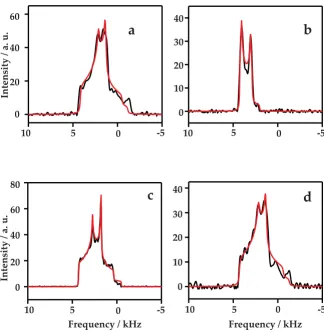
Figure 2a shows the comparison between the experimen-tal 1D spectra of the α-phase and 2b shows the δ-phase of Alq3 with the theoretical line generated using the DMFIT program which gave the quadrupolar coupling constant νQiso
ε
ε+− = πρ α 1
2 4 NA /3M
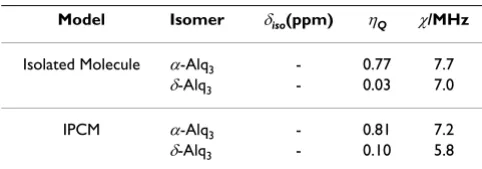
Table 1: The 27Al quadrupolar parameters obtained from the DFT quantum-chemical calculation under the isolated molecule and the isodensity polarisable continuum model (IPCM).
Model Isomer δiso(ppm) ηQ χ/MHz
Isolated Molecule α-Alq3 - 0.77 7.7
δ-Alq3 - 0.03 7.0
IPCM α-Alq3 - 0.81 7.2
(χ) in MHz, the asymmetry parameter (ηQ), and the aver-age value of isotropic shift which is a combination of both the isotropic chemical shift (δiso) and the isotropic quad-rupolar shift. The uncertainties in the values of χ,ηQ, and δiso were estimated by visual comparison of experimental and modelled spectra by employing small changes in the parameters and observing the matching of modelled spec-tra with the experimental ones.
The quadrupolar parameters obtained from the 1D spec-tra (Table 2) conclusively prove that Al+3 ion is situated in an axially symmetric environment in the δ-phase whilst it is in a non-axially symmetric environment in the α-phase of Alq3. (A low asymmetry value generally signifies axial symmetry and a high asymmetry value denotes other-wise.) This agrees well with the previously reported results [10,11,20]. Figs. 2c and 2d show the 1D spectrum of
sol-1D 27Al spectra of different modifications of Alq
3 under MAS
Figure 2
1D 27Al spectra of different modifications of Alq
3 under MAS. Experimental data (black) and fitted spectra (red) of (a)
α-Alq3, (b) δ-Alq3, (c) solvated Alq3, and (d) solvated Alq3 after the removal of ethyl alcohol. -5
b
10 5 0 -5
0 20 40
10 30
Intensity / a. u.
c
10 5 0 -5
0 20 40 60 80
Frequency / kHz
d
0 20 40
10 30
10 5 0 -5
Frequency / kHz
a
10 5 0
0 20 40 60
Intensity / a. u.
Table 2: The 27Al quadrupolar parameters obtained from the 1D MAS and the 2D MQMAS experiments using the DMFIT program.
Experiment Isomer δiso(ppm) ηQ χ/MHz
1D MAS α-Alq3 55.4 ± 1.0 0.80 ± 0.04 7.0 ± 0.1 δ-Alq3 43.6 ± 1.0 0.18 ± 0.03 4.9 ± 0.1 Solvated Alq3 50.5 ± 1.0 0.62 ± 0.04 6.4 ± 0.1 Solvated Alq3 after the removal of ethanol 55.1 ± 2.0 0.85 ± 0.05 6.5 ± 0.3
2D MQMAS α-Alq3 54.7 ± 1.0 0.85 ± 0.04 6.9 ± 0.1
δ-Alq3 43.1 ± 1.0 0.15 ± 0.03 5.1 ± 0.1
vated Alq3 before and after removal of the ethanol respec-tively along with the fitted lines. The 1D spectra of the α-phase of Alq3, the δ-phase of Alq3, and the solvated Alq3 have distinctly different second-order quadrupolar broad-ened line shapes. The quadrupolar parameters obtained using the DMFIT program also show significant difference between the α-phase and the solvated Alq3, which clearly suggests that the introduction of an ethanol molecule inside the Alq3 matrix changes the local environment around Al+3 in the centre. Further, the line shape of the apohost Alq3 (i.e, after the removal of ethanol from the solvated phase) has similar features to that of the α-phase of Alq3 which is also evident from their nearly similar quadrupolar parameters (Table 2).
Figs. 3, 4, 5, and 6 show the 2D 3QMAS spectrum of the αphase, the δphase, and the solvated phase before and after the removal of ethanol respectively of Alq3. Side-bands appear along the F1 dimension of the 2D spectra as the t1 increments were not synchronised with the MAS rotor period. The isotropic spectrum is obtained from a projection on to F1 which in all cases consists of only a sin-gle resonance. This indicates that all the phases studied here have 27Al in an unique crystallographic site. The cross section extracted along the ridge line shape parallel to the F2 axis was fitted using the DMFIT program. From the fit the quadrupolar parameters were extracted and are given in Table 1. Figure 7 shows a comparison of the 2D MQMAS experimental anisotropic slice with the theoreti-cal line generated using the DMFIT program. Since the
DMFIT program gives the model spectrum of a site under ideal excitation, there will be some difference in the line shapes of the model and the experimental spectra, never-theless the procedure for the model calculation is quite robust and gives fairly accurate results [22].
The quadrupolar parameters in Table 2 indicate that the α phase of Alq3 contains only the meridional isomer as reported from the XRD study [3] and the δphase of Alq3 is composed of purely facial isomer as reported from the XRD study [5].
From Figs. 5 and 6, it can be observed that the isotropic projection for solvated Alq3 is much narrower compared to the α-phase, the δ phase, and the solvated Alq3 from which ethanol was removed. It is well known that chemi-cal and/or rotational exchange processes can influence the powder patterns of half-integer spin quadrupolar nuclei [33]. In general, the higher the rate and symmetry of the exchange process the narrower will be the line width. Hence, the reason for the narrowing down of isotropic projection of solvated Alq3 could be due to the high mobility of the quinoline ligands between chemically equivalent orientations around the 27Al site due to the introduction of ethanol into the crystal structure. Also it was observed that the shape of the cross section extracted along the F2 dimension of the solvated Alq3 is completely different from that of the α-phase of Alq3 which was ear-lier indicated by their 1D MAS spectra as well. This also clearly indicates that the local electronic environment
(a) 2D 3QMAS spectra of meridional Alq3 (α-phase)
Figure 3
(a) 2D 3QMAS spectra of meridional Alq3 (α-phase). The optimized excitation pulse and conversion pulse lengths were 3.8 μs and 1.8 μs. A total of 64 t1 increments was taken with 10 μs of dwell time with 288 transients per increment. The
recy-cling delay was 1 s. Total experiment time was 5 hours. (b) The anisotropic slice along the direction parallel to the F2 dimen-sion. (c) The isotropic projection along the F1 dimension.
c
20 15 10 5 0
25
a
Frequency / kHz
F1
F2
10 5 0 -5
10 5 -5
0
20
25 5
15 10
Frequency / kHz Frequency / kHz
b
10 5 0 -5
around the 27Al centre undergoes significant change upon the introduction of ethanol into the matrix. Similar results were reported by Brinkmann et al. [3] where they showed that the unit crystal structure of the α-phase (triclinic) is different from that of a solvated phase of the form Alq3(C6H5Cl)1/2 (monoclinic). On the other hand the flu-orescence emission spectra (Fig. 1) interestingly show practically no difference between the α-form (meridional)
of Alq3 and the solvated Alq3 containing ethyl alcohol. It shows fluorescence in Alq3 is determined at molecular level and hardly influenced by molecular packing. Further the shape of the anisotropic slice of the apohost Alq3 has remarkable resemblance to that of the α-phase. However, the isotropic projection is broader in the apohost form compared to the later. In a recent study on the polymor-phism of a hexa-substituted benzene derivative, Hexakis
(a) 2D 3QMAS spectra of facial Alq3 (δ-phase)
Figure 4
(a) 2D 3QMAS spectra of facial Alq3 (δ-phase). The optimised excitation pulse and conversion pulse lengths were 4.4 μs and 1.9 μs. Rest of the experimental parameters are as in Figure 3. (b) The anisotropic slice along the direction parallel to the F2 dimension. (c) The isotropic projection along the F1 dimension.
b
c
5 0 -5 20 15 10 5 0
Frequency / kHz
10 25
F2 F1
a
10 5 0 -5
10 5 -5
0
20
25 5
15 10
Frequency / kHz Frequency / kHz Frequency / kHz
(a) 2D 3QMAS spectra of solvated Alq3 (containing ethanol)
Figure 5
(a) 2D 3QMAS spectra of solvated Alq3 (containing ethanol). Optimised excitation and conversion pulse lengths were 4.6 μs and 2.5 μs. A total of 192 t1 increments was taken with 8 μs of dwell time with 96 transients per increment. The
recy-cling dealy was 1 s. Total experiment time was 5 hours 18 mins. (b) The anisotropic slice along the direction parallel to the F2 dimension. (c) The isotropic projection along the F1 dimension.
b
c
10 5 0 -5 20 15 10 5 0
Frequency / kHz
a
10 5 0 -5
10 5 -5
0
20
25 5
15 10
F2 F1
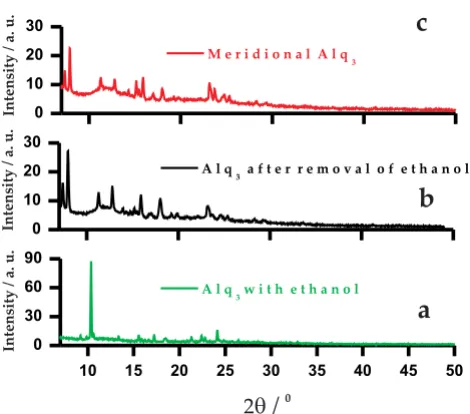
(4-cyanophenyloxy) benzene, it was suggested that one can get four different polymorphic forms of the above mentioned compound when crystallising it from melt [34]. It can be argued qualitatively that removal of ethanol from the solvated Alq3 is akin to the process of crystallis-ing from melt, as the number of ethanol molecules exist-ing per unit Alq3 to solvate it is very small. Therefore it is possible that more than one polymorph may appear from the re-crystallisation process giving rise to a distribution of NMR parameters resulting in the broadening of the ridges in the 3QMAS experiments. The quadrupolar parameters obtained for the α-phase of Alq3 and the apohost Alq3 are similar to each other indicating a similar environment around 27Al in the two forms. Similar observations were also made from the XRD analysis, Figure 8, where the sol-vated form of Alq3 containing ethanol has distinctly dif-ferent feature from that of the α-phase. However, when the ethanol was removed from the solvated phase it gave XRD feature similar to that of the α-phase.
Figure 9 shows the data from the thermo gravimetric anal-ysis of the solvated phase indicating a mass loss of 9.4% at 185°C which corresponds to loss of one molecule of ethanol from Alq3(C2H5OH)1. It should be noted that Mq3 where M is a trivalent metal can host small molecules in its solvated phase [3]. The removal of ethanol at a tem-perature higher than its boiling point confirms its partici-pation in the crystal lattice. Though ethanol is not chemically bonded to Alq3 its presence within the lattice affects the electronic distribution around Al and as a result
the quadrupolar parameters of the solvated phase are dif-ferent from either the αor the δphase.
Quantum-chemical calculation
Quantum-chemical calculations yield principal compo-nents of EFG tensor, qii, in atomic unit, with |qzz|≥|qyy|≥|qxx|. The calculated qii values were used to obtain the quadrupolar parameters manually [17],
where Q is the quadrupolar moment of 27Al nuclei. The atomic Q(27Al) value is 14.66 × 10⁻³⁰m2 [35]. The calcu-lated values of quadrupolar parameters are tabucalcu-lated in Table 1.
DFT calculation of EFG principal values were done for iso-lated Alq3 molecule. The asymmetry parameter ηQ obtained for the α-form was 0.77 while ηQ for the δ-phase of Alq3 came to be 0.03. Previously Kaji et al. [20] also did similar kind of DFT calculations where they predicted that the ηQ values for the α-form and the γ form of Alq3 are 0.72 and 0.0 respectively. They also reported that the DFT calculation for the δ-phase yielded inconsistent results. Utz et al. [11] carried out a simple calculation for the esti-mation of EFG tensor on the basis of the assumption that the EFG tensor is determined by three point charges of -e at the oxygen sites. However, the values of ηQ predicted by this model (0.91 for meridional and 0.26 for facial)
over-χ
η η
=
= − ≤ ≤
e Qq h
q q q
zz
Q yy xx zz Q
2
0 1
/
| ( ) / |, Asymmetry parameter
(a) 2D 3QMAS spectra of solvated Alq3 after the removal of ethanol
Figure 6
(a) 2D 3QMAS spectra of solvated Alq3 after the removal of ethanol. Optimised excitation and conversion pulse lengths were 3.8 μs and 1.8 μs. A total of 60 t1 increments was taken with 5 μs of dwell time with 576 transients per
incre-ment. The recycling dealy was 1s. Total experiment time was 9 hours 42 mins. (b) The anisotropic slice along the direction par-allel to the F2 dimension. (c) The isotropic projection along the F1 dimension.
a
b
c
20 10 0 -10
10 5 0 -5
Frequency / kHz
Frequency / kHz
Frequency / kHz Frequency / kHz
10 5 0 -5
10 5 -5
0
20
25 5
15 10
shoot the experimental values obtained by us for both the isomers.
Here we propose a model for DFT calculation where mol-ecules are considered under the influence of a continuum dielectric medium (IPC model) which is a more realistic situation. Under this model it is observed that the theoret-ically predicted values (0.81 for meridional and 0.10 for facial) show a relatively good agreement with the experi-mental values. In the case of solvated Alq3, it was not pos-sible to take a suitable model for the DFT calculation.
Conclusion
We have performed 1D MAS and 2D MQMAS experi-ments to obtain high-resolution spectra of meridional (α-phase) and facial (δ-(α-phase) isomers of Alq3. We have determined the quadrupolar parameters from 1D MAS spectra using the DMFIT program. The 2D MQMAS exper-iments have shown that all the different modifications of Alq3 have 27Al in single unique crystallographic site which
is evident from the single isotropic peak along F1 dimen-sion. The quadrupolar parameters were also predicted using the DFT calculation under isolated molecule assumption and also under the IPC model. The theoreti-cally calculated values of quadrupolar parameters improve and come close to the experimentally obtained values when calculations are done under the IPC model where an Alq3 molecule is assumed to be solvated in a sur-rounding of similar Alq3 molecules, which is the closest to the actual situation. Solid-state NMR data indicate that the solvated phase of Alq3 containing ethanol has struc-tural difference from the α-phase of Alq3 (containing meridional isomer). This was also confirmed by the XRD features, though the fluorescence spectra did not show any significant difference between them which again reaf-firms the fact that fluorescence is determined at molecular level in Alq3 and does not depend on the crystal structure. Further the isotropic projection of the solvated Alq3 is much narrower than all the other polymorphs, which could be due to dynamic exchange processes.
Thermo-Comparison between 2D MQMAS (black) and fitted (red) line shapes for (a) meridional (α-phase), (b) facial (δ-phase), (c)
sol-vated Alq3 containing ethanol, and (d) after the removal of ethanol from the solvated Alq3
Figure 7
Comparison between 2D MQMAS (black) and fitted (red) line shapes for (a) meridional (α-phase), (b) facial (δ -phase), (c) solvated Alq3 containing ethanol, and (d) after the removal of ethanol from the solvated Alq3.
10 5 0 -5
0 20 40
10 5 0 -5
0 20 40 60
10 5 0 -5
0 20 40
a
b
c
d
10 5 0 -5
0 20 40 60
Frequency / kHz Frequency / kHz
Intensity / a. u.
gravimetric analysis show that there is one ethanol mole-cule per Alq3 in the solvated form. After the removal of ethanol the solvated Alq3 becomes structurally similar to the α-phase of Alq3. However, due to the possible intro-duction of more than one polymorph during re-crystalli-sation, broader ridges appear in the 2D 3QMAS spectrum of the apohost Alq3. Solid-state NMR can hence be used as an effective complementary tool to XRD for characterisa-tion and structural elucidacharacterisa-tion. A more realistic approach to the calculation of the EFG tensor would be to consider
the molecule to be solvated by similar molecules (IPC model).
During the review process of this manuscript similar find-ings were published by Nishiyama et al. [36]. They report two distinct sites for α-Alq3 which is at variance to our observation. This could be due to the differences in the sample preparation conditions as it seems Nishiyama et al. have collected all the portions from the train sublima-tions whilst we have collected the porsublima-tions from a hot region (~170°C) and near the sublimation boat. The α-Alq3 sample in the current work was also characterised by powder XRD.
Competing interests
The authors declare that they have no competing interests.
Authors' contributions
PKN prepared the samples and carried out all the non-NMR experiments, MG performed the non-NMR experiments and data analysis, PKN and MG conceived of the DFT studies and implemented them, NP and PKM conceived the study, PKM drafted the manuscript, and all authors read and approved the final manuscript. PKN and MG contributed equally to this manuscript.
Acknowledgements
We acknowledge the use of National Facility for High-Field NMR, TIFR, for the use of the Bruker AV500 spectrometer, Thomas Bräuniger for discus-sions and a careful reading of the manuscript, and M. V. Naik for technical assistance.
References
1. Adachi C, Tsutsui T: Organic Light Emitting Devices Edited by: Shinar J. NewYork: Springer-Verlag; 2004.
2. Tang CW, Van Slyke SA: Organic electroluminescent diodes. Appl Phys Lett 1987, 51:913-916.
3. Brinkmann M, Gadret G, Muccini M, Taliani C, Masciocchi N, Sironi A: Correlation between molecular packing and optical prop-erties in different crystalline polymorphs and amorphous thin films of mer-tris(8-hydroxyquinoline)aluminum(III). J Am Chem Soc 2000, 122:5147-5157.
4. Braun M, Gmeiner J, Tzolov M, Coelle M, Meyer FD, Milius W, Hille-brecht H, Wendland O, Schutz JUV, Brutting W: A new crystalline phase of the electroluminescent material tris(8-hydroxyqui-noline) aluminum exhibiting blueshifted fluorescence. J Chem Phys 2001, 114:9625-9632.
5. Cölle M, Dinnebier RE, Brütting W: The structure of the blue luminescent d-phase of tris(8-hydroxyquinoline)alumin-ium(III) (Alq3). Chem Commun 2002, 23:2908-2909.
6. Cölle M, Gmeiner J, Milius W, Hillebrecht H, Brütting W: Prepara-tion and characterizaPrepara-tion of blue-luminescent tris(8-hydrox-yquinoline)- aluminum (Alq3). Adv Funct Mater 2003, 13:108-112. 7. Lin BC, Cheng CP, You ZQ, Hsu CP: Charge transport proper-ties of tris(8-hydroxyquinolinato)aluminum(III): Why it is an electron transporter. J Am Chem Soc 2005, 127:66-67.
8. Lesage A, Bardet M, Emsley L: Through-bond carbon-carbon connectivities in disordered solids by NMR. J Am Chem Soc 1999, 121:10987-10993.
9. Kaji H, Schmidt-Rohr K: Conformation and dynamics of atactic poly(acrylonitrile). 1. Trans/Gauche ratio from double-quan-tum solid-state 13C NMR of the methylene groups. Macromol-ecules 2000, 33:5169-5180.
10. Utz M, Nandagopal M, Mathai M, Papadimitrakopoulos F: Chracter-ization of isomers in aluminium tris(quinoline-8-olate) by
XRD data of (a) solvated Alq3, (b) after the removal of
etha-nol, and (c) the α-phase of Alq3 (meridional)
Figure 8
XRD data of (a) solvated Alq3, (b) after the removal of ethanol, and (c) the α-phase of Alq3 (meridional).
10 15 20 25 30 35 40 45 50 0
30 60 90 0 10 20 30 0 10 20 30
A l q
3w i t h e t h a n o l
A l q
3a f t e r r e m o v a l o f e t h a n o l M e r i d i o n a l A l q3
a
b
c
Intensity / a. u.
Intensity / a. u.
Intensity / a. u.
2
q
/
0Thermo-gravimetric analysis (TGA) and differential thermal
analysis (DTA) plots of solvated Alq3 containing ethanol
Figure 9
Thermo-gravimetric analysis (TGA) and differential thermal analysis (DTA) plots of solvated Alq3 con-taining ethanol.
100 200 300 400 500 0
20 40 60 80 100
TG
DTA
-20 -16 -12 -8 -4 0
Temperature / C0
Mass / %
Open access provides opportunities to our colleagues in other parts of the globe, by allowing
anyone to view the content free of charge.
Publish with
Chemistry
Central and every
scientist can read your work free of charge
W. Jeffery Hurst, The Hershey Company.
available free of charge to the entire scientific community peer reviewed and published immediately upon acceptance cited in PubMed and archived on PubMed Central yours you keep the copyright
Submit your manuscript here:
http://www.chemistrycentral.com/manuscript/ one-dimensional 27Al NMR under magic angle spinning. Appl
Phys Lett 2003, 83:4023-4025.
11. Utz M, Nandagopal M, Mathai M, Papadimitrakopoulos F: Chracter-ization of molecular diorder in vapor-diposited thin film of aluminium tris(quinoline-8-olate) by one-dimensional 27Al NMR under magic angle spinning. J Chem Phys 2006, 124:0347051-0347058.
12. Bräuniger T, Poupko R, Luz Z, Gutsche P, Meinel C, Zimmermann H, Haeberlen U: The dynamic disorder of azulene: A single crys-tal deuterium nuclear magnetic resonance study. J Chem Phys 2000, 112:10858-10870.
13. Bräuniger T, Poupko R, Luz Z, Zimmermann H, Haeberlen U: Quan-tification of the orientational disorder in ortho-dichlorote-tramethylbenzene: A single crystal deuterium nuclear magnetic resonance and x-ray study of the site populations. J Chem Phys 2001, 115:8049-8059.
14. Jerschow A: From nuclear structure to the quadrupolar NMR interaction and high-resolution spectroscopy. Prog Nucl Magn Reson Spectrosc 2005, 46:63-78.
15. Medek A, Harwood JS, Frydman L: Multiple-quantum magic-angle spinning NMR: A new method for the study of quadru-polar nuclei in solids. J Am Chem Soc 1995, 117:12779-12787. 16. Goldbourt A, Madhu PK: Multiple-quantum magic-angle
spin-ning: High-resolution solid state NMR spectroscopy of half-integer quadrupolar nuclei. Monatshefte für Chemie 2002, 133:1497-1534.
17. Goldbourt A, Madhu PK: Multiple-quantum magic-angle spin-ning: High-resolution solid-state NMR of half-integer spin quadrupolar nuclei. Annu Rep NMR Spectrosc 2004, 54:81-153. 18. Laws DD, Bitter Hans-Marcus L, Jerschow A: Solid-state NMR
spectroscopic methods in chemistry. Angew Chem Int Ed 2002, 41:3096-3129.
19. Schurko RW, Wasylishen RE, Foerster H: Characterization of ani-sotropic aluminum magnetic shielding tensors. Distorted octahedral complexes and linear molecules. J Phys Chem A 1998, 102:9750-9760.
20. Kaji H, Kusaka Y, Onoyama G, Horii F: Relationships between light-emitting properties and different isomers in poly-morphs of tris(8-hydroxyquinoline) aluminum(III) (Alq3) analyzed by solid-state 27Al NMR and Density Functional Theory (DFT) calculations. Jpn J Appl Phys 2005, 44:3706-3711. 21. Cramer CJ: Essentials of Computational Chemistry-Theories and Models
Chichester: John Wiley and Sons; 2003.
22. Massiot D, Fayon F, Capron M, King I, Calve SL, Alonso B, Durand Jean-Olivier, Bujoli B, Gan Z, Hoatson G: Modelling one- and two-dimensional solid-state NMR spectra. Magn Reson Chem 2002, 40:70-76.
23. Ravi Kishore VVN: Photo-luminescence and electron-lumines-cence of hydroxy quinoline based organic semiconductors. In PhD Thesis Tata Institute of Fundamental Research, Department of Chemical Sciences; 2004.
24. Vogel AI: A Text Book of Quantitative Inorganic Analysis Including Elemen-tary Instrumental Analysis 3rd edition. New Delhi: ELBS; 1970. 25. Mucccini M, Loi MA, Kenevey K, Zamboni R, Masciocchi N, Sironi A:
Blue luminescence of facial tris(quinolin-8-olato)alumi-num(III) in solution, crystals, and thin films. Adv Mater 2004, 16:861-864.
26. Brown SP, Wimperis S: Two-dimensional multiple-quantum MAS NMR of quadrupolar nuclei. Acquisition of the whole echo. J Magn Reson 1997, 124:279-285.
27. Thakur RS, Kurur ND, Madhu PK: Swept-frequency two-pulse phase modulation for heteronuclear dipolar decoupling in solid-state NMR. Chem Phys Lett 2006, 426:459-463.
28. Ganapathy S, Delevoye L, Amoureux J-P, Madhu PK: Heteronuclear dipolar decoupling effects on multiple-quantum and satel-lite-transition magic-angle spinning NMR spectra. Magn Reson Chem 2008, 46:948-954.
29. Frisch MJ, Trucks GW, Schlegel HB, Scuseria GE, Robb MA, Cheese-man JR, Zakrzewski VG, Montgomery JA Jr, Vreven T, Kudin KN, Burant JC, Millam JM, Iyengar SS, Tomasi J, Barone V, Mennucci B, Cossi M, Scalmani G, Rega N, Petersson GA, Nakatsuji H, Hada M, Ehara M, Toyota K, Fukuda R, Hasegawa J, Ishida M, Nakajima T, Honda Y, Kitao O, Nakai H, Klene M, Li X, Knox JE, Hratchian HP, Cross JB, Bakken V, Adamo C, Jaramillo J, Gomperts R, Stratmann RE, Yazyev O, Austin AJ, Cammi R, Pomelli C, Ochterski JW, Ayala PY, Morokuma K, Voth GA, Salvador P, Dannenberg JJ, Zakrzewski VG,
Dapprich S, Daniels AD, Strain MC, Farkas O, Malick DK, Rabuck AD, Raghavachari K, Foresman JB, Ortiz JV, Cui Q, Baboul AG, Clifford S, Cioslowski J, Stefanov BB, Liu G, Liashenko A, Piskorz P, Komaromi I, Martin RL, Fox DJ, Keith T, Al-Laham MA, Peng CY, Nanayakkara A, Challacombe M, Gill PMW, Johnson B, Chen W, Wong MW, Gonzalez C, Pople JA: Gaussian Inc., Wallingford CT; 2004. 30. Foresman JB, Keith TA, Wiberg KB, Snooria J, Frisch MJ: Solvent
effects. 5. Influence of cavity shape, truncation of electrostat-ics, and electron correlation on ab initio reaction field calcu-lations. J Phys Chem 1996, 100:16098-16104.
31. Takahagi T, Saiki A, Sakaue H, Shingubara S: Computer-aided chemistry estimation method of electronic-polarization die-lectric constants for the molecular design of low-k materials. Jpn J Appl Phys 2003, 42:157-161.
32. Martin RL, Kress JD, Campbell IH, Smith DL: Molecular and solid-state properties of tris-(8-hydroxyquinolate)-aluminum. Phys Rev B 2002, 61:15804-15811.
33. Schurko RW, Wi S, Frydman L: Dynamic effects on the powder line shapes of half-integer quadrupolar nuclei: A solid-state NMR study of XO4- Groups. J Phys Chem A 2002, 106:51-62. 34. Das D, Barbour LJ: Polymorphism of a hexa-host: Isolation of
four different single-crystal phases by melt crystallization. J Am Chem Soc 2008, 130:14032-14033.
35. Kello V, Sadlej AJ, Pyykko P, Sundholm D, Tokman M: Electric quad-rupole moment of the 27Al nucleus: Converging results from the AlF and AlCl molecules and the Al atom. Chem Phys Lett 1999, 304:414-422.