Issues
ISSN: 2146-4138
available at http: www.econjournals.com
International Journal of Economics and Financial Issues, 2015, 5(Special Issue) 207-214.
2nd AFAP INTERNATIONAL CONFERENCE ON ENTREPRENEURSHIP AND BUSINESS MANAGEMENT (AICEBM 2015), 10-11 January 2015, Universiti Teknologi Malaysia, Kuala Lumpur, Malaysia.
A New Business Process and Outcome Oriented Corporate Social
Responsibility Index for Islamic Banking
Abdullah Rajeh Ali Alamer
1*, Hussin Bin Salamon
2, Muhammad Imran Qureshi
3, Amran Md. Rasli
41
Faculty of Management, Universiti Teknologi Malaysia, Skudai 81310, Johor, Malaysia,
2Faculty of Islamic civilization,
Universiti Teknologi Malaysia, Skudai 81310, Johor, Malaysia,
3Faculty of Management, Universiti Teknologi Malaysia,
Skudai 81310, Johor, Malaysia,
4Faculty of Management, Universiti Teknologi Malaysia, Skudai 81310, Johor, Malaysia.
*Email: [email protected]
ABSTRACT
This article has answered on two questions; what the process-outcome weight ratio for oriented outcome should be? The second question is: What are
the items would be reflected elements under dimensions of both sides? In logic thinking, the used corporate social responsibility (CSR) dimensions
of Islamic banks (IBs) have different impacts on the society as result for that these dimensions should be different. There still is very lack in using appropriate weights of dimensions to measure of CSR in IB. By redistribution of the dimensions to two types; business process dimensions (BPDs)
and oriented outcome dimensions (OODs) then give each type specific weight to suit their consequence on the CSR’s level in IBs. From 115 items,
23 sub-dimensions, and 7 dimensions that have taken from 18 articles since 2005 until 2013, this article has selected 16 items, 9 sub-dimensions, and
5 dimensions. Only Mohammed et al. (2008) built an index has different weights of the CSR’s dimensions based on several academic experts in IB. The dimensions’ weights has been calculated based on weights of Mohammed et al (2008) in which ratio of BPDs and OODs has been 54 and 46 respectively.
Keywords: Corporate Social Responsibility, Business Process, Oriented Outcome Dimensions
JEL Classifications: K40
1. INTRODUCTION
1.1. Index Development Illustrated
The discussion of the previous units gives us the understanding
that, from an Islamic argument of view, how ethically and
responsibly an organization performs its corporate functions is
more important than how it employs its earning. This being so,
corporate social responsibility (CSR) measures relating to essential
business practices warrant more weight than the outcome-oriented
measures or the measures not related to the essential processes.
While it is conceptually justified that more weight be given to the
process measures, at least two important questions need answers
for illustrating the index development. The first question is: How
much more? Should the process-outcome weight ratio be 80/20,
70/30, 60/40, or something else? How is it decided? The second
question is: What are the elements would be reflected items
under dimensions of business process? Before continuing to
addressing these questions, we need to clarify that what follows is
an illustration of how we do to develop a differentially weighted
CSR index for Islamic banks (IBs).
1.2. Weights Ratio of Processes and Outcomes
Dimensions
Although in a span of almost one decade (2005-2013), many
researchers studied social responsibility of IBs using many
measures, effort to assign different weights to dimension and items
of CSR measures is originate only in one case. Out of 18 sources
listed, 11 sources used Accounting and Auditing Organization
for Islamic Financial Institutions (AAOIFI’s) index, the ethical
Nazir et al. (2014) recognized 34 CSR measurement items under
six basic criteria. It looks their items have different weights, but
actually they do not. Items were rated on a 10-point scale from
five experts and an average score was calculated for each item
to decide whether the item was important enough to be included
under a particular standard for CSR measurement. Based on
Maqasid framework, Mohammed et al. (2008) and Rasli et al.
(2014) developed performance measures of IBs. Their Maqasid
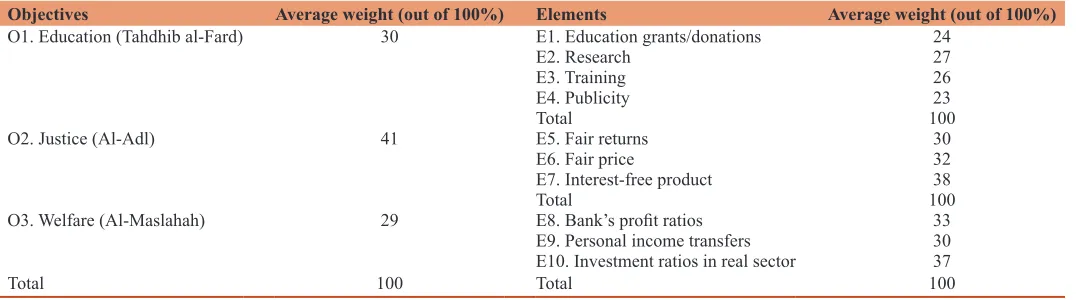
index is created on 10 elements under three objectives that were
allocated differential weights as shown in Table 1.
The distribution of weights to 3 objectives and 10 elements suggest
us significant clues to ascertaining a preliminary process-outcome
weights ratio of 54:46. The Table 2 shows how we arrived at this
preliminary ratio. The calculation in it shows a process-outcome
ratio of 53.85:46.15 that has been rounded to 54:46.
1.3. Items Selection and Their Weights Allocation
As mentioned earlier, the second question for the development of
the index is what items are to be included in the index. For this
purpose, from the 18 articles stated, a compilation of 110 items
belonging to 9 dimensions and 28 sub-dimensions has been made
(all measurements of CSR in IBs from related published literature
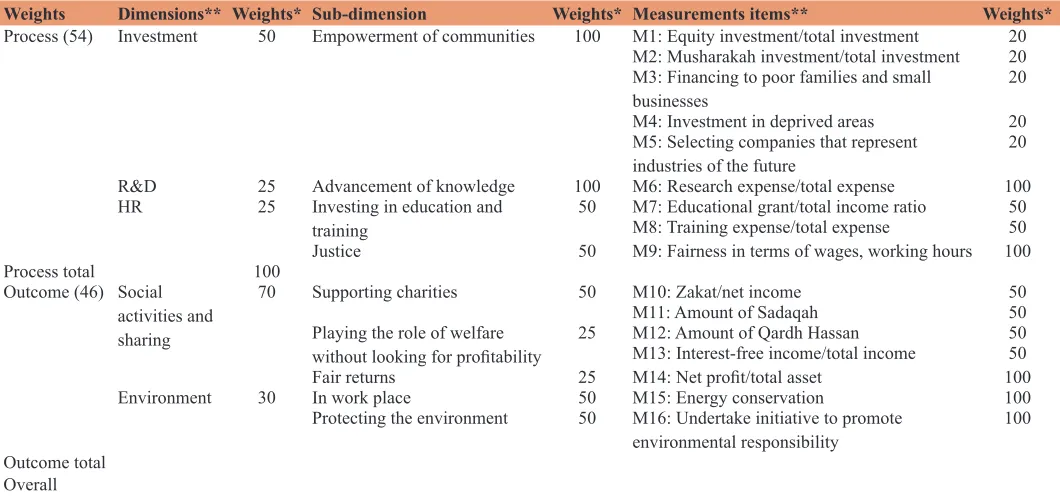
are attached in Appendix A). As a technique of illustration, nine
items have been chosen under business process dimensions (BPDs)
which fall under three dimensions and four sub-dimensions.
Similarly, seven items have been selected under oriented outcome
dimensions (OODs) that belong to two dimensions and five
sub-dimensions. All these selections are shown in Table 3. The notes
below Table 3 temporarily describe how actual selection will be
made and various weights will be allocated.
2. DISCUSSION
Some authors (e.g., Sairally, 2005; Farook et al. 2011) recognized
expectations of the stakeholders of IBs based on the experience
of the conventional literature of CSR, in spite of Wood’s (2010)
recommendation of deliberate incorporation of research and
delving into other domains of CSR literature. Others (Mohammed
et al., 2008; Yusuf and Bahari, 2011) have collected CSR
dimensions from IBs’ literature through studying Islamic principles
and law without paying more attention to the source of action.
The CSR actions come from the core business of IBs or from
external activities. Usmani (2002) stated that, according to Islamic
principles, business transactions could never be separated from the
moral targets of a society. Woermann (2013) argued that increasing
emphasis on entering CSR into the core business approach is a
tool for companies to meet their CSR obligations. As a result,
this paper is relevant and a worthy contribution because it uses
dimensions divided into two parts, that is, dimensions from core
business transactions and from oriented activities. The structure
of the index is like the structure of a real business, in which there
are two parts: The business process and the oriented outcomes.
Table 1: Average weights for three objectives/10 elements given by Shari’ah experts
Objectives Average weight (out of 100%) Elements Average weight (out of 100%)
O1. Education (Tahdhib al-Fard) 30 E1. Education grants/donations 24
E2. Research 27
E3. Training 26
E4. Publicity 23
Total 100
O2. Justice (Al-Adl) 41 E5. Fair returns 30
E6. Fair price 32
E7. Interest-free product 38
Total 100
O3. Welfare (Al-Maslahah) 29 E8. Bank’s profit ratios 33
E9. Personal income transfers 30
E10. Investment ratios in real sector 37
Total 100 Total 100
Source: Mohammed et al. (2008)
Table 2: Ascertaining preliminary weights ratio for process measures/outcome measures
Objectives
(average weights) Process-based Calculation Elements classified
of weights* Output-oriented Calculation of weights* O1. Education (30) E1. Education grants/donations 30×0.24=7.2
E2. Research 30×0.27=8.1
E3. Training 30×0.26=7.8
E4. Publicity 30×0.23=6.9
O2. Justice (41) E5. Fair returns 41×0.30=12.3
E6. Fair price 41×0.32=13.12
E7. Interest-free product 41×0.38=15.58
O3. Welfare (29) E8. Bank’s profit ratios 29×0.33=9.57
E9. Personal income transfers 29×0.30=8.7 E10. Investment ratios in real sector 29×0.37=10.73
Process total 53.85 Outcome total 46.15
This structure of the measures index is considered a contribution
to CSR and the IB field.
One should see to the long-term impacts through IB products and
investments by using macroeconomic and MS, and incorporate
that in measuring CSR in IBs. Siddiqi (2006) argued that IBs
should not look at the microeconomic targets of their investments
to arrive at current targeted profits. Instead, they must look at
the long-term benefits and the positive consequences for the
community and economy. Farook et al. (2011) and Yusof et al.
(2010) stated that equity finance is in line with goals of Islam
Maqasid Shari’ah, specifically justice, good economic impacts
and social equality. However, Farook et al. (2011) and Yusof et al.
(2010) argued that using debt as an investment tool has failed and
is one of the major causes of the global financial crisis. They and
other researchers stated that IBs should increase their share in
equity finance. Malik et al. (2011) concluded that it is crucial to
remember that the purpose of Islamic finance practitioners is not
to “replicate” conventional finance products in an Islamic way at
all times, but rather to create new financial ideas or products which
appeal to IBs and investors, even if this means slower growth
than Islamisation. Musharakah financing and equity investment
are included as new measurements in the index to measure CSR
in IBs (Table 3).
The major contribution of this paper is its use of different weights
based on the impact and importance of every dimension. Indexes
are used to measure the CSR disclosure in IBs, including AAOIFI’s
index, the EII (Haniffa and Hudaib, 2007; Hassan and Harahap,
2010; Zubairu et al., 2012; Rashid et al., 2013; and Kamla and
Rammal, 2013). Maali et al. (2006); Aribi and Gao (2010); Abbasi
et al. (2012); and Farook et al. (2011) used a disclosure index
approach.
3. CONCLUSION
The paper attempted to explain the need for having an IB CSR
measurement index, which allocates more weight to the
process-based measures than to outcome-oriented measures.
REFERENCES
Abbasi, T.H., Kausar, A., Ashiq, H., Inam, H., Nasar, H., Amjad, R. (2012), Corporate social responsibility disclosure: A comparison between
Islamic and conventional financial institutions in Bahawalpur region.
Research Journal of Finance and Accounting, 3(3), 51-62.
Aribi, Z.A., Gao, S. (2010), Corporate social responsibility disclosure: A comparison between Islamic and conventional financial institutions. Journal of Financial Reporting and Accounting, 8(2), 72-91.
Dusuki, A.W., Dar, H. (2005), Stakeholders’ perceptions of corporate
social responsibility of Islamic banks: Evidence from Malaysian economy. Paper Presented at the 6th International Conference on Islamic Economics and Finance, Islamic Economics and Banking in the 21st Century, Jakarta, Indonesia.
El Mousaid, F., Boutti, R. (2012), Relationship between Corporate Social Responsibility and Financial Performance in Islamic Banking. Research Journal of Finance and Accounting, 3(10), 93-103. Farook, S., Hassan, M.K., Lanis, R. (2011), Determinants of corporate
social responsibility disclosure: The case of Islamic banks. Journal of Islamic Accounting and Business Research, 2(2), 114-141. Haniffa, R., Hudaib, M. (2007), Exploring the ethical identity of Islamic
banks via communication in annual reports. Journal of Business Ethics, 76(1), 97-116.
Hassan, A., Harahap, S.S. (2010), Exploring corporate social responsibility disclosure: the case of Islamic banks. International Journal of Islamic and Middle Eastern Finance and Management, 3(3), 203-227. Kamla, R., Rammal, H.G. (2013), Social reporting by Islamic banks:
Table 3: Developed index for differentiated dimensions to measure CSR of IBs
Weights Dimensions** Weights* Sub-dimension Weights* Measurements items** Weights* Process (54) Investment 50 Empowerment of communities 100 M1: Equity investment/total investment 20
M2: Musharakah investment/total investment 20 M3: Financing to poor families and small
businesses 20
M4: Investment in deprived areas 20 M5: Selecting companies that represent
industries of the future 20
R&D 25 Advancement of knowledge 100 M6: Research expense/total expense 100 HR 25 Investing in education and
training 50 M7: Educational grant/total income ratioM8: Training expense/total expense 5050 Justice 50 M9: Fairness in terms of wages, working hours 100
Process total 100
Outcome (46) Social activities and sharing
70 Supporting charities 50 M10: Zakat/net income 50
M11: Amount of Sadaqah 50
Playing the role of welfare
without looking for profitability 25 M12: Amount of Qardh HassanM13: Interest-free income/total income 5050
Fair returns 25 M14: Net profit/total asset 100
Environment 30 In work place 50 M15: Energy conservation 100
Protecting the environment 50 M16: Undertake initiative to promote
environmental responsibility 100
Outcome total Overall
*These weights are arbitrarily assigned for illustrative purposes. For actual development of the index, preliminary weights will be decided and justified based on literature review, which will then be validated through a panel of experts using online Delphi techniques. **Measurement items and dimensions will be judiciously selected to reflect and capture the notion of
Does social justice matter? Accounting, Auditing and Accountability Journal, 26(6), 911-945.
Maali, B., Casson, P., Napier, C. (2006), Social reporting by Islamic banks. Abacus, 42(2), 266-289.
Malik, M.S., Malik, A., Mustafa, W. (2011), Controversies that make Islamic banking controversial: An analysis of issues and challenges. American Journal of Social and Management Sciences, 2(1), 41-46. Mohammed, M.O., Abdul Razak, D., Taib, F.M. (2008), The performance
measures of Islamic banking based on the Maqasid framework. Paper presented at the IV IIUM International Accounting Conference (INTAC IV), Putrajaya, Malaysia.
Musa, M. (2011), Islamic Business Ethics and Finance: An Exploratory Study of Islamic Banks in Malaysia. In 8th International Conference on Islamic Economics and Finance. p1-27.
Nazir, S., Khan, S., Jamil, R.A., Mehmood, Q.S. (2014), Impact of customer relationship management on customer satisfaction in hoteling industry. Journal of Management Info, 3(1), 84-98. Nor, S., Asutay, M. (2011), Re-considering CSR and sustainability identity
of islamic banks in Malaysia: An empirical analysis. International Conference on Islamic Economics and Finance, p1-17.
Rahman, A., Hashim, M., Bakar, F. (2010), Corporate social reporting: A preliminary study of Bank Islam Malaysia Berhad (BIMB). Issues in Social and Environmental Accounting, 4(1), 18-39.
Rashid, M., Abdeljawad, I., Ngalim, S.M., Hassan, M.K. (2013), Customer-centric corporate social responsibility: A framework for
Islamic banks on ethical efficiency. Management Research Review,
36(4), 359-378.
Rasli, A.M., Norhalim, N., Kowang, T.O., Qureshi, M.I. (2014), Applying managerial competencies to overcome business constraints and create
values evidence from small technology-based firms in Malaysia.
Journal of Management Info, 3(1), 99-121.
Sairally, S. (2005), Evaluating the “social responsibility” of Islamic
finance: Learning from the experiences of socially responsible
investment funds. In the 6th International Conference on Islamic Economics and Finance, Islamic Economics and Banking in the 21st Century, Jakarta, Indonesia.
Samina, Q.S. (2012), Practice of corporate social responsibility in Islamic banks of Bangladesh. World Journal of Social Sciences, 2(6), 1-13.
Siddiqi, M.N. (2006), Islamic banking and finance in theory and practice:
A survey of state of the art. Islamic Economic Studies, 13(2), 1-47. Usmani, M.T. (2002), An Introduction to Islamic Finance. The Hague:
Kluwer Law International. p111-116.
Woermann, M. (2013), Reconsidering the meaning of corporate social responsibility. Netherlands: Springer. p89-123.
Wood, D.J. (2010), Measuring corporate social performance. International Journal of Management Reviews, 274, 50-84.
Yusof, E.F.E., Kamal, A.A., Kashoogie, J. (2010), Islamic finance: Debt versus equity financing in the light of Maqasid al-Shari’ah. Banking,
No. 20722. p1-19.
Yusuf, M.Y., Bahari, Z. (2011), Islamic corporate social responsibility in Islamic banking: Towards poverty alleviation. Paper Presented at the 8th International Conference on Islamic Economics and Finance, Doha, Qatar.
Appendix A: All measurements of CSR in IBs are from the related published literature (18 articles)
No. Dimension No. Sub-dimension No. Measurements Sources Author/s 1 Human
resource 1 Protecting health and safety 1 Insurance and welfare for employees Interviews/respondents Yusuf and Bahari (2011) and Musa (2011) 2 Remuneration and benefits/reward
for ethical behavior Annual reports/respondents Rahman et al. (2010) and Musa (2011) 3 Place of work safe and comfortable Interviews/annual
reports Yusuf and Bahari (2011); Nor and Asutay (2011) 4 The standards include provisions for
health and safety regulations. Adhere to outlined procedures
Respondents Dusuki and Dar (2005) and Musa (2011)
5 Work does not exceed limits and time Interviews Yusuf and Bahari, 2011 2 Investing in education
and training 6 Training expense/total expense Annual reports Mohammed et al., 2008 7 Education grant/total income Annual reports Mohammed et al., 2008 8 Policy on education and training
of employees. Trained on Shari’ah
principles for Islamic banking
Annual reports Farook et al., 2011; Maali et al., (2006) Rahman et al. (2010) and Musa (2011)
9 Appropriately trained Respondents Musa (2011) 10 Facilities for personal Shari’ah
obligations Respondents Musa (2011)
11 Disclosure of employee including number of employees and training: Shariah awareness
Annual reports The Ethical Identity Index (EII). (1)
3 Responsible in work 12 Fulfill every contract demand Interviews/
respondents Yusuf and Bahari, (2011) and Musa (2011) 13 Employee appreciation Annual reports (1) +
Aribi and Gao (2010) 14 Optimal for using time and expertise Interviews Yusuf and Bahari, 2011
15 Free will Interviews Yusuf and Bahari, 2011
16 Fair competition Interview Yusuf and Bahari, 2011 17 Integrity in the work. Gifts in return
for favor is normal Interview/respondents Yusuf and Bahari (2011) and Musa (2011) 18 Transparency. Advise one another Respondents/
interviews Sairally (2005); Yusuf and Bahari (2011) and Musa (2011)
19 Working in accordance with the limitations and responsibilities. Avoid hurting each other
Interviews/
respondents Yusuf and Bahari (2011) and Musa (2011)
20 Accountability Interviews Yusuf and Bahari (2011)
21 Trust Interviews/
respondents Yusuf and Bahari, 2011; Musa (2011) 4 Justice 22 The existence values of brotherhood
and religious motivation Interviews/respondents Yusuf and Bahari (2011) and Musa (2011) 23 Fair in terms of wages, working
hours Respondents Dusuki and Dar (2005) and Musa (2011) 24 Eligible for wages Interviews Yusuf and Bahari, 2011 25 Promoting human rights. False
expenses claims are normal Respondents (Dusuki and Dar, 2005; Abbasi et al., 2012) and Musa (2011).
26 Ensuring that the operation respects
human rights Respondents Dusuki and Dar (2005)
27 Equal opportunity Annual reports Aribi and Gao, (2010) 28 Emphasize on ethical values and
moral behavior Respondents Nor and Asutay (2011); Musa (2011) 29 Improve the socio-economic
condition of employees Annual reports and other publications Samina (2012) 2 Good
governance 5 Vision and mission statement 30 Commitments in operating, serving the needs of community Annual reports The Ethical Identity Index (EII). (1) 31 CSR should be embedded in Islamic
banks’ policy Respondents Nor and Asutay (2011)
Appendix A: (
Continued...
)
No. Dimension No. Sub-dimension No. Measurements Sources Author/s 32 CSR relevant to Islamic banking
concept Respondents Nor and Asutay (2011)
33 Engage only in permissible
investment within Shariah principles Annual reports/respondents The Ethical Identity Index (EII) (1) and Nor and Asutay (2011)
34 Regulations essential to avoid
exploitation Respondents Musa (2011)
35 Whistle-blowers not victimized and
encouragement to report breach Respondents Musa (2011) 36 CSR upholds the social justice
dimension of Islamic Economics Respondents Nor and Asutay (2011) 6 Board members and
top management 37 Disclosure of names, positions Websites Farook et al., 2011 38 Limited multiple directorships and
shareholdings Website The Ethical Identity Index (EII). (1) 39 Balanced board, no role duality Annual reports The Ethical Identity
Index (EII). (1) 7 Fair dealings 40 Building long-lasting relationships
with customers Annual reports Hassan and Harahap (2010) 41 To give due importance to the SSB’s
opinions Annual reports Hassan and Harahap (2010)
42 Having an audit committee Annual reports The Ethical Identity Index (EII). (1) 43 Reducing the adverse impact of the
investment Interviews Yusuf and Bahari, 2011
44 Bank’s assets often used for
personal gain Respondents Musa (2011)
45 To maintain good relations with
employees Annual reports/respondents Hassan and Harahap (2010); Sairally (2005) 46 Good relations with shareholders Annual reports Hassan and Harahap (2010) 47 Code of ethical conduct clearly
communicated Respondents Musa (2011)
3 SSB: Shariah Supervisory Board
8 SSB members and
their role 48 Names Websites The Ethical Identity Index (EII). (1)
49 Remuneration Annual reports Rashid et al., 2013 50 Number of meetings held Annual reports The Ethical Identity
Index (EII). (1) 51 Basis of examination of the
documents Annual reports The Ethical Identity Index (EII). (1) 52 Attestation that profits is gained
lawfully Annual reports The Ethical Identity Index (EII). (1) 53 Their recommendations to rectify
the defects products and the actions taken by management
Annual reports and
websites The Ethical Identity Index (EII). (1)
54 Doctorate qualification of SSB
member Website Farook et al., 2011
55 Reputable scholars and background Websites Farook et al., 2011 56 Shariah Supervisory Council Annual reports Rahman et al., (2010) 57 Number of SSB members Websites Farook et al. 2011 9 Compliance with
Shari’ah 58 Instrument selection/industry selection Interviews/annual reports and other publications
Yusuf and Bahari, (2011), Samina (2012)
59 Ex-ante and Ex-post approved for
new products Annual reports Maali et al. (2006); Mosaid and Boutti (2012) 60 IBI’s investment in halal products Interviews/annual
reports Yusuf and Bahari (2011); Rahman et al. (2010) 61 Not investing in impermissible
activities Respondents Sairally (2005) & AAOIFI
62 Avoiding profit from non-halal Interviews Yusuf and Bahari, 2011
63 Calculation of Zakat Annual reports Maali et al. (2006); Hassan and Harahap (2010); Mosaid and Boutti 2012 64 Revenues Annual reports Maali et al. (2006); Hassan
and Harahap (2010)
65 Operations Annual reports Rashid et al., 2013;
Musa (2011) 66 Distribution of profit-loss, method of
allocating PLS with (IAH) Annual reports Hassan and Harahap (2010); Mosaid and Boutti (2012); AAOIFI 67 Selections of customers according to
Shariah Interviews Yusuf and Bahari, 2011
68 Unusual supervisory restrictions Annual reports Rahman et al. (2010) 69 Screening clients and contractors Annual reports and
other publications Samina (2012) 4 Environment 10 Investment and finance 70 No investment in any projects that
may harm the environment Use of all sources All authors except Mohammed et al., 2008 11 In work place 71 Educating employees to care for and
treat the environment Interviews Yusuf and Bahari, 2011 72 The use of recycled materials Annual reports Yusuf and Bahari, 2011 73 Good waste and recycle policy Respondents Dusuki and Dar (2005) 74 Energy conservation Respondents:
annual reports Dusuki and Dar (2005); Mosaid and Boutti (2012); Nor and Asutay (2011) 12 Protecting the
environment 75 Undertake initiatives to promote environmental responsibility Respondents/annual reports, websites and other publications
Dusuki and Dar (2005); Samina (2012); Rahman et al. (2010)
5 R & D 13 Advancement of
Knowledge 76 Research expense/total expense Annual reports Mohammed et al., 2008 77 Supporting the R&D, training
conducted by academics, changes in restricted investment
Annual reports or
websites Hassan and Harahap (2010); AAOIFI
14 Innovative 78 Introduce new products based on
R&D of Islamic concepts Annual reports Hassan and Harahap (2010); Aribi and Gao, (2010); Rahman et al. (2010) 6 Investment 15 Affordable products
and services 79 Bad debt/total investment Annual reports Mohammed et al., 2008 16 Empowerment of
communities 80 IAH funds/shareholder funds Annual reports Farook et al., 2011 81 Amount of financing to poor families
and small businesses Interviews Yusuf and Bahari, (2011), Samina (2012) 82 Financing housing construction Respondents Sairally (2005)
83 Financing of health services Respondents Sairally (2005) 84 Selecting companies that represent
industries of the future Respondents/annual reports and other publications
Sairally (2005); Samina (2012)
7 Social activities
and sharing 17 Alleviate social problems 85 Disclosure of debtors including amount of debts written off Annual reports (1) and Musa (2011) 86 Without ulterior motive Respondents Musa (2011)
87 Help solve social problems Respondents Dusuki and Dar (2005) 18 Support and help fund
welfare 88 Participating in social activities Websites/annual reports/ respondents
All authors except
Mohammed et al., 2008 and Yusuf and Bahari, 2011 89 Alliance and support with charitable
organizations Respondents Nor and Asutay (2011) and Musa (2011) 90 Waqf management: Annual reports and
other publications Samina (2012)
Appendix A: (
Continued...
)
No. Dimension No. Sub-dimension No. Measurements Sources Author/s
Appendix A: (
Continued...
)
No. Dimension No. Sub-dimension No. Measurements Sources Author/s 91 The selection of investors to support
the activities for social welfare Interviews/annual reports and other publications
Yusuf and Bahari (2011), Samina (2012)
92 Education, social donations Interviews Yusuf and Bahari (2011) 93 Sponsoring Islamic educational and
social events Annual reports/respondents The Ethical Identity Index (EII). (1), Nor and Asutay (2011) and Musa (2011)
19 Supporting charities 94 Sources of Zakat funds Annual reports/
respondents Maali et al., 2006; Mosaid and Boutti (2012); Nor and Asutay (2011)
95 Amount of Zakat Use all sources All authors except Samina (2012) 96 Zakat/net income Annual reports Mohammed et al., 2008
97 Amount of Sadaqah Annual reports (2)
98 Zakat obligation Annual reports Rahman et al. (2010) 99 The uses of the Zakat fund Annual reports/
respondents Maali et al., 2006; Mosaid and Boutti 2012; Nor and Asutay (2011)
20 Playing the role of welfare without looking solely for
profitability
100 Interest free income/total income Annual reports Mohammed et al., 2008
101 Prevalence of ethics over profits Respondents Musa (2011) 102 Participate in management of
public affairs and Participates in government social activities
Respondents Dusuki and Dar (2005) and Musa (2011)
103 Play a role in society, goes beyond
profit maximization Respondents Dusuki and Dar, 2005
104 Policy of Qardh Hassan Annual reports (1) 105 Amount of Qardh Hassan: Its source
and use Use all sources All authors
21 Fair Returns 106 Net profit/total asset Annual reports Mohammed, 2008 22 Achieve economic and
social goals 107 Numbers of female branches Annual reports (1) 108 Creating job opportunities Annual reports (1)
109 The existence values of brotherhood Interview Yusuf and Bahari, 2011 110 Have the same opportunity Interview Yusuf and Bahari, 2011 111 Refrain lending to oppressive regime
or companies violating human rights Respondents Dusuki and Dar, 2005 112 Providing grant for educational
purposes or scholarship to students Annual reports Sairally, 2005
113 Services excellent Interview Yusuf and Bahari (2011), Samina (2012)