23
MULTIPLE INTELLIGENCES AS PREDICTORS OF READING
COMPREHENSION AND VOCABULARY KNOWLEDGE
Abbas Ali Zarei
Associate professor, Imam Khomeini International University, Qazvin, Iran.
email: [email protected]Nima Shokri Afshar
Islamic Azad University, Takestan
email: [email protected]
Abstract: The present study was conducted to investigate types of Multiple Intelligences as predictors of reading comprehension and vocabulary knowledge. To meet this objective, a 60-item TOEFL test and a 90-item multiple intelligences questionnaire were distributed among 240 male and female Iranians studying English at Qazali and Parsian Universities in Qazvin. Data were analyzed using a multiple regression procedure. The result of the data analysis indicated that musical, interpersonal, kinesthetic, and logical intelligences were predicators of reading comprehension. Moreover, musical, verbal, visual, kinesthetic and natural intelligences made significant contributions to predicting vocabulary knowledge.
Key words: Multiple intelligences, reading comprehension, vocabulary knowledge.
KECERDASAN MAJEMUK UNTUK MEMPREDIKSI
MEMBACA PEMAHAMAN DAN PENGETAHUAN
KOSAKATA
Abstrak: Penelitianini dilakukan untuk mengetahui tipe-tipe kecerdasan majemuk sebagai prediktor dari membaca pemahaman dan pengetahuan kosa kata. Untuk mencapai tujuan tersebut, sebuah tes TOEFL terdiri dari 60 pertanyaan dan kuesioner mengenai kecerdasan majemuk yang terdiri dari 90 pertanyaan disebarkan kepada 240 mahasiswa laki-laki dan perempuan Iran yang belajar Bahasa Inggris di Universitas Qazali dan Parsian di Qazvin. Data dianalisis menggunakan multi regresi. Hasil dari data analisis menunjukkan bahwa kecerdasan musik, interpersonal, kinestetik, dan matematis logis merupakan prediktor membaca pemahaman. Lebih lanjut, kecerdasan musikal, verbal, visual, kinestetik, dan naturalis memberikan kontribusi signifikan dalam memprediksi pengetahuan kosa kata.
Katakunci: Kecerdasan majemuk, membaca pemahaman, pengetahuan kosa kata.
Until early 1980s,
intelligence was
regarded as a unitary trait. In 1983, the idea
of general intelligence was replaced with
multiple intelligences. Gardner (1983)
revolutionized the view of intelligence. He
argues that MI Theory pluralizes the
traditional concept. Gardner claims that
24
as a ''biopsychological potential to process
information that can be activated in a
cultural setting to solve problems or create
products that are of value in a culture'' (pp.
33-34).
According
to
Gardner
(1999),
intelligence is more than IQ because the IQ
test only measures logical and verbal
intelligences. He states that besides the
above two types of intelligence, individuals
have seven more intelligences including
visual, kinesthetic, musical, interpersonal,
intrapersonal, naturalist, and existential
intelligences. The present study is
concerned with types of MI as predictors of
reading comprehension and vocabulary
knowledge. Examination of our current
understanding of the relationships among
MI, reading comprehension and vocabulary
knowledge indicates the need for a richer
understanding of this relationship. The
objective of this study, therefore, is to
explore to what extent or in what
combination, intelligences are predictors of
reading comprehension and vocabulary
knowledge. More specifically, the purpose
of the present study is to answer the
following research questions: (1) Which of
the multiple intelligence types is a better
predictor of reading comprehension? And,
(2) Which of the multiple intelligence types
is a better predictor of vocabulary
knowledge?
Green andTanner (2005) hold that each
person has an individual intelligence
profile, consisting of different capacities
that are related to all the nine intelligences.
These
intelligences
constitute
how
individuals
process
information.
In
addition, Multiple Intelligence theory
supports the idea of existence of a number
of intelligences that result in a unique
cognitive profile for each person.
Gardner (1999) differentiates between
intelligence and domain. He defines
intelligence as a person's biopsychological
potential by virtue of their species
membership, but domain is viewed as a
socially constructed human endeavor. As
such, several intelligences can be applied
in the same domain, and the same
intelligences in many domains.
Razmjoo (2008) refers to analytical,
introspective and interactive domains as
the three domains of multiple intelligences
which can serve as an organizer for
exploring
and
understanding
the
relationships among the intelligences and
how multiple intelligences work with one
another. McKenzie (2002) states that each
domain has its own sub-branches. The
analytic domain includes the musical,
logical and naturalist intelligences; these
three intelligences promote the processes
of analyzing and incorporating data into
existing schema. The interactive domain
contains the interpersonal, kinesthetic and
linguistic
intelligences;
these
three
intelligences encourage interaction to
achieve understanding. The introspective
domain includes existential, visual and
intrapersonal intelligences; these three
intelligences require a looking inward by
the learner, an emotive connection to
his/her own experiences to make sense of
new learning. The analytical, interactive
and introspective intelligences are by their
nature heuristic, social and affective
processes, respectively.
25
ability to make and recognize music, sing
and to understand or use rhythm. Auditory
functions and recognition of tonal and
rhythmic patterns are required for a person
to develop this intelligence. Music smart
includes thinking in sounds and patterns,
performing music and leading in songs.
Musicians, singers, voice coaches, and
composers exhibit musical intelligence
(Armstrong,
1994).
Bodily/kinesthetic
intelligence is the ability to use one's body
skillfully to solve problems. It challenges
and contradicts the belief that mental and
physical
activities
are
unrelated.
Interpersonal
intelligence
involves
individuals using their social skills to
understand and notice people's motivations,
temperaments and goals. It involves
cooperating and communicating with
others. Typical roles are therapists, leaders,
educators, teachers, doctors and coaches
(Gardner, 1993). Intrapersonal intelligence
is the ability to distinguish, reflect, analyze
and identify various personal thoughts and
feelings and to use them to understand and
plan one's own behaviour. Self-awareness,
personal objectivity, and one's relationship
to others and the world are important in
this intelligence. Naturalist intelligence
displays
empathy,
recognition,
and
understanding for living and natural things.
It allows individuals to distinguish, classify
and use features of the natural world
around them. Typical roles are farmers,
geologists and gardeners who can name
and describe the features of environment
(Gardner,
1999).
Finally,
Gardner
associates existential intelligence with
people who are able to comprehend
fundamental questions and issues of
existence. They are most comfortable and
productive when they are discussing or
writing about experiences.
MI theory and language teaching
As Christison (1999) proposes, the theory
of
multiple
intelligences
should
be
introduced to language educators in order
to demonstrate how to use multiple
intelligences in lesson planning, language
learning tasks, and assessment. She claims
that it is encouraging for language
educators to develop all intelligences to a
reasonably high level.
According to Armstrong (1995), the
first step in using multiple intelligence
theory is to determine the educator's own
multiple intelligence profile. He adds that
as educators learn more about their own
profile, they will become more confident in
the choices they make that affect their
teaching. The types of learning activities
educators choose as teachers are directly
related to their experiences, which in turn
affect the multiple intelligence profile of
their students.
MI theory can contribute to language
teaching in a number of ways. According
to Botelho (2003), MI theory has helped
teachers to reflect on their practice, and has
given them a basis to develop and enhance
their focus. It has also helped teachers to
encourage themselves to look beyond the
narrow confines of teaching plans and
curriculum. To show the importance of
multiple intelligence theory in language
teaching, Richards and Rodgers (2001)
argue that MI is richest in proposals for
lesson
organization
and
planning.
Similarly, Viens (1999) holds that MI
application provides a range of activities in
the classroom to ensure learners the
opportunity to develop and enhance
abilities in a range of intelligence areas.
26
satisfying for participants who find the
learning more enjoyable, more personally
relevant and more motivating" (p.320).
Another advantage of MI theory is that
it seeks to cultivate the various ways in
which learners reflect intelligently; so, its
outcomes differ from predictable outcomes
of traditional education. Eisner (2003) is of
the opinion that "If one of the important
aims of education is the cultivation of the
students'
unique
capacities,
then
acknowledging differences in the ways in
which children and adolescents are smart
would, one might think, be of extraordinary
importance'' (p.32).
Nikolva (2007) maintains that in MI
theory teachers may encounter lack of
resources and overcrowded classrooms.
Classifying
and
comparing
learners'
abilities in MI classroom may be difficult.
On the other hand, MI application has
many benefits for teachers and learners;
''the theory broadens the vision of
education. Teachers acknowledge that
students learn in different ways and thus
the different kinds of intelligence would
allow different ways of teaching, rather
than one. Students begin to understand how
they are intelligent'' (p.108).
MI theory may also have implications
for reading comprehension and vocabulary
learning. As to reading comprehension,
Gaines and Lehmann (2002) showed that
the use of MI theory improved learners'
reading comprehension and enhanced their
academic performance. In another study,
Owolabi and Okebukola (2009) showed
that
reading
comprehension
in
MI
classrooms enhances learners
’interaction
with the print and ideas presented.
Furthermore, according to Abdulkader,
Gundogdu
and
Eissa
(2009),
the
implementation of MI theory coupled with
increased parental involvement can lead to
substantial gains in the learners' reading
comprehension and vocabulary knowledge.
In much the same vein, Motallebzadeh and
Manuchehri (2008), focusing on the
relationship between MI and reading
comprehension of learners, hold that MI
theory can improve learners' reading skill,
especially by logical intelligence.
As to vocabulary learning, in MI
classrooms,
learners
’vocabulary
knowledge can be enhanced by visual
techniques,
verbal
explanation,
and
linguistic mnemonics. In visualization,
learners can pair pictures with the words
they need to learn. Verbal-explanation is
the best method to show the meaning of
abstract worlds. In MI classrooms, teachers
use
examples,
situations,
synonyms,
antonyms and definitions.
A number of studies have investigated
the effects of MI on various aspects of
second and foreign language learning.
Christison
(1996)
studied
the
application of his own teaching style as it
applies to MI theory. The findings of his
study clarify how MI theory informs
teaching and learning in his classroom, and
he concludes that there is a relationship
between the learning activities and his own
MI profile.
27
with the spiritual and environmental
intelligences'' (p. 206).
MI theory can be used in the teaching of
a chosen course. Xie and Lin (2009)
conducted a study to explore the effects of
MI teaching versus traditional teaching. It
was found that the experimental group
learners receiving MI instruction learned
faster and better than the control group
learners.
Gender differences in the assessment of
MI have also been investigated. Kaur and
Chhikara (2008) compared the mean scores
of boys and girls. The results suggested
that girls were stronger in linguistic and
musical intelligences while boys were
stronger in logical and bodily kinesthetic
intelligences.
In another study, the relationship
between
gender
differences
and
intelligence types was examined by
Saricaoglu and Arikan (2009). They note
that logical, musical, linguistic and
intrapersonal intelligences are stronger in
females. However, they conclude that there
are no significant sex differences in MI
types.
Campbell (1989) assessed MI in a group
of third grade learners. His program aimed
to teach seven intelligences to 27 learners
and to engage MI in it. He concluded that
his role as a teacher shifted as the learners
worked at their multiple centers and he
became a facilitator of learning in the
classroom.
Akbari and Hosseini (2008) sought to
determine the relationship between the use
of language learning strategies and MI
scores. Significant relationships were
found between them. However, they
reported
no
significant
relationship
between musical intelligence and any
aspect of strategy use.
The use of MI theory in an online
situation might seem challenging. Green
and Tanner (2005) worked on the
applications of MI theory in the online
training of teachers. They hold that using
MI theory as a framework in teaching and
training can be very satisfying and
enjoyable. They also argue that online
training is a much more motivating type of
instruction that accommodates learners
’MI. In other words, application of MI in an
online situation can be useful regardless of
the physical location of learners and
teachers.
The discipline of distance education
requires intellectual skills and abilities. In a
study conducted by Ojo and Olakulein
(2006), the importance of MI in the
actualization of the objectives of distance
learning was emphasized.
Veenema
and
Gardner
(1996)
investigated the significance of MI theory
for
improving
effective
educational
materials and approaches. They argue that
applications of MI could provide ways to
improve knowledge of various minds.
It is possible to use MI as a learning
intervention. Harding (2006) studied MI as
a model for coaching and mentoring. The
use of MI during coaching and mentoring
process was found to improve learners'
learning.
In their study, Hoffman and Frost
(2006) studied the effects of emotional,
cognitive and social intelligences on the
interpersonal styles and methods. Findings
showed that MI is a useful approach to
predict interpersonal styles, and that MI
framework focuses on assessment centers
as a useful tool to enhance understanding
of the important components of these styles
and methods.
28
activities develops
new models
for
educators.
In a study conducted by Abdulkader et
al. (2009), it was shown that MI-based
program improves reading comprehension
in
disabled
learners.
Similarly,
Motallebzadeh and Manouchehri (2008)
studied the relationship between MI and
reading comprehension of IELTS learners.
Only logical intelligence was found to be
related to learners' reading comprehension
in IELTS.
Razmjoo
(2008)
investigated
the
relationship between MI and English
language proficiency in Iran. He concluded
that there is no significant relationship
between MI and language proficiency in
Iranian context.
To conclude, although there are a
number
of
studies
to
explore
the
relationship between MI and language
teaching and learning, there is still a gap in
the relationship between MI on the one
hand, and reading comprehension and
vocabulary knowledge on the other. In
order to fill this gap, this study aims to
investigate the types of MI as predictors of
reading comprehension and vocabulary
knowledge.
METHOD
Participants
In the present study, a sample of 270 EFL
students (male and female) at Qazali and
Parsian universities in Qazvin was selected.
The initial number of participants was then
reduced to 240 after the administration of
the Michigan Test of English Language
proficiency and McKenzie questionnaire
and taking their results into account. 18
participants were excluded because their
proficiency level did not match that of the
other participants. Another 12 participants
were removed because of not taking part in
the
McKenzie
questionnaire.
The
participants were all adult learners of
English ranging in age from 18 to 25.
Instruments
To conduct the present study, four
instruments
were
employed.
They
included: a Michigan test of English
language proficiency (MTELP), a TOEFL
vocabulary subtest, a TOEFL reading
subtest, and an MI questionnaire. The
MTELP was administered to check the
homogeneity of the participants. MTELP is
one of the popular tests for measuring the
ESL or EFL learners' degree of language
proficiency. It is a three-part, 100–item
multiple-choice test containing 40 grammar
items in a conversational format, 40
vocabulary items, and reading passages
followed by 20 comprehension questions.
A multiple-choice TOEFL test was
administered to the participants to measure
their
vocabulary
and
reading
comprehension ability. It consisted of 60
questions including 30 vocabulary items
and 30 reading comprehension items.
McKenzie
's (1999) questionnaire was
used to assess the participants' intelligence
profile. This questionnaire includes 90
statements related to each of the nine
intelligences proposed by Gardner (1999).
A validated sample of the test is available
athttp://surfaquarium.com/MI/MIInvent.
html.
Procedures and Data analysis
29
from the subsequent analyses. As a result,
18 of the participants had to be excluded
from the study. 12 other participants were
also excluded from the analyses because
they failed to complete their cooperation
and did not respond to the McKenzie
questionnaire.
The
vocabulary
and
reading
comprehension subtests of a TOEFL test
were used to measure the vocabulary
knowledge and reading comprehension
ability of the participants. Each subtest
contained 30 items in multiple-choice
format.
At the end, the McKenzie questionnaire
was used to identify learners' intelligence
profiles. Each learner was required to
complete the questionnaire by placing
either 0 or 1 next to each statement. 1
meant that it corresponded to the learner
and 0 showed that it did not. Having
administered the tests and the questionnaire
and gathered the data, two separate
multiple regression analyses were run to
see which multiple intelligence types are
better predictors of reading comprehension
and vocabulary knowledge, respectively.
FINDINGS AND DISCUSSION
Investigation of the first research
question
The first question attempted to see which
types of MI are predictors of reading
comprehension. To this end, a multiple
regression procedure was used. Table 1
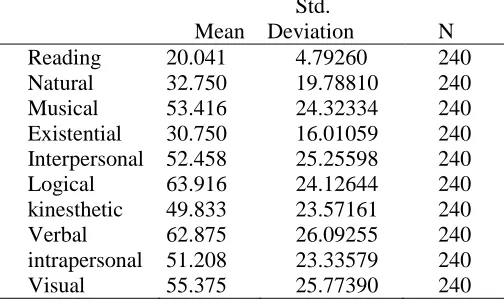
summarizes the descriptive statistics for the
reading scores as well as the various
intelligences of the learners.
Table 1.Descriptive statistics for reading comprehension scores and multiple intelligences
Mean
Std.
Deviation N
Reading 20.041 4.79260 240
Natural 32.750 19.78810 240
Musical 53.416 24.32334 240
Existential 30.750 16.01059 240 Interpersonal 52.458 25.25598 240
Logical 63.916 24.12644 240
kinesthetic 49.833 23.57161 240
Verbal 62.875 26.09255 240
intrapersonal 51.208 23.33579 240
Visual 55.375 25.77390 240
Based on Table 1, logical intelligence group's mean score is the highest and existential intelligence group's mean score is the lowest. A correlation coefficient was run to
see the degree of the relationship between reading and types of MI, the results of which are shown in Table 2.
Table 2. Correlations among reading comprehension scores and multiple intelligences
Readi ng
Natur al
Music al
Existent ial
Inter-person al
Logic al
Kinesthet ic
Verba l
Intra-person
al Visual Reading 1.000 .365 .568 .434 .524 .377 .512 .423 .441 .483
Natural 1.000 .312 .431 .321 .289 .347 .331 .343 .364
Musical 1.000 .487 .447 .388 .491 .435 .473 .509
30
Interpersonal 1.000 .289 .411 .347 .411 .496
Logical 1.000 .270 .645 .382 .419
Kinesthetic 1.000 .425 .447 .444
Verbal 1.000 .444 .398
Intrapersonal 1.000 .357
Visual 1.000
As shown in Table 2, reading comprehension has the highest correlation with musical intelligence and the lowest correlation with natural intelligence. Table 3 shows how
much variance is explained by all the nine predictors entered into the regression equation.
Table 3. Model Summary
Model R
R
Square Adjusted R Square
Std. Error of the Estimate
1 .693a .480 .460 3.52326
a. Predictors: (Constant), visual, intrapersonal, natural, logical, kinesthetic, interpersonal, musical, existential, verbal
The result tells us that all intelligence types collectively account for 46% of the variance in reading comprehension. Table 4, gives the results of the ANOVA performed on the
model. The ANOVA tests the null hypothesis that the predictive power of the model is not significant. Based on Table 4, a significant result was shown.
Table 4.ANOVA on reading comprehension test
Model Sum of
Squares df
Mean
Square F Sig.
1 Regression 2634.51 9 292.724 23.581 .000a
Residual 2855.06 230 12.413
Total 5489.58 239
a. Predictors: (Constant), visual, intrapersonal, natural, logical, kinesthetic, interpersonal, musical, existential, verbal
b. Dependent Variable: reading
To see how much of the variance in reading comprehension is accounted for by each of the nine predictors, the standardized coefficients
and the significance of the observed t-value for each predictor were checked. The results are summarized in Table 5.
Table 5.Coefficientsof multiple intelligences Model
Unstandardized Coefficients
Standardized Coefficients
T Sig.
B Std. Error Beta
1 (Constant) 10.128 .776 13.047 .000
Natural .019 .013 .077 1.406 .161
Musical .050 .012 .253 3.994 .000
Existential -.005 .019 -.018 -.275 .784
Interpersonal .043 .011 .226 3.737 .000
Logical .014 .013 .070 1.079 .282
31
Verbal .007 .012 .036 .538 .591
Intrapersonal .012 .012 .058 .971 .332
Visual .015 .012 .079 1.237 .218
a. Dependent Variable: reading
As Table 5 shows, of all the nine predictors, musical, interpersonal, and kinesthetic intelligences account for a statistically significant portion of the variance in reading comprehension. Of these three intelligence types, musical intelligence is the best predictor of reading comprehension, accounting for approximately 25 percent of variance in reading comprehension. This means for every one standard deviation of change in one's musical intelligence, there will be about .25 of a standard deviation change in one's reading comprehension. This is closely followed by interpersonal intelligence, accounting for around 22% of the variance in reading comprehension. The kinesthetic intelligence is the least powerful predictor of the three, explaining only 18% of the variance in reading comprehension.
To analyze the data further, a stepwise multiple regression was conducted, which showed that musical, interpersonal, kinesthetic and logical intelligences entered into the regression equation (stepwise criteria: probability of F<= 0.050). Model summary (Table 6) shows that the musical intelligence and reading comprehension share 32% of variance. Musical and interpersonal intelligences together share 40% of variance with reading comprehension. The combinations of musical, interpersonal and kinesthetic intelligences explain 44% of variance in reading comprehension. In addition, logical intelligence makes an additional contribution of about one percent to the predictive power of the previous intelligence types in reading comprehension.
Table 6. Model Summary Model
R R Square
Adjusted R Square
Std. Error of the Estimate
1 .568a .323 .320 3.95261
2 .643b .414 .409 3.68400
3 .673c .454 .447 3.56537
4 .683d .467 .458 3.52872
a. Predictors: (Constant), musical
b. Predictors: (Constant), musical, interpersonal
c. Predictors: (Constant), musical, interpersonal, kinesthetic d. Predictors: (Constant), musical, interpersonal, kinesthetic, logical
e. Dependent Variable: reading
This means that musical, interpersonal, kinesthetic and logical intelligences were found to be positive predictors of reading comprehension. Table 7, shows the Beta value
and significance level of the observed t-value for each of the four intelligences that entered the regression equation.
Table 7. Coefficients of Multiple Intelligences Model
Unstandardized Coefficients
Standardized Coefficients
T Sig.
B Std. Error Beta
1 (Constant) 14.063 .617 22.802 .000
32
2 (Constant) 12.288 .645 19.060 .000
Musical .082 .011 .417 7.505 .000
Interpersonal .064 .011 .338 6.080 .000
3 (Constant) 11.417 .659 17.333 .000
Musical .064 .011 .327 5.624 .000
Interpersonal .053 .011 .282 5.075 .000
Kinesthetic .048 .012 .235 4.127 .000
4 (Constant) 10.451 .763 13.693 .000
Musical .057 .012 .289 4.856 .000
Interpersonal .050 .010 .265 4.797 .000
Kinesthetic .046 .011 .226 3.998 .000
Logical .025 .010 .127 2.435 .016
a. Dependent Variable: reading
Investigation of the second research question
The second question attempted to see which types of MI are predictors of vocabulary
knowledge. To this end, a standard multiple regression and a stepwise regression analyses were run. Table 8 summarizes the descriptive statistics.
Table 8.Descriptive Statistics for vocabulary scores
Mean Std. Deviation N Vocabulary 17.595 4.99615 240
Natural 32.750 19.78810 240
Musical 53.416 24.32334 240
Existential 30.750 16.01059 240 Interpersonal 52.458 25.25598 240
Logical 63.916 24.12644 240
Kinesthetic 49.833 23.57161 240
Verbal 62.875 26.09255 240
Intrapersonal 51.208 23.33579 240
Visual 55.375 25.77390 240
It can be seen that the mean score of the logical intelligence group is the highest and the mean score of the existential intelligence group is the lowest. A correlation analysis was used
to see the degree of the relationship among vocabulary test and types of MI, the results of which are shown in Table 9.
Table 9.Correlations among vocabulary scores and multiple intelligences Voca
b
Nat ural
Musi cal
Existen tial
Interpers onal
Logi cal
Kinesth etic
Ver bal
Intraper sonal
Visu al
Vocabulary 1.000 .395 .587 .424 .465 .447 .499 .526 .469 .537
Natural 1.00 .312 .431 .321 .289 .347 .331 .343 .364
Musical 1.00 .487 .447 .388 .491 .435 .473 .509
Existential 1.00 .514 .332 .421 .368 .452 .511
Interpersonal 1.00 .289 .411 .347 .411 .496
Logical 1.00 .270 .645 .382 .419
Kinesthetic 1.000 .425 .447 .444
33
Intrapersonal 1.000 .357
Visual 1.000
As it is shown, vocabulary knowledge has the highest correlation with musical intelligence and the lowest correlation with natural intelligence. The model summary tells
us that the combination of all intelligence types account for around 50% of the total variance in vocabulary test.
Table 10. Model Summaryb Model
R R Square
Adjusted R Square
Std. Error of the Estimate
1 .722a .521 .502 3.525
a. Predictors: (Constant), visual, intrapersonal, natural, logical, kinesthetic, interpersonal, musical, existential, verbal
b. Dependent Variable: vocabulary
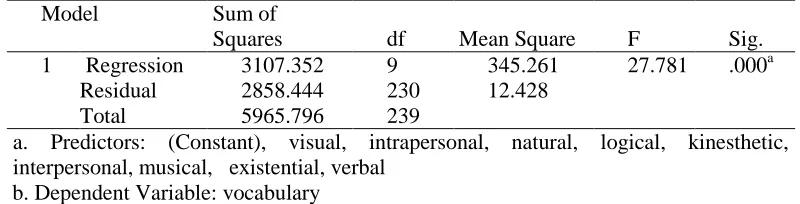
Table 11 gives the results of the ANOVA performed on the model, testing the null
hypothesis that the predictive power of the model is insignificant.
Table 11. ANOVA on vocabulary test
Model Sum of
Squares df Mean Square F Sig.
1 Regression 3107.352 9 345.261 27.781 .000a
Residual 2858.444 230 12.428
Total 5965.796 239
a. Predictors: (Constant), visual, intrapersonal, natural, logical, kinesthetic, interpersonal, musical, existential, verbal
b. Dependent Variable: vocabulary
Based on Table 11, a significant result was shown. To see how much of the variance in vocabulary knowledge is accounted for by each of the nine predictors, the standardized
coefficients and the significance of the observed t-value for each predictor were checked. The results are summarized in Table 12.
Table 12. Coefficient of Multiple Intelligences Model
Unstandardized Coefficients
Standardized Coefficients
t Sig.
B Std. Error Beta
1 (Constant) 6.560 .777 8.446 .000
Natural .025 .013 .099 1.876 .062
Musical .052 .012 .254 4.178 .000
Existential -.017 .019 -.054 -.876 .382
Interpersonal .020 .011 .102 1.754 .081
Logical .013 .013 .062 .997 .320
Kinesthetic .025 .012 .117 2.019 .045
Verbal .033 .012 .171 2.638 .009
Intrapersonal .018 .012 .083 1.438 .152
34
ModelUnstandardized Coefficients
Standardized Coefficients
t Sig.
B Std. Error Beta
1 (Constant) 6.560 .777 8.446 .000
Natural .025 .013 .099 1.876 .062
Musical .052 .012 .254 4.178 .000
Existential -.017 .019 -.054 -.876 .382
Interpersonal .020 .011 .102 1.754 .081
Logical .013 .013 .062 .997 .320
Kinesthetic .025 .012 .117 2.019 .045
Verbal .033 .012 .171 2.638 .009
Intrapersonal .018 .012 .083 1.438 .152
Visual .033 .012 .172 2.827 .005
a. Dependent Variable: vocabulary
Based on Table 12, of all the nine predictors, only musical, verbal, visual, and kinesthetic intelligences account for a statistically significant portion of the variance in the dependent variable (Vocabulary Knowledge). Of these four intelligence types, musical intelligence is the best predictor of vocabulary knowledge, accounting for approximately 25 percent of variance in vocabulary knowledge. This means for every one standard deviation of change in one's musical intelligence, there will be about .25 of a standard deviation change in one's
vocabulary knowledge. This is closely followed by verbal and visual intelligences; accounting for around 17% of the variance in vocabulary knowledge. Kinesthetic intelligence is the least powerful predictor of the four, explaining only 11% of the variance in vocabulary knowledge.
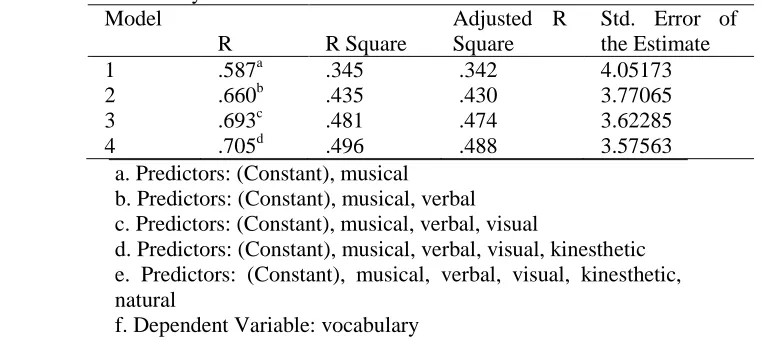
To analyze the data further, a stepwise multiple regression was conducted, which showed that musical, interpersonal, kinesthetic, logical, and natural intelligences entered the regression equation (stepwise criteria: probability of F<= 0.050).
Table 13. Model Summary Model
R R Square
Adjusted R Square
Std. Error of the Estimate
1 .587a .345 .342 4.05173
2 .660b .435 .430 3.77065
3 .693c .481 .474 3.62285
4 .705d .496 .488 3.57563
a. Predictors: (Constant), musical b. Predictors: (Constant), musical, verbal c. Predictors: (Constant), musical, verbal, visual
d. Predictors: (Constant), musical, verbal, visual, kinesthetic e. Predictors: (Constant), musical, verbal, visual, kinesthetic, natural
f. Dependent Variable: vocabulary
Table 13 shows that musical intelligence and vocabulary knowledge share 34% of variance. Musical and verbal intelligences together share 43% of variance with vocabulary knowledge. The combination of musical, verbal, visual, and kinesthetic
35
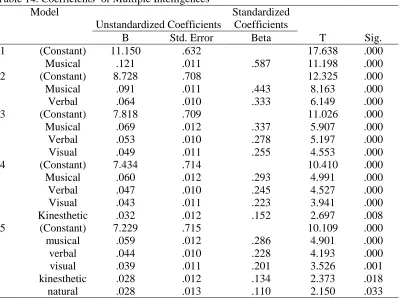
in vocabulary knowledge is accounted for by each of the nine predictors, the standardized coefficients and the significance of theobserved t-value for each predictor were checked. The results are summarized in Table 14.
Table 14.Coefficientsa of Multiple Intelligences Model
Unstandardized Coefficients
Standardized Coefficients
T Sig.
B Std. Error Beta
1 (Constant) 11.150 .632 17.638 .000
Musical .121 .011 .587 11.198 .000
2 (Constant) 8.728 .708 12.325 .000
Musical .091 .011 .443 8.163 .000
Verbal .064 .010 .333 6.149 .000
3 (Constant) 7.818 .709 11.026 .000
Musical .069 .012 .337 5.907 .000
Verbal .053 .010 .278 5.197 .000
Visual .049 .011 .255 4.553 .000
4 (Constant) 7.434 .714 10.410 .000
Musical .060 .012 .293 4.991 .000
Verbal .047 .010 .245 4.527 .000
Visual .043 .011 .223 3.941 .000
Kinesthetic .032 .012 .152 2.697 .008
5 (Constant) 7.229 .715 10.109 .000
musical .059 .012 .286 4.901 .000
verbal .044 .010 .228 4.193 .000
visual .039 .011 .201 3.526 .001
kinesthetic .028 .012 .134 2.373 .018
natural .028 .013 .110 2.150 .033
a. Dependent Variable: vocabulary
As Table 14 shows, of the nine predictors, only musical, verbal, visual, kinesthetic, and natural intelligences account for a statistically significant portion of the variance in vocabulary knowledge. Of these five intelligence types, musical intelligence is the best predictor, accounting for approximately 28 percent of variance in vocabulary knowledge. This is closely followed by verbal intelligence, accounting for around 22%, and visual intelligence accounting for around 20% of the variance in vocabulary knowledge. Kinesthetic and natural intelligences are the least powerful predictors of the five, explaining 13% and 11% of the variance in vocabulary knowledge, respectively.
The present study attempted to investigate types of MI as predictors of reading comprehension and vocabulary knowledge. Some of the findings of the present study are in
accordance with a number of previous studies (e.g. Akbari & Hosseini, 2008; Alghazo, Obeidat, Al-trawneh, & Alshraideh 2009; Arnold & Fonseca 2004; Hashemi 2007) which support the present findings in that they all, much like the present study, emphasized different types of MI as predictors of reading comprehension and vocabulary knowledge. However, the findings are different from some other studies (e.g. Razmjoo, 2008; Saricaoglu & Arikan, 2009), which did not find MI types as predictors of reading comprehension and vocabulary knowledge.
36
unlike Hashemi’s study, verbal intelligence was not found to be a predictor of reading comprehension here. Moreover, Akbari and Hosseini (2008) showed verbal intelligence as the most appropriate predictor of language proficiency. This is partially supported by the findings of the present study, as the participants' verbal intelligence turned out as the second best predictor of vocabulary scores. The present study is also compatible with that of Medina (1993), which diagnosed musical intelligence as a significant predictor of language ability. In this study, musical intelligence was the strongest predictor of both vocabulary and reading comprehension ability. On the other hand, the results of the present study are different from a number of studies reviewed earlier. This study revealed that some MI types could be predictors of reading comprehension and vocabulary knowledge, but Razmjoo (2008) found no significant relationship between MI and English language proficiency in Iranian context. Motallebzadeh and Manuchehri (2008) also reported that only logical intelligence has a significant relationship with reading comprehension and the eight other types have no significant relationship with reading comprehension.One of the possible reasons for such differences may be partially attributable to the gender differences leading to different abilities of the participants. In this study, gender was not taken into account. However, studies such as Kaur and Chhikara (2008), Razmjoo (2008), Saricaoglu and Arikan (2009), and Shearer (2006) emphasize the prominent role of gender differences in MI-based programs.
Another possible reason could be differences in the proficiency level of the participants. In this study, the participants were intermediate level students while in studies such as Razmjoo (2008), the participants were Ph.D students and in Kaur and Chhikara (2008), the participants were young adolescents.
One of the surprising findings of this study was that linguistic intelligence was not a significant predictor of either vocabulary or reading comprehension. Since both of the above are components of language, it is hard to
explain why this happened. Another surprise was that logical/mathematical intelligence was not among the predictors of vocabulary and reading comprehension ability. Since both language and mathematics learning involve analytic processing, one would expect both vocabulary and reading ability to be closely correlated with mathematical intelligence.
The above mentioned areas of conflict are probably indicative of the need for further research. Perhaps what makes this study different from other studies is that it was carried out in an EFL context while most of the mentioned studies were conducted in ESL settings.
CONCLUSION
Based on the findings of the present study, a number of points may be concluded. First, the findings indicate that musical intelligence is the best predictor of both vocabulary and reading comprehension. Since musical intelligence involves the ability to sing, and to understand and use rhythm, it can be concluded that the inclusion of poems and songs should facilitate both reading comprehension and vocabulary learning. Second, since visual intelligence turned out to be significantly correlated with vocabulary knowledge, the conclusion to be drawn is that pictorial presentation of vocabulary, or combining vocabulary with pictures in the form of pictorial glosses or photo dictionaries, may positively influence vocabulary learning. In addition, since reading and vocabulary knowledge are significantly correlated with only three and four of the intelligences, respectively, activities could be incorporated in the classroom to activate only the right kind of intelligence to improve the learning conditions. In short, the findings of the present study can help teachers to obtain a clear understanding of MI theory and its applicability in a pedagogical context. Teachers can find new ways of teaching to consider their learners' need as well as their intelligence profiles.
37
specifications of MI types as predictors of language learning.REFERENCES
Abdulkader, F., Gundogdu, K., & Eissa, M. (2009). The effectiveness of Multiple Intelligences-based program on improving certain reading skills in 5th-year primary learning disabled students. Electronic Journal of Research in
Educational Psychology, 7(3), pp.
673-690.
Akbari, R., & Hosseini, K. (2008). Multiple intelligences and language learning strategies: Investigating possible relations.
System, 36(2), pp. 141-155.
Alghazo, K., Obeidat, H., Al- trawneh, M., & Alshraideh, M. (2009). Types of multiple intelligences in social studies, Arabic and English language textbooks for the first three grades. European Journal of Social Sciences, 12(1), pp. 7-20.
Armstrong, T. (1994). Multiple intelligences: seven ways to approach curriculum.
EducationalLeadership.
Armstrong, T. (1995). Multiple intelligences in
the classroom. Alexandria, VA: ASCD.
Arnold, J., & Fonseca, M.C. (2004). Multiple intelligence theory and foreign language
learning: A Brain-based perspective
.
IJES
,
4
(1), pp. 119-136.
Botelho, M. (2003).
Multiple Intelligences
theory in English language teaching:
An analysis of current textbooks,
materials and teachers’ perceptions.
Master thesis. Ohio University.
Campbell, B. (1989). Multiplying
intelligence in the classroom.
Learning's
On The Beam
,
4
(2), pp.
7-167.
Christison, M. A. (1996). Teaching and
learning languages through multiple intelligences. TESOL, 6(1), pp. 10-14. Christison, M. A. (1998). Applying multipleintelligences theory in pre-service and in-service TEFL education programs.
English Teaching Forum, 36(2), pp. 2-13.
Christison, M. A. (1999). Multiple
intelligences. ESL Magazine, 2(5), pp. 10-13.
Eisner, E. (2004). Multiple intelligences: Its tensions and possibilities. Teachers College Record, 106(1), pp. 31-39. Gaines, D., & Lehmann, D. (2002). Improving
student performance in reading comprehension through the use of
Multiple Intelligences. MA thesis, Saint
XavierUniversity and Skylight Professional Development Field-based Master’s Program. ED467 515. Gardner, H. (1983). Frames of mind. New
York: Basic Books.
Gardner, H. (1993). Multiple intelligences: The
theory in practice. New York: Basic
books.
Gardner, H. (1999). Intelligence reframed. New York: Basic Books.
Green, C., & Tanner, R. (2005). Multiple intelligences and online Teacher education. ELT Journal,59(4), pp. 312-321.
Harding, C. (2006). Using the multiple
intelligences as a learning intervention: A model for coaching and mentoring. International Journal of Evidence Based
Coaching and Mentoring, 4(2), 19-39.
Hashemi, A. (2007). On the relationship between multiple intelligences and reading comprehension tasks: An authentic MI Theory-based assessment. Unpublished doctoral Dissertation, University of Roudehen, Iran.
Hoffman, B. J., & Frost, B. C. (2006). Multiple intelligences of transformational leaders: an empirical examination. International
Journal of Manpower, 27(1), pp. 37-51.
Kaur, G., & Chhikara, S. (2008). Assessment of Multiple Intelligence among Young Adolescents. Hum. Ecol.,23(1), 7-11. McKenzie, W. (2002). Multiple intelligences
and instructional technology. Eugene,
OR: ISTE Publications.
McKenzie, W. (2009). Walking the walk: Multiple intelligences in educator
professional development. Massachusetts
38
McKenzie, W. (1999).
Multiple
Intelligences Survey
.
http://surfaquarium.com/MI/MIinvent.
htm
Medina, S. (1993). The Effect of music on second language vocabulary acquisition. National Network for Early Language learning, 6(3), pp. 1-8.
Motallebzadeh, K., & Manouchehri, M. (2008). On the Relationship between Multiple Intelligences and Reading Comprehension gain on IELTS. SID Journal, 42(2), pp. 135-140.
Nikolva, K. (2007). Multiple intelligences theory and educational practice,Annual
Assen Zlatarov, 36(2), pp. 105-109.
Ojo, O. D., & Olakulein, F. K. (2006). The place of multiple intelligence in achieving the objectives and goals of open and distance learning institutions: A critical analysis. Turkish Online Journal of
Distance Education-TOJDE, 7(3), pp.
19-27.
Owolabi, T., & Okebukola, F. (2009). Improving the reading ability of science students through study groups and multiple intelligences. US-China
Education Review, 6(2). pp. 38-43.
Razmjoo, S. A. (2008). On the relationship between multiple intelligences and language success. The Reading Matrix, 8(2), pp. 155-174.
Richards, J., & Rodgers, T. (2001).
Approaches and methods in language
teaching. Second edition. Cambridge:
Cambridge University Press.
Saricaoglu, A., & Arikan, A. (2009). A study of multiple intelligence, foreign language success and some selected variables. Journal of Theory and Practice in
Education 5(2), pp. 110-122
Shearer, C. B. (2006). Reading skill and
multiple intelligences. Researched and
consulting: Kent, Ohio.
Tirri, K., & Nokelainen, P. (2008). Identification of multiple intelligences with the Multiple Intelligence Profiling Questionnaire III.
PsychologyScienceQuarterly, 50(2),
206--‐221.
Veenema, S. & Gardner, H. (1996). Multimedia and multiple intelligences.
The American Prospect, 29, pp. 69-75.
Viens, J. (1999). Understanding multiple intelligences: The theory behind the practice. NCSALL, 3(1),pp. 6-10. Visser, B., Ashton, M., & Vernon, P. (2006).
Beyond g: Putting multiple intelligences theory to the test. Intelligence, 34(5), pp. 487-502.
Xie, J. C., & Lin, R. L. (2009). Research on multiple intelligences teaching and
assessment. Asian Journal of Management